The True Gospel Verses Calvinism: Part 2
“The whole idea that Christians are unable to obey the law in a way that is acceptable to God is an absurd contradiction of a massive body of Scripture. But yet, this is widely accepted in Reformed circles and key to understanding their doctrine.”
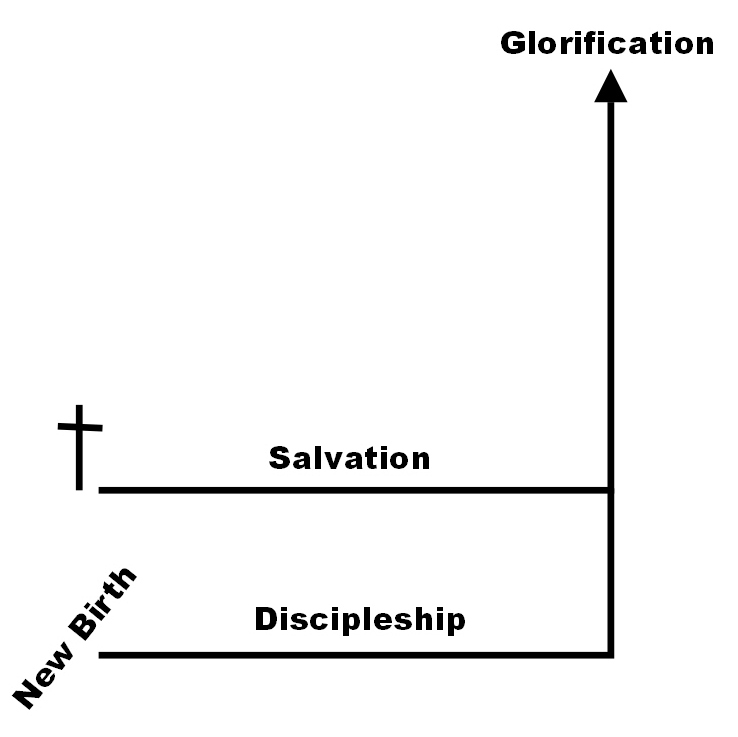
“And moreover, according to Reformed theology, the law is still a standard that must be maintained to get justification home to glorification by driving on a road named Sanctification.”
“However, If you will stay your mind on the reality of the above illustration, and dogmatically assert that all Reformed theology in some way relates to this illustration, you will be given insight into the soul of Reformed theology. Do not let the Reformed academics move you away from this reality with rhetoric.”
“So, in Reformed theology, because the law remains a standard for progressive justification, perfect obedience to the law in sanctification must also be imputed to us.”
Let’s begin by revisiting the original question that prompted this two part post:
Paul, please explain in layman’s terms how Calvinism views justification and sanctification. I am trying to understand this. Does this have anything to do with the saint’s persevering?
What most people don’t understand is the fact that Reformed theology is all but a complete demolition of the truth. The election/free will debate is hardly the issue; this theology barely falls short of contradicting every basic theological point of Scripture.
This starts with the fusion of justification and sanctification….
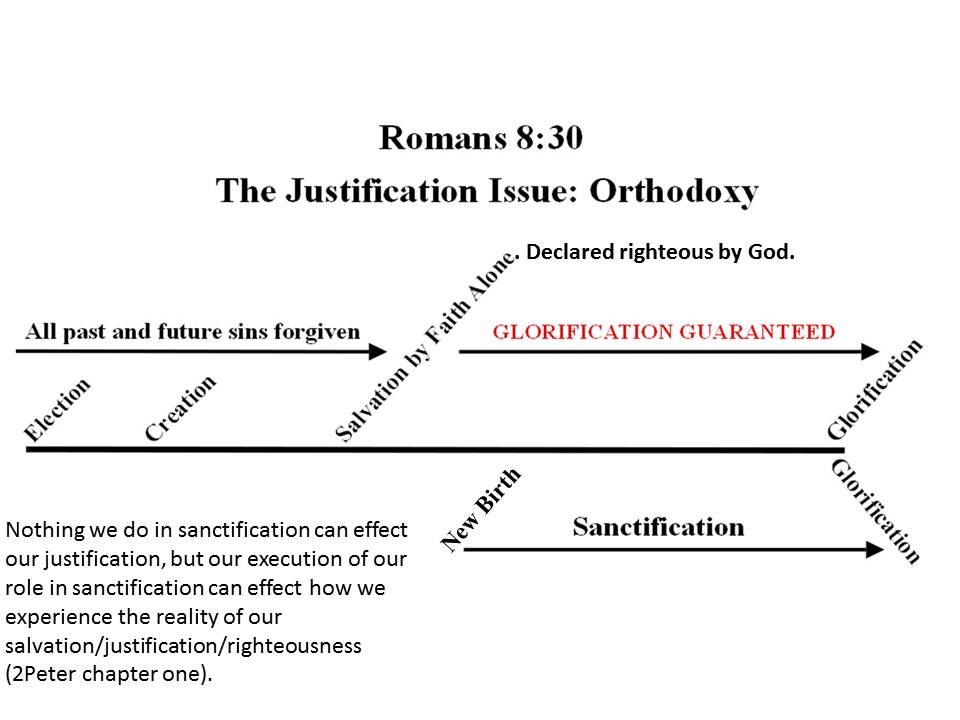
….this fusion is the leaven that leavens the whole lump. Reformed theology thinks that sanctification links justification to glorification. It believes that sanctification is the growing part of salvation. But, salvation doesn’t grow, it’s a finished work. The chart below from a Calvinist organization should make my point (click to enlarge if necessary).
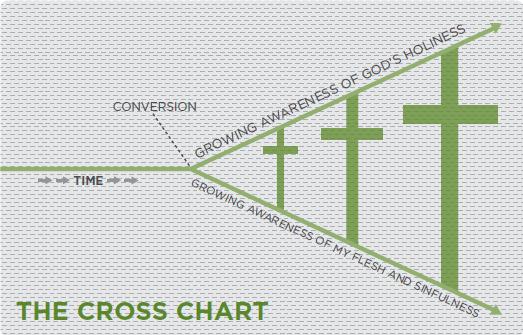
Also note: the believer doesn’t grow, the cross does. In fact, the believer gets worse! Or at least endeavors to increasingly realize how rotten he/she is. But what about the new birth? Reformed theology denies it regardless of the fact that Christ said, “You must be born again.” I can already hear the cat cries, but I will make my case. There isn’t a theology on earth that is more wrong than Reformed theology for many reasons including the denial of the new birth.
First of all, while denying that they fuse justification and sanctification together, the core element of Reformed theology is based on such. If justification and sanctification are fused together, we abide in the milieu that is between the two. That can make sanctification very tricky, unlike my biblical thesis in part one—we don’t abide in that realm that is a finished work. If we reside in a place where justification progresses to glorification, can we mess it up? According to Calvinists, “yes.” More on that later. But again, they clearly recognize this problem and base their core doctrine on it.
So, what doctrine is that? Well, there is only one way to prevent us from short circuiting justification on the way to glorification: cut us out of sanctification all together and make it a 100% work of God. And I agree, if our sanctification is the link between justification and glorification, we would need to be cut out of the equation all together. This is greatly magnified in Reformed theology by the idea that justification must be maintained by the keeping of the law. So, justification begins, but needs to be maintained until it arrives to glorification via the road of sanctification. This can be seen in a personal conversation I had with the well-known Calvinist Voddie Baucham:
paul: “Do you believe in this Gospel Sanctification stuff?”
Baucham: “I’m not sure what you mean.”
paul: “The same gospel that saved us also sanctifies us.”
Baucham: “Yes, absolutely!”
paul: “But Dr. Baucham, justification is a finished work, how can it sanctify us?”
Baucham: Nodding toward the window where we were standing; “That road out there is a finished work, but we still use it.”
Is that true? Are we sanctified by justification? Do we still “use” justification to get to glorification? At least in the Reformed view, the answer to all three of those questions is “yes,” and the perfect maintaining of the law to get justification home to glorification is the key. Justification must be maintained by the perfect keeping of the law, or else the legal declaration that we are justified is, “legal fiction” according to Reformed academics. This is the exact term they use to explain why sanctification must maintain justification by a perfect maintaining of a true legal declaration by perfect law-keeping. And moreover, according to Reformed theology, the law is still a standard that must be maintained to get justification home to glorification by driving on a road named Sanctification. As we discussed in part one, the law has been voided in regard to justification. Paving a road from justification to glorification, and naming it Sanctification, and using the law for the asphalt is a gargantuan theological misstep.
Well, that certainly excludes us! No? But don’t worry, Calvinists have a solution to this problem—it’s the doctrine of The Objective Gospel Outside of Us. The gospel gets justification home to glorification on the road named Sanctification, and we don’t have anything to do with it because the road is maintained by the perfect keeping of the law. How in the world does all of this work? I will explain, stay tuned. But first, let me establish that Calvinists believe that the law must be obeyed perfectly to maintain justification. This can be seen clearly in the writings of John Calvin himself. In context of sanctification, Calvin wrote that any attempt by a Christian to keep the law in sanctification was akin to an effort to keep the law….for justification. So, in Reformed theology, whatever is….for sanctification, IS ALSO….for justification because the two are the same. Calvinists use James 2:10, which is a statement….for justification, and apply it….for sanctification as one example, but they also routinely speak as if justification, and sanctification are the same thing with the same standard for keeping the law. Here is what Calvin said on this wise in his Institutes (Book 3; ch. 14, sec. 9,10):
Let the holy servant of God, I say, select from the whole course of his life the action which he deems most excellent, and let him ponder it in all its parts; he will doubtless find In it something that savors of the rottenness of the flesh, since our alacrity in well-doing is never what it ought to be, but our course is always retarded by much weakness. Although we see that the stains by which the works of the righteous are blemished, are by no means unapparent, still, granting that they are the minutest possible, will they give no offense to the eye of God, before which even the stars are not clean? We thus see, that even saints cannot perform one work which, if judged on its own merits, is not deserving of condemnation.
Even were it possible for us to perform works absolutely pure, yet one sin is sufficient to efface and extinguish all remembrance of former righteousness, as the prophet says (Ezek, 18:24). With this James agrees, “Whosoever shall keep the whole law, and yet offend in one point, is guilty of all” (Jam 2:10).
Notice that there is nothing a Christian does that is considered good or righteous by God. The same is echoed by Calvinists in our day like Tullian Tchividjian (click to enlarge if necessary):

And also notice what the standard for that is: the law….for justification in sanctification. The whole idea that Christians are unable to obey the law in a way that is acceptable to God is an absurd contradiction of a massive body of Scripture. But yet, this is widely accepted in Reformed circles and key to understanding their doctrine. Obviously, the law is still the standard, which is a problem in and of itself if you read part 1. The road named Sanctification that links justification and glorification together is paved with the law, and the asphalt is kept in perfect condition by a perfect keeping of the law. As discussed in part one, the law is not available to progress justification forward. For purposes of progressing justification—the law is void—we are no longer UNDER it….for justification. Therefore, justification can’t progress. It doesn’t get bigger, and it doesn’t grow. But obviously, if we are still on that road, things get tricky.
Therefore, Reformed theology holds to the idea that salvation grows to perfection until glorification, but we must remain OUTSIDE of this process lest the growing process is messed up by our mortal imperfection. This is where the Centrality of the Objective Gospel Outside of Us comes into play. Reformed academics get a covert pass on this because listeners assume they are talking about justification only—BUT THEY ARE NOT—THEY ARE TALKING ABOUT BOTH JUSTIIFICATION AND SANCTIIFCATION. So, we must be cut out of the growing process of salvation because of our imperfection while being able to lay claim to it. But how? Here is how: THE GOSPEL GROWS, BUT WE DON’T. Remember the cross illustration above?
Ok, so, in Reformed theology, justification and sanctification are the same thing. Sanctification is the growing of justification until it reaches glorification, and in the process, justification must not be “legal fiction.” Therefore, sanctification maintains justification by the perfect keeping of the law until the day of glorification . We can lay claim to it, but because of our mortal imperfection, we can’t be part of justification progressing to glorification. So how does this work in Reformed theology? We will get to that, but first, let me further substantiate my claims thus far. Let me begin by quoting Calvin on the idea that justification is progressive. Really, our first clue should be the title of chapter 14 from the Calvin Institutes: “The Beginning of Justification. In What Sense Progressive.” Calvin states the following in that chapter:
Therefore, we must have this blessedness not once only, but must hold it fast during our whole lives. Moreover, the message of free reconciliation with God is not promulgated for one or two days, but is declared to be perpetual in the church (2 Cor 5:18, 19). Hence believers have not even to the end of life any other righteousness that that which is there described. Christ ever remains a Mediator to reconcile the Father to us, and there is a perpetual efficacy in his death, i.e., ablution, satisfaction, expiation; in short, perfect obedience, by which all our iniquities are covered. In the Epistle to the Ephesians, Paul says not that the beginning of salvation is of grace, but “by grace are ye saved,” “not of works, lest any man should boast” (Eph 2:8, 9).
Furthermore, a Reformed think tank that was highly regarded in the early seventies, the Australian Forum, published the following illustration that captures the general idea of the doctrine (click to enlarge):
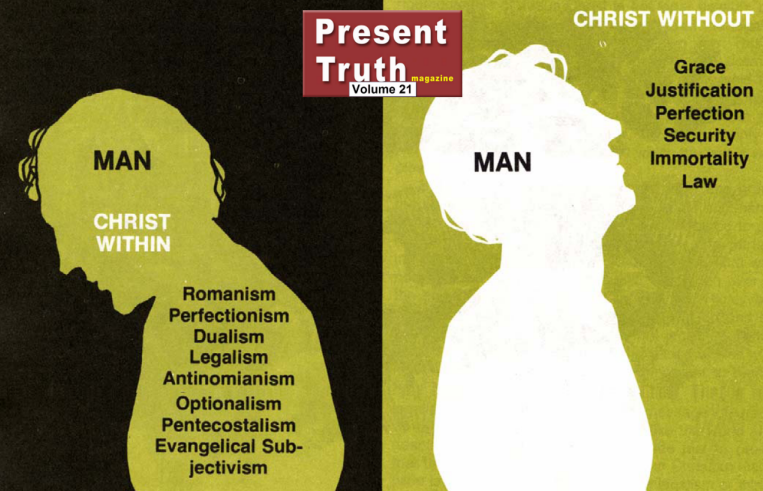
Let me add an additional note:

Obviously, this illustration provokes multiple questions in regard to practical application which will be discussed later (how this supposedly works in sanctification). But the key reality must not leave your mind: Christians cannot really participate in sanctification according to Reformed theology with the exception of one concept, and unfortunately, as we shall see, that one concept can only be works salvation. Not only is our role limited and narrow, the specific role is efficacious to maintaining our own salvation. However, If you will stay your mind on the reality of the above illustration, and dogmatically assert that all Reformed theology in some way relates to this illustration, you will be given insight into the soul of Reformed theology. Do not let the Reformed academics move you away from this reality with rhetoric.
Let’s also illustrate that proponents of Reformed theology fuse justification and sanctification together and speak of the two as being the same thing. In their sermons and teachings, they do this by virtue of the missing transition of subject matter—that being the difference between sanctification and justification. In their messages, they transition between the two without noting any difference as if the two are the same thing—because that is what they believe. Furthermore, this is an excellent communication method for assimilating this idea into the minds of their parishioners victims without them realizing what is happening. Examples of this are strewn about everywhere, but I will cite the following example from The Truth About new Calvinism, page 18:
Regarding the same message in context of who the audience was, in the sermon notes, the top of the page had statements like, “Things Jesus wants us (“us” would presumably be Christians) to know about the law.” The top parts of the notes were also replete with “we” in regard to the law, but the bottom part had statements like: “We live in the Age of Grace; salvation is not of works,” but yet, the whole message clearly regarded the role of the law in the lives of Christians. Therefore, whether unawares or otherwise, the pastor extended the relationship of the law in regard to justification (salvation) into the realm of sanctification (our life as already saved Christians), by virtue of a missing transition in subject matter. Hence, the subject of the law’s relationship to the lost was spoken of as being the same thing as its relationship to those who are saved. Theologians call this a collapsing of sanctification into justification or the synthesizing of the law’s relationship to justification and sanctification. This is most definitely a hallmark of New Calvinist doctrine to keep in mind for later discussion. The communication technique of the missing transition is also a technique used often by New Calvinists.
Next, let’s establish the fact that in Reformed theology, the law must still be the standard for sanctification because sanctification is the growing process of justification; in other words, progressive justification. Again, if law is not the standard for sanctification which is supposedly the progression of justification, then justification (according to Reformed theology) is mere “legal fiction.” Well, justification does not grow, it is based on God’s declaration—not law (as discussed in part one), and there is a reason why sanctification need not be perfect as a kingdom life totally separate from the finished work of justification which will be addressed later. But without further ado, the aforementioned Reformed view can be seen in Calvin’s diatribe in which he thinks it of abundant importance for Christians to know that they cannot obey the law in order to please God:
For since perfection is altogether unattainable by us, so long as we are clothed with flesh, and the Law denounces death and judgment against all who have not yielded a perfect righteousness, there will always be ground to accuse and convict us unless the mercy of God interpose, and ever and anon absolve us the constant remission of sins. Wherefore the statement which we set out is always true. If we are estimated by our own worthiness, in everything that we think or devise, with all our studies and endeavors we deserve death and destruction.
We must strongly insist on these two things: that no believer ever performed one work which, if tested by the strict judgment of God, could escape condemnation (Calvin Institutes: book 3; ch.14, sec. 10,11).
So, though the apostle Paul states that the paramount goal of Christians is to please God (2Cor. 5:10); obviously, Reformed theologians state unequivocally that the law is not the standard for that. Again, it can’t be, because sanctification is growing justification which demands a perfect adherence to the law in order not to be “legal fiction.” Therefore, if not the law, what? This interpretive question is the juggernaut of the subject at hand. The answer: more salvation. According to Reformation theology, our only possible participation in progressive justification is the same thing that justified us to begin with: faith alone. But wait a minute, in Reformed theology, we are not justified per se. Remember the illustration that is the soul of Reformed theology that we cannot be removed from, and the reality thereof. All righteousness , Christ, grace, ect., must remain outside of us. Nothing of grace can be within. So, we have no righteousness that is our own….for sanctification. Like….for justification, it must remain outside of us. In fact, Reformed theologians believe that if grace, Christ, or any kind of valid righteousness is inside of us, that is infusing grace into us while in sanctification. And if we do that, we are making sanctification the ground of our justification. Get it? If sanctification is a road that takes justification to glorification, and it must be paved with perfection, and we are on that road, and grace is infused into us, then we are made part of the progressive justification process. Game over.
We must (according to Reformed theology) walk side by side with justification on the road named Sanctification that takes us to glorification without being a part of the process. Otherwise, our participation is legal fiction because we obviously still sin. An “aberration” that believes that we have righteousness inside of us is called “infused grace” by Reformed academics and is the primary offence to the soul of Reformed theology: The Objective Gospel Outside of Us. Again, reobserve the two-man Christ within/Christ without Reformed illustration that is the soul of this doctrine. All Righteousness must remain outside of us and we must walk the road named Sanctification the same way we were initially permitted to be on the road, by faith only. If we work, or obey the law, we are believing that there is a righteousness inside of us that can participate with progressive justification in arriving at glorification at the end of the road. This is infusing grace into us and making our ability to travel with justification the ground of our justification. At least partially, which is a horseshoe and hand grenade issue in regard to justification anyway. Now, let’s observe the “elder statesman” of New Calvinism reiterating what I have just written. Take note that John Piper’s comments following were in regard to a lecture by Graeme Goldsworthy at Southern Seminary. Goldsworthy was one of the key members of the aforementioned Reformed think tank, the Australian Forum. The following excerpts were taken from The Truth About new Calvinism, pages 41-43:
In the aforementioned article concerning Goldsworthy’s lecture at Southern, Piper agrees that the original Reformation sought to correct the reversal of sanctification and justification:
“This meant the reversal of the relationship of sanctification to justification. Infused grace, beginning with baptismal regeneration, internalized the Gospel and made sanctification the basis of justification. This is an upside down Gospel.”
In case one would think that Piper excludes evangelicals from this concern because of his mention of baptismal regeneration, consider what he said in the same article: “I would add that this ‘upside down’ gospel has not gone away— neither from Catholicism nor from Protestants….”
….Piper concurs with Goldsworthy that “infused grace” is the problem. The like complaint is that the completely outside of us gospel empowers us inwardly, subjects us to subjective distractions from the power of the historic Christ event, and makes the natural result of the gospel our power source (the fruit), instead of the outward power of the gospel, the real root. To infuse grace is to suggest that we are enabled to participate in being justified by our own efforts in bringing about the natural results of the gospel.
Nothing shows this kinship between the Forum and New Calvinism more than a Piper quote from this same article and a visual aid used by Robert Brinsmead to demonstrate how “infused grace” supposedly puts our souls in peril. First Piper’s quote:
“When the ground of justification moves from Christ outside of us to the work of Christ inside of us, the gospel (and the human soul) is imperiled. It is an upside down gospel [emphasis Piper’s—not this author].”
Now observe Brinsmead’s illustration on the next page: [the two-man Christ within/Christ without chart which was published by the Australian Forum].
This necessarily leads to the Reformed denial of the new birth. Obviously, the idea that Christ lives within us and works within us is part and parcel to the new birth—and a big problem for The Objective Gospel Outside of Us. Reformed theologians know that they cannot blatantly deny the new birth and retain credibility, so they have many cute ways of relegating it to insignificance in order to bolster their staple doctrine. I have addressed how they do this in many other articles including chapter 11 of The Truth About New Calvinism, and will not continue to do so here, but will at least note some interesting quotes that speak to my assertion:
It robs Christ of His glory by putting the Spirit’s work in the believer above and therefore against what Christ has done for the believer in His doing and dying.
~ Geoffrey Paxton (Australian Forum)
But to whom are we introducing people to, Christ or to ourselves? Is the “Good News” no longer Christ’s doing and dying, but our own “Spirit-filled” life?
~ Michael Horton
And the new-birth-oriented “Jesus-in-my-heart” gospel of evangelicals has destroyed the Old Testament just as effectively as has nineteenth-century liberalism. (footnoted to Paxton’s article with above quote).
~ Graeme Goldsworthy (Australian Forum)
One would therefore think that this theology would lead to a view that believers are no different from the unregenerate save belief in the gospel only. Practically, Christians remain totally depraved like the unregenerate. And you would be correct about that. Reformed theology holds to the idea that justification initially recons us righteous in Christ, and without Christ in us, and then continues to recon us clothed with Christ’s righteousness (and none of our own in sanctification) as long as we “live by faith” ALONE….for sanctification. Moreover, only the POSITION of a person is changed in salvation, not the character, personhood, or creaturehood. There is no better illustration of this than the following citation from Michael Horton’s Christless Christianity, p.62:
Where we land on these issues is perhaps the most significant factor in how we approach our own faith and practice and communicate it to the world. If not only the unregenerate but the regenerate are always dependent at every moment on the free grace of God disclosed in the gospel, then nothing can raise those who are spiritually dead or continually give life to Christ’s flock but the Spirit working through the gospel. When this happens (not just once, but every time we encounter the gospel afresh), the Spirit progressively transforms us into Christ’s image. Start with Christ (that is, the gospel) and you get sanctification in the bargain; begin with Christ and move on to something else, and you lose both.
The tail end of Horton’s quote brings me to the next point. Notice that Horton states that “we” can “lose,” as in l-o-s-e “both.” Both what? Obviously, justification and sanctification. Which equals = no salvation. “Paul, is he really saying that we can lose our salvation?” Sure he is—IF—we “move on to something else.” Which equals = moving on to something else but faith alone…for sanctification which is the same thing as moving on to something else….for justification. Progressive justification is not the only theological anomaly that Reformed theologians are content with, they must also add sanctification by faith alone. But all of this is necessary in order to stay consistent with their core doctrine: The Centrality of the Objective Gospel Outside of Us. Yes, let them squeal all night long; nevertheless, they teach that you can lose you salvation.
I will illustrate this further by revisiting the idea that Reformed theology fuses justification and sanctification together. Reformed theologians are big on the “Golden Chain of Salvation” concept based on Romans 8:30. We discussed Romans 8:30 in part one along with its ramifications for salvation. The Reformed take on this verse is the idea that sanctification is excluded because it is one and the same with justification. The opposite position was presented in part one to some extent. Note the following quotation by John Piper:
This is probably why in the golden chain of Romans 8:30 the term sanctification is missing: “And those whom he predestined he also called, and those whom he called He also justified, and those whom he justified he also glorified.” When Paul jumps directly from justification to glorification he is not passing over sanctification, because in his mind that process is synonymous with the first phase of glorification and begins at conversion. (God is the Gospel, footnote, p. 93).
Ok, notice that Piper calls justification (“conversion”) “the first phase of glorification.” So, again, we see that justification grows in glory and culminates at complete glorification and sanctification is part of that “process.” Not so. In regard to the fusion of justification and sanctification, what is a “chain”? Reformed theologians clearly refer to the justification “process” as a chain with justification on one end and glorification on the other end, and sanctification in the middle. Moreover, John Piper preached a sermon in which he warns that if we do not participate in the salvation “links” in the proper way, that we put ourselves in great danger—presumably in regard of losing our salvation. The following illustration with a golden chain and Piper’s quotes from the sermon should clearly make my point here (click to enlarge):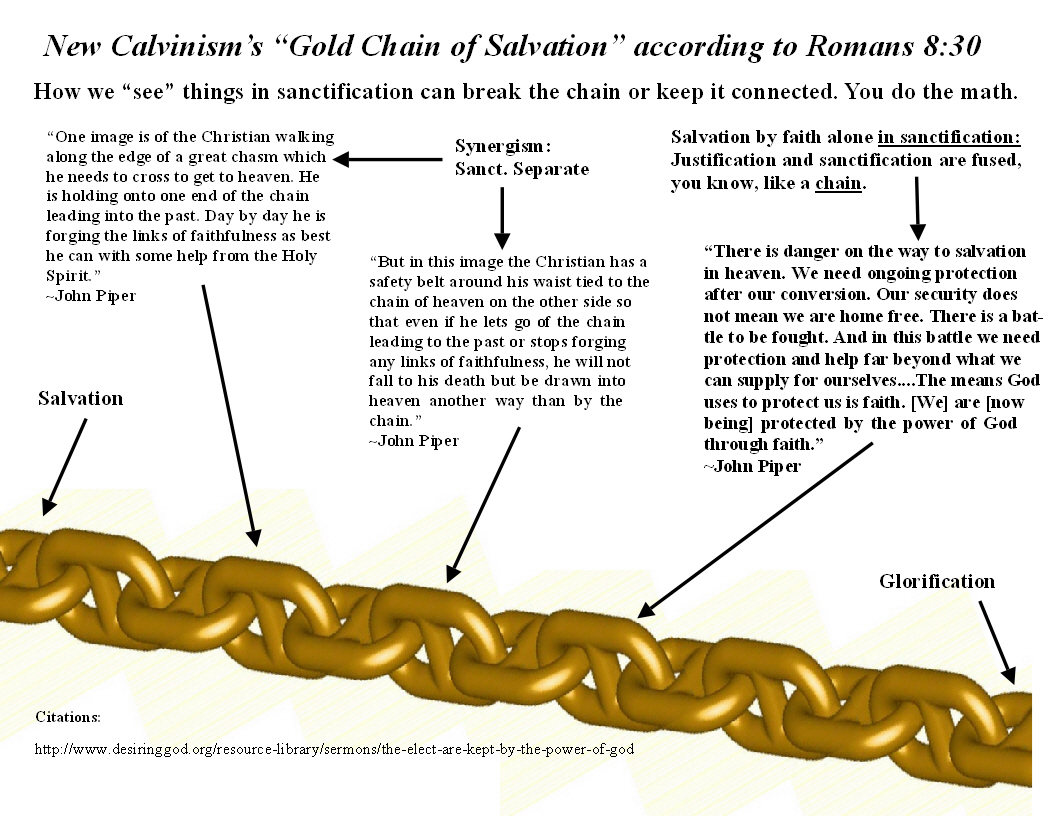
Which brings me to yet another point. If we can lose our salvation, what do we have to do to keep it? Whatever that is, it’s a work to maintain justification. And that is works salvation. In the case of Reformed theology, we have to keep our salvation by sanctification by faith alone. Hence: salvation by Christ + faith alone in sanctification. Think about that. To the Reformed, moving on to anything else but sanctification by faith alone will cause us to lose our salvation. Historically, the relaxing of the law in sanctification has always been deemed antinomianism. Is Reformed theology salvation by antinomianism? Yes, I think it is—the fusion of justification and sanctification can hardly end up anywhere else.
This entails the belief that Christ not only came to die for our sins, but He also came to live a perfect life of obedience to the law so that His perfect obedience in the life he lived on earth could be imputed to us in sanctification. So, in Reformed theology, because the law remains a standard for progressive justification, perfect obedience to the law in sanctification must also be imputed to us. In other words, Jesus obeys for us. How our justification must be maintained in our sanctification (according to Reformed theology) is well articulated by the Australian Forum Reformed think tank (The Truth About new Calvinism: p. 101, 102):
After a man hears the conditions of acceptance with God and eternal life, and is made sensible of his inability to meet those conditions, the Word of God comes to him in the gospel. He hears that Christ stood in his place and kept the law of God for him. By dying on the cross, Christ satisfied all the law’s demands. The Holy Spirit gives the sinner faith to accept the righteousness of Jesus. Standing now before the law which says, “I demand a life of perfect conformity to the commandments,” the believing sinner cries in triumph, “Mine are Christ’s living, doing, and speaking, His suffering and dying; mine as much as if I had lived, done, spoken, and suffered, and died as He did . . . ” (Luther). The law is well pleased with Jesus’ doing and dying, which the sinner brings in the hand of faith. Justice is fully satisfied, and God can truly say: “This man has fulfilled the law. He is justified.”
We say again, only those are justified who bring to God a life of perfect obedience to the law of God. This is what faith does—it brings to God the obedience of Jesus Christ. By faith the law is fulfilled and the sinner is justified.
On the other hand, the law is dishonored by the man who presumes to bring to it his own life of obedience. The fact that he thinks the law will be satisfied with his “rotten stubble and straw” (Luther) shows what a low estimate he has of the holiness of God and what a high estimate he has of his own righteousness. Only in Jesus Christ is there an obedience with which the law is well pleased. Because faith brings only what Jesus has done, it is the highest honor that can be paid to the law (Rom. 3:31).
A more contemporary example from the Journal of Biblical Counseling (David Powlison’s CCEF) can be observed in the following citation:
It is by virtue of Christ’s perfect life, death on the cross and resurrection-plus nothing-that we are justified (made and declared right with God) and sanctified (set apart, kept, and viewed as right with God) and sanctified (set apart, kept, and viewed as right in the Lord’s eyes by virtue of His obedience). Christ is our holiness. Christ is our sanctification.
Therefore, our walk with Christ must be a continual reoffering of the works of Christ to maintain our just standing. When we come to the last resurrection, we will be judged accordingly. If we lived sanctification in this way, the righteousness of Christ will be the ground of our justification and we will be glorified. See the following illustration from a John Piper video clip (click to enlarge):
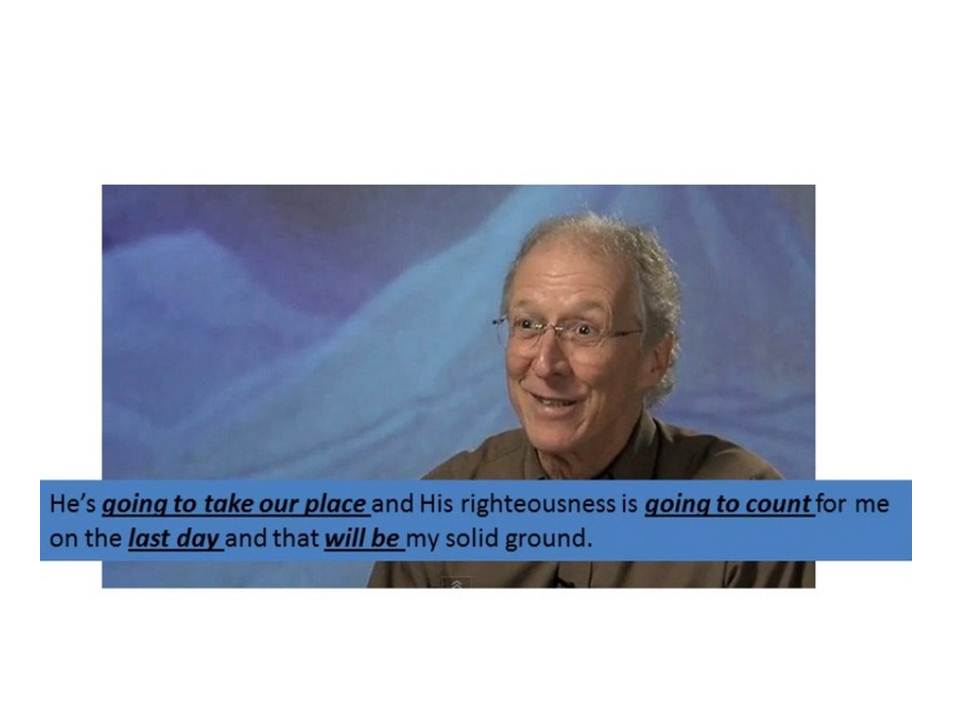 Christians will stand in no such judgment. And via the new birth, we are new creatures that in fact are righteous. Our lack of imperfection, though displeasing to the Lord, has no bearing….for justification. We are new creatures that deplore the weakness of our mortality, but are indwelt and enabled to obey God through our new life in the Holy Spirit. We are declared righteous, and in fact are righteous. We are not colaboring with our flesh like the world, but we rather colabor with God (1Cor. 3:9, 1Thess. 3:2, 2Cor. 6:1). Therefore, Paul could say, “Now if I do what I do not want, it is no longer I who do it, but sin that dwells within me (Romans 7:20). We will look at the supposed practical application of Reformed theology in part three, and compare it to the truth in light of assurance, spiritual growth, perseverance of the saints, and other sanctification issues.
paul
The True Gospel Verses Calvinism: Part 1
 “The difference between Calvinism and the true gospel is a fine line of distinction with eternal consequences.”
“Justification is a finished work that guarantees glorification apart from anything that happens in progressive sanctification….Justification is a finished work that guarantees glorification completely apart from progressive sanctification.”
“All bible verses must be interpreted by, verse….for justification, or verse….for sanctification.”
This post is actually in reply to the following question posted in the comment section of this blog:
Paul, please explain in layman’s terms how Calvinism views justification and sanctification. I am trying to understand this. Does this have anything to do with the saint’s persevering?
My initial response was several hundred words which were deleted somehow when I was near completion; I must have hit a wrong key or something, but this time I will be smart and type it on Microsoft Word first.
Let me begin by addressing this part of the reader’s question first: “Does this have anything to do with the saints persevering?” No. Please, let’s just focus on the foundation—you can address all of the many other issues later, but you will be unable to address them definitively until you have an understanding in regard to the first part of your question: “….how Calvinism views justification and sanctification.”
Short answer: It views them as being the same thing, and that’s a false gospel, and I will explain why (the forthcoming long answer). But first, know this: election does not necessarily mean that God predetermined before creation who was/is going to be saved and not saved. How God weaves His sovereignty together with our choices is a mystery. For example, “The heart of man plans his way, but the Lord establishes his steps (Proverbs 16:9).” Does this mean that we shouldn’t bother planning because the Lord has already determined our steps? Hardly. Proverbs 16:9 is speaking of the mystery/paradox of God’s weaving together of what we do and His sovereign will. Does prayer change things? Certainly it does. When we present the gospel to someone, do we say, “I am just here to find out whether you are one of God’s chosen or not. So, I am going to present the gospel to you, and if you believe and repent, you are one of the chosen, if you don’t, you are toast for eternity.” No, we persuade with all diligence and knowledge (like the apostle Paul did) as if it depends on us, because to some degree, it does. Bottom line:
How then will they call on him in whom they have not believed? And how are they to believe in him of whom they have never heard? And how are they to hear without someone preaching? (Romans 10:14).
God’s offer of salvation is a legitimate offer.
Justification 101 (For now, forget about sanctification, this concerns justification only!)
Nevertheless, when they/we believe, we know it’s because of Romans 8:30, which will be the focus of my explanation/long answer. Let’s now observe Romans 8:30:
And those whom he predestined he also called, and those whom he called he also justified, and those whom he justified he also glorified.
Done deal. Finished before the creation of the world. He predestined us, then called us, then justified us, and finally, glorified us. The word “justified” is dikaioo. It is a legal declaration of innocence that sets one free. Christians are declared righteous before creation, and glorification (when we will be instantly transformed completely at the resurrection) is guaranteed. We cannot mess that up. It’s a finished work by God before we were born. How can we possibly mess that up? We can’t.
Law/Justification [Gospel]
Also, the law can’t touch us. Why? We are already declared righteous, that’s why. Stop everything you are thinking about and take note of this: the law is no longer the standard for maintaining our salvation/justification. Do not turn your mind off here because of familiarity—this is not what you think it is. Pay attention! The difference between Calvinism and the true gospel is a fine line of distinction with eternal consequences. Caution: this is a concept that it so simple that it escapes us. We are no longer ….key word alert,….UNDER the law. In the book of Romans, Chapter 7, Paul compares our relationship to the law as a marriage covenant that is no longer valid because one of the spouses died:
Do you not know, brothers —for I am speaking to men who know the law—that the law has authority over a man only as long as he lives? 2 For example, by law a married woman is bound to her husband as long as he is alive, but if her husband dies, she is released from the law of marriage. 3 So then, if she marries another man while her husband is still alive, she is called an adulteress. But if her husband dies, she is released from that law and is not an adulteress, even though she marries another man.4 So, my brothers, you also died to the law through the body of Christ, that you might belong to another, to him who was raised from the dead, in order that we might bear fruit to God.
Now, I will slightly digress and bring danger of confusion, but will then quickly return to the subject of justification. Paul is talking about justification in this passage, and then finishes the thought with a mention of justification’s purpose; sanctification: “….in order that we might bear fruit to God.” BUT, as we shall see, other than the fact that justification makes sanctification (our kingdom living) possible, the two are totally separate, and the separation of the two is the key to understanding the issue at hand, and the true gospel in general.
….for justification.
We, as Christians, are dead to the law. It can’t touch us. We are no longer UNDER it:
Romans 2:12
All who sin apart from the law will also perish apart from the law, and all who sin under the law will be judged by the law.
But not us. The law can’t judge us, we are no longer under it:
Romans 3:19
Now we know that whatever the law says, it says to those who are under the law, so that every mouth may be silenced and the whole world held accountable to God.
Note that the world is under the law, but we are not. We have no regard for the law whatsoever, ….for justification.
Slavery/Justification
Paul also described our relationship to the law in regard to not being enslaved by it. To be evaluated by the law is to be in bondage to it:
Romans 6:14
For sin shall no longer be your master, because you are not under the law, but under grace.
Galatians 4
21 Tell me, you who want to be under the law, are you not aware of what the law says? 22 For it is written that Abraham had two sons, one by the slave woman and the other by the free woman. 23 His son by the slave woman was born according to the flesh, but his son by the free woman was born as the result of a divine promise.
In fact, Paul said for us Christians, ALL things are lawful!
1 Corinthians 6:12
All things are lawful for me, but not all things are profitable. All things are lawful for me, but I will not be mastered by anything.
All things are lawful, but not all things are profitable. All things are lawful, but not all things edify.
But not expedient, or profitable….
….for sanctification. Sanctification 101
There are two kinds of sanctification, but only one kind of justification, and the two sanctification are totally separate from justification. If not, we are eternally doomed. Justification must be a finished work that we have no part in except for showing others how they can be justified like we are; saved, if you will. Note: Romans 8:30, the epic verse of justification, does not include the subject of sanctification because the two must be separate. One is a finished work (justification), the other, sanctification (or, kingdom living) is progressive. In fact, Dr. Jay E. Adams states well that sanctification (our Christian life) does not in any way draw it’s life or power from justification because justification is a legal declaration that determines our POSITION:
The problem with Sonship™ [same thing as New Calvinism prior to 2008] is that it misidentifies the source of sanctification (or the fruitful life of the children of God) as justification. Justification, though a wonderful fact, a ground of assurance, and something never to forget, cannot produce a holy life through strong motive for it. As a declaration of forgiveness, pardon, and adoption into the family of God, it is (remember) a legal act. It changes the standing, but not the condition, of the person who is justified.
That’s because justification is a finished work, and discipleship (sanctification) is not; it’s progressive. But, there is also a positional sanctification that is also a finished work that even preceded justification. But like justification, it is a finished work and cannot produce progressive life, because for crying out loud, a finished work doesn’t continue to produce a progression. This would seem evident. Remember this: sanctification is a word that merely means, “to set apart.” So, sanctification is a progressive separating from the world. As we progress in our sanctification, we look more like Christ, and less like the world. But there is also a positional separation from the world that is also a finished work that includes predestination, election, calling, justification, and a setting apart:
Such were some of you; but you were washed, but you were sanctified, but you were justified in the name of the Lord Jesus Christ and in the Spirit of our God (1Corinthians 6:11).
Notice the past tense of the verse. Our position is a finished work. We were washed, set apart, and justified. Peter asked Jesus to wash him. But Christ told him that there was no need for him to be washed because it had already been done, he only needed a daily washing of his feet:
The evening meal was being served, and the devil had already prompted Judas Iscariot, son of Simon, to betray Jesus. Jesus knew that the Father had put all things under his power, and that he had come from God and was returning to God; so he got up from the meal, took off his outer clothing, and wrapped a towel around his waist. After that, he poured water into a basin and began to wash his disciples’ feet, drying them with the towel that was wrapped around him. He came to Simon Peter, who said to him, “Lord, are you going to wash my feet?” Jesus replied, “You do not realize now what I am doing, but later you will understand.” “No,” said Peter, “you shall never wash my feet.” Jesus answered, “Unless I wash you, you have no part with me.” “Then, Lord,” Simon Peter replied, “not just my feet but my hands and my head as well!” Jesus answered, “A person who has had a bath needs only to wash his feet; his whole body is clean. And you are clean, though not every one of you.” For he knew who was going to betray him, and that was why he said not everyone was clean (John 13:2-11).
Justification and the New Birth
Though justification is a finished work, it passes the torch to something that is a mark of true salvation. This is where sanctification draws its power. This element of sanctification is a Proof of Purchase Seal that you and I have been purchased by God with the price of His Son. It is the new birth. We are born of the Holy Spirit into new creatures. Our spiritual growth is now a colaboring with the Holy Spirit who indwells us. He also colabored with saints of old, but His permanent indwelling of New Testament believers is probably related to the engrafting of the Gentiles. But whatever the reasons, remember that the saints of old were also justified by faith alone, and like us, they were not UNDER the law….for justification.
Paul makes this point in Galatians 3:13-18:
Christ redeemed us from the curse of the law by becoming a curse for us, for it is written: “Cursed is everyone who is hung on a tree.” He redeemed us in order that the blessing given to Abraham might come to the Gentiles through Christ Jesus, so that by faith we might receive the promise of the Spirit.
Brothers, let me take an example from everyday life. Just as no one can set aside or add to a human covenant that has been duly established, so it is in this case. The promises were spoken to Abraham and to his seed. The Scripture does not say “and to seeds,” meaning many people, but “and to your seed,” meaning one person, who is Christ. What I mean is this: The law, introduced 430 years later, does not set aside the covenant previously established by God and thus do away with the promise. For if the inheritance depends on the law, then it no longer depends on a promise; but God in his grace gave it to Abraham through a promise.
Hence, the law CANNOT be our standard…. for justification. Paul makes that clear by pointing out that the law didn’t come for 430 years after Abraham was justified according to the covenant of promise. Nevertheless, we must be born again (new birth). Again, the new birth is proof of Justification, but is not powered by it. The new birth is the indwelling Holy Spirit colaboring with His new creatures. Theologians call this, regeneration. We, like the saints of old, MUST BE BORN AGAIN. Before the cross, and before Pentecost, Christ made this clear to Nicodemus in the present tense, and expressed surprise that he was ignorant of the new birth (John, chapter 3).
And this is very, very important: regeneration does not work towards/for glorification. Sanctification (the progressive type) is NOT a link to glorification. Remember, glorification is a finished work. Romans 8:30 speaks of it in the past tense. It is the guarantee of our justification. Both happened before the creation of the world. Some theologians call glorification, “final sanctification.” Perish the thought! Glorification is the manifestation of positional sanctification (both are final, finished works), NOT the completion of progressive sanctification. Though the completion of progressive sanctification happens at the same time as glorification—glorification is a finished work, and therefore is not the culmination of progressive sanctification’s progressive work; it is rather, redemption. Redemption is the manifestation of glorification when God cashes in on his purchase:
There will be signs in the sun, moon and stars. On the earth, nations will be in anguish and perplexity at the roaring and tossing of the sea. People will faint from terror, apprehensive of what is coming on the world, for the heavenly bodies will be shaken. At that time they will see the Son of Man coming in a cloud with power and great glory. When these things begin to take place, stand up and lift up your heads, because your redemption is drawing near (Luke 21: 25-28).
Though the Bible speaks of glorification as a future event, Romans 8:30 refers to it in the past tense. This is because it does not need progressive sanctification to complete it (again, progressive sanctification is not included in the list of Rom. 8:30), and the past tense usage points to the guarantee that accompanies justification.
Justification and progressive sanctification are totally separate. Progressive sanctification DOES NOT link justification to glorification. Justification is a finished work that guarantees glorification apart from anything that happens in progressive sanctification. This is why progressive sanctification is excluded from this paramount justification verse….for justification, and speaks of justification and glorification in the past tense. Justification is a finished work that guarantees glorification completely apart from progressive sanctification.
One Law; Three Relationships/Standards
Hence, the law, which includes all of Scripture (see Matthew 4:4, 2Timothy 3:16) must always be read in this context: ….for justification, or….for sanctification. The standard/relationship…. for [our] justification is ZERO LAW. The standard/relationship….for [our] sanctification is….100% law! Why not? It’s not related to our justification anyway! Therefore:
Do not think that I have come to abolish the Law or the Prophets; I have not come to abolish them but to fulfill them. For truly I tell you, until heaven and earth disappear, not the smallest letter, not the least stroke of a pen, will by any means disappear from the Law until everything is accomplished. Therefore anyone who sets aside one of the least of these commands and teaches others accordingly will be called least in the kingdom of heaven, but whoever practices and teaches these commands will be called great in the kingdom of heaven. For I tell you that unless your righteousness surpasses that of the Pharisees and the teachers of the law, you will certainly not enter the kingdom of heaven (Matthew 5:17-20).
The word for “set aside” is lou. It means to “relax” or loosen. That is, in regard to the “least of these commandments.” So, do we interpret this way: “Whoever practices and teaches these commands”….for justification; or, ….for sanctification ? The framing of a house and the rightness of its foundation will determine its quality. Are the frame and the foundation going to be perfect? No. But is that the standard? One would hope so. We should strive for perfection in sanctification for many reasons, but most of all, because it has no bearing on our justification which is a settled issue. However, Christ links a poor attitude towards the law in sanctification to an absence of the new birth/ new creaturehood:
For I tell you that unless your righteousness surpasses that of the Pharisees and the teachers of the law, you will certainly not enter the kingdom of heaven.
Unfortunately, the relationship/standard in regard to the unregenerate is perfection ….for justification because they are UNDER the law and in bondage to it. Christians are free from the law for justification and “uphold” (Romans 3:31) it…. for sanctification. That is why James refers to it as the “perfect law of liberty” in James 1:25. All Bible verses must be interpreted by, verse….for justification, or verse….for sanctification.
Eschatology and Justification
This is why in the study of biblical last things (eschatology), we find two resurrections and two judgments. One resurrection and judgment for the saved, and a separate resurrection and judgment for the unsaved. Unfortunately, the standard for the second set will be perfection, and nobody will measure up (Revelation 20:4-6; 11,12). We will be a part of the “resurrection of the just” (Luke 14:14) and will not stand in such a judgment because we have already been declared just. Our judgment will be for rewards:
For we must all appear before the judgment seat of Christ, so that each of us may receive what is due us for the things done while in the body, whether good or bad (2 Corinthians 5:10).
Obviously, we can’t do this: 2Cor 5:10…. for justification. That would be a huge problem.
I will conclude with a visual chart to help clarify the above. In the second part, we will examine the difference between this and Calvinism.
Cluelessness Saves Southern Baptist Pastors From New Calvinist Heretic David Platt
New Calvinism is a resurgence of authentic Calvinism. Since its conception during the so called “Reformation,” authentic Calvinism dies a social death from time to time because of the spiritual tyranny that its basic philosophy produces. Most of the rediscovery/resurgence movements of the past since authentic Calvinism died out after the Reformation have made little impact on Christianity. However, Calvinism Light (sanctified Calvinism) is left behind to live on after these movements die. When resurgence happens, the sanctified Calvinists actually take offence, not realizing that they are not really authentic Calvinists. Authentic Reformation theology in the vein of Augustine, Luther, and Calvin, is gross heresy. It is a works salvation with Gnosticism as its practical application. This also contributes to its eventual demise, but this takes a while because Augustine, Luther, and Calvin were masters of nuance and using familiar terms to articulate their doctrine.
The rediscovery movement that has become New Calvinism is different. Robert Brinsmead, the father of contemporary New Calvinism, argued that the recovery movements of the past failed due to a lack of systemization. Three other Reformed theologians agreed, and they started a theological think tank (the Australian Forum and its theological journal, Present Truth Magazine) to prepare the doctrine for a proper launching. That was in 1970, when the doctrine was originally known as the centrality of the objective gospel completely outside of us and New Covenant Theology. NCT took a brutal beating in Reformed Baptist circles and caused a split in at least one convention. Eventually, the doctrine was only represented by about twenty churches in those circles. However, the doctrine found new life in Presbyterian circles as Sonship Theology. Nevertheless, Sonship experienced a severe pushback by sanctified Calvinists in Presbyterian circles and was forced underground in circa 2000. It was renamed, “Gospel Transformation” and experienced massive growth between 2000 and 2004.
In 2004, the fallout from its tyranny became more evident, but no one could identify the doctrine. It was coined “Gospel Sanctification” by a small group of protestants including Dr. Jay E. Adams. But its influence and controversy continued to expand and the whole world started taking note when it was dubbed “New Calvinism” in 2008. Like the prior rediscovery movements, it has spawned a massive wave of spiritual abuse in the church under the auspices of several different sub movements such as Patriarchy and the Shepherding Movement. New Calvinists have also reached back into history and revived movements that were based on authentic Calvinism and brought them back into the fold. The whole thing is a perfect storm of mystical despotism dressed in orthodoxy. Robert Brinsmead was right; the movement needed the systematic touch.
In 1981, a Presbyterian started an organization for the sole purpose of taking over the Southern Baptist Convention with this doctrine, and today that organization is known as Founders Ministries. Until last week’s controversy concerning one of the speakers at the annual SBC Pastors Conference, authentic Calvinist heretic David Platt, I was convinced that the SBC was doomed to be taken over by this doctrine. But the response by 80% of the pastors who attended has given me great comfort. Per the normal, my beloved Southern Baptist brethren are too theologically illiterate to be led astray by a false doctrine. Their utter incompetence is demonstrated by the fact that heretics such as Platt could even be invited to speak at such a conference, and the additional fact that the flagship seminary of the SBC is run by New Calvinist “Big Al” Mohler.
Platt dissed the Sinner’s Prayer in his message, calling it “superstitious and unbiblical.” His particular beef with the prayer is the concept of “accepting Jesus into our hearts.” Platt’s message was full of nuanced and peculiar use of the English language, including the misidentification of subjects and objects, and turning verbs into adjectives, which should have begged the question: “What is this guy’s particular beef with the Sinner’s Prayer?” But my beloved Southern Baptists didn’t even blink, and did what I can always count on them doing lest they think below the surface of anything leading to possible deception; they focused on the ridicule of one of their sacred traditions. Thank goodness for that ole time religion. My dumbed down faithful brethren moved quickly to submit a resolution to the convention to confirm the validity of the Sinner’s Prayer. The resolution passed by more than 80%. Whew, that was a close one! Platt, apparently amazed at his inability to deceive them, responded to the clamor by saying that he wished he would have presented it differently. In other words, I think he meant that he wished he would have simplified it more. Platt need not worry; it wouldn’t have made any difference. I am now totally assured that my brothers are safe.
Actually, Platt’s problem with “asking/accepting Jesus in our hearts” is directly related to authentic Calvinism’s rejection of the new birth. Classic: one of the rising stars in the SBC, like Big Al, rejects the new birth, but how dare them diss the Sinner’s Prayer! You see, authentic Calvinism borrows the Platonist concept of emphasis. Though shadows are true, they are only a result of the sun’s true reality. Therefore, to emphasize shadows is to reject the only thing that can truly give life—the sun. Shadows can’t give life, only the sun’s light can. Since authentic Calvinism believes that life only comes from meditating on the works of Christ outside of us, an emphasis on the new birth, which is inside us, is to emphasize the result of Christ’s works and not Christ himself. So, to the degree that we focus on regeneration, we take away from the only thing that gives life: the personhood of Christ and His works. That is exactly what Platt’s beef is in regard to “accepting Jesus in our hearts.”
The crux of what Platt is really after was articulated by the Australian Forum. They dedicated a whole issue of their theological journal to The False Gospel of the New Birth. One article was titled as such. I will quote two members of the Australian Forum on this wise and throw in other quotes by contemporary New Calvinists as well:
“The false gospel of the new birth” imagines that the new birth refers primarily to what happens in the believer and that this is the greatest news in the world. This is classical Roman Catholicism. It teaches that a good thing is the best thing, that the work of the Spirit is greater than that of the Son. It takes the fruit of the gospel and elevates it over the root, which is the gospel. It confuses the effect of the gospel with the gospel itself.
~Geoffrey Paxton: Present Truth; The false Gospel of the New Birth Volume Thirty-Seven — Article 4
How can my life, my doing, be fruit and not root? The fruit of the tree of justification and not the root of justification? The fruit of God being on my side rather than the root of making God be on my side? How can it be the fruit of the Holy Spirit so that I’m acting in the power of another and not in my own power?
~John Piper: http://marshill.com/media/guests/be-killing-sin-or-sin-will-be-killing-you
Bultmann’s existential gospel led him inevitably to a negative view of the Old Testament. And the new-birth oriented “Jesus-in-my-heart” gospel of evangelicals has destroyed the Old Testament just as effectively as has nineteenth-century liberalism.1 [Goldsworthy’s footnote #1] (1 See Geoffrey J. Paxton, “The False Gospel of the New Birth,” Present Truth Magazine 7, no.3 (June 1978): 17-22).
~Graeme Goldsworth: Present Truth; Obituary for the Old Testament Volume Forty-One — Article 2
It robs Christ of His glory by putting the Spirit’s work in the believer above and therefore against what Christ has done for the believer in His doing and dying.
~ Geoffrey Paxton (Australian Forum)
But to whom are we introducing people to, Christ or to ourselves? Is the “Good News” no longer Christ’s doing and dying, but our own “Spirit-filled” life?
~ Michael Horton
As my lovely wife said in her first session at last week’s conference on spiritual tyranny:
By glazing over the finer details of Christianity and focusing on more moderate doctrines he [Billy Graham] made evangelism enticing, non-threatening, and easy to swallow, and in a lot of ways gave definition to easy believeism.
His mission to present the “gospel” and get people saved and on their way to heaven permeated the focus of many fundamental churches thereafter, particularly the Southern Baptist denomination with which Billy Graham was associated.
As a result of the success of Billy Graham, many other evangelists and pastors adopted and adapted his mode of operation in order to” bring in the sheaves.” This is often referred to as the first gospel wave that swept over America in the 50’s and continued on into the early 70’s.
Please do not misunderstand my opening remarks. The biographical remarks were taken from an article written of Billy Graham. We all believe that people were genuinely saved as a result of the ministry of Billy Graham; but I want to also say that many thought they were saved as a result of his ministry as well. Here’s the dilemma his type of evangelism created: a) genuine salvation experiences occurred and b) professions of salvation made but no outward change in living or life-style and c) lack of assurance of salvation as a result of poor follow-up and discipleship.
In my neck of the woods the “At least he is saved mentality” which the Billy Graham Association innocently created, helped people rationalize sinful lifestyles, make valid emotional experiences and equate them with regeneration, and issued “fire insurance” policy mentality amongst church going people. Just say the sinner’s prayer and you are guaranteed a home in heaven.
So, at least some people get saved, and they’re too doctrinally illiterate to be taken over by a movement that is completely of the devil.
Maybe it’s not all bad!
paul
Beaverton Scandal is Just More New Calvinist Spiritual Tyranny
 Frustrating. Once again, we are focused on symptoms and not the disease. New Calvinism and its doctrine/philosophy is the disease, Beaverton is a symptom. Beaverton what? Beaverton as in Beaverton Grace Bible Church in Beaverton, Oregon. Here is their website: http://www.beavertongracebible.org/. And here is the scandal: http://bgbcsurvivors.blogspot.com/2012/05/anticipation.html.
Another survivors website to add to my blogroll. But it is the same old story: 1; New Calvinism comes to a church. 2; Members start asking questions. 3; New Calvinists use the techniques they learn at conferences to dissuade concerns. 4; But most churches have at least a few people that can think for themselves which = trouble/possible exposure that the leadership is slowly assimilating the “unadjusted gospel” into the minds of the people. 5; Since one of the tenets of this doctrine is that the (usually newly appointed under the new system) elders can bring someone under church discipline for ANY sin, and contesting the “underestimated” gospel is paramount to propagating false doctrine, the pesky member is disciplined and thereby neutralized as a threat to the authority of the elders. And, to discuss why the “sinner” is under discipline would be, but of course, gossip. The pesky member can now scream, squawk, or anything else they would like to do to no avail; their credibility is history. It’s the same old, worn out, five-step story being played out over and over again while rolling up the body count on the landscape of American Christianity.
This has been going on now for 42 years. The sharp increase in church discipline reported by the Wall Street Journal in 2008 is directly related to the New Calvinist movement which was launched by the Australian Forum think tank in 1970. It is a return to heavy handed Geneva style Reformed leadership—the days when Calvin had “heretics” burned and beheaded. Here in America, the scarlet letter of church discipline and lawsuits are the next best thing for those who dare contend against the “scandalous gospel.” Granted, many who contend against it don’t understand the theology per se, but have concerns about the results they see: control issues; fast changes without regard to the feelings of others; unbalanced preaching; and troublesome ideas like our total inability as believers to please God. That’s too close for comfort for most New Calvinist spiritual despots. This movement is also the primary supporter and catalyst for other movements like Quiver Full, Patriarchy, Vision Forum, SGM, Shepherding, etc. These movements comprise easily 90% of the spiritual abuse that takes place in American Christianity.
But yet again, even though it would seem like New Calvinists are on the ropes with the embarrassing revelation in the Beaverton situation concerning John MacArthur’s Grace Community Church, they win. Why? Because once again, symptoms are the issue, and not the movement’s doctrine/philosophy driving the behavior. Ronald Reagan knew how to get rid of a problem. He didn’t focus on the naughty behavior of communism—he sought to destroy the beast. And for certain, many bloggers don’t want to see the demise of New Calvinism for they would have nothing to write about anymore. In the same way, the National Inquirer dreads the idea that movie stars and politicians would start behaving.
This is a nasty philosophy: a play scripted with three primary characters; the enlightened totally depraved chosen by God to contain the total depraved peasantry until the day of apocalypse, and using the law and government for guardrails. Phil Johnson’s response to the Beaverton situation is beyond disingenuous. He knows grade A well that once a parishioner is excommunicated, they can be “treated like an unbeliever.” I can confidently say that his reference to the defendants as “believers” is not what he believes about them. With this doctrine, authority = truth which is why MacArthur will once again entertain with CJ Mahaney at this year’s Resolved Conference despite the fact that CJ has never repented of his criminal activity. Stuff happens in the messy business of controlling the totally depraved in order to present them to God as those who excepted the fact that Jesus has always obeyed for them (and any obedience on our part rejects the atonement). CJ’s behavior is unfortunate collateral damage in a war where the one in 99 is expendable for the Geneva commune. By the way, while New Calvinists pontificate about the virtues of separation of church and state, this ministry receives information regularly about their consorted effort to get in bed with the government, especially through the U.N.
I guess my only question is how high does the destroyed family body count have to get before people wake up?
As James Carville said in the four words that got Bill Clinton elected: “It’s the economy doctrine stupid.”
paul

 Paul's Passing Thoughts
19 comments