2013 PPT’s Top Ten Heretics of Our Day
10. David Platt

Heresy: Progressive Justification
9. Paul Washer

Heresy: Progressive Justification
8. Ligon Duncan

Heresy: Sonship Theology
7. David Powlison

Heresy: Sonship Theology
6. Albert Mohler

Heresy: Progressive Justification
5. Mark Dever and 4. CJ Mahaney

Heresy: Progressive Justification
3. Elyse Fitzpatrick

Heresy: Progressive Justification
2. Tim Keller

Heresy: Mysticism, Sonship Theology
1. John Piper

Heresy: Mysticism, Progressive Justification
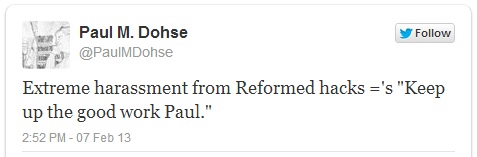
Loving The Truth is Often Bittersweet

“Part and parcel with being made a new creature in Jesus Christ is love for the truth.”
This is something that I don’t write about enough. Loving the truth and upholding the truth can be a rough life. I don’t think about them much, but when I do in a thoughtful way I find myself in tears; those who have lost almost everything over truth. I feel their pain when I read their emails and published articles. We are social creatures and losing all of your friends is not a pleasant experience. It causes us to long for the day when we will gaze upon the personification of truth among enumerable truth lovers.
Today this hits close to home. Someone very dear to me is once again faced with a choice: the comfort of compromise, or standing by the truth at all cost. The Bible has much to say about this. Let me repeat that another way: God has strong opinions about this issue.
2 Corinthians 10:5 – We destroy arguments and every lofty opinion raised against the knowledge of God, and take every thought captive to obey Christ, 6 being ready to punish every disobedience, when your obedience is complete.
Truth is God’s opinion about what makes the world He created tick, and apparently, those who know more about life than He does are very annoying to Him. Equally annoying to Him is the idea that His truth is ambiguous and not near to all. Listen to what Moses had to say about that:
Deuteronomy 30:11 – “For this commandment that I command you today is not too hard for you, neither is it far off. 12 It is not in heaven, that you should say, ‘Who will ascend to heaven for us and bring it to us, that we may hear it and do it? ‘ 13 Neither is it beyond the sea, that you should say, ‘Who will go over the sea for us and bring it to us, that we may hear it and do it? ‘ 14 But the word is very near you. It is in your mouth and in your heart, so that you can do it.
15 “See, I have set before you today life and good, death and evil. 16 If you obey the commandments of the Lord your God that I command you today, by loving the Lord your God, by walking in his ways, and by keeping his commandments and his statutes and his rules, then you shall live and multiply, and the Lord your God will bless you in the land that you are entering to take possession of it. 17 But if your heart turns away, and you will not hear, but are drawn away to worship other gods and serve them, 18 I declare to you today, that you shall surely perish.
God doesn’t appreciate the implication that His truth is not near to us—that it is ambiguous and difficult to ascertain—that we need orthodoxy from a host of mystic academics. No, and by the way, we can’t blame those who we chose to listen to in the end; the truth is near to all of us—we are responsible for the sum and substance of our own lives.
Part and parcel with being made a new creature in Jesus Christ is love for the truth. The apostle Paul, in his apocalyptic letter to the Thessalonians, warned that those who perish have not “received the love of the truth.” Receiving this love also comes part and parcel with an attitude: read about Daniel’s three friends and the bunch in Hebrews 11.
This attitude might also be influenced by something believers know about God. When God made a covenant with Israel as stipulated in the Book of the Covenant, and they broke it with defiant flare while Moses was on Mt. Sinai receiving the “tablets of the testimony,” we observe the following scene when Moses returned:
Exodus 32:25 – And when Moses saw that the people had broken loose (for Aaron had let them break loose, to the derision of their enemies), 26 then Moses stood in the gate of the camp and said, “Who is on the Lord’s side? Come to me.” And all the sons of Levi gathered around him. 27 And he said to them, “Thus says the Lord God of Israel, ‘Put your sword on your side each of you, and go to and fro from gate to gate throughout the camp, and each of you kill his brother and his companion and his neighbor.’” 28 And the sons of Levi did according to the word of Moses. And that day about three thousand men of the people fell. 29 And Moses said, “Today you have been ordained for the service of the Lord, each one at the cost of his son and of his brother, so that he might bestow a blessing upon you this day.”
Christ said God’s word is truth, and ONLY truth sanctifies (John 17:17). Sanctification is separation from the world, and hence, when separation occurs—it is often difficult to distinguish naive Christians from worldly false confessors. A stand for the truth is seen as fanaticism. Perhaps rock legend Alice Cooper said it best:
Drinking beer is easy. Trashing your hotel room is easy. But being a Christian, that’s a tough call. That’s real rebellion!
paul
Heretic David Platt: Don’t Go to Hell Their Way; Go to Hell My Way

Moses: The anti-Calvin
“….which doesn’t see justification as a finished work that cannot be affected by sanctification.”
This may be a shock to you, but heretic David Platt has a new book out. Is anybody keeping a running score on this? Who is ahead? I think John Piper has written about 600 books; where does Platt measure up to that? Is Kevin DeYoung like second or third? The promotional trailer follows after my commentary. In the classic Reformed either/or metaphysical interpretive prism, he insinuates that you either know what he knows about salvation, or you are one of those minions of the present Dark Age of Synergistic Sanctification. And you also think people are saved by the mindless citation of a prayer. If you don’t believe what he believes—that’s you. You believe that you have led someone to Christ just because you got them to recite a prayer.
That’s what Platt means by Follow Me. “Follow me” really means meditating on what Jesus has done rather than anything that we do resulting in Christ’s life and obedience being imputed as a substitute for our obedience in sanctification. Emptying ourselves means to look at all of life as a way to make us smaller and the cross bigger. Got rape? Awesome! What could be more useful in humbling us in the death we deserve and being resurrected by the fruits of Jesus? And not to mention forgiving our rapist to show the world that we forgive the way Jesus forgave us. We are all just sinners saved by grace and if not for the mercy of Jesus—I would also be a rapist, so who am I to judge? Point being: don’t be deceived into thinking that Platt really believes that following Jesus means learn and do. He means meditate and watch. That’s how we get to heaven by faith alone in sanctification; which doesn’t see justification as a finished work that cannot be affected by sanctification.
And that’s ironic because he cites Matthew 7:21-23 to make his point. But what is the context of that text? Those who don’t learn and practice have houses built on sand and no assurance of salvation; ie., what Platt propogates. Learning, and “jumping from the command to obedience” is…. “obeying in our own efforts.” Following Jesus really means learn and watch.
Him and is heretic book-writing buddies can deny this all they want to, but it’s called: “the imperative command is grounded in the indicative event.” It’s a Reformed tradition, and invites the words, “Depart from me you who work anomia (anti-law [those who don’t learn and do]), for I never knew you.
Moses told us how to choose life or death. Or, how to choose a house built on sand or a house built on a rock. Once splattered with blood, the word is near to us, and in us, and not too difficult for us to obey. This is the opposite of the “centrality of the objective gospel outside of us.” The word is NOT in us, and it is most certainly TOO HARD for us to obey—Jesus must do it for us, or you are not living by faith alone.
So, don’t go to hell the way Biblicists supposedly go to hell—go to hell David Platt’s way.
paul


 Paul's Passing Thoughts
14 comments