Pedestrian Christian Run Over By Wartburg for Calling a Heretic “Sophomoric”
 I consider Alex Guggenheim, the author of The Pedestrian Christian blog a good friend of this ministry. Every now and then, I find time to swing by and read his stuff. Wish I could do that more often, but this ministry is growing and I am doing the work of several people.
As Susan and I learn more and more about the Protestant tradition, the list of things to write about and the consideration of approaches is very long, so we have to work by priority. Low on the list is the tsunami of illogical functioning and reasoning by many discernment bloggers. However, after reading Alex’s report concerning the treatment he received over at Wartburg Watch, I am motivated to point some things out. Is this because I like Alex and am therefore offended by the treatment he received? Probably, but nevertheless, the point is worthy of a temporary jettison to the top of the list.
I will get to what happened to Alex specifically in a bit, but in order to lay some groundwork first, I will cite a paragraph from his account:
The Wartburg Watch blog, as I have observed, inaugurated itself with an emphasis on Neo-Calvinism, ecclesiastical malfeasance of many sorts but particularly with sexual misconduct or abuse and patriarchalism/complementarism excesses or even its existence. Something needed in general, though I certainly do not subscribe to all of their criticisms or theological persuasions.
And apparently, because of what happened to Alex, and what I have seen likewise among many discernment bloggers, there are good New Calvinists and naughty New Calvinists. I believe “Deb and Dee,” the Wartburg authors, call them the “Calvinistas.” New Calvinism is a doctrine; specifically, the false doctrine of progressive justification. This is just the FACT of the matter. Anybody who propagates New Calvinism is a heretic, plain and simple. I have been researching this doctrine for almost six years now, and as will be demonstrated in our upcoming June conference, there is absolutely nothing about this doctrine that is true. It denies the new birth, rejects the Trinity, rejects sanctification, and is vehemently anti-Semitic.
While referring to New Calvinists as “Calvinistas,” Wartburg strongly endorses and networks with none other than Wade Burleson. Burleson is a strong advocate of Jon Zens who is one of the forefathers of the present-day New Calvinist movement. Burleson propagates progressive justification in its purest form along with the accompanied belief that the Bible is a mystical gospel meta-narrative. What his preaching seems to project is of no concern of mine; the quality of the milk is determined by the cow. Furthermore, according to Burleson, he is enamored by the Puritans while posing himself as an understanding advocate for the spiritually abused. Wartburg, affirming such accordingly, sponsors an e-church that features his preaching live on every Sunday. Anyone who knows the history of Puritanism would find this ironic.
In discernment blogging, there is an illogical disconnecting between doctrine and behavior as if the two are totally unrelated. If you applied the same logic to Nazism, there would be good Nazis and bad Nazis because some Nazis where good Lutherans who didn’t work the ovens at the concentration camps. It is generally recognized that not every Nazi behaved badly, but that the ideology is the problem. Leave it to Christians to abandon common sense on that wise. I use the Nazi example because New Calvinists, though often dressed in the demeanor of Mr. Rogers, and their female counterparts that of Mary Poppins, are among the most vicious and heartless homosapiens walking the face of the earth. Trust me, if they had the marriage between themselves and the state that they seek, the behavior would be no different than it was in Geneva. This is a certainty. As it presently stands, they improvise through other means.
The thing that really gets me is the anti-spiritual abuse bloggers who hold to Reformed theology and even call themselves Calvinists. This is where the Nazi example is apt. This utterly disconnects history from reality and Christ’s declaration of, “By their fruits you will know them.”
Alex keyboarded into one of these illogical endeavors over at Wartburg. They were actually pitting the supposed virtue of New Calvinist Thabiti Anyabwile against the supposed racism of New Calvinist Doug Wilson. As an aside, let me mention that John Piper endorses Doug Wilson and Anyabwile endorses Piper but Anyabwile doesn’t endorse Wilson but Piper does because Wilson “has the gospel right” and he also endorses Anyabwile and so it goes. Somewhere in all of the discussion, the obvious is missed: Wilson is the one with the most virtue because he is consistent. The South was practically an unofficial Presbyterian theocracy during the Civil War. The theological endorsement of slavery during that time by the Presbyterian Church is confirmed by a cursory observation of American history. And Anyabwile is a Calvinist. And the Prebyterian church was founded on Calvinism, and yet, Anyabwile is taking on Wilson for merely connecting with their (singular) historical roots. And by the way, Wilson’s assessment overall is not far from the mark.
But apparently, this absurd contradiction is ok because Anyabwile is (according to Dee during her scolding of Alex), “walking while black.” I have news for Wartburg, Calvinism has a large share in two world Holidays: Martin Luther King Day, and the International Religious Freedom Day. Their share in the former is hefty, and their share in the latter is 100% as that holiday was founded after Calvinistic Puritans hung three Quakers in Boston for “walking while Quaker.” What is up with all of this? Why do Neo-Calvinists get a pass on their history while Nazi’s don’t—the connection between Nazism and Reformed theology another conversation notwithstanding to boot?
Alex Guggenheim is too damn nice: calling Anyabwile theologically “sophomoric” is like describing Jeffrey Damher as one over-curious about culinary issues. Anyabwile is a walking hypocritical heretic and his color has nothing to do with anything. I firmly believe that New Calvinists laugh about getting the church tangled up in these worthless discussions.
Wartburg did get something partially right in the article that Alex commented on, but it unfortunately adds to their grossly misinformed promotion of Anyabwile:
I disagree with Wilson in the matter. Slavery almost always involves racism since it is the forced servitude of people groups. The South’s slaves were black. Slavery results in the perception that said group is inferior and deserves to be enslaved. This attitude, after the Civil War, resulted in the separation of whites from blacks. “Separate but equal” was anything but equal and it took the Civil Rights movement to expose the ugliness of this entrenched view of the superiority of the white race.
The proper term is CASTE SYSTEM. And NO, it is NOT fundamentally racist. Racism is a result of the root: spiritual caste systems. Caste is not fundamentally racist—it is fundamentally spiritual. A dear friend of this ministry, church historian John Immel would argue that it is fundamentally ideological and philosophical. He would contend that theological doctrine is the result of the ideology. Well, I would agree because theological error is separate from the Bible anyway and a mere human ideology by default. Either way, racism is a mere residual consequence of the core problem.
And Calvinism is a spiritual caste spectacle. It is predicated on preordained enlightened mediators ruling over the unenlightened masses on behalf of God, whether perceived as a cosmic force or a person. This concept is the bedrock of ancient Paganism which gave birth to Hinduism, was integrated into Socratism by Plato, became Neo-Platonism and gave birth to Gnosticism and the Nicolaitanism (translated: “power over the laity”) that plagued the first century church, was adopted by Augustine and Gregory, and passed on intellectually to their mentorees Luther and Calvin. And the results are always the same. Nazism was a horrific brew of Hinduism and Augustinianism, and Calvinistic fruit does not fall far from that tree. The aforementioned spiritual caste system drives Calvinism and the Neo-Calvinistic movement of our day in particular. Patriarchy, racism, etc., etc., etc., etc., etc., etc., are all results of that fundamental ideology.
We are the laity; and Calvinistic elders, according to Al Mohler (a popular target of Wartburg), are “appointed” to save us from, “ignorance.” And our response is to act like we need it while whining about the spiritual abuse that always comes with it. For the most part, New Calvinists do not take discernment bloggers seriously for the following reason: like dumb fish that swim after every breadcrumb thrown over the bridge by children, we will chase every red herring thrown out the window by New Calvinists.
Like the racism issue.
paul
Calvinists Pretend That They Think Salvation Changes Us: A Picture Story
“This is why the present-day Reformed counseling culture led by the likes of David Powlison is the biggest scam ever perpetrated on Christianity.”
John Piper once stated in an interview that Protestants are not ready for the hard truth of the Reformed authentic gospel. And what is that truth? It is the “truth” that salvation doesn’t change us. They say, “We are transformed into Christ’s image, and “We are sanctified” etc., but they believe no such thing and for our sake lie about it because we are not “ready” for the “hard truth.” This is why the present-day Reformed counseling culture led by the likes of David Powlison is the biggest scam ever perpetrated on Christianity. Christians go to counseling because they think we can change with God’s help and for His glory, and the anticipation of happiness. Powlison has built an empire on allowing Christians to believe that initially like we allow our children to believe in Santa Clause. That way, he can draw them in and “help” them with his superior spiritual knowledge.
What is that knowledge? It is the “centrality of the objective gospel outside of us.” John Piper states it plainly: if any work of grace happens in us at all, it makes sanctification the ground of our justification. I document all of this in much detail in chapter four of The Truth About New Calvinism. Below is a picture that illustrates this. It was published by a Reformed think tank that Graeme Goldsworthy was involved in. Like the following pictures, you can click on it for a larger picture:

Let’s look at other Reformed illustrations that show clearly that they deliberately deceive by pretending they believe that Christians change. REMEMBER, these are their illustrations, NOT mine:


In the first chart, we only grow by the same two things that saved us: knowledge of our sin, and knowledge of God’s holiness. This is why we must “preach the gospel to ourselves every day.” But, in this chart, what is growing? Us? No, the cross. We don’t grow, the cross grows. Besides, if we grow, that circumvents the “growth” process right? If we get better, the other half of Reformed epistemology does not keep going down but becomes more level—making the cross smaller. No?
Look at the other chart that is really the same concept turned up instead of sideways. In the heart shape it claims transformation, but again, a second thought tells us that this couldn’t be what they are really thinking. If we get better, it destroys the Reformed metaphysical centrality of the objective gospel outside of us which is predicated on a deeper and deeper knowledge of how evil we are.
Furthermore, a good demonstration of the deliberate deception afoot is Paul David Tripp’s book, “How People Change.” They don’t believe we change, that’s a lie. Calvin’s total depravity also applies to the saints in Reformed theology. I document this in False Reformation. An illustration from Tripp’s book is integrated into the other illustrations by me to demonstrate this:
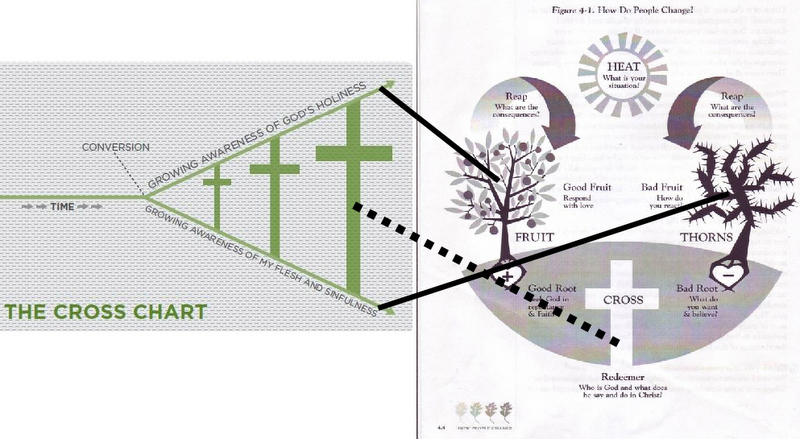
So then, what do these guys really believe about change? Well, it starts with gospel contemplationism which leads to “manifestations” of “the true and the good.” See the man in the first picture? See how he is meditating on all of the stuff outside of him? Through contemplationism, it is kinda like standing in the rain. The world sees the gospel, which in this illustration is the rain as a gospel “manifestation,” and as Christians we experience and feel the rain, but it has nothing to do with us or anything going on inside of us. For all practical purposes (in his general session address at the 2013 Shepherds’ Conference), John MacArthur likened it to a manifestation of the wind. You feel it and see its effects, but it is a force that is completely outside of us. He attributed Nicodemus’ later obedience after conversion to a mere blowing of the wind and not anything that Nicodemus could be credited with. We are talking MANEFESTATIONS here and not anything we do. It is similar to the concept of birthing the spiritual realm into the material realm.
In other words, when it gets right down to it—it’s Eastern mysticism. It began with the ancient paganism that saturated early civilization and morphed into Hinduism. Then Plato integrated the philosophy of Socrates with Hinduism. From there, it became Gnosticism which has all of the caste elements of Hinduism, and not by accident. The Reformed connections to Eastern mysticism are really no big secret and well-known among church historians.
Cults all come from the cradle of society and its spiritual caste. That’s why cults are innumerable and predicated on CONTROL. A characteristic not absent from Calvinism by any stretch of the imagination. The Gnostic Nicolaitans wreaked havoc on the first century church and the word means “conquerors of the lay people.” The name Nicodemus comes from Nicolaitans, so before his conversion, Nicodemus was probably guilty of what MacArthur said he wasn’t guilty of,
being a Calvinist.
paul
Preaching the Gospel to Ourselves: The Devil is in the Details
 After nearly six years of research on the Reformation I have come to the conclusion that like all cults, its proponents deliberately deceive by changing the definition of familiar terms and using subtle verbiage. They condone this because they don’t think we are “ready” for the hard truth of the authentic Reformed gospel. John Piper said that outright during an interview while answering the question, “What would you say to the Pope if you had two minutes with him?”
A good example of this subtle deception is a recent article posted on SBC Voices. Here it is:
If you search through the blogosphere, you’ll see some who advocate Christians “preaching the gospel to ourselves” daily, and you’ll see others who are staunchly against “preaching the gospel to themselves.” I think some who speak against “preaching the gospel to ourselves” misunderstand and/or misrepresent what we mean. Here is why I preach the gospel to myself. Out of the gospel flows both justification (being declared righteous by Christ alone) and sanctification (the immediate positional adoption by Christ into God’s kingdom, and the progressive setting apart of our lives from the Devil’s kingdom into God’s kingdom). The gospel is the source of both, but the two are separate acts of the Spirit’s work in our lives. If you repent and have faith in Christ, trusting in His life, death, and resurrection for your salvation, you are immediately justified and sanctified, and you will be progressively sanctified as God works out salvation in you. Christ, the gospel, is the source of the Spirit’s work through faith alone.
This is a little less subtle than what followed in the same article, but the goal by the writer of said post is to sound biblical while trying to sell us Calvin’s progressive justification. The Devil is in the details. Like all cults, Calvinism distorts the Trinity by overemphasizing one member over the others. The Jehovah Witnesses overemphasize God the Father and destroy the role of Christ while others overemphasize the Spirit’s work to the exclusion of Christ and the Father. Calvinists overemphasize Christ and exclude the Father’s role in justification. Notice he states that Christ is THE gospel: “Christ, the gospel.” The definite article “the” is ever so subtle, and completely untrue. The Trinity is the gospel, not just Christ. Notice that he also states,
If you repent and have faith in Christ, trusting in His life, death, and resurrection for your salvation, you are immediately justified and sanctified, and you will be progressively sanctified as God works out salvation in you.
According to the post, we have to trust “in His life” as well as His death for our salvation. Did you catch that little subtle statement? That is the belief that Christ lived a perfect life on earth so that His obedience can be imputed to our sanctification while we are justified by His death. This comes from Calvin who believed that Christians are still under the jurisdiction of the law and it must be obeyed perfectly until we get to heaven where our final justification is verified. As long as we live by faith alone in sanctification, Christ’s perfect obedience is applied to our sanctification which prevents “making sanctification the ground of our justification,” a truism often uttered by John Piper.
This is where all of this living by the same gospel that saved us and preaching the gospel to ourselves comes into play. If we live by the same gospel (faith and repentance only) that saved us in sanctification to prevent our sanctification from being the ground of our justification, the perfect obedience of Christ to the law will continue to be imputed to our Christian walk. This promotes the idea that it is alright for Christians to remain under the law as long as Christ keeps it for us. This is why they say justification is “distinct” from sanctification but “never separate” because Calvin saw sanctification as a process that completes justification. That’s a VERY problematic gospel. Note:
Christ, the gospel, is the source of the Spirit’s work through faith alone.
The Spirit’s work? Is he talking about the Spirit’s work in justification or sanctification? Yes, because they believe they are both the same. And here is the kicker: if you don’t live your Christian life by faith alone (the same gospel that saved you) resulting in Christ’s obedience being imputed to your sanctification, you lose both justification and sanctification. So, you have to keep your salvation by living by faith alone in sanctification. Remember, you have to trust in Christ’s life, not just His death and resurrection. Note the following statement by New Calvinist Michael Horton:
Where we land on these issues is perhaps the most significant factor in how we approach our own faith and practice and communicate it to the world. If not only the unregenerate but the regenerate are always dependent at every moment on the free grace of God disclosed in the gospel, then nothing can raise those who are spiritually dead or continually give life to Christ’s flock but the Spirit working through the gospel. When this happens (not just once, but every time we encounter the gospel afresh), the Spirit progressively transforms us into Christ’s image. Start with Christ (that is, the gospel) and you get sanctification in the bargain; begin with Christ and move on to something else, and you lose both.
Much more could be said, but I think you get the picture. The author of the post furthers his position by referring his readers to seven elements pertaining to the same subject by a Rick Phillips. Phillips is much more subtle, but his first element reads as follows:
1. Justification and Sanctification are twin benefits that flow from union with Christ through faith. Christ is himself the center of the gospel, and through faith we are saved in union with him (Acts 16:31; Eph. 1:3). Justification and Sanctification are distinct benefits flowing through union with Christ by faith alone.
Regardless of whatever else these guys say, this is the bottom line: if we remain in union with Christ by faith alone, justification and sanctification continue to flow by “faith alone.” What did James say about that? John Piper:
We are kept by the power of God through faith [emphasis mine].
It’s works salvation by living by faith alone in sanctification; i.e., the same antinomianism they claim to refute. Because we are supposedly still under the law, Christ must keep it for us so His perfect obedience to the law will cover us at the judgment day. But the only obedience of Christ that is part of the atonement is His obedience to the cross—we don’t need obedience to a law that we were justified apart from. We are now enslaved to the law and its righteousness, but it can’t judge our justification. It has no jurisdiction over our justification, period.
The Devil is in the details.
paul
The Parable of the Talents, Calvinism, and Basketball
“Is there a more apt description of American Christians? Ones who fully intend to only give back to God what He has initially granted. To do otherwise would be to ‘add to our salvation.’ We must live by some formula that posits the idea that Jesus does everything ‘through us.’ This is a very complicated formula given all the biblical imperatives we see in the Bible, but don’t worry, our Protestant nannies will grant us forgiveness if we obey them lest we add thinking to our list of works salvation or anything we do ‘in our own efforts.’”
Christians are to be unified by truth, and the Bible, which supplies its own interpretive methods, states the following principles among many:
1. Unity is truth-centered.
2. God’s word is truth.
3. Christians are unified to the point of agreement on the one mind in Christ.
4. The Holy Spirit sanctifies with truth only, not errant ideas.
Bad ideas about God’s truth are the cause of most woes in the church. It is to the point in America that unbelievers do not even have to persecute us anymore, but rather leave us to ourselves. This ministry is here because we target the idea that we think has led to the lion’s share of woes in the American church: Calvinism.
Calvinism is a bad idea because it has an unbiblical view of Man. Calvin, like his mentors, integrated Grecian philosophical presuppositions about man with the Bible and came up with total depravity—which also includes Christians as well. So, when we do something great, it’s not us doing it, it’s God doing it through us. And in the end, Christ will judge himself accordingly. When He states, “Well done faithful servant,” the verse must be interpreted in its “gospel context.” And remember, Calvin was a Protestant which doesn’t mean we are not Catholics. It means we are Catholics who protested priestly bad behavior. The core four of the Reformation, Augustine, Gregory, Luther, and Calvin agreed with Catholicism on its basic presuppositions concerning man which came from the same ancient pagan philosophy, but thought the doctrinal approach should be somewhat different and demanded moral despotism. The fruit doesn’t fall far from the tree; whether Arminian or Calvinistic, we believe Jesus will judge Himself in the end. And the fact that the apostle Paul insisted that servants in the church be honored must also be seen in its “gospel context.”
The fact that this philosophy is in the hands of youth via New Calvinism has turbocharged the problem. Hence, we read the following from the New York Times:
What may have been the most significant contest this season took place more than four months ago in Iowa between a small college and an even smaller one. It pitted Grinnell against Faith Baptist, and by the time it was over, Grinnell’s Jack Taylor had scored an N.C.A.A. record of 138 points.
. . . He poured in those 138 points, playing virtually the entire 40-minute game, while Grinnell was routing Faith Baptist, 179-104. . . .
Grinnell’s coaches, in other words, kept their star guard on the floor and shooting, and kept up their full-court defensive pressure, against an opposing team they were leading by 50, then 60, then 70 points. A college that prides itself on its values — rigorous academic standards, commitment to the common good, historical involvement in the abolition and Social Gospel movements — inflicted a defeat so absolute that it borders on public humiliation.
Sporting tradition has always made allowances so the vanquished can save face. Youth leagues have a “slaughter rule” to halt lopsided games. Football quarterbacks with a big lead hand off the ball rather than passing it. Basketball teams run down the clock instead of running up the score. Coaches pull the starters and send in the bench warmers. Very little mitigation of that sort happened last November at Grinnell.
And beyond the question of athletic ethics, the rout has taken on an overtly religious cast. Jack Taylor, an evangelical Christian, attributed his achievement to divine intervention.
In an interview with the Fellowship of Christian Athletes Web site, in which he alluded to a parable about talents in Matthew 25, Mr. Taylor said of God: “He definitely multiplied my talents that night. His fingerprints were all over that game.” . . .
If Grinnell has gone through much soul-searching, it doesn’t sound like it. From the athletic director and coaches to the ethicist in its philosophy department, the college community continues to point to the 179-104 game against a school less than one-fifth its size as a wholly admirable effort. . . .
“What strikes me in this story about Grinnell is that you have the unapologetic, brazen appeal to ‘Jesus’ right alongside the unrepentant quest to make a name for the school, the team and the player,” said Amy Laura Hall, an ethics professor at Duke Divinity School who is writing a book about muscular Christianity. “Would the story have even come across our radar if the coach had consciously pulled the player out, and kept the score more sportsmanlike, and missed the chance for a moment of fame, on principle? I wish that were the story to cover, this week after Easter, but it isn’t.”
It all starts with a flawed presupposition which leads to said interpretation of Matthew 25:14-30. God doesn’t entrust us with talents that are to be attended by our own efforts, but rather, God increases our talents at times of His choosing, like in a basketball game, and the only way we can know that He has done this is by what happens. No doubt, with everything going on in the world God wanted to glorify Himself via a college basketball game. Good American Christians everywhere give God the glory for doing our laundry, washing our car, and going to fetch the mail. Conveniently, pesky standards are not to be expected from anybody.
And ironically, God’s agitation with this attitude is the point of the very parable. The “wicked,” “lazy” servant feared what God’s response would be to his own efforts. “But Paul: that was just an excuse.” Right, that’s one of my points; such theology is often an excuse to be lazy and irresponsible in spiritual matters. It is a free ticket to not take responsibility for the sum and substance of our own life, the Life that, and I love this, “bears our own name” (John Immel). But don’t miss this: the master was agitated that the servant’s goal was to return to him only what he had received and nothing more.
Is there a more apt description of American Christians? Ones who fully intend to only give back to God what He has initially granted. To do otherwise would be to “add to our salvation.” We must live by some formula that posits the idea that Jesus does everything “through us.” This is a very complicated formula given all the biblical imperatives we see in the Bible, but don’t worry, our Protestant nannies will grant us forgiveness if we obey them lest we add thinking to our list of works salvation or anything we do “in our own efforts.”
The point of the parable is that certain attitudes come part and parcel with salvation versus those of the unregenerate. That’s the point. Here is how Christ concludes the parable:
And cast the worthless servant into the outer darkness. In that place there will be weeping and gnashing of teeth.
This parable has eternal ramifications. It is not teaching that we can earn our salvation, but rather teaches an attitude of service that comes with salvation and totally separate from its finished work. The wicked servant feared that his work would be judged by a standard that was impossible to obtain, and he feared losing any of the master’s original investment. But apparently, the other servants didn’t have this same fear. The clear difference between the servants is fear of a future judgment. The other servants eagerly anticipated the masters return to see how pleased he would be with their investments on His behalf; the latter servant feared a standard he thought he couldn’t live up to.
This is the grave danger of fusing justification with sanctification, and I see the application of this parable written all over such doctrines that confuse the finished work of salvation with the Christian life. Like Calvinism in particular. Biblical salvation changes the Christian’s relationship to the law—the law provokes him/her to serve rather than provoking them to sin. In unbiblical salvation, the law is an unkeepable standard that cannot be used to please the master. In this parable, the master had an unattainable standard that the wicked servant feared, so he played it safe and made sure He returned to the master what was only granted.
Christians should take a really hard look at any doctrine that fosters the same attitude of this wicked servant, or for that matter, anything that comes close to it. What does it say about the gospel that we really believe and the type of heart that comes with it?
paul
A Replacement for the New Calvinist “Two Ways” Gospel Presentation
I have been asked what I think of the New Calvinist “Two Ways to Live” gospel presentation. The following is my answer:
“Two ways: 1. self-rule 2. ‘Relying on the death and resurrection’ in sanctification towards a ONE final judgment to determine if you successfully lived by faith alone in sanctification. Of course, living by faith alone in a sanctification heavily endowed with commands is very tricky business. But don’t worry; elder rule versus ‘self-rule’ will lead us safely home.
That’s what that supposed gospel presentation is about.”
The following is my replacement:
PDF file: Two Ways Copy
Slide show:

 Paul's Passing Thoughts
11 comments