John Calvin’s Anti-Love Trilogy
 St. Augustine was a strong advocate of allegorical interpretation for obvious reasons; the Reformed gospel cannot withstand a commonsense interpretation of Scripture. Reformed writings are often in blatant contradiction to the plain sense of Scripture.
While the apostle Paul instructed us to make it our goal to please God, and John recorded Christ’s instruction to love Him by keeping His commandments, John Calvin denied that the Christian could do either. This can be found in the Calvin Institutes (3.14.9-11).
Calvin’s primary argument for this supposed inability to love God through obedience is also extremely problematic. Calvin insisted that justification is defined by the Law of Moses, and a perpetual perfect keeping of the law has to be maintained in order for justification to be valid. Not only does the Bible state that justification is apart from the law, the apostle Paul stated that there is NO law than can give life. Hence, who keeps the law for us is irrelevant—the law can’t give life.
Calvin sanctified this egregious error by making the perfect obedience of Christ part of the atonement. Supposedly, Christ came to die for our justification, and also came to fulfill the law through perfect obedience to maintain that justification. This leads to even more egregious error: the idea that justification isn’t a finished work.
This also leads to a works salvation by the practice of antinomianism in sanctification. Because the law defines justification and mortal Christians cannot keep it perfectly, they must live out their Christian life by faith alone. If they do this, the perfect obedience of Christ will be applied to their Christian life and they will remain saved. So, Christians must live by the same gospel that saved them in order to keep themselves saved. The Reformed mantra, “We must preach the gospel to ourselves everyday” is a means, or a practice, something WE DO in order to keep ourselves saved.
Therefore, according to Calvin, Christians love Christ by applying His obedience to their lives by faith alone.
Secondly, Calvinism denies biblical love by calling on Christians to live in constant fear of the final judgment. Calvin believed that falling short of the law’s standard separates Christians from grace. As a way to motivate Christians to return to the same gospel that saved them, Calvin prescribed a focus on the final judgment and the fear of it (CI 3.3.3-9).
This is in direct contradiction to 1John where the apostle states that there is no fear in love because fear has to do with judgment. This blatant contradiction to Scripture by Calvin is mindboggling.
In addition, this whole idea of calling on the same atonement that originally saved us turns the book of Hebrews completely upside down. The Hebrew writer states that those who have tasted of grace, and turn away from it, cannot be brought back to a place of repentance. Calvin prescribed a use of the law that shows this very turning away, and a need to be brought to repentance again. The Hebrew writer states the following: that’s impossible!
Moreover, this is in direct contradiction to the Bible and its eschatology: Christians will not stand in the final judgment because that is a judgment according to the law. Christians are not under the law, and will stand in a separate judgment that will determine rewards. In fact, in direct contradiction to the apostle Paul, Calvin’s gospel is one that keeps Christians under law and a subsequent need for continued grace. That’s NOT “under grace.” Under law is the very definition of a lost person in the book of Romans. Christians are not under law…for justification, but rather under grace. The law now informs our sanctification and Christian living. This very fact is behind the “T” in TULIP, the idea that Christians are still under the law and unable to keep the law in a way that pleases God. Perfection is NOT required to maintain our justification because we are not under the law; under grace means that we are able to use the Bible to love God through obedience, and our shortcomings are a family matter of sonship—not a salvation issue.
And lastly on this second point, it turns the book of James completely upside down. James stated that faith without works is dead in the same way that a body without a spirit is dead. Calvinism states that the Christian life is lived by faith alone and that all of the works are of Christ; ie., Christ supposedly loves Himself with His own works. And apparently, when Christ will say, “Well done faithful servant,” He will be supposedly talking to Himself. Of course, Calvinists would say that the “well done” refers to living a life of faith alone, but specific works are cited by Christ, not faith alone. If that’s what they really accomplished apart from works, why wouldn’t Christ simply say so?
Thirdly, Calvin believed that the Christian lives out their baptism through a process of “mortification and vivification.” Mortification and vivification is a formal part of Reformed systematic theology. It is repentance for sins that separate us from grace (mortification) resulting in the joy of our original salvation (vivification). In other words, a focus on evil leads to joy. The apostle Paul said that love does not rejoice in evil, but according to Calvinism, a focus on evil is efficacious to having joy.
paul
John Piper’s Vine and Branches Conference: A Synopsis of its Heresy
“Take note that Calvin is also confirming the Reformed belief that sins in the Christian life separate us from salvation. Therefore, the same repentance and faith that was needed originally continues to be needed as a way to keep ourselves saved. However, according to Calvin, the same gospel that originally saved us must be continually administered by Reformed pastors.”
John Piper states in the promotional video for his Vine and Branch conference that the union with Christ doctrine could be the most important doctrine that you have never heard of. The blogger Alex Guggenheim responded to that notion this way:
Okay, so here we have Neo-Calvinists who have, for the last 15-20 years and certainly the last 10 years, overwhelming their people and those being assimilated, being offered a conference on “the most important doctrine you’ve never heard of.”
Hmmm…so Neo-Calvinists, what have you been doing all this time if this doctrine is central to all things as your promo says? Suddenly you now offer the most important doctrine. I suggest theological and ecclesiastical malfeasance with such an admission.
If it was and is so important, and it is, why haven’t you made it the centrality of your teaching and articulations all this time or…is this just another gimmick to incite spiritual anxiety in people who now believe they have been missing something and cannot miss this?
Good grief.
The Calvin Institutes of the Christian religion is their playbook, and it is a very thick linguistic droning. This is their bible, and they are continually mining it for new ideas. Sometimes these ideas take a while to find in the book of Calvin. However, I believe it is the same document that will hang them because people are starting to read the document for themselves. Piper begins the promotion for the conference with a statement by Calvin, so let’s start with Calvin.
John Calvin
The crux of the Reformation false gospel is the idea that justification is not a finished work. Therefore, they make the separate work of sanctification the growing, or progression of justification. The saint becomes a colaborer in the finishing of justification rather than a colaborer for the kingdom as an ambassador. The saint is not working towards a reward from his Master, he is working towards the final prize of salvation.
Therefore, the saint must obtain that final prize the same way he received it, by FAITH ALONE. So, he must run the race of salvation by faith alone. This is made possible by the “vital union with Christ.” Our “union with Christ” sanctifies our participation in justification. Let me repeat that:
Our “union with Christ” sanctifies our participation in justification.
It makes running the race by faith alone possible. It enables us to gobble up more and more grace in order to keep ourselves saved—by faith alone of course. James addressed the problem of this very notion in James 2:14-26. It hearkens back to the problem of justification and sanctification not being completely separate; one being a finished work and the other being a progressive work. This is the Achilles’ heel of every false gospel that has ever come down the pike.
So, how do we supposedly run the race by faith alone? The same way we started; by faith alone which entails “living by the gospel.” We live to get more grace. If we keep filling up our gas tank at the salvation filling station, we will be able to “stand in the judgment” that we are driving to. In fact, this is exactly how Reformed theologians frame the issue:
We repeat, Justification is not a thing that we pass and get behind us. As Barth rightly said, it is not like a filling station that we pass but once. As we hold to its eschatological implications, justification by faith can never become static but must remain the dynamic center of Christian existence, the continuous present. We are always sinners in our eyes, but we are always standing on God’s justification and, perhaps more importantly, moving toward it. To be justified is a present-continuous miracle to the man who present-continuously believes, knowing that he who believes possesses all things, and he who does not believe possesses nothing. Such a life is only possible where the gospel of justification is continually heard and where God’s verdict of acquittal is like those mercies which Jeremiah declared were new every morning—”great is Thy faithfulness” (Lam. 3:22-23).[1]
Also…
Rather than obsessing through a checklist of necessary Christian behavior, he argued that it is important to get back to the heart of Christianity. Faith, he says, shouldn’t be based on “our performance” but, instead, it should be predicated upon “God’s performance for us in Jesus.”[2]
But there is no “performance” for us by Jesus in the Christian life that maintains justification. That work is done. In regard to justification, “It is finished” and Christ has sat down at the right hand of the Father. We work together with Christ in our sanctification. Again, at issue is the fusion of a finished work with a progressive work. But since the Reformation sees justification/salvation as progressive, we must continually fill our gas tanks with the same grace that saved us. That is the essence of union with Christ; it enables us to receive perpetual fillings of salvation. There are two primary ways that we “keep ourselves in the love of God”[3] or in union with Christ.
1. Mortification and vivification. According to Calvin, mortification and vivification is obtained through the union with Christ.[4] It is a lifestyle of “constant confession and repentance” that avoids the pursuit of a godly life and embraces a life that is “literally Christ himself.”[5] Simply stated, it is perpetual resalvation through the same repentance and sorrow for sin, and belief in the works of Christ only that saved us. By focusing on our depravity (“deep repentance”), a new need for grace is realized and when embraced results in a refreshing of the soul (vivification); viz, a joy experience.
This is the perpetual reliving of our baptism—a “daily dying and rising.”[6] It also results in EXPERIENCING the works of Christ in our life “subjectively,” but it is not really us doing the work—it is a manifestation of Christ’s work that we only experience [7]. This is otherwise known as “new obedience” in Reformed circles. It can be compared to standing in the rain; you experience it, but you are not participating in the work of it or producing it. This enables us to live our Christian lives by the same gospel that saved us, and resulting in being able to “stand in the judgment.”
2. The Sacraments. We get more saving gospel through the Sacraments. Said Calvin:
It is irrational to contend that sacraments are not manifestations of divine grace toward us… We conclude, therefore, that the sacraments are truly termed evidences of divine grace, and, as it were, seals of the good-will which he entertains toward us. They, by sealing it to us, sustain, nourish, confirm, and increase our faith.[8]
God gathers his people together in a covenantal event to judge and to justify, to kill and to make alive. The emphasis is on God’s work for us – the Father’s gracious plan, the Son’s saving life, death, and resurrection, and the Spirit’s work of bringing life to the valley of dry bones through the proclamation of Christ. The preaching focuses on God’s work in the history of redemption from Genesis through Revelation, and sinners are swept into this unfolding drama. Trained and ordained to mine the riches of Scripture for the benefit of God’s people, ministers try to push their own agendas, opinions, and personalities to the background so that God’s Word will be clearly proclaimed. In this preaching the people once again are simply receivers – recipients of grace. Similarly, in baptism, they do not baptize themselves; they are baptized. In the Lord’s Supper, they do not prepare and cook the meal; they do not contribute to the fare; but they are guests who simply enjoy the bread of heaven.[9]
3. Absolution through church membership. According to Calvin:
Nor by remission of sins does the Lord only once for all elect and admit us into the Church, but by the same means he preserves and defends us in it. For what would it avail us to receive a pardon of which we were afterwards to have no use? That the mercy of the Lord would be vain and delusive if only granted once, all the godly can bear witness; for there is none who is not conscious, during his whole life, of many infirmities which stand in need of divine mercy. And truly it is not without cause that the Lord promises this gift specially to his own household, nor in vain that he orders the same message of reconciliation to be daily delivered to them. Wherefore, as during our whole lives we carry about with us the remains of sin, we could not continue in the Church one single moment were we not sustained by the uninterrupted grace of God in forgiving our sins. On the other hand, the Lord has called his people to eternal salvation, and therefore they ought to consider that pardon for their sins is always ready. Hence let us surely hold that if we are admitted and ingrafted into the body of the Church, the forgiveness of sins has been bestowed, and is daily bestowed on us, in divine liberality, through the intervention of Christ’s merits, and the sanctification of the Spirit.
To impart this blessing to us, the keys have been given to the Church (Mt. 16:19; 18:18). For when Christ gave the command to the apostles, and conferred the power of forgiving sins, he not merely intended that they should loose the sins of those who should be converted from impiety to the faith of Christ;531 but, moreover, that they should perpetually perform this office among believers. This Paul teaches, when he says that the embassy of reconciliation has been committed to the ministers of the Church, that they may ever and anon in the name of Christ exhort the people to be reconciled to God (2 Cor. 5:20). Therefore, in the communion of saints our sins are constantly forgiven by the ministry of the Church, when presbyters or bishops, to whom the office has been committed, confirm pious consciences, in the hope of pardon and forgiveness by the promises of the gospel, and that as well in public as in private, as the case requires. For there are many who, from their infirmity, stand in need of special pacification, and Paul declares that he testified of the grace of Christ not only in the public assembly, but from house to house, reminding each individually of the doctrine of salvation (Acts 20:20, 21). Three things are here to be observed. First, whatever be the holiness which the children of God possess, it is always under the condition, that so long as they dwell in a mortal body, they cannot stand before God without forgiveness of sins. Secondly, This benefit is so peculiar to the Church, that we cannot enjoy it unless we continue in the communion of the Church. Thirdly, It is dispensed to us by the ministers and pastors of the Church, either in the preaching of the Gospel or the administration of the Sacraments, and herein is especially manifested the power of the keys, which the Lord has bestowed on the company of the faithful. Accordingly, let each of us consider it to be his duty to seek forgiveness of sins only where the Lord has placed it. Of the public reconciliation which relates to discipline, we shall speak at the proper place.[10]
…by new sins we continually separate ourselves, as far as we can, from the grace of God… Thus it is, that all the saints have need of the daily forgiveness of sins; for this alone keeps us in the family of God. [11]
Take note that Calvin is also confirming the Reformed belief that sins in the Christian life separate us from salvation. Therefore, the same repentance and faith that was needed originally continues to be needed as a way to keep ourselves saved. However, according to Calvin, the same gospel that originally saved us must be continually administered by Reformed pastors.
John Piper
John Piper is the guru of Christian joy. Most Christians find it strange that he puts so much emphasis on Christian joy; that is, until you understand mortification and vivification. If vivification is not taking place; viz, the upside of mortification and vivification, then you are not in union with Christ. This totally explains the following outrageous statements by him:
“Unless a man be born again into a Christian Hedonist he cannot see the kingdom of God” (Desiring God page 55).
“Could it be that today the most straightforward biblical command for conversion is not, ‘Believe in the Lord,’ but, ‘Delight yourself in the Lord’?” (Desiring God page 55).
“The pursuit of joy in God is not optional. It is not an ‘extra’ that a person might grow into after he comes to faith. Until your heart has hit upon this pursuit, your ‘faith’ cannot please God. It is not saving faith” (Desiring God page 69).
“Not everybody is saved from God’s wrath just because Christ died for sinners. There is a condition we must meet in order to be saved. I want to try to show that the condition…is nothing less than the creation of a Christian Hedonist” (Desiring God page 61).
“We are converted when Christ becomes for us a Treasure Chest of holy joy” (Desiring God page 66).
“Something has happened in our hearts before the act of faith. It implies that beneath and behind the act of faith which pleases God, a new taste has been created. A taste for the glory of God and the beauty of Christ. Behold, a joy has been born!” (Desiring God page 67).
“Before the decision comes delight. Before trust comes the discovery of treasure” (Desiring God, page 68).
Michael Horton
The following statement by Michael Horton is a good summation of the Reformation’s false gospel:
Where we land on these issues is perhaps the most significant factor in how we approach our own faith and practice and communicate it to the world. If not only the unregenerate but the regenerate are always dependent at every moment on the free grace of God disclosed in the gospel, then nothing can raise those who are spiritually dead or continually give life to Christ’s flock but the Spirit working through the gospel. When this happens (not just once, but every time we encounter the gospel afresh), the Spirit progressively transforms us into Christ’s image. Start with Christ (that is, the gospel) and you get sanctification in the bargain; begin with Christ and move on to something else, and you lose both.[12]
Paul David Tripp
Lastly, out of necessity, Calvin’s doctrine must depend on an allegorical interpretation of Scripture. As Rick Holland has stated, “bad grammar makes good theology.”[13] That’s because this doctrine cannot survive a grammatical examination. Tripp, one of the more viral forms of Calvinism, concedes on page 27 of How People Change (2006) that a literal interpretation of Scripture does call us to “change the way we think” (one of the more passive forms of obedience), but that this approach “omits the person and work of Christ as Savior.” In other words, a literal interpretation that circumvents use of the Bible as a tool for returning to the same gospel that saved us cuts off the progressive justification process.
paul
Endnotes
1. “We” are the authors of the theological journal published by the Australian Forum project that launched the present-day Calvinist resurgence: Graeme Goldsworthy, Robert Brinsmead, Geoffrey Paxton, and Jon Zens. Citation from Present Truth Magazine volume 35—article 3, Righteousness by Faith part 4, chapter 8.
2. The Blaze interview with Tullian Tchividjian: Oct. 15, 2013 9:01am | Billy Hallowell.
3. CJ Mahaney has used this theme many times and prescribes “preaching the gospel to ourselves” as the prescription. In reality, this is a means of keeping ourselves saved according to Reformed theology.
4. The Calvin Institutes 3.3.9, first sentence.
5. Paul David Tripp: How People Change Punch Press 2006, p.6
6. Michael Horton’s Systematic Theology for Pilgrims on the Way: p.661
7. Ibid p.661, Ibid note 5, p. 215
8. The Calvin Institutes 4.14.7
9. Michael Horton: Christless Christianity; pp.189-191
10. The Calvin Institutes 4.1.21,22
11. John Calvin: Commentaries on the Catholic Epistles; The Calvin Translation Society 1855. Editor: John Owen, p. 165 ¶4
12. Michael Horton: Christless Christianity; p. 62
13. Rick Holland: Uneclipsing the Son; p. 39


John Calvin’s Gospel of Works, Fear, and NO Assurance
 “While the soteriology lends uncertainty to one’s eternal destiny, is assurance found more in having the elder’s approval? After all, if he states that you are saved, heaven will bind it.”
John Calvin was pure heretic. The present-day exaltation of him by the who’s who of evangelicals is an abomination before the Lord. For Calvin, the Christian life is lived out in a progression of justification; viz, justification is not a onetime event that is a finished work by God alone. The Christian life starts with repentance and faith, and that not only justifies us in the beginning, it must continue to justify us throughout the course of our life. “Progressive sanctification” is really progressive justification. The Christian life is not lived out as a result of our salvation; we must live in the progression of salvation and stay in its status through faith and repentance alone. We must keep ourselves saved by perpetual repentance. This is the “P” in TULIP, “perseverance of the saints.” No distinction is made between repentance unto salvation and repentance as a son of God. Calvin evokes all Scriptural calls to repentance for salvation as indicative of the Christian life. Calvin cites biblical salvation verses—as verses pertaining to the Christian life throughout the Calvin Institutes.
Furthermore, Calvin insisted that Christian repentance is motivated by fear, and repentance is active, while the results of repentance, a joyful rebirth experience, is the work of God. It is a perpetual revisiting of the gospel that saved us in order to keep ourselves saved. Our only work is repenting of sin while works imputed by God to our Christian life are only experienced, and not performed.
First, Calvin defines repentance in his Institutes. Keep in mind that he is not writing about original salvation, but the Christian life. This will be confirmed after this citation:
Certain learned men, who lived long before the present days and were desirous to speak simply and sincerely according to the rule of Scripture, held that repentance consists of two parts, mortification and quickening. By mortification they mean, grief of soul and terror, produced by a conviction of sin and a sense of the divine judgment. For when a man is brought to a true knowledge of sin, he begins truly to hate and abominate sin… By quickening they mean, the comfort which is produced by faith, as when a man prostrated by a consciousness of sin, and smitten with the fear of God, afterwards beholding his goodness, and the mercy, grace, and salvation obtained through Christ, looks up, begins to breathe, takes courage, and passes, as it were, from death unto life. I admit that these terms, when rightly interpreted, aptly enough express the power of repentance; only I cannot assent to their using the term quickening, for the joy which the soul feels after being calmed from perturbation and fear. It more properly means, that desire of pious and holy living which springs from the new birth; as if it were said, that the man dies to himself that he may begin to live unto God (CI 3.33).
We must now explain the third part of the definition, and show what is meant when we say that repentance consists of two parts—viz. the mortification of the flesh, and the quickening of the Spirit (CI 3.3.8).
And for how long do we partake in this perpetual repentance (mortification) and rebirth (vivification)?
This renewal, indeed, is not accomplished in a moment, a day, or a year, but by uninterrupted, sometimes even by slow progress God abolishes the remains of carnal corruption in his elect, cleanses them from pollution, and consecrates them as his temples, restoring all their inclinations to real purity, so that during their whole lives they may practice repentance, and know that death is the only termination to this warfare…It is not denied that there is room for improvement; but what I maintain is, that the nearer any one approaches in resemblance to God, the more does the image of God appear in him. That believers may attain to it, God assigns repentance as the goal towards which they must keep running [emphasis added] during the whole course of their lives (CI 3.3.9).
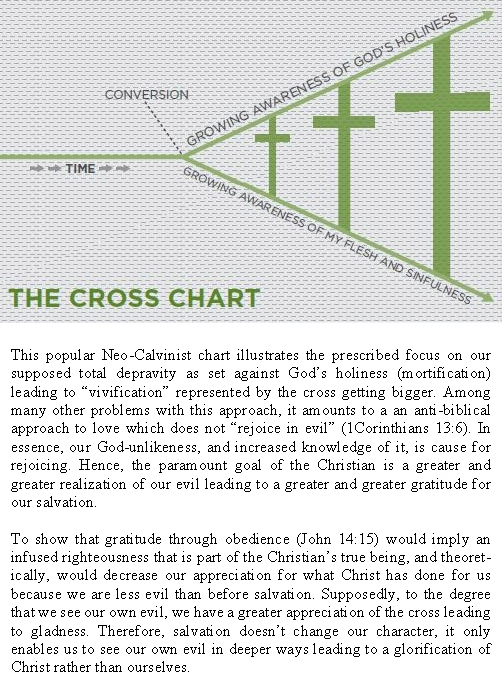
Though Calvin wrote of being transformed into the “image” of God, this is part and parcel with the passive and perpetual rebirth experience by the Christian. This does not denote a change or improvement in the Christian’s nature which would lessen the need for repentance. Obviously, if you look at the chart below, raising the trajectory of repentance makes the cross smaller, so repentance leading to real change is not in focus here. Calvin’s idea of transformation regards the birthing of realms which is experienced by the Christian through joy. Hence, the new birth is perpetual through the Christian’s life and is the result of perpetual repentance. We are to repent and dwell on our own depravity, and leave any quickenings or rebirth experiences to God:
He, however, who has emptied himself (cf. Phil. 2:7) through suffering no longer does works but knows that God works and does all things in him. For this reason, whether God does works or not, it is all the same to him. He neither boasts if he does good works, nor is he disturbed if God does not do good works through him. He knows that it is sufficient if he suffers and is brought low by the cross in order to be annihilated all the more. It is this that Christ says in John 3:7, »You must be born anew.« To be born anew, one must consequently first die and then be raised up with the Son of Man. To die, I say, means to feel death at hand (Martin Luther: Heidelberg Disputation, theses 24).
In obedience to God’s word we should fight to walk in the paths where he has promised his blessings. But when and how they come is God’s to decide, not ours. If they delay, we trust the wisdom of our Father’s timing, and we wait. In this way joy remains a gift, while we work patiently in the field of obedience and fight against the weeds and the crows and the rodents. Here is where joy will come. Here is where Christ will reveal himself (John 14:21). But that revelation and that joy will come when and how Christ chooses. It will be a gift… Heaven hangs on having the taste of joy in God. Therefore, it might not be so strange after all to think of fighting for this joy. Our eternal lives depend on it (John Piper: When I Don’t Desire God; p.43, p.34).
It is also important to note that in this construct, for the most part, repentance is something we focus on, and not something we necessarily try to do. The goal is to see our own depravity in a deeper and deeper way, and this results in a joyful rebirth experience that is totally out of our control. But yet, we must fight for this joy, or rebirth experience because “Our eternal lives depend on it.” Not only is this clearly works salvation, but it makes our eternal destiny ambiguous at best. Therefore…
Let us, therefore, embrace Christ, who is kindly offered to us, and comes forth to meet us: he will number us among his flock, and keep us within his fold. But anxiety arises as to our future state. For as Paul teaches, that those are called who were previously elected, so our Savior shows that many are called, but few chosen (Mt. 22:14). Nay, even Paul himself dissuades us from security, when he says, “Let him that thinketh he standeth take heed lest he fall,” (1 Cor. 10:12). And again, “Well, because of unbelief they were broken off, and thou standest by faith. Be not high-minded, but fear: for if God spared not the natural branches, take heed lest he also spare not thee,” (Rom. 11:20, 21). In fine, we are sufficiently taught by experience itself, that calling and faith are of little value without perseverance, which, however, is not the gift of all (CI 3.24.6).
There is danger on the way to salvation in heaven. We need ongoing protection after our conversion. Our security does not mean we are home free. There is a battle to be fought (John Piper: Bethlehem Baptist Church Minneapolis, Minnesota; The Elect Are Kept by the Power of God October 17, 1993).
According to Calvin, fear of future judgment is one of the primary motivations for repentance in the Christians life:
By mortification they mean, grief of soul and terror, produced by a conviction of sin and a sense of the divine judgment [sec.3]… it seems to me, that repentance may be not inappropriately defined thus: A real conversion of our life unto God, proceeding from sincere and serious fear of God; and consisting in the mortification of our flesh and the old man, and the quickening of the Spirit. In this sense are to be understood all those addresses in which the prophets first, and the apostles afterwards, exhorted the people of their time to repentance. The great object for which they labored was, to fill them with confusion for their sins and dread of the divine judgment, that they might fall down and humble themselves before him whom they had offended, and, with true repentance, retake themselves to the right path [sec.5]… The second part of our definition is, that repentance proceeds from a sincere fear of God. Before the mind of the sinner can be inclined to repentance, he must be aroused by the thought of divine judgment; but when once the thought that God will one day ascend his tribunal to take an account of all words and actions has taken possession of his mind, it will not allow him to rest, or have one moment’s peace, but will perpetually urge him to adopt a different plan of life, that he may be able to stand securely at that judgment-seat. Hence the Scripture, when exhorting to repentance, often introduces the subject of judgment, as in Jeremiah, “Lest my fury come forth like fire, and burn that none can quench it, because of the evil of your doings,” (Jer. 4:4)… The stern threatening which God employs are extorted from him by our depraved dispositions [sec.7] [from the CI 3.3.3-7].
Of course, this is all in egregious contradiction to the Scriptures; viz,
1John 4:18 – There is no fear in love, but perfect love casts out fear. For fear has to do with punishment, and whoever fears has not been perfected in love.
Calvin’s false gospel requires us to run a race of perpetual repentance driven by fear of judgment in order to keep ourselves saved. The new birth is not a onetime event known as regeneration, but is only an EXPERIENCE that follows the mortification of repentance. Calvin states that these quickenings that follow mortification are accompanied by joy and subjective manifestations of God’s image. Many are called, but not all have the gift of persevering in the cycle of mortification and vivification. Therefore, assurance of salvation is dubious at best.
Beside the fact that the apostle John wrote the book of 1John so that we can “know” that we are saved, Calvin’s gospel contradicts a mass of holy writ. This subjective gospel also adds a peculiar twist if you consider Calvin’s power of the keys; ie., whatever elders bind on earth will be bound in heaven. While the soteriology lends uncertainty to one’s eternal destiny, is assurance found more in having the elder’s approval? After all, if he states that you are saved, heaven will bind it.
paul


 Paul's Passing Thoughts
1 comment