Why Catholicism and Protestantism Both are False Gospels
“This is not mere semantics concerning the best way to grow spiritually; what we believe about sanctification shows what we believe about justification. Is it a finished work or not? And if it isn’t, what we believe about sanctification is a purely salvific discussion by default anyway. The Reformers, new and old, do not frame sanctification in salvific terms; this is disingenuous and they know it. Confusion in regard to sanctification enables them to speak of sanctification in a justification way.”
“According to the Reformers, contemplative repentance is the fuel that powers our car on the justification highway to heaven. If we try to get to heaven any other way; i.e., some sort of belief that the highway is not a highway at all but a finished declaration and present reality, we lose justification and sanctification both (Michael Horton: Christless Christianity; p. 62).
In other words, contemplative repentance as a work that we do is the only way to heaven. Reformers like Tullian Tchividjian insist that it is Christ + Nothing = Everything; but again, that is because, like Calvin, he deems contemplative repentance as a non-work in sanctification that doesn’t cause our justification car to run out of gas. In fact, the think tank that launched the present-day Reformation resurgence framed it in those exact terms.”
Protestantism, which came from Catholicism, is also a false gospel. This is because Protestantism only reformed the means of progressive justification and didn’t reject it. Both are guilty of fusing justification and sanctification together. Therefore, both are false gospels because according to both, justification is not a finished work and progresses through sanctification. Therefore, the question of what man must believe so that justification is properly finished is the difference between heaven and hell. Salvation becomes a matter of the right justification process as opposed to simply believing on a finished work by God.
If sanctification (the Christian life) is the progressive expression of justification, man is involved in the justification process, and when this is the case, it is salvation by works because doing is involved even if the doing is believing only. Sanctification becomes a discussion about what is works in sanctification and what isn’t a work in sanctification, but doing something, whether believing or breathing, is a work; it’s all work. Hence, all of the confusion, and if you will, denominations. The propagation of sanctification by faith alone is always indicative of a justification that is not finished.
In truth, nothing we do in sanctification is a work for justification because that work is already finished. And this is the crux in regard to what Paul wrote to the Galatians:
Gal 3:1 – O foolish Galatians! Who has bewitched you? It was before your eyes that Jesus Christ was publicly portrayed as crucified. 2 Let me ask you only this: Did you receive the Spirit by works of the law or by hearing with faith? 3 Are you so foolish? Having begun by the Spirit, are you now being perfected by the flesh?
“Being perfected” can be a little misleading if one does not examine this text carefully. The word for “perfected” is epiteleō which means “to complete, bring to an end.” This is why Young’s Literal Translation has it this way:
O thoughtless Galatians, who did bewitch you, not to obey the truth — before whose eyes Jesus Christ was described before among you crucified? 2 this only do I wish to learn from you — by works of law the Spirit did ye receive, or by the hearing of faith? 3 so thoughtless are ye! having begun in the Spirit, now in the flesh do ye end? [ESV Olive Tree footnote: “Or now ending with”].
The issue at hand was the fact that the Galatians were being influenced by the “circumcision party” (Gal 2:12). They taught salvation by circumcision. Paul called it justification by the law, but understand what he meant by that. The circumcision party emphasized justification by circumcision, but relaxed the rest of the law. Christ referred to this same sort of theology in the Sermon on the Mount (Matt 5:19). Paul’s point is that if you want to be justified by the law, all of the law must be kept perfectly in order to do so (Gal 4:2-4).
Freedom to obey the law aggressively (as love) in sanctification points to our view of justification. Aggressive obedience in sanctification points to the belief that justification is a finished work and unrelated to our work for God and others. It embraces the whole law and pursues righteousness for the sake of loving God and others truthfully. Though we fall short and that is disappointing, it cannot affect a work that is already finished: justification. Those misleading the Galatians taught that circumcision finished justification, and perhaps, as well, that any focus on the finer points of the law would circumvent the circumcision. In essence, those leading the Galatians astray were antinomians:
Gal 2:15 – We ourselves are Jews by birth and not Gentile sinners; 16 yet we know that a person is not justified by works of the law but through faith in Jesus Christ, so we also have believed in Christ Jesus, in order to be justified by faith in Christ and not by works of the law, because by works of the law no one will be justified.
17 But if, in our endeavor to be justified in Christ, we too were found to be sinners, is Christ then a servant of sin? Certainly not! 18 For if I rebuild what I tore down, I prove myself to be a transgressor. [parabatēs “lawbreaker”].
When justification and sanctification are fused together and sanctification is the progression of justification, invariably, some tradition or combination of traditions replaces a literal adherence to law. In other words, the law needs to be dumbed down because it is part of the justification process. So, mark it well: our attitude towards the law in sanctification reveals what we believe about justification:
Gal 5:7 – You were running well. Who hindered you from obeying the truth? 8 This persuasion is not from him who calls you.
They were “running” well. “Well” (kalōs) carries the idea of good morals. Paul was certainly NOT commending them for “running well” for justification. They replaced the law keeping of love in sanctification with the supposed fulfilment of justification by the traditions of men and their interpretation of the law. In this case, the primary tradition was circumcision. This is how the Amplified Bible states it:
Gal 3:2 – Let me ask you this one question: Did you receive the [Holy] Spirit as the result of obeying the Law and doing its works, or was it by hearing [the message of the Gospel] and believing [it]? [Was it from observing a law of rituals or from a message of faith?]
The paraphrase, “observing a law of rituals” is a good one. The Galatian error involved the necessary dumbing down of the law because the Christian life is seen as an extension of justification. To the contrary, there is NO law in justification because no man can withstand its judgment for righteousness (Rom 2:12, 3:19-21, 28, 4:15, 5:13, 6:14,15, 7:1, 6, 8 “Apart from the law, sin lies dead”). However, a relaxed view of the law of love in sanctification points to a law in justification that must be fulfilled by some sort of tradition:
Gal 5:6 – For in Christ Jesus neither circumcision nor uncircumcision counts for anything, but only faith working through love. 7 You were running well. Who hindered you from obeying the truth?
Notice that faith works (Jms 2:22) “through love,” and love fulfills the law (Rom13:8). This is a “running” by “obeying the truth.” This is why justification and sanctification must be completely separate. Justification is a finished work, and sanctification is a progressive work of love through obedience to the word of God.
Gospels that fuse justification and sanctification together always posit the idea that a striving to keep God’s law truthfully, as a way to earn salvation, is the pandemic of the day. That is not true at all. An effort to “run well” is always associated with the idea that the running has nothing to do with justification at all. Justification is God’s love to us and is finished; our love towards God and others is sanctification.
1Jn 4:19 – We love because he first loved us.
“We love” is sanctification. “He first loved us” is justification.
In both Romanism and Protestantism, justification is progressive, and sanctification is the progression of justification. This calls for a special formula that keeps us from circumventing the process. It also requires that we do something to maintain the process. “But Paul, doesn’t justification have a finished aspect and also a progressive aspect?” No, but even if that point is conceded, if justification isn’t properly finished, the beginning of it is for naught. In fact, this is exactly what John Calvin taught in regard to the perseverance of the saints. He stated that all who were chosen would not necessarily persevere to the end. Hence, their initial justification was for naught (CI 3.24.6-8).
The Protestant special formula is best exemplified in the writings of John Calvin. First, he made a perfect keeping of law the standard for justification. Justification was defined by a law standard. In the Calvin Institutes (CI), Calvin claimed that Christ obtained justification “by the whole course of his obedience” (CI 2.16.5). In the same section, Calvin interprets Christ’s one act of obedience (Rom 5:19) to the cross as pertaining to his whole life (that only refers to His obedience to the cross Pil 2:8). He also notes that Christ was “born under the law” (Gal 4:4,5) and offers that “proof” as well. But all that is saying is that Christ was born into the world like all other men: under the law. Christ is the only man born into the world that could withstand a judgment by the law—that doesn’t mean he had to keep it in order to fulfill all righteousness. For that matter, all righteousness was fulfilled when He was baptized by John the Baptist (Matt 3:15).
Calvin then goes on to explain that any law-keeping by the Christian is futile because we cannot keep it perfectly (CI 3.14. 10), and no Christian has ever done a work pleasing to God (CI 3.14.11). According to Calvin, the obedience of Christ must be continually applied to our lives until we get to heaven (Ibid). Furthermore, we must continually return to the same gospel that saved us for the forgiveness of new sins committed in the Christian life (Ibid, and CI 4.1.21,22).
So, the Protestant formula is returning to the same gospel that saved us in order to maintain our justification. Supposedly, it’s not of works because the initial repentance that saved us was by faith alone, so a perpetual returning to the same gospel maintains our justification while qualifying as faith alone. This, according to Calvin, does not circumvent the “Progressive” “Sense” of justification (see title: CI 3.14).
In this Protestant construct, Martin Luther’s alien righteousness was very important. This teaches that ALL righteousness remains outside of the believer. The believer has no righteousness of his own. This is important if you are on the justification bus going to glorification. Your inner righteousness would be part of the process that keeps the progression moving forward, perseverance if you will. This version of the Protestant formula to reach heaven by the same faith alone without works that saved/justified us can be seen in the Protestant concept of Sabbath Salvation. In the same way that the Israelites were not allowed to work on the Sabbath upon pain of death, anyone who works in their Christian life will suffer eternal death. Said Calvin:
Ezekiel is still more full, but the sum of what he says amounts to this: that the Sabbath is a sign by which Israel might know God is their sanctifier. If our sanctification consists in the mortification of our own will, the analogy between the external sign and the thing signified is most appropriate. We must rest entirely, in order that God may work in us; we must resign our own will, yield up our heart, and abandon all the lusts of the flesh. In short, we must desist from all the acts of our mind, that God working in us, we may rest in him (CI 2.8.29).
Calvin was adamant that none of God’s righteousness could be transferred to the believer (CI 3.14.11) in the “two-fold grace”(i.e., two-fold justification: Calvin deliberately used perceived synonyms to nuance what he believed) of justification and sanctification. All righteousness must remain outside of the believer. If the believer has no righteousness that is his/hers, they can continually affirm their belief in justification by faith alone and continue to receive forgiveness based on faith alone. In this way, Christ’s death and obedient life is perpetually applied to the believer in sanctification until they get to heaven (Ibid).
Therefore, it stands to reason that the only duty of the believer is to see their own sinfulness in sanctification; by doing this, they affirm they have no righteousness that is their own, and can do no work pleasing to God. According to the Protestant formula, this is the only work that is not a work. It is the “mortification of the will.” So, all work in sanctification must be the same repentance that originally saved us—this keeps us in the saving graces of God.
Contemporary Calvinists like John Piper refer to this as the Gospel continuing to save us IF we continue to “live by the gospel.” In a sermon titled, How Does the Gospel Save Believers? Part 2 Piper made the following statement:
We are asking the question, How does the gospel save believers?, not: How does the gospel get people to be believers? (August 16, 1998 by John Piper | Scripture: Romans 1:16-17 | Series: Romans: The Greatest Letter Ever Written).
So, let’s be clear, what we believe the gospel is, keeps us saved. The Protestant gospel is a sanctification defined by repentance only that keeps us saved. If we believe we have a righteousness of our own, all bets are off. Because sanctification is part of the “two-fold” grace (singular) of justification, man’s righteousness cannot participate. This is opposed to another view of the gospel that we are born again of God literally (1Jn 3:9, 5:18) and therefore righteous, and in fact full of goodness (Rom 15:14).
The fact that Christians still sin as mortals does not negate the fact that they are inherently righteous as proven by a change of direction. Certainly, perfection is the goal in sanctification, but not the standard for justification. The Bible explains it as an exchange of slavery. Those “under the law” and not “under grace” are free to do good, but enslaved to unrighteousness (Rom 6:20-22). Those under grace are enslaved to righteousness, but also free to sin (Rom 7:25). The chart below may help illustrate how this results in a change of life direction.

There is no law in justification, and it is a finished work apart from sanctification which fulfils the law by love. The law is now the standard for love in sanctification. As mentioned before, gospels that fuse justification and sanctification together in order to make justification an unfinished work often teach that obedience to the word of God circumvents the formula of salvation. In the case of Protestantism, a belief that we can please God by obeying His word assumes a righteousness that circumvents their gospel.
Hence, anything except repentance or mortification of the flesh assumes righteousness on our part. Regeneration (the new birth) must be manifested by the works of Christ alone in sanctification. There is no room here to expound on the point, but “obedience” in this construct is only an experience specifically called “vivification.” The “heart” of the believer is only changed in regard to its increased ability to experience Christ’s obedience. We experience the “active” obedience of Christ imputed to our sanctification (His “passive” obedience was His death on the cross), but we are not the ones doing it. This protestant idea can be seen in a statement by Calvinist Paul David Tripp:
When we think, desire, speak, or act in a right way, it isn’t time to pat ourselves on the back or cross it off our To Do List. Each time we do what is right, we are experiencing [underline added] what Christ has supplied for us (Paul David Tripp: How People Change; Punch Press 2006, p. 215).
John Calvin, as you will notice if you read his writings carefully, often replaced the idea of direct obedience to God with experiencing God’s works. This is very similar to the Gnostic idea of experiencing objective, or pure good subjectively. There are many variations of this throughout Protestantism, but at the very least, and in all cases, it will instigate a relaxed attitude towards the law.
And how does this relaxing of the law that Christ warned of take place? Simply stated, it takes the two-fold act of love which is sanctification, put off and put on (Eph 4:20-24), and makes them both the responsibility of Christ while we are mere experiencers of the manifestation. This is done by primarily making sanctification ALL about repentance only, but even then, it is for the purpose of more “seeing” via the “heart.” Hence, spiritual growth is defined by an increased capacity to experience Christ as opposed to being able to actually follow Him.
Therefore, the word of God is for gospel contemplationism, or better stated, repentive contemplationism, and is not actually applied to life by the kingdom citizen; that would be working for our justification. So, life application is defined as a work, and not working is defined as not a work; i.e., contemplationism is not a work. Essentially, this is the very construct Christ attacked in the Sermon on the Mount.
The Reformers, old and new, have always tried to do a metaphysical end around on this with “distinction without separation.” Unfortunately, Bible students who formidably challenged the Reformers and elicited this rebuttal in regard to the juxtaposing of justification and sanctification have been expunged from church history. The only detractors who get press were chosen by the Reformers because they had other problems theologically.
As a way to simplify this as much as possible, let’s focus on the fact that the likes of Calvin defined sanctification by repentance only. And remember, that repentance is only contemplationism as well. I will be using an article written by Cornelis P. Venema in the Mid-America Journal of Theology to make my points (Calvin’s Understanding of the “Two-Fold Grace of God” and Contemporary Ecumenical Discussion of the Gospel MJT 2007). I will underline what I want to emphasize.
The first part of Calvin’s basic formula for relating these two aspects of God’s grace [justification and sanctification] in Christ reflects his judgment that justification and sanctification concern two different questions, and denote two distinct facets of God’s relation to us. Whereas justification concerns the basis or reason for our salvation, sanctification concerns the way in which our life is converted to God (p. 79).
Note that justification is the beginning point of a “way” to “conversion” (salvation). Sanctification is the justification highway that leads to final salvation. Justification is not a finished work, it’s a starting point. The “distinction” is the beginning, or name of the highway project, and sanctification is the building project. But the Bible states that justification cannot be a building project because it is a finished work. This is not mere semantics concerning the best way to grow spiritually; what we believe about sanctification shows what we believe about justification. Is it a finished work or not? And if it isn’t, what we believe about sanctification is a purely salvific discussion by default anyway. The Reformers, new and old, do not frame sanctification in salvific terms; this is disingenuous and they know it. Confusion in regard to sanctification enables them to speak of sanctification in a justification way.
In addition, Calvin not only made repentive contemplationism the sum and substance of sanctification, but…
Throughout all of his writings—in his Institutes, commentaries, and sermons—Calvin consistently refers to this “double grace” or twofold benefit of our reception of the grace of God in Christ as comprising the “sum of the gospel.” These two benefits, justification and sanctification (or repentance) are the “two parts” of our redemption, both of which are bestowed upon us by Christ through faith. Together they form the two ways in which the “justice of God” is communicated to us, and in which we are cleansed by the holiness of Christ and made partakers of it. They constitute that “twofold cleansing” (double lavement), or “twofold purification” (duplex purgandi), which are granted to us by the Spirit of Christ. The “twofold grace of God” answers to the two ways in which Christ lives in us, and forms the invariable content of all Christian preaching about redemption in Christ and its application to human existence (p. 70).
Calvin usually terms the second benefit of our reception of God’s grace in Christ, “regeneration” (regeneratio) or “repentance” (poenitentia). Though inseparably joined with justification and faith, this benefit must not be confused with it. “As faith is not without hope, yet faith and hope are different things, so repentance and faith, although they are held together by a permanent bond, require to be joined rather than confused” (p. 76).
The author’s heavily footnoted assertions are correct (see source), Calvin, as with all of the Reformers, made repentance (actually, repentive contemplationism/contemplative repentance) synonymous with faith, grace, redemption, justification, sanctification, hope, purification, viz, a perpetual “’justice of God’…communicated to us.”
According to the Reformers, contemplative repentance is the fuel that powers our car on the justification highway to heaven. If we try to get to heaven any other way; i.e., some sort of belief that the highway is not a highway at all but a finished declaration and present reality, we lose justification and sanctification both (Michael Horton: Christless Christianity; p. 62).
In other words, contemplative repentance as a work that we do is the only way to heaven. It’s salvation by Christ plus contemplative repentance. Reformers like Tullian Tchividjian insist that it is Christ + Nothing = Everything, but again, that is because like Calvin, he deems contemplative repentance as a non-work in sanctification that doesn’t cause our justification car to run out of gas. In fact, the think tank that launched the present-day Reformation resurgence framed it in those exact terms.
We repeat, Justification is not a thing that we pass and get behind us. As Barth rightly said, it is not like a filling station that we pass but once. As we hold to its eschatological implications, justification by faith can never become static but must remain the dynamic center of Christian existence, the continuous present. We are always sinners in our eyes, but we are always standing on God’s justification and, perhaps more importantly, moving toward it. To be justified is a present-continuous miracle to the man who present-continuously believes, knowing that he who believes possesses all things, and he who does not believe possesses nothing. Such a life is only possible where the gospel of justification is continually heard and where God’s verdict of acquittal is like those mercies which Jeremiah declared were new every morning—”great is Thy faithfulness” (Lam. 3:22-23) [Present Truth Magazine: Righteousness by Faith (Part 4) Chapter 8 — The Eschatological Meaning of Justification; Volume Thirty-Five — Article 3].
In regard to another topic in which there is no room here, said think tank criticized contemporary Reformed thinkers for moving away from the original Reformation gospel which was salvation by justification plus contemplative repentance in sanctification. The specific criticism was against a gospel that perceived justification as being a finished work. Throughout the years, due to a misunderstanding of Reformed epistemology, those who fancied themselves as being of the Reformed camp gravitated to a separation of justification and sanctification, and justification being a finished work, and sanctification a progressive work by the believer and the Holy Spirit.
It has often been said, especially in the Reformed stream of thought, that justification is a once-and-for-all, nonrepeatable act… What inevitably happens in this way of viewing things is that justification becomes static. It becomes relegated (as far as the believing community is concerned) to a thing of the past. There is a tendency for it to become a warm memory (Ibid).
This has led to many contemporary quarrels between “Old” Calvinists and “New” Calvinists due to the fact that New Calvinism is a return to the authentic article. Most notably, the “Sonship” debate within Presbyterian circles and the New Covenant Theology debate within Reformed Baptist circles. This misunderstanding also led to debate in the contemporary biblical counseling movement where some Calvinists heavily emphasized obedience to the word of God, while Calvinists being influenced by the Resurgence called such emphasis in sanctification, “Phariseeism.”
Does the new birth make Christians righteous? Is the Holy Spirit’s power displayed in sanctification through our cooperative obedience and following? Is justification finished or not? Does sanctification have any connection to justification? And if it does, what? These questions, and the answers should be a line in the sand between the two gospels in our day.
In the summation of this point, what Calvin wrote specifically at times is very telling. Emphasis by underline added:
“…by new sins we continually separate ourselves, as far as we can, from the grace of God… Thus it is, that all the saints have need of the daily forgiveness of sins; for this alone keeps us in the family of God” (John Calvin: Commentaries on the Catholic Epistles; The Calvin Translation Society 1855. Editor: John Owen, p. 165 ¶4).
Nor by remission of sins does the Lord only once for all elect and admit us into the Church, but by the same means he preserves and defends us in it. For what would it avail us to receive a pardon of which we were afterwards to have no use? That the mercy of the Lord would be vain and delusive if only granted once, all the godly can bear witness; for there is none who is not conscious, during his whole life, of many infirmities which stand in need of divine mercy. And truly it is not without cause that the Lord promises this gift specially to his own household, nor in vain that he orders the same message of reconciliation to be daily delivered to them” (The Calvin Institutes: 4.1.21).
Calvin plainly states that “reconciliation” must be continually applied to cover new sins. Therefore, justification must be progressive; reconciliation IS justification—there is no justification without it. Instead of making peace with God once and entering into His family, reconciliation must be perpetual. At any given time that you think justification is a onetime event, you separate yourself from the “vital union” with Christ.
However, the Reformed end around on that is the idea that justification is a onetime event because it is both a declaration and a process. In one regard, it happened once, but in another regard, it keeps happening: “it’s a basis.” So, progressive justification is deceptively called “progressive sanctification.” Or, “Justification is the ground (basis) of our sanctification.” Right, because as stated also, “Sanctification is the fruit of justification.” This is deliberate deception. Certain words are used to mask the real Protestant gospel: salvation must be earned and maintained by a continual return to the same gospel that originally saved you.
The following chart published by those of Reformed thought illustrates how contemplative repentance works:
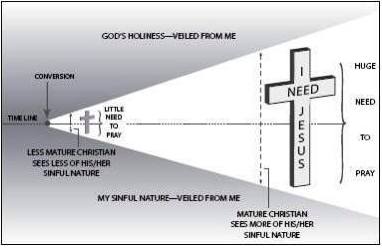
Notice the emphasis on merely seeing (i.e., contemplationism). Furthermore, it’s antithetical to the biblical putting off and putting on prescribed by the Scriptures.
Catholicism is little different, it also fuses justification and sanctification together; justification is not a finished work. The following are excerpts from Catechism of the Catholic Church | Part 3, Life in Christ | Section 1, Man’s Vocation Life in the Spirit | Chapter 3, God’s Salvation: Law and Grace | Article 2, Grace and Justification: section…
1987: The grace of the Holy Spirit has the power to justify us, that is, to cleanse us from our sins and to communicate to us “the righteousness of God through faith in Jesus Christ” and through Baptism.
Notice that there is an ongoing communication of righteousness to the believer which is Protestantesque. This is a perpetual imputation of justification. In theology, “righteousness” and “justification” are used interchangeably.
1988: Through the power of the Holy Spirit we take part in Christ’s Passion by dying to sin, and in his Resurrection by being born to a new life; we are members of his Body which is the Church, branches grafted onto the vine which is himself.
This is nothing more or less than the Protestant doctrine of mortification and vivification (see CI 3.3.2,9). Through confession, (mortification/repentance), we partake again in Christ’s passion resulting in a perpetual new birth experience symbolized/imputed initially by water baptism.
1989: The first work of the grace of the Holy Spirit is conversion, effecting justification in accordance with Jesus’ proclamation at the beginning of the Gospel: “Repent, for the kingdom of heaven is at hand.” Moved by grace, man turns toward God and away from sin, thus accepting forgiveness and righteousness from on high. Justification is not only the remission of sins, but also the sanctification and renewal of the interior man.
There is little ambiguity here; in Catholicism, like Protestantism, you are sanctified by justification…
1995: The Holy Spirit is the master of the interior life. By giving birth to the “inner man,” justification entails the sanctification of his whole being.
So, why the major beef between Catholicism and Protestantism? It boils down to “infused righteousness.” Romanism holds to the idea that the believer is enabled to participate in his/her final justification via confession and ritual. In the minds of Protestant theologians, that makes man a participant in justification. However, if all righteousness is outside of the believer and remains so, he/she is not a participant in the justification process. The same means, through contemplative repentance to communicate justification as an ongoing process is ok, but not the idea that the righteousness of God indwells the believer. It must be Luther’s alien righteousness. This is the way Calvinist John Piper presents the argument:
This meant the reversal of the relationship of sanctification to justification. Infused grace, beginning with baptismal regeneration, internalized the Gospel and made sanctification the basis of justification. This is an upside down Gospel (Desiring God blog: June 25, 2009; Goldsworthy on Why the Reformation Was Necessary).
When the ground of justification moves from Christ outside of us to the work of Christ inside of us, the gospel (and the human soul) is imperiled. It is an upside down gospel (Ibid).
In it [Goldsworthy’s lecture at Southern] it gave one of the clearest statements of why the Reformation was needed and what the problem was in the way the Roman Catholic church had conceived of the gospel….I would add that this ‘upside down’ gospel has not gone away—neither from Catholicism nor from Protestants (Ibid).
Romanism believes in an infused grace that enables the believer to partake in the justification process which is condoned because the beginning of justification is purely of God. The beginning of justification is pure grace, but sanctification is a “help”:
2025: We can have merit in God’s sight only because of God’s free plan to associate man with the work of his grace. Merit is to be ascribed in the first place to the grace of God, and secondly to man’s collaboration. Man’s merit is due to God.
2027: No one can merit the initial grace which is at the origin of conversion. Moved by the Holy Spirit, we can merit for ourselves and for others all the graces needed to attain eternal life, as well as necessary temporal goods.
This drove the Reformers berserk. In their construct, man, saved or otherwise, can have NO merit. It is fair to say that the main contention between the Reformers and Rome was metaphysical in nature. The crux of the contention was/is: How can man be found righteous at the end of his/her salvation journey?
This paper contends that there is NO salvation journey in regard to justification; it is a finished work. Only our lives as God’s children progress; the fact that we are part of God’s family is a complete, and settled issue. A person is born into a family once, and their growth does not increase their status as a family member; that was settled the day they were born.
Any gospel that posits justification as part of the sanctification process must necessarily involve man in the justification process, and the exclusion of works salvation is impossible. Everything becomes a work or doing something to MAINTAIN our justification. Even doing something passive that is not considered a work like thinking has a purpose, and that purpose can never be to complete a work that Christ has completed.
This is why Protestantism and Catholicism are both false gospels. It is a return to the Galatian error. Protestantism relaxes the law in sanctification to finish the finished work of justification by saying Christ obeys the law for us in sanctification if we live by faith alone in sanctification. Catholicism does its part in relaxing the law of love by replacing it with rituals in sanctification. Different means with the same purpose: to cooperate in the finishing of a finished work. That’s a false gospel.
Mom Wants to Know: Why I Don’t Like Mike Huckabee (and Other Adorable People)
 I am very busy and need to combine eight posts into one which is not difficult because it’s all related. I need to write about Mike Huckabee, Joni Eareckson Tada, Boz Tchividjian, K-Love, stuff happens theology, plumbing, Communism, and of course John Calvin, but not necessarily in that order.
Let’s start with a conversation that occurred over at my mom’s house about former Governor Mike Huckabee. Susan and I were over at her house overseeing the repair of her furnace. My study of medieval religion has given me a robust appreciation in regard to American ingenuity and technology. A working furnace is critical for someone my mom’s age in sub-zero weather. The furnace was repaired by a competent young man within hours of us calling, and let me add that he also laughed at my jokes.
Plumbing
When all was accomplished, Susan and I said farewell to mom and then received a call on my cellphone about four miles from her house; she reported a funny hissing sound in the kitchen. We returned, and concluded that a frozen water pipe had broken under the kitchen floor. This was totally unrelated to the furnace repair. There we were, the day well spent, and a broken water pipe shooting out gallons of water by the minute underneath the shallow crawl space of the kitchen.
Another competent repair man to the rescue, even at that hour? Maybe, but my mom is long retired and lives on a limited income. I went down to the basement and turned off the main water supply to the house and also observed the following: much cost was spared in installing shutoff valves, but the kitchen was an isolated run of two copper pipes easily accessible before entering the long and shallow crawl space under the kitchen. It became apparent that those two pipes could be sealed off and the rest of the house would have water until the broken pipe was fixed. The trade of a dishwasher and one faucet for flushing toilets etc. in the rest of the house would be a good trade indeed.
I have some past limited background in plumbing, so Susan and I drove to the nearest Lowes to buy sand paper, a propane torch, two copper end-caps, solder, flux, a small brush, a hack saw, and inner pipe brush. Then we talked to a delightful young man that informed me that American plumbing had indeed changed since fifteen years ago when I was dabbling in it here and there as a builder. He informed us that we would only need two “push fittings” and a mini pipe cutter, and about five minutes.
“Uh, let me get this straight. I just cut the pipe, and push this thing on the end of it, and I am done? ‘Right.’”
Now visualize me looking at the guy like he is the Lowes version of John Calvin as he explained how the simple contraption worked. Remember those weaved tubes that we used to put on our friends’ finger when we were kids back in the days of extreme political incorrectness? The tightness of the device around the finger increased with pull. It was the initiation ceremony of choice for all neighborhood club houses. In this case, the pipe is the finger and the water pressure is the sadistic adolescent.
Huckabee
All of this is why I don’t like Mike Huckabee. After the plumbing repair, we hung around awhile and watched the Mike Huckabee show on the Fox news channel. I informed mom and Susan that I don’t like the guy. Like many, they were astounded that anyone of Christian stripe could dislike that cornball.
“Why don’t you like Huckabee?!”
I really didn’t have an answer at the time. But I thought about it all night and realized that the answer was right under my nose the whole time—so I hereby write.
Tada
Huckabee had the mega storied Joni Eareckson Tada on his show. Both of these people are impressive and adorable. Tada has been a paraplegic since her teen years, but her life accomplishments are over the top. Both are the epitome of American pie and conservative Christianity. The reason Huckabee had Tada on his show was to discuss the “Academy’s rescinding of its Oscar nomination for ‘Best Original Song,’ which appeared in the inspirational American colonial epic, ‘Alone Yet Not Alone,’ when it discovered that the composer, Bruce Broughton, had sent a short email bringing the song to the attention of Oscar voters.” Tada was the vocalist.
Christians en masse stand in awe of Tada, and Huckabee added to her mystique with his mainstream Christian appeal. And this is the problem with Huckabee: he doesn’t get it. Huckabee is the poster child for the Christian metaphysical treadmill. Tada is very much a part of the New Calvinism movement which is a return to authentic Reformation ideology.
Communism
It is nothing more or less than Communism dressed in Bible verses. This is where the Huck doesn’t get it; as a political/religious conservative, he is representative of many in Christianity who allow their principles to fornicate with contrary ideology. This leads to a never ending endeavor to change society while unwittingly giving credence to the very ideologies that are the source of the problem.
In the same show, Huckabee, prior to Tada’s segment, criticized the opening ceremonies at this year’s winter Olympics in Moscow which promoted the virtues of Communism. He commented that Lenin’s murderous legacy was conveniently left out. Meanwhile, in the next segment, here comes Joni Eareckson Tada who represents a return to John Calvin purism. Granted, Tada’s extensive education came from seminaries that don’t teach the significance of how philosophy progressed through history and how that applies to the doctrine she embraces. Long story short, this leads to a contradictory motif in her own life as she benefits from an array of technological advances that has made much of her success possible (more on that later), but the larger point is that Reformation theology and Communism came from the exact same ideological source along with its presuppositions concerning mankind.
Hence, Huckabee partakes in the same hypocrisy that he criticizes. The Reformers were NO LESS murdering despots than Lenin—that’s conspicuous history plain and simple. In fact, in most cases, Lenin had people shot in the head while the Reformers wouldn’t have tolerated such a quick and painless departure by those whom they disagreed with. Huckabee is the epitome of the well-polished American do-gooder that refuses to come to terms with the fact that the Pilgrims, the Puritans, and the Reformers are not part of the ideology that made America; they are in fact part and parcel with Communist ideology. Putin needs ratings no less than Huckabee does.
The progression of philosophy and how it affects humanity is magnified in the differences between America and Russia. Huckabee, again, in the same show, pointed to the poor quality of life in Russia that is hindering the Olympics. What he doesn’t realize is that it would be much worse if it wasn’t for America. You have to have technology to eventually destroy the Great Satan, but if Russia ever succeeds, technology goes bye-bye, and the mass graves become filled with the Joni Eareckson Tada’s of the world because they can’t “contribute to the greater good of the group.” This is why Russia’s technology will never rival that of American ingenuity: Communists see technology as a necessary evil, Americans see technology as a means to accomplish good.
Really, this can be summarized in the living contradiction that is Joni Eareckson Tada. While promoting Luther’s worm theology and making one statement by God to the apostle Paul the whole enchilada, she continually pontificates, “God’s power always shows up best in weakness.” Communism asserts that the masses are hapless and incompetent; Reformation theology asserts that man defaces the glory of God through his own accomplishments. Both share the same presuppositions in regard to mankind. Tada points to her disability as set against her accomplishments as proof of Reformed doctrine while completely dismissing God’s use of technology invented by those who in many cases could care less about God. Tada has a lot of education in regard to what others told her is in the Calvin Institutes, and conveniently missing are Calvin’s vast discussions of Plato and Aristotle. I dare say that the Reformation had more to do with those two men than “justification by faith alone.”
And by the way, the Reformation wasn’t about that either; it was about cutting man completely out of the salvation process because of Plato’s philosophical presuppositions concerning mankind. This later morphed into Gnosticism.
Stuff Happens Theology
Can we summarize this dilemma with T-shirt theology? “S— Happens.” No, stuff doesn’t just happen (there is a logic that drives everything). And that’s how Huckabee functions because of his metaphysics: stuff happens and you have to relentlessly address that stuff until all of the stuff has been refuted. No, you have to stop fornicating with the logic that creates the stuff. The apostle Paul stated it this way: “A little leaven leavens the whole lump.” If Huckabee wants unleavened bread, he needs to take some culinary philosophy classes. And if you don’t like what you learn, stop criticizing the Communists for editing history.
And by the way, what scares the bejeebers out of me is that the average Communist on the street understands these issues as opposed to American Christians. They know exactly why their country stinks; because mankind and life stinks. Get with the caste program or it will stink even worse. It’s about the best world hospice care possible. The fray between Americanism and Communism really began when the Pilgrims landed at Plymouth Rock. That’s where the rewriting of history for us began as well; “Pilgrim” is a soft term for “Puritan.” These are people who saw the likes of Benjamin Franklin as troublers who stir up the anger of the gods with their big ideas. Now they have to use those same ideas to put an end to the egregious idea that man has worth. That’s Joni Eareckson Tada metaphysics.
Hence, supposedly, technology doesn’t enable us to do more ministry. It would have been better to replace my mother’s furnace with a wood burning stove. It would have been better if my mother would have had to write me a letter about the broken water pipe instead of calling me on my cellphone. See, if we were like the Russians, we wouldn’t need plumbing anyway. For Tada, technology is a necessary evil to spread the word that we all suck. If she thinks that is an absurd evaluation of her metaphysics, she should stop promoting men who believe just that in no uncertain terms. She would know this if her reality wasn’t completely formed by the likes of John MacArthur Jr.
The Republican Party and Mike Huckabee in particular need to wake up to a new reality: New Calvinism has made the American church the New Communist Party. Again, stuff just doesn’t happen; there is a reason why many well-known New Calvinist pastors voted for Obama. Sure, they don’t agree with his stance on abortion and other issues, but there is agreement on the bigger issue at hand: mankind needs the best hospice care possible; unfortunate collateral damage can be dealt with when Calvinism is back in bed with the state. This is why the institutional church is the institutional church and partakes in many things institutional like movie production, formal education etc., etc., ect. The state gave it birth, and it will always gravitate back to its mother. This is why Christ’s assembly was never an institution.
The Boz
Let’s continue now with stuff happens theology and the adorable Boz Tchividjian aka the Boz. The Boz is another impressive guy. How can we criticize the Boz? For crying out loud, he left his station as a district attorney who prosecuted child abusers to start G.R.A.C.E, an acronym for, Godly Response to Abuse in the Christian Environment. The Boz bemoans “the continued culture of silence and protection [for child abusers] in American Evangelicalism.” This is a reality—stuff happens. No, stuff doesn’t just happen. Read the history for yourself. Seriously, people have actually written this ministry and stated, “Evangelicalism is beginning to look like Catholicism in regard to child abuse.” This is stuff happens theology.
Catholicism was founded on Platonism, and Protestantism came from Catholicism, and never left it. Augustine, an avowed Neo-Platonist, is both the father of Reformed theology and a Doctor of Grace in the Catholic Church. Later, Baptists became Protestants when the issue of infant baptism became a “secondary” issue. Apparently, after all of the Anabaptists of the home church variety were executed by a joint effort of Catholics and Protestants, the institutional breed of Baptist was accepted. After all, they paid the tithe tax. In regard to Catholics and their bastard children, there is no heresy more egregious than tax evasion. Evangelicalism became a necessary addition to Protestantism when people could no longer be compelled by force to attend church and tithe.
Again, we criticize the Communists for propaganda, but yet colonial America was a Puritan theocracy that executed people for being theologically incorrect and jailed people for not attending church and tithing. The Puritans were the first to bring slaves to America at Jamestown. The American Revolution was a pushback against colonial tyranny. While the Boz seeks to rectify the child abuse stuff in “Evangelicalism,” he holds fast to the same presuppositions concerning mankind and the divine right of kings that flows from it. He wants to rid “Evangelicalism” of the behavior, but continues to fornicate with the ideology that produces it.
This ministry, which understands Reformed ideology, has therefore continually stated that G.R.A.C.E. cannot help victims of child abuse in the church. This is because the Boz, like all of those in a Calvinist mindset, sees all of humanity as being in the same boat. Peruse if you will all of the G.R.A.C.E . literature, I was not able to find the word, “justice” anywhere. And yet, didn’t the Boz come from a justice system? Though God himself demands justice for the maltreated, Calvinism holds justice in contempt because it assumes humanity deserves NOTHING more than eternity in hell.
I have written extensively on the problem of dealing with abuse in the church with Reformed ideology. The difference is the mindset that puts as much value on one life as it does all of life versus collectivism which sees the individual as expendable for the benefit of the group. This is known as collectivism. This is a big player in the Reformation’s Platonist roots. This is about philosophical metaphysics—not the Bible. While the Boz deplores the behavior of child abuse, his remedy requires that the victim and the abuser both recognize that we are all just “sinners saved by grace.” In at least one sense, he believes that the abusers would repent if the victims would admit that they are no better than their abusers. Example: while the Wartburg Watch blog portends to be an advocacy for the spiritual abused, they partner with Pastor Wade Burleson, a Calvinist, who suggested that abuse would be greatly reduced if the church was not guilty of failing to pray for abusers. Here we have yet another example of attempting to bake unleavened bread while adding leaven to the dough.
Furthermore, discernment blogs, like the Boz, have a common goal of purifying the institutional church. This gets right back to collectivism which is always dependent on the state. Plato’s Republic was about the best hospice care for humanity: government must own man and truth so that humanity can be as comfortable as possible while dying. To the contrary, Christ said He came to give eternal life and life more abundantly in the here and now. And the Christian has no fight with those who believe in a limited government that assures humanity’s right to freedom and the pursuit of happiness. This is closer to the priesthood of believers that devalues church as an institution. This is why the New Testament church was primarily home based before being driven underground in oppressive countries by necessity. To the contrary, the American church functions primarily in institutional venues: higher learning; corporate expression; missionary organizations; political organizations; and even movie making. Discipleship and citizenship to the glory of God is barely on the radar screen.
Therefore, the institutional church will always be one step away from a liaison with state. The institution is what the institution does—it collects taxes and tithe, and doesn’t much care for those who don’t contribute to the group.
Yes, all of the above is why I was able to predict the inevitable outcome of G.R.A.C.E.’s involvement in the Bob Jones University abuse scandal months beforehand. It’s a Reformed institution investigating a Reformed institution. Don’t be fooled by the good cop bad cop routine. They are all cops when it is all said and done. BJU’s final sentence of their statement in regard to firing G.R.A.C.E. after the smoke was clear says it all:
We grieve with those who have suffered abuse in their past, and we desire to minister the grace of Christ to them. Our prayer for the abused is that God will be their refuge and strength.
Yes, they ministered G.R.A.C.E. to them alright, and that message is loud and clear lest the discernment bloggers and victims cannot yet see it:
Justice isn’t the issue; who in the hell do you think you are? You think you deserve justice? If you had a smidgen of spirituality you would seek refuge in God and not the justice of men! How dare you threaten the institution wherein salvation is found because you will not accept the will of God! You were raped, big deal! Jesus hung on the cross for your sins! You are the unmerciful servant who received forgiveness but will not forgive!
K-Love
…is a radio station that plays contemporary Gnostic Christian music. Here is what my missionary son in law posted on Facebook a couple of days ago:
We have been listening to the newest Christian music on K-Love as we travel and I am noticing an odd trend: there are several songs that ask for God to break someone or make them lonely with the expected result of being a better person. Having been broken and very lonely a couple times in life I am pretty sure they are not really aware of what they are asking for. You don’t have to be broken in order to listen to God’s voice and indeed if you learn to listen to His voice you will not break or be broken even when you do face difficult times.
It’s not odd really, but is part of the whole all reality than can be perceived with the five senses (which of course includes us) is evil and only the invisible spirit realm is good metaphysics dressed up in Bible verses. We have to understand the ideology that drives all of this stuff and stop focusing on the stuff. It explains the madness behind the music, why a pastor would vote for Obama, why someone like Tada endowed with all sorts of technical power and influence would glory in her “weakness” while being far more empowered than most Americans, and for that matter, why a Buddhist monk would set himself on fire just to make a statement.
John Calvin
…is the epicenter of all that is going on in Christianity right now, and the key to understanding the significance of Calvin and his cultural impact has little to do with the Bible and everything to do with the fact that his ideology is the premise that drives a lot of stuff across the spectrum of life and society. Focusing on the stuff will only delay the inevitable. And per the usual, people will continue to focus on the stuff, because stuff happens, and we like to talk about it—it’s like rubber necking to get the best view that we can of a traffic accident—it’s like flirting with the voluptuous vampiress that just might bite our necks and suck all of our blood. There is no thrill in solutions like traffic safety or a silver bullet.
And what would Mike Huckabee talk about on his show? But others have a choice; we don’t have to strive in baking unleavened bread while allowing leaven. We don’t have to give mere platitudes to the suffering…
we can set them free with real truth, and be a blessing in our own little corner of the world. And when you stand before Jesus, as we all will, it’s better that way. Jesus said that whatever we do for the least of the little ones we do unto Him. With Jesus, love is about the individual—not the collective good.
paul
The Truth About the Lord’s Table
 The Lord’s Table was never meant to be an institutional solemn ceremony administered by church hierarchy. Neither was it ever intended that the Lord’s Table impart additional grace. Clearly, especially with the present-day resurgence of medieval religion embodied in New Calvinism, church is a filling station that keeps the gospel gas tank full until we get to heaven. If you don’t partake in the daily fillings consummated by the topping-off on Sunday, your race car self will not finish the “race of faith” alone that requires a perpetual application of the same death, burial, and resurrection that saved you.
The Protestant Reformation was Catholicism Light, and continues to be so today. In the early days, both were harlots drunk on the blood of the saints. Protestants would have slain as many saints save their distraction in warring with their harlot mother. Money is thicker than blood, and there is big bucs in the salvation business.
The first battle over sacramental salvation pitted the Anabaptists against the Catholics and the Protestants. Both tortured and executed the Anabaptists with the same vigor. This is conspicuous history that is inconvenient truth. Later, Protestantism morphed into an exception regarding infant baptism called “Baptist” which rejected the idea that baptism itself imparts salvation, but retained Reformed soteriology (see the 1689 London Baptist Confession of Faith). Over the years, because it is the same soteriology, Baptists have come to function like their harlot mother while denying the Protestant foundation of salvation through the institutional church.
The Reformers believed that the institutional church held the “power of the keys” which is the authority to forgive sins on earth. Calvin, as well as the rest of the Catholic Light crowd, believed that sins committed as Christians separate us from our original salvation. Hence, a perpetual reapplication of Christ’s death and resurrection must be perpetually applied through the institutional church to maintain salvation (CI 3.14.11 among many other references: see It’s Not About Election available on Amazon and free reading @ 7questions.org). People wonder why New Calvinism is taking over Baptist churches like a wild fire and Baptists seem defenseless against it. The answer is simple: they have functioned like their harlot mother for centuries and New Calvinism is merely helping them to come out of the closet muttering, “Had we been alive during the times of our Protestant fathers we would have not murdered the Anabaptists.”
And that is not a pretty historical sight. Among other examples of cruelty on steroids, Protestants liked to toss Anabaptists in some deep body of water enclosed in sacks while mockingly asserting that they were merely rebaptizing them according to the desire of the Anabaptists. Protestants by and large condoned this cruelty because they believed there was only one thing more terrible: denying infants salvation through the authority of church bishops. Moreover, to suggest that Baptists came from the Anabaptists is a cruel joke; historically, Baptists have always held fast to the institutional salvation of Protestantism. This explains, in every instance, the behavior of Baptists that I have observed over the years:
1. 10% of the members do 100% of the work: it’s not about discipleship; it’s about being saved via membership.
2. Faithful members, on average, comprise 25% of the membership roles: this speaks for itself.
3. The Alter call is Absolution Light.
4. The Lord’s Table is a solemn ceremony and a time of self-examination: see #3.
The list of examples could be much longer, but you get the point. New Calvinists are merely suggesting that a deeper commitment to the local church is needed; whisper: “to get into heaven” who can argue with that?
Baptism has remained as the onetime act that represents the beginning of justification in Protestantism. The Lord’s Table represents the perpetual need for the same gospel that saved you in order to keep yourself saved. It’s New Calvinist Transubstantiation Light. When a New Calvinist states that this “sacrament …imparts grace,” what they are really saying in broad daylight goes right over our heads; you think “grace” means help in sanctification while by “grace” they really mean salvation. We are saved by Jesus, and the Christian life is an endeavor to get more and more Jesus until we can stand at the final Judgment full of grace. And of course, we can only get grace installments through the local church. New Calvinists say this continually in public and outright. Yet, no one can stop the New Calvinist tsunami. Why? Because when it gets right down to it—that’s who we are.
What is the Lord’s Table? First, it is a Jewish tradition. The Lord’s Table must be seen through its Jewishness or it will not be understood. The Lord’s table is a remembrance in regard to a covenant that God made with Israel. God did not make that covenant with anyone but the nation of Israel. By faith, Gentiles are included, they are invited to the Jewish feast, but it is a Jewish feast. Gentiles are invited to the Sabbath rest, but it is a Jewish rest. New Jerusalem’s foundation bears the names of the 12 apostles—that’s future, and the names of 12 Jews. One of the earliest epistles was written to the 12 tribes of Israel because that’s all there was in the beginning of the church.
What is the New Covenant, and who was the covenant made with? Let’s see:
Jere 31:31 – “Behold, the days are coming, declares the Lord, when I will make a new covenant with the house of Israel and the house of Judah, 32 not like the covenant that I made with their fathers on the day when I took them by the hand to bring them out of the land of Egypt, my covenant that they broke, though I was their husband, declares the Lord.
When will the covenant be fully executed?
Jere 31:38 “Behold, the days are coming, declares the Lord, when the city shall be rebuilt for the Lord from the Tower of Hananel to the Corner Gate. 39 And the measuring line shall go out farther, straight to the hill Gareb, and shall then turn to Goah. 40 The whole valley of the dead bodies and the ashes, and all the fields as far as the brook Kidron, to the corner of the Horse Gate toward the east, shall be sacred to the Lord. It shall not be plucked up or overthrown anymore forever.”
What will the people there be like?
Jere 31:33 – For this is the covenant that I will make with the house of Israel after those days, declares the Lord: I will put my law within them, and I will write it on their hearts. And I will be their God, and they shall be my people. 34 And no longer shall each one teach his neighbor and each his brother, saying, ‘Know the Lord,’ for they shall all know me, from the least of them to the greatest, declares the Lord. For I will forgive their iniquity, and I will remember their sin no more.”
Will this covenant ever be voided because of something Israel did?
Jere 31:35 – Thus says the Lord, who gives the sun for light by day and the fixed order of the moon and the stars for light by night, who stirs up the sea so that its waves roar—the Lord of hosts is his name: 36 “If this fixed order departs from before me, declares the Lord, then shall the offspring of Israel cease from being a nation before me forever.” 37 Thus says the Lord: “If the heavens above can be measured, and the foundations of the earth below can be explored, then I will cast off all the offspring of Israel for all that they have done, declares the Lord.”
This is why Christ first and foremost went to the cross for the Jews; because the covenant was made with them:
Acts 5:31 – God exalted him at his right hand as Leader and Savior, to give repentance to Israel and forgiveness of sins…13:23 – Of this man’s offspring God has brought to Israel a Savior, Jesus, as he promised…28:20 – For this reason, therefore, I have asked to see you and speak with you, since it is because of the hope of Israel that I am wearing this chain.”
The setting from which the Lord’s Table comes is no different from the original model set forth during the Exodus. The tabernacle was obviously not made to facilitate regular corporate meetings, and the rest was ordinary tent structures among the people. Small groups met under the leadership of elders for teaching and fellowship. The tabernacle was not for discipleship. During the time of Christ, this is the same model: discipleship took place in homes. The Lord’s Table is not a temple ordinance—it is a remembrance tradition within the venue of discipleship and fellowship.
It is also VERY informal. Christ initiated the fellowship tradition of remembrance (not a “church ordinance” or “sacrament”) during the Passover meal and while all were reclined at the table (Matt 26, Mark 14, Luke 22, John 13-17?). This event was typical of the house meetings that took place in the lay synagogues. The meetings were in the upper rooms, involved a fellowship meal, a lesson, and a departure by the singing of a hymn. This particular meeting’s lesson/teaching may be completely detailed in John 13-17 which would have been a pretty hefty study. According to the book of Acts, Paul taught a lesson where a disciple fell asleep and plummeted to the ground from the upper room.
The Lord’s Table initiated by Christ involved one cup and eating from one loaf. Christ was very deliberate in using one cup, and the apostle Paul later confirms that the eating from one loaf was the tradition carried forward (1Cor 1:17). This points strongly to the intended relevance of this tradition taking place in a small group. Could it be that the Lord’s Table is the only argument one needs for the home fellowship model as a total replacement for the institutional church? On the one hand, it is a solemn ceremony that should be done with all reverence, but on the other hand, the setting is one that circumvents one of the main points of the remembrance.
But most of all, the fact that the Lord’s Table represents the New Covenant made with Israel is circumvented, and also, the fact that the finalization of the covenant is future. Christ said that He would not drink of that cup again until He could drink of it again in the kingdom. That is a day when all of national Israel is saved (Rom 11:26). Christ inaugurated the New Covenant with His death, the kingdom will be the full consummation of God’s covenant with Israel. The Gentiles have been included in the common wealth of Israel (Eph 2:11,12).
Hence, the true significance of the Lord’s Table has been stripped from Protestantism in the same way that Protestants skewed the true significance of baptism. And likewise, in the same way that the Anabaptists defied Protestant whoredom in their home fellowships—the same needs to be done today in regard to the Lord’s Table. We have little to fear in our day as opposed to the Anabaptists—the New Calvinists can only replace the burning stake with musings of running us over with buses (Mark Driscoll) and throwing us into death with human catapults (James MacDonald). The true spirit of the Baptists is revealed by the fact that they still follow those who espouse such wishful thinking by the thousands.
Each and every Christian is now the temple in which the Spirit dwells permanently. Each and every Christian is a priest. Each and every Christian is a citizen of Israel’s holy commonwealth. This should be remembered informally and in a joyful fellowship as we watch for His coming when Christ the Lord will join us in the lifting of that cup,
Holy be His name, our Glorious King.
paul
Calvin’s Get Out of Hell Free Card: The “Power of the Keys”
Is Calvin’s gospel really good news? Not so much. It entails running a race of faith alone in sanctification and then appearing at one final judgment where everyone who has ever lived finds out whether they made it or not; where the children of God will be “made manifest.” Because Calvin’s gospel fuses justification and sanctification together, it involves a complicated system of determining what IS works in sanctification and what IS NOT works in sanctification because justification and sanctification are the same thing. Hence, no works can be done in sanctification (the Christian life). Calvin stated that New Testament sanctification is the succession of the Sabbath Day rest (CI 2.8.29).
Calvin stated unequivocally that Christians shouldn’t have any security (CI 3.24.6) because living by faith alone is indeed tricky business, but followers of Calvin do have an ace-in-the-hole: the power of the keys. This is the idea that Reformed elders have been given the authority to speak for God, and whatever they bind on earth will be bound in heaven, and along with that comes the authority to forgive sins that unjustify (CI 4.1.22).
So, if the elders like you, you’re in. The doctrine creates fear, but assurance can be found in supporting your local Reformed elder.
paul

 Paul's Passing Thoughts
1 comment