A Foundational Position on Election
 “Incredibly, and in broad daylight, MacArthur’s kinship to Augustine’s Platonism was eerily on display. This is not a side issue; this is the meat of the total depravity gospel which invariably leads to a Reformed view of election.”
“The idea that people can do no good work is not even true of unbelievers. But the problem for the Reformed is this: if the unbeliever can do good works, though falling far short of God’s glory in totality, one of those good works might be choosing God. That’s a huge problem for the Reformed theologian. Hence, the ability to do any good work must be eradicated; viz, total depravity.”
As anybody who visits here much at PPT knows, I have stayed clear of a specific position on election aside from discussing some inclinations about the subject. This is because I am convinced that most Christians don’t have a solid understanding of justification which is very definitive, unlike the question of election. The following makes sense to me: nail down what we can know definitively first, then perhaps the rest will fall into place.
This has worked for me; I have come to some foundational conclusions about election while knowing there is much more to learn. But the following is what I know at this time. These are difficult questions, but the very difficultly indicates an expectation by God: we are to be zealously involved in the working out of these questions. Granted, at this time, there are some things only God will know, but we are responsible for what we can know (Due 29:29, 30:11-14). Pleading ignorance because of your awareness of God’s greatness can be a cloak for wicked laziness (Matt 25:14-30).
I was inspired yesterday to put together thoughts I have had for some time after stumbling upon John MacArthur’s speech about total depravity at the 2008 T4G conference. Coming to a resolute conclusion about MacArthur’s “Christian” worldview has been a long and hard journey for me. I know Augustine, Calvin, and Luther well as I read them daily—that’s my ministry—that’s what those who support this ministry expect me to do, and MacArthur is in league with that worldview lock, stock, and barrel.
The exception would be his eschatology which doesn’t match his Reformed soteriology, and perhaps that is why there has been a parting of the ways between MacArthur and T4G. Multiple judgments and resurrections suggest a separation between justification and sanctification, and assurance of justification which is an Augustinian anomaly.
Fruit of the Poisonous Tree
In a court of law, information from a bad source or means is looked upon with much skepticism, and the fact is, the doctrine of election came from the Reformers; this makes the doctrine of election VERY suspect for concrete reasons. While stating that election didn’t come from the Reformers, but rather the Bible, all admit that the Reformers brought it to our attention that election is in the Bible, and then we went to look for ourselves based on the “biblical facts” they pointed to.
Indeed, we caution ourselves because a clock that doesn’t work is right twice a day, but in this case, the clock has no hands. The Reformers brought it to our attention that election is in the Bible, and then also brought it to our attention that we are worthy of death if we don’t agree with their assessment of election. Most Reformed confessions and counsels, including Westminster, included this clause, and Calvin stated it to Francis I in the prefatory address of his Institutes. This lacks Jesus likeness, and a tree is known by its fruit.
Secondly, Reformed soteriology is clearly at odds with biblical justification. First and foremost, the Reformers wanted to make a case for total depravity. If man is totally depraved and unable to choose God, obviously, God must elect. In his introduction at T4G, MacArthur notes that total depravity wasn’t invented by Calvin or Luther, but historically, it went all the way back to the fifth century and Saint Augustine. Apparently, older is better. 2008 was the first year that Neo-Calvinism was dubbed, “New Calvinism,” and I believe MacArthur wanted to make a case that it wasn’t “new,” a word that can make Evangelicals a little skittish. MacArthur et al deem total depravity to be the very bedrock of the Reformed gospel, and clearly, he was making a case for historical precedent. But there are two reasons why this leads to a Reformed Achilles’ heel on both feet.
Augustine was an avowed Neo-Platonist who would have considered the material, including man, as being evil and only the invisible/spiritual as being good. Furthermore, a just society was the paramount goal of Platonism which necessitates the marriage of church and state. And, “just” was defined as “united” by Plato which necessitates unquestionable allegiance to the ruling class, or philosophers. When Augustine, the undisputed father of Reformed soteriology merged Neo-Platonism with Christianity, another assertion that few dispute, Plato’s philosopher kings became the clergy. In the minds of the Platonist Reformed clergy, the state is ordained to enforce “orthodoxy.”
Incredibly, and in broad daylight, MacArthur’s kinship to Augustine’s Platonism was eerily on display. This is not a side issue; this is the meat of the total depravity gospel which invariably leads to a Reformed view of election. In addressing the pastors at T4G, he described them as the most important people in the world—more important than the rulers of nations, and because of their calling, the only ones adequate to proclaim the gospel. He referred to them as those who are “a savor of life to life and death to death.” The idea of elitism could not hold a candle to his address. Consequently, the idea that the lesser important government should enforce “life to life” for the betterment of the collective good could not be far behind, and historically, never has been.
In Augustine’s endeavor to integrate Christianity with Platonism, there was a glitch: mankind seems to perform good deeds from time to time whether saved or lost. This suggests that mankind is endowed with a general competency and ability to interpret reality. The solution? Make a perfect keeping of law the standard for justification and the maintenance thereof. If an act does not conform to the law perfectly, as if that wouldn’t be possible to begin with, it has no merit with God and is worthy of condemnation. And even if it were possible to do one truly good act, it is discredited by James 2:10 because if you break the law at one point, you are guilty of breaking all of it. This is Calvin’s cardinal point in 3.14.9-11 of the Calvin Institutes.
This is where Augustine shot Reformed soteriology in the other foot as well. A careful examination of Pauline theology contradicts this by way of extreme antithesis. God’s righteousness is imputed APART from the law (Rom 3:21). There is NO law that can give life (Gal 3:21). We are deemed sinless because there is NO law in justification. The law that judged our weakness in the flesh was ENDED by Christ (Rom 10:4) “…for righteousness.” If not for the old self and the flesh, we would obey God perfectly, but the old us that was under that law (Rom 6:14) died with Christ. Therefore, being dead, that law cannot judge us (Rom 7:1-6). You can’t bring a dead person to trial.
More Poisonous Fruit
Throughout his speech at the 2008 T4G, MacArthur referred to the “sinner’s” inability to “see the evil in their good…he does not see his sin in his goodness.” MacArthur also complained about the belief that man has a “residual good,” and an ability to “contribute to his salvation.” In true authentic Reformed style, MacArthur was deliberately ambiguous in regard to any distinction between justification and sanctification. Is a “sinner” referring to the regenerate or unregenerate or both? By “salvation,” does he mean a finished work that only pertains to the saved, or an ongoing work that encompasses the saved who are also sinners? When he used the word, “man” and “mankind,” is that mankind in general or just unbelievers?
He never said specifically, but if true to the theology of the camp where he was speaking, he meant both. He meant that believers remain totally depraved and unable to do a work that pleases God. This is indeed Calvin to a T (CI 3.14.11), and is more poisonous fruit as MacArthur, like all authentic Calvinists, talk about sanctification in a justification way. What we are really talking about is the total depravity of the saints though he never stated that outright, but that’s what it is speaking of and he knows it. This is deliberate and deceptive communication. When he spoke of “salvation,” did he mean progressive justification, or the finished work of justification? If Calvin’s title to the 14th chapter of book three (Calvin Institutes) is any indication, he meant the former (progressive justification).
That’s not only Calvin—MacArthur said something in the speech that connects all of these ideas together: salvation/ justification is progressive, total depravity also refers to the saints, and the saints can do no work pleasing to God; i.e., if the believer does not consider all of his/her works to be filthy rags, if he/she cannot see the evil in their good, they are no whit any different than the unbeliever. The only difference between a believer and an unbeliever is their ability to see how evil they are. This is revealed by his citation of a John Bunyan quote during the speech: The best prayer I ever prayed had enough sin in it to condemn the whole world. Elsewhere quoted by others: “There is enough sin in my best prayer to send the whole world to Hell.” Any questions?
That is untrue and reveals the Reformed skewing of biblical justification. The prayers of the saints contain no sin that can condemn—believers are not under the law. Where there is no law there is no sin (Rom 5:13), and the law has nothing to say to us for justification (Rom 3:19). Bunyan was talking about transgressions that can condemn according to the law, but according to James,
The effective prayer of a righteous person has great power
Moreover, when MacArthur complained in the same speech that one who thinks he can do good works also thinks he can “contribute to his salvation”—we must assume that he was speaking of believers as well. This would also be consistent with Reformed thought.
The idea that people can do no good work is not even true of unbelievers. But the problem for the Reformed is this: if the unbeliever can do good works, though falling far short of God’s glory in totality, one of those good works might be choosing God. That’s a huge problem for the Reformed theologian. Hence, the ability to do any good work must be eradicated; viz, total depravity.
As I was preparing for this post this morning, Susan overheard MacArthur’s comments on the mp3 that there is no good in man’s goodness. She immediately became indignant and ratted off several Bible references that clearly contradict that idea. That is one of the many beauties of Scripture; it presents a historic motion picture of metaphysics. It is a history that documents reality in regard to the milieu of life. Men teach certain things that you hear, and you say to yourself,
Wait a minute; I was reading in such and such book and such and such were having a conversation about this, that or the other and that makes no sense in light of what is being taught here.
You don’t need to be a theologian per se, the Bible is a metaphysical truth statement. Often, what is being taught merely doesn’t line up with reality, mathematical-like truth notwithstanding. Jesus said evil men know how to give good gifts to their children. Yes, they are evil, but they can do good works. I am not sure what is more evident. Romans 6:20 states that the unregenerate are enslaved to unrighteousness, but are free to do good. In other words, pleasing God is not the aim of their life, but they can still do good works.
You can’t have it both ways; if believers are enslaved to righteousness and free to sin, and they are (Rom 7:25), then the opposite must be true of unbelievers. Regeneration is a reversal of slavery and freedom resulting in a change of direction, not perfection, but the change of direction is counted as true righteousness. This is because the mind of the believer is a servant of the law while the sins of his/her flesh are not counted against them in regard to justification (Rom 7:17).
MacArthur claims that total depravity is the linchpin of the gospel, but in reality, it is the foundation that makes Reformed theology utterly devoid of truth. If man is unable to choose, and God must elect in that regard, it stands to reason that Christ only went to the cross for the elect, or in other words, limited atonement, the “L” in TULIP. Dying for all men implies that the ball is in their court. Aloof is the point that no one would suggest that man could supply the means of salvation, at issue is choice. Can man choose the means that God has supplied? So, what does the Bible say about limited atonement? Well, in several places it states that Christ died for all men. The Reformed are quick to assert the following in reply: “That means ‘all kinds of men,’ not ‘all’ men.” John 3:16 poses a significant problem for this view as “world” (κόσμος kosmos) would refer to all men period. Titus 3:4 states that a “love toward man” (Baker Interlinear—φιλανθρωπία philanthrōpia) appeared. Curiously, the ESV, a Neo-Calvinist translation, translates “love toward man” as simply “kindness.”
In addition, we cannot implore people to not “neglect such a great salvation” (Heb 2:3) if there is no salvation for them to neglect in the first place. If limited atonement is true, we simply have no way of knowing whether or not that is a valid appeal. Moreover, why would the Spirit of grace be “outraged” (Heb 10:29) that people turn their backs on a salvation that is not theirs in the first place? It makes more sense that He would be outraged because people turn their backs on a sacrifice that was made for them.
Even More Poisonous Fruit
While we are on the subject of TULIP, one wonders if Reformed ideologues like MacArthur have an apt understanding of what Calvin really taught; particularly, the relationship between the “I” and the “P.” Calvin taught that there are the non-elect, the called, or the general elect, which are temporary recipients of “irresistible grace,” and those who are granted the “gift” of perseverance. Ultimately, those who persevere show themselves to be the true elect. It is interesting that Calvin actually taught a temporary illumination/election (see CI 3.24.7,8). Frankly, I think this buffoonery speaks for itself. While MacArthur bemoaned those who worship a god of their own making during said speech, he worships a capricious Calvinistic god that temporarily illumines and is outraged at people who reject a salvation that was never given.
I have examined several “proof texts” that support total depravity and man’s inability/unwillingness to respond to God, or choose God. By and large, the gospel call to repentance and belief, and instances of strong exhortation to believe by God, Christ and the apostles, which assume ability to choose, far outnumber passages that seem to reflect predestination because of total depravity, and the fewer passages do not state specifically that man has no ability to choose. Moreover, one is generally uncomfortable with the idea that God commands us to do things we are incapable of doing. Augustine’s profound unction of “Lord command what you will and grant what you command!” doesn’t pass the reality smell test, and has creepy similarities to the parable of the talents.
And without a doubt, many of the proof texts presented deal with man’s will/ability to participate in the means of salvation, and have little to do with man choosing the means supplied by God alone. In other words, man can believe and choose, but it goes without saying that he cannot summon the Holy Spirit to regenerate him—that is totally out of man’s control, yet a promise for believing.
Total depravity and its Reformed take on election is fruit from the poisonous tree. MacArthur further validated this by his closing comments at the 2008 T4G conference which were very disturbing to say the least. In a show of his Augustinian kinship to Platonism, MacArthur said that the gospel was a “call to the sinner to flee from all that is natural, and run to the cross.” Really? “All” that is “natural”? This smacks of Luther’s theology of cross which asserts that ALL reality is interpreted by the gospel. Also, “Reality is not on the outside—it is on the inside.” Why would MacArthur make a point of insinuating that there is no reality in the “outside” world? Those who are familiar with Platonism will immediately recognize these concepts that are also part and parcel with Plato’s stepchildren, the Gnostics.
MacArthur also closed with two “immutable truths”: “all hearts are the same,” and “all need the same gospel—God’s work is heart work—mind work.” What does he mean by “all”? Is he saying that the heart of the unbeliever is no different than that of an unbeliever? Is he saying that both need the same gospel? Well, that would be authentic Reformed doctrine, so we must assume the answer is, “yes.”
In the final analysis, man does have a choice, but it is not that simple and this is an untapped frontier of study. For example, there is little discussion about God’s activity in our lives that aids our choices. God has promised in His word that He will not allow more in our lives than we can bear etc. As far as man being able to do works that have merit with God, it is clear that he can; for example, those who bless Israel will be blessed, and those who curse Israel will be cursed. Though a terrible reality in which to make a point, there will be degrees of eternal punishment which clearly demonstrates some kind of merit on the part of unbelievers.
The apostle Paul exhorted and implored people to be reconciled to God, and I believe he did so because he knew of man’s ability to be persuaded. Persuasion indicates choice, and let’s faces it, the belief that man has no choice does dampen evangelistic aspirations—this is unavoidable. And what is the Reformed explanation for that? Evangelism is a “savor of life to life and death to death” for God’s glory. Supposedly, both obtain glory for God.
I reject that because God, according to Him, takes no pleasure in the death of the wicked. I reject that because Christ wept over Jerusalem.
And I reject that because the doctrine of total depravity is fruit from a wicked Reformed tree. MacArthur et al refuse to acknowledge the reality of Reformation history and are driven by a logic that they refuse to repent of. It is an elitist mentality that calls for “hard preaching” that makes the parishioners “soft” (Ibid 2008 T4G). If not for the almighty Reformed elder, parishioners en masse would be left to their own hard hearts.
And here we go again, the Bible NEVER states that believers have hearts that are bent towards hardness or wickedness. In the Bible, the heart is the regenerated part of the believer that is holy and righteous. If you follow MacArthur’s message closely and draw logical conclusions from his Reformed-like nuanced statements, salvation is a beginning heart work that progresses only in the believer’s ability to “see” the works of Christ without being directly involved in them. Like he said, we can take no credit or gain any merit with God by what we do. These assertions make the Bible a metaphysical train wreck.
And perhaps that is the idea—to keep the Christian masses confused and pliable. MacArthur stated in his speech that the goal isn’t to be cool, but to be clear. This was probably a subtle statement about the YYR New Calvinist subculture, but let me be clear about what MacArthur wants to be clear: the great unwashed masses are confused, and are in desperate need of the “most important men in the world” to do the thinking for them. Preaching must be “hard” to keep parishioners softhearted pliable/controllable through fear of condemnation.
Like all of the Reformed elitists of our day, MacArthur presents himself as an angel of light, but birds of the feather flock together, and the fruit of the Reformation is undeniable, and a tree is known by its fruit.
And if you forget all else, don’t forget this: a position on election/total depravity coming from those who don’t understand the elementary principles of justification is ill-advised.
paul
Books by Paul M. Dohse Sr.
The New Calvinist Wide Road to Hell: “Your” Doesn’t Mean, “Your”; Matthew 5:20
 As posted yesterday, accepting any rewriting of history is a very dangerous precedent, especially in regard to the gospel, and the New Calvinist crowd works hard at rewriting history. The Resolved series of conferences sponsored by John MacArthur Jr. focused heavily on rewriting history, often representing Puritans as martyrs when many were executed for political intrigue. The Fox’s Book of Martyrs is a shameful and egregious rewriting of history; specifically, it omits the fact that Protestants were guilty of the exact same persecution towards those who disagreed with them. The book has no credibility whatsoever.
This brings us to the rewriting of history in regard to the Pharisees by New Calvinists. The narrative goes like this:
The Pharisees were really, really good at keeping the law, but at the end of the day, Christ said that you need a righteousness that exceeds theirs! What to do? Answer: cling to faith alone which imparts righteousness to us not our own. When Jesus said “your” righteousness must exceed that of the Pharisees, he was really talking about His own righteousness imputed to us.
So, saving faith is defined as knowing you are wicked. The unregenerate are defined as those who think they possess righteousness. The new birth is therefore defined as a different knowing—not a different person. If you think you are a different person who possesses a righteousness that is part of you, well, you don’t “need a physician.”
Hence, you must see Christ’s role in justification as ongoing and not finished, and you must continue to appropriate the imputation of His righteousness by simply believing and not “anything we do.” The New Calvinists of our day use the exact same lingo as the Australian Forum did, and that is why they are running from that history:
Christ’s doing and dying—not ours.
This truism was uniquely Forum, as well as many other truisms authored by them and used by the New Calvinists of our day. However, let us not miss the fact that this idea of an ongoing need for a justification physician is fundamental Calvinism whether the theologians of our day know it or not. If you are going to call yourself a Calvinist, you really ought to read Calvin for yourself.
So, in Matthew 5:20, when Christ referred to “your” [our] righteousness, “your” really doesn’t mean “your,” He meant “His” [my]. Therefore, according to New Calvinists, a better rendering would be:
For I tell you, unless you have my righteousness which exceeds that of the Pharisees who are really, really good at keeping the law, you will never enter the kingdom of heaven.
Supposedly then, only those who know they are wicked inherit eternal life. Hmmmmm, really? Actually, there are a couple of huge problems here, and what is at stake is the true gospel. First, the Pharisees were not really, really good at keeping the law—they were horrible at keeping the law. Christ said they were “lawless” on the inside and the outside. They also edited the law with their own traditions. This whole, the Pharisees were really, really good at keeping the law is a rewriting of history.
Secondly, the Bible states in many, many places that Christians possess righteousness that is part and parcel with their being. We are not only declared righteous, we are righteous, and only the righteous will inherit the kingdom. Pastors, I warn you: when you hear a fellow Christian say they “have no righteousness of their own,” you better qualify that. Righteousness, albeit a gift, is ours because it is gifted to us, and certain attitudes about works in sanctification reveal what we believe about justification; e.g., the Parable of the Talents.
The reason we are considered righteous, and are righteous regardless of the fact that we still sin is a matter of proper understanding about law and gospel. Suffice to say for purposes of this post that we have this treasure in jars of clay, but yet, that doesn’t take away from the value of the treasure—it is still a treasure. In 1John, we are told God’s seed is IN us. End of argument. Moreover, Paul uses a double emphasis to state the fact that Christians possess a goodness that is part and parcel with their being:
Romans 15:14 – I myself am satisfied about you, my brothers, that you yourselves are full of goodness, filled with all knowledge and able to instruct one another.
What part of “you yourselves” do we not understand? When Christ said “your” righteousness, he meant “your.” Christ said, “You must be born again.” This isn’t a rebirth of mere awareness that James railed against; this is a rebirth of your being.
Another reason New Calvinism wants to separate itself from the Forum is because they lacked the same nuance that New Calvinists like John Piper and Al Mohler have mastered. The Forum wrote an article titled, “The False Gospel of the New Birth” footnoted by one of its participants and leading authority on New Calvinist hermeneutics, Graeme Goldsworthy, who was invited to lecture at Sothern Seminary in 2009. The clear argument of the article was that the new birth was true (as are shadows, but do not have the sun’s life-giving source), but any emphasis on it would take away from the “best thing” which is Christ. In other words, the new birth is true, but irrelevant—even damaging because it puts the focus on us and not Christ. This gets into the whole subjective gospel versus objective gospel that there is no room for here.
I fear that New Calvinism is one of the wide roads that lead to hell that Christ warned us of. It redefines the new birth as a mere awareness devoid of new creaturehood. It is a movement that heralds the total depravity of the saints and denies the new birth.
paul
Not on my Watch Tim | Challies Tries to Rewrite New Calvinist History
 A reader of PPT sent me a timeline chart produced by Tim Challies that supposedly traces the history and source of New Calvinism. The reader sent me the link yesterday because he thought I “might be interested” in it. Yes, he would be correct about that, I am VERY interested.
History is a paramount teacher and a protector of civilization. It protects us from those who are hell-bent on foisting their worldview on the masses because it is the “right way that has never been rightly applied.” If you want to understand how this works, see John Immel’s presentation at the 2012 TANK conference here. Tyrants always want to rewrite history because people might get the wrong idea about how their logic has been inappropriately applied in past history yielding bad results. Hence, an accurate portrait of what happened, in their minds, misrepresents their logic.
That’s a dangerous precedent. The rewriting of history has always been Propaganda 101 for the tyrant. Bottom line: the explosion of discernment blogs, especially those of the spiritual abuse/spiritual tyranny sort are a direct result of the New Calvinist movement; therefore, Tim Challies has now taken his place as the Joseph Goebbels of New Calvinism.
I suppose if nothing else, I have served mankind with an in-depth appraisal of New Calvinism’s TRUE contemporary history, and no Tim, John Piper is not the father of New Calvinism, a Seventh Day Adventist theologian by the name of Robert Brinsmead is the true father of New Calvinism. Colleague John Immel is probably right, that knowledge will more than likely do little to avert people from “New” Calvinism, but just the same, we will keep it on the record for giggles if nothing else. This is why I am abundantly pleased that TTANC 1 will go beyond being self-published in the near future. Immel wonders aloud why New Calvinists care that people know who the real father of the movement is, but obviously, they do care or they wouldn’t be rewriting history. Below is the true illustrative chart that appears on page 92 of TTANC 1. TTANC 2 will delve even deeper into the history as well.
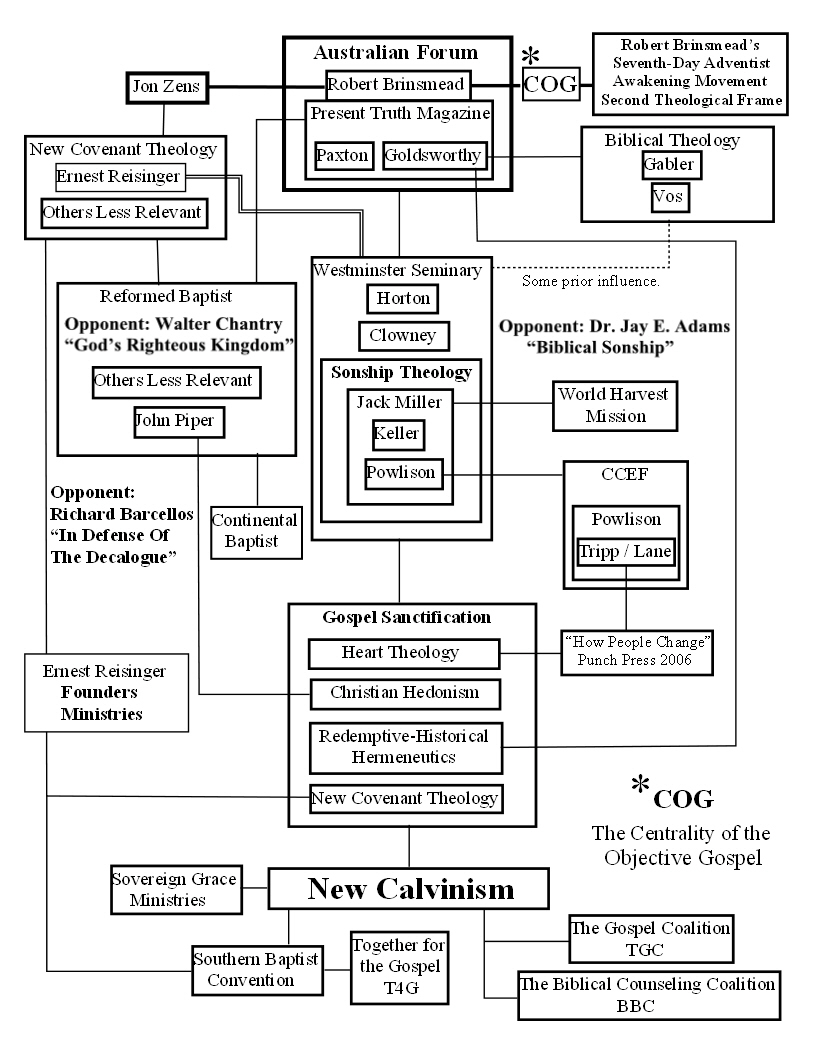
The theological journal written by Robert Brinsmead, Present Truth Magazine, was the most widely published theological journal in the world during the 70’s. The rediscovery/resurgence project that sought to bring back authentic Reformed soteriology to the church was known as the Australian Forum. They had their own core four: Robert Brinsmead, Graeme Goldsworthy, Geoffrey Paxton, and the father of New Covenant Theology, Jon Zens. Brinsmead and Zens worked together on NCT which is a slightly different twist on the law than Covenant Theology, but both hold firmly to Augustine’s Neo-Platonism. That is, those who really understand what the Reformers propagated.
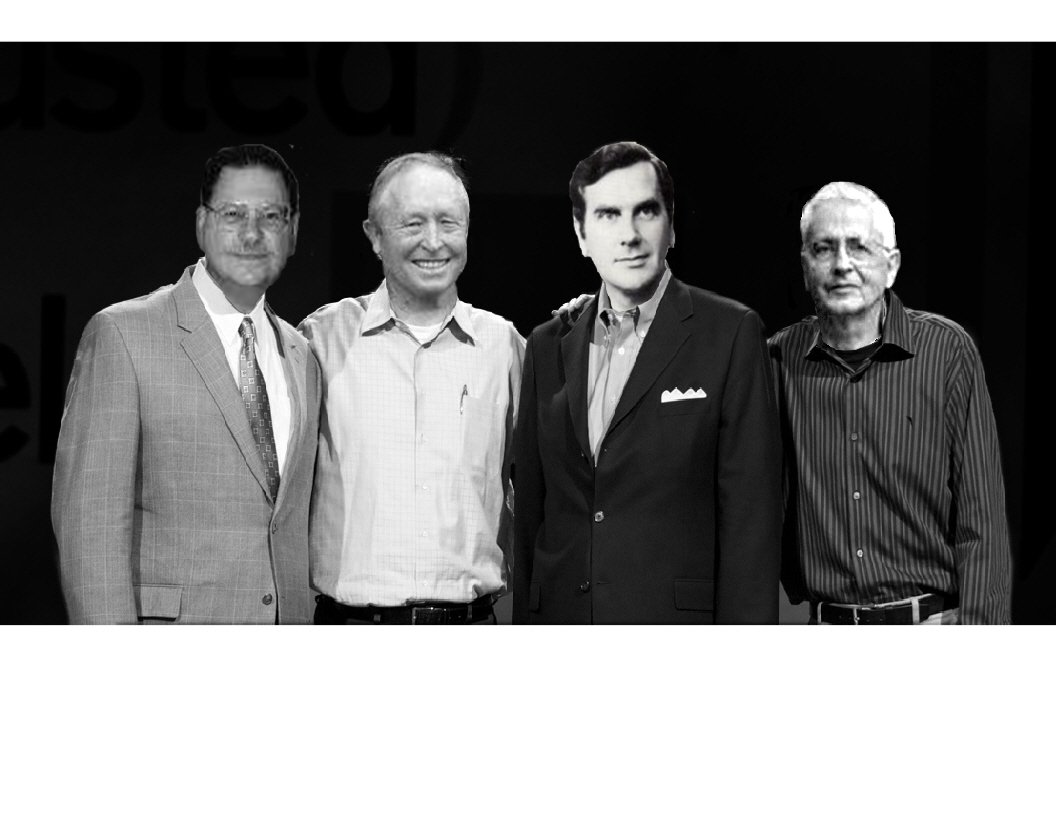 More than likely, John Piper got his theology from Present Truth Magazine. During the 70’s, and regardless of denomination, only pastors who resided on the moon had never heard of the journal or read it. Piper himself uses terminally that was uniquely that of the Australian Forum. In fact, the centrality of the objective gospel outside of us was a Forum distinctive. The Forum also developed the root and fruit/tree paradigm so often used among New Calvinists. They also developed the emphasis hermeneutic as well; i.e., “a good thing is not the best thing and to the degree that you talk about good things, you take away from the best thing.” This is the Gnostic concept of sun versus shadows; shadows are true, but they can’t give life like the sun, so we don’t want to emphasize shadows. The Forum, and Graeme Goldsworthy in particular, used this hermeneutic to redefine the new birth. These four men, whatever you think of them, were master thinkers and able to repackage complex theological ideas in an understandable way.
New Calvinism has not strayed far from the model they established, including a strong focus on pastors’ conferences. As noted in chapter 4 of TTANC 1, when Goldsworthy was invited to lecture at Southern Seminary, John Piper couldn’t help himself and wrote an article about Goldsworthy’s lecture. Until then, Piper’s kinship to the Forum was extremely difficult to establish.
Brinsmead and other notable Adventist theologians hoped to reform the Seventh Day Adventist church with authentic Reformed soteriology. The question of the final judgment has always been a sticky wicket for Adventists, and the Reformed gospel offers a solution: Jesus stands in the judgment for us. The Awakening movement that Brinsmead started in 1969 still lives in Adventist circles, and they archived all 53 volumes of Present Truth Magazine. The Forum also wrote extensively on the fact that Ellen White was a student of Luther’s writings and also wanted to solve the problem of the final judgment with authentic Reformed soteriology. This is what led Brinsmead to research the writings of the Reformers in order to solve the final judgment debate that had plagued Adventism for many years. In both Adventism and Reformed theology, the law is the standard for justification; therefore, the problem with the law being fulfilled is found in Christ fulfilling the law and “covering” the believer with the perfect obedience of Christ.
In contrast regarding the Reformation gospel and Adventism both, the Christian’s sin, in regard to justification, is not covered—it’s ENDED, and we will not stand in any judgment that determines justification.
Truly, a book could be written on the fallacies of this bogus history chart authored by Challies, but in closing I will only mention one more: the following misrepresentation by Kevin DeYoung (2008 on the timeline); the Emergent church isn’t Reformed. Why this is a big fat lie can be explained via this free booklet. Other than that, Challies’ timeline is peppered with the who’s who of the Emergent church movement, while the aforementioned notable event on the timeline denies Emergent connections. I am not sure that there has ever been a movement with more followers with an inability to think.
It’s true: I did think that New Calvinism’s connection to Adventism would be a game changer, but more significant is the fact that New Calvinism is old Calvinism, and that is also a history that has been completely rewritten. The accepted history of the Reformation and its impact on western civilization is propaganda that could only pass in the church or a Communist country.
And for whatever it is worth, and for whatever it might accomplish, that is why we are here, and it is why we do what we do, and we will do it for an audience of One if that is all that ever becomes of it.
But be sure of this: I will not stand silent while yuppie heretics rewrite history. Not while the Lord gives me breathe on this watch.
paul

 Paul's Passing Thoughts
1 comment