Plan Moving Forward
As some of you know, I have been in the process of writing The Truth About New Calvinism Volume 2. There are also other book projects running in the background for the future. One of them is a home fellowship manifesto of sorts. The theses follows:
- The assemblies of Christ were intended to be home fellowships and nothing else.
- Any professing Christian indwelt by the Spirit has the authority to baptize or serve the Lord’s Table.
- Home fellowships should be organized according to New Testament principles.
- Home fellowships should be totally disconnected from the institutional church.
- Home fellowships are individual centered—not group centered; in other words, the focus is on individual gifts.
- The institutional church is historically rooted in the false gospel of progressive justification. The very gospel of “church” is progressive justification and salvation by institution.
- Home fellowships are predicated on fellowship for a common purpose, not authority.
- Home fellowships are predicated on encouragement and leadership, not horizontal lordship.
In light of recent episodes in the ongoing institutional church megadrama, such as the infamous John Piper tweet, “If Jesus is not empathetic to your mistreatment, you don’t need to be. If he is, no one else needs to be. He will settle,” it has been suggested that this project running in the background be moved up to first priority, and I agree. More and more, the true colors of the institutional church are becoming evident:
If you want to have any chance at all of getting to heaven, keep your damn mouth shut, give your tithe, and know that without us you have no hope because you are clueless.
Therefore, instead of resuming my writing schedule for TTANC 2 on Monday, I will be delving into this project: AC Preveiw
This is not going to be a lengthy writing project as we have been stockpiling articles and information for this project for some time (It should be in print by December 2014).
What is important is that the book will set forth a powerful argument that will embolden Christians to free themselves from this institutional church dark age and live out their calling to the fullest.
Please be in prayer, and by all means give us your input.
paul
What is the Reformed/Calvinist “Noble Lie”?
 This post wasn’t on my schedule this morning, but I am nevertheless compelled to start my day by commenting on a link that “Carmen” has sent me. Carmen comments on PPT publically, and I continually get emails along the line of, “Hey, did you see Carmen’s comment? She really gets it.” Not only that, Carmen sends me research that flavors what is written here, and frankly, I fear that a lot of it will be lost in PPT’s 1 TB plus archives.
Therefore, starting with this post, and because she comments publically as “Carmen,” we are going to attach her relevant input on the bottom of posts where applicable to the subject. This will prevent her efforts from being lost in PPT electronic files and my 58 year old mind. This might include one of her comments that often contain research, or research that she sends us.
Furthermore, the research she sends influences the writings here to the point where it is becoming a borderline plagiarism issue. We know that she probably isn’t concerned about this, but we are. Therefore, whenever Pearl or the other contributors want to pad a post with her research, it will be archived along with the post at the bottom starting with this post where you can refer to the link that she sent me.
Let’s now address the link sent: a post on the TGC blog by Colin Smith concerning “change.” Let’s also be clear: Reformed thought disavows the idea that people change. When they write books like “How People Change” by the habitual liar Paul David Tripp, they don’t really intend to teach that people change. This should be obvious, no? How many of these guys have publicly proclaimed on the one hand that, “I am done trying to fix people” while on the other hand speaking of “change.” So, what’s going on?
 “Cognitive dissonance!” That was easy. We have to go further than that; we have to discuss the most important element of CD, which is a mental form of ED. CD is functioning by two contradictory ideas or a series of contradictions, and in the case of CD, there is what psychologists call the “consonant” or “buffer.” It is the ideas that attempt to reconcile the contradictions and relieve the anxiety that causes it.
In the case of Reformed thought, the consonant is orthodoxy. What is orthodoxy? It is a dignified form of mythology which shouldn’t need dignifying. Mythology is not a collection of ancient superstitions as many people suppose. Mythology is the teaching construct of spiritual caste. This is the most common philosophy of world history. It presupposes an epistemological pecking order between deity, or a natural force, and humanity. The deity, or force, preselects those who can comprehend reality to lead those who cannot comprehend reality. Sometimes, those who cannot comprehend reality don’t know they can’t comprehend reality and hinder the preordained from bringing order and wellbeing to humanity; we call that “war.”
So, mythology is simply parables written by the preordained to help those who cannot understand reality to understand why they should follow the preordained. Predeterminism is central to this common philosophy and dominates mythology in general. Plato articulated this construct in The Republic this way: philosopher kings, warriors, producers. The producers do not necessarily take mythology literally, though some do (now you can invoke “superstition”); they understand that it is a narrative tool to help the producers understand why they should function a certain way in society. It is no different than the concept of children’s story books, except mythology is for adults. We try to instill principles in children based on what we know they can’t completely understand through stories and narratives—it’s the same construct. Of course there isn’t really a “Little Blue Engine That Can.” The personification of a train is not to be taken literally.
Orthodoxy is the same thing. It is the traditional teachings of preordained “Divines” who write creeds, confessions, and catechisms for the great unwashed masses. In mythology, orthodoxy’s kissing cousin, we have what’s called the “noble lie.” It is the misrepresentation of something cognitive that the producers understand in an elementary way. People don’t really change, but most producers are unable to grasp that, so the goal is to teach “change” in a way that produces the functionality desired by the philosopher kings.
Hence, the meaning of words in the minds of philosopher kings rarely mean the same thing to the producers. Philosopher kings allow the producers to assume they mean the same thing, but they don’t. And it’s not a lie because words that producers understand, and the way they understand them must be used in orthodoxy in order to lead the ignorant to green pastures of wellbeing; it is the noble lie.
And, the break point: the consonant is “paradox,” viz, contradictions only seem to be contradictions because the producers cannot comprehend what the philosopher kings can comprehend. And, this construct is appealing to the producer class for a number of reasons. If you want to see this construct in historical living color, study Nazi orthodoxy during the WWII era. The Bible makes it clear that there are some things God knows that we cannot understand, however, the bible also makes it clear that we are responsible for what we can know, and what we need to do in order to know it. In this construct, people are not responsible for knowing anything and many people like that idea for many misguided reasons not excluding good old fashioned laziness.
So, now we know the definitions of mythology, orthodoxy, superstition, and paradoxy in their true historical context.
The Colin Smith post is just another example of all of this. If you examine his sentence structure carefully, you begin to suspect that he really isn’t saying what he seems to be saying, and that’s the whole idea; he really isn’t saying what he seems to be saying. It’s a philosopher king thing, you wouldn’t understand. Notice that he subtly defines “birth” as an idea that can’t be dichotomized from the growth process. To think of a man as different from a baby is to deny babies because the growth that made the man is dichotomized from the separate concept of “baby.” Reformed elders constantly practice this cultish form of metaphysical two- stepping communication. It’s subtle, and very evil. It is often done by eliminating conjunctions/transitions and thereby making two different things the same. Their deceptive communication techniques are an identifiable system and complex.
Look, I am not going to dissect all of his nuance in the post; there is no need as others in his camp make it clear that people don’t change. Obviously, he is not saying what he seems to be saying, and you are supposed to accept it based on the Reformed CD consonant.
Don’t but it. It’s nothing more or less than Nazi Light.
paul

Sent by “Ghostwriter”: Recipe for a Hostile Takeover
Originally published June 28, 2013
 Preamble: An anonymous person sent me the following satire of New Calvinist Ernest Reisinger’s article on how to take over a church covertly. Reisinger left the Earth in 2004. He was one of the forefathers of the present-day New Calvinist movement. I detail Reisinger’s departure from Presbyterian circles for the sole purpose of taking over the SBC with the Australian Forum’s doctrine in my fifteen-page addendum to The Truth About New Calvinism: Volume One (TANC Publishing 2011). Reisinger and his brother John were part of a small group of men associated with the Forum who believed that they had rediscovered the true Reformation gospel. And they were right. But key was the fact that they were also armed with the Forum’s brilliant systemization of the doctrine for contemporary consumption—a feat that has given New Calvinism its staying power.
This small group of men set the precedent and procedure for covert takeovers. The protocol was further articulated in Dan Southerland’s book, “Transitioning: Leading Your Church Through Change” (Zondervan 1999). Ghostwriter is a member of a church in America, which means that it is in the process of being taken over by New Calvinists or the takeover is complete; hence, good reason to remain anonymous because these guys will utterly ruin your life if you stand up to them. How? Well, for one, most American Christian wives just want to be a member of a church and enjoy the community of it without any controversy. It’s just the way Protestants have been programmed over the years. This is one of the points of exploitation, among many that are used. And unfortunately, a change of membership will more than likely find the same problem.
The only answer is to reject the New Calvinist premise altogether and come out from among them. Unfortunately, much more carnage will have to be displayed before that happens to any significant degree.
paul
Recipe for a Hostile Takeover
It’s the “Little Red Book” of hostile Reformed church takeover, publically available for all to see. (My italics are the satire, obviously)
“Therefore He says: “Awake, you who sleep, Arise from the dead, And Christ will give you light.”
“whose minds the god of this age has blinded, who do not believe, lest the light of the gospel of the glory of Christ, who is the image of God, should shine on them.”
_______________________________________________________________________________________________________
REFORMING A LOCAL CHURCH
STRENGTHEN THE THINGS THAT REMAIN
by Ernest C. Reisinger
Rev. 3:2
“Wake up! Strengthen what remains and is about to die…”
Rev. 3:4
“Yet you have a few people…who have not soiled their clothing.”
Chapter III
SOME PRACTICAL SUGGESTIONS FOR THE CONTEMPORARY SCENE- ( i.e. an unsuspecting, biblically sound free-grace preaching Church in need of radical reform )
Some who read this pamphlet are in, or will be in a reforming (hostile takeover) situation. And each situation has some different obstacles to deal with. The size of the church and the staff will make some difference in the approach as will the kind of membership, (discerning Christians- avoid these churches like the plague, or ripe-for-harvest mindless troglodytes already under the influence of Nicolaitanism, seek these for takeover) the spiritual caliber of the leadership (see above). I wish we had some little pamphlet with ten rules to success (we don’t now but one is probably forthcoming, every other dictatorship on earth has a pamphlet like the little red book, etc), but it is not that simple. There are not ten rules to guarantee success. There are some principles, however, that will always be helpful and will save some shipwrecks .
1. Don’t try any reformation until you have earned some spiritual credibility with the church (Pretend you are what you aren’t, hide your true views from the search committee and the congregation until you have suckered them in, be sure to throw in an old-time revival/gospel meeting every now and then to woo the wary).
2. The first suggestion is study the biblical principle of accommodation. There is a little pamphlet on this subject (The Principle of Biblical Accommodation as Applied to the Invitation System), (shows you how to pretend to be a free-grace preacher until you have your hand-picked elders and a quarter of the congregants under your sway) and an excellent message on tape by Thomas K. Ascol. This is available through The Christian Gospel Foundation, 521 Wildwood Parkway, Cape Coral, FL 33904, or Pastor Thomas K. Ascol, Grace Baptist Church, 204 SW 11th Place, Cape Coral, FL 33991.
3. Three questions should be asked, and carefully answered:
a) What is the right, biblical thing to do?
b) How should these changes be implemented?
c) When should they be implemented? Don’t try to do too much too soon. Many mistakes have been made by doing the right thing in the wrong way or at the wrong time (because even ignorant congregants were able to quickly see through the cloak.
4, The principle of priorities must be applied. You can’t change everything at once–first things first (go slow, it will take time to deceive).
5. The principle of two churches must be before us at all times.
a) The church as it should be, conceived from the scriptures (actually the Calvin Institutes, Westminster, various Baptist confessions of faith), in idealism–never abandon this.
b) The church as it is–the one you look at 11:00 on Sunday morning (you know, the one that has real people with real Scriptural beliefs in it?). One must realize that the two shall never meet on earth, but you will find joy and satisfaction in narrowing (weeding out the Arminian Free Grace miscreants) the difference between them, that is, when you see the one you look at on Sunday morning make some steps toward the (Calvinist) ideal one.
6. The principle of church membership. Don’t make church membership any narrower than the New Testament (suck in as many poor saps as you can before you uncork the bottle).
7. The principle of restraint. Don’t tackle the whole church at one time (this will never work for reasons stated above). Choose a few men who are sincere, teachable (unwary, biblically unlearned, unwilling to engage brains in coherent thought, nice guys but mindless) and spiritually minded (religious but not holding to any solid beliefs except that somehow Christ died for them) and spend time with them (indoctrinating them in your intellectually superior beliefs ) in study and prayer. They will help you to reform (because they don’t know any better). This principle is found in Titus 1:5: “For this cause left I thee behind in Crete, that thou shouldest set in order the things that are wanting and ordain elders in every city, as I had appointed thee.” Acts 14:23: “And when they had ordained them elders in every church, and had prayed with fasting, they commended them to the Lord, on whom they believed.” Acts 1 1:30: “Which also they did, and sent it to the elders by the hands of Barnabas and Saul.” Acts 20:17,28: “And from Miletus he sent to Ephesus, and called the elders of the church. Take heed therefore unto yourselves, and to all the flock, over which the Holy Ghost hath made you overseers, to feed the church of God, which he hath purchased with his own blood.” Don’t get bogged down with what you call these men until they are trained (indoctrinated)–they are called overseers–elders (putty in your hands, yes-men).
8. Don’t get hung up on secondary matters (like preaching the Gospel, helping the poor, widows in the congregation).
9. Don’t use theological language that is not in the Bible, in the pulpit, such as, Calvinism, reformed, doctrines of grace, particular redemption etc. (duh, these aren’t in the Bible for a reason, moron. We are trying to take over a church here, not preach the truth). Most people will not know what you are talking about (because it is not found in the Bible and any discerning Christian will throw you out on your ear if they hear these terms, indoctrinate them slowly with simplistic language).
10. Use sound literature, not indiscriminately, but wisely. Little things at first, that is, pamphlets and books with some doctrinal and experimental substance (written by John Piper, RC Sproul, perhaps Jonathan Edwards… Those first two are the most important).
11. Don’t use the pulpit to scold people. You cannot scold people into reformation (you can only trick them into reformation).
12. Exercise common sense (see above. Don’t be an impatient idiot and get yourself canned).
13. Depend on the only weapons we have: prayer, preaching and teaching (wielding the newfound power of your inner circle of yes-men).
14. Be sure that you understand the foundational doctrines and how they are related to each other and to your situation (you freakin well better have completely aced the TULIP test).
15. I would suggest that you check the history of your church in respect to early constitutions or declarations of faith. Often you will find, particularly, in older churches, a statement expressing the doctrines which you desire to establish (in other words a Church that has already tried reform theology but it blew up in their face, don’t worry, our new brand will work). A gracious appeal to this document will help to give you credibility, at least they will know that you are not coming from Mars (just from infiltrated seminaries completely out of touch with reality and the laity and completely under the influence of the doctrines of men). Hide behind these articles of faith (I can’t even think of anything sarcastic to say to this, can’t believe it is so blatant). Hide behind our Baptist fathers, such as Bunyan, Spurgeon, Fuller, Boyce, Dagg, Broadus, Manly, W. B. Johnson, R. B. C. Howell and B. H. Carroll (because they will love you if you quote their founding fathers until you are ready to reveal your true colors).
Most of these suggestions come from experience, and, she is a queer old teacher. She first gives you the test and then the lesson. Unlike other teaching (which relies on Scripture to give the lesson).
Victims and Discernment Bloggers: Let’s Ask the Right Questions
“So, they would say to the young ladies and boys who have been molested in the church, ‘So what?’ The same sin that indwells the pedophile is in the victim as well. Can we not survey the past and present abuse and see this worldview plainly?”
Even though we hate to think commonsense is important in understanding spiritual issues, the fact remains that such is the case. We struggle with this because of our notion that material is evil and spiritual is good. This notion is deep-seated in the Western psyche. Consequently, we are often willing to throw math out the window for something spiritual. Also, the spiritual get out of commonsense free card comes in handy when we have invested too much of our own self-esteem in a bad idea. If we humble ourselves and admit we were wrong, our intellect labeled as “humbleness” (lest it have no credibility) seems to lose its credibility.
Frankly, I find admission of wrong freeing. Yes, it may make you feel stupid for a while, but the problem with being wrong is that you can’t get anything done with bad information, and not getting anything done leads to hopelessness. Ultimately, even if you are stupid, people will judge you by what you get done, and even if they don’t, God will. Christ is documented throughout the New Testament as being annoyed by verbal assent to righteousness rather than actual doing, and bad information does not lead to right doing. This would seem evident.
But what if you can’t really know anything? And what if you can’t really do anything good? What would the results of that be? Well, look at the blogosphere spiritual discernment and victim “healing” ministries. In full force since 2009, matters continue to get worse, not better, and to date, justice for the victims is found nowhere. Why? Why doesn’t discernment ministry work? In the analysis of Herman Cain’s acronym, W-A-R, discernment bloggers are not working on the right problem, asking the right questions, nor removing the necessary obstacles.
What is the right question? It follows: “Why doesn’t discernment ministry accomplish anything?” Need proof? Anybody remember the outrageous ABWE scandal? Thought so. A secular media producer just cancelled “Here Comes Honey Boo Boo” because of the mere potential of a smidgen element of the ABWE scandal, yet, ABWE continues to thrive unabated. How can this be? is another right question.
No, that is THE right question. And what is the obvious answer? It follows: people keep supporting ABWE financially. In case it escapes anyone, ABWE cannot continue unless it receives money. That raises another question: “Why do people keep sending such an organization money despite their deplorable behavior?”
Um, I can only tell you why the people who keep sending ABWE money say they keep sending ABWE money. Would that suffice? The reasons follow:
- Because ABWE, and institutions like it are God’s anointed, preordained vessels to take the gospel to a dying world, they are the only ones qualified to do so. If ABWE fails, thousands and thousands of souls will go to hell for eternity. ABWE must survive.
- ABWE must operate with people, and where there are people, there is sin, this is unavoidable.
- ABWE should be forgiven as Christ forgave us.
These are the reasons that no justice can be found in the institutional church. These are the reasons that religious institutions continue to spiritually abuse unabated. That’s the problem that must be worked on. Those answers assume the following: spiritual hierarchy, moral equivalency, and individual value defined by contribution to the group; i.e., no justice for the individual is what’s best for the many.
Note: the institution in and of itself is not the problem, people in and of themselves within the institution are not the problem, and money in and of itself is not the problem: the logic is the problem. The threefold logic clearly gives license to the behavior. The threefold logic insists that nothing can be done, or that nothing should be done. In fact, the threefold logic insists that there really isn’t a problem to be worked on in the first place—this is clearly ascertained by the normative results of all of these scandals.
So, how do discernment blogs work on the problem? By exposing the problem, “properly” identifying the problem, and assuming that the institutions will respond and seek justice for the victims. How’s that working for us so far?
So let’s ask another right question: “Why isn’t that approach working?” One reason is the identification of a particular problem that discernment bloggers like to call “cognitive dissonance.” This is the study of how people believe contradictory propositions and their attempts to reconcile the contradictions. But this is where discernment bloggers totally miss it: spiritual hierarchy is more times than not predicated on the idea that the masses cannot properly interpret reality itself. How many times have we heard the following?
No matter what it looks like, you need to trust the leaders who have been working close to the situation and know all of the details.
Though we would not agree with a naked verbalization of the idea that only spiritual leaders can properly interpret reality, we by all means function that way. However, more and more in Reformed circles, this concept is being openly stated in the following way:
All of reality, or what is truly reality, is interpreted through redemption, and only the gifted are able to do so. Meanwhile, it is acceptable to obtain worldly knowledge, and some of it is good, but a good thing is not always the best thing.
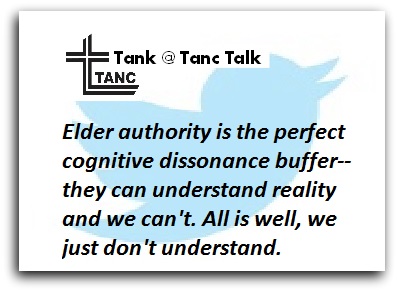 Therefore, when it comes to spiritual matters, trust God’s anointed regardless of the obvious. In cognitive dissonance, the thing used in an attempt to reconcile two contradictions as much as possible is called the “buffer.” In this case, the buffer is the belief that spiritual leaders must be obeyed because they are the ones who can see reality and we can’t. Sure, we can understand worldly things that have no eternal value, but when it comes to eternal matters the leaders must be trusted at all cost. The right problem to address is the buffer, not the symptom of being comfortable with contradictions. Discernment bloggers wrongly identify the real problem and work on the wrong one. They fail completely on Cain’s “W.”
And by the way, if you want to read a sermon by a conservative evangelical that exemplifies this dualist approach to reality, you can read it here, and listen to it here.
In addition, this author can give firsthand evidence of this mentality via correspondence from someone upset by what this ministry publishes.
Deep down you know that it is true. Turning logic on its head, twisting words, pseudo-scholarship, and outright attacking people for things that both you and I know they do not believe does no one any good.
Another misunderstanding is that I somehow knew and stood behind any improper things you may have experienced at Clear Creek.
These statements were made in light of the fact that citations/quotations make-up approximately 30% of what our ministry writes, and improper things “you may have” experienced is set against a website that thoroughly documents what exactly happened. The individual wrote these statements in the face of undeniable documentation. How can he do that? Because only those with authority can properly interpret reality despite the evidence presented to the contrary. That’s why. The individual also accused our ministry of “pseudo-scholarship.” Why is it such according to him? Because it doesn’t have the authority of Reformed institutional scholarship—they are the ones who really know the truth. Discernment bloggers seem to miss the point that institutional tyrants do not interpret reality in the normative sense.
Another point missed by discernment bloggers is: tyrants who interpret reality differently will not always act out in the same way. However, if the same ideology does not produce shameful behavior, it will at least produce tolerance for it. And the right question here is, “why is this so?” Answer: moral equivalence. If everyone is Adolf Hitler at heart, who is anyone to judge anybody for anything? We are ALL just sinners saved by grace after all. “Justice,” you say? What justice? We ALL deserve hell! Again, this is also seen in the aforementioned correspondence:
I truly grieve for the things that you have shared have happened with your family, but all either of us can do from here is look to faithful God and away from the sin that is in our heart and other men who will always ultimately disappoint because none of us are sinless.
Notice that he grieves for the things “that you have shared happened with your family,” i.e., how I interpret their actions, not what they actually did. And notice that the sin these men may have committed against me is also in my heart as well. So, they would say to the young ladies and boys who have been molested in the church, “So what?” The same sin that indwells the pedophile is in the victim as well. Can we not survey the past and present abuse and see this worldview plainly?
So, if there is no moral unequivalence necessitating a need for justice, all that is left is unity and peace for the sake of unity and peace which can only be obtained by blindly following those preordained to lead the great unwashed masses. We must also understand that this logic gave rise to institutions in general and the institutional church in particular.
Let’s work on the right problem: the worldview of the institutional church. Let’s ask the right question: “What should we do about it?” And finally, let’s remove obstacles to what works.
The obstacle that needs to be removed is fellowship with the institutional church. Again, the institution in and of itself is not the problem, but its caste worldview is the problem. Christians en masse must stop giving their money to the institutional church and must warn all people that they involve themselves with the institutional church at their own risk. It looks something like this:
Mark, likewise, I don’t care to debate with you because we see reality differently. I interpret reality grammatically, and you interpret reality redemptively like the Neo-Platonist “Christians” that you follow. Even John Street has bought into this latter-day antinomian nonsense. All I want to hear is that you stay clear of my family, and let’s be clear, it is not a wish—it is a demand, and I will protect my family at all cost—be sure of it.
Keep your family away from the institutional church. What else needs to happen in order to demonstrate that its fundamental worldview is horribly distorted? Husbands need to step up and take over their responsibility before Christ to lead their own families spiritually. You need to join a fellowship and be encouraged by men of God who can think for themselves and fear the Holy Spirit more than puffed-up control freaks. If you cannot find such a fellowship, do so in your own home.
paul
Related articles:
Love Your Local Institutional Church
 One of the advantages of having Calvinist friends on my Facebook friend list is that little gems like this one appear in my news feed from time to time. The article is entitled “Do You Love the Church Like Jesus Does?” It was written by a young man named Mark Perry, Associate Pastor of Westerville Bible Church in Westerville, Ohio, a suburb of Columbus. Mr. Perry could be considered to be of the “young, restless, and reformed” variety.
The opening caption of the article asks the question, is it possible to love Jesus and not love His church? Obviously, a question such as this establishes the premise that such a thing is not possible. We are to assume that these two things are not compatible. If you don’t love the church then you must not love Jesus. The purpose of the article seeks to first define the “church” and then make the argument of why and how we are to love it. Again, you can read the entire article here, but I have reproduced the body of the article in this post so that I can offer a review of Mr. Perry’s arguments (in italics) and insert my comments to relevant sections that I want to point out to you.
Do You Love the Church Like Jesus Does?
What is the church?
We use the word “church” in many different ways. How can we pinpoint what that means? In Ephesians we are told that “Christ loved the church and gave himself up for her” (Eph 5:25). We can identify the church by asking for which “church” Jesus died.
The church is not the building in which believers assemble. We often use the word church to refer to the building: “What a lovely church!” or “The church could use a new coat of paint.” But surely this is not the church for which Jesus died. In fact, New Testament congregations met in members’ homes (e.g., Rom 16:5; 1 Cor 16:19; Col 4:15; Philemon 1:2). In many parts of the world today, our brothers and sisters in Christ meet in homes, parks, or public locations. It is not necessary to own property or have a physical building dedicated to the regular assembling of Jesus’ body.
So far so good. All very well stated. These are all things that Paul and I have both stated on regular occasions. I would agree with Mr. Perry on this point. Notice how he establishes that the church is not a building. In fact, he goes to some length to establish what the church is not, thereby framing his argument to follow. Reading on:
The church is not the meetings or ministry programming. Another way we use the word church is to refer to a worship service or ministry program: “Church was great this morning; I really enjoyed the sermon.” “My church has so many ministry opportunities available.” Many people see the church as the sum of services or ministries offered: children’s ministries, fellowship opportunities, teaching and preaching, or other benefits offered to members or adherents. But did Jesus die to secure singles’ ministries, Vacation Bible School, and youth groups? Did Jesus love a certain style of music or preaching so much that he left heaven to give his life? Every generation of believers since the book of Acts has had to work out how to obey Jesus’ command to make disciples in their culture.
Ok, here he starts to drift a little. First of all, we don’t have to “work out” how to obey Jesus’ commands. His commands are clear. We either do them or we don’t. The way we make disciples or “learners” is by teaching them exactly what Jesus said to do. The message of the Gospel of the Kingdom is not culture-specific. It is the same for all men everywhere. We don’t have to “figure it out.”
The other thing I notice in this statement is the implication that evangelism takes place within the confines of the institutional gathering or its ministries. This is patently false. Evangelism is an individual mandate. We don’t bring the unsaved to the church through the means of some “program” or “ministry” in order to get them saved. We as individuals go out to them and preach the gospel to them. When they hear and believe and become saved, we then invite them to fellowship with the assembly for the purpose of edification.
Moving on…
The church is the regular assembly of believers in Jesus. We often say, “The church is the people”
This is correct. Yay! The reason we often say it is because it’s true.
and we are right—almost.
Wait…Huh? What do you mean “almost?”
On one hand, the universal church includes all believers in Jesus from the Day of Pentecost until the Rapture. At the moment of Jesus’ return in the air, the universal church will be assembled for the first time: “those who have fallen asleep” and “we who are alive, who are left” (1 Thess 4:14, 17). But until that time, the church exists on earth in localized assemblies of believers who meet regularly for prayer, Scripture reading, teaching of apostolic doctrine, and fellowship (Acts 2:42). The Greek word translated “church” (ἐκκλησία) means assembly or gathering and sometimes in the New Testament it even refers to groups of unbelievers (e.g., Acts 19:32, 39, 41).
Ok, while I don’t see the NT making any distinction between “universal church” and “local church”, nevertheless his other points here are spot on. And he would have been better served stopping right there, but he didn’t. Read on…
The church is the church when it is assembled.
WHAT? Read that again. He said, “The church is the church when it is assembled”? The logical inverse of that statement would necessarily follow that the church is not the church when it is not assembled. But he just said the word “church” is the word “ekklesia” which means “assembly.” The reality of his statement indicates that the church does not exist when it is not assembled. That would mean the church only has relevance when it is assembled.
At the beginning this author made points about what a church is not. It is not a building, it is not a program. But please notice his emphasis is still on some group entity over the individual. And this is something that “Argo”, a blogger who frequently comments on Paul’s Passing Thoughts, has written on extensively over the past few weeks. In Reformed and Protestant orthodoxy, there is no relevance or meaning or existence outside of the group! To them, our relevance as believers only matters within the church. So, when we are not assembled, we don’t matter.
It is those believers who regularly gather in Jesus’ name. Therefore, the church that Jesus loves and for whom he died is the gathering of believers. These local assemblies or gatherings of believers are the only church we can know this side of heaven.
I would dare to ask Mr. Perry that if the church is the Body, and we are individual members of that Body, each with our own function, then do we cease to be a part of that Body when we are not assembled? Are we only part of the Body when we meet on Sundays (or Wednesday, or Saturday, or any other required meeting time/place)? I contend that our relevance as believers extends far beyond that which we do when we gather for fellowship. And our not being assembled together in fellowship at any given time does not preclude our identity as a member of the Body of Christ. He continues:
What does it mean to love the church?
We are commanded to “walk in love, as Christ loved us and gave himself up for us” (Eph 5:2). In other words, we are to love the church just as Jesus does. The command to love Jesus’ church is the same as the oft-repeated New Testament command to “love one another” (e.g., Rom 12:10; 13:8; 1 Thess 3:12; 4:9; 2 Thess 1:3; 1 Pet 1:22; 4:8; 1 John 3:11; 4:7, 11, 12; 2 John 1:5). So we love Jesus’ church when we love the brothers and sisters in our local assembly.
What about other brothers and sisters in other assemblies around the world who are not part of our cult group assembly, who don’t necessarily share all the same beliefs in matters of practice? Are they not a part of the body because they don’t assemble with us? Is our church somehow better/superior to their church because we don’t “worship” the same way they do, because we “do church” the “right way”? Are they any less part of the body of Christ? Are they part of the assembly because they are born-again believers in Christ or instead because they regularly assemble at our “church”?
And this is where it gets difficult. We may love our church’s beautiful building, we may be enraptured by our favorite preacher’s sermon series, or we may appreciate the array of ministries and opportunities our church offers, but loving these difficult, obnoxious, unkind, and sinful people is a different matter entirely! Jesus’ love for us is our example to love his church. What about the sinful people in my church? Jesus loved me while I was a sinner (Rom 5:6–8). What about the cantankerous or antagonistic people in my church? Jesus loved me while I was his enemy (Rom 5:10). What about the people who have weak consciences or unreasonable standards in my church? Jesus served others, not himself (Rom 15:3; Mark 10:45).
Mr. Perry must not think very much of the members in his church. Look at what he calls them: “difficult, obnoxious, unkind, and sinful people… cantankerous or antagonistic… people who have weak consciences or unreasonable standards”. Wow, I sure want to be a part of that church now that I know what the pastoral staff thinks of me! The view of the continued total depravity of the saints is clearly evident in this paragraph. The Bible does not call believers “sinners”. That is what we were in the past. Let us not forget the rest of 1 Corinthians 6:11, “…but ye are washed, but ye are sanctified, but ye are justified in the name of the Lord Jesus, and by the Spirit of our God…” Believers are righteous, Mr. Perry, because we have the righteousness of God the Father. We have His seed in us that cannot sin! (1 John 3:9)
As I continue to read these last points, the emphasis of the church as an institution (…our church’s beautiful building…preacher’s sermon series…array of ministries and opportunities…) vs. a body of individuals is apparent. The “church” is referred to in terms that place the emphasis on this “entity” that is something other than the body of Christ. It is very subtle, but the undertones are there.
How can we love the church?
How then can we “walk in love” and serve one another through love (Gal 5:13)? Here are four practical ways.
Meet regularly with Jesus’ church. Don’t turn your back on Jesus’ church because you don’t like the facilities or prefer a different ministry emphasis. Don’t abandon Jesus’ church for something that is not the church. Jesus has promised his presence with his church until the end of the age (Matt 28:20). Jesus meets with his church—do you?
There is a veiled threat in this point regarding abandoning the church. What happens to the one who abandons the church? What is the “something that is not the church”? Do you not see the equivocation here that if you are not part of the church then you are not a part of the Body, ergo, you are not saved? Whether or not it is stated plainly, reformed orthodoxy functions under the belief that salvation is found within the institution.
Pray for Jesus’ church. If you see problems [sic] When you see problems in your church, pray for your church.
Yes, by all means, we ought to pray for each others’ needs as we fellowship together. We ought to pray that our fellowship time is efficacious. We ought to pray that we would be on our guard for wolves who would do violence to the flock, and that we would be discerning regarding false teaching. But that is not what this author has in mind. His concern here is with the actual institution itself. Consider report after report of spiritual abuse and scandals that have rocked the religious word in the last few years. But yet it is these same institutions that must be preserved for the “cause of Christ”, regardless of the problems that exist. Look at this next paragraph:
Are you concerned about your church? Remember Jesus loves his church—he died for her—and he cares for your church more than you ever could (Rev 1:12, 20). We pray with confidence when we pray according to God’s will (1 John 5:14), and we know what God’s will is for the church—that she becomes like Jesus! This is what God is at work doing (Phil 1:6; 2:13). Pray the God-breathed prayers of the New Testament for your church (e.g., Eph 3:14–21; Phil 1:9–11; Rom 15:5–6; 1 Thess 5:23–24). Jesus prayed for his church (John 17:20–26) —do you?
Notice the collectivist emphasis in terms. The individuals are expendable. The “church” must become like Jesus, not individuals. We must pray for God’s will for the “church”, not the individuals. Jesus died for the “church”, not the individuals. Jesus prayed for the “church”, not the individuals. But consider that last reference in John 17 carefully. When Jesus prayed that night in the garden, he wasn’t praying for a church, he was praying for you and me! He was praying for the PEOPLE, the individuals that comprised His Body.
Follow the spiritual leaders Jesus has placed over his church. If you don’t like or don’t “click with” your church leadership, you might be tempted to turn your back on Jesus’ church. In fact, disagreement with the teaching or ministry direction of our leaders is a very spiritual-sounding reason for abandoning the group of brothers and sisters to whom we have committed ourselves
It’s more that just “spiritual-sounding”, it is commanded by Scripture! Come out from among them and be ye separate. Earnestly contend for the faith. Mark and avoid those who cause divisions because of contrary doctrine. But somehow this is abandonment?
But if Jesus was going to show us something new from his Word or to correct a misunderstanding we had about the Bible, how would he do that? Wouldn’t he use the leaders and teachers he has given to his church for that very purpose (Eph 4:11–14)? It seems the Chief Shepherd would use the shepherds he has set up over his church (1 Pet 5:4–5) to “keep watch over your soul” (Heb 13:17). Jesus, the Great Shepherd of the sheep, entrusted the church for which he died to your elders (Heb 13:20–21; Acts 20:28)—do you follow them?
First of all, there is nothing “new” in the Bible. We’ve had it for 2000 years or more. Are leaders and teachers giving us new revelation? Do they have some special dispensation or gifting that enables them to speak for God? Has God divinely appointed them (predetermination) to be in a place of authority, and so we must obey them? No because pastors and teachers are gifts given for the purpose of equipping and edifying the assembly, not for the purpose of authority or speaking for God. There is no mediator between God and man other than Jesus. We don’t need men to interpret God’s word for us. Shepherds guard and protect, they don’t rule. They see to the needs of the flock so that each believer can be effective in his own ministry. They don’t dictate to the flock how to think and act.
Put the spiritual needs of Jesus’ church above your own preferences. Often our opinions about how the building should be decorated or the way in which the meetings or programs should be set up are more important to us than the spiritual needs of our brothers and sisters.
Mr. Perry keeps bringing up these references to the building and ministries after he made it a point early on to emphasize that the church is not either of these. Why do these thoughts constantly permeate our thinking? Because it’s been ingrained into our mindset. This beast has created all of its own problems. Matters of preference or décor or carpet color or music choice or programs or how much to tithe all become moot when we simply get back to a Biblical model of fellowship.
If anyone could have lobbied for his own interests instead of giving himself for his church, it was Jesus (Phil 2:3–8). Jesus gave up his rights and reputation for his church—do you?
This is obviously a reference to Philippians 2:7, “But made himself of no reputation…”, but this same passage also states that Jesus gave up nothing, but instead constantly affirmed His equality with the Father.
Next Lord’s Day, as you gather in Jesus’ name with that group of believers you call your brothers and sisters in Christ, look around and ask yourself this question: “Do I love this church like Jesus does?”
Thankfully, that is the end of the article, because there is much more I could add, but I’d be writing forever. The bottom line here is that consistently the emphasis in the NT regarding the church is the assembly, or the individual members of the Body. We are to love the people, not this thing they call the “church”. Reformed and Protestant orthodoxy equivocate whenever it speaks of “church”, and that is by design. Their double-speak confuses and obfuscates the real matter- their belief of salvation being tied to the institution, and not the finished work of Christ. When you love the people you are loving the church because we are all members of it every moment, not just when we gather for fellowship. We are individual members of a Body, and no man ever hated his own body. We have got to be clear what we are talking about when we use the words we use!
Andy

 Paul's Passing Thoughts
leave a comment