New Calvinism’s Contribution to the Church: It Reveals What Calvin Really Believed
 Originally published August 24, 2013
“A question we often hear is, ‘What is the difference between an Old Calvinist and a New Calvinist?’ The answer: maybe the music style and dress code, but that’s about it, Old Calvinists that don’t know what Calvin really believed about soteriology notwithstanding.…. This is the one area where New Calvinists can recommend themselves: they have a firm handle on Calvinology.”
Once upon a time, there was a family in Christianville that was highly respected among all of the town’s people. They owned the town’s water purification plant and purified the town’s water with a formula that had been in their family for centuries.
Then a distant relative of the family moved into town. He was obviously a fellow of the baser sort. “Well, every family has a black sheep” the town’s people reasoned. But then they found out this relative had also purified water in other towns with the same family formula resulting in the death of thousands. Apparently, for the first few years, the formula appears to improve the health of people, but ill effects follow in the long term.
The prestigious family objected and insisted that the family member had tampered with the original formula. What will Christianville do now?
No doubt, New Calvinism must be exposed and stopped, but its unwitting service to the church should not go unmentioned: it has exposed the original family formula, the same formula that evangelicals have fustigated the Catholic Church for over the years. For some reason, we are willing to buy into the idea that three Catholics founded an anti-Catholic movement and never stopped being Catholics. Truly, our Enlightenment forefathers would be ashamed of us for believing such.
Supposedly, the “Reformers” modified the original formula enough to bring life out of death. Now there is debate between the New Calvinists and the Old Calvinists in regard to the originality of that formula. Old Calvinists say the New Calvinists modified the formula. That’s not the case. A question we often hear is, “What is the difference between an Old Calvinist and a New Calvinist?” The answer: maybe the music style and dress code, but that’s about it, Old Calvinists that don’t know what Calvin really believed about soteriology notwithstanding. This is the one area where New Calvinists can recommend themselves: they have a firm handle on Calvinology.
Old Calvinists are obviously very threatened by what the New Calvinists have brought to light. Those who proudly label themselves with something that they misunderstood to begin with fall significantly short of being impressive. But their dilemma is understandable to a point. The Reformers interpreted all reality through Martin Luther’s Theology of the Cross. This seeks to use the Bible as a tool for gospel contemplationism only. The sole purpose of the Bible is to show us our sin (mortification), and God’s holiness, leading to a gospel visitation afresh (vivification). The Bible aids us in perpetual rebirth experiences. This is known as the Redemptive Historical use of the Bible.
But that is not the normative in regard to how people interpret literature or reality. Naturally, we interpret literature grammatically. Intuitively, we are exegetical beings. The way words are arranged in a sentence interprets our realty. Until Adam named the animals, they had no part in reality. You say, “Yes they did, even though they were unidentified, they were there—they had presence.” No, the word “unidentified” gives them their meaning in reality. Words interpret our reality. In the Redemptive Historical construct, all the words in the Bible must serve to show us our need to be saved perpetually—those words must continually show us our ruined state so that we can experience salvation (vivification) rather than being a participant in it via sanctification. That would be works salvation according to the Reformers.
To simplify this, it is fair to say that the Reformers brought an Eastern way of interpreting reality into the Western religious world. So, as Christians throughout the centuries read their Bibles, they are/were naturally drawn away from the original Reformed epistemology. The New Calvinists basically rediscovered the original epistemology of the Reformers. Their interpretive construct is critical for living by faith alone in sanctification as a way to maintain justification.
The proof in the pudding is interaction with Old Calvinists who scoff at the idea that New Calvinism is the same thing as their vaunted Reformed heritage. I cite here a debate I recently had with Calvinistic pastor Bret L. McAtee on a social network. The debate represents something that the laity must overcome in regard to seeking out truth and standing for it: academic antagonism. This is a Reformed mainstay. Much of the populous is eliminated from the debate because of a standard set up by the Reformers themselves. This was borrowed from the Eastern concept of social caste. The Reformers established a whole other standard of truth through councils, creeds, and catechisms attended by, “Divines.” Notably, those who drafted the Westminster Confession of Faith are known as the “Westminster Divines.” This is no more or no less than the Hindu Sage. True, Hinduism looks inward to interpret reality beyond the five senses while Reformed theology looks outward. But both interpret reality through an anti-grammatical construct. New Calvinists state implicitly that a literal, grammatical interpretation must bow to the redemptive interpretive process and its mortification /vivification experience.
Point being, throughout my debate with Pastor Bret L. MacAtee, he resorts to this, you’re a peasant and I am a sage communication technique. He also tried to use the Reformed debate technique of assumptive metaphysics. What’s that? That is the assumption that the reality established by the Reformers is truth because they state it so. And this has worked well. Most Christians associate truth with “orthodoxy.” Orthodoxy is a truth established by men. The Reformers play word games here by calling documents such as the Westminster Confession, “subordinate truth,” but that is disingenuous. In fact, those who reject orthodoxy are referred to as “heterodox,” and as we shall see, MacAtee makes that synonymous with rejecting the gospel itself. Part and parcel with debating a Calvinist is their attempt to set the metaphysical parameters of the debate. I did not allow this to happen.
Let’s review these important points: a debate with a Calvinist will always involve academic antagonism and metaphysical assumption.
Note: Posts on social internet threads don’t always appear in the intended order because of varied response times to particular points. Also, it was a lengthy thread, and only the posts that articulate my summation here are included, and in the order that best clarifies the points that are being made.
McAtee got the ball rolling by using academic antagonism right out of the gate:
BM: And that New Calvinism is authentic Calvinism is a howler of a statement.
PD: Bret, It’s a “howler” because you get your information from men. I get my information from 6 years of research on the Reformation and the Calvin institutes. You are clueless.
BM: LOL … Your indicting the wrong Chap Paul. Want to compare our reading over the years in Calvin and Calvin studies?
You’d lose.
And … I’ve read your books as well.
Those well versed in Reformed theology need not bow to this antagonism. We are in the truth business and are not bound by the musings of men. One must bring the debate to one or more subjects where Calvinism is vulnerable; in this case, progressive justification:
PD: Oh, so you believe in Progressive Justification?
BM: Nope … I believe in eternal justification, objective justification and then subjective justification … rightly explained and understood.
PD: “Nope”? Really? So tell me what book and chapter in the Calvin Institutes where Calvin talks about Progressive Justification.
PD: You there Brett?
BM: Yes yes Paul … I’ve read your open letter. An open letter that suggests you don’t know what you’re talking about and are a theological novice.
Two things here. First, his description of what he believes about justification is in fact New Calvinism to a “T.” New Calvinists, like Calvin, believed that grace remains completely outside of the believer and is only objective truth outside of us. Justification during our Christian life continues and is experienced subjectively. “Eternal justification” could refer to election or final justification which he seems to have left out. Nevertheless, note his description in relationship to the New Calvinist mantras, the centrality of the objective gospel outside of us and the subjective power of the objective gospel. The illustration below shows the kinship between New Calvinism and what McAtee stated:
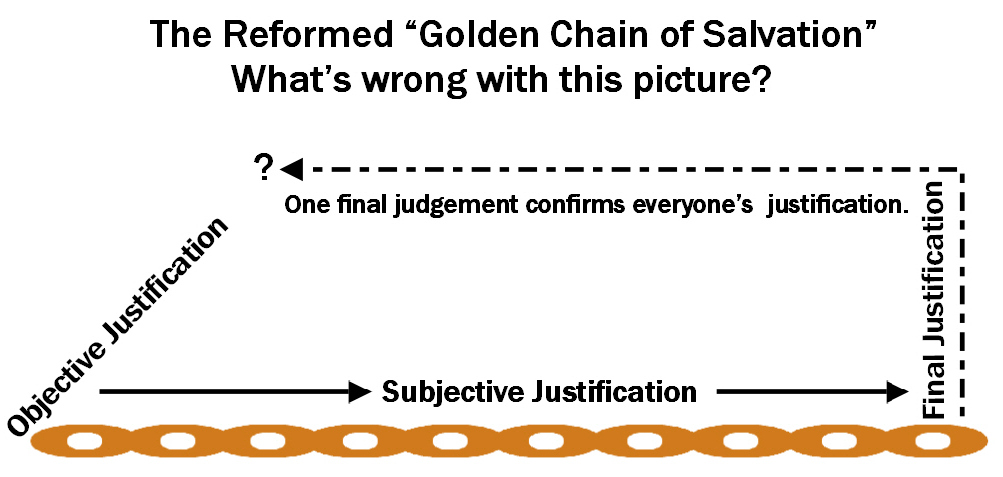
One Achilles’ heel for Calvinists is while denying that they believe in progressive justification, the title of book three and the fourteenth chapter of the Calvin Institutes is, “The Beginning of Justification. In What Sense Progressive.” This is what I was trying to get McAtee to explain. He once again resorted to academic antagonism by calling me a “theological novice” while this is one of several questions that he wouldn’t answer.
PD: So, when Calvin said that justification is progressive, he really didn’t mean that justification is progressive. Is that what you are saying?
BM: I’m saying you don’t know the difference between progressive and perpetual.
PD: Both move forward in time.
PD: No? Am I missing the definition in its “gospel context”?
PD: Both move forward in time—yes or no big guy.
This is the whole motif that Calvinists are on some higher plane of understanding to the point where what seems obvious to the peasantry really isn’t realty. Hence, “progressive” and “perpetual” are supposedly different concepts that the common man is unable to understand. Again, I ignored the academic antagonism and asked him if both words have the idea of moving forward in time. He wouldn’t answer the question; instead, he posed a question based on Reformed pseudo-church history:
BM: Only an idiot could believe that Cardinal Sadolet and Rome hated Calvin because he agreed with them on Justification.
This response combines academic antagonism and metaphysical assumption. The assumption is that, according to the Reformed motif, there was a great gulf in the view on justification between Rome and the Reformers, and the only reason Rome hated the Reformers is because of their diametrically opposed views on justification. This is not reality at all for a couple of reasons. First, Calvin got his theology from St. Augustine who is a celebrated spiritual hero in the Catholic Church till this day. Secondly, Augustine, Luther, nor Calvin ever renounced their own membership in the Catholic Church. Here is how I sated it further along in the debate:
PD: Bret, let me also say that a cursory observation of church history shows that Augustine, Calvin, and Luther never left the Catholic Church. Yet, you are incredulous that their take on justification would be basically the same. So is it, A. You just don’t know any better, or B. You know, but you are deliberately keeping your flock dumbed down? Augustine was a die-hard Catholic till the end while Calvin cites him more than 400 times in the Institutes. And the idea that they had the same basic approach to justification as Rome is an over the top idea?
McAtee continued to bear down with heavy doses of academic antagonism and metaphysical assumptions with this statement:
BM: Like all idiots you are reading Calvin through a keyhole and then reinterpreting him through the Keyhole instead of letting his whole corpus of thought inform you. You are an example of someone that got in way over his head into areas he was not yet ready to think about. You may yet return to Biblical Christianity Paul and leave your heterodox ways and thinking.
Please remember at this point that he refused to answer the simplest of questions: did Calvin mean progressive by “progressive,” and does both perpetual and progressive have the idea of moving forward in time? Instead, he suggests that all of Calvin’s massive literary droning would have to be read and studied to properly understand what Calvin meant by the very use of specific words. Of course, that is a ridiculous notion, but not a rare argument among the Reformed. The same argument is often used to defend John Piper who has also written a huge mass of literary droning. Note also that my “heterodox” (other than orthodoxy) is likened to a departure from “Biblical Christianity.” The mode of operation is to demean and argue from a reality that results in the desired outcome.
McAtee then introduces another Reformed technique of debate that we will call, drowning by orthodoxy. He then began to copy and paste a mass of Reformed orthodoxy that would take two days to read. The assumption is that I am not familiar with what he pasted into the stream. It assumes the response, “Oh my! I don’t understand any of this deep orthodoxy! And there is so much of it! Hark, I know nothing! What to do? His mind is so far above me!” Actually, I am very familiar with the information posted, especially his references to articles in the Trinity Review. Ironically, if that is a strong enough word, the founder of the Trinity Review bought into New Calvinism during the 90’s. I stated the following later in the thread:
PD: Furthermore Bret, you said you read my book, but yet you quote John W. Robbins’ Trinity Review above to make your point. As clearly documented in my book on pages 63-65, I show that Robbins bought into the Forum’s teachings via the SDA theologian Robert Brinsmead in 1995. As you know, New Calvinism came out of the Forum and Graeme Goldsworthy is popular in the movement till this day. Robbins reprinted Brinsmead’s magnum opus on justification in the Trinity Review, yet, you cite The Trinity Review as proof that Calvinists are not New Calvinists. Now if anything is funny, that is.
One of his several references to the Trinity Review follows:
The Trinity Foundation – Calvin on the “Pernicious Hypocrisy” of Justification by Faith and Works
http://www.trinityfoundation.org
That some serious slippage has occurred away from the classical Protestant doctrine of justification sola fide has been well documented in many religious publications. Certain teachers – Douglas Wilson.
Furthermore, his excerpts copied and pasted from the Calvin Institutes contained things like the following:
…a great part of mankind imagine that righteousness is composed of faith and works [but according to Philippians 3:8-9] a man who wishes to obtain Christ’s righteousness must abandon his own righteousness…. From this it follows that so long as any particle of works-righteousness remains some occasion for boasting remains with us [Institutes, 3.11.13].
This is yet another technique used by Calvinists to confuse those who are trying to nail their false doctrine by making distinctions between justification and sanctification—they continually refer back to justification and Sola Fide. Any attempt to make theological distinctions between the two is answered with more and more Reformed sanctification by justification orthodoxy. Even his Institute pasting was in context of what the Trinity Review said about it. This elicited the following responses from me:
PD: Brett, smothering me in all of this orthodox propaganda isn’t answering my question. Have you read CI 3.14 on what Calvin said about progressive justification or not? Why are you citing other people? I asked you as someone who says he reads the CI. You deny that your information comes from men, and then you cite a bunch of men. I want to know your specific evaluation of CI 3.14
[Note: all of his citations avoided the aforementioned title of CI 3.14 which resulted in the following reply: “I’m citing Calvin Paul. Read the quotes from the Institutes. You can’t make CI 3.14 disagree with the rest of what Calvin said on the subject. Good grief man … this is elementary hermeneutics” ( i.e., progressive doesn’t mean “progressive” because of other things Calvin wrote)].
PD: Right, he is applying justification truth to sanctification, so what’s your point?
PD: No Bret, I am not confused by your discussion of sanctification in a justification way.
I will shortly pause here and introduce yet another debate tactic of the Calvinist: the divine unction by a philosopher king declaring me to be unregenerate. Simply pronouncing a curse on your opponent has to be the quintessential easy button:
O Foolish Dohse … who has bewitched you?
Like all good Calvinists, McAtee believes in Calvin’s “power of the keys” that gives Reformed elders the power to loose or bind sin on earth. I have received several veiled threats by Reformed elders to bind my sin on earth. Some not so veiled.
McAtee’s comment about “elementary hermeneutics” was also addressed:
PD: “Elementary hermeneutics” ? Which hermeneutic? You act like there is only one.
BM: I’m talking about the place of Hermeneutics in interpreting literature. You’re hermeneutic on Calvin sucks.
PD: Redemptive or Grammatical Bret? Which one?
BM: Paul … I’m not talking about hermeneutics in terms of reading Scripture. I’m talking about hermeneutics in terms of reading Calvin which should be Historical Grammatical.
Here, McAtee seems to infer that there is a different hermeneutic for interpreting literature, and a different hermeneutic for interpreting the Bible. I will let that statement stand on its own and move on to the part of the debate where McAfee concedes that perpetual forgiveness, the same kind of forgiveness that saved us, needs continued application in the church:
PD: (Quoting BM) “Do you really want to advance the idea that Calvin and Rome agreed on Justification? Is that really your position Paul?” (Answer) Both held to a linear gospel which is progressive justification. They disagreed on how to get from justification to glorification.
But when it gets right down to it, BOTH by ecclesiastical absolution. Citations from CI available upon request.
BM: LOL!
PM: Bret, may I list the very fair questions you have not answered yet?
BM: Paul … purple.
BM: Paul … should I post again the very fair quotes from Calvin’s own pen indicating that he did not believe in progressive justification and so did not believe that one had to be sanctified before one could be justified?
PD: Of course not, he believed sanctification was progressive justification. But here is the better question: Why did he believe a justifying forgiveness of sins needed to be continually sought IN the church?
After all of his vehement denial that Calvin believed in a progressive justification, he begins to concede that a perpetual forgiveness for sin in the church for the purpose of keeping us justified is needed:
BM: “Not by righteousness which we have done, but according to his mercy he saved us”; that being justified by his grace, we might become the heirs of everlasting life, (2Ti 1: 9; Tit 3: 4, 5). By this confession we strip man of every particle of righteous, until by mere mercy he is regenerated unto the hope of eternal life, since it is not true to say we are justified by grace, if works contribute in any degree to our justification. The apostle undoubtedly had not forgotten himself in declaring that justification is gratuitous, seeing he argues in another place, that if works are of any avail, “grace is no more grace,”
(Rom 11: 6). And what else does our Lord mean, when he declares, “I am not come to call the righteous, but sinners to repentance?” (Mat 9: 13). If sinners alone are admitted, why do we seek admission by means of fictitious righteousness?
BM: Why do we expect corn plants to be irrigated outside a corn field?
PD: So, the point you are making here agrees with Calvin in context of sanctification. Justification must continually be sought in sanctification to retain a just standing before God.
BM: Section 11. In addition to the two former arguments, a third adduced against the Sophists, to show that whatever be the works of the regenerate, they are justified solely by faith and the free imputation of Christ’s righteousness….[Finally, BM quotes from the infamous 14th chapter of book three from the Institutes. Curiously, he only cites the section. Calvin’s point in sections 9-11 (BM’s long copy and paste is omitted here) is that Christians are not capable of doing any meritorious work before God. Therefore, they need “perpetual reconciliation” in the church. BM cites theses sections from the Calvin Institutes to make the very point that he denied throughout the whole debate].
PM: Bret, why did Calvin believe that a justifying forgiveness had to be continually sought in the church?
BM: The Church is the body of Christ where Christ is proclaimed. Where else would one go to be reminded that they are forgiven? [Do Christians need to be “reminded” that they have been forgiven? Peter said that we only forget that we are forgiven when we fail to ADD works to our faith (2PET 1:5-11)].
PD: Bret, he wasn’t talking about being “reminded” he was talking about perpetual “reconciliation.”
PD: What does “reconciliation” mean Bret?
PD: Do we need continual reconciliation?
BM: Paul … does Christ ever live to intercede for us?
Why?
PD: So, you are saying that is to keep us justified?
BM: Are you saying that we could be justified without His ongoing Intercession? Could we be justified by a Christ who was not at the right hand of the Father as our continual advocate? If Justification is merely in the death of Christ then there was no reason for Him to have been resurrected, ascended and set apart for the continual Priestly work of Intercession.
PD: Then why did Calvin teach that we have to continually seek that forgiveness in the church? If Christ is doing all of the work in heaven?
BM: Why do we expect corn plants to be irrigated outside a corn field?
[Note: We have to keep ourselves justified by staying in the cornfield of justification. He is conceding what he denied throughout the whole debate].
BM: The Church is the body of Christ. The minister the voice of Christ pronouncing the reminder of sins forgiven.
[Note: We have to be continually reminded that we are forgiven in order to stay justified].
PD: So, there is a continued need for forgiveness of sins to remain justified?
BM: Ask Jesus,
5 Then he poured water into a basin and began to wash the disciples’ feet and to wipe them with the towel that was wrapped around him. 6 He came to Simon Peter, who said to him, “Lord, do you wash my feet?” 7 Jesus answered him, “What I am doing you do not understand now, but afterward you will understand.” 8 Peter said to him, “You shall never wash my feet.” Jesus answered him, “If I do not wash you, you have no share with me.” 9 Simon Peter said to him, “Lord, not my feet only but also my hands and my head!” 10 Jesus said to him, “The one who has bathed does not need to wash, except for his feet, but is completely clean.
PD: You make my point for me. Calvin clearly said the whole washing of the body is continually needed.
PD: Jesus said it isn’t needed, Calvin said it is. That is, “the washing” which Calvin called “ablution.”
McAtee unwittingly cited John 13:5-10 in an effort to make his point. Jesus’ point in the passage is that once a person is washed (justified: 1COR 6:11) they are clean and have no further need of washing. There is a need to seek forgiveness for daily sin that disrupts our family relationship with God. That is probably what Christ is talking about in regard to the washing of feet. I would probably include 1John 1:9 here as well. This is further seen in what Christ told the woman at the well. When one drinks the water of salvation, they will never thirst again. In other words, there is no need for a perpetual returning to the well of salvation/justification.
paul
Freewriting Notes for “Against Church”: The Problem with Church; Salvation Does NOT Sanctify
 What’s wrong with church? Every honest longtime confessing evangelical will testify to the same experience; we have all been longing and searching for that elusive “revival.” Where is the power of Christ’s resurrection that the apostle Paul wrote of? Evangelicals spend their whole lives looking for the newest program that will usher in revival after the last one failed. Some programs offer a hope of revival, but soon burn out like a comet.
“Revivals” come and go. Church history is full of them. Christian scholars study them in order to “rediscover” the secret to escaping this mundane repetition we call church. We show up at a certain time, we are told when to stand, when to sing, when to sit down, when to raise our hand, what to think, when to put our money in the plate, when to leave, and when to come back. Our children cynically refer to the mandatory routine as “doing church.” Every now and then we recognize that we bring our Bibles with us to church, but really don’t need them, and wonder why; an unasked question that our children stopped asking themselves long ago. In most cases, Bibles are unopened during the week and church lost and found boxes are full of unclaimed Bibles. Precious few are excited about witnessing, and the vast majority of evangelicals have never led another person to the Lord.
Let’s be honest: church is boring except when it is controversial. We are so desperate for some spiritual excitement that we have our own Christian versions of Entertainment Tonight and The National Enquirer, and frankly, the church excels at supplying fodder for such. Sadly, the unchurched that have not yet been duped by the pitch, “We are different at Community Different Church, come visit and see for yourself” are now few and far between. The so-called New Calvinist revival of our day is really just a redistribution of sheep from smaller institutions to bigger institutions that offer more bells and whistles.
In all of this, no one asks if church might be the problem with church. While confessing, “The church is not a building; it’s the people,” emphasis on the institutional aspects of church dwarf any consideration of individuals. Committees abound for the sake of the institution while individuals are “left in the hands of God and His unfailing mercies.” If the church needs a coat of paint, you can bet a work day will be scheduled to get it done. But when a life needs renovation, Christians are utterly powerless to do anything about it. Pastors routinely farm-out serious life problems to the “experts.” The Bible is adequate for run of the mill problems, but the experts are needed for the “deeper” problems of life; besides, “at least they are saved.” Because He lives, you can face tomorrow because you are going to heaven anyway. Little of Christianity is about offering present hope and is mere fire insurance. When our children see this, they assume at least two things: God doesn’t have answers, and if He really created us, why not?
Could it be that the whole problem is profoundly simple? Could it be that the church is trying to live out the power of Christ’s resurrection through His death? And if so, why is that the problem?
It is the problem because Christ’s death is a onetime past event that is finished while the power of His resurrection is present continuance by virtue of the fact that it is power. Christ never needed a death or resurrection; He did that for us because we needed it, and many still do. Christ’s death and resurrection is a gift to us—the “good news.” One is a finished work, but the other is alive, and where there is life, growth is assumed. Life is not powered from death, life is powered from life.
The purpose of Christ’s death was to get rid of the old us, and for the new us to experience the power of His resurrection. Do we accomplish that through His death, or His resurrection? Did the old us really die, and is the new us really a completely new person endowed with the life and power of Christ’s resurrection? If that’s the case, why is the experience of Christ’s resurrection so elusive?
The problem follows: a literal resurrection of the individual empowers the individual and not the institution. The American church is comprised of splendid buildings full of broken people. In fact, at a conference in Columbus, Ohio Calvinist DA Carson stated that Christians are “broken people.” Well, look around, the mega-church buildings are not broken—far from it as they invoke awe in those who look upon them. More and more evangelical pastors are proudly coming out of the ecclesiastical closet and “resigning from the job of trying to fix people” because they can’t be fixed. Recently, Calvinist James MacDonald triumphantly proclaimed such while overseeing a multimillion dollar institutional church campus network. However, far be it from the church to resign from fixing the church building or in any way hinder the operation of the institution.
There is only one reason why the visible facilities of the church deserve so much honor, and by no means excluding things like four million dollar aquariums in the foyers: salvation by institution. However, the biblical emphasis is on the individual as a vital part of the body of Christ, and the temples being the very bodies of the believers:
1 Corinthians 3:6 – I planted, Apollos watered, but God gave the growth. 7 So neither he who plants nor he who waters is anything, but only God who gives the growth. 8 He who plants and he who waters are one, and each will receive his wages according to his labor. 9 For we are God’s fellow workers. You are God’s field, God’s building.
10 According to the grace of God given to me, like a skilled master builder I laid a foundation, and someone else is building upon it. Let each one take care how he builds upon it. 11 For no one can lay a foundation other than that which is laid, which is Jesus Christ. 12 Now if anyone builds on the foundation with gold, silver, precious stones, wood, hay, straw— 13 each one’s work will become manifest, for the Day will disclose it, because it will be revealed by fire, and the fire will test what sort of work each one has done. 14 If the work that anyone has built on the foundation survives, he will receive a reward. 15 If anyone’s work is burned up, he will suffer loss, though he himself will be saved, but only as through fire.
16 Do you not know that you are God’s temple and that God’s Spirit dwells in you? 17 If anyone destroys God’s temple, God will destroy him. For God’s temple is holy, and you are that temple.
1Corinthians 12:12 – For just as the body is one and has many members, and all the members of the body, though many, are one body, so it is with Christ. 13 For in one Spirit we were all baptized into one body—Jews or Greeks, slaves or free—and all were made to drink of one Spirit.
14 For the body does not consist of one member but of many. 15 If the foot should say, “Because I am not a hand, I do not belong to the body,” that would not make it any less a part of the body. 16 And if the ear should say, “Because I am not an eye, I do not belong to the body,” that would not make it any less a part of the body. 17 If the whole body were an eye, where would be the sense of hearing? If the whole body were an ear, where would be the sense of smell? 18 But as it is, God arranged the members in the body, each one of them, as he chose. 19 If all were a single member, where would the body be? 20 As it is, there are many parts, yet one body.
21 The eye cannot say to the hand, “I have no need of you,” nor again the head to the feet, “I have no need of you.” 22 On the contrary, the parts of the body that seem to be weaker are indispensable, 23 and on those parts of the body that we think less honorable we bestow the greater honor, and our unpresentable parts are treated with greater modesty, 24 which our more presentable parts do not require. But God has so composed the body, giving greater honor to the part that lacked it, 25 that there may be no division in the body, but that the members may have the same care for one another. 26 If one member suffers, all suffer together; if one member is honored, all rejoice together.
This is why it is critical that God’s people disciple each other in private homes and not institutions; invariably the focus becomes the institution and not the individual member. The institution becomes the temple to the exclusion of the temples. Not only is it not God’s intention that His people meet corporately in a large central location, but it never was the model until it was introduced in the 4th century. Synagogues operated in private homes and were separate from temple worship and priests. Synagogues, which later became the home fellowships of the 1st century Christian assemblies, were operated by the laity. Though priests were treated with honor when they visited, they had no authority in the local synagogues. The only exception was Philo’s Hellenistic influence on Jewish culture which led to institutionalized synagogues. Even the priesthood of the temple was redefined as a holy nation of royal priests, originally in reference to individual believers (1Peter 2:9).
Adding to the misplaced emphasis on church as institution is the idea that God’s kingdom is presently on earth. The good news of the kingdom means that God’s kingdom is presently on earth and seeking to eventually take dominion over all things. Of course, this fuels the concept of institution dramatically. In contrast, believers are “aliens,” “sojourners,” and “ambassadors” here on earth.
1Peter 2:11 – Beloved, I urge you as sojourners and exiles to abstain from the passions of the flesh, which wage war against your soul. 12 Keep your conduct among the Gentiles honorable, so that when they speak against you as evildoers, they may see your good deeds and glorify God on the day of visitation.
2Corinthians 5:20 – Therefore, we are ambassadors for Christ, God making his appeal through us. We implore you on behalf of Christ, be reconciled to God. 21 For our sake he made him to be sin who knew no sin, so that in him we might become the righteousness of God.
Symptoms of salvation by institution can be seen everywhere in contemporary evangelicalism. A minority of truth-loving Christians are often dumbfounded by the mysterious behavior of Christianity at large in the institutional church. Nevertheless, most of this behavior can be explained via salvation by institution. If God appointed a glorious institution to usher people into heaven, we can expect the buildings to reflect God’s glory while the inner rooms are full of wickedness, and if not wickedness, compromise.
How this concept crept into the church historically encompasses the subject of ancient philosophy that will be addressed later; this chapter focuses on the necessary gospel that flowed from the philosophical concept of salvation by institution. Salvation by institution is church, and church therefore needed its own gospel that functions in an institutional construct. This is a gospel that necessarily focuses on the wellbeing of the institution and not the individual. If individuals have all they need to be a temple in and of themselves—they don’t need an institution. That’s a problem for institutions. Therefore, the individual must be stripped of all ability, and must be completely dependent on the institution for…spiritual growth? Hardly. Those stakes are not high enough to sufficiently support the institution; the individual must trust the institution for their very salvation.
Therefore, salvation cannot be a finished work. Salvation must be progressive. If the individual is saved and secure, they have need of little including some sort of institution. If NOTHING can separate us from the love of God (Romans 8:31-39), what do we need an institution for?
Consequently, the institution must be the temple and not the believers, and when believers assemble together, it is in a temple and not the gathering together of a body. The biblical distinctions between body and temple are very deliberate. Christians are to view saved individuals as functioning body parts. The apostle Paul stated clearly that there is no spiritual caste system in a body. Body parts are categorized as visible/nonvisible, but obviously, the nonvisible parts are just as important as the visible parts. In a home fellowship construct, the focus is body parts, in the institutional church the focus is the temple. The New Testament invests in this distinction considerably. Christ doesn’t want centralized worship—He wants a fluid mass of body parts worshiping in spirit and truth. Christianity doesn’t need temples; the individual Christians are temples that are home to the Holy Spirit, and the focus is that the Holy Spirit is at peace in His dwelling.
Why then do many pastors farm-out Christians who have no peace in their temples to “experts”? Because they are seen as a drag on the institutional machine. They are not seen as part of the body, they are seen as a mere recipient of institutional salvation. Likewise, sin is swept under the rug to preserve the institution because it is a conduit from beginning salvation to final salvation, and the gospel of church will serve that purpose and that purpose alone. Threats of any sort to the institution must be neutralized.
The institutional gospel must endorse the institutional church as a conduit to heaven. That necessarily requires that salvation is not finished. If salvation is finished, the institutional church is not needed; therefore, the church must have its own gospel. The institutional church cannot be supported by the low stakes of quality Christian living—the stakes must be higher to support what some call a “vast evangelical industrial complex.” That would be salvation itself—the consequences must be eternal.
The simplest way to differentiate the home fellowship gospel from the church gospel is “law.” In the Bible, “law” is a word that refers to the full counsel of God. It is also referred to as “Scripture,” “holy writ,” “the law and the prophets,” “the gospel,” “the word,” “the law of liberty,” or simply, “the law.” The Bible explains how people are saved, and guides believers according to the issues of life and life more abundantly. Unbelievers will be judged by the Bible if they refuse to be reconciled to God; in that sense the Bible condemns. But believers learn and apply the wisdom of the Bible to their lives leading to a life “built on a rock.”
Matthew 7:24 – “Everyone then who hears these words of mine and does them will be like a wise man who built his house on the rock. 25 And the rain fell, and the floods came, and the winds blew and beat on that house, but it did not fall, because it had been founded on the rock. 26 And everyone who hears these words of mine and does not do them will be like a foolish man who built his house on the sand. 27 And the rain fell, and the floods came, and the winds blew and beat against that house, and it fell, and great was the fall of it.”
Wise obedience to God’s law also leads to a blessed life:
James 1:25 – But the one who looks into the perfect law, the law of liberty, and perseveres, being no hearer who forgets but a doer who acts, he will be blessed in his doing.
Likewise, doing the word leads to peace:
Philippians 4: 8 – Finally, brothers, whatever is true, whatever is honorable, whatever is just, whatever is pure, whatever is lovely, whatever is commendable, if there is any excellence, if there is anything worthy of praise, think about these things. 9 What you have learned and received and heard and seen in me—practice these things, and the God of peace will be with you.
To the unbeliever, the law is death, but to the believer the law is life. This has never changed from the time Moses exhorted the Israelites to choose between life and death until now. In regard to salvation, the unbeliever must have the law’s ability to condemn cancelled which leads to a new life in the Spirit guided by God’s law. When someone is saved, they pass from death to life; that is, from the law’s condemnation to life in the law. The law’s ability to condemn is cancelled. Now, the same law gives life—it’s the full counsel of God for life and godliness (2Peter 1:3).
This takes place when a candidate for salvation realizes that salvation is not a mere mental ascent to the facts of the gospel, it is a decision to follow Christ in death and resurrection. The person desires to die with Christ for the purpose of eradicating the old self that was under the condemnation of the law, and wishes to be resurrected with Christ as a new creature who loves His law. The new creature should not see obedience as a requirement for anything, but rather a privilege to love God and others. He/she has chosen life over death. Obedience is not a requirement of any sort, it is the way of wisdom and life.
If the Christian is permanently sealed by the Holy Spirit until the day of redemption, is able to understand the full counsel of God independently (and that counsel is the final word on truth), cannot be condemned by the law, and cannot be separated from the love of God by anyone or anything, then the institutional church is not efficacious for eternal life. Nothing is needed to finalize salvation; and in regard to living a life that glorifies God, an organization is not needed, only the body of Christ is needed. The key is mutual edification—not institutional authority.
As God’s supposed overseer of salvation, the church proffers a gospel that restricts the law to a single dimension of condemnation. In other words, the law can only condemn, and cannot liberate, bless, or sanctify. “Sanctification” is the setting apart of one’s life for holy purposes. “Justification” is the impartation of God’s righteousness to the believer through the quickening of the Holy Spirit. This is the new birth in which a person is born anew by the seed of God (1John 3:8-10). The new birth makes the believer righteous. This is because they are born of God, and their desires are turned towards fulfilling the law which once condemned them. Prior to salvation there is no love for God’s law, but now…
Psalm 119:97 – Oh how I love your law! It is my meditation all the day. 98 Your commandment makes me wiser than my enemies, for it is ever with me. 99 I have more understanding than all my teachers, for your testimonies are my meditation. 100 I understand more than the aged, for I keep your precepts. 101 I hold back my feet from every evil way, in order to keep your word. 102 I do not turn aside from your rules, for you have taught me. 103 How sweet are your words to my taste, sweeter than honey to my mouth! 104 Through your precepts I get understanding; therefore I hate every false way. Nun 105 Your word is a lamp to my feet and a light to my path. 106 I have sworn an oath and confirmed it, to keep your righteous rules.
Also prior to salvation, all the law could do was condemn—this is the apostle Paul’s “under law” versus “under grace” distinction between the saved and the unsaved.
In regard to the institutional church in our Western culture, this book primarily addresses the Reformation which was founded as an institutional model from its conception, and needed a gospel suited for such.
The Reformation gospel makes no distinction between the law’s role for the unsaved and saved; in both cases, the law can only condemn. The most basic problem arising out of this is the law becomes the standard for justification when in fact God makes believers righteous “apart from the law” (Romans 3:21). There is NO law in justification. Christ went to the cross to end the law for justification (Romans 10:4). Those under grace nevertheless now love God’s law. What the Reformers did in essence said…
“You love the law, fine and dandy, but a perfect keeping of the law must be maintained in order for you to be justified and remain justified, so any attempt to keep the law as a Christian is the same as trying to keep the law in order to justify yourself.”
This premise of the Reformation gospel, the crux of it, is well articulated by the late Reformed think tank, the Australian Forum:
After a man hears the conditions of acceptance with God and eternal life, and is made sensible of his inability to meet those conditions, the Word of God comes to him in the gospel. He hears that Christ stood in his place and kept the law of God for him. By dying on the cross, Christ satisfied all the law’s demands. The Holy Spirit gives the sinner faith to accept the righteousness of Jesus. Standing now before the law which says, “I demand a life of perfect conformity to the commandments,” the believing sinner cries in triumph, “Mine are Christ’s living, doing, and speaking, His suffering and dying; mine as much as if I had lived, done, spoken, and suffered, and died as He did . . . ” (Luther). The law is well pleased with Jesus’ doing and dying, which the sinner brings in the hand of faith. Justice is fully satisfied, and God can truly say: “This man has fulfilled the law. He is justified.”
We say again, only those are justified who bring to God a life of perfect obedience to the law of God. This is what faith does—it brings to God the obedience of Jesus Christ. By faith the law is fulfilled and the sinner is justified.
On the other hand, the law is dishonored by the man who presumes to bring to it his own life of obedience. The fact that he thinks the law will be satisfied with his “rotten stubble and straw” (Luther) shows what a low estimate he has of the holiness of God and what a high estimate he has of his own righteousness. Only in Jesus Christ is there an obedience with which the law is well pleased. Because faith brings only what Jesus has done, it is the highest honor that can be paid to the law (Rom. 3:31). [The Forum’s theological journal, Present Truth: “Law and Gospel,” Volume 7, Article 2, Part 2; also see the Calvin Institutes 3.14.9-11].
This is what makes the Reformation gospel patently false. The law is not Justification’s standard. If there is any standard at all, it is a love for the law, not a perfect keeping of it. Christ ended the law for justification, and the law is now the standard of love for sanctification. The Christian’s motives for obedience are pure because he/she knows the law has NO bearing on their justified state. The only motive for obedience is love, but the law is now the standard for what love is in sanctification.
The crux for the Reformed gospel now becomes how one obtains a perfect keeping of the law apart from any obedience of the “believer.” This is a system where perfect obedience must be continually imputed to the believer in order to satisfy the law. It boils down to a system where perfect obedience satisfies the law through faith alone in whatever that system is. In the Reformed construct, that necessarily requires that Jesus not only died for our sins, but also lived a life of perfect obedience to the law while He was ministering on earth. This is called “double imputation.” Our sins were imputed to Christ, and then He died to pay the penalty thereof, and His perfect obedience to the law is also imputed to us so that the law, being the standard of justification, is satisfied.
This is not a new approach; this whole idea of justification’s standard being a perfect keeping of the law. The apostle Paul argued against this universal anti-gospel in his letter to the Galatians in the following way:
Galatians 3:15 To give a human example, brothers: even with a man-made covenant, no one annuls it or adds to it once it has been ratified. 16 Now the promises were made to Abraham and to his offspring. It does not say, “And to offsprings,” referring to many, but referring to one, “And to your offspring,” who is Christ. 17 This is what I mean: the law, which came 430 years afterward, does not annul a covenant previously ratified by God, so as to make the promise void. 18 For if the inheritance comes by the law, it no longer comes by promise; but God gave it to Abraham by a promise.
19 Why then the law? It was added because of transgressions, until the offspring should come to whom the promise had been made, and it was put in place through angels by an intermediary. 20 Now an intermediary implies more than one, but God is one.
21 Is the law then contrary to the promises of God? Certainly not! For if a law had been given that could give life, then righteousness would indeed be by the law. 22 But the Scripture imprisoned everything under sin, so that the promise by faith in Jesus Christ might be given to those who believe.
23 Now before faith came, we were held captive under the law, imprisoned until the coming faith would be revealed. 24 So then, the law was our guardian until Christ came, in order that we might be justified by faith. 25 But now that faith has come, we are no longer under a guardian, 26 for in Christ Jesus you are all sons of God, through faith. 27 For as many of you as were baptized into Christ have put on Christ. 28 There is neither Jew nor Greek, there is neither slave nor free, there is no male and female, for you are all one in Christ Jesus. 29 And if you are Christ’s, then you are Abraham’s offspring, heirs according to promise.
What is Paul saying? He is speaking from the perspective of offspring and the offspring that gives eternal life according to “the promise.” Salvation is based on the covenant God made with Abraham based on promise alone. The promise involved ONE offspring, NOT more than one. If law is a standard for justification, it is in fact an additional offspring—that’s Paul’s point exactly.
This is where the concept of covenant comes in. To say that all sin was imputed to Christ is not exactly right. Actually, all sin is imputed to the Old Covenant law, and then Christ came to end the law and all of the sin imputed to it. Sin is defined by breaking the law (1John 3:4). All sin is imputed to the Old Covenant law until faith comes. That’s why Christ came to end the law for righteousness. In regard to justification, the law and all of our sins imputed to it are cast away as far as the east is from the west. That’s the function of the New Covenant in this age: it ends sin while the Old Covenant only covered sin. That’s why the New Covenant is a “better” covenant; it doesn’t just cover sin, it ends sin. The coming of the Old Covenant did not replace the Abrahamic covenant because it was ratified according to the promise of the one seed 430 years prior. The Old Covenant was a “guardian” or protector until Christ came to end the law.
Hence, to say that the law is the standard for righteousness is to also say that it was part of the promise and is an additional seed that can give life—no, only Christ can give life. Who keeps the law is irrelevant, it cannot give life in regard to justification—there is only ONE SEED. Christ didn’t come to keep the Old Testament law for us—He came to end the law for us. The New Covenant is not a covering of sin—it is an ending of sin.
On this wise, the Old Covenant still has a function presently; unbelievers are still under it. Every sin they commit is against that law and imputed to it. When they believe on Christ, that law, the “law of sin and death” is ended along with all sins they ever committed. One reason for this ending is because they die with Christ, and are no longer under that covenant:
Romans 7:1 – Or do you not know, brothers—for I am speaking to those who know the law—that the law is binding on a person only as long as he lives? 2 For a married woman is bound by law to her husband while he lives, but if her husband dies she is released from the law of marriage. 3 Accordingly, she will be called an adulteress if she lives with another man while her husband is alive. But if her husband dies, she is free from that law, and if she marries another man she is not an adulteress.
4 Likewise, my brothers, you also have died to the law through the body of Christ, so that you may belong to another, to him who has been raised from the dead, in order that we may bear fruit for God. 5 For while we were living in the flesh, our sinful passions, aroused by the law, were at work in our members to bear fruit for death. 6 But now we are released from the law, having died to that which held us captive, so that we serve in the new way of the Spirit and not in the old way of the written code.
Indeed, the Old Covenant law was “served,” but now the law that kept our sins “captive” is ended by Christ, and we “serve” in the new way of the Spirit, BUT that does not mean that there is not a written law that we “UPHOLD” (Romans 3:31). This same law which includes both covenants is now the sword of the Spirit and our guide for loving God and others. We not only died with Christ to end our sins, but we were resurrected with Him in order to uphold the law for the sake of love. Our NEW desire is to love God and others through obedience to the law. It was the same, as we have seen in Psalms 119 for those under the Old covenant, but at that time their sins were only covered by the law and not ended. This makes the New covenant “better.”
We are saved (justified) by faith alone, but in sanctification, our faith WORKS through love:
Galatians 5:2 – Look: I, Paul, say to you that if you accept circumcision, Christ will be of no advantage to you. 3 I testify again to every man who accepts circumcision that he is obligated to keep the whole law. 4 You are severed from Christ, you who would be justified by the law; you have fallen away from grace. 5 For through the Spirit, by faith, we ourselves eagerly wait for the hope of righteousness. 6 For in Christ Jesus neither circumcision nor uncircumcision counts for anything, but only faith working through love [“If you love me, keep my commandments”].
And what about future sin after salvation?
Romans 4:15 – For the law brings wrath, but where there is no law there is no transgression.
Romans 7:8…Apart from the law, sin lies dead.
However, the universal anti-gospel of the ages retains the law as a covering and the very standard of justification. It makes the law a co-heir with Christ. This necessary separation of law from the believer because he/she cannot keep it perfectly circumvents any ability to love God and others (“If you love me, keep my commandments”), separates law from sanctification, and is the very definition of antinomianism. In the Bible, antinomianism is stated as the antithesis of love (Psalm 119:70, Matthew 24:11, John 14:15).
Consequently, the vast majority of denominations that came out of the Protestant Reformation came up with their own systems that impute a satisfaction of the law to the “believer” who must appropriate this satisfaction by faith alone in whatever that system may be. However, most systems followed the basic principles of the most notable Reformers, Martin Luther and John Calvin. Also, it stands to reason that these systems are encompassed within the authority of an institution because of the complexity of such systems, but also the simplicity as well. Because a perfect keeping of the law must be satisfied in order to justify, and no one can keep the law perfectly, there must be a way for the “believer” to have a perfect keeping of the law credited to their account. When figuring that out from Scripture, it seems complex, but institutions endowed with God’s authority are supposedly vested with the responsibility to make the application simple for the great unwashed masses via orthodoxy. Said another way; ritual, or the “traditions of men.” Note once again Galatians 5:2ff., the Judaizes proffered the ritual of circumcision as a fulfillment of the law for justification. Paul said no; ritual cannot replace a fulfillment of the law for justification unless you keep the whole law perfectly. The law must be ended.
In the final analysis, most religions and denominations that comprise them, bridge a particular standard of righteousness with a ritual system based on a mediation authority between the common people and God. This is always a temple focused institution. God’s system has no standard for righteousness, but only a standard that defines love. When it gets right down to it, what standard could ever adequately define God’s righteousness? The apostle John stated that the world was not big enough to hold a book that would record the good works Christ did while He ministered on earth; so, we are to believe that Christ fulfilled all righteousness in our stead by obeying the Old Testament perfectly? In addition to this problematic question, the New Testament had not yet been written, and many prophecies in both the Old and New testaments are not yet fulfilled.
These substitute systems that errantly seek to satisfy a law by proxy offer the masses a simplistic ritual or tradition that shows their faith in whatever system that credits perfection to their account. This is always done via an institution. The institution is supposedly the God-ordained authority to usher the masses into an eternal utopia of some sort. People then pick the institution of their choice generally assuming that their good intentions and willingness to humbly submit to an authority will get them into heaven.
In the Protestant construct, that is defined as present and future sins removing us from grace which requires perpetual atonement. This is achieved by continually returning to the same gospel that saved us. “We must preach the gospel to ourselves every day” is even a well-traveled mantra among the Neo-Calvinists of our day. This perpetual return to the same gospel that saved us is only sanctioned in the institutional church overseen by Reformed elders:
Moreover, the message of free reconciliation with God is not promulgated for one or two days, but is declared to be perpetual in the Church (2 Cor. 5:18, 19). Hence believers have not even to the end of life any other righteousness than that which is there described. Christ ever remains a Mediator to reconcile the Father to us, and there is a perpetual efficacy in his death—viz. ablution, satisfaction, expiation; in short, perfect obedience, by which all our iniquities are covered (The Calvin Institutes: 3.14.11).
Nor by remission of sins does the Lord only once for all elect and admit us into the Church, but by the same means he preserves and defends us in it. For what would it avail us to receive a pardon of which we were afterwards to have no use? That the mercy of the Lord would be vain and delusive if only granted once, all the godly can bear witness; for there is none who is not conscious, during his whole life, of many infirmities which stand in need of divine mercy. And truly it is not without cause that the Lord promises this gift specially to his own household, nor in vain that he orders the same message of reconciliation to be daily delivered to them (The Calvin Institutes: 4.1.21).
To impart this blessing to us, the keys have been given to the Church (Mt. 16:19; 18:18). For when Christ gave the command to the apostles, and conferred the power of forgiving sins, he not merely intended that they should loose the sins of those who should be converted from impiety to the faith of Christ; but, moreover, that they should perpetually perform this office among believers (The Calvin Institutes: 4.1.22).
Secondly, This benefit is so peculiar to the Church, that we cannot enjoy it unless we continue in the communion of the Church. Thirdly, It is dispensed to us by the ministers and pastors of the Church, either in the preaching of the Gospel or the administration of the Sacraments, and herein is especially manifested the power of the keys, which the Lord has bestowed on the company of the faithful. Accordingly, let each of us consider it to be his duty to seek forgiveness of sins only where the Lord has placed it. Of the public reconciliation which relates to discipline, we shall speak at the proper place (Ibid).
…by new sins we continually separate ourselves, as far as we can, from the grace of God… Thus it is, that all the saints have need of the daily forgiveness of sins; for this alone keeps us in the family of God” (John Calvin: Commentaries on the Catholic Epistles; The Calvin Translation Society 1855. Editor: John Owen, p. 165 ¶4).
This is why Christ primarily limited His apologetic concerns to the traditions of men and antinomianism. Almost without exception, the traditions of men, bolstered by intimidating authoritative institutions, make the lives of “Christians” a segue from beginning salvation to final salvation. The institution is trusted to manage the Christian’s life in a way that they will be able to “stand in the final judgment.” Invariably, almost all religious institutions focus on preparing people for some kind of final judgment.
But Christ came to set people free from judgment, and into freedom to love. The Bible was written to individuals. The Bible always addresses particular individuals or an assembly/group. The Bible never addresses an hierarchy; NEVER. The Bible is written to Spirit-filled individuals called to fulfill their individual and unique callings. The emphasis is not making sure you get to heaven via a preordained institution. That concept circumvents love because the focus is making sure you can “stand in judgment” according to what the institution says will accomplish that.
Salvation doesn’t grow. Sanctification is not the “growing part” of salvation. Salvation is a conception of life that is a onetime event that creates a new creature. The creature grows, but not the conception. The conception is completed. The baby has been born. A baby cannot bring themselves into the world, but in due time they can take the gift of life and participate in it. Their birth is a finished work that makes growing in life possible, but in no way perpetually contributes to it. Likewise, salvation does not sanctify.
Keeping people under the law keeps them saved by keeping them from any attempt to love because that would be works salvation. Christians need to grow in an environment where the individual calling to love and good works is the emphasis, not salvation by faith in an institution. Even in cases where the latter is professed, the fruit of tradition that came from the roots of the Protestant tree is the actual function. Therefore, function mimics slavery to the law while proclaiming freedom. No, true freedom from the law is the only salvation that will yield abundant love in sanctification.
Salvation Does NOT Sanctify.
paul
Mark Driscoll Did NOT Resign Because He Abused Parishioners

Mark Driscoll
Sigh. Does anybody have any idea how many “Lessons Learned from Mark Driscoll’s Resignation” posts have been written? How do you write a post on that when the fundamental premise is dead wrong?
Mark Driscoll did not have to step down because he abused people. That was the excuse to get rid of him, but not the reason. We will probably never know what he really did to turn the other institutional church power brokers against him, but it had absolutely NOTHING to do with abusing people.
Abuse in the institutional church is rampant and completely condoned. James MacDonald, a friend of Driscoll’s, is guilty of the EXACT same behavior, actually worse; so, why is he still around? Because he plays well with the power brokers—that’s why. I am incredulous that anyone would believe that he was forced out of ministry for mistreating parishioners. That’s a laugher.
Let’s take Clearcreek Chapel of Springboro, Ohio for instance. The elder board there has a long history of abuse. Former members have fled the state of Ohio to get as far away from that church as possible, literally east coast and west coast, while others have sought psychiatric care after tangling with said elder board. This is an elder board that has a very long list of unresolved conflict with many, many Christians including myself.
Nevertheless, they have the full endorsement of the Reformed counseling community along with their own training center for counselors endorsed by the Association of Certified Biblical Counselors. The director of John MacArthur’s counseling program at Master’s Seminary, Dr. John Street, will be speaking there in January 2015. And of course, few need to be brought up to speed on the continued endorsement of CJ Mahaney despite overt criminal behavior.
In regard to Driscoll, the institutional church power brokers took the opportunity to appear principled, but in reality Driscoll crossed some sort of inner circle code of conduct. Sometimes we can know the real reason, but in Driscoll’s case it is doubtful.
Rob Bell is a case where we can know. The inner circle kicked him to the curb for writing the book Love Wins. In the book, Bell proffered universal salvation. Ouch. You can do many, many naughty things as a New Calvinist celebrity, but you may never, never, never remove the fear factor from being a Protestant. Bell messed with the control/fear factor—that’s a no, no. That’s messing with the mutton bigtime.
However, Francis Chan did the same thing in a book he wrote that was supposedly an answer to Bell’s book, and got away with it though he was much more ambiguous about it. How? Chan has way more star power than Bell had, and only implied that we can’t know for certain what God means by the term “hell,” but it’s probably a bummer. At any rate, Chan’s book was far from a literal, grammatical statement on hell.
It’s all about politics and the power brokers of what many well respected Christian journalists call the “evangelical industrial complex” (or google “John Calvin’s Geneva Theocracy”). We live in America where the institutional church is not backed by the government; the only thing that the institutional church has to fall back on is salvation by institution, and that has been sold masterfully to God’s people and was a staple of the Reformation. The Protestant institutional church is clearly a corporate man-following popery.
No? With the demise of Driscoll, the Mars Hill empire with multiple campuses nationwide completely collapsed overnight. It’s completely gone. The ministry stood on the feet of the corporate pope and nothing else. This is exactly why James MacDonald is able to extort outrageous salary increases from his own campus empire. If he goes, the whole enchilada goes and everyone knows it. That’s also why MacDonald was able to excommunicate one of the campuses because the elders of that particular campus dared question him. Think about it, he declared every member of that campus unbelieving and condemned just because their elders had questions. MacDonald has also expressed the desire to have the authority to execute parishioners who disagree with him. Again, Driscoll could not even begin to hold a candle to MacDonald’s despotism.
There is one other possibility: Driscoll might have done something really stupid that will come out later, and the rats are jumping ship, but again, we will probably never know the real reason.
Perhaps everyone wants to believe that Driscoll was thrown under the bus because the first pope of New Calvinism, John Piper and the other power brokers really care about the spiritually abused, but it’s not reality by any stretch of the imagination.
paul
New Calvinists: Unregenerate and Singing Joyfully About It
Originally published March 13, 2013
“But our ongoing Potter’s House studies in the book of Romans reveals something else even more incredulous: the song is a self-described depiction, according to the apostle Paul, of the unregenerate response to the law.”
One of the more popular songs in our New Calvinist nation is “More Like Falling in Love” by antinomian heartthrob Jason Gray. Like all anti-law proponents of our day, he has been allowed to own the dialogue which usually results in winning the argument. In his own bio about the song, he states the following:
Is it weird to anyone else that we’ve made salvation a matter of who has the best information?
Notice how Gray trades the word “truth” for “information.” Switch the words in his sentence, reread, and he is exposed for the wretch that he is. When heretics are allowed to own the dialogue, they can write their own metaphysics. Here are the lyrics to the song:
“More Like Falling In Love”
Give me rules
I will break them
Show me lines
I will cross them
I need more than
A truth to believe
I need a truth that lives
Moves and breathes
To sweep me off my feet, it’s gotta be
More like falling in love
Than something to believe in
More like losing my heart
Than giving my allegiance
Caught up, called out
Come take a look at me now
It’s like I’m falling, oh
It’s like I’m falling in love
Give me words
I’ll misuse them
Obligations
I’ll misplace them
‘Cause all religion
Ever made of me
Was just a sinner
With a stone tied to my feet
It never set me free, it’s gotta be
More like falling in love
Than something to believe in
More like losing my heart
Than giving my allegiance
Caught up, called out
Come take a look at me now
It’s like I’m falling, oh
It’s like I’m falling in
Love, love, love
Deeper and deeper, it was
Love that made me a believer
In more than a name
A faith, a creed
Falling in love with Jesus brought
The change in me
More like falling in love
Than something to believe in
More like losing my heart
Than giving my allegiance
Caught up, called out
Come take a look at me now
It’s like I’m falling, oh
It’s like I’m falling
More like falling in love
Than something to believe in
More like losing my heart
Than giving my allegiance
Caught up, called out
Come take a look at me now
It’s like I’m falling, oh
It’s like I’m falling in love
It’s like I’m falling
(Falling in love)
It’s like I’m falling
Much could be contested here once you get past the initial shock of the song’s brazen anti-truth stance, especially the idea that love-feelings verify authentic truth. But our ongoing Potter’s House studies in the book of Romans reveals something else even more incredulous: the song is a self-described depiction, according to the apostle Paul, of the unregenerate response to the law. In the song, Gray posits the idea that the law merely provokes sin. For the lost person that’s true:
Romans 4:15 – For the law brings wrath, but where there is no law there is no transgression.
Romans 7:7 – What then shall we say? That the law is sin? By no means! Yet if it had not been for the law, I would not have known sin. For I would not have known what it is to covet if the law had not said, “You shall not covet.” 8 But sin, seizing an opportunity through the commandment, produced in me all kinds of covetousness. For apart from the law, sin lies dead. 9 I was once alive apart from the law, but when the commandment came, sin came alive and I died. 10 The very commandment that promised life proved to be death to me. 11 For sin, seizing an opportunity through the commandment, deceived me and through it killed me. 12 So the law is holy, and the commandment is holy and righteous and good.
13 Did that which is good, then, bring death to me? By no means! It was sin, producing death in me through what is good, in order that sin might be shown to be sin, and through the commandment might become sinful beyond measure. 14 For we know that the law is spiritual, but I am of the flesh, sold under sin.
Notice Paul is speaking in the past tense. Before he was saved, the sin that he was enslaved to utilized the law to provoke sinful reactions. And like Jason Gray states in his song,
Give me rules
I will break them
Show me lines
I will cross them….
Give me words
I’ll misuse them [right, like switching “truth” with “information”]
Obligations
I’ll misplace them
Throughout Romans, Paul describes this state as being “under the law” as opposed to being “under grace”:
Romans 6:14 – For sin will have no dominion over you, since you are not under law but under grace.
You are either “under law” or “under grace.” When you are under law, sin has “dominion over you,” κυριευω (kyrieuo) has both the idea of lordship and control. Paul further explains in Romans 8:7-9:
7 For the mind that is set on the flesh is hostile to God, for it does not submit to God’s law; indeed, it cannot. 8 Those who are in the flesh cannot please God. 9 You, however, are not in the flesh but in the Spirit, if in fact the Spirit of God dwells in you. Anyone who does not have the Spirit of Christ does not belong to him.
Again, exactly as Gray proudly boasts:
Give me rules
I will break them
Show me lines
I will cross them….
Give me words
I’ll misuse them
Obligations
I’ll misplace them
However, when one is “under grace,” their minds are enslaved to the law:
Romans 7:25 – Thanks be to God through Jesus Christ our Lord! So then, I myself serve the law of God with my mind, but with my flesh I serve the law of sin.
The word for “serve” is “δουλευω (douleuo), a verb form of doulos which is a bond slave. Hence, as believers, our minds are enslaved to the law though we don’t keep it perfectly. Nevertheless, the law is now inclined to incite us to obedience rather than disobedience. Paul states it this way in Romans 8:3-4:
3 For God has done what the law, weakened by the flesh, could not do. By sending his own Son in the likeness of sinful flesh and for sin, he condemned sin in the flesh, 4 in order that the righteous requirement of the law might be fulfilled in us, who walk not according to the flesh but according to the Spirit. 5 For those who live according to the flesh set their minds on the things of the flesh, but those who live according to the Spirit set their minds on the things of the Spirit.
Furthermore, when we don’t seek to love God by learning and doing, we become ignorant in regard to the law and the likes of Jason Gray can propagate this New Calvinist antinomianism unfettered. And again, the dialogue is not challenged as well. Paul stated,
Romans 6:17 – But thanks be to God, that you who were once slaves of sin have become obedient from the heart to the standard of teaching to which you were committed, 18 and, having been set free from sin, have become slaves of righteousness.
But Jason Gray states:
More like falling in love
Than something to believe in
More like losing my heart
Than giving my allegiance
“Allegiance”? Paul called it a commitment to a “standard of teaching.” We are now slaves to righteousness leading to sanctification (ROM 6:18-19).
That’s New Calvinism: singing praises to Jesus as they draw nearer and nearer to a day of reckoning where they will give an account for their false gospel.
paul
The Elephant in the Room: The Historical-Redemptive Gospel
 Originally published September 3, 2013
How Should We Read Our Bibles?
There isn’t a bigger elephant in the Sunday school room or the sanctuary than the issue of Bible interpretation. The reason for this follows: the method of interpretation that comes natural to us is assumed.
What is that method? This gets into an area of study called hermeneutics (the theory of interpretation), and the two primary theories thereof are exegesis and eisegesis. These are big theological words that the average Protestant is not supposed to know. This is because the Protestant interpretation of the Scriptures is based on authority.
We will get to exegesis and eisegesis, but the crux of the issue is authority. The Reformers came from Romanism and clearly, their interpretive construct was based on authority; i.e., the average parishioner was not free to interpret the Bible and follow it according to one’s own conscience:
Rightfully and nobly did the Protestant Reformers claim religious liberty for themselves; but they resolutely refused to concede it to others. [1]
The very foundation of Protestant interpretation is based on authority; that is, the leaders dictate meaning. Therefore, traditionally, the need for Protestants in general to understand interpretive principles would be unnecessary, and as a result, Protestantism functions that way till this very day. In the early days of the Reformation, private interpretation was outlawed [2]; in our day, education regarding the tools needed to interpret the Bible are merely excluded.
This fact brings us to an interesting word, “orthodoxy.” Traditionally, this word is associated with “truth” as a synonym. This is not the case at all. Orthodoxy is the authority of truth based on counsels of any given sect. [3] The opinions of these counsels regarding the meaning of “truth” are known as “creeds” and “confessions.” These are “truths” (actually, opinions concerning the meaning of any given subject) repackaged for those who have limited understanding, and usually recited and learned through catechisms [4].
Authority Versus Individual Interpretation
Hence, Protestant interpretation is based on authority and not individual interpretation. The structure of this interpretive process is orthodoxy formed through counsels, distributed by creeds/confessions, and practiced through catechisms. In Europe and early Colonial America, it was a matter of civil law, in our day the process is tempered by the freedom to choose your own orthodoxy, but it is still orthodoxy. Once a typical American parishioner chooses who they want to believe, they will follow that leader as an authority. A like tendency caused the Apostle Paul to confront the believers at Corinth (1COR 3:1-9).
Of course, the authoritative method of interpretation is at the root of every cult. Traditionally, when people seek to find God, they begin by finding an authority that they are comfortable with. This is why many people prefer authoritative interpretation in a free society: it allows them to choose their own general truth while leaving the hard task of thinking to others. The Apostle Paul said this would be particularly problematic in the last days (2TIM 4:3-5).
The visible authority structure within the church is known as “church polity” or church government. [5] Again, the whole construct is based on authority. If authority is the interpretive prism, roles in the church are going to be seen as positions of authority rather than gifts. When Christ ministered here on earth, disciples were free to follow Him or not follow Him under their own free volition (JN 6:66-69). Christ made it clear to the disciples that their roles in the kingdom were not that of authority (Matthew 20:20-28).
The word “office” inserted in the English translations when associated with “bishop” or “deacon” were added in to the translations and do not appear in the Greek manuscripts while in other places these roles are spoken of as gifts (EPH 4:11-16). We have been given authority to proclaim the gospel of the kingdom on earth, but that is a vertical authority and not horizontal. Those who protest the gift idea versus the authority idea often cite the following text:
Hebrews 13:17 – Obey your leaders and submit to them, for they are keeping watch over your souls, as those who will have to give an account. Let them do this with joy and not with groaning, for that would be of no advantage to you.
The word for “obey” in this verse is πείθω (peithō) which means to persuade by argument. The word “submit” is ὑπείκω (hypeikō) which means “to surrender.” Here is the best rendering according to a heavy paraphrase:
Be persuaded by your leaders’ arguments from Scripture and don’t be stubborn in regard to the truth for this is no advantage to your own spiritual wellbeing. Besides, they have to give an account for how they led you, and let that account be a joyful recital to the Lord rather than a sorrowful report.
Why is this important? Because every person is personally culpable before God for following the truth, not men. Paul was an apostle, yet the Bereans verified what he taught according to their own understanding of Scripture (Acts 17:11). Paul told the Corinthians that he should only be followed as he followed Christ (1COR 11:1). Every individual will stand before God to give an account of the sum and substance of their own lives, not who they followed among mortals.
The Exegesis and Eisegesis of Hermeneutics
The theological word for the science of biblical interpretation is hermeneutics. The first consideration of hermeneutics must be exegesis and eisegesis. Exegesis draws conclusions from written text depending on the grammatical meaning and arrangement of words. Eisegesis approaches the text with an interpretive prism. One who uses the exegetical approach will even approach the text to learn how the text itself should be interpreted. Eisegesis assumes one must approach the text with a proper presupposition in order to properly understand it.
Therefore, this takes us right back to the basic question of authority versus the freedom of individual interpretation. Eisegesis will approach the text with a prescribed method of interpretation while exegesis will look for the best way to interpret the text from the text itself. The interpretive prism for eisegesis comes from an authority. The common contention from those of the authority camp is that everybody approaches the Bible with presuppositions, and this is unavoidable; so, it is important to use the right interpretive prism. Since we are supposedly incapable of approaching the Bible objectively, we should bow to their authority in regard to the proper interpretive prism.
Historical-Grammatical Versus Historical Redemptive: The Elephant in the Room
Eisegesis and exegesis really boils down to authority versus individualism, and so does the two major methods of interpretation in the church: historical-grammatical method and the historical-redemptive method. This is where we get into discussion about the elephant in the room. These two devices of interpretation yield completely different results. When we sit under any given teacher, he/she will be using one of these hermeneutics. The two different approaches will sound the same because each uses all of the familiar terms, “gospel,” “justification,” etc., but the terms mean different things in each construct. This is the elephant in the sanctuary and the Sunday school room that no one is talking about.
As suggested by the terms themselves, one interprets the Bible grammatically, and the other interprets the Bible through a Redemptive prism. The latter seems perfectly reasonable: “Isn’t the Bible primarily about Redemption?” The former would judge that assertion by a grammatical evaluation of the text. In other words, conclusions are drawn by the arrangement of words, their meaning, and what those words meant to people in that historical context. This is exegesis.
The redemptive method presupposes that the Bible is a gospel narrative about the works and personhood of Christ. It presupposes that this is the dominate theme of the Bible and everything else in the Bible is secondary and points back to Christ. For example, biblical commands aren’t really meant for us to obey, but rather illustrate the works that Christ has accomplished for us and illustrative of what we are unable to do. This bypasses the normal grammatical interpretation of an imperative expectation, and interprets it as a finished work that God in fact does not want us to do. This is assumed because of the redemptive presupposition. As Neo-Calvinist Paul David Tripp has said, biblical commands must be seen in their “gospel context.” [6]
The Gospel Transformation Study Bible and the Redemptive-Historical Gospel
Dr. Kathleen Nielson, in a promotional video for the Gospel Transformation study Bible, stated that the historical-redemptive theme is not imposed on the text, “it’s actually in there!” This, we by no means deny, but are the works of Christ and His personhood something that every verse in the Bible points to? Nielson, like many from the redemptive-historical camp, use the grammatical approach to determine that something is in the text, and then make that an authoritative interpretive prism.
I have talked face to face with pastors who use this hermeneutic. As one stated to me, “You might have to cover multiple chapters in one sermon in order to see the Christocentric theme God is showing you at the time.” Others are even more direct:
At this time, resist the temptation to utilize subsequent passages to validate the meaning or to move out from the immediate context. Remembering that all exegesis must finally be a Christocentric exegesis.
Look for Christ even if He isn’t there directly. It is better to see Christ in a text even if He isn’t, than to miss Him where He is. [7]
Again, we see that a “Christocentric exegesis,” something that is in the text grammatically, becomes the authoritative eisegesis. And this elephant is a big one, because interpreting the Bible this way is intrinsically tied to the gospel that comes part and parcel with the redemptive method. The historical-redemptive method is a tool for enabling the believer to live by faith alone in their Christian walk. The historical-redemptive method is actually a gospel in and of itself. To interpret the Bible grammatically is to conclude that God actually wants us to exert our own will in response to commands in the Bible. To proponents of the redemptive-historical method, this is works salvation because Christ is not obeying for us in our Christian life. This is what the Reformation motto, “Christ for us” means. The Neo-Calvinist John Piper has stated it this way, “[Christ] 100% for us.” [8] Piper has also said that “necessary sanctification” comes from faith alone in the Christian life (Ibid).
Therefore, according to proponents of the redemptive model, a historical-grammatical interpretation of Scripture necessarily leads to works salvation and making what we do in the Christian life “the ground of our justification” (Ibid). For all practical purposes, Paul David Tripp has stated such:
….and the Bible does call us to change the way we think about things. But this approach again omits the person and work of Christ as Savior. Instead, it reduces our relationship to Christ to “think his thoughts” and “act the way Jesus would act.” [9]
Here, Tripp concedes that the Bible can be interpreted grammatically, “and the Bible does call us to change the way we think about things.” Grammatically, one assumes the commandments are to us and that we are called to do them. Again, Tripp clearly recognizes this fact. But what does he say the results are?
But this approach again omits the person and work of Christ as Savior.
What happens if we “omit” Christ as “Savior”? Clearly, Tripp is stating that if we interpret the Bible literally and obey it, we are circumventing Christ’s salvific work. Much more than mere semantics are at stake here. The elephant in the room is absolutely huge! This is about the gospel.
The historical-redemptive method of interpretation is all the rage in contemporary Christianity. Projects and programs that promote this method of interpretation and target all age groups abound. Almost all Christian publishers are on board with the historical-redemptive hermeneutic. The latest project that has been unveiled towards this endeavor is Crossway Publishers’ The Gospel Transformation Bible. It will be available 10/19/13.
The subtitle is, “Christ in all of Scripture, Grace for all of Life.” This is typical of those who promote this method of interpretation and its gospel. Christians will assume that the title only pertains to justification by faith alone, but it doesn’t. “Transformation” or change has to do with the Christian life, and in the subtitle, “Grace” replaces “gospel” to veil the real crux of this doctrine. Basically, it teaches that Christians are transformed by continually revisiting the same gospel that saved them. Not only that, we keep ourselves saved by doing such. This is what is behind the Neo-Calvinist mantra, “We must preach the gospel to ourselves every day.” John Piper has said that the question is not only how one gets saved, but how one must use the same gospel that saved him/her to keep themselves saved. [10] Piper has also said that we must “see” the same gospel that saved us over and over again as a requirement to enter heaven. [11]
Note: This is what’s so critical about the Reformed historical-redemptive interpretative model according to many Calvinists, it enables us to fulfill what is “required of us” to enter heaven (Ibid). In essence, once saved, how we read our Bible determines whether we keep our salvation or not. So therefore, those who promote The Gospel Transformation Bible actually see it as a resource for maintaining one’s salvation.
The “Gospel-Driven” Life
The question that is invariably raised is, “How do proponents of the historical-redemptive model explain obedience and the Christian life?” Primarily, they say Christians must “experience” obedience, but must not be the ones who perform it in the Christian life. By revisiting the gospel afresh, the works of Christ are “manifested” in our lives. When this happens, the obedience is experienced by a willing, joyful spirit. As we use the historical-redemptive model to see how sinful we are (a deeper realization of our sin, the realization that originally saved us), and thereby gaining a greater appreciation for what Jesus did for us, we experience “vivification.” This is some sort of joyful rebirth. Proponents of this hermeneutic, primarily those of Reformed theology, refer to this as “mortification and vivification.” A “daily dying and rising,” a “living out of our baptism.” [12] [13]
The Origin of the Historical-Redemptive Hermeneutic
Where did this hermeneutic originate? Even though Martin Luther’s 95 Theses launched the Reformation, the framework of the Reformation’s doctrine and gospel was articulated by Martin Luther six months later. Essentially, Luther’s Heidelberg Disputation to the Augustinian Order in 1518 is the heart and soul of the Reformation. Calvin’s Institutes of the Christian Religion is a greatly expanded treatise of Luther’s framework. However, every fundamental element of Reformation doctrine can be found in Luther’s Disputation, and this by no means excludes the historical-redemptive hermeneutic. [14]
The primary theme of Luther’s Disputation is known as The Theology of the Cross. It was comprised of the glory story and the cross story. Luther believed that salvation must be maintained by an incessant emptying of self. One’s focus must be OUTWARD only. Any semblance of an inward look was the “glory story.” The outward focus on Christ and His works, and nothing about us whatsoever is the “cross story.” A beginning focus on the cross saves us, and a continued focus on the cross story keeps us saved the same way we were originally saved: by faith alone. Sola Fide also pertains to the Christian walk/life. The historical-redemptive model came from Luther’s Theology of the Cross.
Luther believed the outward focus and utter eradication of self leads to a subjective power displayed by the Holy Spirit that we experience. However, we are not to be concerned with it because there is no way for us to distinguish between our own efforts and those of the Spirit. [15] Mortification and vivification can be ascertained in Theses’ 16 and 17 of the Disputation.
Never have Christians been so oblivious to such a critical issue. What we believe about the gospel and how we convey it to the world is at stake. Every Sunday in America, historical-grammatical parents deliver their children to historical-redemptive teachers while clueless in regard to the ramifications. This reality actually creates mixed families and marriages via two different gospels. One spouse buys into sanctification by faith alone while the other one doesn’t. Eventually, you have a mixed marriage.
The issue with these two hermeneutics is not a matter of semantics and preference—these are two different gospels. This issue is the elephant in the sanctuary and the Sunday school room.
ENDNOTES
1. Nabu Public Domain Reprints: The Principles of the Westminster Standards Persecuting; William Marshall, D.D., Coupar – Angus. Edinburgh, William Oliphant & Co. 1873, p. 13.
2. Ibid., pp. 19-22, 28.
3. Bruce Overton: MacMillan’s Modern Dictionary; The Macmillan Co. New York 1943.
4. Ibid.
5. Ibid. designated as synonymous with “politic” : the science of government.
6. Paul David Tripp: How People Change; Punch press 2006, p. 26.
7. The Biblical Theological Study Center: A Christo-Presuppositional Approach to the Entire Scriptures; Max Strange. Online source: http://goo.gl/5sGjP).
8. John Piper: Desiring God .org blog: Video, If you had 2 minutes with the Pope, what would you say?
9. Paul David Tripp: How People Change; Punch press 2006, p. 27.
10. John Piper: Desiring God .org blog; How Does The Gospel Save Believers? Part 2. August 23, 1998 Bethlehem Baptist Church.
11. Ibid, Part 3.
12. Michael Horton: The Christian Faith: A Systematic Theology for Pilgrims On the Way; Zondervan 2011, p. 661.
13. Paul Washer: The Gospel Call and True Conversion; Part 1, Chapter 1, heading – The Essential Characteristics Of Genuine Repentance, subheading – Continuing and Deepening Work of Repentance.
14. In its fundamental elements. It was not referred to as the historical-redemptive hermeneutic for many years afterward.
15. Heidelberg Disputation: Theses 24.

 Paul's Passing Thoughts
leave a comment