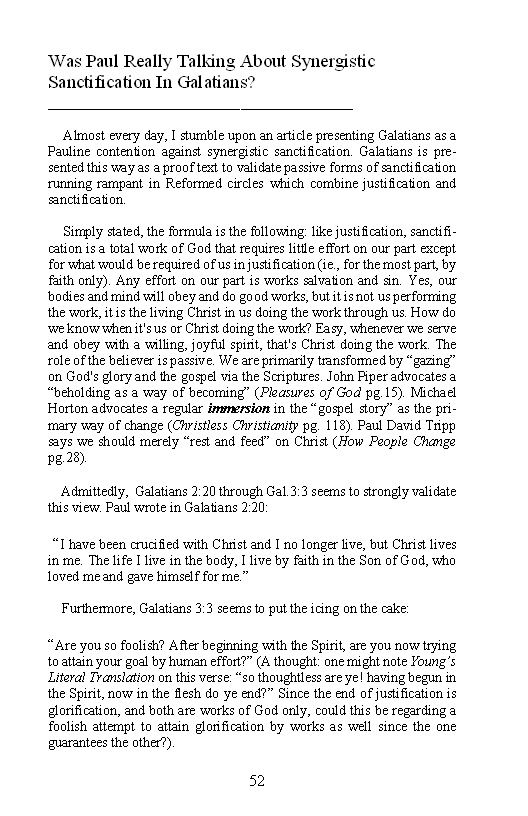
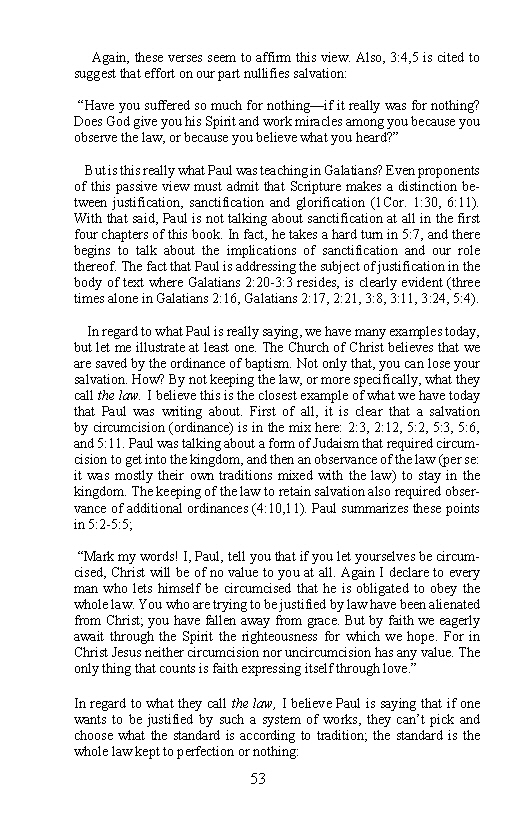
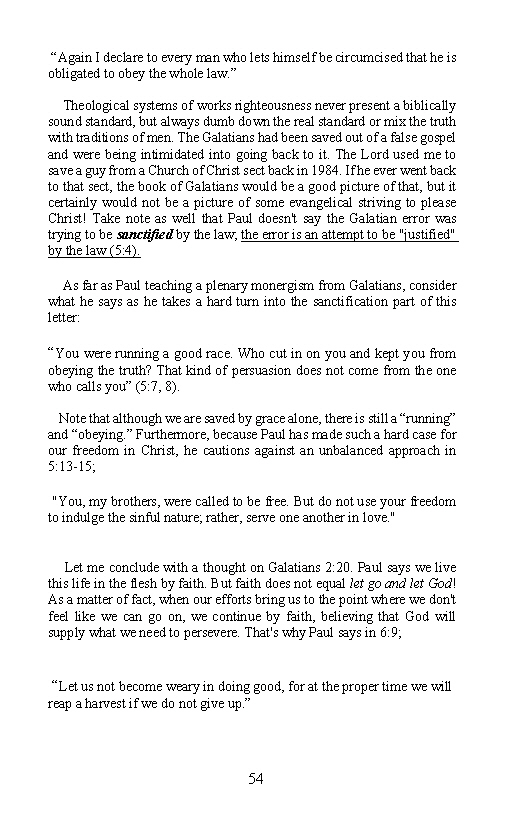
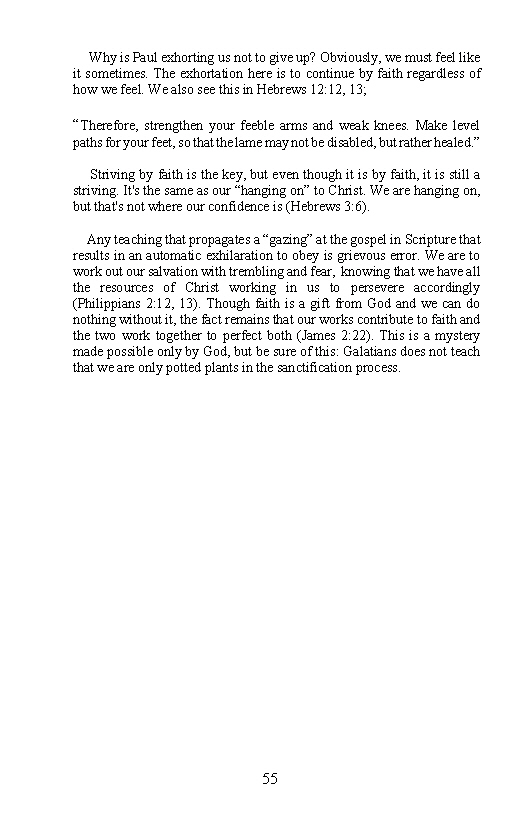
Elyse Fitzpatrick, The Antinomian, says Antinomianism Doesn’t Exist
 Sigh. The latest novelty among New Calvinist is to teach that Antinomianism doesn’t exist. Elyse Fitzpatrick, who Justin Taylor called the greatest gospel-centered writer among women, posted a hypothetical open letter to an antinomian.
In the letter, she limits the definition of an antinomian to those who use grace as a license to sin, and then insinuates that such a person is a myth:
“Dear Mr. Antinomian,
Forgive me for writing to you in such an open forum but I’ve been trying to meet you for years and we just never seem to connect. While it’s true that I live in a little corner of the States and while it’s true that I am, well, a woman, I did assume that I would meet you at some point in my decades old counseling practice. But alas, neither you nor any of your (must be) thousands of brothers and sisters have ever shown up for my help…So again, please do pardon my writing in such a public manner but, you see, I’ve got a few things to say to you and I think it’s time I got them off my chest.”
Fitzpatrick (hereafter EF) offers the suggestion that she has never met an antinomian in her counseling practice as a profound indictment against the idea of Antinomianism. Sigmund Freud didn’t meet any antinomians in all of his years of counseling either. It doesn’t mean anything when those looking have a distorted view of Scripture, and obviously, EF would be no exception to that. The English word, “antinomianism” is a biblical word. It is the word “anomia” in the Bible and means: without the law; against the law; lawless; lawlessness. Paul called the Antichrist the “anomia one,” and the “man of antinomianism.” Paul also said that we are in an age where the “mystery of antinomianism doth already work.” Christ said that in the latter days, because of antinomianism, “the hearts of many would wax cold.” Christ also said that He would say to many at the judgment, “Depart from me, you workers of antinomianism (anomia), I never knew you.”
For EF to deny antinomianism is patently absurd, but she continues to deny the reality with the following paragraph:
“I wonder if you know how hard you’re making it for those of us who love to brag about the gospel. You say that you love the gospel and grace too, but I wonder how that can be possible since it’s been continuously reported to me that you live like such a slug. I’ve even heard that you are lazy and don’t work at obeying God at all…Rather you sit around munching on cigars and Twinkies, brewing beer and watching porn on your computer. Mr. A, really! Can this be true?”
Yes Elyse, it can be true because your really thick gospel narrative tells us so. Of course, hundreds of verses could be cited other than this: “Dear friends, although I was very eager to write to you about the salvation we share, I felt I had to write and urge you to contend for the faith that was once for all entrusted to the saints. For certain men whose condemnation was written about long ago have secretly slipped in among you. They are godless men, who change the grace of our God into a license for immorality and deny Jesus Christ our only Sovereign and Lord.” The apostle Paul also wrote specifically about “Mr. Antinomian[‘s]” mentality that EF presents as myth: “What shall we say, then? Shall we go on sinning so that grace may increase? By no means!” This clearly demonstrates EF’s rejection of a literal interpretation of Scripture.
Ef then continues in a New Calvinist approved pastime—erecting straw men:
“So many of my friends and acquaintances are simply up in arms about the way you act and they tell me it’s because you talk too much about grace. They suggest (and I’m almost tempted to agree) that what you need is more and more rules to live by. In fact, I’m very tempted to tell you that you need to get up off your lazy chair, pour your beer down the drain, turn off your computer and get about the business of the Kingdom.”
This is the false accusation that Evangelicals blame grace for Antinomianism; when in fact, the complaint is against a form of Antinomianism known as contemplative spirituality. This is the belief that contemplating the gospel leads to Christ obeying for us. In other words, Antinomianism can approach against the law in several different ways, including the denial that we have been enabled to keep it and are obligated to do so. EF continues in her false accusations via straw men by rewording the evangelical belief in repentance in petty terms: “….what you need is more and more rules to live by.” Notice the “more and more” emphasis that implies a piling on of what we cannot bear as a solution. This, in fact, reveals EF for the antinomian that she is. Evangelicals see “more and more” rules as not just “rules,” but the wisdom of God that sets us free from the former bondage of living in ignorance of how to properly think and act in a way that pleases God.
Ef continues in her shameless twisting of Scripture:
“I admit that I’m absolutely flummoxed, though, which is why I’m writing as I am. You puzzle me. How can you think about all that Christ has done for you, about your Father’s steadfast, immeasurable, extravagantly generous love and still live the way you do? Have you never considered the incarnation, about the Son leaving ineffable light to be consigned first to the darkness of Mary’s womb and then the darkness of this world? Have you never considered how He labored day-after-day in His home, obeying His parents, loving His brothers and sisters so that you could be counted righteous in the sight of His Father? Have you forgotten the bloody disgrace of the cross you deserve? Don’t you know that in the resurrection He demolished sin’s power over you? Aren’t you moved to loving action knowing that He’s now your ascended Lord Who prays for you and daily bears you on His heart? Has your heart of stone never been warmed and transformed by the Spirit? Does this grace really not impel zealous obedience? Hello…Are you there?”
Yes he’s there Elyse, whether you believe it or not. The New Calvinist denial of a battle between the flesh in us and our regenerated spirit can be seen here. The astute Bible student will see many assumptions in the above statement that denies that the flesh wars against us, and assumes that the flesh lays down in surrender as we obtain a deeper and deeper understanding of what Christ accomplished for us, while denying that applying His wisdom to life also gives us a deeper understanding of the former person we were saved from. When the biblical dynamic of inner warfare with the flesh is denied (which is the case, particularly in the NC counseling culture that EF is part of [note the Adams/Welch debate on heart/flesh]), other assumptions tend to fill the void; such as, the perfect obedience of Christ being imputed to us in order to replace any obedience we might perform (because perfect obedience from believers is supposedly required to complete justification[double imputation]), and musings concerning what Christ experienced in Mary’s womb.
The last paragraph is really just a summation of the rest, but she closes with this:
“Again, please do forgive me for calling you out like this. I really would like to meet you. I am,
Trusting in Grace Alone,
Elyse”
Elyse, please forgive me for calling you out like this as well, but as JC Ryle said, it is not proper to say that we are sanctified by faith alone as your departure phrase implies, even though you use the word “trusting” to cover your tracks. And for efficiency sake, let me introduce you to Mrs. Antinomian instead of her husband—look in the mirror.
paul
Sure, I Can Do That, But….
….I wasn’t born yesterday. The top part of your essay is the imperative. The bottom part is the indicative: “What we sinners fail to understand is that there is no true freedom apart from wearing the yoke of God’s anointed one. Jesus said, ‘Come unto Me, all you who labor and are heavy laden, and I will give you rest. Take My yoke upon you and learn from Me, for I am gentle and lowly in heart, and you will find rest for your souls. For My yoke is easy and My burden is light’ (Matthew 11:28-30).”
Ie., the imperative commands are grounded in the indicative event. The “true freedom” you are talking about is freedom from the law when we take upon ourselves the yoke of Jesus and enter into “His rest” from the law. The imperatives you describe in the first part are an effortless “mere natural flow (NCT guru Chad Bresson)”—flowing from the indicative event (Christ’s atonement).
Nice try, and here is what you sent me:
“I was just wondering if you thought the following might have been written by one of those pernicious NCT Antinomians. Perhaps you would like to publish it as an example of how they try to turn people away from true righteousness.
Randy Seiver
LET US BREAK THEIR BONDS ASUNDER
Let us break their bonds asunder, and let us cast away their yokes from us (Psalm 2:3).
The scene portrayed in these verses is one of high treason against the LORD of heaven and earth. Those engaged against Him are recalcitrant rebels who refuse to be controlled any longer. They have set themselves in battle array against Jehovah and against His Anointed one. They refuse to wear the restraint of His law any longer. They desire to throw off the yoke of obedience to Him. The metaphor is taken from balky animals that break the cords that restrain them and throw off the yoke.
Israel is often guilty of refusing Jehovah’s yoke in this manner. In Hosea’s prophecy, Jehovah charges that His people are like a heifer that backs away from the yoke (Hosea 4:16). Such is the nature of sinful rebels. We imagine we will be happy if only we can free ourselves from God’s oppressive demands. Yet, we find when we are most free from His yoke that we are most shackled in the bonds of iniquity.
What we sinners fail to understand is that there is no true freedom apart from wearing the yoke of God’s anointed one. Jesus said, “Come unto Me, all you who labor and are heavy laden, and I will give you rest. Take My yoke upon you and learn from Me, for I am gentle and lowly in heart, and you will find rest for your souls. For My yoke is easy and My burden is light” (Matthew 11:28-30).
Nevertheless, the struggle to be free continues from generation to generation. We continue to balk and bawl at the sight of the Christ’s yoke until God in sovereign grace makes us willing to be subdued”
Thank you for this example of classic New Calvinist deception,
paul
Open Discussion: The Horton Statement That Nobody Wants To Talk About
Christless Christianity, page 62:
“Where we land on these issues is perhaps the most significant factor in how we approach our own faith and practice and communicate it to the world. If not only the unregenerate but the regenerate are always dependent at every moment on the free grace of God disclosed in the gospel, then nothing can raise those who are spiritually dead or continually give life to Christ’s flock but the Spirit working through the gospel. When this happens (not just once, but every time we encounter the gospel afresh), the Spirit progressively transforms us into Christ’s image. Start with Christ (that is, the gospel) and you get sanctification in the bargain; begin with Christ and move on to something else, and you lose both.”
Gospel Sanctification and Sonship’s Gospel-Driven Genealogy, Part 10: A Strong Finish For “Dr.” John MacArthur Not Looking Good
“Where did this ‘eclipsing Christ’ standard of truth come from? And does it add anything to the genealogy hypothesis?”
When I saw the advertisement, my heart sank. In my wrestling with proponents of Gospel Sanctification over the years, one of their mantranized mottos has been whether or not something “eclipses Christ” as a primary standard for determining truth. As others will attest who witnessed the hostile takeover of Clearcreek Chapel by the Chad Bresson cartel, “I have a problem with that view because it eclipses Christ” was a phrase that was constantly heard.
Back to the advertisement: MacArthur has written the forward to a new book written by one of his close ministry associates, Rick Holland. The title of the book is, “Uneclipsing The Son” by “Dr.” (a title that more and more is becoming a sign of danger more than respect) Rick Holland. Even from the standpoint of this (me) Evangelical peasant, “Dr.” MacArthur’s forward to the book raises troubling questions:
“This book is an insightful, convicting reminder that no one and nothing other than Christ deserves to be the central theme of the tidings we as Christians proclaim—not only to one another and to the world, but also in the private meditations of our heart.”
I asked the Sultana of Optimism, my wife Susan, to evaluate the statement. She immediately pointed out that the second part of the statement concerning private meditation was biblically untrue for many reasons. As far as Christ ALWAYS being the CENTRAL theme of the gospel, I will address that in future parts. Granted, Christ must always be part of a gospel presentation, it’s not the gospel without Him, but is He always the one and only central theme of the presentation as MacArthur suggests? Is Christ the only one who “deserves” to be a central figure of the gospel? Phil Johnson’s (the Executive Director of MacArthur’s ministry) endorsement of the book is even more disturbing as his statement mirrors John Piper contemplative spirituality:
“We become like whatever we worship (Psalm 135:15-18). So the key to sanctification and spiritual maturity is a simple principle: As we set our affections on Christ and keep Him at the center of all our thoughts, activities, desires, and ambitions, we are transformed into His likeness (2 Corinthians 3:18).”
Barry E. Horner also echo’s concern on page 192 of Future Israel when he writes: ‘This is not an insignificant point since it is common today, especially within Reformed Christianity as Thomas Smail pointed out in The Forgotten Father, for an incorrect prominence to be given to Jesus Christ (as though impossible to challenge) that results in biblical distortion.’”
As far as meditation on Christ alone being the one “simple” principle for sanctification as stated by Phil Johnson above, Dr. Jay E. Adams states:
“The problem with Sonship is that it misidentifies the source of sanctification (or the fruitful life of the children of God) as justification. Justification, though a wonderful fact, a ground of assurance, and something never to forget, cannot produce a holy life through strong motive for it.”
“Certainly, all of us may frequently look back to the time when we became sons and rejoice in the fact, but there is no directive to do so for growth, or even an example of this practice, in the New Testament….The true reminder of the good news about Jesus’ death for our sins is the one that he left for us to observe-the Lord’s supper (‘Do this in remembrance of Me’).”
Where did this eclipsing Christ standard of truth come from? And does it add to the genealogy hypothesis? (http://wp.me/pmd7S-Gm ) (Revised: http://wp.me/pmd7S-K7 ). You be the judge. The following are excerpts from the Australian Forum archives, one excerpt per article:
When the law is emphasized so as to eclipse the glory of the gospel, the church falls under the bondage of legalism.
…faith and never want to lose it, and may even fear that if any other truth is emphasized, it will eclipse the wonderful message of salvation. …
From “The Centrality of the Gospel”: evangelical preaching has contributed more to the eclipse of the Bible than we would ever dare to imagine.
They are used to eclipse or displace Christ’s imputed righteousness! “That glory cannot be taken away from Christ and transferred to either our renewal or …[same statement used in at least three other articles].
They are used to eclipse or displace Christ’s imputed righteousness!
When the law is emphasized so as to eclipse the glory of the gospel, the church … and rapturous experience) of having Christ come into the heart—and then …
When the law is emphasized so as to eclipse the glory of the gospel, … grace alone, on account of Christ’s obedience alone, and received by faith alone …
truth is emphasized, it will eclipse the wonderful message of salvation. …. And from Jesus Christ, who is the faithful witness, the firstborn from the …
Church history may be seen as a struggle to keep law and gospel in proper tension. When the law is emphasized so as to eclipse the glory of the gospel, …
Because they are put in the very room of the gospel! They are used to eclipse or displace Christ’s imputed righteousness! “That glory cannot be taken away …
… any other truth is emphasized, it will eclipse the wonderful message of salvation. …. Similarly, non-believers may reject the gospel because of their …
Tavard explains that when Luther began his work as a Reformer, the gospel was in “partial eclipse.” The Council of Trent, however, “reformulated” the gospel …
These sample statements were gleaned from the AF archives by a cursory search. Uneclipsing the Son (or his works) is a dominate theme that saturates AF doctrine.
Legacies are usually determined by how we end. This brings to mind something that we may want to meditate on often: the call to persevere. Christ didn’t say meditating on Him makes perseverance easy or guarantees that He will do it for us. MacArthur may not believe that, but he certainly lends credibility to those who do. Will the last leg of his ministry be remembered as lending creditability to Antinomians and even embracing their doctrines? I think it’s very likely.
If I had to bet, would I bet that I will find uncanny parallels between Holland’s new book and the AF archives? Absolutely. I am working on several side-by-side quotation charts, I trust that “Dr.” Holland will have a significant contribution to the comparisons.
paul



2 comments