The Answer to Rachel’s Question Highlights the Vile Hopelessness of New Calvinism
 “New Calvinism’s answer to troubled people is a continual revisiting of our salvation which results in, note carefully, a ‘transformation.’”
I had other plans this morning. Then I thought I would visit http://frombitterwaterstosweet.blogspot.com/ to see what was going on over there before I began my day. The first thing I saw was a question from “Rachel” and an invitation by the author of the blog for somebody to answer her question. Rachel framed her question in regard to the subject of depression; you know, the kind where you wake up in the morning and everything in you doesn’t want to get out of bed and face another day. Why? Because it’s hard to function in life when your soul is stripped of joy on the one hand, and full of torment on the other. Sleep with narcotic (medication) induced dreams are the only relief—at least the horrible dreams are being observed and not experienced in real life.
Yes, I will answer the question because this is deeply personal and plunges the depths of why I hate the doctrine of New Calvinism. Yes, I hate New Calvinism because I love hope, and hope has no greater enemy in our day than New Calvinism. Rachel’s inquisition follows:
Can someone answer this question for me? (I’m trying to fit some puzzle pieces together about NC)…
I see from the example in the post (that of a woman being abused “partaking in Christ’s suffering”) that NCs can come off as ambivalent about helping/stopping suffering when it rears its ugly head.
Do they take it a step further and actually emphasize suffering as a goal/way of life?
In other words, it’s one thing to tell a suffering person that they shouldn’t seek to change their situation. It’s another thing to tell a happy person that they should actively aspire to be suffering.
I am starting to see this attitude in my church and it really bothers me. For one thing, I know very few well-adjusted people who actually aspire towards suffering as a way of life (plenty of people who give lip service to that, mind you, but I see them out having fun and smelling the roses just like everyone else). Also, as someone who has struggled with depression and anxiety, I’ve had to hold onto God’s promise of mercy, joy and hope in order to get myself to a place of health and healing…and I see people in my church who have never struggled with these things decreeing quite confidently that trying to escape suffering is not what we want. (I wonder if any of them have ever found themselves truly unable to get out of bed in the morning, and how they justified that this was necessary for them to serve God….don’t know about you all, but I always serve God better when I get up, go about my day, and interact with other humans).
Anyway…thoughts?
Yes Rachel, I have some thoughts. Let me use these comments by you to begin:
Do they take it a step further and actually emphasize suffering as a goal/way of life?
In other words, it’s one thing to tell a suffering person that they shouldn’t seek to change their situation. It’s another thing to tell a happy person that they should actively aspire to be suffering.
No, they don’t do that, but they clearly teach that it is wrong for you to rectify your condition “in your own efforts.” As one depressed follower of New Calvinism said to me: “It’s not about anything that I can do, It’s about what Jesus has done.” Sounds spiritual, no? But let me tell you my precious sister, those are words of death. Put another way by a New Calvinist friend of demons:
Jesus comes to transform our entire being, not just our mind. He comes as a person, not as a cognitive concept we insert into a new formula for life.
Note the subtle devaluing of obedience with the words, “a cognitive concept we insert into a new formula for life.” Elsewhere, this vile false teacher states:
Along with deep repentance, Scripture calls us to faith that rests and feeds upon the living Christ. He fills us with Himself through the person of the Holy Spirit and our hearts are transformed by faith.
And that is the counsel that the depressed will receive from today’s New Calvinists: “rest and feed.” Rachel, compare the statement above with the New Calvinist illustration I posted in the article that provoked your question. And remember, this is their illustration, not mine:

New Calvinism’s answer to troubled people is a continual revisiting of our salvation which results in, note carefully, a transformation. New Calvinists don’t believe that we change, they believe that through a continual revisiting of salvation, we manifest one of two realms; flesh or spirit, but I will stick to the basics for now and not delve too deeply into their denial of the new birth. What they call the new birth has nothing to do with real personal change. This should be evident from the visual illustration. But the concept enables them to deceive with doublespeak. Hence, another quotation by the aforementioned satanic minion who poses as a biblical counselor:
Instead, even the Christian version of this approach [following biblical commands] separates the commands of Scripture from their Christ-centered, gospel context.
In both phases of his Christian life, the work of Christ on the cross was radically minimized by Andy’s own efforts. The first three years evidenced a Christ-less activism that produced pride and self-sufficiency.
This whole concept can also be observed if you note carefully the words of this New Calvinist:
Where we land on these issues is perhaps the most significant factor in how we approach our own faith and practice and communicate it to the world. If not only the unregenerate but the regenerate are always dependent at every moment on the free grace of God disclosed in the gospel, then nothing can raise those who are spiritually dead or continually give life to Christ’s flock but the Spirit working through the gospel. When this happens (not just once, but every time we encounter the gospel afresh), the Spirit progressively transforms us into Christ’s image. Start with Christ (that is, the gospel) and you get sanctification in the bargain; begin with Christ and move on to something else, and you lose both.
New Calvinism’s Onslaught Against the Hope of Obedience
“Andy’s own efforts” are the difference between life and death in our Christian life. As I continue to state, New Calvinism got its doctrine from Robert Brinsmead and the Australian Forum. The Forum was established in 1970-71, and roughly the same time, a problem occurred named Jay Adams. In his book, “Competent to Counsel,” he offered an alternative to the hopelessness left by the hyper-grace theology of the first gospel wave. Proponents of the Forum’s new twist on hyper-grace considered Adams a threat. But if you talk to Adams, he relates his experience in churches across the land as he answered invitations to speak: “They were surprised that someone was teaching that we could do something in the Christian life. They thought it was some kind of new teaching [paraphrase from memory].”
Exactly. New Calvinists teach that obedience must always flow from an exultation induced by gospel contemplationism. Hence, a depressed person shouldn’t do anything that is not motivated by a gratitude for their original salvation. And it’s not really us doing it—it’s a manifestation of the Spirit (or the spirit realm verses the flesh real). In other words, it’s a sanctified obedience since “totally depraved Christians” cannot really obey in and of themselves. The New Calvinist born again individual is one who merely manifests one realm or the other at any given time. At a time in my life when I was almost drawn into this theology and it was thought that I could be spoken to openly, a fairly well-known New Calvinist concurred with this realm approach in an email to me. However, you can only see it in his writings if you know what to look for. I have never read the debates between Jay Adams and Dr. Ed Welch on the heart/flesh issue, but I assume this philosophy could probably be seen in Welch’s response. At any rate, one must ask: “If we are still totally depraved, where does the obedience come from?” Again, look at the New Calvinist illustration, our goal is to make the cross bigger by plunging the debts of understanding in regard to our own depravity. This approach can also be seen in the writings of New Calvinist Terry Rayburn:
There are several problems with that essentially Legalistic view of Sanctification, as reflected in the following observations:
1) Our flesh cannot get better. In Romans 7:18 Paul wrote, “For I know that NOTHING good dwells in me, that is, in my flesh…” Your flesh cannot be improved. Flesh is flesh, and spirit is spirit.
2) Our new nature, on the other hand cannot get better, because it has already been made new and perfect through regeneration. We have been given a “new heart” (new nature, or new spirit), and not a defective one, which would be absurd. This new spirit has been made “one spirit with Him” (1 Corinthians 6:17), such that when we “walk according to the Spirit” (i.e., the Holy Spirit), we also walk according to our own new spirit.
3) Those who deal with Sanctification by zeroing in on so-called “Progressive” Sanctification as the main point of Sanctification, are at best in Kindergarten.
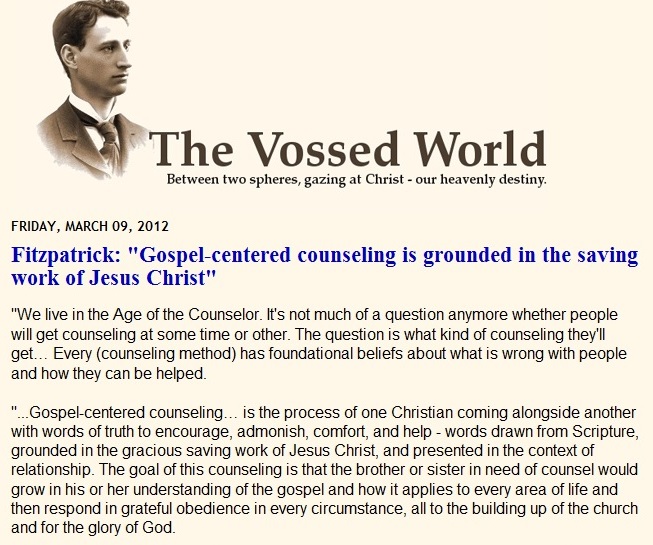
What could be clearer? We, in and of ourselves as born again believers, do not change, we manifest one realm or the other, and anything more than that is “legalism.” This is what is often meant by the New Calvinist slogan, “between two realms, “ or “between two worlds,” or “between two spheres.” In fact, I couldn’t remember one of the exact phrases, so I went to a New Calvinist blog to check, and behold, there was a newly posted article by New Calvinist Elyse Fitzgerald that states exactly what I have said here about gospel contemplationism. The following screen shot encompasses all of my thoughts on this one point:
These New Calvinists are exactly the same as the imposters before them. As one author said of the 4th century heretic Arius:
More important, the unfavorable ruling of the council provoked Arius to alter his strategy in a significant way. Without actually modifying his views, he worked hard to refine his language to make himself sound as orthodox as possible. He insisted that he had been misunderstood and misrepresented. He continued to profess his adherence to all the major creeds and apostolic doctrinal formulae. He even occasionally claimed that he had no major disagreement with the Nicene Council’s position. The actual difference between them was very slight, he insisted.
This reminds me of a written response by Dr. Albert Mohler in which he ignored all of my specific concerns, said he didn’t know anybody that believed what I was stating, and made a general statement about holding to all of the beliefs contained in the Southern Baptist Convention’s statement of faith. Which is a lie, and you can quote me on that.
There is no doubt that all of salvation is of God. But there is something very evident about God that he makes clear in his word. He delights in colaboring with his children. We can see this in the creation account and in specific statements throughout the New Testament (1Cor.3:9, 1Thess.3:2, 2Cor.6:1). God delighted in letting Adam name the animals, and it was really Adam that named them. And it is really us doing the work in sanctification. For crying out loud, we will even be rewarded for our work! Words mean things, and Christ knows how to communicate with His created beings. When He will say, “Well done faithful servant,” He didn’t mean to say that we really won’t be doing what was “well done.” A beautiful picture of how we colabor with our Savior can be seen in John 14:12-16. Christ said He was going away to the Father so that He could do greater works, or us? We are here working in greater numbers, but the Lord said He would be with the Father so that if we asked anything in His name, He would do it to glorify the Father. He also said to love Him by keeping His commandments, and in the NEXT sentence, Christ said he would send us a “HELPER.” What’s a “helper”? Get it? He “helps” us. If Christ does it all, why do we need help? Our efforts and the Holy Spirit’s help is seamless. It’s not either/or. This can be seen throughout the Scriptures: “The fruit of the Spirit is…. self –control.” Who is doing the controlling? Answer: self (that would be you). Who’s fruit? Answer: the Holy Spirit. We are to “pursue” the Holy Spirit’s fruit, but if we don’t pursue—no fruit. And no reward. And no blessings. RC Sproul said it best before he was afflicted with New Calvinist dementia:
Sanctification is cooperative. There are two partners involved in the work. I must work and God will work. If ever the extra-biblical maxim, “God helps those who help themselves,” had any truth, it is at this point. We are not called to sit back and let God do all the work. We are called to work, and to work hard. To work something out with fear and trembling is to work with devout and conscientious rigor. It is to work with care, with a profound concern with the end result (Pleasing God p. 227).
The only time we work in a way that displeases God is when we work according to arrogant ideas that do not align with God’s word, like the New Calvinesque woman who said that Mary was blessed because she gave birth to the Savior. Did anybody know the personhood of Christ better than Mary? Yet, Christ rebuked the woman publicly and said that it was the ones who hear His commands and obey that are blessed (Lk. 11:27). In 2Samuel chapter 7, king David assumed that it wasn’t right that he lived in a palace and God dwelled in a tent. God rebuked him, and for all practical purposes asked him where he found such an idea in the Scriptures. Likewise, New Calvinists assume that anything we do in sanctification is a slight against God getting all the glory. God is the judge of what gives Him glory, not man.
The apostle Paul’s counsel
So what would the apostle Paul say about all of this? Well, do depressed people need “peace”? Say yes. They need it in the worst way. In Philippians 4:9, Paul wrote the following:
What you have learned and received and heard and seen in me—practice these things, and the God of peace will be with you.
That’s what you call a promise. And trust me, if God is with you, all is well. And Paul makes it a point to state that he is the God of “peace.” But the promise is contingent on what? Answer: doing our part, and doing it the right way. What we have “learned,” and “received,” and “heard,” and “seen,” implies more than the gospel and what Christ did to save us. If that’s what Paul wanted to say, he would have simply stated it. Prior to this statement in verse 9, Paul said that the pathway to “peace” is putting off worry and replacing it with specific prayer (verse 6), and right thinking (verse 8), and right doing (verse 9).
Christ promised the same thing in the conclusion of the Sermon on the Mount. A house built on a rock hears the word of God and “puts it into practice” with the Holy Spirit’s help. And remember, Christ said that the Spirit would help, that’s a promise also.
New Calvinists are the servants of the Quietist Grinch that steals hope. They are clouds without water. They serve a false God that supposedly only wants to be gazed upon rather than obeyed as Lord. Be not deceived. Chooses life instead. Choose hope.
paul
Why Jay Adams Had to be Neutralized by the New Calvinists
Susan and I had a glorious fellowship with another Christian couple this afternoon. They are in a ministry of significant influence and will be unnamed. At some point, the conversation turned to New Calvinism. As Susan and I sat and listened to the husband’s testimony concerning what he valued in John Piper’s teachings, I was filled with an understanding in regard to why Piper’s teachings are so attractive. I might add that I was very impressed with his calm, articulate answer immediately following my comment that I believe Piper to be one of the premier heretics of our day.
What this brother described was the fact that serious Christians were looking for an alternative to the fallout from the first gospel wave in contemporary Christian History: raise your hand, sign a card, don’t drink, smoke, chew, or hang out with girls that do. Christianity had been reduced to living by a list of do’s and don’ts by people who didn’t have any life to show for it. Fair enough. Guilty as charged.
But the fact of the matter is that Jay Adams did offer a viable alternative. It was based on hearing the word of God and applying it to our lives according to the whole counsel of God’s wisdom and not just, “stop doing that.” I saw firsthand how this “first generation” biblical counseling movement changed lives in radical fashion, including my own. And the movement continues to do so today even though the fact of that matter is covered up by a whole lot of New Calvinist noise.
To me the crux of the matter is in this brother’s testimony. New Calvinists have effectively sold the idea that they are offering the only alternative to easy believeism in our day. That’s only true because they got rid of the other alternative through slander and persecution, and they know it. Jay Adams’ “first generation” biblical counseling was a threat to the emerging New Calvinist tsunami. Why? 1) Because it worked and God used it to change lives. 2) It was/is the antithesis of New Calvinism because the latter fuses justification and sanctification while first generation counseling doesn’t. Furthermore, this is what New Calvinist David Powlison said was the fundamental difference between the two while teaching at John Piper’s church:
This might be quite a controversy, but I think it’s worth putting in. Adams had a tendency to make the cross be for conversion. And the Holy Spirit was for sanctification. And actually even came out and attacked my mentor, Jack Miller, my pastor that I’ve been speaking of through the day, for saying that Christians should preach the gospel to themselves. I think Jay was wrong on that.
If we associate justification with “conversion,” and we do, Powlison’s statement can be reworded as follows for clarification:
Adams had a tendency to make the cross be for justification (justification cannot be separated from conversion). And the Holy Spirit was for sanctification.
Second generation counseling/New Calvinism is sanctification by justification, and that was also propagated by his mentor that he mentions. New Calvinists choose their words carefully. Imagine how far the movement would get if they didn’t replace “justification” with “gospel”:
The same finished work of justification that saved you also sanctifies you. Or, we must preach justification to ourselves every day. Or, sanctification is the finished work of justification in action.
I explained to the brother that the other alternative was relentlessly persecuted, and that’s why it would seem that there is only one alternative. He concurred that he perceives criticism of Adams taking place on a continual basis. Why? Because the truth he teaches is the competition. It’s a threat.
This is an approach that I have never used before: 1) Powlison admits a fundamental difference between first generation and second generation counseling; ie, sanctification by the cross (justification) verses sanctification by the Spirit apart from the finished work of justification. 2) An alternative is confirmed. 3) You only have the New Calvinists’ testimony that they are the only alternative. 4) Why not investigate and find out for yourself?
He agreed, and was sent off with a copy of The Truth About New Calvinism. Please pray for the situation. Christianity doesn’t need a second gospel wave. The first wave devalued sanctification by focusing on justification only; the second devalues it as well by making it the same thing as justification. Both are just as deadly, and when the novelty of New Calvinism wears off, the results will be worse.
paul
Patriarchy and Shaving Daddy. Really?
Voddie Baucham is presently all the rage at the 2012 Shepherds Conference. Who does the vetting over there? Oh, I forgot, Voddie is a New Calvinist.
This Says it All About New Calvinism
An accusation against a ministry associate of mine after he asked, “What is my heresy against the church?”
The accuser’s answer: “Synergistic sanctification. Which underhandedly denies justification by faith alone.”
1. In the mind of a New Calvinist, the two are obviously fused.
2. Therefore, what we do in sanctification effects justification.
3. Whatever that would be, whether something, nothing, or otherwise, if we are involved, our justification is DOA.
4. New Calvinism is a false gospel on steroids.
Jean Larroux III as Sectarian
 What is a biblical “sect”? And why should New Calvinism be classified as such?
The Biblical Meaning of Heresy
Discernment ministries serve as a teaching tool by antithesis (finding error often leads to discovering more truth in the antithesis). And here, we have an excellent example for I would have never known the true meaning of the word “heresy” if not for this ministry. Like most folks, I assumed the word just referred to erroneous teachings by “heretics.” Such is not the case. The word refers to a group of people, or a movement that causes division and controversies by teaching error.
First, the foundation of what sects do is based on the biblical concept that truth unifies and error divides. A call for unity by the apostles is also a call to be of the “same” mind and judgment:
1 Corinthians 1:10
I appeal to you, brothers, by the name of our Lord Jesus Christ, that all of you agree, and that there be no divisions among you, but that you be united in the same mind and the same judgment.
1 Corinthians 9:8
Do I say these things on human authority? Does not the Law say the same?
Philippians 2:2
complete my joy by being of the same mind, having the same love, being in full accord and of one mind.
Secondly, the cause of division:
Romans 16:17
I appeal to you, brothers, to watch out for those who cause divisions and create obstacles contrary to the doctrine that you have been taught; avoid them.
1 Corinthians 1:10
I appeal to you, brothers, by the name of our Lord Jesus Christ, that all of you agree, and that there be no divisions among you, but that you be united in the same mind and the same judgment.
Jude 1:17
But you must remember, beloved, the predictions of the apostles of our Lord Jesus Christ. 18 They said to you, “In the last time there will be scoffers, following their own ungodly passions.” 19 It is these who cause divisions, worldly people, devoid of the Spirit.
Ephesians 4:13
Till we all come in the unity of the faith, and of the knowledge of the Son of God, unto a perfect man, unto the measure of the stature of the fulness of Christ:
14 That we henceforth be no more children, tossed to and fro, and carried about with every wind of doctrine, by the sleight of men, and cunning craftiness, whereby they lie in wait to deceive;
Truth unites, and error divides; therefore, a heretic is described in Titus 3:10:
“As for a person who stirs up division, after warning him once and then twice, have nothing more to do with him,
The actual word for “division” as translated in the ESV is the English word “heretic[k]” (KJV). It is translated that way because of the following note that is found in some English/Greek dictionaries: “From the same as G140; a schismatic. (“heretic” is the Greek word itself).”
Therefore, in the Bible, those who teach error and are divisive are synonymous.
Division With a Purpose
In the same way that heresy, heretics, and division cannot be separated, the idea that these are always sectarian is also the biblical maxim. In fact, Young’s Literal Translation uses the word “sectarian” in place of “divisive” or “heretic” in Titus 3:10. 1Corithians 11:19 states the following:
For there must be also heresies among you, that they which are approved may be made manifest among you.
The word in Titus 3:10 is “heretic,” and likewise, the English form of the word in 1Corinthians 11:19 is “heresies.” But most English translations use the word “faction.” The ESV is one example among many. It means “party,” “group,” or “sect.” In other words, these English words translated from the Greek are all used interchangeably in the biblical text, especially with “heresy” or “heretic.” This idea that sects, division, and doctrinal error go hand in hand is plainly stated in the Bible:
Acts 20:30
and from among your own selves will arise men speaking twisted things, to draw away the disciples after them.
Acts 24:5
For we have found this man a plague, one who stirs up riots among all the Jews throughout the world and is a ringleader of the sect of the Nazarenes.
In fact, Christianity was seen as a sect because of the divisions caused by sanctification:
Acts 24:14
But this I confess to you, that according to the Way, which they call a sect, I worship the God of our fathers, believing everything laid down by the Law and written in the Prophets, [refer back to 1Corinthians 11:19 as well].
Note that the word used in the ESV for “sect” is “heresy,” which is the same word used in Titus 3:10 to describe a heretic. Hence the following reference by others that I found helpful in regards to Titus 3:10:
Some say that in Titus 3:10 ‘a factious [sectarian] man’ should be translated ‘a man who teaches heresy’ and that this expression does not refer to a divisive person. But in Greek this expression denotes a person who holds an opinion or a different doctrine that tends toward division. Thus, the English versions translate this as (1) a factious man—American Standard Version, New American Standard Bible, Marshall’s Interlinear Greek-English New Testament; (2) a man who is factious—Revised Standard Version, Amplified Bible; (3) a heretical sectarian and cause of divisions—Amplified Bible; (4) a heretical person causing divisions—Wuest; (5) a sectarian—W. J. Conybeare; (6) a man who causes divisions—R. F. Weymouth; (7) a factious person—James Moffatt; (8) a sectarian man—Concordant Literal New Testament, Berry’s Interlinear Greek-English New Testament; (9) a factious person—Berkeley Version; (10) a heretical man, i.e., one given to ‘lift up’ opinions, sound or unsound, and an unstable, unsettled individual who wishes to form sects—Young’s Translation; (11) causing division by a party spirit, factious—Vine’s Expository Dictionary of New Testament Words; (12) a divisive person—New International Version.
To say that division over doctrine exemplifies New Calvinism would be the understatement of the century! Throughout the Bible, sectarians are also described as COVERT—another adjective describing New Calvinism that is an understatement on steroids. In fact, they themselves boast that they are divisive because they preach a “scandalous” gospel. Well, that’s exactly what the apostle Paul said sectarians do:
I appeal to you, brothers, to watch out for those who cause divisions and create obstacles contrary to the doctrine that you have been taught; avoid them.
The word for “obstacles” in this verse is, “scandalon” or “scandal.” So for all practical purposes, New Calvinists admit that they preach a divisive gospel. New Calvinism came forth from its Australian Forum womb drawing away disciples and causing divisions on personal levels and corporate levels to a degree that may be unprecedented in church history.
The Cure
New Calvinism is a super-sect that must be exposed and stopped, and only one cure will work: biblical separation. The apostles described sectarianism as a disease that would quickly spread and wreak havoc on God’s people (“gangrene”). They said that a little leaven will leaven the whole lump. Men who gather to “discuss” the symptoms of sectarianism with its proponents show that they do not understand what the Bible teaches about sectarianism. While they feast with these men and discuss “issues,” the gangrene does not wait.
paul



2 comments