The Calvinist’s Greatest Fear: The Spiritual Peasantry Will Understand Law and Grace
 Originally published January 2, 2013
“The two are completely separate; the law is left behind in the former and loved in the latter.”
Susan and I perceive constantly that most Christians don’t understand the difference between justification and sanctification. Said another way, they don’t understand the difference between law and grace. This is by design. Instead of outlawing the Bible like the Popes, the Reformers merely posited the Bible as a catechism that aped their orthodoxy derived from counsels and creeds. I won’t mention names, but prominent evangelical leaders have shared with me personally that they know the general populous of American Christians are theologically illiterate. And again, this is by design. And, most Christians in our day openly admit it, and in some cases are proud of it. The remainder admits they believe that the pastorate is an intermediary between them and what God wants us to understand.
There are a number of problems with this, but primarily, God thinks it’s a bad idea. The Bible is clearly written to Christians in general. And His word cannot be properly understood unless it is read in the context of justification/sanctification. Whatever your opinion of the American church, it is a product of parishioner illiteracy in regard to doctrine; that is certain and indisputable.
Though it takes a lot of study to see some things in simple form, the simple fact of Calvinism (and we are all Calvinists if we are Protestant) is that it makes “under” a verb and not what it is: a preposition. They could get away with this in medieval times because most people didn’t know the difference. In our day, we know the difference, but assume the pastorate has a set of metaphysical eyes given to them by God before the foundation of the world that we don’t have—so our eyes don’t even blink when their interpretations contradict the plain sense of Scripture.
As we have seen in our previous observations from the book of Romans, Christians are UNDER grace and were previously UNDER law. All people born into the world are born into it UNDER the law, and will be judged by it at the end of their lives if they don’t escape it. Christ was the only man ever born under the law that could live by it without sin and was therefore the only man ever born who could die for our sins. We escape the condemnation of the law by believing in what He did to make a way of escape for us. Calling on Christ to save us acknowledges that we all fall short of God’s glory and are therefore in danger of eternal separation from Him.
We are “under” grace, NOT “under” law:
Romans 6:14—For sin will have no dominion over you, since you are not under law but under grace.
The word for “under” here is hupo which is a primary preposition. Calvinism teaches that we are still under the law. This is the main reason that it is a false gospel. Now, they would vehemently deny this in the following way with red faces and veins popping out of their necks:
NONSENSE! We emphatically state constantly that no man is justified by the law unless he can keep it perfectly and we all know that no man can keep the law perfectly. We constantly cite James 2:10 which states that if we break the law at one point—we are guilty of breaking the whole law. HOW DARE YOU SLANDER US IN THIS WAY!!!
This argues the point by making “under” a verb (something we do or don’t do) rather than a position. Therefore, they are not arguing jurisdiction, they are arguing practice in regard to how we are justified. Position is the issue, not what we do; i.e., keeping the law or not keeping the law, or doing this/that in this way or the other way etc. Calvinists believe our position stays the same; therefore, what we do becomes critical. In fact, what we don’t do keeps us saved; e.g., “You don’t keep the law by keeping the law.”
There are four versions of “Christians” still being “under” the law, or under its jurisdiction. First, antinomianism which teaches that we are still under the law, but God cancelled our obligation to keep it because it promotes grace. Secondly, that we are still under the law, but the Holy Spirit helps us keep it so that we will pass the final judgment. Thirdly, that we are still under the law, but if we perform certain rituals within the church, by authority of the church, our sins are continually forgiven (perpetual pardon in the face of the law). Fourthly, we are still under the law, but Jesus keeps it for us while we continually contemplate His saving works in the Scriptures. This is the Reformed view. And of course—it’s no less a false gospel than the former three.
This is verified by their interpretation of Galatians 2:20—this exposes their heresy:
I have been crucified with Christ. It is no longer I who live, but Christ who lives in me. And the life I now live in the flesh I live by faith in the Son of God, who loved me and gave himself for me.
We supposedly remain spiritually dead, which as they know is clearly synonymous with being under the law in Scripture. So, Galatians 2:20 is interpreted as being applicable to our Christian life. We don’t live in our Christian life, we are still spiritually dead, but the living Christ within us keeps the law for us so that the “ground of our justification will be Christ in the final judgment.” Calvinists believe that we are not under the law in regard to the idea that we don’t keep it in our Christian life to be justified, Christ keeps it for us. Hence, “under” is a verb issue rather than a position issue. What we do becomes critical, not where we are positionally. Therefore, Calvinism makes our Christian life (sanctification) by faith alone as a way to maintain our just standing for the final judgment. Only problem is, we are still fulfilling a requirement of the law in cooperation with Christ—this is the problem of salvation being a verb issue rather than a preposition issue. If the law no longer has jurisdiction over us FOR JUSTIFICATION, who keeps it or doesn’t keep it is irrelevant FOR JUSTIFICATION.
Then what is Paul talking about in Galatians 2:20? He is talking about justification; not sanctification, this should be evident. Consider the context:
Galatians 2:16—yet we know that a person is not justified by works of the law but through faith in Jesus Christ, so we also have believed in Christ Jesus, in order to be justified by faith in Christ and not by works of the law, because by works of the law no one will be justified.
Galatians 2:17—But if, in our endeavor to be justified in Christ, we too were found to be sinners, is Christ then a servant of sin? Certainly not!
Galatians 3:11—Now it is evident that no one is justified before God by the law, for “The righteous shall live by faith.”
Consider verse 21 which immediately follows 2:20:
I do not nullify the grace of God, for if righteousness were through the law, then Christ died for no purpose.
Why do Calvinists apply Galatians 2:20 to sanctification? Because what we do is the issue, not our position, so Christ must obey the law for us. To the contrary, we are justified because the old self that lived in the flesh died with Christ. And when it did, we also died to the law. So, in regard to justification, we can only be justified if the life we lived in the flesh is dead and no longer under the law. Being alive in the flesh equals: being under the law. Now, obviously, our mortal bodies are still alive in one sense in that we are walking around, but in reality the old self is dead and the power of sin and the law are broken. In that sense, we are dead, and justified via the fact that Christ was resurrected for our justification (Romans 4:25). Notice that Paul states that he is dead in regard to his life “in the flesh.” This doesn’t mean that we are also spiritually dead in sanctification. The context of Galatians 2:20 is justification. Hopefully, Romans 6:5-14 will clarify this for you:
5 For if we have been united with him in a death like his, we shall certainly be united with him in a resurrection like his. 6 We know that our old self was crucified with him in order that the body of sin might be brought to nothing, so that we would no longer be enslaved to sin. 7 For one who has died has been set free from sin. 8 Now if we have died with Christ, we believe that we will also live with him. 9 We know that Christ, being raised from the dead, will never die again; death no longer has dominion over him. 10 For the death he died he died to sin, once for all, but the life he lives he lives to God. 11 So you also must consider yourselves dead to sin and alive to God in Christ Jesus.
12 Let not sin therefore reign in your mortal body, to make you obey its passions. 13 Do not present your members to sin as instruments for unrighteousness, but present yourselves to God as those who have been brought from death to life, and your members to God as instruments for righteousness. 14 For sin will have no dominion over you, since you are not under law but under grace.
As we have noted before in our Romans study, being under the law comes part and parcel with being lost and under the power of sin which is provoked by the law. The flesh under the law is like throwing gasoline on a fire (Romans 7:8-11). But notice in Romans 6:5-14 that there is both death and life. This passage in Romans also adds “death” to being under the law and the bondage of sin. Galatians 2:20 only speaks of our death to the law and sin (“Apart from the law, sin lies dead”), not the life we have in sanctification. Romans 5-14 speaks to both because the context includes both sanctification and justification:
13 Do not present your members to sin as instruments for unrighteousness, but present yourselves to God as those who have been brought from death to life, and your members to God as instruments for righteousness. 14 For sin will have no dominion over you, since you are not under law but under grace.
We have been brought from death to life. The life we live in the flesh has had the power and dominion of sin under the law broken because we died with Christ. We are dead and Christ lives for our justification:
Romans 4:23—But the words “it was counted to him” were not written for his sake alone, 24 but for ours also. It will be counted to us who believe in him who raised from the dead Jesus our Lord, 25 who was delivered up for our trespasses and raised for our justification.
In regard to justification and this life we live in the flesh, we are dead, and more importantly, also dead to the law as well, and only Christ is alive, but that doesn’t pertain to sanctification as well. In sanctification, we are alive, and UNDER GRACE. In justification, the old self is dead and no longer under the law. Calvinists believe we remain under the law in sanctification, and being under the law is synonymous with still being spiritually dead. Therefore, we remain dead in sanctification and under the judgment of the law, so the law must be fulfilled for us.
Being under grace is synonymous with being born again, new creatures, informed by the law, not under it (see Galatians 2:19), and lovers of the truth. Obedience to the law is now our means of loving the Lord and showing the world that we love Him. The law is the full counsel of God in regard to family harmony and kingdom living. It informs us on how to be separate from the world. In a word: sanctification. The law in regard to judging our justification has NO jurisdiction over us. We are no longer under it.
The very fact that Calvinists propagate a total depravity of the saints in which bondage to sin is not broken clearly illustrates that the law is still a standard for our justification; we are still under its jurisdiction for our just standing. A cursory perusal of Reformed writings can produce a motherload of citations to establish this fact, but one from Reformed icon G. C. Berkouwer should suffice:
Bavinck too, wrote in connection with the regenerating work of the Spirit: “The regenerate man is no whit different in substance from what He was before his regeneration” (Faith and Sanctification p. 87).
Clearly, this can only mean one thing: the one that is “no whit different” must also remain under the law. His position hasn’t changed, so lest one attempt to be justified by the law, what is done in sanctification becomes paramount in eternal issues as opposed to it being a Divine family matter. The Reformed camp uses the book of Galatians to argue for this when the book actually addresses their specific error. They use the book of Galatians, as mentioned, particularly 2:20, to argue a supposed Pauline position that the Galatians were doing things in their sanctification that was affecting the status of their just standing. Again, the Reformed crowd makes what we do in sanctification the issue, not our position which biblically proposes that nothing done in sanctification can affect justification. The Reformed use of Galatians to argue this propagates a fusion of justification and sanctification which makes the law the standard for justification from salvation to glorification.
However, the book of Galatians is the antithesis of such as it shows a clear dichotomy between justification/sanctification and the application of the law in each. In justification: NO application. In sanctification: obedience. In regard to no law in justification, but the law informing our sanctification, consider Galatians 2:19:
For through the law I died to the law, so that I might live to God.
We have also noted in our Romans study:
But now the righteousness of God has been manifested apart from the law, although the Law and the Prophets bear witness to it—
We are justified apart from the law, but we would not know anything about these issues if not informed by the “Law and the prophets.” Furthermore, after belaboring the point about their being no law in justification, in both Romans and Galatians Paul makes his point by asking “What saith the Scriptures?” (Romans 4:3 and Galatians 4:30). And the absolute classic point on this is Galatians 4:21:
Tell me, you who desire to be under the law, do you not listen to the law?
There is no law in justification, but the law informs our obedience in Sanctification. Scriptural examples are myriad, but consider Galatians 5:2-7:
2 Look: I, Paul, say to you that if you accept circumcision, Christ will be of no advantage to you. 3 I testify again to every man who accepts circumcision that he is obligated to keep the whole law. 4 You are severed from Christ, you who would be justified by the law; you have fallen away from grace. 5 For through the Spirit, by faith, we ourselves eagerly wait for the hope of righteousness. 6 For in Christ Jesus neither circumcision nor uncircumcision counts for anything, but only faith working through love.
7 You were running well. Who hindered you from obeying the truth?
Verses 2 through 6 are about justification by faith alone apart from the law. Verse 7 concerns sanctification—running and obeying which we are free to do aggressively without fear of it affecting our justification. The two are completely separate; the law is left behind in the former and loved in the latter. I once heard a Reformed pastor fuming from the pulpit over a statement that he heard at a conference: “He said that the law leads us to Christ, and then Christ leads us back to Moses. THAT’S BLASPHEME!!!”
No it isn’t. When the law was increased through Moses, it had a dual purpose: to increase sin in order to show those under the law their need for salvation, and as can be ascertained by many other texts, for the saved to better glorify God:
Romans 5:20—The law was brought in so that the trespass might increase. But where sin increased, grace increased all the more,
Galatians 3:19—Why then the law? It was because of transgressions….
paul
Romans 12:17-21, More on Forgiveness and Enemies
 I don’t know how many articles I have written for my ongoing attempt to slay the blank check forgiveness evangelical sacred cow, but I continue to chop away at him. Despite all of the blood, the stinkin’ thing still lives.
So, let’s keep trying, but first, where does this “offering grace” blank check forgiveness stuff come from? If you followed our Heidelberg Disputation series, you know. There are two kinds of Protestants: Calvinists, and functioning Calvinists. The former hold to predestination and the soteriology, the latter function according to the soteriology while denying the specific orthodoxy.
Blank check forgiveness comes from the Reformation doctrine of total depravity which results in moral equivalency and a single perspective on justice. Basically, due to the total depravity of man, and the idea that man saved or unsaved possesses no good or righteousness within (Luther’s Alien Righteousness), everybody deserves hell; including Christians regardless of their conversion; anything other than hell or lesser than hell is “grace,” and therefore, being wronged is only valuable for showing forth the same grace that we received. Few Protestants understand the doctrine of mortification and vivification. That’s “deep theology,” so instead, they teach and apply the applications of the doctrine that are too deep for them to understand. Blank check forgiveness is one of them.
Mortification and vivification is the perpetual revisiting of our spiritual baptism. In other words, the new birth doesn’t happen once, but is experienced numerous times throughout our Christian lives. Now, Baptists can moan and cry in denial like alley cats in heat, but that’s Protestant doctrine reflected in the Westminster Confession and London Baptist confessions as well. I will keep saying it; there is no religion more confused nor pathetic than Protestantism. At least even Muslims know what they believe for crying out loud.
But back to mortification and vivification which is the primary model for change in Protestant orthodoxy. The goal is to experience our baptism as much as possible via joy. That’s the vivification part that is totally out of our control—it is the resurrection part. But it begins with our part/role in the Christian life: “dying daily,” or mortification. This is how the whole taking up our cross and dying daily verses are interpreted. According to Luther and Calvin, God helps us out with the dying part by bringing tragedy into our lives. Look, if you are, for example, a rape victim that has been counseled by ACBC or CCEF, lightbulbs are starting to turn on right about now.
Enough of that for now, let’s go to Romans 12:
“17 Do not repay anyone evil for evil. Be careful to do what is right in the eyes of everyone. 18 If it is possible, as far as it depends on you, live at peace with everyone.19 Do not take revenge, my dear friends, but leave room for God’s wrath, for it is written: ‘It is mine to avenge; I will repay, says the Lord.’ 20 On the contrary: ‘If your enemy is hungry, feed him; if he is thirsty, give him something to drink. In doing this, you will heap burning coals on his head.’ 21 Do not be overcome by evil, but overcome evil with good.”
This is one of the many love your enemies verses. I guess I will keep on saying it: why would Paul concede that we will have enemies in spite of our best efforts if we are to simply forgive everybody who offends us? This passage gives instructions for dealing with enemies. Furthermore, the Bible promises rewards for relating to our enemies in the biblically prescribed way; therefore, does blank check forgiveness deprive us of reward? I think it does. And moreover, there is NO forgiveness of enemies with God unless they repent. In the same way that God blesses His enemies who have not repented, we bless our enemies who have not repented, and this is what leads them to repentance (Romans 2:4). Now, I have some learning to do in regard to how this model works itself out, but that IS the model, NOT blank check forgiveness. It would appear that replacing revenge with blessings prevents bitterness and leads to repentance. It would also seem that the goodness unresponded to will lead to a greater judgment in the end by God.
So, all in all, do I think blank check forgiveness keeps people from repenting? Yes.
paul
The Elephant in the Room: The Historical-Redemptive Gospel
 Originally published September 3, 2013
How Should We Read Our Bibles?
There isn’t a bigger elephant in the Sunday school room or the sanctuary than the issue of Bible interpretation. The reason for this follows: the method of interpretation that comes natural to us is assumed.
What is that method? This gets into an area of study called hermeneutics (the theory of interpretation), and the two primary theories thereof are exegesis and eisegesis. These are big theological words that the average Protestant is not supposed to know. This is because the Protestant interpretation of the Scriptures is based on authority.
We will get to exegesis and eisegesis, but the crux of the issue is authority. The Reformers came from Romanism and clearly, their interpretive construct was based on authority; i.e., the average parishioner was not free to interpret the Bible and follow it according to one’s own conscience:
Rightfully and nobly did the Protestant Reformers claim religious liberty for themselves; but they resolutely refused to concede it to others. [1]
The very foundation of Protestant interpretation is based on authority; that is, the leaders dictate meaning. Therefore, traditionally, the need for Protestants in general to understand interpretive principles would be unnecessary, and as a result, Protestantism functions that way till this very day. In the early days of the Reformation, private interpretation was outlawed [2]; in our day, education regarding the tools needed to interpret the Bible are merely excluded.
This fact brings us to an interesting word, “orthodoxy.” Traditionally, this word is associated with “truth” as a synonym. This is not the case at all. Orthodoxy is the authority of truth based on counsels of any given sect. [3] The opinions of these counsels regarding the meaning of “truth” are known as “creeds” and “confessions.” These are “truths” (actually, opinions concerning the meaning of any given subject) repackaged for those who have limited understanding, and usually recited and learned through catechisms [4].
Authority Versus Individual Interpretation
Hence, Protestant interpretation is based on authority and not individual interpretation. The structure of this interpretive process is orthodoxy formed through counsels, distributed by creeds/confessions, and practiced through catechisms. In Europe and early Colonial America, it was a matter of civil law, in our day the process is tempered by the freedom to choose your own orthodoxy, but it is still orthodoxy. Once a typical American parishioner chooses who they want to believe, they will follow that leader as an authority. A like tendency caused the Apostle Paul to confront the believers at Corinth (1COR 3:1-9).
Of course, the authoritative method of interpretation is at the root of every cult. Traditionally, when people seek to find God, they begin by finding an authority that they are comfortable with. This is why many people prefer authoritative interpretation in a free society: it allows them to choose their own general truth while leaving the hard task of thinking to others. The Apostle Paul said this would be particularly problematic in the last days (2TIM 4:3-5).
The visible authority structure within the church is known as “church polity” or church government. [5] Again, the whole construct is based on authority. If authority is the interpretive prism, roles in the church are going to be seen as positions of authority rather than gifts. When Christ ministered here on earth, disciples were free to follow Him or not follow Him under their own free volition (JN 6:66-69). Christ made it clear to the disciples that their roles in the kingdom were not that of authority (Matthew 20:20-28).
The word “office” inserted in the English translations when associated with “bishop” or “deacon” were added in to the translations and do not appear in the Greek manuscripts while in other places these roles are spoken of as gifts (EPH 4:11-16). We have been given authority to proclaim the gospel of the kingdom on earth, but that is a vertical authority and not horizontal. Those who protest the gift idea versus the authority idea often cite the following text:
Hebrews 13:17 – Obey your leaders and submit to them, for they are keeping watch over your souls, as those who will have to give an account. Let them do this with joy and not with groaning, for that would be of no advantage to you.
The word for “obey” in this verse is πείθω (peithō) which means to persuade by argument. The word “submit” is ὑπείκω (hypeikō) which means “to surrender.” Here is the best rendering according to a heavy paraphrase:
Be persuaded by your leaders’ arguments from Scripture and don’t be stubborn in regard to the truth for this is no advantage to your own spiritual wellbeing. Besides, they have to give an account for how they led you, and let that account be a joyful recital to the Lord rather than a sorrowful report.
Why is this important? Because every person is personally culpable before God for following the truth, not men. Paul was an apostle, yet the Bereans verified what he taught according to their own understanding of Scripture (Acts 17:11). Paul told the Corinthians that he should only be followed as he followed Christ (1COR 11:1). Every individual will stand before God to give an account of the sum and substance of their own lives, not who they followed among mortals.
The Exegesis and Eisegesis of Hermeneutics
The theological word for the science of biblical interpretation is hermeneutics. The first consideration of hermeneutics must be exegesis and eisegesis. Exegesis draws conclusions from written text depending on the grammatical meaning and arrangement of words. Eisegesis approaches the text with an interpretive prism. One who uses the exegetical approach will even approach the text to learn how the text itself should be interpreted. Eisegesis assumes one must approach the text with a proper presupposition in order to properly understand it.
Therefore, this takes us right back to the basic question of authority versus the freedom of individual interpretation. Eisegesis will approach the text with a prescribed method of interpretation while exegesis will look for the best way to interpret the text from the text itself. The interpretive prism for eisegesis comes from an authority. The common contention from those of the authority camp is that everybody approaches the Bible with presuppositions, and this is unavoidable; so, it is important to use the right interpretive prism. Since we are supposedly incapable of approaching the Bible objectively, we should bow to their authority in regard to the proper interpretive prism.
Historical-Grammatical Versus Historical Redemptive: The Elephant in the Room
Eisegesis and exegesis really boils down to authority versus individualism, and so does the two major methods of interpretation in the church: historical-grammatical method and the historical-redemptive method. This is where we get into discussion about the elephant in the room. These two devices of interpretation yield completely different results. When we sit under any given teacher, he/she will be using one of these hermeneutics. The two different approaches will sound the same because each uses all of the familiar terms, “gospel,” “justification,” etc., but the terms mean different things in each construct. This is the elephant in the sanctuary and the Sunday school room that no one is talking about.
As suggested by the terms themselves, one interprets the Bible grammatically, and the other interprets the Bible through a Redemptive prism. The latter seems perfectly reasonable: “Isn’t the Bible primarily about Redemption?” The former would judge that assertion by a grammatical evaluation of the text. In other words, conclusions are drawn by the arrangement of words, their meaning, and what those words meant to people in that historical context. This is exegesis.
The redemptive method presupposes that the Bible is a gospel narrative about the works and personhood of Christ. It presupposes that this is the dominate theme of the Bible and everything else in the Bible is secondary and points back to Christ. For example, biblical commands aren’t really meant for us to obey, but rather illustrate the works that Christ has accomplished for us and illustrative of what we are unable to do. This bypasses the normal grammatical interpretation of an imperative expectation, and interprets it as a finished work that God in fact does not want us to do. This is assumed because of the redemptive presupposition. As Neo-Calvinist Paul David Tripp has said, biblical commands must be seen in their “gospel context.” [6]
The Gospel Transformation Study Bible and the Redemptive-Historical Gospel
Dr. Kathleen Nielson, in a promotional video for the Gospel Transformation study Bible, stated that the historical-redemptive theme is not imposed on the text, “it’s actually in there!” This, we by no means deny, but are the works of Christ and His personhood something that every verse in the Bible points to? Nielson, like many from the redemptive-historical camp, use the grammatical approach to determine that something is in the text, and then make that an authoritative interpretive prism.
I have talked face to face with pastors who use this hermeneutic. As one stated to me, “You might have to cover multiple chapters in one sermon in order to see the Christocentric theme God is showing you at the time.” Others are even more direct:
At this time, resist the temptation to utilize subsequent passages to validate the meaning or to move out from the immediate context. Remembering that all exegesis must finally be a Christocentric exegesis.
Look for Christ even if He isn’t there directly. It is better to see Christ in a text even if He isn’t, than to miss Him where He is. [7]
Again, we see that a “Christocentric exegesis,” something that is in the text grammatically, becomes the authoritative eisegesis. And this elephant is a big one, because interpreting the Bible this way is intrinsically tied to the gospel that comes part and parcel with the redemptive method. The historical-redemptive method is a tool for enabling the believer to live by faith alone in their Christian walk. The historical-redemptive method is actually a gospel in and of itself. To interpret the Bible grammatically is to conclude that God actually wants us to exert our own will in response to commands in the Bible. To proponents of the redemptive-historical method, this is works salvation because Christ is not obeying for us in our Christian life. This is what the Reformation motto, “Christ for us” means. The Neo-Calvinist John Piper has stated it this way, “[Christ] 100% for us.” [8] Piper has also said that “necessary sanctification” comes from faith alone in the Christian life (Ibid).
Therefore, according to proponents of the redemptive model, a historical-grammatical interpretation of Scripture necessarily leads to works salvation and making what we do in the Christian life “the ground of our justification” (Ibid). For all practical purposes, Paul David Tripp has stated such:
….and the Bible does call us to change the way we think about things. But this approach again omits the person and work of Christ as Savior. Instead, it reduces our relationship to Christ to “think his thoughts” and “act the way Jesus would act.” [9]
Here, Tripp concedes that the Bible can be interpreted grammatically, “and the Bible does call us to change the way we think about things.” Grammatically, one assumes the commandments are to us and that we are called to do them. Again, Tripp clearly recognizes this fact. But what does he say the results are?
But this approach again omits the person and work of Christ as Savior.
What happens if we “omit” Christ as “Savior”? Clearly, Tripp is stating that if we interpret the Bible literally and obey it, we are circumventing Christ’s salvific work. Much more than mere semantics are at stake here. The elephant in the room is absolutely huge! This is about the gospel.
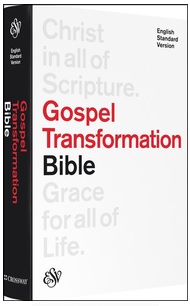
The historical-redemptive method of interpretation is all the rage in contemporary Christianity. Projects and programs that promote this method of interpretation and target all age groups abound. Almost all Christian publishers are on board with the historical-redemptive hermeneutic. The latest project that has been unveiled towards this endeavor is Crossway Publishers’ The Gospel Transformation Bible. It will be available 10/19/13.
The subtitle is, “Christ in all of Scripture, Grace for all of Life.” This is typical of those who promote this method of interpretation and its gospel. Christians will assume that the title only pertains to justification by faith alone, but it doesn’t. “Transformation” or change has to do with the Christian life, and in the subtitle, “Grace” replaces “gospel” to veil the real crux of this doctrine. Basically, it teaches that Christians are transformed by continually revisiting the same gospel that saved them. Not only that, we keep ourselves saved by doing such. This is what is behind the Neo-Calvinist mantra, “We must preach the gospel to ourselves every day.” John Piper has said that the question is not only how one gets saved, but how one must use the same gospel that saved him/her to keep themselves saved. [10] Piper has also said that we must “see” the same gospel that saved us over and over again as a requirement to enter heaven. [11]
Note: This is what’s so critical about the Reformed historical-redemptive interpretative model according to many Calvinists, it enables us to fulfill what is “required of us” to enter heaven (Ibid). In essence, once saved, how we read our Bible determines whether we keep our salvation or not. So therefore, those who promote The Gospel Transformation Bible actually see it as a resource for maintaining one’s salvation.
The “Gospel-Driven” Life
The question that is invariably raised is, “How do proponents of the historical-redemptive model explain obedience and the Christian life?” Primarily, they say Christians must “experience” obedience, but must not be the ones who perform it in the Christian life. By revisiting the gospel afresh, the works of Christ are “manifested” in our lives. When this happens, the obedience is experienced by a willing, joyful spirit. As we use the historical-redemptive model to see how sinful we are (a deeper realization of our sin, the realization that originally saved us), and thereby gaining a greater appreciation for what Jesus did for us, we experience “vivification.” This is some sort of joyful rebirth. Proponents of this hermeneutic, primarily those of Reformed theology, refer to this as “mortification and vivification.” A “daily dying and rising,” a “living out of our baptism.” [12] [13]
The Origin of the Historical-Redemptive Hermeneutic
Where did this hermeneutic originate? Even though Martin Luther’s 95 Theses launched the Reformation, the framework of the Reformation’s doctrine and gospel was articulated by Martin Luther six months later. Essentially, Luther’s Heidelberg Disputation to the Augustinian Order in 1518 is the heart and soul of the Reformation. Calvin’s Institutes of the Christian Religion is a greatly expanded treatise of Luther’s framework. However, every fundamental element of Reformation doctrine can be found in Luther’s Disputation, and this by no means excludes the historical-redemptive hermeneutic. [14]
The primary theme of Luther’s Disputation is known as The Theology of the Cross. It was comprised of the glory story and the cross story. Luther believed that salvation must be maintained by an incessant emptying of self. One’s focus must be OUTWARD only. Any semblance of an inward look was the “glory story.” The outward focus on Christ and His works, and nothing about us whatsoever is the “cross story.” A beginning focus on the cross saves us, and a continued focus on the cross story keeps us saved the same way we were originally saved: by faith alone. Sola Fide also pertains to the Christian walk/life. The historical-redemptive model came from Luther’s Theology of the Cross.
Luther believed the outward focus and utter eradication of self leads to a subjective power displayed by the Holy Spirit that we experience. However, we are not to be concerned with it because there is no way for us to distinguish between our own efforts and those of the Spirit. [15] Mortification and vivification can be ascertained in Theses’ 16 and 17 of the Disputation.
Never have Christians been so oblivious to such a critical issue. What we believe about the gospel and how we convey it to the world is at stake. Every Sunday in America, historical-grammatical parents deliver their children to historical-redemptive teachers while clueless in regard to the ramifications. This reality actually creates mixed families and marriages via two different gospels. One spouse buys into sanctification by faith alone while the other one doesn’t. Eventually, you have a mixed marriage.
The issue with these two hermeneutics is not a matter of semantics and preference—these are two different gospels. This issue is the elephant in the sanctuary and the Sunday school room.
ENDNOTES
1. Nabu Public Domain Reprints: The Principles of the Westminster Standards Persecuting; William Marshall, D.D., Coupar – Angus. Edinburgh, William Oliphant & Co. 1873, p. 13.
2. Ibid., pp. 19-22, 28.
3. Bruce Overton: MacMillan’s Modern Dictionary; The Macmillan Co. New York 1943.
4. Ibid.
5. Ibid. designated as synonymous with “politic” : the science of government.
6. Paul David Tripp: How People Change; Punch press 2006, p. 26.
7. The Biblical Theological Study Center: A Christo-Presuppositional Approach to the Entire Scriptures; Max Strange. Online source: http://goo.gl/5sGjP).
8. John Piper: Desiring God .org blog: Video, If you had 2 minutes with the Pope, what would you say?
9. Paul David Tripp: How People Change; Punch press 2006, p. 27.
10. John Piper: Desiring God .org blog; How Does The Gospel Save Believers? Part 2. August 23, 1998 Bethlehem Baptist Church.
11. Ibid, Part 3.
12. Michael Horton: The Christian Faith: A Systematic Theology for Pilgrims On the Way; Zondervan 2011, p. 661.
13. Paul Washer: The Gospel Call and True Conversion; Part 1, Chapter 1, heading – The Essential Characteristics Of Genuine Repentance, subheading – Continuing and Deepening Work of Repentance.
14. In its fundamental elements. It was not referred to as the historical-redemptive hermeneutic for many years afterward.
15. Heidelberg Disputation: Theses 24.
Paris, Prayer, and the Evangelical State of Islam
 Let me clarify something in the beginning of this post: The Paris terrorist attack was NOT God’s will. Secondly, God didn’t use ISIS to judge Paris or France in general. Thirdly, stop praying that God will spare America from an attack if “it be thy will.” Trust me, it’s not God’s will that anyone dies ever. God hates death, period. And lastly, but by no means leastly, stop warning America to repent lest it suffer the same judgment from God. Westboro Baptist church much?
Why do Protestants, Baptists, Catholics, and evangelicals in general pray like this? Well, I could push the easy button and say it’s because we are among the most ignorant misinformed people on the face of the earth, and that would be true, but the fact is that these prayers reflect the worldview and doctrine of the Protestant forefathers.
What was that worldview? Simply stated, the material world is evil, and of course that includes material beings. Like all pagan religions founded on the garden disputation, the goal is freedom to perceive well-being without any real participation in it other than the disparaging of all things material. If you have been following our Heidelberg Disputation series, you know Luther believed that ALL spiritual perception comes through suffering. Ignorant evangelicals deny this theses out of hand because purist Reformation ideology has been watered down over time, but they at least function according to the original principles because as the saying goes, “The apple doesn’t fall far from the tree.” Hence, these prayers are grounded in the ancient idea that all things material are evil, and to the point that it is destroyed, goodness is perceived and experienced though not effected by any act of the homosapien, e.g., “I didn’t do it! The Holy Spirit did it!” Sound familiar?
Therefore, knowing that it is our “natural” inclination to avoid the suffering that would do us good, we take “not my will Father, but your will” (which is supposedly suffering) completely out of context and invoke it into prayer such as the aforementioned. It was certainly God’s will that Christ suffered, but that doesn’t make suffering a good thing, nor does it make suffering the primary epistemology. This bypasses God’s just character and His demand for justice in the world. So consequently there is little justice in the church accordingly, and it is replaced with “forgive others as Christ forgave you,” also taken out of context. Injustice is tolerated in the church for three simple reasons: 1. It’s God’s will 2. Suffering dissuades focus on worldly things and forces us to focus on God (Luther/Calvin) 3. Only suffering leads to increased spiritual well-being. So, yes, what happened to you when you were raped by deacon Don in the hallway closet was absolutely horrible! But…it is God’s will for you to suffer, we should forgive others the way we are forgiven, and if this event becomes public the church will be harmed, and per the Reformers as well, the church is the only way to heaven. If you don’t suck it up and forgive deacon Don, “people will go to hell and their blood will be on your hands.” Sound familiar?
As I am well reminded in my present research for the TANC 2016 project, the undisputed Doctor of the Church for both Catholics and Protestants is Saint Augustine who was an unabashed Platonist. It’s just this simple: Protestantism is fundamentally a Platonist religion, this is simply unambiguous history, and though most Protestants are unaware of this, the fact is often revealed in their mindless truisms, viz, stuff that happens really isn’t done by us if it’s a good work, God preordains death and disaster because everyone deserves hell and anything short of that is “grace,” and a general indifference to justice accordingly. Furthermore, this can also be seen in the average parishioner’s aversion to knowledge as unspiritual. This is a consummate Platonist principle; mankind cannot comprehend reality, and needs preordained gifted mediators to lead others unquestioned. In other words, knowledge is arrogance and refuses to “submit itself to God’s anointed.” This is right out of Plato’s philosophical playbook.
Take note of something if you will: while the present-day evangelical church is hellbent on following the Neo-Calvinist movement, note carefully their commentary on all things ISIS. Have you noticed the lack of outrage? In fact, how many posts would you like to be referred to that actually have a hint of endorsement of ISIS from the who’s who of the Neo-Calvinist movement such as John Piper and Al Mohler? Why is this? Because the fundamental worldview is the same: 1. The material world is evil 2. God preordains seers to obtain unity 3. Unity is based on the submission to authority granted to the seers by God 4. To enforce the orthodoxy of the seers is “just war.” Listen, whether Catholic or Protestant, history shows that enforcing orthodoxy by the sword has always been the policy of both. Read the Westminster Confession for yourself rather than taking the pastor’s word for what’s in there. Besides, he’s only telling you what Al Mohler and John Piper told him.
And look, enforced orthodoxy is not only a Platonist fundamental, but has always been, and always will be a Protestant fundamental principle of orthodoxy. The American Revolution screwed that up, and hence, the Neo-Calvinist disdain for American nationalism. Yes, yes, I know the shtick, we have made Americanism a god, blah, blah, blah, but that is entirely disingenuous. Protestantism, like ISIS, is totally all about enforcing orthodoxy through the state, and ALWAYS has been, and ALWAYS will be. The tension between its church-state lust and filthy America is heard in this prayer…
“Hey America, you better ‘repent’ and turn to God (orthodoxy) or he will judge you! See, see, see what happened on 9/11? You guys better listen to us and do what we say!”
Yes, in the minds of the Neo-Calvinists, and they have as much said it outright, 9/11 was a backdoor enforcement of Protestant orthodoxy akin to the long lost glory days of the Protestant church-state under Augustine who they claim as “the one who returned us to the ancient faith” (B.B. Warfield). Indeed he did. And yes indeed, if America doesn’t start letting God’s anointed run the show, we can expect terror attacks in the future. Read their posts carefully; what did Al Mohler mean when he said “one man’s terrorist is another man’s patriot”? Creepy much?
ISIS and evangelicals make strange bedfellows, but nevertheless, the tie that binds can be heard in their prayers.
paul
Spurgeon’s False Gospel
 Meme Post #4
Where to start in all the ways that this meme contradicts Scripture and denies the new birth and true gospel? Let’s start with a few blatant contradictions.
Our faith does NOT rest. Our faith WORKS through love (Gal 5:6). Faith is a GIFT, but that doesn’t mean we don’t put the gift to work. In fact, the belief that our faith doesn’t work suggests that we must continue to keep ourselves saved through “rest.” Spurgeon, like most lying Calvinist heretics, held to the Reformation’s Sabbath Rest Salvation. It holds to the idea that the Old Testament Sabbath rest is New Testament sanctification and we must continue to live by faith alone in our Christian lives to keep ourselves saved. This, according to Calvin, happens through receiving continued forgiveness for “present sin” through church membership.
And remember, Spurgeon once said that Calvinism isn’t “just a nickname,” but “is the gospel” itself.
True faith doesn’t rest–it works. There is no true love in a faith that rests.
Secondly, the Bible makes it clear that we grow spiritually through obtaining knowledge; what’s up with the idea that knowledge doesn’t define who we are as believers? Frankly, I don’t care how many people think this guy is a spiritual icon–you know, kinda like the Bereans who held Paul accountable to Scripture.
Thirdly, the idea that who we are doesn’t point to the legitimacy of our faith and is therefore not a resting faith contradicts a vast number of Scriptures and Hebrews 11 in particular.
Fourthly, how we feel is most certainly important because the Bible says that faith not working in love will cause the believer to be full of fear.
Why is it ok for Spurgeon to blatantly contradict Scripture? Because Baptists have a longstanding tradition of being man-followers, that’s why.
Furthermore, note that we supposedly rest in the idea that who we are is NOT who Christ is! HUH!!!! Say what???? If Jesus is your big brother because you are literally born into the same family, you had better be like Him or you aren’t born again (see 1John).
And finally, note that we rest in what Christ has both DONE and is DOING. This is the Reformed doctrine of Double Imputation. It teaches that Christ came to secure our salvation by both dying for sin and keeping the law in our stead. It teaches that justification is based on perfect law-keeping rather than the new birth. Jesus could die for us because He lived up to the standard of the law, and presently keeps the law for us if we are “resting” in what He has “done and is doing.” This is a blatant contradiction to Galatians chapter 3. This is the very idea that Paul is refuting in that chapter.
This makes the law a co-life-giver with God and promotes an additional seed (offspring), but their is only ONE SEED (see Gal 3). In essence, Paul was arguing that this very idea makes the law a fourth member of the Trinity. And in fact, Calvinists state this openly when they say that “the empty hand of faith presents the doing and dying of Christ to the law and the law is satisfied.”
So, instead of God electing the means of salvation, Christ dying to end the law, and the Spirit fulfilling “The Promise” of resurrection and baptism to Abraham and Christ, we now have that added fourth element of the law being the standard for justification instead of new birth obtained by faith alone in The Promise. The contrary view of this meme keeps the so-called believer under law rather than under grace, and that’s supposedly ok because Jesus keeps the law for us.
But this also keeps the believer from performing the purpose of the law for sanctification, faith working through love. Instead, we must rest because Jesus is the only one that can keep the law perfectly as the law supposedly gives salvific life when fulfilled. In contrast, the Old Covenant kept sin captive until Christ came and ended it. The law was ended by Christ’s death in regard to its ability to condemn, and we are now free to serve the law in regard to love (Rom 7 and Heb 6:10). The Old Covenant still holds all sin captive that is committed against it (“all sin is against the law”) until a person believes in Christ resulting in the law being ended for condemnation and the person being set free to “use the law lawfully” (1Tim 1:8ff.) for purposes of loving God and others. Those who do not believe on Christ will be condemned by the law, but there is “NOW NO condemnation for those in Christ.” Rather, true believers are free to fulfill the law in aggressive love for God and others (Rom 8).
For the outcome of Spurgeon’s “rest” see the Parable of the Talents. Resting in love that Christ supposedly fulfills for us evokes this response from Him: “You lazy, wicked servant.”

 Paul's Passing Thoughts
leave a comment