The Case for Caste
Is the American church a religious caste system? Consider: seminary students do not teach what they learn in seminary to congregants. In fact, those who do are ridiculed for doing so. Secondly, why are American parishioners so dumbed down theologically? Are the first two questions answered in regard to a higher knowledge that only pastors can understand? In Reformed circles, elders state openly that they are gifted to understand things that parishioners are unable to. Point in case: New Calvinist Dr. Devon Berry: Elder Preaching is Infallible .
Academic degrees have become the primary qualification for a pastor in our culture. Who would deny that? In pulpit committees, any resume that states less than a Masters degree gets file 13 immediately. But yet, academic qualifications are nowhere listed in the biblical qualifications for an elder. Also consider: how can the laity obtain degrees while supporting a family, serving their local church, and working full time? While 90% of all doctrinal error is coming from seminaries, the laity is deemed less qualified. The salaries being paid to heretical sheep abusers is 80,000 per year on the low side. And I might mention that what I have learned in the past five years through independent study would have never been taught to me in a seminary, No way. Not even close. Seminaries are maintaining the status quo.
Parishioners are living from a steady diet of materials published by the academics and not their own Bibles. Who would deny this? Why? Because they are supposedly critical to understanding the higher knowledge that the laity cannot understand. They interpret for us. What is more obvious?
Why do well-known leaders turn a blind eye to the abused laity? Why is John MacArthur Jr. completely indifferent to what his pal CJ Mahaney has done to people? Simple, the value of the laity and where they are in the caste system strata.
Why is getting justice for the sexually abused ABWE missionary children like pulling teeth from a leopard? Easy, Donn Ketcham is high on the strata; the missionary children are low, and of less value to the organization. The caste system protects the organization that cannot be destroyed over justice for the lowly. Besides, the lowly are expendable for the pleasures of the upper crust. Absurd notion? Then why do GARB churches continue to support ABWE en masse? Where is the outcry for justice? Why does the money continue to pour in?
Though the Bible instructs the church to publically rebuke elders that sin, this is NEVER done. Pastors get a pass while parishioners are disciplined and excommunicated routinely. Again, value is the issue.
The New Testament is replete with examples of Christ and the apostles contending against religious caste systems—formal and informal.
Following is my pictorial thesis:

PPT Statement on the Gospel
1. The gospel of the death, burial, and resurrection is for the unsaved—not the saved. There shouldn’t be anything more obvious. The apostle Paul said that we have a ministry of “reconciliation” to the world. Unlike the world, we are already reconciled.
2Corinthians 5:
11 Since, then, we know what it is to fear the Lord, we try to persuade others. What we are is plain to God, and I hope it is also plain to your conscience. 12 We are not trying to commend ourselves to you again, but are giving you an opportunity to take pride in us, so that you can answer those who take pride in what is seen rather than in what is in the heart. 13 If we are “out of our mind,” as some say, it is for God; if we are in our right mind, it is for you. 14 For Christ’s love compels us, because we are convinced that one died for all, and therefore all died. 15 And he died for all, that those who live should no longer live for themselves but for him who died for them and was raised again.
16 So from now on we regard no one from a worldly point of view. Though we once regarded Christ in this way, we do so no longer. 17 Therefore, if anyone is in Christ, the new creation has come: The old has gone, the new is here! 18 All this is from God, who reconciled us to himself through Christ and gave us the ministry of reconciliation: 19 that God was reconciling the world to himself in Christ, not counting people’s sins against them. And he has committed to us the message of reconciliation. 20 We are therefore Christ’s ambassadors, as though God were making his appeal through us. We implore you on Christ’s behalf: Be reconciled to God. 21 God made him who had no sin to be sin for us, so that in him we might become the righteousness of God.
2. Salvation is Trinitarian. God chose, elected, and justified. Christ paid the penalty for all of our sins past, present, and future by dying on the cross. And the Holy Spirit set us apart positionally when God glorified us before the foundation of the earth.
1 Corinthians 6:11
And that is what some of you were. But you were washed, you were sanctified, you were justified in the name of the Lord Jesus Christ and by the Spirit of our God.
Romans 8:29
For those God foreknew he also predestined to be conformed to the image of his Son, that he might be the firstborn among many brothers and sisters.
Romans 8:30
And those he predestined, he also called; those he called, he also justified; those he justified, he also glorified.
3. The Spirit’s work in the Christian’s life is powered by the Spirit and not the gospel. The work of the Spirit in the Christian’s life is not the same work that He did before creation when we were justified. That setting apart (sanctification) was positional, and was a onetime finished work. His present progressive work is not powered by the finished work of justification. Christ spoke of the washing before creation as a work that was finished and no longer needed.
1 Corinthians 6:11
And that is what some of you were. But you were washed, you were sanctified, you were justified in the name of the Lord Jesus Christ and by the Spirit of our God.
John 13:
9 “Then, Lord,” Simon Peter replied, “not just my feet but my hands and my head as well!”
10 Jesus answered, “Those who have had a bath need only to wash their feet; their whole body is clean. And you are clean, though not every one of you.”
4. Sanctification requires a different repentance than repentance unto salvation. This indicates the separation between the two. Again, see the aforementioned reference from John 13.
5. A call to salvation includes: believing that God is; he sent His Son to die for our sins; the Holy Spirit resurrected Christ on the third day, and a commitment to kingdom living through the new birth.
Hebrews 11:6
And without faith it is impossible to please God, because anyone who comes to him must believe that he exists and that he rewards those who earnestly seek him.
1 Corinthians 15:
1 Now, brothers and sisters, I want to remind you of the gospel I preached to you, which you received and on which you have taken your stand. 2 By this gospel you are saved, if you hold firmly to the word I preached to you. Otherwise, you have believed in vain.
3 For what I received I passed on to you as of first importance: that Christ died for our sins according to the Scriptures, 4 that he was buried, that he was raised on the third day according to the Scriptures, 5 and that he appeared to Cephas, and then to the Twelve. 6 After that, he appeared to more than five hundred of the brothers and sisters at the same time, most of whom are still living, though some have fallen asleep. 7 Then he appeared to James, then to all the apostles, 8 and last of all he appeared to me also, as to one abnormally born.
9 For I am the least of the apostles and do not even deserve to be called an apostle, because I persecuted the church of God. 10 But by the grace of God I am what I am, and his grace to me was not without effect. No, I worked harder than all of them—yet not I, but the grace of God that was with me. 11 Whether, then, it is I or they, this is what we preach, and this is what you believed.
Acts 17:30
In the past God overlooked such ignorance, but now he commands all people everywhere to repent.
Acts 2:38
Peter replied, “Repent and be baptized, every one of you, in the name of Jesus Christ for the forgiveness of your sins. And you will receive the gift of the Holy Spirit.
Acts 3:19
Repent, then, and turn to God, so that your sins may be wiped out, that times of refreshing may come from the Lord,
Acts 20:21
I have declared to both Jews and Greeks that they must turn to God in repentance and have faith in our Lord Jesus.
Acts 26:20
First to those in Damascus, then to those in Jerusalem and in all Judea, and then to the Gentiles, I preached that they should repent and turn to God and demonstrate their repentance by their deeds.
John 3:
3 Jesus replied, “Very truly I tell you, no one can see the kingdom of God unless they are born again.”
4 “How can someone be born when they are old?” Nicodemus asked. “Surely they cannot enter a second time into their mother’s womb to be born!”
5 Jesus answered, “Very truly I tell you, no one can enter the kingdom of God unless they are born of water and the Spirit. 6 Flesh gives birth to flesh, but the Spirit gives birth to spirit. 7 You should not be surprised at my saying, ‘You must be born again.’ 8 The wind blows wherever it pleases. You hear its sound, but you cannot tell where it comes from or where it is going. So it is with everyone born of the Spirit.”
2 Corinthians 5:17
Therefore, if anyone is in Christ, the new creation has come: The old has gone, the new is here!
6. The offer of salvation to all is a legitimate offer. The apostle Paul clearly indicates that “persuasion” is an important part of the gospel invitation.
2 Corinthians 5:11
Since, then, we know what it is to fear the Lord, we try to persuade others.
Acts 17:4
Some of the Jews were persuaded and joined Paul and Silas, as did a large number of God-fearing Greeks and quite a few prominent women.
Acts 18:4
Every Sabbath he reasoned in the synagogue, trying to persuade Jews and Greeks.
Acts 26:28
Then Agrippa said to Paul, “Do you think that in such a short time you can persuade me to be a Christian?”
Acts 28:23
They arranged to meet Paul on a certain day, and came in even larger numbers to the place where he was staying. He witnessed to them from morning till evening, explaining about the kingdom of God, and from the Law of Moses and from the Prophets he tried to persuade them about Jesus.
7. The law is no longer a standard for the believer’s justification. It is now truth for sanctification. There is no maintaining of the law necessary for the believer’s justification. In regard to justification—the law has been abolished. This is distinct from the law’s role in sanctification. In sanctification, it is the truth that sanctifies; ie., the truth that the Holy Spirit uses to set the believer apart from the world. Hence, in regard to justification, “law” is often the word used most. In regard to sanctification, the words used most are, “Scripture,” “Holy Writ,” “word.”
Romans 7:
1 Do you not know, brothers and sisters—for I am speaking to those who know the law—that the law has authority over someone only as long as that person lives? 2 For example, by law a married woman is bound to her husband as long as he is alive, but if her husband dies, she is released from the law that binds her to him. 3 So then, if she has sexual relations with another man while her husband is still alive, she is called an adulteress. But if her husband dies, she is released from that law and is not an adulteress if she marries another man.
4 So, my brothers and sisters, you also died to the law through the body of Christ, that you might belong to another, to him who was raised from the dead, in order that we might bear fruit for God. 5 For when we were in the realm of the flesh,[a] the sinful passions aroused by the law were at work in us, so that we bore fruit for death. 6 But now, by dying to what once bound us, we have been released from the law so that we serve in the new way of the Spirit, and not in the old way of the written code.
John 17:17
Sanctify them by the truth; your word is truth.
8. Assurance of salvation is obtained through obedience.
2Peter 1:
5 For this very reason, make every effort to add to your faith goodness; and to goodness, knowledge; 6 and to knowledge, self-control; and to self-control, perseverance; and to perseverance, godliness; 7 and to godliness, mutual affection; and to mutual affection, love. 8 For if you possess these qualities in increasing measure, they will keep you from being ineffective and unproductive in your knowledge of our Lord Jesus Christ. 9 But whoever does not have them is nearsighted and blind, forgetting that they have been cleansed from their past sins.
10 Therefore, my brothers and sisters, make every effort to confirm your calling and election. For if you do these things, you will never stumble, 11 and you will receive a rich welcome into the eternal kingdom of our Lord and Savior Jesus Christ.
9. The unsaved are born under the law and the law of sin.
All born into the world are born under the law, and unless they repent unto salvation, will be judged by the law and condemned by it on the judgment day. Also, in the life of an unbeliever, the law provokes sin. The nature of the unregenerate man is provoked by the law because in essence, he despises it.
Romans 3:19
Now we know that whatever the law says, it says to those who are under the law, so that every mouth may be silenced and the whole world held accountable to God.
Romans 7:5
For when we were in the realm of the flesh, the sinful passions aroused by the law were at work in us, so that we bore fruit for death.
Romans 7:8
But sin, seizing the opportunity afforded by the commandment, produced in me every kind of coveting. For apart from the law, sin was dead.
10. Double imputation is the righteousness of God imputed to us and our sins imputed to Christ. It is not the righteousness of Christ and His perfect life lived on earth. Christ’s perfect life lived on earth was not imputed to us as a substitute for our obedience in kingdom living (sanctification). This would be necessary if salvation was a “golden chain” (linear), but it isn’t. Justification and sanctification are separate. Christ died for our sins, but did not live for our sanctification. The point of Christ’s perfect life is that He is the only man who could have been born under the law and not be condemned by it before dying on the cross for the sins of the world.
Furthermore, Christ did not have to prove Himself the lamb of God by keeping the law perfectly, he is the lamb of God by virtue of who He is.
2 Corinthians 5:21
God made him who had no sin to be sin for us, so that in him we might become the righteousness of God.
Philippians 3:9
and be found in him, not having a righteousness of my own that comes from the law, but that which is through faith in Christ—the righteousness that comes from God on the basis of faith.
2 Peter 1:1
Simon Peter, a servant and apostle of Jesus Christ, To those who through the righteousness of our God and Savior Jesus Christ have received a faith as precious as ours:
Romans 1:17
For in the gospel the righteousness of God is revealed—a righteousness that is by faith from first to last, just as it is written: “The righteous will live by faith.”
Hebrews 10:14
For by one sacrifice he has made perfect forever those who are being made holy.
Romans 5:
18Consequently, just as one trespass resulted in condemnation for all people, so also one righteous act resulted in justification and life for all people. 19 For just as through the disobedience of the one man the many were made sinners, so also through the obedience of the one man the many will be made righteous.
Philippians 2:8
And being found in appearance as a man, he humbled himself by becoming obedient to death— even death on a cross!
11. The saved are called Holy, called to be Holy, and are Holy because the seed of God is in them through the new birth. We are declared righteous, and are infused with righteousness, and coexist temporary with our sinful humanity which has had its enslavement broken through our death in Christ. Warfare between the flesh and our redeemed heart therefore rages as we are aided by the Holy Spirit. This is not warfare for justification, but warfare in kingdom life.
Galatians 5:
16 So I say, walk by the Spirit, and you will not gratify the desires of the flesh. 17 For the flesh desires what is contrary to the Spirit, and the Spirit what is contrary to the flesh. They are in conflict with each other, so that you are not to do whatever you want.
Romans 7:
21 So I find this law at work: Although I want to do good, evil is right there with me. 22 For in my inner being I delight in God’s law; 23 but I see another law at work in me, waging war against the law of my mind and making me a prisoner of the law of sin at work within me. 24 What a wretched man I am! Who will rescue me from this body that is subject to death? 25 Thanks be to God, who delivers me through Jesus Christ our Lord!
So then, I myself in my mind am a slave to God’s law, but in my sinful nature a slave to the law of sin.
1 John 3:9
No one who is born of God will continue to sin, because God’s seed remains in them; they cannot go on sinning, because they have been born of God.
12. The use of the word “gospel” in the Bible means more than the death, burial, and resurrection. There is the “good news of the kingdom,” and “the good news of God the Father and Jesus Christ.” Romans 1:16-15:21 is a statement on what the gospel is. It is more than the works of Christ.
Matthew 24:14
And this gospel of the kingdom will be preached in the whole world as a testimony to all nations, and then the end will come.
Matthew 26:13
Truly I tell you, wherever this gospel is preached throughout the world, what she has done will also be told, in memory of her.
Acts 1:3
After his suffering, he presented himself to them and gave many convincing proofs that he was alive. He appeared to them over a period of forty days and spoke about the kingdom of God.
Acts 5:31
God exalted him to his own right hand as Prince and Savior that he might bring Israel to repentance and forgive their sins.
Acts 5:32
We are witnesses of these things, and so is the Holy Spirit, whom God has given to those who obey him.”
Acts 6:7
So the word of God spread. The number of disciples in Jerusalem increased rapidly, and a large number of priests became obedient to the faith.
Acts 8:12
But when they believed Philip as he proclaimed the good news of the kingdom of God and the name of Jesus Christ, they were baptized, both men and women.
Acts 8:14
When the apostles in Jerusalem heard that Samaria had accepted the word of God, they sent Peter and John to Samaria.
Acts 12:24
But the word of God continued to spread and flourish.
Acts 13:5
When they arrived at Salamis, they proclaimed the word of God in the Jewish synagogues. John was with them as their helper.
Heresy in Heels: The Queens of Progressive Justification
 “As one respected Reformed pastor noted: it is the same Catholic salvation that those of Reformed thought claim to refute.”
He is supposedly the Master who does all the work for us lest He be robbed of any glory. Somehow, if we actually do any of the work as born again slaves, that doesn’t honor the Master, but yet, he insists on being known as a master. It seems like God would want to be known by something else other than, “Lord.”
Using language that referred to the slave culture of that day, the apostle Paul said we were “bought with a price.” We were purchased as slaves with the blood of Christ, but the gospel that is all the rage of our day denies this very purchase and the lordship of Christ; it’s replaced with a supposed purchase of parasites.
As the heretic Paul David Tripp states it: we “rest and feed” on Christ. Got that? We are the slaves, He is the Lord, but we “rest and feed.” Really? And how valid is any profession of faith that doesn’t understand this relationship? How valid is a profession that accepts Christ as Savior only and denies the purchase?
Contemporary Reformed leaders of our day are now cashing in on this false gospel two-fold. The judgement they are heaping upon themselves for present-day cash is not enough—they are getting their wives in on the action. The organization True Woman .com is only one of many massive organizations saturating Christian culture with New Calvinism’s fusion of justification and sanctification.
The organization is led by several wives of the who’s who of neo-Calvinism—following their husbands in heresy. And I am not the only one saying so. Even those of the “Reformed tradition” label the neo-Calvinist active obedience of Christ (Christ obeys for us) as, “heresy,” “works salvation” by not working in sanctification, “easy believism,” and antinomianism.
When justification and sanctification are fused together, justification is not a finished work. The doctrine makes two justifications: one finished and one progressive. They deceptively refer to this as “progressive sanctification.” Hence, “progressive sanctification” is really finishing justification. That’s a huge problem because we are in the sanctification process and what we do can therefore effect our “just standing with God.” It requires a maintaining of antinomianism to keep our just standing before God; ie., sanctification by faith alone. But living by faith alone in sanctification becomes a way to maintain our just standing before God—for all practical purposes, works salvation by antinomianism.
It’s not an oxymoron; when justification and sanctification are fused together, everything we do in sanctification points back to, or effects our justification because at least one aspect of it is not finished. As one respected Reformed pastor noted: it is the same Catholic salvation that those of Reformed thought claim to refute.
Furthermore, the primary catalyst for the doctrine’s present success was its Sonship theology package hatched at Westminster Seminary by Dr. John “Jack” Miller. A self-proclaimed understudy of Miller’s, David Powlison, then made the doctrine the foundation of Westminster’s biblical counseling curriculum via CCEF. In a book written by Dr. Jay E. Adams, he clearly states that the doctrine promotes a view that sanctification is powered by justification. Clearly, even in the Reformed community, there is a dispute in regard to the very reason we are supposed to be here: the gospel.
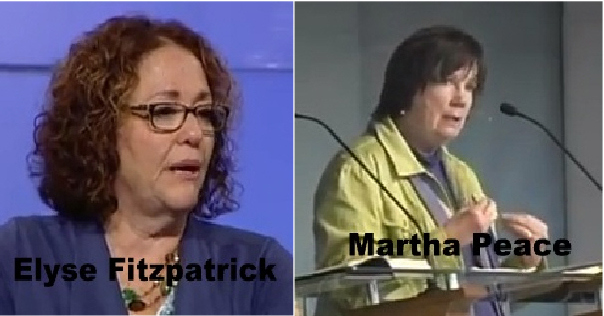
But does the Reformed tradition trump gospel truth? The answer is a resounding, “yes,” especially in the biblical counseling community. The two primary queens of that movement are Elyse Fitzpatrick and Martha Peace. Fitzpatrick has openly denied that there is any such thing as an antinomian because man is helplessly legalistic. Like all good neo-Calvinists, the poo-pooing of specific biblical truth is done without a blinking of the eye. In this case, the biblical word “anomia” is completely dismissed. And apparently, Satan came to Eve in the garden as a legalist.
Peace is a hardcore New Calvinist proponent of the active obedience of Christ and sanctification by faith alone. But yet, these two women are the toast of the biblical counseling community—even by those who refute the neo-Calvinist take on double imputation (the active and passive obedience of Christ imputed to our sanctification).
Why? Because it’s really not about the gospel. That’s why. And as far as counseling, people can’t be helped with a false gospel. No way.
paul
Comment Post: The Difference Between Old Calvinism and New Calvinism
With addendum:
Lydia,
Authentic Calvinism eventually dies a social death. It looks like the following pattern: It dies, then there is a resurgence that lasts 30-50 years. The death usually lasts about 100 years before another “rediscovery.” Remnants of the resurgence live on with more biblically grounded soteriology, but retains the name, “Calvinism.” Moreover, this is why contemporary Calvinism (the remnant) has a soteriology that is inconsistent with their eschatology. Hence, many “Calvinists” of our day contend against “New Calvinism.”
The historical rediscoveries die out as a result of:
1. The novelty wears off and the “gospel” repetition becomes boring and lifeless.
2. The saints eventually discover that it is a false gospel.
3. It is always accompanied by escalating tyranny.
4. The lack of sound doctrine regarding sanctification begins to have ill results in the lives of many people.
New Calvinism is a resurgence of authentic Calvinism with a new twist: for the first time in church history, it was systematized and packaged for the present church culture via the Australian Forum (1970). This time, it may not go away and become part of the last day antinomian blitzkrieg that will precede Christ’s return. However, Susan and I have been visiting churches that were on the cutting edge of the most recent resurgence. They were the ones who embraced this Reformed model early on as the movement was picking up steam (early 80′s). And what we are seeing is almost surreal. The best way we can explain it is: the outward expression of praise and worship with no life. Almost like skeletons raising their hands in praise to Jesus. Lots of praise and worship, but in both cases, large crowds of people move past each other like ships in the night. While the message is love, love, love, joy, joy, joy; we were not greeted by anybody. Never in my life have I seen so many unfriendly people with smiling faces.
paul
Politics and Religion Have the Same Soul
 When I didn’t know any better as a Christian, I was indifferent to politics because it made no sense to me. My problem was the following: I was always focused on outcomes. It never made any sense to me that regardless of outcomes, people would vote the same ideologues into office time and time again. In my frustration I would think, “Politics are a waste of time because people are stupid. Regardless of outcomes, they vote these same people into office time and time again.” This made absolutely no sense to me.
Until recently, church never made any sense to me either. Consider this picture: vast institutions pregnant with ultra-educated people coming up with ideas that plainly contrast Scripture. Again, regardless of the poor outcomes, the SYSTEM remains intact. The system seems to offer a devil that we know, and have become comfortable with, as opposed to a devil that we don’t know.
If you think about it, what is the difference between contemporary Christianity and the slave caste system of the Civil War era? To stand up against injustice is really the same thing as challenging the system. Action is stalled because people hope that the system will change (good luck with that)—that’s easy, changing the system is hard. However, we will fight harder to not change the system, as opposed to changing the system because it’s what we know. Hence, the system takes precedent over God’s justice and is protected by political spin dressed in biblical garb.
But people aren’t stupid, they just prefer whatever the normal is for the day—especially if they aren’t the ones being tied between two horses running in opposite directions. Pathetic, but it is what it is. And both politics and religion are kept alive by the same heart in this regard; the epic question of, “Who owns man?” Ownership is the soul of politics and religion.
Since the day that the framers of the American Constitution posed this question and answered it with the resolve of “Give me liberty or give me death,” be sure of this: the question of who owns man is the soul of American politics and always will be. Whether the American public realizes it or not, those who vote for Obama think government owns man. People who vote for Romney (albeit not their preferred choice) believe that we own ourselves, and are responsible to no other than God for the sum and substance of our life.
That’s the crux, until the day that the former wins the day—then politics will not be necessary because everything is decided in regard to the arena of ideas—there won’t be any arena—the government decides what a good idea is, and what it isn’t.
And religion is no different. That’s because the American framers of the Constitution were home wreckers. They caused the divorce between the European marriage of church and state. In Europe prior to the Enlightenment era that gave birth to the framers; as it was in the government, so it was in the church. There was no arena of ideas save the think tanks that devised efficient machines to eliminate free thinkers with as much pain as possible. Never before in human history has more science been poured into the technology of death machines than in Medieval Europe. And as part of the totally depraved masses, suggesting ideas privately or otherwise was extremely hazardous to one’s health.
It was a very efficient marriage. The church came up with the ideas and controlled them, and the government enforced the churches’ ideas. But there was a problem. The problem can be seen in one Bible verse among God’s full philosophical statement to man regarding truth: “Come, let us reason together saith the Lord.”
Reason. Even God presents His truth in an arena for man’s hearing. In the book of Job, we even find God challenging Satan in that arena. Like no other creatures, we are the ones called to reason—it is how we are wired by God. The results of shutting down man’s ability to think are abundantly evident from European history. Man is created to think. A man who is not allowed to think is exactly like a fish out of water. Eventually, he will start flopping around.
The framers understood this. They knew that any attempt by government to control ideas would only result in a repeat of European history. They also knew that religion is the fundamental gene pool in that regard. But systems die hard. Regardless of the eight-hundred-year European raging fire that could not be extinguished with blood, European religious tyrants who came to setup shop in America could only propagate their system in the government protected American-made arena of ideas.
The divorced couple must play by American rules thus far. In the American political system, it’s communism/socialism. In the religious realm, it’s European Reformed theology. The fight between the Europeans and the yanks continues in the arena of ideas instead of the battlefield. But be also certain of this: every drop of blood spilled in human history has been over ideas. The American framers of the Constitution, for the first time in history, invented a caste system that could implement ethics through politics without blood. Preferable in my book. And I am allowed to say so.
The soul of politics and religion is therefore the same. Who owns man? What could be more obvious? Does government own man? Or does man own man? It could be rightfully argued that God owns man, but even he says, “Come, let us reason together” while the European Reformer Martin Luther called reason a “whore” who should have “dung rubbed in her face to make her ugly.” The separated spouse, government, thinks they know best as well. Thinking, ideas, and reason, in the hands of the masses are supposedly the same as handing an eight-year-old a loaded gun as a play toy. And in the American arena of ideas, many are convinced that this is true.
Now you know the heart of the election that is now upon us. Obama has clearly stated that it is common sense that man exists for the government, and doesn’t build anything: “I hear business owners say, ‘I built this or that.’ You didn’t build that.” And obviously, the idea that led to the building project had nothing to do with it as well. The contrast can be pointed out in a recent speech by Romney at the Dayton, Ohio International airport in which he said that FREEDOM of IDEAS are critical to the overall American economy and wellbeing. It is also reflected in his recent bemoaning that 47% of Americans are dependent on the government and will not vote for him. Right. Exactly. That’s the crux: who owns man? And is he created to reason and think? And is it ok with God when man’s ideas produce positive outcomes?
What is at stake in this election? You only need to look at the governments estranged spouse—the church. For the most part, European Reformed theology has won out in the arena of ideas. The caste system formed by the Westminster Confession and rabid Puritans has been embraced willingly by those convinced that the church owns them. Sure, there is rape. Sure, there is the denial of ideas. Sure, there is injustice. Sure, there are no other answers but “the gospel.” Sure, we are still totally depraved and helpless. Sure, church is boring. Sure, the church is full of mindless followers. But what else is there? If not for the system, then what? If not for the system of Reformed “orthodoxy” enforced by church “polity” and executed by various and sundry unpleasantries that replaced the burning stake forbidden by our American forefathers, then what?
Ownership by government always leads to the same thing. Always. There are no exceptions. Regardless of outcomes, many American voters who like to be owned by their religion will also vote to be owned by the state. I also wonder how much this might be connected to the whole issue of culpability before God. After all, if we are unable to think for ourselves, and our ideas are dangerous to our own wellbeing, how can God hold us responsible? This provokes one to think of Nazi Germany and that people’s refrain, “The government made us do it.”
“One thing we don’t discuss in mixed company is politics and religion.” Right, because there is no doubt; that divorced couple is a volatile subject, especially when the two are poligion. We do know the devil of poligion, but change is hard and inconvenient. Luther suggested that reason be consigned to the “closets of the house” and we have obeyed. And whatever you do, don’t look in the closet—the monster of history is in there.
Nevertheless, when you pull the lever in November, the question isn’t, “Romney or Obama?” The real question is the soul of politics and religion: “Who owns you?”
paul

 Paul's Passing Thoughts
5 comments