Are Calvinists Saved?
 The begging of the question has a sound Scriptural argument.
This ministry has made much of the critical importance of separating justification (salvation) and sanctification (growth in holiness, or kingdom living). The Reformed (Calvin/Luther Reformation doctrine/gospel) “never separate, but distinct” doublespeak doesn’t cut it in the arena of truth, and we will see why. “Never separate” =’s false gospel. If you get a little lost in the first part of my argument which gives the lay of the land, don’t worry, when I get into the specific Scriptural argument, it will clear things up and make it all come together for you.
It must delight the ghosts of the Reformation that the argument has always been in the arena of freewill verses predestination. It’s the primary thrust of this ministry to change that argument. This isn’t a quibbling about semantics in the mainstream—this is about the truth of the gospel. As New Calvinist Russ Kennedy once thundered from the pulpit in his mousy voice: “Any separation of justification and sanctification is an abomination!”
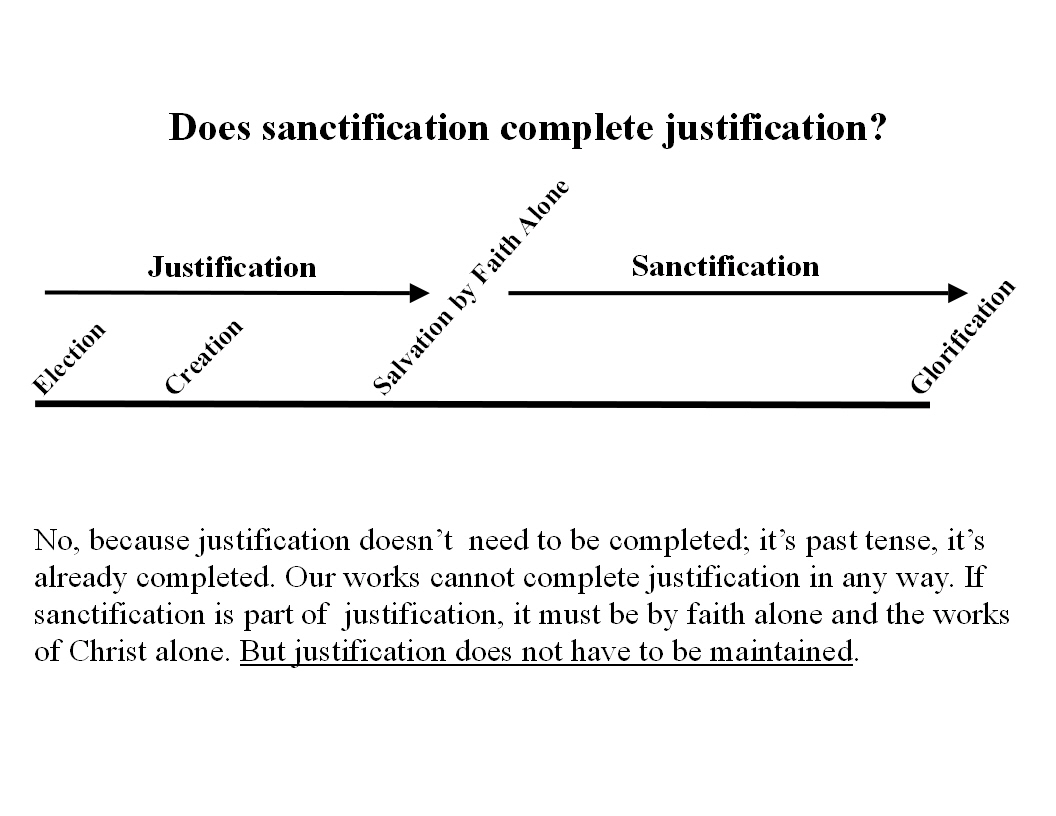
I have often argued from the standpoint of this issue. If sanctification is the middle of the Reformed “golden chain of salvation” then sanctification is part of finishing justification. This means that what happens in sanctification determines whether or not justification is properly finished. What’s a chain? John Piper even preached a message about the eternal importance of our contribution to the “links” in just the right way. In essence, sanctification becomes a spiritual minefield.
This is exactly the same thing that the Reformed crowd has always accused Rome of: the fusing together of justification and sanctification. However, as we shall see, they are both guilty of the exact same heresy/false gospel. As we shall see, both teach that sanctification finishes justification.
This is a linear gospel (one unified chain from salvation to resurrection (glorification) versus a parallel gospel with salvation on one plane as a finished work before the foundation of the world, and kingdom living that runs parallel with the finished work and reflects the reality of our salvation until glorification. Typical in the linear gospel is the idea that Christ died for all of our past sins, but we must now finish the work (with the Holy Spirit’s help [sanctified works salvation]) until glorification when we are completely transformed into complete holiness. This is the often-heard bemoaning of “Christ PLUS something.”
An excellent example is some strains of Freewill Baptists who teach that Christ died for all of our past sins, but with the help of the Holy Spirit, we must confess and repent of every sin we commit until the resurrection; e.g., Christ plus salvation by repentant prayer for sins committed after we are “saved.” My grandparents were saved out of this tradition. When my grandfather asked my grandmother if she thought that God could ever forgive him of all the sins he committed, she answered: “Yes, but you are going to have to pray awful hard!” Praise God that through the ministry of several individuals my grandparents eventually abandoned that gospel for the true one of salvation by faith alone as a finished work.
Likewise, Rome teaches that you must let the Catholic Church finish your justification through ritual; e.g., Christ plus Catholic ritual. The Reformation gospel is also Christ plus something else, but the something else is ever-so-subtle. In both cases, sin must be dealt with in sanctification in order for the saint to remain justified until the final judgment. In other words, the righteous standard of justification must be maintained on our behalf. Like all other proponents of a linear gospel, the Reformed crowd contends that anything less than the perfection demanded of the law (“all sin is transgression of the law”) is “legal fiction.” So both Rome and the Reformers agree: justification must be maintained by sanctification, and in the case of the Reformers specifically, they believe that the perfect standard of the law must be maintained until glorification; otherwise, our justification is “legal fiction.”
Here is where Reformed subtlety is uncanny: Christ keeps the law for us in sanctification. He maintains the perfect standard. All the fruit of sanctification (obedience/good works) flows from the life He lived on Earth and His death on the cross. Christ plus the works of Christ to finish salvation. “But Paul, what in the world is wrong with that!” Here is what is wrong with it: works are still required to maintain justification. That is a huge problem, even if it is Christ doing the work. What did the Hebrew writer say about Christ’s work for justification not being complete?
And even more subtle is the following Reformed idea: believing that the law is no longer a standard for maintaining justification is antinomianism. Antinomianism =’s legal fiction. Their definition of antinomianism is the removal of the law from justification as the standard for maintaining it. Traditionally, among Biblicist, antinomianism is the removal of the law from sanctification, and herein lays even further steroidal subtlety: the Reformed theologians would refute a removal of the law from sanctification as well, not only because they think justification and sanctification are the same thing, but because its perfect keeping is required to maintain a true declaration of the just that is not “legal fiction.”

However, the Biblicist believes that the law is a standard for kingdom living and is no longer a standard for justification. Therefore, if we attempt to obey it with the Holy Spirit’s help, and to please/serve the Lord, it can have no bearing on our just state. While the Biblicists think they are therefore joint contenders with the Reformers against antinomianism, such is far from the truth. The Reformed mind believes the Biblicist is either a legalist or an antinomian, or both. The Biblicist is supposedly an antinomian because he/she has removed the law from justification as a just standard, or is a legalist because they think they should strive to keep the law in sanctification. Since sanctification finishes justification’s perfect standard of law keeping, our “own” attempts to keep the law in sanctification is an attempt to finish justification. Hence, what the Biblicist fails to understand is the Reformers belief that Christ must maintain the law for us in sanctification because justification and sanctification are not separate. Anything more or less is supposedly works salvation.
On the other hand, because it is vital that Christ obeys the law for us in sanctification, the likes of John Piper and Tullian Tchividjian contend that those who are really preaching the Reformed gospel will indeed be accused of antinomianism. All in all, their position is easy to see if you pay attention. John Piper and many other Calvinists often state that, “Good works are the fruit of justification.” And, “Justification is the root, and sanctification is the fruit.”
Well, the average Biblicist then thinks, “Yes, but of course, our salvation makes good works in sanctification possible.” But that’s not what they are saying. If you pay closer attention, they are saying that justification is a tree that produces its own fruit. Justification is the root, and whatever happens in true sanctification is the fruit of the root of the justification tree. Problem is, justification doesn’t grow. Justification is a finished work. What Calvinists refer to as “progressive sanctification” is really the fruit of the root: progressive justification. Another name for this that they throw around is “definitive sanctification.” The word “definitive” refers back to the definite completion of justification.

Revision: this ministry now rejects the idea that orthodoxy is truth; orthodoxy is the traditions of men. Never in Scripture do we find premise for a body of teaching that explains the teaching. The above illustration is valuable for demonstrating that the fruit of justification is glorification, NOT sanctification.
This brings us to the Scriptural argument which begins with a question I asked myself just this morning: “Paul, you are always harping about the crucial importance of the separation of justification and sanctification—a parallel gospel versus a linear one. But where does the Bible say specifically that this is critical?”
First, the very definition of a lost person in the Bible is one who is “under the law”:
Romans 3:19
Now we know that whatever the law says it speaks to those who are under the law, so that every mouth may be stopped, and the whole world may be held accountable to God.
Romans 6:14
For sin will have no dominion over you, since you are not under law but under grace.
Romans 6:15
What then? Are we to sin because we are not under law but under grace? By no means!
1 Corinthians 9:20
To the Jews I became as a Jew, in order to win Jews. To those under the law I became as one under the law (though not being myself under the law) that I might win those under the law.
Romans 7:1
Or do you not know, brothers —for I am speaking to those who know the law—that the law is binding on a person only as long as he lives?
Romans 7:2
For a married woman is bound by law to her husband while he lives, but if her husband dies she is released from the law of marriage.
Romans 7:3
Accordingly, she will be called an adulteress if she lives with another man while her husband is alive. But if her husband dies, she is free from that law, and if she marries another man she is not an adulteress.
The unsaved are “under the law” and will be judged by it in the end. This is the very definition of the unsaved. Calvinists define Christians the same way—we are supposedly still under the law and will be judged by it in the end. That’s why Christ must keep the law for us—because we are still under it.
If not this position, why do many in the Reformed tradition hold to the idea that Christ’s perfect obedience is imputed to our sanctification? His death justifies us, and His perfect life sanctifies us. Hence, His death pays the penalty for past sins, and then His perfect life imputed to our sanctification keeps us justified. Why would an imputation to our sanctification be necessary if we are no longer under the law? This is known as the Reformed view of “double imputation” and has been called out as heresy by many respected theologians for this very reason: it implies that Christians are still under the law.
In regard to sustaining the law in our stead, why? It has been totally abolished in regard to our just standing:
Romans 3:20
For by works of the law no human being will be justified in his sight, since through the law comes knowledge of sin.
Romans 3:21
But now the righteousness of God has been manifested apart from the law, although the Law and the Prophets bear witness to it—
Romans 4:15
For the law brings wrath, but where there is no law there is no transgression.
The keeping of the law by anybody DOES NOT do anything to justify mankind:
Romans 3:28
For we hold that one is justified by faith apart from works of the law.
Here is where the separation of justification and sanctification is vital on this first point: we ARE NOT under the law for justification, but rather UPHOLD THE LAW in sanctification. The two must be separate because of the differing relationships to the law:
Romans 3:31
Do we then overthrow the law by this faith? By no means! On the contrary, we uphold the law.
Romans 6:15
What then? Are we to sin because we are not under law but under grace? By no means!
Furthermore, if we are still under the law (whether or not Christ obeys it for us to keep us in a just standing), this means we are still under the power of sin. Being under the law and also under its spell to provoke sin in the unregenerate is spoken of as being synonymous in the Bible. Those who are “under the law” are also under the power of sin and enslaved to it:
Romans 7:4
Likewise, my brothers, you also have died to the law through the body of Christ, so that you may belong to another, to him who has been raised from the dead, in order that we may bear fruit for God.
Romans 7:5
For while we were living in the flesh, our sinful passions, aroused by the law, were at work in our members to bear fruit for death.
Romans 7:6
But now we are released from the law, having died to that which held us captive, so that we serve in the new way of the Spirit and not in the old way of the written code.
Romans 7:8
But sin, seizing an opportunity through the commandment, produced in me all kinds of covetousness. For apart from the law, sin lies dead.
If we are still under the law, and will be judged by it, whether or not Christ stands in the judgment for us with His own works, we are still enslaved to sin by virtue of being under the law…. for justification. And Calvinists know this to be true, that’s why they say we are still…. what? Right, even as Christians, “totally depraved.” And, “enemies of God.” Of course, throughout the Bible, Christians are spoken of as being friends of God and no longer His enemies. Our status as enemies of God is stated in the past tense. But the Reformed crew continually state that Christians are vile enemies of God and are enslaved to sin. They realize that this goes hand in hand with being under the law.
To the contrary, dying to the law in the death of Christ….for justification—sets us free to be enslaved to the righteousness that is defined by the law. We are dead to the law for justification and alive to obey truth….for sanctification:
Romans 8:2
For the law of the Spirit of life has set you free in Christ Jesus from the law of sin and death.
Romans 8:3,4 [emphasis by author]
For God has done what the law, weakened by the flesh, could not do. By sending his own Son in the likeness of sinful flesh and for sin, he condemned sin in the flesh,….in order that the righteous requirement of the law might be fulfilled in us, who walk not according to the flesh but according to the Spirit.
Romans 8:7
For the mind that is set on the flesh is hostile to God, for it does not submit to God’s law; indeed, it cannot.
Romans 9:31
but that Israel who pursued a law that would lead to righteousness did not succeed in reaching that law.
John 17:17
Sanctify them in the truth; your word is truth.
James 1:25
But the one who looks into the perfect law, the law of liberty, and perseveres, being no hearer who forgets but a doer who acts, he will be blessed in his doing.
So, that is the separation that must be for the true Christian: Justification has no law for which we are judged, and we live by the law of blessings in sanctification.
This brings us to another important separation in the two: the judgments. Those under the law and sin will stand in a final judgment which will be according to the law. Again, because Calvinists believe that we are still under the law, albeit that Christ obeyed/obeys it for us, Christians will supposedly stand in the same judgment as the damned who are under the law and enslaved to it. At that time, the children of God, according to Calvinists, will be “made manifest.”
But because Christians are not under the law and cannot be judged by it, they will stand in a judgment for rewards and not a judgment that determines a perfect keeping of the law by Christ in our stead. Hence, there will be two different resurrections: one for those under the law and another for those under grace, and two different judgments for the same two groups. One for rewards, and one to determine if those under the law kept it perfectly. That judgment doesn’t go well for any standing in it.
Luke 14:12-14
He said also to the man who had invited him, “When you give a dinner or a banquet, do not invite your friends or your brothers or your relatives or rich neighbors, lest they also invite you in return and you be repaid. 13 But when you give a feast, invite the poor, the crippled, the lame, the blind, 14 and you will be blessed, because they cannot repay you. For you will be repaid at the resurrection of the just.” [Notice that this is a resurrection for the “just.” They are already determined to be just before they are resurrected].
2Corinthians 5:9,10
So whether we are at home or away, we make it our aim to please him. 10 For we must all appear before the judgment seat of Christ, so that each one may receive what is due for what he has done in the body, whether good or evil.
1Corintians 3:11-15
For no one can lay a foundation other than that which is laid, which is Jesus Christ. 12 Now if anyone builds on the foundation with gold, silver, precious stones, wood, hay, straw— 13 each one’s work will become manifest, for the Day will disclose it, because it will be revealed by fire, and the fire will test what sort of work each one has done. 14 If the work that anyone has built on the foundation survives, he will receive a reward. 15 If anyone’s work is burned up, he will suffer loss, though he himself will be saved, but only as through fire.
Hebrews 6:10
For God is not unjust so as to overlook your work and the love that you have shown for his name in serving the saints, as you still do.
Revelation 20:6
Blessed and holy is the one who shares in the first resurrection! Over such the second death has no power, but they will be priests of God and of Christ, and they will reign with him for a thousand years.
Revelation 20:11-15
Then I saw a great white throne and him who was seated on it. From his presence earth and sky fled away, and no place was found for them. 12 And I saw the dead, great and small, standing before the throne, and books were opened. Then another book was opened, which is the book of life. And the dead were judged by what was written in the books, according to what they had done. 13 And the sea gave up the dead who were in it, Death and Hades gave up the dead who were in them, and they were judged, each one of them, according to what they had done. 14 Then Death and Hades were thrown into the lake of fire. This is the second death, the lake of fire. 15 And if anyone’s name was not found written in the book of life, he was thrown into the lake of fire.
Don’t let anyone tell you that eschatology is a “secondary” or “nonessential” consideration. Your eschatology is your gospel. It will state your position regarding whether or not you fuse justification and sanctification together; ie, likening Christians to those under the law.
Yet another vital difference in sanctification and justification is repentance. Repentance for salvation (when you are justified) is different from our repentance in sanctification. Among many in the Reformed tradition where the “same gospel that saved you also sanctifies you,” the repentance is the same. Repentance unto salvation is not a onetime “washing,” but rather a means to continue “in the gospel” through what they call, “deep repentance.” Biblicism holds to repentance in sanctification that restores his/her fellowship and communion with God as His children. They would see repentance unto salvation as differing, and only necessary for salvation—a onetime decision to take one’s life in a new direction by following Christ, and believing in his death, burial, and resurrection.
Reformed repentance, according to the likes of Paul David Tripp and others is a “daily rescue.” Our original repentance was for rescue, and we need rescue today as much as we needed rescue when we were saved. Again, this indicates their belief that we are still under the curse of the law and need to be continually rescued from it while remaining under the bondage of sin.
However, Christ made it clear to Peter (John 13:6-11) that those who have been washed (1Corinthians 6:11, Romans 8:30) do not need another washing. Those who drink of the living water do not thirst again (John 4:13,14).
Lastly, though many other separations could be discussed, why saints can be considered just while they still sin at times is of paramount importance. There is no sin in our justification because there is no law, and where there is no law, there is no sin. Though unfortunate, there can be sin in our sanctification because it is totally separate from justification and can’t affect our just standing with God.
Basically, all of the aforementioned makes it of necessity to deny the new birth. If we have God’s seed in us, and we do (1John 3:9), that dispels total depravity, and without total depravity, justification and sanctification cannot be fused together. The new birth is a huge problem for Reformed theology. If the old man that was under the law is dead (Romans 7:1ff), and the seed of God is in the saved person, and the sin due our weakness in the flesh cannot be laid to our account for justification, then our justification is not “legal fiction” because we do not exhibit perfect obedience to the law. This is another grave consideration because Christ said, “You must be born again.” Obviously, despite their denials that they deny the new birth—you can’t be both totally depraved and born again.
Reformation doctrine is clearly a false gospel. Its version of justification does not void the law, and denies the new birth while distorting everything in-between. Freewill verses predestination is hardly the issue, the very gospel itself is the issue.
paul
Blogality: Why, and How New Calvinists Stalk Detractors
This post is about an element of blogosphere reality, or “blogality”; ie, being stalked by New Calvinists.
First, why do New Calvinists stalk people? Well, they have to because what they teach is out of the mainstream which means their teachings have to be covertly assimilated into the minds of their victims. While they are feeding the saints the elephant a bite at a time, anybody who knows about the whole elephant, and might pull it out of the barn for everyone to see is a serious threat. The saints mustn’t receive the truth “before they are ready for it.”
Furthermore, a parishioner of any given church can start Googling phrases and obtain all kinds of information that Reformed elders would prefer they didn’t know. The blogosphere is the engine of the information age, and information empowers people. And Reformed elders are not in the empowerment business—they are in the control business. That’s just bogality. And if the New Calvinist movement dies a social death like all other resurgent movements before it—the internet will be a primary reason.
Information and education is the foe that New Calvinists fear most. This is because truth doesn’t need to fear the facts. Hence, New Calvinists need to neutralize truth bearers for survival purposes, and the primary tool is stalking. Stalkers always want something. New Calvinists want you to shut up, and will stalk you till you do so. The following are their stalking techniques:
1. Fear of Authority and God. New Calvinists will first appeal to your fear of authority and God. Leaders are supposedly anointed by God and speak for Him directly. To contend against them is to contend against God.
2. Identity. They will attempt to educate you as far as “your place” in the spiritual food chain. And trust me, it will be low.
3. Loving Bombing. They will approach you out of concern and “love” for your own good. This will subtly be compared to them trying to help a crippled animal out of compassion that doesn’t know that the human is attempting to help them. This love bombing will be accompanied with prayer that “God will open your eyes of understanding.” This also feeds number four.
4. Dogma. They will not debate scriptural truth with you. This is part of a motif that they want to constantly present that their rightness is absolutely certain. To discuss theology with you would give credence to the idea that you are on the same spiritual plane of understanding. This also feeds the authority angle. Their position is absolutely right and nonnegotiable. This feeds an aurora of absolute self-confidence that New Calvinists continually and deliberately exude. This also contributes to, and feeds number five.
5. Undermining of self-confidence. This is why I have decided to no longer communicate with New Calvinists for any reason. Job one is to undermine your self-confidence (in what you know and who you are). Their stalking will always be focused on this, and there is no other agenda. They will attempt time and time again, relentlessly, to breakdown your self-confidence. This is the crux of their stalking.
6. Heart Experts. They understand the complex workings of the heart. Fact (supposedly): they “see certain things in you” that equal specific “idols of the heart.” They are the experts—you must succumb to their superior knowledge in regard to the heart of mankind.
All New Calvinist communications will flow from these six. Conversation with them is not fruitful because they will continue to come at you with these six approaches—continually recycling the approaches in various orders and in different forms. They will do this till they break you down and gain your submission.
Of course, anybody who has a cursory knowledge of cults will recognize the techniques as being the same.
paul
Reformed Caste System: The Puritans Saw Violation of Caste as Equal to Violation of the 5th Commandment

“But with this considered, the Puritans believed that the idol of upward social mobility was a specific violation of the 5th commandment. Yes, wanting to improve the lot you were born into was dishonoring one’s parents.”
There is a reason for everything. I like reasons; the “why.” I understand that “Stupid is—is stupid does,” but I want to know why people are stupid. “They’re just stupid”; that’s easy, discovering why they are stupid can enable us to save them from their stupidness and thus give them hope. See, I really am a loving, hopeful kind of guy.
Why do New Calvinists constantly quote and point to the Westminster Confession to make their points? And why does that irritate us so much? The second why is easy; they act like the Confession has the same authority as Scripture. An added third why changes our irritation to fear: the Westminster Confession was a standard of civil law compiled by Calvinistic Puritans at the beckoning of the Church of England. Hence, when New Calvinists cite the confession, they are exposing their kinship, knowingly or ignorantly, to a theocratic document (“Theocracy is a form of government in which official policy is governed by immediate divine guidance or by officials who are regarded as divinely guided, or is pursuant to the doctrine of a particular religion or religious group”[and I will give you three wild guesses as to who the New Calvinists believe are the “divinely guided” ones]).
Later, the Church of England and the Puritans had a lovers quarrel over control of European mutton, and the Puritans were labeled, “nonconformists.” Other groups of Baptist origin were labeled the same regardless of their devotion to the same totalitarian principles as the Church of England; ie., The 1689 Baptist Confession of Faith which was drawn from the Westminster Confession and written by Puritans as well. After this totalitarian plague landed in America, another document was drafted from the Westminster model, this time by the “Pilgrims” (alien European Puritans): The Savoy Declaration.
These documents encompass a conviction for state and church to rule together at the supposed pleasure of God, and with all of His authority by proxy. Ooopsies and boo-boos are covered by diplomatic immunity. Be not deceived: the spirit of the Westminster Confession is the lust of every New Calvinist. That’s the why behind their obsessive citation of it.
 However, the central idea of the Westminster Confession that totally depraved mankind must be ruled with a divine iron fist is going to manifest itself in a number of different applicable elements. New Calvinists use this for cover; the “fact” that they don’t “agree with everything” in the Confession supplies cover for the fact that they are totally sold out for the central idea that is the foundation of the document. That would be the control of the totally depraved by the “Westminster divines” of whom they are kin.
The heart of the document and its sentiment is revealed in the applicable elements—one being a caste system modeled after the extreme European social caste system of that day. Misrepresenting your social class to marry into a family that was in a higher social stratum was a capital offence. Different social classes dressed differently, and entitlements were also determined by class as well.
The Puritans were really, really big on the whole idea of being content with were God had sovereignly placed you in life. In all caste systems, your social stratum is determined by what stratum you were born into; ie, determined by the social stratum of your parents. The system disallowed mobility between the social strata, or for all practical purposes: improvement. Of course, there were rare exceptions born of the milieu of life combined with intentionality for those who dared.
Notwithstanding, the Puritans saw a desire to climb the social strata as a “heart” problem: pride, discontent, thinking that your totally-depraved-self deserves more than your sovereignly appointed lot in life—which is a magnificent gift compared to what you deserve: hell. Today’s New Calvinist Puritan wannabes would say that you have “idols of the heart.”
But with this considered, the Puritans believed that the idol of upward social mobility was a specific violation of the 5th commandment. Yes, wanting to improve the lot you were born into was dishonoring one’s parents:
The essence of the Puritan idea of status is found in the Larger Catechism of the Westminster Confession of Faith, that comprehensive body of theology hammered out by the Puritan scholars of Cromwell’s England in the mid-1640′s. The question of status was basic to the Puritans’ interpretation of the Fifth Commandment, “honor thy father and thy mother.”
By father and mother, in the fifth commandment, are meant not only natural parents, but all superiors in age and gifts; and especially such as, by God’s ordinance, are over us in place of authority, whether in family, church, or commonwealth…. The general scope of the fifth commandment is, the performance of those duties which we mutually owe in our several relations, as inferiors, superiors, or equals (Gary North: The Freeman; June 1974 • Volume: 24 • Issue: 6).
The logical conclusion is borne out by what the Americanized Puritans (Pilgrims) instituted as civil law in their own New England old England way. Undoubtedly, due to European influence that connected dress to status, the Pilgrims included what is known as Sumptuary Laws (laws regarding what one may or may not wear) in their theocratic laws:
Colonial Laws of Massachusetts, 1651
Sumptuary Laws (Laws Regarding What One May or May Not Wear)
ALTHOUGH SEVERAL DECLARATIONS and orders have been made by this Court against excess in apparell, both of men and women, which have not taken that effect as were to be desired, but on the contrary, we cannot but to our grief take notice that intolerable excess and bravery have crept in upon us, and especially among people of mean condition, to the dishonor of God, the scandal of our profession, the consumption of estates, and altogether unsuitable to our poverty. And, although we acknowledge it to be a matter of much difficulty, in regard of the blindness of men’s minds and the stubbornness of their wills, to set down exact rules to confine all sorts of persons, yet we cannot but account it our duty to commend unto all sorts of persons the sober and moderate use of those blessings which, beyond expectation, the Lord has been pleased to afford unto us in this wilderness. And also to declare our utter detestation and dislike that men and women of mean condition should take upon them the garb gentlemen by wearing gold or silver lace, or buttons, or points at their knees, or to walk in great boots; or women of the same ran to wear silk or tiffany hoods, or scarves which, though allowable to persons of greater estates or more liberal education, we cannot but judge it intolerable. . . .
It is therefore ordered by this Court, and authority thereof, that no person within the jurisdiction, nor any of their relations depending upon them, whose visible estates, real and personal, shall not exceed the true and indifferent value of £200, shall wear any gold or silver lace, or gold and silver buttons, or any bone lace above 2s. per yard, or silk hoods, or scarves, upon the penalty of 10s. for every such offense and every such delinquent to be presented to the grand jury. And forasmuch as distinct and particular rules in this case suitable to the estate or quality of each perrson cannot easily be given: It is furtber ordered by the authority aforesaid, that the selectmen of every town, or the major part of them, are hereby enabled and required, from time to time to have regard and take notice of the apparel of the inhabitants of their several towns respectively; and whosoever they shall judge to exceed their ranks and abilities in the costliness or fashion of their apparel in any respect, especially in the wearing of ribbons or great boots (leather being so scarce a commodity in this country) lace, points, etc., silk hoods, or scarves, the select men aforesaid shall have power to assess such persons, so offending in any of the particulars above mentioned, in the country rates, at £200 estates, according to that proportion that such men use to pay to whom such apparel is suitable and allowed; provided this law shall not extend to the restraint of any magistrate or public officer of this jurisdiction, their wives and children, who are left to their discretion in wearing of apparel, or any settled militia officer or soldier in the time of military service, or any other whose education and employment have been above the ordinary degree, or whose estate have been considerable, though now decayed.
And:
By 1674, Cotton Mather’s father, Increase Mather, was convinced that the continual violation of the Fifth Commandment — the status commandment — was the chief sin of his generation. (That someone named Increase could take this position only serves to emphasize the irony.) Inferiors were rising up against superiors in the commonwealth — in families, schools, churches. It was not an uprising that he feared, but this incessant rising up. “If there be any prevailing iniquity in New England, this is it…. And mark what I say, if ever New England be destroyed, this very sin of disobedience to the fifth commandment will be the ruin of the land.” Samuel Willard agreed with Mather.
The problem, as the Puritan divines saw it, was that men were not satisfied with their lot in life. Daniel Dension’s last sermon, appended by another famous preacher of his day, William Hubbard, to Hubbard’s funeral sermon for Denison, cities ambition as the curse of the land, along with envy:”… Ambition is restless, must raise commotions, that thereby it might have an opportunity of advancement, and employ envy to depress others, that they fancy may stand in their way….” Such ambitious men are unwilling “to abide in the calling, wherein they are set; they cannot stay for the blessing, nor believe when God hath need of their service, he will find them an employment, whatever stands in the way of their design, must give place…”(Ibid).
Of course, New Calvinists would reject this outwardly, but what they can’t deny is that they are merely rejecting a nuance of the central idea that they embrace with all passion.
Caste is king.
paul
Martin Luther: Justification/Salvation is Perpetual
From the archives of the Australian Forum:
The present continuous nature of justification was the genius of Luther’s emphasis. In “The Disputation Concerning Justification” (1536). He says:
. . . forgiveness of sins is not a matter of a passing work or action, but comes from baptism which is of perpetual duration, until we arise from the dead. — Luther’s Works(American ed.; Philadelphia: Muhlenberg Press; St. Louis: concordia, 1955), vol. 34, p. 163.
. . . Forgiveness of sins is not a matter of a passing work or action, but of perpetual duration. For the forgiveness of sins begins in baptism and remains with us all the way to death, until we arise from the dead, and leads us into life eternal. So we live continually under the remission of sins. Christ. is truly and constantly the liberator from our sins, is called our Savior, and saves us by taking away our sins. If, however, he saves us always and continually, then we are constantly sinners. — Ibid., p.164.
On no condition is sin a passing phase, but we are justified daily by the unmerited forgiveness of sins and by the justification of God’s mercy. Sin remains, then, perpetually in this life, until the hour of the last judgment comes and then at last we shall be made perfectly righteous. — Ibid., p.167.
For the forgiveness of sins is a continuing divine work, until we die. Sin does not cease. Accordingly,Christ saves us perpetually. —Ibid., p.190.
Daily we sin, daily we are continually justified, just as a doctor is forced to heal sickness day by day until it is cured. — Ibid., p.191.

 Paul's Passing Thoughts
10 comments