The Potter’s House. Sunday, January 13, 2013: Romans 5:6-21; The Gospel, Tenses, and Prepositions
 “Fact is, much Reformed theology posits the idea that we are elected, but then must maintain our election through what we do, or don’t do. You deny that? For crying out loud, simply look at their theology in regard to Israel.”
“Look and do; that’s not how we get salvation, but it’s how we experience salvation.”
“A favorite notion of the Reformed is the idea that ALL people approach the Bible with their own presuppositions and this is unavoidable. Therefore, it is important to choose the right presupposition; i.e., the presupposition that every verse in the Bible is about Jesus. This is pandering protocol to the elder mindset that the masses are mindless and unable to interpret reality objectively.
Pointing out the contrast between what we are finding in Romans through our independent study and our experience of how church has been done in this culture is unavoidable here at the Potter’s House. This ministry is joined at the hip with TANC, which researches Reformed theology and its effects on contemporary Protestantism.
There is a reason we conduct church at home, a reason why we are working through the book of Romans, and a reason why this series is going to be compiled into a commentary on Romans and the gospel (all following visual illustrations can be enlarged by clicking on them).
Susan and I are on a journey. She has been a Christian for 51 years, and I have been a Christian for 30 years. During those years, we worked hard to support the church and donated hard-earned money to those entrusted with what Peter called the “ministry of the word” (Acts 6:4). And what is that ministry? John 21:15 ff.: feed the lambs, tend the sheep, and feed the sheep. From the young to the old, feed them and tend to them.
Susan and I, like many Christians, have put a lot of trust in the theological experts of Western Protestantism over the years to do that job, but what we are finding out in our journey is that we haven’t been told a lot of things, and we don’t like that. And clearly, when the average Christian takes it upon themselves to find out things on their own in order to show themselves approved of God—trouble lingers not far behind. “Unity” now equals, not asking any questions. You must limit your Biblical knowledge of God to whatever the status-qua is of that church or you are a “troublemaker.”
Limiting one’s knowledge of the Scriptures in order to fit in and be accepted is a bad idea, and in the Bible study we attended yesterday at the Church of the Messiah, Susan and I were quite surprised to learn what probably took place at the last supper in regard to what we refer to as “communion.” I did some poking around on the Googleberg press and found one teacher who pieced together what happened at the last supper, as documented in the New Testament, and compared it with how the Jews traditionally celebrate the Passover. But anyway, Susan and I looked at each other with the Who knew? deer-in-the-headlight look.
I’m not the one saying the following; I am paraphrasing from some video’s I was watching on the Googleberg press yesterday. John Piper stated that he is glad that many countries are closed societies because it keeps American Christianity out. He said that; not me. Paul Washer stated that Christian churches overseas tell him to go back to America and request that our missionaries stay home. These guys are saying that; not me. Why is this? My brothers and sisters, it is because the American church is dumbed-down biblically. The Protestant fruit does not fall far from the Catholic tree. This is by design. This follows a basic philosophy that drives doctrine.
People email me about evangelicals giving credence to Catholic teachers. Well, of course they do, and I believe we will see this more and more as Protestants return to the Catholic Church which is also predicated on the spiritual ignorance of the masses. Two different doctrines, but based on the exact same philosophy—that’s why the results are the same. I’m beginning to receive emails now on the most recent sex scandal; get this, at Bob Jones University and another school associated with it.
When is enough going to be enough? After being led by a Christian academia that is matched by none, it’s not getting better—it’s getting worse. Yes, the neo-Calvinism movement is growing, but not with new converts—they are stealing congregants that are completely defenseless against this doctrine due to the fact that they have been dumbed- down by Reformed Light. Authentic Calvinism is the new novelty, but it will dumb-down the American church even more than it is now with present results on steroids.
So what does this have to do with Romans 5:6-21? EVERYTHING! Christians in our day who are dumbed-down by Reformed Light do not know the difference between justification and sanctification. Now they are being led into authentic Calvinism that will teach them that there is no such thing as sanctification at all! I believe many mainline pastors of our day will let New Calvinism into their churches due to the fact that they have not properly trained their parishioners—it’s a matter of if you can’t beat them, join them. They know that if they don’t play along—they will lose their congregation.
Christians in America are asked to remain stateside and wallow in our own filth because we do not even know who we are in Christ. Since the advent of Billy Grahamism, no word has been used more in the church than “gospel.” It has become some kind of generic word that can take the place of any and every verb, noun, adjective, etc. in any sentence. But yet, ignorance concerning the true gospel has never been more prevalent. As one parishioner said to me about trying to ascertain what was going on in their church with their new pastor, “We don’t have the answers to any of the questions, and we aren’t even sure that we even know the right questions to ask.”
Obviously, other countries don’t want our gospel. Why? Because it has no sanctification. They may not know to articulate it in that way—they simply see the results.
Well, Romans five is very much about who we are in Christ, and it doesn’t match with what’s in vogue. The idea is NEWNESS, not “sinners saved by grace.” Throughout Romans five we have strong contrast: who we were verses who we are now. Regardless of any objections, drawing conclusions from tenses in the Bible is part of proper exegesis and recognizing the Bible’s authority. Christ used a Hebrew tense to argue for the resurrection (Matthew 22:23-33). And we will therefore take biblical tenses seriously in our study:
5:1—Therefore, since we have been justified by faith, we have peace with God through our Lord Jesus Christ. 2 Through him we have also obtained access by faith into this grace in which we stand, and we rejoice in hope of the glory of God.
Romans five is full of tenses that aid in describing who we are as Christians. We have been justified by faith. Past tense. Therefore, we have peace with God through Christ. Present tense. We were justified in the past and therefore are presently reconciled to God. We are no longer his enemies. We have obtained access to His grace through that same faith, and in that we rejoice in the hope we have. We stand in this grace, and the certainty of it is the bases of our hope and joy. To the degree that we are uncertain of our standing, we lose hope and joy. Knowing the certainty of our standing in His grace is critical for present hope and joy. Listen carefully to how Kenneth S. Wuest interprets these two verses in his expanded translation of the New Testament:
Having therefore been justified by faith, peace we are having with God through our Lord Jesus Christ, through whom also our entrée we have as a permanent possession into His unmerited favor in which we have been placed permanently, and rejoice upon the basis of hope of the glory of God.
In these verses, we have some interesting words. “Access” is a Greek word that has the idea of being granted permission to enter into an important place such as the company of a dignitary. “Into” is the Greek preposition eis, and denotes moving into something. In this case, “grace” which of course means “unmerited favor.” The preposition “in,” as in “which we stand” (referring to grace) denotes a rest, or no movement unlike eis which means to “move into.” So, by faith, we are given access to grace and we move into it. But once we are in grace, we stand. Look at the illustration below and imagine that the box is grace.
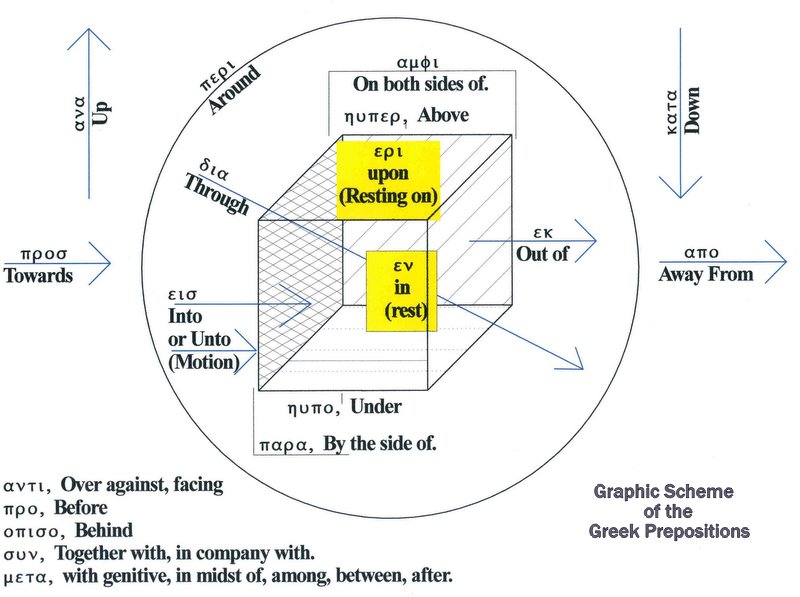 If we stand in unmerited grace, there is no getting out of the box. There is no keeping ourselves there by doing anything because we cannot receive any merit for being there. Said another way, living by faith alone can’t keep us there because then we are receiving merit for maintaining our just standing by faith alone. And certainly, we can’t sin our way out of the box because we are there by grace to begin with. We’re just there, and there is no moving out. You can move in, but there is no moving out. This is why Wuest emphasizes permanence in his expanded translation. What we learn in these first two verses destroys two popular ideas about the gospel in our day: that our justification will not be completely revealed until a last judgment, and the gospel is merely an “announcement.” No, it is a calling to gain access to permanent grace by faith alone. Fact is, much Reformed theology posits the idea that we are elected, but then must maintain our election through what we do, or don’t do. You deny that? For crying out loud, simply look at their theology in regard to Israel.
Last week we discussed verses 3-5, and in this message, I want to look at verses six through eight next. Starting with verses one and two can serve as the first point of this message.
Romans 5:6—For while we were still weak, at the right time Christ died for the ungodly. 7 For one will scarcely die for a righteous person—though perhaps for a good person one would dare even to die— 8 but God shows his love for us in that while we were still sinners, Christ died for us.
We “were” “weak,” past tense, and we “were” “sinners,” past tense. Both of these are in the past tense. We are not “sinners” saved by grace. We are saints saved by grace. Paul continues:
Romans 5:9—Since, therefore, we have now been justified by his blood, much more shall we be saved by him from the wrath of God. 10 For if while we were enemies we were reconciled to God by the death of his Son, much more, now that we are reconciled, shall we be saved by his life.
Paul’s point here is that if Christ died for our sins to reconcile us to God when we were God’s enemies, now that we are reconciled, how much more are we saved from His wrath by Christ’s resurrection life. We died with Christ, and are raised with Him—the apostle delves into this much deeper later on in his letter to the Romans. Don’t miss this; in our day, there is the propagation of the idea that our position changes when we are saved, but not who we are, or said another way, our nature is not changed. Not so. We are saved (from the ills of sin) in more and more abundance by the power of Christ and the power that raised Him from the dead after he died for our sins:
Ephesians 1:15—For this reason, because I have heard of your faith in the Lord Jesus and your love toward all the saints, 16 I do not cease to give thanks for you, remembering you in my prayers, 17 that the God of our Lord Jesus Christ, the Father of glory, may give you the Spirit of wisdom and of revelation in the knowledge of him, 18 having the eyes of your hearts enlightened, that you may know what is the hope to which he has called you, what are the riches of his glorious inheritance in the saints, 19 and what is the immeasurable greatness of his power toward us who believe, according to the working of his great might 20 that he worked in Christ when he raised him from the dead and seated him at his right hand in the heavenly places, 21 far above all rule and authority and power and dominion, and above every name that is named, not only in this age but also in the one to come.
Our position is not only changed, who we are is changed, and we are enabled to appropriate the power that has been granted to us in salvation—to experience it. And let there be no doubt about it: this is primarily experienced by studying the Scriptures and applying that knowledge to our life; in a word, OBEDIENCE. The apostle Paul states elsewhere that we strive to make the experience of salvation our own (Philippians 3:12). His love is perfected in us through keeping His word which results in assurance of salvation (1John 2:5).
In verse twelve, and for the second time in chapter five, Paul starts a new line of thought with the phrase, “More than that.” In verse three, Paul uses the phrase to illustrate that we just don’t stand in grace passively, but that it enables us to look at life in a whole new way; e.g., we rejoice in trials because we understand that it is now a process that enables us to experience the power of our salvation in deeper ways leading to greater hope and assurance. I believe that when we are saved we are infused with an initial exhilaration and assurance, but if we do not proceed in aggressive sanctification in putting on Christ (Ephesians 4:20-24), that zeal will wane. This is what happened to the church at Ephesus, and Christ therefore instructed them to return to the works that they had previously practiced (Revelation 2:4,5).
So, here in verse 11, what is this, “More than that”? Paul returns to one of his initial points concerning having peace with God. We are to rejoice in what seems to be Paul’s primary concern in all of this—we have been reconciled to God the Father. Paul is making this the paramount importance of the salvation subject of this context. Look, every verse in the Bible is not about Christ. Salvation is Trinitarian. We baptize in the name of all three Trinity members. Like all gospel aberrations throughout human history, they come part and parcel with an eclipsing of two Trinity members, and the Reformed tsunami of our day is no exception. Geoffrey Paxton, one of the core four of the Reformed think tank that launched New Calvinism circa 1970, had this to say about the relationship between Christ and the other two members of the Trinity:
Luther and Calvin did not simply stress Christ alone over against the Roman Catholic emphasis on works-righteousness. The Reformers also stressed Christ alone over against all—be they Roman Catholics or Protestants (29) — who would point to the inside of the believer as the place where justifying righteousness dwells. Christ alone means literally Christ alone, and not the believer. And for that matter, it does not even mean any other member of the Trinity! (Geoffrey Paxton: The Shaking of Adventism: p. 41. Baker Book House 1978).
Though this statement seems shocking, it is, in fact, the Reformed mindset in regard to the Trinity. Likewise, in more contemporary fashion, even the highly lauded John MacArthur Jr. stated the following:
Rick Holland understands that truth. This book is an insightful, convicting reminder that no one and nothing other than Christ deserves to be the central theme of the tidings we as Christians proclaim—not only to one another and to the world, but also in the private meditations of our own hearts (John MacArthur: Forward to Uneclipsing The Son; Rick Holland 2011).
The pastor who makes anything or anyone other than Christ the focus of his message is actually hindering the sanctification of the flock. Second Corinthians 3:18 describes in simple terms how God conforms us to the image of His Son: “And we all, with unveiled face, beholding the glory of the Lord, are being transformed into the same image from one degree of glory to another” (emphasis added). We don’t “see” Christ literally and physically, of course (I Peter 1:8). But His glory is on full display in the Word of God, and it is every minister’s duty to make that glory known above all other subjects (Ibid).
Though much could be said here in regard to this statement, suffice to say that prayer is a private meditation to say the least, and we are specifically instructed in Scripture to address our prayers to God the Father. Moreover, concerns about the Father being eclipsed by the Christocentricity of Reformed doctrine has also been expressed by Barry E. Horner on page 192 of Future Israel and the book, The Forgotten Father by Thomas A Smail.
Christ dying for the primary purpose of reconciling us to the Father is a major biblical theme, and the Father also works in our ongoing salvation experience. Though we receive grace in all fullness when we are saved, as we work with God, the Son, and the Holy Spirit to separate ourselves from the world more and more (sanctification) in the way we think and do, more and more of salvation’s power and joy is experienced. The Father is always working (John 5:17).
We now move on to verses 12 and 13:
Romans 5:12—Therefore, just as sin came into the world through one man, and death through sin, and so death spread to all men because all sinned— 13 for sin indeed was in the world before the law was given, but sin is not counted where there is no law.
Go back to our box illustration:
We are using this box to illustrate where we stand in grace; the Greek en, if you will. In that box, there is no law. And where there is no law, let me put it this way: SIN DOESN’T COUNT. When you challenge someone that we are not “sinners” (those who sin as a lifestyle) saved by grace, and they contest your assertion with the rhetorical question, “Did you sin today?” answer with another question: “In regard to grace or law?” They won’t know how to answer because New Calvinists don’t understand the very gospel they claim. We cannot sin in either because we are no longer under the law and there is no sin in grace because there is no law in grace. The sin that we sin in sanctification is not a lifestyle of sin and is a completely different matter. “Sinners saved by grace” is an oxymoron accordingly. In these verses, Paul reiterates his Galatians argument that Abraham was counted righteous 400 plus years before the law was given by Moses.
But before we move on, and still using our visual illustration, let me say something about the blessings of grace. If we stand in grace, are there blessings? And will we experience those blessing by just standing there and doing nothing? Where are the blessings? Go with me to James 1:25:
But the one who looks into the perfect law, the law of liberty, and perseveres, being no hearer who forgets but a doer who acts, he will be blessed in his doing.
Looking “into” is eis, but the blessings are “in” (en) the “doing.” Look and do; that’s not how we get salvation, but it’s how we experience salvation. And if you don’t experience salvation, your salvation is in doubt. And as an aside, the Greek preposition for looking into is where we get the word eisegesis (the process of interpreting a text or portion of text in such a way that it introduces one’s own presuppositions). We get exegesis from ek, which means from, or out of. This is the idea that ALL ideas come from the text and are not skewed by presuppositions or agendas. A favorite notion of the Reformed is the idea that ALL people approach the Bible with their own presuppositions and this is unavoidable. Therefore, it is important to choose the right presupposition; i.e., the presupposition that every verse in the Bible is about Jesus. This is pandering protocol to the elder mindset that the masses are mindless and unable to interpret reality objectively.
Very well; therefore, inform them that your presupposition is exegesis. Also inform them that the Bible teaches its own set of presuppositions that are to be used to interpret other Scriptures. So agree with them, but clarify. And if a Christocentric approach is efficacious it seems to me that this would have been an opportunity for James to plainly say so. But he didn’t.
Another item worthy of mention in the arena of the gospel and prepositions is the following illustration that depicts the Reformed gospel construct:
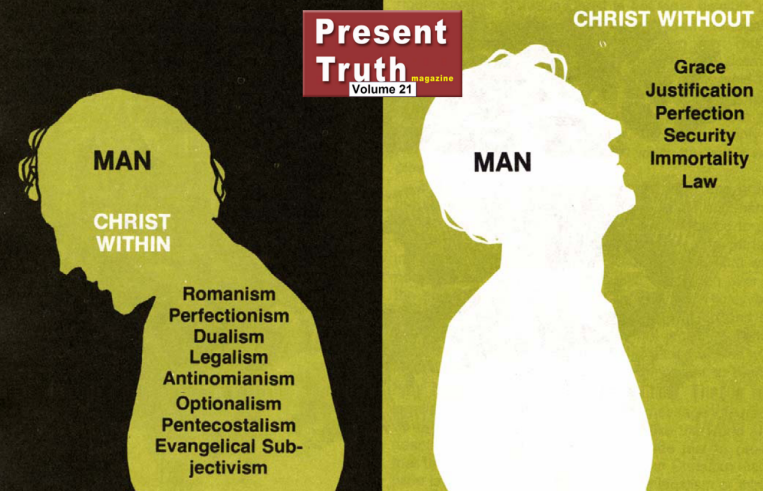
This illustration is known as the often touted, the centrality of the objective gospel outside of us. This propagates the idea, which is very Reformed, that all grace must remain completely outside of the believer or Luther’s alien righteousness. When grace is seen as inside of the believer, this is called “infused grace” and tagged as a false gospel by the Reformed. Any inside considerations are considered subjective and the root of all evil. Furthermore, since the Reformed see justification and sanctification as the same thing, or a “chain” that links justification to glorification—any infusion of grace within us makes us participants in our own justification:
This meant the reversal of the relationship of sanctification to justification. Infused grace, beginning with baptismal regeneration, internalized the Gospel and made sanctification the basis of justification. This is an upside down Gospel (John Piper: Desiring God blog, June 25, 2009 entitled; Goldsworthy on Why the Reformation Was Necessary).
This statement alone, if you think it through carefully, makes the case for the accusation that the Reformed gospel is progressive justification. But if grace cannot be separated from gospel, and we “stand” “en” grace, then it is impossible for us not to be infused with grace. This is our only hope for glory, “Christ en us” (Colossians 1:27). How the Reformed claim that we apply this outside of us gospel to real life is a whole other story that will be the subject of one of my sessions at this year’s TANC conference. Suffice to say for now that mysticism is the only place you can go when this construct is prescribed.
Let’s conclude by reading the apostle’s final point in chapter 5:
Romans 5:14—Yet death reigned from Adam to Moses, even over those whose sinning was not like the transgression of Adam, who was a type of the one who was to come.
15 But the free gift is not like the trespass. For if many died through one man’s trespass, much more have the grace of God and the free gift by the grace of that one man Jesus Christ abounded for many. 16 And the free gift is not like the result of that one man’s sin. For the judgment following one trespass brought condemnation, but the free gift following many trespasses brought justification. 17 For if, because of one man’s trespass, death reigned through that one man, much more will those who receive the abundance of grace and the free gift of righteousness reign in life through the one man Jesus Christ.
18 Therefore, as one trespass led to condemnation for all men, so one act of righteousness leads to justification and life for all men. 19 For as by the one man’s disobedience the many were made sinners, so by the one man’s obedience the many will be made righteous. 20 Now the law came in to increase the trespass, but where sin increased, grace abounded all the more, 21 so that, as sin reigned in death, grace also might reign through righteousness leading to eternal life through Jesus Christ our Lord.
The point that I would like to close with is the fact that we are declared righteous, and made righteous by the one obedient act of Christ on the cross. Paul also stated the following in Philippians 2:8;
And being found in human form, he humbled himself by becoming obedient to the point of death, even death on a cross.
We are not declared righteous because Christ lived a perfect life that was imputed to our sanctification because it finishes justification, another hallmark of Reformed theology. We are made righteous by His death alone. The old us died with Him, and we have been raised in the same power of His resurrection. We are new creatures created for good works (Ephesians 4:23, 2Corinthians 5:17). We were under the law and outside of grace, but now we stand en grace.
What we observe here in Romans five flies in the face of the present-day doctrinal tidal wave overtaking the American church. I would be utterly remiss in not articulating the difference as a way of teaching through antithesis (a method commonly used by Jesus). The Reformed doctrine of our day turns truth completely upside down. It posits a final justification that is yet future; it posits the idea that Christians are not recreated into new creatures; it denies sanctification as separate from justification—making justification progressive; it teaches that the obedience of Christ replaces our obedience in sanctification; it replaces our present goal of pleasing God with a striving for a final justification; it turns study for life application into gospel contemplationism; it replaces exegesis with eisegesis; it replaces assurance through obedience with assurance through contemplationism.
Luther, in his Heidelberg Disputation, the magnum opus of the Reformation, stated that the Christian is indifferent to what works take place in his life because it is Christ doing them anyway. Does that mean that grace abounds more when we sin? Should we be indifferent to good works in our Christian life? We look at the issues of laxness regarding our secure position and its relationship to obedience in chapter six.

Emerging From New Calvinism: We Must Persevere to Complete Our Salvation
 I am presently reviewing an equitable, well written, well-argued position on the idea that our justification is connected with the “[foot] race” of the Christian life. The authors start by presenting four positions, but have not yet used them to clearly state their own position which well be articulated further along in the book. Is the reward of the race salvation? Or rewards for our work in the Christian life? The race involves perseverance and assurance. Does not the Bible speak of obtaining salvation by persevering to the end? Does it not speak of salvation as being the reward? This is a hefty issue. I highly recommend the book as an honest debate on the subject; the fact that I will probably end-up rejecting it in the end notwithstanding. Nevertheless, the book contributes valuable clarification to the issue.
The authors of this book correctly state that we all come to the Bible with presuppositions, and I am reading their book with a particular biblical presupposition in the background: nothing we do in sanctification can be connected in any way to justification. Salvation comes with justification, but salvation’s power is credited to our account in full when we are saved and receive the Spirit. Our race cannot be for an OBTAINING of final salvation which is intrinsically connected to our justification—only the EXPERIENCE of it. Through the Reformed already—no yet construct, an obtaining of final justification is the reward.
That’s a problem—even if Jesus obeys for us in the race via faith alone. One of the verses used to posit this idea is 2Timothy 2:5;
An athlete is not crowned unless he competes according to the rules.
The “crown” is seen as salvation. Justification (our righteous [righteousness] standing) cannot be separated from final salvation. BUT, justification cannot be united to our Christian life in any way as a road for obtaining a final salvation. Why? Because Paul plainly states in this verse that “rules” are involved. Final salvation cannot be obtained through “rules” because the justification that comes with it is “apart from the law” (Romans 3:21, 28, 4:15, 7:1,8). Also, righteousness came before the law (Galatians 3:17,18) and justification is obtained by promise only. A final salvation cannot be obtained via rules because justification is declared apart from any standard. There are simply no rules to guide the race. There are no rules to disqualify anyone.
Secondly, proponents of this view often fail to cite the very next verse that follows 2Timothy 2:5;
It is the hard-working farmer who ought to have the first share of the crops.
Rewards CANNOT be attached to justification in any way, shape, or form (Romans 4:2). So, what about all of the verses in Scripture that seem to say that we will be rewarded with salvation if we persevere to the end? I am presently looking into that issue deeply, and to some extent with the help of the aforementioned book. But closer examination of some of those verses has yielded some interesting findings. Let’s take a look at Revelation 2:11;
He who has an ear, let him hear what the Spirit says to the churches. The one who conquers will not be hurt by the second death.
Clearly, the “second death” refers to the Great White Throne Judgment where those who were not part of the first resurrection will be judged by the law. This will be an eternally tragic epoch. This verse, in the English translation, has a flavor of finality, or past tense. According to my Interlinear that is based on the Received text, the verse is better rendered this way: The one who is presently persevering shouldn’t fear the second death. The obedience they see in their life should give them confidence, or assurance. This better fits with a recognized theme throughout Scripture.
Furthermore, there are many incentives given in Scripture to be diligent in sanctification; why would this be if the prize is salvation? It would seem that lesser incentives would be irrelevant when compared to an actual consummation of salvation that would involve us.
paul
Why Calvinists Have No Understanding
Think “colabor.” And by the way, that’s a biblical word. It should be understood that salvation is completely of the Lord. In our day, it’s just best to leave it at that though some finer points could be argued. Election is what it is, but I think it not a good idea to draw logical conclusions that lead to hardcore determinism. The apostle Paul evangelized like it depended on us to some point—that’s irrefutable. At any rate, if God didn’t make a way for reconciliation—there wouldn’t be any. So, should He get all the glory? Absolutely. Does that mean we have no role at all? I doubt it.
But one thing is clear: the Christian life is a colaboring with God, the Son, and the Holy Spirit. Our role is learn and do. That’s what a “disciple” is. And one of the doings, perhaps the most important one, is….THINKING.
Throughout the Bible, the colaboring of God and the Christian is seen. Unlike salvation and justification, the Christian life (sanctification) is full of conditions, promises, commands, encouragement, warnings, and instruction. If you take note in your daily Bible reading, you will see this colaboring concept throughout. Perhaps the most profound is 2Timothy 2:7. Here is what the apostle Paul said to Timothy:
Think over what I say, for the Lord will give you understanding in everything.
The Lord will give us understanding, BUT, we have to THINK. No thinking—no understanding. To say that Christians in our day believe that God will give us understanding without thinking is quite the understatement.
Clearly, in Reformed circles, the elders think for the parishioners, and the elders get their information from a bunch of Calvinistic dead people, also known as “orthodoxy.” Even when Calvinists do pick-up their own Bibles to read they are anticipating that God will show them “pictures of Jesus” in every verse. Look, those are John Piper’s very words, not mine. Bible reading in Reformed circles has become always been like watching TV; you just watch and let your brain chemicals to the rest. As you read, Jesus will show Himself and whatever Jesus shows you will be imputed to your life because Jesus came to live for our sanctification and die for our justification. The death and resurrection was for our justification, but His life prior to the cross was for our sanctification.
Also implicit in Paul’s charge to Timothy is the fact that Paul expected people to verify for themselves what he taught. Let me show you a picture since we like them so much: When Susan and I are discussing Reformed issues with people while enjoying the perplexity on their faces as we accuse the big names of heresy, this question often follows: “So, who do you follow?” Initially, Susan and I were too shocked at the response to even answer. The question is, at times, also followed by, “You can’t say that about him—he has a lot of followers.”
Not sure I can add to that point. Have a wonderful colaboring day in Christ.
paul
Christian Husbands and Fathers Will Be Held Accountable for Leading Their Families in Calvinism’s False Gospel
 I see a significant laxness towards doctrinal issues in regard to where one goes to church, especially from husbands, and fathers. “But as for me and my household, we will serve the LORD (Joshua 24:15)” is now, But as for me and my household, we will follow the elders. Certainly, the church has never been fuller of mindless, man-following, wimpy husbands.
Husbands are supposed to be like Christ. Christ washes His church in the water of truth. Yes, I know the womenfolk can think for themselves. Here at PPT/TANC, it is mostly women who show theological aptitude in our correspondence with friends of the ministry. Nevertheless, Ephesians chapter five makes it clear that men are responsible for leading their families in truth—not alone, but they are certainly to be in the lead or at least a co-lead for crying out loud. And by the way, elders are nowhere to be found in Ephesians five. Men, Reformed elders have NO authority in your home, period! YOU, and you alone are the pastor of your home. And if you are mixing it up with some Reformed elders who do not get that (and few do), take this advice from someone who learned the hard way: go to your local police station and get a restraining order based on stalking laws, and then notify the local press that you have done so.
Christ said that those who learn His truth and apply it to their lives, and teach others to do the same will be great in the kingdom of heaven (Matthew 5:19). But many husbands in our day want to be great in the eyes of pompous philosopher kings. Christ warned that the LEAST of His commandments were not to be “relaxed.” Many pathetic, spiritually effeminate husbands in our day allow their families to attend Reformed churches that teach the following:
1. Progressive justification.
2. Gospel contemplationism.
3. The complete eradication of self-worth and confidence in applying God-given talents to life.
4. Elder absolution.
5. “Community” as the focal point of all life in Christ.
6. Elder intermediate interpretation of the Bible.
7. Antinomianism.
Basically, they have relinguished total control of their families to sectarian brute beasts. They would do anything that a Reformed elder told them to do, and often do so accordingly. Look, we deal with this. Even husbands who leave Reformed circles have a sort of Stockholm syndrome. They are full of fear, and their life is in turmoil just because they asked a few questions. I correspond with people who are in these groups and are afraid to leave. They are clearly brainwashed, but a consistent comment is, “The leadership doesn’t like to be questioned.” We have even offered asylum to one person in the form of housing, work, and legal counsel. Huh? Right, these groups, i.e., New Calvinism, use “biblical counseling” to gather data on people and then clearly use that information to control them. This is commonplace in the movement. Unless you want a couple of hundred people knowing about sin that you have repented of when you are “brought up before the congregation”—you will play ball the way the elders want you to. Or else.
Doctrinal discrepancy is reason enough, but many husbands relinquish their responsibility before God to lead their home and support this tyranny with their money. After all, not tithing can get you brought up on church discipline in these churches. This is yet another thing that is becoming commonplace as this Reformed movement grows unhindered and unquestioned.
But I have to believe that there will be a day of reckoning, and doctrinal ignorance will be no excuse.
paul
The Potter’s House: Sunday, 1/6/2013; Romans 5:1-5

“In sanctification, our work and the Holy Spirit’s work are seamless”
There are a number of extremely important truths presented here in the fifth chapter of Romans. These are truths that are also particularly important in our day because of the kind of teachings that are in vogue. I would like to first point out that Paul does something here in the first verse that he does throughout his writings: both God the Father and Jesus Christ are strongly emphasized. The stated purpose of salvation in verse one is to reconcile humanity with God. Mankind is God’s enemy. Christ went to the cross to pay the penalty for our sin and was resurrected by God’s power (Ephesians 1:20). He went there for the purpose of reconciling us to God. Salvation is Trinitarian, and an overemphasis on a member of the Trinity is often present with the root of most heresies. And let there be no doubt: an overemphasis on Christ in our day is in the same vein of cults that overemphasize the Father to the exclusion of Christ, and other movements that overemphasize the Spirit to the exclusion of the Father and Christ. Chapter five also reiterates the importance of recognizing that justification is a finished work, and the strong dichotomy between justification and our Christian life (sanctification).
What we are given freely by faith alone is experienced in greater measure in our sanctification—if we have proper understanding of gospel basics. The work of justification is finished. The Father, the Son, and the Holy Spirit all had a role until Christ was resurrected. Christ was raised for our justification (Romans 4:25). He then sat down at the right hand of the Father (Hebrews 1:3). That work is finished, but the Trinity still works in our sanctification. We have all three of the Trinity members behind us in our Christian walk. BUT, reconciliation is a ministry that has given us “access” to the kingdom and now is one of our ministries to the world (2Corinthians 5:18-21). We must understand the actions of the Trinity in Justification and in sanctification as being different actions for different purposes. The confusion of these two works has been detrimental to innumerable Christians.
One of the great gifts of salvation is hope. Life without salvation has no hope. The unsaved are God’s enemies; they are under the constant threat of the revelation of God’s wrath; have little wisdom for making life work in a fulfilling way; and only have eternal judgment to look forward to in the end. Their life will not have a good ending, and they know it. A story with an assured bad ending is hopelessness. The unsaved live in an uncertain (from the mortal perspective) time frame that seeks to keep them as comfortable as possible until the tragic end. Without a doubt, most so-called mental illness is the result of hopelessness. This also hearkens back to the question of what we really want to draw from human wisdom in regard to life and godliness from people who have no hope.
In verse two, we have the hope of justification. It was obtained by faith alone, and rejoices in the grace of God and His glory. Our life story will have a glorious end. We are no longer “under the law”….for justification. But now, the law informs us in regard to something about our hope:
3 Not only that, but we rejoice in our sufferings, knowing that suffering produces endurance, 4 and endurance produces character, and character produces hope, 5 and hope does not put us to shame, because God’s love has been poured into our hearts through the Holy Spirit who has been given to us.
What does trouble in the life of an unbeliever avail? It is a disturbance in their effort to remain as comfortable as possible until they enter eternal judgment. Their only hope is a temporary hope that man can help them salvage as much of their uncertain comfort that may remain. Believers receive hope in the gospel of first importance, but now as the law informs our sanctification, we find that trouble in life aids us in a greater realization of the hope that lies ahead. We are saved in great power and hope (1Thessalonians 1:4, 5), but if we do not begin to rightly apply the law to our sanctification (which cannot effect our justification because there is no law in justification) our assurance will begin to wane, along with hope, and leading to shame.
Paul told Timothy that rightly dividing the law would result in a workman not being ashamed (2Timothy 1:15,16). In verses three and four, Paul documents the process of applying God’s wisdom to trouble in life in order to increase hope—leading to the absence of shame (guilt). Paul might have used the word “rejoice” to get their attention in regard to the Christian approach to trouble as opposed to that of the world. But at any rate, trouble in life lends opportunity for Christians to be more assured of their salvation. You cannot separate hope and assurance. When assurance lacks, the lack of hope follows. A saint that is 100% assured of heaven is immovable as well. What can this world possibly do to him or her?
Paul even explains the details of the process stated in verses 3-5. Endurance produces character. How so? Well, in the law, we find that “trouble,” “temptation,” and “trials” are all words that are used interchangeably. Why? Answer: we are often tempted to sin in a trial.
James 1:2—Count it all joy, my brothers, when you meet trials of various kinds, 3 for you know that the testing of your faith produces steadfastness. 4 And let steadfastness have its full effect, that you may be perfect and complete, lacking in nothing….12 Blessed is the man who remains steadfast under trial, for when he has stood the test he will receive the crown of life, which God has promised to those who love him. 13 Let no one say when he is tempted, “I am being tempted by God,” for God cannot be tempted with evil, and he himself tempts no one. 14 But each person is tempted when he is lured and enticed by his own desire. 15 Then desire when it has conceived gives birth to sin, and sin when it is fully grown brings forth death.
Perhaps we are in the trial because of sin to begin with. “Endurance” is equal to thinking the right way, praying the right way, and doing the right things in a trial. It is the proper application of biblical wisdom to life; so, not surprisingly, it builds what? Right, character.
Now, when we see the character, although we study the issue to find God’s wisdom (that’s what a disciple is, a “learner”) and successfully apply it to our lives, we know that we are actually seeing the “fruit of the Spirit.” In sanctification, our work and the Holy Spirit’s work are seamless. Sure, if we don’t work in sanctification, the Holy Spirit will still work, but more than likely it will be works that seek to confront our spiritual laziness. And, if we grieve Him (Ephesians 4:30), we will live an anemic life full of fear.
One of the fruits of the Holy Spirit is “self-control.” If there is no temptation present, self-control is not needed. And who is doing the controlling? Self– control. We are doing the controlling. But whose fruit is it? Answer: the Holy Spirit’s. We must work. The Holy Spirit will work. But where the two works divide in the finished results is not ascertainable. However, the law is full of promises in this regard: if we do A, the Holy Spirit will do B. There are many different motivations in sanctification to obey Scripture. We are even warned that there is judgment in this life for doing wrong as a Christian (1Thessalonians 4:6, 7, 1Corinthians 11:30-32, 1John 5:16-18, 1Corinthians 5:4,5). But it is a judgment separate from justification. It is a judgment that renders unfortunate consequences in this life.
Paul is describing a sanctification process. Endurance leading to character and hope, resulting in a clear conscience, and manifesting the love of the Holy Spirit in our hearts. I believe this is a testimony of God’s love for us when this process is functioning the way God wants it to. But now one cries out:
See! See!, you are teaching that God’s love for us is increased via certain behaviors; i.e., KEEPING THE LAW! You are saying that we earn God’s love through works!
No I am not, and this idea can be sold to many Christians in our day because of doctrinal illiteracy. Churches must begin to strive for doctrinal education to be returned to the local churches. I have come to believe that seminaries do more harm to Christianity than good.
When we are saved, we are given all of God’s love and righteousness. We cannot earn any of it. It is by faith alone. That granting is initially experienced with much exhilaration, but in sanctification, the question becomes to what degree that we will EXPERIENCE the gift! As we have previously noted in this study series, salvation is separate from justification. Justification is a onetime legal declaration. Salvation is also finished in that its fullness has been credited to our account, in full, and once for all time. Note Ephesians 1:15-23:
15 For this reason, because I have heard of your faith in the Lord Jesus and your love toward all the saints, 16 I do not cease to give thanks for you, remembering you in my prayers, 17 that the God of our Lord Jesus Christ, the Father of glory, may give you the Spirit of wisdom and of revelation in the knowledge of him, 18 having the eyes of your hearts enlightened, that you may know what is the hope to which he has called you, what are the riches of his glorious inheritance in the saints, 19 and what is the immeasurable greatness of his power toward us who believe, according to the working of his great might 20 that he worked in Christ when he raised him from the dead and seated him at his right hand in the heavenly places, 21 far above all rule and authority and power and dominion, and above every name that is named, not only in this age but also in the one to come. 22 And he put all things under his feet and gave him as head over all things to the church, 23 which is his body, the fullness of him who fills all in all.
Salvation doesn’t grow. But our experience of it in sanctification certainly does. As far as the “victorious” Christina life—there has already been a victory—are we going to live the victory and show it to the world in order to glorify God? Will we live a life that causes people to come to us privately and ask about…. what? Our “hope,” right? That’s the word Peter used, right? (1Peter 3:15). Paul notes in our Romans text at hand that hope grows in our Christian life if we deal with life God’s way. BUT it requires our colaboring with the Spirit in sanctification.
This is the dreadful evil of our day: the Christian witness is sapped because of passive sanctification. Why is this? Clearly, it is because sanctification is seen as the “growing part” of our salvation that COMPLETES justification. Therefore, what we do in sanctification is seen as affecting our “just standing.” This is the paramount reason for crippled sanctification in our day. It is the reason for lack of assurance; lack of hope; lack of evangelism, and lack of a powerful Christian witness in the world. As this ministry constantly harps, it is the difference between the linear gospel and the parallel gospel. Some illustrative charts that we use are following:


In the remainder of the chapter, Paul writes about before and after: before salvation; and after salvation. Justification and sanctification are two different realities. Treating them as the same will devastate Christian living. Everywhere Susan and I go, Christians tiptoe around the issue of obedience in sanctification as if it is the Bubonic Plague. Again, this is due to fear that what we do in sanctification might in some way effect our “just standing.” Not the Apostle Paul:
1Thessalonians 4:1— Finally, then, brothers, we ask and urge you in the Lord Jesus, that as you received from us how you ought to walk and to please God, just as you are doing, that you do so more and more. 2 For you know what instructions we gave you through the Lord Jesus. 3 For this is the will of God, your sanctification: that you abstain from sexual immorality; 4 that each one of you know how to control his own body in holiness and honor, 5 not in the passion of lust like the Gentiles who do not know God; 6 that no one transgress and wrong his brother in this matter, because the Lord is an avenger in all these things, as we told you beforehand and solemnly warned you. 7 For God has not called us for impurity, but in holiness. 8 Therefore whoever disregards this, disregards not man but God, who gives his Holy Spirit to you.
And not Peter:
2Peter 1:3—His divine power has granted to us all things that pertain to life and godliness, through the knowledge of him who called us to his own glory and excellence, 4 by which he has granted to us his precious and very great promises, so that through them you may become partakers of the divine nature, having escaped from the corruption that is in the world because of sinful desire. 5 For this very reason, make every effort to supplement your faith with virtue, and virtue with knowledge, 6 and knowledge with self-control, and self-control with steadfastness, and steadfastness with godliness, 7 and godliness with brotherly affection, and brotherly affection with love. 8 For if these qualities[f] are yours and are increasing, they keep you from being ineffective or unfruitful in the knowledge of our Lord Jesus Christ. 9 For whoever lacks these qualities is so nearsighted that he is blind, having forgotten that he was cleansed from his former sins. 10 Therefore, brothers, be all the more diligent to confirm your calling and election, for if you practice these qualities you will never fall. 11 For in this way there will be richly provided for you an entrance into the eternal kingdom of our Lord and Savior Jesus Christ.
12 Therefore I intend always to remind you of these qualities, though you know them and are established in the truth that you have. 13 I think it right, as long as I am in this body, to stir you up by way of reminder, 14 since I know that the putting off of my body will be soon, as our Lord Jesus Christ made clear to me. 15 And I will make every effort so that after my departure you may be able at any time to recall these things.
All of God’s divine power for life and godliness has been granted to us in full. We are now called to be partakers of the divine nature. We have it all, but we must become, what? Answer: “partakers.” We must ADD certain things to our faith as we learn them, and by doing that we “make our calling and election sure.” And we also prepare for ourselves a “rich entry” rather than a deathbed laden with regret, doubt, and a shred of hope.
This is such a critical truth: the difference between who we were and who we are now; and how that applies to our present sanctification. It is the focus of Romans five, and we will continue to delve into this deeper next week with the Apostle Paul’s help.


 Paul's Passing Thoughts
22 comments