The New Calvinist Manifesto: Road to Tyranny

1. The New Calvinist movement is a lean, mean dominion machine. The Calvin Institutes are the primary authority. If you are one who reads the Calvin Institutes daily, you know that it is their modus operandi. It is clearly their authority, and their authority is granted from such along with the historic precedent that the Reformers concocted. They have always sought to rewrite the rules from which reality is interpreted. If you control how Christians interpret history and reality, you control the result.
2. New Calvinist national leaders see themselves in the big picture. Their vision is a Calvinistic world theocracy. They not only desire this, they are actively involved in an attempt to make it happen. Pastors are merely Kool-Aid drinking followers who serve the big picture.
3. New Calvinist national leaders are involved in the political process. Their political agenda is against any construct that does not facilitate the union of church and state. While John Piper has said that he is against the union of church and state, he stated the opposite in a video promotion filmed in Geneva.
4, 6. New Calvinist organizations target pastors. Conferences are indoctrination sessions. And the parishioners blindly pay for it. The PRIMARY role for national leaders is the indoctrination of pastors.
5. Seminaries are targeted and have become, for the most part, pre-indoctrination. Pastor’s conferences are post-indoctrination.
7. This results in covert and hostile takeovers of local churches. Protestants are doctrinally ignorant to begin by ecclesiastical design. This is a tradition that goes back to the Reformation. Hence, most churches have no defense except those who are too doctrinally ignorant to be deceived. There are also books/manuals written on how to take over evangelical churches covertly. New Calvinists have dubbed this, “The Quiet Revolution.”
8. “Ministries” like Peacemaker Ministries are New Calvinist organizations that indoctrinate pastors and make damage control possible. Chilling, is the “peacemaker teams” that are forming in churches, and are trained by Ken Sande’s organization. Sande’s European oligarchy mindset will make the hair stand up on your head. While at times I struggle to take most of these guys seriously, Sande actually frightens me. I consider him to be one of the most formidable threats to the church in our day.
9. “Nicolaitan” means power over the laity. This was a huge Gnostic movement that wreaked havoc on the apostolic church. The roots of this movement are easily traced back from the Reformers to Plato and his Republic construct. To see present-day control structure within the local assemblies as designed by the “Quiet Revolution,” go here: https://paulspassingthoughts.com/2013/03/01/new-calvinist-procedure-for-controlling-parishioners/
10. As New Calvinist Doug Wilson said, it is the agenda of Calvinism to take over every inch of the world. That’s pretty much it in a nutshell.
The Potter’s House: Our Justification Crisis, Perseverance, and Assurance: Part 1


Tonight we will be looking at the present justification crisis, perseverance, and assurance. The relationship between these three is causing much confusion in our day. This is another topical subject related to our Romans study as we have been fluctuating between specific verses in Romans and topics related to Romans. We will look at the crisis tonight, introduce perseverance, and address the remainder of perseverance and assurance next week. Then the following week is our annual conference.
First, the crisis.
Those who love God simply want to know the truth; they want wisdom; they want to know the way; they want to be at peace with God; they want to please God, and they want to be able to share God with others according to the truth. They want hope; they want to know for certain that they will live with God for eternity. I recently watched a disturbing video that was a Q and A excerpt from the 2010 “Shepherds” Conference hosted by Dr. John MacArthur’s church. In light of the supposed Calvinistic view of election, an attendee asked what should be said to people when we evangelize. MacArthur’s answer was somewhat snarky; in essence, “Tell them what the Bible says, duh!” MacArthur then went on to explain that the Bible was full of paradoxes and tensions that couldn’t be understood. Therefore, just obey Scripture and leave all of the logic to God. In essence, understanding is none of our business. Dr. Michael Horton seems to parrot the same idea by stating that the law “gives us something to do.” It would seem that the totally depraved Christian masses need something to keep them focused while God does whatever He is going to do despite ourselves.
Let me just pause here a moment and clarify “supposed” in regard to Calvinists believing in election. Election should give Christians complete confidence that they are going to heaven which is the headquarters for His Tabernacle Project. Chew on that awhile; heaven is not our eternal dwelling place, that’s a Protestant fairytale, to name just one among many others. More would be done for God in the here and now if we understood that it is preparation for much bigger tasks that we will be doing for God in the future. The apostle Paul said that whether here in our present bodies, or present with the lord, we make it our “goal” to please Him. What! In heaven we will have a “goal” to please God? Woe! Perhaps we are not getting the whole story about our future with God. Perhaps our future with God is a lot more definitive than we have been taught. And does this affect our present service for God. Absolutely. Lack of information never facilitates action. Never.
Granted, election is a mystery. But what is important is that election and justification go hand in hand. Romans 8:29,30 makes that clear. Our justification was sealed before the foundation of the world. Our justification was before time, as in, space of time. That’s why in those verses we were also considered glorified. Now look, there are a lot of theories on election, and I don’t care which one who hold to just so you agree with me that our salvation was settled before time, and if we were justified before we were born, we can’t do anything to mess that up.
Unless you’re a Calvinist. If you’re a Calvinist, you can mess that up by unwittingly doing something in sanctification that is a “work” and thereby making sanctification the “ground of your justification.” Reformed elders are the experts in regard to what is a work in sanctification and what isn’t a work in sanctification. Be sure of this: the crux of Calvinism is the following: “We can’t know anything for certain so your best shot at heaven is listening to God’s anointed who save us from ignorance as much as that can be done. Though they don’t claim to know anything for certain either, they have been given the keys to the kingdom and have the authority to declare us unbelieving. They can’t give us assurance of our salvation, because living by faith alone in sanctification is very tricky business, but they can declare the contrary. Be a good Calvinist, keep your mouth shut, obey the elders, and hope for the best. That’s Calvinism, and I will debate anyone who tries to say otherwise. Words mean things, and I have the black and white of their words in abundance.
Unfortunately, Calvinism must be harped on in our day because this ideology has been ruling the American church since 1995. Its contemporary form was launched in 1970 and grew at a very fast pace, but circa 1995 marked a beginning of dominance culminating in the fact that this movement crosses all denominational lines and is the only option available in many US cities. And its view of justification has profound implications for the Christian—utterly profound. If revival is possible in America, Calvinism must be used as an example to highlight the way to real sanctified life; it must be stripped of its deceptive costume because the case has been well presented—evil and brilliance are not mutually exclusive. The leaven that blinds must be rooted out as learning progresses.
I find my discussions with Susan regarding her material for this year’s conference disturbing. On the one hand, Calvinists, including John MacArthur, proudly claim St. Augustine as the father of Reformation doctrine. On the other hand, Augustine flaunted his Platonism in broad daylight and stated in no uncertain terms that the Bible has no credibility without Plato. Pardon me if I am extremely uncomfortable with a justification formed by a committee of which Plato was a contributor. Moreover, the results speak for themselves.
Although the New Calvinists have dominated the American church for eighteen years now, things are not better, they are worse. John Piper, while announcing his future post-retirement plans from Geneva, stated that wherever the Reformation doctrine has sprung forth, that same geography is saturated with the blessed light of God. Well then, where’s the beef? Socially, there were over 333,000 abortions in America last year. Divorce in the church has surpassed secular statistics and is approaching an astounding 60%. Spiritual abuse blogs, mostly focused on New Calvinist leaders, have exploded in number over the past two years. In the past ten years, at least two organizations have been formed to keep New Calvinist churches out of civil and criminal court. This is all unprecedented. Where’s the beef? And where are the NEW converts associated with real revival? Polls have clearly indicated that new sheep are not coming in; they are merely being relocated and rearranged at the cost of split churches.
Yet, New Calvinists constantly talk as if they have arrived on the scene recently and their “revival” is just now getting into second gear. This is nonsense! They have been in solid control of the American church for at least eighteen years. And please, please, do not miss this: they continue to blame the mess they have created on “evangelical subjectivism.” This is the religious equivalent to the political, “Blame it on Bush.” Don’t miss this either: the problems with evangelicalism to begin with are due to the fact that the Reformers gave birth to them resulting in an overemphasis on salvation to the detriment of sanctification.
I say all of that to say this: when the Australian Forum launched Neo-Calvinism in 1970, they highlighted the idea that the church was in a “justification crisis.” That isn’t true, the church was actually in a sanctification crisis, not a justification crisis. But the reason for its crisis was the root that it came from: the belief that justification and sanctification are the same thing. Hence, getting people saved continued to be the obsession along with a woeful devaluing of discipleship. Basically, New Calvinism offered the full dose of the cancer as a cure.
But this is a very good thing. It is especially good because the theological dream team of the Australian Forum systematized this doctrine in a way that gives it staying power. These guys were right in a wrong way (they absolutely did rediscovery the authentic Reformation gospel), but nevertheless, they had brilliant theological minds coupled with personalities capable of strong persuasion. What this will do, finally, is force the church into revisiting the subject of justification in an in-depth way. It will force the American church to come to grips with their long held mentality regarding justification. And here is the crisis of confusion in our present day: what is the relationship between the two?
Here at the Potter’s House we have looked at that deeply. For instance, how could Christ have come stating that he didn’t come to abolish the law while the apostle Paul stated the exact opposite? We conclude that Christ was speaking of sanctification and Paul was referring to justification. Here is a statement for you: “The law is for those under it and those being sanctified, but not the justified.” Or how about this statement: “The law has a relationship to unregeneration and progressive sanctification, but has no relationship to definitive sanctification and justification.” The first one may incite the following conversation:
But I thought anyone who is justified is sanctified. “That’s absolutely true.” So how can you say the law has no relationship to your justification? “Because I didn’t need the law for my justification, but I need it for my sanctification. In fact, I couldn’t be justified with the law.” Then why do you need it for your sanctification? “Because being justified without the law resulted in being enslaved to the law.” So then, what was your relationship to the law before justification? “It was my enemy.” How so? “Because the desires of the flesh are contrary to the law, and the law provoked sinful desires within me. That doesn’t mean the law is bad, the law is holy, and unfortunately while provoking sinful desires within me, a judgment awaited me by that same law in the future. But now the law is my friend, and instead of provoking me to sin, it provokes me to righteousness. I am not sanctified apart from the law (John 17:17), but I am justified apart from the law (Romans 3:21).” But that verse states that the righteousness of God was MANEFESTED apart from the law. That righteousness is Jesus, not you in regard to justification. “Well, if that righteousness manifested was Jesus, that would teach that His righteousness was manifested apart from the law as well, so what’s your point? My point is that justification is apart from the law. If you look at verse 19 prior, and verse 22 after, the point is a righteousness manifested by faith in Christ alone. That’s my point.”
This brings us to Perseverance. Granted, there are verses in the Bible that seem to say that our salvation is contingent on persevering till the end. I have done a lot of reading on this from the Reformed perspective, and clearly, the belief is that the promise of salvation is “conditional.” Sanctification is a race from which we can be disqualified, but if we aren’t, the prize spoken of in Scripture is salvation. Salvation is the prize for finishing the race. The Reformed refer to this as “already-but-not-yet.” This would eliminate any rewards for obedience and service in sanctification. The reward is salvation itself. So, election (already) qualifies us for the race, but we have to finish in a way that doesn’t disqualify us (not yet). The obvious problem here is, if the focus is staying saved by faith alone, or persevering in our salvation, this keeps us focused on staying saved and not serving! No wonder sanctification is so weak in Protestantism, if salvation is not a done deal, that’s where our focus is going to be if we are smart. In fact, we are warned not to “obey in our own efforts” or “live by do’s and don’ts.” This is all very confusing to say the least.
I want to address one particular passage they cite regarding this:
Matthew 10:21 – Brother will deliver brother over to death, and the father his child, and children will rise against parents and have them put to death, 22 and you will be hated by all for my name’s sake. But the one who endures to the end will be saved. 23 When they persecute you in one town, flee to the next, for truly, I say to you, you will not have gone through all the towns of Israel before the Son of Man comes.
Here is what I want to point out: in this passage, “saved” doesn’t mean “salvation.” This is where I keep saying that eschatology is not “secondary.” Eschatology is gospel. Remembering what we have learned in the past makes it obvious that Christ is giving directions for staying alive during the tribulation period. Verse 23 is the point; if you flee from town to town, you options are not going to run out before my return. The obvious implication is that they will remain alive. This is so very important. If you do not understand eschatology, this passage means our salvation is not a finished work; it means we have to persevere to finish our salvation. This passage also adds much weight to the argument for the millennial kingdom following the tribulation period which begins with the judgment of the nations.
Let’s look at what this all boils down to in the following visual illustrations:
As we have discussed before, sanctification is missing from Romans 8:29,30, but what follows is Paul’s point to what he stated in verses 29 and 30:
31 What then shall we say to these things? If God is for us, who can be against us? 32 He who did not spare his own Son but gave him up for us all, how will he not also with him graciously give us all things? 33 Who shall bring any charge against God’s elect? It is God who justifies. 34 Who is to condemn? Christ Jesus is the one who died—more than that, who was raised—who is at the right hand of God, who indeed is interceding for us. 35 Who shall separate us from the love of Christ? Shall tribulation, or distress, or persecution, or famine, or nakedness, or danger, or sword? 36 As it is written,
“For your sake we are being killed all the day long; we are regarded as sheep to be slaughtered.”
37 No, in all these things we are more than conquerors through him who loved us. 38 For I am sure that neither death nor life, nor angels nor rulers, nor things present nor things to come, nor powers, 39 nor height nor depth, nor anything else in all creation, will be able to separate us from the love of God in Christ Jesus our Lord.
This cannot be deviated from. Paul is stating here that trials cannot separate us from the love of God. Something else is being communicated in passages that seem to say that we are required to persevere in life for some kind of “final justification.” Lord willing, we will take a much closer look at this next week
SGM Case Dismissed: Cross Made Bigger
 As the blogosphere’s newly appointed “rabid anti-Calvinist,” I figured I would weigh in on the dismissal of the SGM lawsuit and live up to my new name by blaming this vile injustice on Calvinism.
It’s not a huge stretch; after all, the former primary defendants are Calvinists, and even in light of the horrific accusations, CJ Mahaney continues to be supported by the Calvinist community at large via speaking engagements, and silence. I understand that Kevin DeYoung, who has been silent on the issue, was quick to announce the dismissal on Twitter. The case also exemplifies the hilarious notion that these are men of the Word. The Bible states that accusations against an elder should only be heard by two or three witnesses; in this case, there were eleven, and on the record. Yet, NO Calvinist anywhere will take note of the accusations. Besides, the Bible states clearly that elders are to be beyond reproach, and CJ is hardly that.
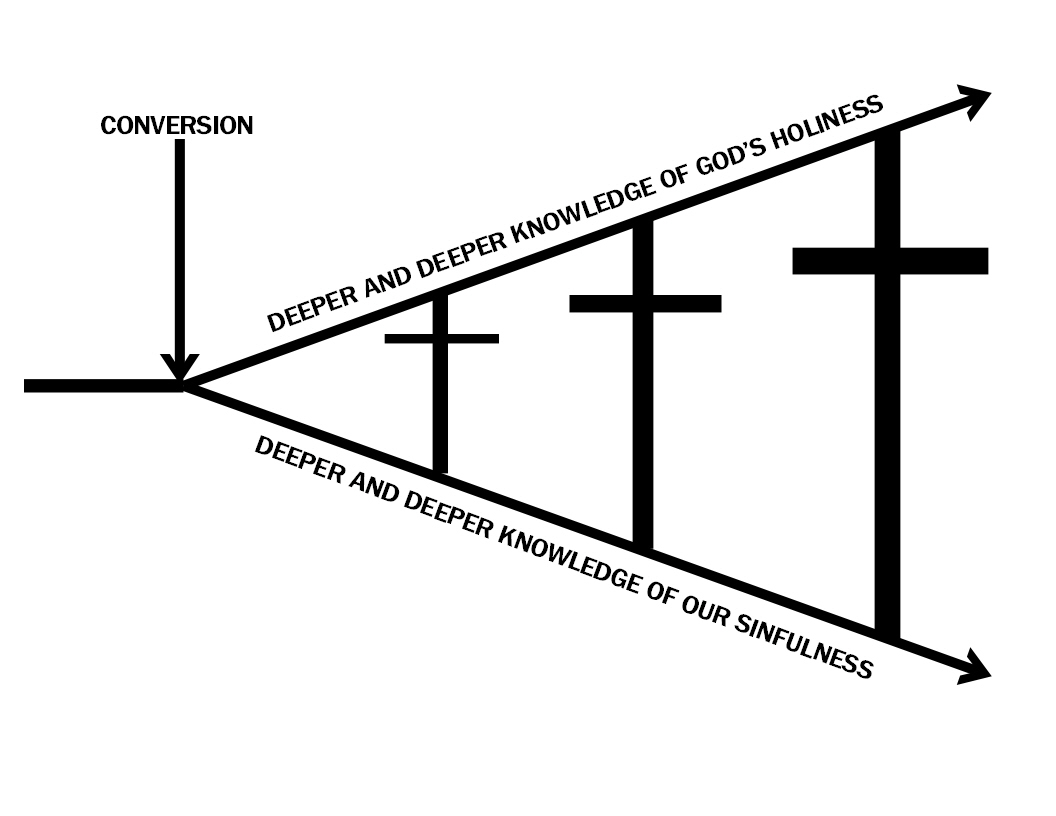
The contemporary Calvinist resurgence movement known as New Calvinism has been getting massive press on its spiritual abuse for about ten years now. How bad is it? There are now two organizations formed for the express purpose of keeping Reformed churches out of court, and paid for by the sheep through donations! I will make this as simple as possible by once again commenting on a popular Neo-Calvinist illustration, published by them—not me:
Click on to Enlarge
This illustration is Calvinist epistemology. This is a visual description of Calvin’s first sentence in 1.1.1 of the Calvin Institutes: wisdom is deducted by knowledge of God and man; i.e., the top and bottom trajectories. That makes the cross bigger. That’s a good thing, right? In Luther’s epistemology, this illustration is known as the Theology of the Cross or the Cross Story as opposed to the glory story. Any possible contribution of good by us makes the cross smaller. That’s a bad thing, right?
Now think about this epistemology as set against these horrific abuses. Do I really have to do the math on this? How are people with this worldview going to look at the subject of justice? If we deserve justice, our trajectory goes up and the cross gets smaller. What about the victims? If they were totally innocent in the situation the trajectory again goes up and the cross gets smaller. What about any pure outrage concerning the actions? Why outrage? That’s a deeper knowledge of how evil we are which makes the cross bigger.
And to a Calvinist, that’s a good thing.
paul
The Potter’s House: January 27, 2013; Romans Chapter 7
Pastor Jake received a phone call from a husband and father who is new in town. “Bob” in his mid-forties, has been visiting churches for purposes of making a decision on church membership for his family. Bob seems a little upset and asks Jake if they can meet for lunch:
“Sure Bob. Twelve o’clock at Bob Evans? ‘That would be great Pastor Jake.’”
Jake secures a table before Bob arrives and watches him as he approaches their table. Bob sits down and is obviously troubled about something:
“Uh, thanks for this Jake. Uh, can I ask you something? ‘Sure Bob, what’s up?’”
Bob: Are some dreams sinful?
Jake: That depends Bob, why don’t you tell me more. When did this dream take place?
Bob: Last night.
Jake: Where?
Bob: At home, last night.
Jake: What was the dream about Bob?
Bob: Uh, well, this is really weird.
Jake: Most dreams are Bob, but you are obviously troubled by this dream and I am hoping that I can help you in some way.
Bob: I was in bed with some young foreign girl, but we were fully clothed. And Jane’s sister [Jane is Bob’s wife] was there watching TV. And I was concerned about what Jane’s sister would think.
Jake: That’s understandable, and it’s never Miss Piggy [the cartoon character who has unrealistic visions of grandeur concerning her own beauty] in the bed.
Bob: [Chuckling uncomfortably] Uh, ya, anyway, she started taking off her clothes.
Jake: I kinda saw that coming.
Bob: But anyway, though she was beautiful, and her figure was exhilarating, I stopped her because of what I believe, and she became very angry.
Jake: [Leaning forward with great interest] Really? Tell me Bob, what is this belief that caused you to stop her?
Bob: Well, I believe lust is just a strong feeling, and if we don’t let it control us, great blessings are the result. Obeying our lust is initially exhilarating, but ends with death. That’s what James said, right? [Jake nodes in agreement]. As I have told you Jake, my job requires me to be on the internet all day. Woe, the way some things are introduced on the internet are very stimulating, but I know that if I let that control me, it will do damage to the wonderful love-life that Jane and I have. I also believe that when I abstain from lust, that makes my marriage more blessed and stronger.
Jake: Bob, I think the counselor just became the counselee. First, you’re right, the world is an expert at enticing us into sin; like I said, it’s never Miss Piggy in the bed, or in the advertisement. You rightly assess, and as you were speaking, several different Scriptures were coming to mind.
Bob: But what about being in bed with that girl? What’s that all about? Isn’t that indicative of sin in my heart? How could I even think something like that?
Jake: Bob, we never just find ourselves in bed with a girl one day. Many bad choices and deaths lead to the big deaths. Like all dreams, yours was especially unrealistic. Because of your Biblical thinking, you are not going to suddenly find yourself in bed with some girl not your wife, and certainly not with her sister in the same house. Bob, did you eat anything before you went to bed?
Bob: Uh, ya, you know, a midnight snack.
Jake: What did you eat?
Bob: Some strawberry custard pie.
Jake: [Trying not to laugh] That will do it Bob. However [regaining his composure on a serious note], I do believe that dreams often reflect our fears, and I think it’s good that you fear sin and failure. There is good reason to fear such. But you have committed no sin, and I cannot point to any biblical text that would instruct us to ask forgiveness for the content of our dreams.
Bob: That’s contrary to what the pastor at the other church we are visiting said.
Jake: Really? What did he say about this?
Bob: He said the dream reflects sin in my heart. Obviously, I have a desire to be with a beautiful foreign woman, and the dream reflects the desire of an adulterous idol in my heart. He said that this is a great opportunity to partake in repentance. He said this would result in the joy of receiving God’s grace in my life.
Jake: Bob, if this dream is bothering your conscience, by all means take it to the Lord in prayer, but let me clarify; he said that the source of our sin is idols in the heart?
Bob: Right.
Jake: So Bob, what’s the game-plan for preventing this idol from returning in the future?
Bob: Well, you really can’t prevent it. He said that our hearts are idol factories that continually produce idols that cause sinful desires. Repentance enables us to experience the joy of grace each time we see them and repent of them. By God’s grace, the idol was revealed in a dream which means I can repent of it before it manifests into the sin of adultery.
Jake: Bob, I see that it is almost time for you to return to work, but I would like to discuss this with you further. Are you in agreement?
Bob: Sure. Let’s get together after Sunday worship.
Bob has a choice. He has two ways of sanctification before him. Our sanctification presents a gospel to our families and the world; much is at stake. This is why the apostle Paul did not want the Romans to be in the dark about the living dynamic of sanctification and how it works in the reality of life.
How does the Christian do battle with sin? This is the next question after the gospel of first importance, “How can I be saved?” God’s full council is not only about how we are saved—it is also about how we “control [our] own body in holiness and honor” (2Thessalonians 4:4). This is the very definition of sanctification; the knowledge of how we control our bodies to God’s glory.
And do we actually change? Can we change? Yes, because as we saw in Romans chapter six, we are now slaves to righteousness through the new birth. Furthermore, Paul states the following in Romans 8:6-8;
6 For to set the mind on the flesh is death, but to set the mind on the Spirit is life and peace. 7 For the mind that is set on the flesh is hostile to God, for it does not submit to God’s law; indeed, it cannot. 8 Those who are in the flesh cannot please God.
Therefore, it goes without saying that those who are not in the flesh can indeed please God. And in fact, that is our goal as Christians (2Corinthians 5:9). I want to begin by revisiting Romans 6:20-23 before we begin in Romans seven:
20 For when you were slaves of sin, you were free in regard to righteousness. 21 But what fruit were you getting at that time from the things of which you are now ashamed? For the end of those things is death. 22 But now that you have been set free from sin and have become slaves of God, the fruit you get leads to sanctification and its end, eternal life. 23 For the wages of sin is death, but the free gift of God is eternal life in Christ Jesus our Lord.
What Christians need more than ever in our day is hope that they can really change. And through Bob’s testimony we learn of a powerful Scriptural concept in making that happen: the choosing of life or death. Even though choosing life is the primary life pattern of the believer, and choosing death is the primary life pattern of the unbeliever, Christians can choose death in this life and often do so through ignorance. Christians must know where our sin comes from, and why it is able to make such a strong appeal to us in regard to choosing death. We must know that choosing life strengthens us spiritually and makes future obedience easier. We must know that obedience leads to spiritual wellbeing. We must know that death leads to more death, and ends with eternal death, while the life of the believer is life upon life ending with eternal life. In regard to assurance of salvation, where death is experienced, death as an end will be feared, and rightfully so. Where life is experienced, and experienced with increase, eternal life will be the expected end. Hence, the devaluing of obedience has crippled innumerable Christians in our day. I believe it is a crisis.
Note Romans 6:22 once again. As Christians, we strive to “get” fruit. We strive for God’s will—our sanctification. We strive for spiritual wellbeing in increase. Paul was saying very little different than what Moses said:
Deuteronomy 30:9 – The Lord your God will make you abundantly prosperous in all the work of your hand, in the fruit of your womb and in the fruit of your cattle and in the fruit of your ground. For the Lord will again take delight in prospering you, as he took delight in your fathers, 10 when you obey the voice of the Lord your God, to keep his commandments and his statutes that are written in this Book of the Law, when you turn to the Lord your God with all your heart and with all your soul.
11 “For this commandment that I command you today is not too hard for you, neither is it far off. 12 It is not in heaven, that you should say, ‘Who will ascend to heaven for us and bring it to us, that we may hear it and do it?’ 13 Neither is it beyond the sea, that you should say, ‘Who will go over the sea for us and bring it to us, that we may hear it and do it?’ 14 But the word is very near you. It is in your mouth and in your heart, so that you can do it.
15 “See, I have set before you today life and good, death and evil. 16 If you obey the commandments of the Lord your God that I command you today, by loving the Lord your God, by walking in his ways, and by keeping his commandments and his statutes and his rules, then you shall live and multiply, and the Lord your God will bless you in the land that you are entering to take possession of it. 17 But if your heart turns away, and you will not hear, but are drawn away to worship other gods and serve them, 18 I declare to you today, that you shall surely perish. You shall not live long in the land that you are going over the Jordan to enter and possess. 19 I call heaven and earth to witness against you today, that I have set before you life and death, blessing and curse. Therefore choose life, that you and your offspring may live, 20 loving the Lord your God, obeying his voice and holding fast to him, for he is your life and length of days, that you may dwell in the land that the Lord swore to your fathers, to Abraham, to Isaac, and to Jacob, to give them.”
It is clear that as we pursue the fruits of the Spirit as Paul instructed Timothy to do in 1Timothy 6:11 that these fruits are increased:
2Peter 1:5 – For this very reason, make every effort to supplement your faith with virtue, and virtue with knowledge, 6 and knowledge with self-control, and self-control with steadfastness, and steadfastness with godliness, 7 and godliness with brotherly affection, and brotherly affection with love. 8 For if these qualities are yours and are increasing, they keep you from being ineffective or unfruitful in the knowledge of our Lord Jesus Christ.
Let’s look at one more before we begin in Romans chapter 7:
Philippians 4:8 – Finally, brothers, whatever is true, whatever is honorable, whatever is just, whatever is pure, whatever is lovely, whatever is commendable, if there is any excellence, if there is anything worthy of praise, think about these things. 9 What you have learned and received and heard and seen in me—practice these things, and the God of peace will be with you.
Paul prayed that we would be “strengthened” in the inner man (Ephesians 3:14-21) and would be “renewed” in our minds. But how does all of this work? It all starts by being set free from the law. That may seem strange, but that’s step one, and goes hand in hand with being saved. Paul will explain:
7:1 – Or do you not know, brothers—for I am speaking to those who know the law—that the law is binding on a person only as long as he lives? 2 For a married woman is bound by law to her husband while he lives, but if her husband dies she is released from the law of marriage. 3 Accordingly, she will be called an adulteress if she lives with another man while her husband is alive. But if her husband dies, she is free from that law, and if she marries another man she is not an adulteress.
4 Likewise, my brothers, you also have died to the law through the body of Christ, so that you may belong to another, to him who has been raised from the dead, in order that we may bear fruit for God. 5 For while we were living in the flesh, our sinful passions, aroused by the law, were at work in our members to bear fruit for death. 6 But now we are released from the law, having died to that which held us captive, so that we serve in the new way of the Spirit and not in the old way of the written code.
From Paul’s opening statement we might conclude that there was a large number of Christians at Rome who didn’t have an abundance of Scriptural knowledge, so Paul refers to those who know the law (Old Testament Scriptures); specifically, those laws pertaining to marriage. The woman was bound to the marriage law as long as her husband lived, but if he died, she was no longer bound to the law of marriage and free to remarry. Likewise, we are now free from the law as believers. But key is the fact that we also died, and are no longer in bondage to the reaction of the former self to the law. This makes it possible for us to bear fruit for God because when we lived as unbelievers, there was a natural adverse reaction to the law; specifically, it provoked us to sin leading to death. So we are now free from the law.
Paul then vindicates the law. It is not the law that caused us to sin when we were unbelievers, but our former sinful nature’s reaction to the law:
What then shall we say? That the law is sin? By no means! Yet if it had not been for the law, I would not have known sin. For I would not have known what it is to covet if the law had not said, “You shall not covet.” 8 But sin, seizing an opportunity through the commandment, produced in me all kinds of covetousness. For apart from the law, sin lies dead. 9 I was once alive apart from the law, but when the commandment came, sin came alive and I died. 10 The very commandment that promised life proved to be death to me. 11 For sin, seizing an opportunity through the commandment, deceived me and through it killed me. 12 So the law is holy, and the commandment is holy and righteous and good. 13 Did that which is good, then, bring death to me? By no means! It was sin, producing death in me through what is good, in order that sin might be shown to be sin, and through the commandment might become sinful beyond measure. 14 For we know that the law is spiritual, but I am of the flesh, sold under sin.
Now that the former unbeliever that we were died with Christ, we are no longer in bondage to this kind of reaction to the law. We are now free to bear fruit for God. However, we are still captive in our mortal bodies (what Paul later refers to as a body of death) which still bear a remnant of the former, and tempts us to sin. Mortality’s appeal to sin is primarily executed through our emotions, or desires. This conduit (desires) has not changed from our former selves, but we are now able to say no in all respects. Before, we were enslaved to our sinful desires which were provoked by the law.
In fact, the law was death to us, but now it is life. Life? Yes. Remember, Paul said the law that promises life was death to the former self (Romans 7:10). Also, the former reaction to the law constantly showed us our need for salvation—the need to be free from enslavement to the former self’s reaction to law and the threat of being judged by it in the end. Being judged by the law is the unbelievers worst nightmare. Christ paid the penalty of death that the law demands, God imputed His righteousness to our life account apart from the law, and the law is now our guide for bearing fruit for God. All of this creates a certain life experience, or warfare, that Paul explains:
Romans 7:15 – For I do not understand my own actions. For I do not do what I want, but I do the very thing I hate. 16 Now if I do what I do not want, I agree with the law, that it is good. 17 So now it is no longer I who do it, but sin that dwells within me. 18 For I know that nothing good dwells in me, that is, in my flesh. For I have the desire to do what is right, but not the ability to carry it out. 19 For I do not do the good I want, but the evil I do not want is what I keep on doing. 20 Now if I do what I do not want, it is no longer I who do it, but sin that dwells within me.
Remember, all of this is being explained by Paul in human terms. If God showed us the actual schematic, for certain, we wouldn’t understand it. We don’t know how our mortal bodies continue to live though the soul of it is dead. Nevertheless, Paul describes the warfare and locates the source of our sin: “in my flesh.” In Romans 6:12, Paul describes the same location as our “mortal bodies.” Mortality is opposed to our love for God and His truth. Somehow, it is alive in a big way, but its ultimate power over us is broken. In fact, it is tenacious enough to even wage war against the indwelling Holy Spirit!
Galatians 5:16 – But I say, walk by the Spirit, and you will not gratify the desires of the flesh. 17 For the desires of the flesh are against the Spirit, and the desires of the Spirit are against the flesh, for these are opposed to each other, to keep you from doing the things you want to do. 18 But if you are led by the Spirit, you are not under the law.
If you are not, “under the law” you do not have to gratify the desires of the flesh. And the part about being “led by the Spirit” will be discussed by Paul in Romans chapter eight. We are to consider the strong dichotomy here between the old us which is dead, and the new us—to the degree that Paul says it is not we who are sinning, that is, the new us, but sin that dwells in us. There is an inner self that is redeemed, and has to fight this mortal body that we temporarily dwell in. Hence:
Romans 7:21 – So I find it to be a law that when I want to do right, evil lies close at hand. 22 For I delight in the law of God, in my inner being, 23 but I see in my members another law waging war against the law of my mind and making me captive to the law of sin that dwells in my members. 24 Wretched man that I am! Who will deliver me from this body of death? 25 Thanks be to God through Jesus Christ our Lord! So then, I myself serve the law of God with my mind, but with my flesh I serve the law of sin.
The same principle applies: our flesh is still provoked by “the law of sin” (law: nomos), but no longer possesses the power to make us obey its desires. There is obviously a redeemed part of us that delights in the law (also nomos), and is at war with sin “that dwells in my members.” Paul calls the renovated or new part of us “the law of my mind.” This is the part of us, the mind, is sometimes referred to in Scriptures as “the heart.” It is the part of us that is to be “renewed.”
Ephesians 4:17 – Now this I say and testify in the Lord, that you must no longer walk as the Gentiles do, in the futility of their minds. 18 They are darkened in their understanding, alienated from the life of God because of the ignorance that is in them, due to their hardness of heart. 19 They have become callous and have given themselves up to sensuality, greedy to practice every kind of impurity. 20 But that is not the way you learned Christ!— 21 assuming that you have heard about him and were taught in him, as the truth is in Jesus, 22 to put off your old self, which belongs to your former manner of life and is corrupt through deceitful desires, 23 and to be renewed in the spirit of your minds, 24 and to put on the new self, created after the likeness of God in true righteousness and holiness.
When supplementing our understanding here with Ephesians 4:17-24, we can deduct that “the flesh” affects all parts of our being, especially the mind. It takes intellect to “wage war” against not only the “law of our minds,” but the indwelling Holy Spirit. But let us remember that our new creaturehood also resides in the whole being and presents our “members” to God’s service:
Romans 6:19 – I am speaking in human terms, because of your natural limitations. For just as you once presented your members as slaves to impurity and to lawlessness leading to more lawlessness, so now present your members as slaves to righteousness leading to sanctification.
In Romans 7:24, the word, “wretched” is a very interesting word. Paul wasn’t calling himself “wretched” as in wretched sinner. The word is talaiporos (tal-ah’ee-po-ros) which means “misery in enduring a trial.” Paul is saying that he is persevering in his fight against sin and longs to be delivered from his body of death. In other words, if we are partaking in the warfare, we long to be delivered from it. We long for His appearing—something to think about.
Let me also reemphasize that Paul said this transformation results in us being “obedient from the heart” (Romans 6:17). Let’s now revisit what the other pastor taught Bob. In this critical treatise by Paul regarding how sin is conceived in our lives, where is there any discussion at all about idols of the heart? From this chapter, can we conclude that our transformed hearts are “idol factories?” To begin with, is the sin in our heart, or in our flesh? A layman by the name of Brian Jonson once did an extensive biblical word study on the location of sin in the believer. He was not able to find one instance where the Bible states that the heart of a believer is sinful, or the heart being the location of sin in the believer. I have included a copy of his study with your notes. See layman Jonson’s study here.
To the contrary, one of God’s purposes of salvation is so that the righteous requirement of the law can be fulfilled “in us” (Romans 8:4). Furthermore, the paramount necessity that justification and sanctification be separate is demonstrated in Romans 8:7,8;
7 For the mind that is set on the flesh is hostile to God, for it does not submit to God’s law; indeed, it cannot. 8 Those who are in the flesh cannot please God.
We please God in sanctification by obeying His law. Our minds were hostile to God before our conversion, unable to obey His law, and in danger of being judged by it. Our good works due to the works of the law written on every heart and being created in His image notwithstanding.
Now that we are saved, we have full pardon from sin because of Christ’s death, and are new creatures because of His resurrection and the gift of the Holy Spirit. Also, we have the full righteousness of God credited to our account apart from the law. Our sin in sanctification will not be judged by the law against our justification because our justification is apart from the law, the penalty required of the law has been paid in full before the foundation of the world, the offender is dead and no longer under the jurisdiction of the law, and the new creature is not the one sinning in the eyes of justification. Hence:
Romans 8:31 What then shall we say to these things? If God is for us, who can be against us? 32 He who did not spare his own Son but gave him up for us all, how will he not also with him graciously give us all things? 33 Who shall bring any charge against God’s elect? It is God who justifies. 34 Who is to condemn? Christ Jesus is the one who died—more than that, who was raised—who is at the right hand of God, who indeed is interceding for us. 35 Who shall separate us from the love of Christ? Shall tribulation, or distress, or persecution, or famine, or nakedness, or danger, or sword?
We may sin in sanctification, but who can bring charges against us? It’s God who justified. Who can pass a sentence against us? Christ paid the penalty. We lay aside fear of a future judgment, and pursue fruit leading to more and more life. This gives assurance of eternal life while putting to death the deeds of our old life that died with Christ. The new us is strengthened, the old us is diminished. And to God be the glory.

Stuart Scott’s Joyful Fellowship With Spiritual Despots is a Microcosm of New Calvinist Reasoning
 “Hence, and don’t miss this, justice is not the point. The concept of justice and fairness digresses from Reformed Calvinistic dualism.”
“….six months after Luther’s 95 Theses launched the Reformation, the true magnum opus of the Reformation was written by Martin Luther; his Heidelberg Disputation to the Augustinian Order. The document reflects Luther’s utter Platonist disdain for humanity.”
“Now, let’s take this information and evaluate why Scott et al are completely indifferent to suffering and injustice.”
Once again, Stuart Scott will break bread with the elders at Clearcreek Chapel (Springboro, Ohio) as he is the featured speaker at this year’s “Family Enrichment” Conference. Clearcreek Chapel having a family enrichment conference is like the Nazis sponsoring an endowment for Judaism. It’s a mockery; the Chapel has ravaged innumerable families and Christian lives since its orchestrated takeover by Russ Kennedy and aided by former Clearcreek elder Greg Cook. Cook brought in a group from another Baptist church which included present Clearcreek elders Chad Bresson and Dr. Dale Evans.
Their attempted takeover of the church they left failed, but their endeavor at the Chapel succeeded—the spiritual carnage notwithstanding. Cook, as the former (?) director of Clearcreek’s counseling program, was giving wives the green light to divorce husbands who had “ruined the family finances” while he himself was just under $200,000.00 in due and owing debt. It is unclear as to whether this revelation led to his stepping down as an elder, or not. Probably not since hypocrisy is a requirement for eldership in our day.
Other present Clearcreek elders have been forced to step down in the past, but have been reinstated; specifically, Mark Schindler who was re-baptized after his prior eldership. Apparently, not being sanctified by justification was the prior cause of his disgrace. Whatever it was specifically, his wife gave testimony that she never considered divorce and was determined to make the marriage work. It’s a pity that such wifely resolve that saved Schindler’s marriage is not encouraged among wives in the counseling rooms of the Chapel in this day. But one must remember that such resolve is only honorable in regard to saving the marriages of New Calvinist philosopher kings.
It all seems insane, until you realize that people act from their logic. Why would Scott give credence to such a camp? Why would he ignore the pleadings of the oppressed? Why is he, like all New Calvinists, utterly indifferent to justice? We get a clue from his book, The Exemplary Husband on page 72. He states the following:
God uses everything in our lives for His perfecting (growing) purposes (Romans 8:28-29; James 1:2-4). As we learned earlier, our growth as Christians toward Christ-likeness is a life-long process, often referred to as sanctification. Because God is so intent on sanctifying us, we know that He will certainly use our most important human relationships to do this.
Right. As I have worn out multiple keyboards emphasizing here on PPT, New Calvinism is a dualist philosophy. Let’s go over this again. Below is THEIR illustration, NOT mine:

Note first that regardless of their verbiage, they don’t believe we really grow, it’s the cross (what it represents) that grows. That’s obviously job one. The endeavor thereof requires a primary focus on two goals and two goals only: a deeper and deeper UNDERSTANDING of our sinfulness, and absolutely nothing else, as set against God’s holiness. Part and parcel with this is also the idea of worthlessness on our part.
The cross represents bigger and bigger salvation which must be manifested more and more until the day when our “final justification” is “revealed.” This occurs as we are sanctified the same way we are saved, by partaking in the realizing of our sinful worthlessness before God and His holiness. The more we understand the difference between the two, the more our salvation is manifested. We don’t change, only the greatness of our salvation changes in order to glorify God. Of course, this obviously redefines the new birth and denies it.
As prorogated in the satanic treatise, “How People Change” by Paul David Tripp, ALL tragic and sinful events in life serve the bottom of the cross chart, and ALL good that occurs in our lives serves the top of the chart. As we contemplate the gospel narrative, the goodness of God is manifested which contributes to more understanding at the top of the chart. Goodness is not our fruit, its God’s fruit only for the purpose of aiding us in understanding His goodness—not ours. Hence, and don’t miss this, justice is not the point. The concept of justice and fairness digresses from Reformed Calvinistic dualism.
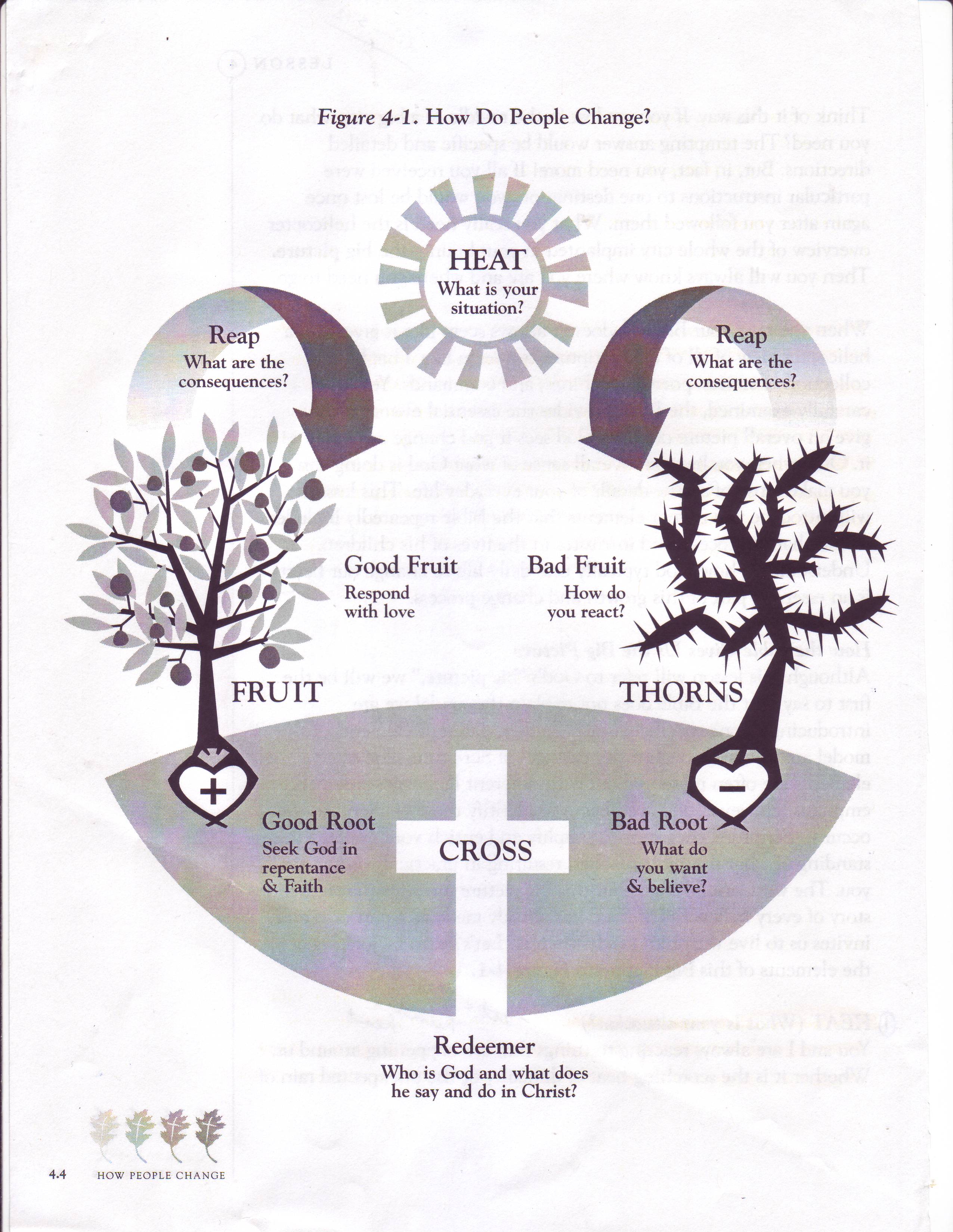
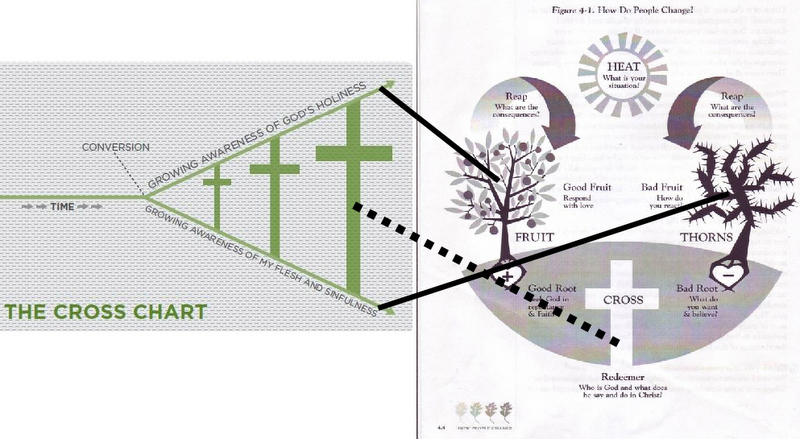
The next point is that in the neo-Calvinist gospel schema, the Scriptures serve as a Cross narrative to help us see this dualism in a clearer way. In the mind of the neo-Calvinist, the Scriptures do not define what is right and fair; the Scriptures define Luther’s “cross story.” Here is what the vast majority of Christians do not understand: six months after Luther’s 95 Theses launched the Reformation, the true magnum opus of the Reformation was written by Martin Luther; his Heidelberg Disputation to the Augustinian Order. The document reflects Luther’s utter Platonist disdain for humanity.
In Luther’s Disputation, all reality must be seen through the cross story; i.e., the cross illustration at hand here, and ALL else is the “glory story” or anything at all to do with us—our glory, not the cross story that makes God bigger and mankind smaller. To any degree that we are in the equation, the cross story is diminished.
Now, let’s take this information and evaluate why Scott et al are completely indifferent to suffering and injustice. What did the Clearcreek elders do that is wrong? Nothing because the purpose of the Bible is not to judge the authority of Reformed elders, it is to show forth the cross story, not our story, and injustice is an Us Story kind of thing. Have former parishioners at Clearcreek suffered unjustly at the hands of the elders? Well, that’s a good thing! That suffering shows us the bottom of the chart. And besides, “justice”? If we got what we all deserved, there wouldn’t be any grace! Is this like Paul’s protest in Romans against propagating more evil that grace may abound? Yes, I think so. To the contrary in the minds of neo-Calvinists, we should bow down and thank God for bringing such abuse into our lives.
This is the gospel construct that rules the majority of biblical counseling in our day and is taking over the church in this country. It is a Platonist world view that set Europe on fire for hundreds of years with unspeakable horrors. And it is a story that is playing at a local church near you.
And this weekend, Stuart Scott brings his version of the show to Springboro, Ohio. A celebration of suffering in the name of Christ. But I have news for Scott: the sins of the Clearcreek elders does not cause grace to abound. And his appearance there has nothing to do with grace or love.
If there are any parishioners at Clearcreek (who may be reading this) who are presently there against their will for fear of public humiliation or things revealed in counseling —in your desperation, don’t slip Scott a note—he’s one of them.
paul

 Paul's Passing Thoughts
4 comments