Southern Baptist “Financial Crisis” May Not Be Good News
The President of the International Mission Board (IMB) of the Southern Baptist Convention (SBC), Gnostic heretic David Platt, has announced a financial crisis and the inevitable dismissal of between 600 and 800 missionaries accordingly. I was initially rejoicing at this good news before I came to my senses.
While it may be good news that there will be 600-800 fewer people spreading the false gospel of progressive justification all over the globe while being paid for it by dumbed down professing Christians, in reality, something else may be afoot.
In the minds of the Neo-Calvinists who have taken over the SBC, there is only one thing that is preventing them from taking over the whole world with their historical-redemptive worldview; those in the church hopelessly bound, albeit anemically, to a historical-grammatical view of reality.
Now look, in the past, I have owned several businesses and know as well as anyone else that you can make company accounting books say anything you want them to say; is the IMB really in the red, or is this a ploy to purge missionaries who don’t get it?
I know at least this much: if missionaries really need to be cut, and the SBC is comprised of Biblicists and Christocentric Gnostics, and it is, and the latter is running the show, and they are, who gets laid-off is going to be selective. Do you really think Platt is going to lay-off any YRR (Young, Restless, Reformed) Brownshirts? No way. Note this from the news account:
The first of the cuts will come from voluntary retirements, followed by a restructuring.
That would be the earthy old fogies more inclined to a historical-grammatical view of reality. That would be the old guard who are getting what they deserve. They let the foxes into the henhouse, so let them take their medicine.
David Platt has something else to gain in this for the Neo-Calvinist movement. He can blame the old guard for getting the SBC into this mess, and hark! it took a YRR to see the problem. And this is typical: Calvinism is obviously going to have a relaxed view of evangelism; so, while the Neo-Calvinists are the cause of the decline, they can claim to be the solution.
Destructive social movements always supply their own demand. They create the problem, and then claim to be the solution. In the same way, the viral Reformed biblical counseling movement is inundating the SBC as a result of the SBC faithful getting a consistent dose of messages based on condemnation from Neo-Calvinist pulpits. Who would not seek counseling after being told that they are totally depraved week in, week out? However, and likewise, this is a purging process. The counseling construct is “redemptive church discipline.” The primary goal of this counseling is to determine what gospel individuals hold to. The counselee presentation problems are not the issue though that’s the pretense; the real issue is the worldview of the counselees. This is why the present-day “biblical counseling” movement that presently saturates the SBC is producing church discipline and marital divorce at epidemic proportions.
Am I suggesting that this latest SBC drama could be more of a purge than a real and present financial crisis? Pretty much.
paul
The Essence of Gnosticism and Why the Proof is NOT in the Pudding
 Originally published September 2, 2014
“To emphasize the shadows is to emphasize life itself.”
There is one proof that today’s church is saturated with Gnosticism, other than the tyranny that comes with it. For the most part, when you listen to any given message taught to Christians, you will notice that a neutral or third option is missing. It’s an either/or worldview. The essence of Gnosticism is known as “dualism.” All knowledge is either good or evil. In the case of Protestantism, it’s Luther’s cross story or glory story: the knowledge of good and evil; sound familiar? All reality falls into two categories only: it’s EITHER about you, OR it’s about the cross.
“_______…is not necessarily a bad thing (fill in the shadow element), it’s just not the best thing.” Yes my friend, why do you emphasize the shadows when it is only the Son that gives life? In Protestantism, “Son.” In Platonism, “Sun.” For both: shadows = life and the material realm. To emphasize the shadows is to emphasize life itself.
Shadows are true. Plato never said that shadows don’t exist—he just deemed them useless for true knowledge. The virtuous person does not live in the shadows, he/she lives according to the true,good, and beautiful aka Plato’s trinity. The shadows, viz, life and whatever may be going on, is irrelevant to the wellbeing experience of the true, good, and beautiful. In the same way, good Protestants are deemed happy regardless of their circumstances; it is well with our soul.
If ISIS raises their flag above the White House—it is well with our soul.
If there is a pedophile in our church—it is well with our soul.
“Justice!” you say? If you want self-justice, you are just as guilty as the one who followed his self-desire. Come now, use this preordained opportunity to be the bigger person, to show forth the cross of self-denial. If you deny yourself justice, you are showing forth the gospel to the one who should have denied himself the fulfillment of his self-desire. We must “bring grace to the situation.” We must “show forth the gospel.” We must show forth the self-death of the cross.
All of these things are just shadows after all. And to the Gnostic, whether an atheist or a good Protestant, the biggest shadow of all is capitalism. The profound spell of Plato is that he appeals to the social scientist and the religionist alike. Self-concept is the waters of the shadow world that we swim in. To the degree that we empty self and live solely for the sake of community, our individual soul is transformed. To the degree that individuals are transformed, society is transformed. Atheists and Protestants must not fuss; here now, hold hands and say, “ahhhmen.” After all, we all want the same thing: community wellbeing.
One is greatly mistaken if they point to the woes of societies living in the rotten fruits of Eastern mysticism as a contention. Those people are deemed virtuous because they are content in the shadows. If everyone would follow their example, the world would be balanced and the true, good, and beautiful would be manifested. The only reason that countries are poor is because capitalism’s greed takes from some and gives to others, and the earth is therefore unbalanced. The only way to a balanced, unified earth is collective self-death. This is where the liberal Democrat and the Neo-Calvinist both walk in the way of Martin Luther’s cross story.
Hence, the likes of ISIS is an unfortunate example of those who are a bit over-zealous. But they understand the importance of devaluing the life of the individual—they are just a bit extreme in demonstrating that truth. They are misguided, but yeah, if only the capitalist understood their child-like faith.
Bad results are no pudding test. Capitalism isn’t the cure, it’s the cause. This is where the contrast between Christ who said, “the poor will always be with you,” and the dominion theology of the Neo-Calvinist and the liberal democrat alike should strike terror in our hearts.
paul
When Church is Spiritual Gangrene: Sanctification by Justification
 We have recently received our weekly dose of Neo-Calvinist drama. This time, it was Matt Chandler’s turn to give discernment bloggers the gift that just keeps on giving. This recent incident involving Chandler’s Village Church has gone super-viral. Secular news networks are even reporting on the episode resulting in a public outcry.
These incidents are not isolated and will continue to be exposed in both Protestant and Catholic circles because they are the result of a false gospel. As Jesus said, a tree is known by its fruit.
Jordan Root
Apparently, the constant drama taking place in the evangelical church is not nature’s way of telling us something is wrong. However, the most recent drama concerning former missionary Jordan Root supplies a pretty decent insight into the core problem of progressive justification.
Christ’s called out assembly is a body that depends on individual members. The apostle Paul used a body analogy because it is the perfect analogy of Christ’s called out assembly. Strong individual members make a strong body. Consequently, every member’s role must be identified and nourished. To the degree that members (body parts, not the Salvation Club membership) do not function properly, the body is crippled and falls short of fulfilling Christ’s mandate.
Christ is the only head. The common goal is the one mind in Christ. The advent of Christ’s called out assembly was a monumental event. The monumental event was the baptism of the Holy Spirit. The Spirit is a major participant in the plan of salvation. Beware of any doctrine that emphasizes one of the three Trinity persons over the other in the plan of salvation. Salvation is Trinitarian.
 There was a new birth before the death, burial, and resurrection of Christ, but until that time, salvation was atonement by the law. In other words, according to Moses, obedience to the law could bring both life and death, but at that time the law was a covering for sin. All sin was imputed to the law and the law held that sin captive along with the believer. The believer was blessed by obedience to the law, and their sins that were a violation of the law were held in escrow until the coming of Christ. Of course, the terms of this particular escrow is an eradication instead of a payment.
On the other hand, the sins of unbelievers were not imputed to the law, but rather the law condemned them for every offence. In both cases, life and death according to the law was experienced, but with different ENDS. Whether believer or unbeliever, degrees of life and death occurred, but salvation determined a life end while being unsaved determined a death end with degree of violation determining the wages of eternal death.
When it was the Spirit’s time for His major event, He resurrected Christ from the grave and gave gifts to Christ’s assembly while baptizing Jews and Gentiles into one body. Christ died to end the law by paying the penalty for ALL sins imputed to it. With the ending of the law, all sins committed against it were ended as well except for those who were not covered by it. For unbelievers, the law was not ended and therefore they remain condemned by it.
Hence, the law is no longer an atonement for believers, but only serves as a means to love God and others. Before the baptism of the Holy Spirit, it served as atonement and a means of love, now it can only serve as a means of loving God and others. However, for unbelievers in this day, the law has a sort of grace to it; in that sin is still imputed to it. If and when they believe in Christ, every sin they committed against the law (all sin is a violation of the law) is ended with the law and now there is no law that can condemn them in the future. Therefore, the Old Testament atonement is still a “ministry of death” that is “passing away” (From an eschatology point of view, this is why believers were in the abode of the dead until Christ died on the cross. During the three days after His crucifixion, he preached to the “captives” and set others free leading them to heaven in a victory procession).
Nevertheless, through ignorance, the believer can experience as much present death, or even more death than unbelievers who will come to realize a death ending. There is a specific dynamic that figures in. The Bible splits this up into “under law” and “under grace.” Under law is the biblical definition of an unregenerate person and possesses a certain metaphysical dynamic, or state of being. Those under law are free to do good but enslaved to sin. This is primarily because they are under the law’s condemnation or judgement. In conjunction with SIN, the law empowers sin. When the law is ended, sin is stripped of its power because there is no condemnation. Sin finds its power in condemnation.
And death finds its sting in sin. The primary root of all fear is fear of judgment, and mankind, having the “works of the law” written on their hearts and administered by the conscience, knows intuitively that future death means future judgement. But “perfect love casts out fear.” What’s that? That’s “under grace” which is now no longer under the condemnation of the law; the law only serves to inform the believer in regard to loving God and others. There is NOW NO condemnation for those in Christ.
Yet, there is still a death/life dynamic going on that is experienced by the believer and unbeliever alike. The end is different, but not necessarily the life experience. Those under grace are enslaved to righteousness, but unfortunately free to sin. They are enslaved to righteousness because of the baptism of the Spirit. Don’t get too hung-up on the “slave” nomenclature. Under law enslaves the unbeliever to the laws condemnation. That is inescapable. They are crippled and enslaved to constant condemnation and the fear of death. This is where it is vital to realize that the baptism of the Spirit is a literal death of the person who is under law and enslaved to it. They are enslaved to its inevitable endgame of death measured by the degree of life choices regarding law—primarily the law of their conscience, but ultimately the full brunt of God’s specific law of which they are indifferent.
Once a person is saved, they are ”free” from the condemnation of the law also known as the “law of sin and death,” and “free to serve another.”
Romans 7:4 – Likewise, my brothers, you also have died to the law through the body of Christ, so that you may belong to another, to him who has been raised from the dead, in order that we may bear fruit for God. 5 For while we were living in the flesh, our sinful passions, aroused by the law, were at work in our members to bear fruit for death. 6 But now we are released from the law, having died to that which held us captive, so that we serve in the new way of the Spirit and not in the old way of the written code.
Note the slave terminology. Through the death of Christ, he purchased all of mankind by ending the law. His death purchased all people from the Sin slave master. Think about that in regard to those under law. Their freedom has been purchased already. If Christ died to end the law, and He did (Romans 10:4), and all unsaved people are under the law, and they are (Romans 8:2, 6:14), those who believe in Christ are now dead to the law and any possible condemnation in the future.
Christ didn’t die for anyone in particular, He died to end the law that all of mankind is under at one time or another. That necessarily demands a conclusion that Christ died for all people unless some are born into the world who are not under law, and that is obviously not the case.
To believe in Christ is to follow Him in the Spirit’s baptism. It is not merely a mental ascent to the facts of the gospel of first importance, it is a decision to follow Christ in that baptism. You recognize that Christ has purchased you from the Sin master, and know that you will not escape if you reject so great a salvation. The judgement is greater in this era because atonement spoke on earth through Moses and none who rejected it escaped, but now the call comes from heaven.
In Romans 7:4, we see both sides of the Spirit’s baptism:
A. Death;
you also have died to the law through the body of Christ, so that you may belong to another.
B. Resurrection;
But now we are released from the law, having died to that which held us captive, so that we serve in the new way of the Spirit.
This is summarized this way:
Romans 6:3 – Do you not know that all of us who have been baptized into Christ Jesus were baptized into his death? 4 We were buried therefore with him by baptism into death, in order that, just as Christ was raised from the dead by the glory of the Father, we too might walk in newness of life.
5 For if we have been united with him in a death like his, we shall certainly be united with him in a resurrection like his. 6 We know that our old self was crucified with him in order that the body of sin might be brought to nothing, so that we would no longer be enslaved to sin. 7 For one who has died has been set free from sin. 8 Now if we have died with Christ, we believe that we will also live with him. 9 We know that Christ, being raised from the dead, will never die again; death no longer has dominion over him. 10 For the death he died he died to sin, once for all, but the life he lives he lives to God. 11 So you also must consider yourselves dead to sin and alive to God in Christ Jesus.
12 Let not sin therefore reign in your mortal body, to make you obey its passions. 13 Do not present your members to sin as instruments for unrighteousness, but present yourselves to God as those who have been brought from death to life, and your members to God as instruments for righteousness. 14 For sin will have no dominion over you, since you are not under law but under grace.
We are released from the law (death) in order to be freed to “serve” another (resurrection). The guide for that service is the Spirit’s law. That’s a really good thing to call the Bible: the Spirit’s law; He uses it to convict the world of sin and the judgment to come in regard to those under law, and uses it to sanctify those under grace (John 17:17).
This is all by faith because if we do not live by this dynamic, if we do not take it literally, the metaphysical dynamic of life/death starts to bear unfortunate fruit – the death type. We will practice and apply what we believe to be true. How literally we take this dynamic does not modify the natural effect of the dynamic. If a tree really fell in the forest, that really happened whether we believe it or not. And the life/death dynamic happens whether we believe it or not.
Even though the endgame for every believer is life, they can live a life of death through ignorance. Through ignorance, they can actually be enslaved to the sin they were freed from. How does this happen? The Bible is very clear about how this happens.
It begins with ignorance about desire.
Though the old us/we literally died with Christ, and we are no longer under the law and free to serve Christ rather than serving the law of sin overseen by our old master, our mortal bodies that are not yet redeemed still possess the desires of the old man. The “mind” is redeemed, and we therefore share the same desires of the Spirit, but sin can still harass us through sinful desires. It is important to note that “the flesh” is NOT inherently evil, but rather “weak.” “Sins of the flesh” and “desires of the flesh” refer to when the flesh, or our bodies are succumbing to desires that come from sin via our choices regarding obedience. The body can also be used for holy purposes as well as sinful purposes.
At any rate, one who has died with Christ and has been resurrected to new creaturehood with Christ is able to say “no” to desires that come from sin that still resides in our mortal bodies. One reason among others that we are able to say “no” is due to the fact that sin’s power has been stripped away because it can no longer condemn us (1Corinthians 15:56). Our motives in love are by default pure in regard to justification because we are righteous and justified apart from the law. The law cannot condemn us, so the only venture left is to use the law for loving God and others. Any attempt by a believer to earn justification is completely illogical because that would be an attempt to finish an already finished work (Galatians 3:3 | note the YLT version).
Succumbing to sinful desires as a Christian is a matter of family sin, and not sin that relates to justification in any way. So in regard to justification we are blameless via the new birth that ended the law, but we may be chastised by God in regard to not loving our Father and others as we are called to. Note in the Lord’s Prayer that we ask forgiveness from our Father which is an altogether different matter than seeking salvation from sin that condemns us.
The Bible also teaches us that the intensity of sinful desires is increased if we give “provision” to those desires. In other words, by obeying sinful desires, we increase the intensity of sin’s appeal through the passions and emotions. Furthermore, since we become slaves of the master we obey, Christians can become enslaved “once again” to the demands and desires of the old master. Of course, this is due to extreme ignorance. Nevertheless, obeying sinful desires nourishes the desires, intensifies them, and over time a Christians can be habituated in regard to those desires.
This problem finds its roots in religions that promote progressive justification. Because salvation is supposedly a process that begins at point A and progresses to point B (rather than a onetime, and once-for-all-time transformation that guarantees salvation), the “Christian” life, also known as sanctification, is part of the salvation/justification “progression” from point A to point B. Consequently, the very definition of sanctification, ie., knowing how to “control our own bodies” (1Thessalonians 4:3,4) is egregiously circumvented.
And the idea of being sanctified by justification plays well for existing guilt. True believers feel bad that Christ had to die for our sin, and our lack of ability to grasp the full gravity of Christ’s sacrifice feeds that guilt as well. Far removed from the actual historical event, our lack of identification with Christ’s suffering makes us feel unthankful and indifferent. As a result, we are open to ways that enable us to better identify with Christ’s actual suffering as a way to obtain an acceptable appreciation of our salvation. This idea plays to our natural and logical inclinations.
But there are several problems with this approach. First, the Bible doesn’t call us to continually revisit the same gospel that saved us in order to obtain more and more gratitude for our salvation. This can easily become a way of earning our salvation via acceptable gratitude. Secondly, the guy who would be able to plunge the depths of why Christ had to die for him IS dead. Thirdly, the new creature cannot endeavor to better understand the condemnation that Christ died to end precisely because there is no condemnation. The subject is looking for something that cannot exist apart from the law, and therefore, if he/she finds any, it’s a figment of their misguided imagination.
Unless of course, they are deceived and are actually experiencing real condemnation because belief in a progressive justification gospel did not bring about the baptism of the Spirit. Remaining under law, they are finding ample condemnation that is “making the cross bigger and people smaller.”
In most cases, and due to overall ignorance regarding sanctification because all of the traditional rage is to make sanctification part of the justification process, the new Christian is immediately confused that they are experiencing sinful desires. After 2000 years since the advent of the Spirit’s baptism, EVERY new believer should be able to say:
According to the Bible, I just experienced a sinful desire. God has promised me that I am able to say “no” to that desire, and if I disobey that desire, I am sucking the life out of it more and more and learning to hate it more and more. I am a slave to whatever I obey, and sanctification is putting off the old habits of the old person and putting on the new habits of the new creature. Obedience results in habituation to either godliness or ungodliness.
This dynamic is not operative in those under law because they are not born again and are indifferent to God’s word. Psalm 119 is the heart of a born again individual. Those under law may live a moral life that is part and parcel with being created in the image of God, but every violation of the law is a wage for death. Not being subject to certain desires of the baser sort does not exclude them from being under law—they will just suffer a more tolerable end.
There is something VERY important to understand about the desires that come from sin: they are myriad, of various and sundry stripes, and at times horrifying. They can, and do include a desire to murder people, all kinds of covetousness, and a plethora of unnatural sexual desires.
Nothing is sadder than a Christian who experiences a baser type of sinful desire and doesn’t understand what’s going on. Immediately, in most cases, they will doubt that they were really saved. That will lead to fear of condemnation which is not love. Likewise, a person may profess Christ to escape such a desire, and rightfully so, only to find out that the desire is not gone. Not understanding that the desire is stripped of its power, the individual will be thrown into turmoil because the desire still presents itself. At this point, believing that the sinful desire is still a part of their redeemed being, which it is not, is very unhelpful to the cause of godliness to say the least.
How much better is it that a person follows Christ in death and resurrection, but understands that the desire may present itself after salvation? That should be the case. The individual should be prepared to understand the desire and what to do about it. Believing that sin no longer has “dominion” over the saint is part of believing the truth of the new birth and salvation itself. Others who seek Christ will have lesser struggles and different issues that caused them to seek Christ. Some may be moral persons who put many Christians to shame, but want the hope of eternal life. Even though they are upright persons as far as persons go, they are aware that they still fall short of God’s glory. Such persons will have a lesser struggle in sanctification.
But in all cases, various and sundry desires can be reduced to a whisper through depriving the desire of nutrients (provisions), and practicing selfless love. It’s hard to sin while you are loving God and others.
A sanctification dynamic that is not helpful is the idea of a Christian having “two natures.” No, a Christian only has ONE nature, the new one. The two natures construct gives under law and under grace equal billing, and places them in the ring to duke it out. No, Christian living is not a series of battles lost or won between two natures with equal dominion over the believer. Only one nature has dominion, and love is a choice. James explains the dynamic clearly:
James 1:13 – Let no one say when he is tempted, “I am being tempted by God,” for God cannot be tempted with evil, and he himself tempts no one. 14 But each person is tempted when he is lured and enticed by his own desire. 15 Then desire when it has conceived gives birth to sin, and sin when it is fully grown brings forth death.
All sin, even the family sin of saints that does not condemn brings forth some sort of death albeit very subtle in a lot of cases. For the believer, it is the present consequences of sin. ALL sin brings about some sort of death. Again, the death that is often brought about is very subtle. One consequence of sin that is apparent may actually be the culmination of several other sins. A person may look 15 years older than they should, and that can be the result of years of bad thinking, or the culmination of trillions of bad thoughts. This can even be more scientific; researchers have determined, on average, how much each cigarette smoked shortens one’s life. When a person smokes a cigarette, they don’t drop dead on the spot, but the one cigarette has brought forth death. Furthermore, this same analogy can be used to illustrate how obeying the desire to smoke one cigarette leads to being enslaved to the habit of smoking.
Back to Jordan Root
Let’s suppose that as a young man in seminary, Jordan was afflicted with the very unfortunate desire to have sexual relations with children. Horrible. Like most professing Christians in a progressive justification church culture, he would not have had the tools to deal with this affliction. Many in his shoes are afraid to approach individuals privately about the struggle because they are obviously very ashamed and confused that they have this desire. After all, it doesn’t seem to go well with a Christian profession to say the least. Many go to sermon after sermon after sermon in hopes that the issue will be addressed. In the Protestant church—that would be a pipe dream because sanctification is not the focus, returning to the same gospel that saved us in order to keep our justification moving forward is the focus.
That necessarily brings us to the preaching that Root eventually began to sit under: Neo-Calvinism. For Root to make direct efforts to rid himself of the desire through literal biblical instruction would have been “focusing on his own doing instead of what Jesus HAS done.” And you see, the whole problem with desires is that we “desire something more than Jesus.”
This doctrine would have been, and is presently a death sentence for Root. Typical is the creation of such problems by the nonexistent sanctification of Neo-Calvinism followed by their claim to be the cure for what they helped to create.
Gangrene
This is also exactly why the apostle Paul called false doctrine “gangrene” (2Timothy 2:17). My wife Susan contracted gangrene after a motorcycle accident. The doctor discovered it during a routine follow-up examination after the accident. The condition was completely painless and Susan was totally unaware that gangrene was silently and slowly eating away her leg. Fortunately, the condition was discovered before her leg needed to be amputated in order to prevent its spread to the rest of her body resulting in certain death.
There is not a more apt description of sin’s slow death and the false doctrines that promote it.
Progressive justification is driven by a return to the same gospel that saved us because apparently, as Christians, we still need salvation. And if we still need to be saved as Christians, as plainly stated by Dr. John Piper and many others including Matt Chandler, we abide in death still. In fact, the Neo-Calvinist doctrine of mortification and vivification calls for a meditation on our sin while only EXPERINCING resurrection—not walking in it. By a deeper and deeper realization of how sinful we are, we experience the joy of “future glory.” Sin is our function, while resurrection is not our function—only an EXPERIENCE. Even the experience is a progression towards the ultimate experience of “final justification.” Neo-Calvinist Paul Washer stated it this way:
At conversion, a person begins to see God and himself as never before. This greater revelation of God’s holiness and righteousness leads to a greater revelation of self, which, in return, results in a repentance or brokenness over sin. Nevertheless, the believer is not left in despair, for he is also afforded a greater revelation of the grace of God in the face of Christ, which leads to joy unspeakable. This cycle simply repeats itself throughout the Christian life. As the years pass, the Christian sees more of God and more of self, resulting in a greater and deeper brokenness. Yet, all the while, the Christian’s joy grows in equal measure because he is privy to greater and greater revelations of the love, grace, and mercy of God in the person and work of Christ. Not only this, but a greater interchange occurs in that the Christian learns to rest less and less in his own performance and more and more in the perfect work of Christ. Thus, his joy is not only increased, but it also becomes more consistent and stable. He has left off putting confidence in the flesh, which is idolatry, and is resting in the virtue and merits of Christ, which is true Christian piety” (Paul Washer: The Gospel Call and True Conversion; Part 1, Chapter 1, heading – The Essential Characteristics Of Genuine Repentance, subheading – Continuing and Deepening Work of Repentance).
Obviously, in this progressive justification process, “Christians” live for the sole purpose of experiencing joy only through primarily focusing on sin. Note that this joy is accompanied by a progressive “resting.” Clearly, this reduces Christianity to an experience only. Moreover, is this not, for all practical purposes, a rejoicing in evil that the apostle Paul warned about in 1Corintians 13? Is this, in essence, the antithesis of love? I believe it is. Justification is a rest; sanctification is a labor of love more and more as we see the day approaching. If we don’t actually do the work, we are not doing the love.
Progressive justification is a doctrine of death, and there are many Jordan Roots rotting away in the clutches of gangrene. Like Root, they at some point start losing limbs, but return to the source rather than new birth. Their end will be certain death.
paul
Like John Street, Like Stuart Scott: A Celebration of Mystic Despotism

Will Speak at Clearcreek Chapel’s 2015 “Family Enrichment” weekend.
 “Hence, and don’t miss this, justice is not the point. The concept of justice and fairness digresses from Reformed Calvinistic dualism.”
“….six months after Luther’s 95 Theses launched the Reformation, the true magnum opus of the Reformation was written, his Heidelberg Disputation to the Augustinian Order. The document reflects Luther’s utter Platonist disdain for humanity.”
“Now, let’s take this information and evaluate why Scott et al are completely indifferent to suffering and injustice.”
Once again, Stuart Scott will break bread with the elders at Clearcreek Chapel (Springboro, Ohio) as he is the featured speaker at this year’s “Family Enrichment” Conference. Clearcreek Chapel having a family enrichment conference is like the Nazis sponsoring an endowment for Judaism. It’s a mockery; the Chapel has ravaged innumerable families and Christian lives since its orchestrated takeover by Russ Kennedy and aided by former Clearcreek elder Greg Cook. Cook brought in a group from another Baptist church which included present Clearcreek elders Chad Bresson and Dr. Dale Evans.
Their attempted takeover of the church they left failed, but their endeavor at the Chapel succeeded—the spiritual carnage notwithstanding. Cook, as director of Clearcreek’s counseling program, was giving wives the green light to divorce husbands who had “ruined the family finances” while he himself was just under $200,000.00 in due and owing debt. It is unclear as to whether this revelation led to his stepping down as an elder, or not. Probably not since hypocrisy is a requirement for eldership in our day.
Other present Clearcreek elders have been forced to step down in the past, but have been reinstated; specifically, Mark Schindler who was re-baptized after his prior eldership. Apparently, not being sanctified by justification was the prior cause of his disgrace. Whatever it was specifically, his wife gave testimony that she never considered divorce and was determined to make the marriage work. It’s a pity that such wifely resolve that saved Schindler’s marriage is not encouraged among wives in the counseling rooms of the Chapel in this day. But one must remember that such resolve is only honorable in regard to saving the marriages of New Calvinist philosopher kings.
It all seems insane until you realize that people act from their logic. Why would Scott give credence to such a camp? Why would he ignore the pleadings of the oppressed? Why is he, like all New Calvinists, utterly indifferent to justice? We get a clue from his book The Exemplary Husband on page 72. He states the following:
God uses everything in our lives for His perfecting (growing) purposes (Romans 8:28-29; James 1:2-4). As we learned earlier, our growth as Christians toward Christ-likeness is a life-long process, often referred to as sanctification. Because God is so intent on sanctifying us, we know that He will certainly use our most important human relationships to do this.
Right. As I have worn out multiple keyboards emphasizing here on PPT, New Calvinism is a dualist philosophy. Let’s go over this again. Below is THEIR illustration, NOT mine:

Note first that regardless of their verbiage, they don’t believe we really grow, it’s the cross (what it represents) that grows. That’s obviously job one. The endeavor thereof requires a primary focus on two goals and two goals only: a deeper and deeper UNDERSTANDING of our sinfulness, and absolutely nothing else, as set against God’s holiness. Part and parcel with this is also the idea of worthlessness on our part.
The cross represents bigger and bigger salvation which must be manifested more and more until the day when our “final justification” is “revealed.” This occurs as we are sanctified the same way we are saved, by partaking in the realizing of our sinful worthlessness before God and His holiness. The more we understand the difference between the two, the more our salvation is manifested. We don’t change, only the greatness of our salvation changes in order to glorify God. Of course, this obviously redefines the new birth and denies it.
As propagated in the satanic treatise “How People Change” by Paul David Tripp, ALL tragic and sinful events in life serve the bottom of the cross chart, and ALL good that occurs in our lives serves the top of the chart. As we contemplate the gospel narrative, the goodness of God is manifested which contributes to more understanding at the top of the chart. Goodness is not our fruit, its God’s fruit only for the purpose of aiding us in understanding His goodness—not ours. Hence, and don’t miss this, justice is not the point. The concept of justice and fairness digresses from Reformed Calvinistic dualism.
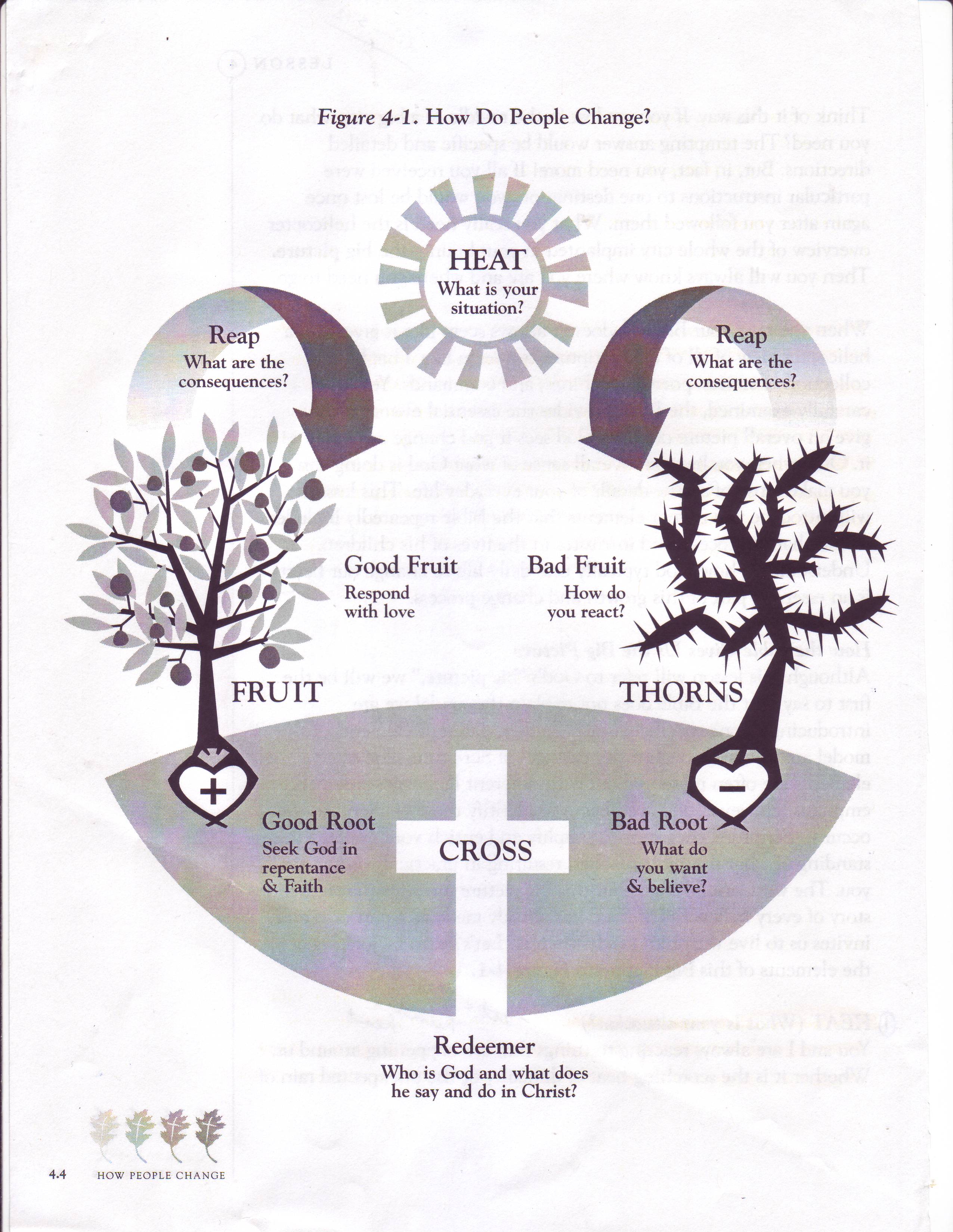
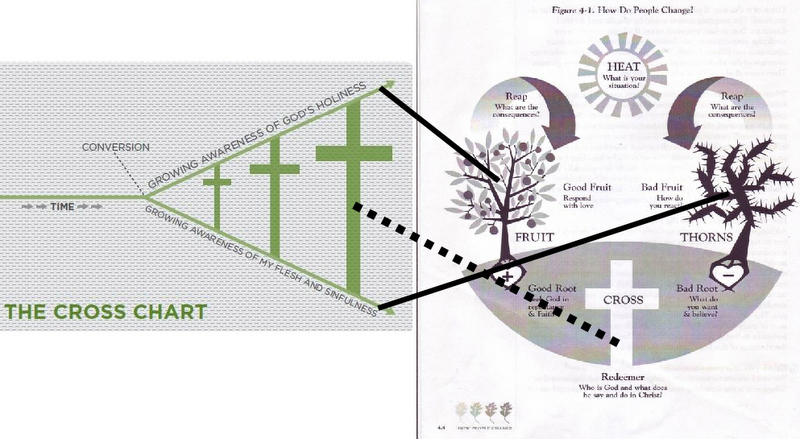
The next point is that in the neo-Calvinist gospel schema, the Scriptures serve as a Cross narrative to help us see this dualism in a clearer way. In the mind of the neo-Calvinist, the Scriptures do not define what is right and fair; the Scriptures define Luther’s “cross story.” Here is what the vast majority of Christians do not understand: six months after Luther’s 95 Theses launched the Reformation, the true magnum opus of the Reformation was written, his Heidelberg Disputation to the Augustinian Order. The document reflects Luther’s utter Platonist disdain for humanity.
In Luther’s Disputation, all reality must be seen through the cross story; i.e., the cross illustration at hand here, and ALL else is the “glory story” or anything at all to do with us—our glory, not the cross story that makes God bigger and mankind smaller. To any degree that we are in the equation, the cross story is diminished.
Now, let’s take this information and evaluate why Scott et al are completely indifferent to suffering and injustice. What did the Clearcreek elders do that is wrong? Nothing because the purpose of the Bible is not to judge the authority of Reformed elders, it is to show forth the cross story, not our story, and injustice is an Us Story kind of thing. Have former parishioners at Clearcreek suffered unjustly at the hands of the elders? Well, that’s a good thing! That suffering shows us the bottom of the chart. And besides, “justice”? If we got what we all deserved, there wouldn’t be any grace! Is this like Paul’s protest in Romans against propagating more evil that grace may abound? Yes, I think so. To the contrary in the minds of neo-Calvinists, we should bow down and thank God for bringing such abuse into our lives.
This is the gospel construct that rules the majority of biblical counseling in our day and is taking over the church in this country. It is a Platonist world view that set Europe on fire for hundreds of years with unspeakable horrors. And it is a story that is playing at a local church near you.
And this weekend, Stuart Scott brings his version of the show to Springboro, Ohio. A celebration of suffering in the name of Christ. But I have news for Scott: the sins of the Clearcreek elders does not cause grace to abound. And his appearance there has nothing to do with grace or love.
If there are any parishioners at Clearcreek (who may be reading this) who are presently there against their will for fear of public humiliation or things revealed in counseling —in your desperation, don’t slip Scott a note—he’s one of them.
paul
The New Calvinist Manifesto: Road to Tyranny
Originally published August 19, 2013

1. The New Calvinist movement is a lean, mean dominion machine. The Calvin Institutes are the primary authority. If you are one who reads the Calvin Institutes daily, you know that it is their modus operandi. It is clearly their authority, and their authority is granted from such along with the historic precedent that the Reformers concocted. They have always sought to rewrite the rules from which reality is interpreted. If you control how Christians interpret history and reality, you control the result.
2. New Calvinist national leaders see themselves in the big picture. Their vision is a Calvinistic world theocracy. They not only desire this, they are actively involved in an attempt to make it happen. Pastors are merely Kool-Aid drinking followers who serve the big picture.
3. New Calvinist national leaders are involved in the political process. Their political agenda is against any construct that does not facilitate the union of church and state. While John Piper has said that he is against the union of church and state, he stated the opposite in a video promotion filmed in Geneva.
4, 6. New Calvinist organizations target pastors. Conferences are indoctrination sessions. And the parishioners blindly pay for it. The PRIMARY role for national leaders is the indoctrination of pastors.
5. Seminaries are targeted and have become, for the most part, pre-indoctrination. Pastor’s conferences are post-indoctrination.
7. This results in covert and hostile takeovers of local churches. Protestants are doctrinally ignorant to begin by ecclesiastical design. This is a tradition that goes back to the Reformation. Hence, most churches have no defense except those who are too doctrinally ignorant to be deceived. There are also books/manuals written on how to take over evangelical churches covertly. New Calvinists have dubbed this, “The Quiet Revolution.”
8. “Ministries” like Peacemaker Ministries are New Calvinist organizations that indoctrinate pastors and make damage control possible. Chilling, is the “peacemaker teams” that are forming in churches, and are trained by Ken Sande’s organization. Sande’s European oligarchy mindset will make the hair stand up on your head. While at times I struggle to take most of these guys seriously, Sande actually frightens me. I consider him to be one of the most formidable threats to the church in our day.
9. “Nicolaitan” means power over the laity. This was a huge Gnostic movement that wreaked havoc on the apostolic church. The roots of this movement are easily traced back from the Reformers to Plato and his Republic construct. To see present-day control structure within the local assemblies as designed by the “Quiet Revolution,” go here: https://paulspassingthoughts.com/2013/03/01/new-calvinist-procedure-for-controlling-parishioners/
10. As New Calvinist Doug Wilson said, it is the agenda of Calvinism to take over every inch of the world. That’s pretty much it in a nutshell.

 Paul's Passing Thoughts
1 comment