Calvinism Show and Tell With 3 Pictures
Click Picture to enlarge:
PsychoHeresy Unawareness: Dr. John Street Shot the Sheriff, but He Didn’t Shoot the Deputy
 No doubt, PAM reveals many problems with the biblical counseling movement that one may expect when it is based on a false gospel. But John Street’s real sin is his participation in a mass propagation of a false gospel.
Dr. John Street, founder of Clearcreek Chapel in Springboro, Ohio has finally made it big in the biblical counseling movement. This is evident from the fact that he has become a target of PAM (PsychoHeresy Awarness Ministries). PAM is directed by Martin and Deidre Bobgan who without a doubt are the most formidable critics of the “biblical” counseling movement.
John Street is an elder at John MacArthur’s Grace Community Church in California, and the Chair of the graduate program for biblical counseling at the seminary associated with MacArthur’s church. Also, last time I checked, Street is the president of the National Association of Nouthetic Counselors (NANC).
In the most recent PAM newsletters (http://www.psychoheresy-aware.org/street_tmc&s.html and http://www.psychoheresy-aware.org/street_tmc&s_2.html) Street is barbecued for practicing counseling methods that the Bobgans deem unbiblical. PAM primarily decries the biblical counseling movement’s “problem-centered counseling” verses “Christ-centered Ministry” (http://www.psychoheresy-aware.org/e-books/CCMpcc-ebk.pdf ).
I am not sure what PAM means by “Christ-centered ministry,” but it seems to be a passive approach regarding the disciple’s role in sanctification:
This is why we say that those who minister to one another need to get in the way and out of the way. They need to be available, but they need to let God work rather than push their own agenda.
The idea of pushing our own agenda could mean “let go and let God” instead of pushing an agenda that just so happens to be God’s agenda. The wording is unsettling. Elsewhere the Bobgans write the following:
Christ-centered ministry encourages spiritual growth and depends on the Lord to do the work in each individual through His Word and Spirit. Therefore, one can confidently assure believers that this ministry is more effective, long-lasting, and spiritually rewarding than problem-centered counseling for those who are willing to go this way.
Depend on the Lord to do the work? At the very least, the Bobgans need to clarify their position more thoroughly because by and large, gospel contemplationism is the primary thrust of NANC counseling. One wonders if PAM is accusing NANC of what they are guilty of: an overly passive approach to sanctification.
And, NANC, when they were (past tense) helping many people, encouraged an aggressive role in sanctification by the counselee. Christians are called to “study to show thyself approved,” and then aggressively apply that truth to their lives in order to have a life built on a rock (Matthew 7:24).
This was NANC’s approach in the past, and it did result in massive professions of faith, and real lasting change. I know; I was there; I am a firsthand witness. This was before David Powlison via CCEF and company infiltrated NANC with the gangrene of progressive justification. Unbelievably, in broad daylight, Powlison admitted (during a lecture at John Piper’s church while Piper was on sabbatical searching for different “species of idols” in his heart) that NANC’s “first generation” counseling was in contention with “second generation counseling” over the very definition of the gospel!
And this is my point: PAM is focused on the supposed evil of “problem-centered” counseling (is the gospel itself not problem-centered? The gospel did not come to solve a problem?) while the real issue is that NANC and CCEF both propagate a blatant false gospel. The counseling is based on the fusion of justification and sanctification with gospel contemplationism as its practical application.
CCEF’s counseling is based on Sonship theology. Dr. Jay E. Adams nailed that doctrine specifically as the fusion of justification and sanctification in his book, “Biblical Sonship” published in 1999. Adams, in the book, decried Sonship’s position that regeneration is powered by the finished work of justification. CCEF then effectively infiltrated NANC and took it over with the same doctrine. I use over 200 pages to document all of this in “The Truth About New Calvinism” (thetruthaboutnewcalvinism.com).
Hence, we must assume that NANC counseling yields many ill results, and I will say this: PAM points them out though they are missing the much larger issue. Case in point:
The truth is that counselors and especially counselors with an agenda (their particular approach) too often take credit for successes and attribute failures to the counselees. The trumping truth is that success is primarily in the hands of the counselees….
And worse yet, The counselee’s “failure” ends up in church discipline!
Also:
Problem-centered counseling is typically a one-to-one relationship. Sometimes couples and families are involved, but the relationship is generally artificial and restrictive. The counseling relationship itself usually does not extend outside the counseling room. The relationship lasts as long as counseling is being provided and normally does not extend to other involvement, even in most biblical counseling centers. Problem-centered counselors commonly do not involve themselves with counselees outside the counseling room. That is why both psychological and biblical counselors sometimes use intake forms requesting a great deal of personal information. Because this relationship is generally isolated, the counselor and counselee can be selective as to what they want to reveal about themselves. In fact, as we mentioned earlier, research shows that counselees often lie to their counselors and protect themselves by concealing important information.
The great advantage of Christ-centered ministry is that it is not limited to an artificial one-to-one relationship where one has the problem and the other supposedly has the solution. In the Body of Christ all are growing together. there are many opportunities to know one another and to interact in genuine relationships. When a believer is experiencing problems, more than one person may be involved in ministering to that individual. One may be teaching. One may be reminding. Another may simply be extending support and fellowship. Another may be helping in practical ways. Another may be exhorting. Another may be admonishing. And, in a few cases, some may be exercising the responsibility of disciplining a fellow believer for the sake of restoration. But, all can be praying and encouraging the individual in the direction of the Lord. And, through all this, all are growing together and the relationships may deepen with one another as well as with the Lord.
No doubt, PAM reveals many problems with the biblical counseling movement that one may expect when it is based on a false gospel. But John Street’s real sin is his participation in a mass propagation of a false gospel. It reminds me of Eric Clapton’s ode to one who objects to being accused of shooting a deputy when he really shot the sheriff.
paul
John Calvin: Gnostic Extraordinaire
“If you believe that going to a Reformed ‘biblical’ counselor is about change, I have some oceanfront property in Xenia, Ohio that I would like to sell you.”
“In the first sentence of the Institutes, Calvin completely circumvents one of the primary purposes of God’s word for the believer.”
Note: You can click on charts to make them bigger.
It’s really not rocket science. The much touted idiom for Reformed thought is, the objective gospel outside of us. What does this mean? It means that all truth, wisdom, knowledge, and reality is contained in the knowledge of God which =’s “the gospel” which =’s the “personhood and works of Christ.” The dirty little Reformed secret is that the effects of the knowledge of God continues to remain outside of us even after salvation. Recently, New Calvinists have had to come clean on this to some extent by admitting that total depravity also applies to believers, and much to the consternation of Sanctified Calvinists who don’t know that they have been sanctified from Reformed soteriology. TANC is in the process of producing a 12 step program for recovering Sanctified Calvinists. The first step is to admit that Calvin was a Gnostic: “Hi, my name is Bob, I unwittingly promoted a Gnostic for ______years.” Hi Bob. The second step is vital for rebuilding self-esteem: “Hi my name is Bob, I have never been a Gnostic, and I am not totally depraved.” Hi Bob.
Obviously, if you are totally depraved, you can’t know anything that actually becomes a part of you and changes your behavior. Sanctified Calvinists must come to grips with the logical conclusions that follow the idea that GRACE remains completely outside of the believer. Reformed thought eventually referred to the antithesis of the “true gospel” as “infused grace.” In other words, the new birth does not change the individual by making grace a part of him, and thus making change possible via the new creaturehood. If words mean things, and they do, total depravity does not = change. Hence, grace does not enable individuals to perform works.
This line of thought educes statements from the likes of Tullian Tchividjian who boasts that he has never done one work that pleased God and looks to this as the assurance of his salvation. These fanatical concepts are running amuck and unfettered in today’s church because they came from Calvin, and nobody wants to take on Calvin. This is because too many have not paid attention for too long and now don’t want to look stupid. Basically, instead of thinking for themselves, and studying for themselves, they followed others.
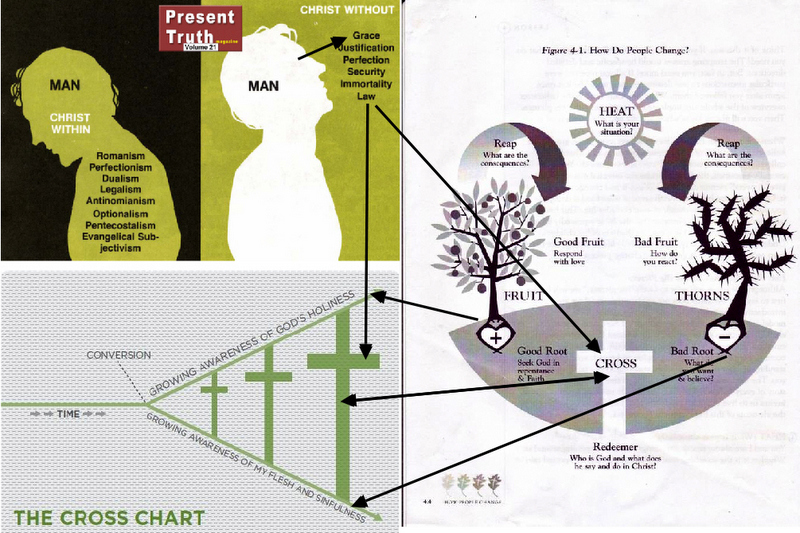
John Piper teaches that the crux of the Reformation was the idea that grace remains outside of us after salvation. In other words, grace changes our position, but not us. And he is exactly correct in his assessment. He, like the Reformers, attributes infused grace to the very root of all evil as demonstrated by the following chart published by a Reformed think tank (I discuss Piper’s Reformed view of this in detail: chapter 4 of The Truth About New Calvinism):

I have a lot of work to do in order to nail all of this down specifically, but the basics are pretty simple: if you note the chart above carefully, and think about it, the only place to go from there is Gnosticism—Gnosticism makes it work—Gnosticism is the practical application—nothing else works. By the way, a primary contributor to the above chart was Graeme Goldsworthy. Think about that one for a while. Graeme Goldsworthy was also a contributor to an article entitled, “The False Gospel of the New Birth.” In the article, the new birth is explained away by the Gnostic concept of “emphasis.”
Plato, the father of Gnosticism, believed that matter was a form or shadow of the true, good, and beautiful. The forms were certainly TRUE in regard to being a reality, but man’s basic problem was that he/she EMPHASIZES the shadows over the true form. Likewise, the new birth is true, but is merely a form of the true gospel. Focusing on the new birth (ie., our responsibility to exercise our redeemed will to obey God), “eclipses” the true Sun (a play on words). The life-giving ray of the Sun that manipulates dead matter and gives it form is a constant theme throughout the Calvin institutes and literature like Pilgrims Progress. We are frozen blocks of ice until the Sun shines its light on us and changes the form of the block gradually, but obviously, the block of ice has no participation in the process.
Calvin presents this Gnostic epistemology in the very first sentence of his Institutes. He states:
Our wisdom insofar as it ought to be deemed true and solid wisdom, consists almost entirely of two parts; the knowledge of God and of ourselves. But as these are connected together by many ties, it is not easy to determine which of the two proceeds and gives birth to the other. For in the first place, no man can survey himself without forthwith turning his thoughts toward the God in whom he lives and moves; because it is perfectly obvious, that the endowments which we possess cannot possibly be from ourselves; no, that are very being is nothing else than subsistence in God alone.
So, ALL wisdom concerns knowledge of ourselves and God, but the knowledge of ourselves must come first through God. And, since God is the good, and we are the evil, God is the knowledge of the good and we are the knowledge of the evil. All of the Calvin Institutes are framed within this prism—the knowledge of good and evil. I have made a chart below to illustrate this:

As we delve deeper and deeper into the knowledge of both, the glory of God is manifested. As illustrated by the following chart that is a viral illustration in Reformed circles. The knowledge of the good coupled with the knowledge of the evil makes the cross bigger; or in other words, the glory of God:

Of course, this is eerily similar to the lie in the garden. I wouldn’t drive a theological stake on this, but it seems that God called His creation good (including Adam and Eve), and the serpent came along and told Eve that there was also a knowledge of the evil that God was keeping from them. They rest is history. So, God redeems us, and once again His creation is good (as in the new birth made possible by Jesus Christ), and here comes the Reformed crowd with the knowledge of God’s goodness and the news that we are still evil, and the knowledge thereof. Creepy, if you think about it. And I suggest that you do. Go ahead, it’s safe for you to do so—Calvin and Luther are both dead.
Even though we do not really change according to Reformed thought, what does change? Before I address that, let me first answer the cat-cries that I presently hear. Notice in the very popular Reformed illustration above that we don’t change, the cross does. It gets bigger. We get worse in our own minds which also makes the cross bigger. We are the knowledge of the evil and are totally depraved accordingly. If you believe that going to a Reformed “biblical” counselor is about change, I have some oceanfront property in Xenia, Ohio that I would like to sell you. Come now, let us reason together, how do the totally depraved change?
According to Reformed thought, we don’t change; we manifest God’s glory; ie, “spiritual formation” or “transformation” or “reorientation of the heart.” Regardless of how change-like their terms sound; once again, ask yourself how the totally depraved change, and remember—we don’t change, only the manifestation of God’s glory does. This transformation takes place by “knowing.” We are transformed into the image of what we know. This is also a Gnostic concept. In fact, Calvin quotes Plato accordingly in book 1, chapter 3, section 3:
This did not escape the observation even of philosophers. For it is the very thing which Plato meant (in Phoed. et Theact.) when he taught, as he often does, that the chief good of the soul consists in resemblance to God, i.e., when by means of knowing him she is wholly transformed into him.
As an aside that I am not going to address deeply here, Reformed thought holds to the idea that anything more than obtaining the knowledge of the good while letting any result thereof happen naturally—is works salvation. As some in that camp state it: “You can’t just leap from the command to obedience.” Right. You have to know that the command is a command that we can’t keep, and see it as a work that Christ has already accomplished for us—anything more than that is works salvation. What we know about the command will create a manifestation of God’s glory. “Ya, like, we will then obey, right?” No, no, and no. Again, how do the totally depraved obey? Again, how do we obey if only the cross grows, but not us? By the way, the cross illustration above also illustrates Luther’s Gnostic concept of law/gospel. The law is meant to drive us to despair of self-righteousness (knowledge of the evil via the good) which drives us back to the foot of the cross. See illustration below:

This is only true of unbelievers, but for the born again believer, the Bible is God’s full philosophical statement for life and godliness (Matthew 4:4, 2Tim. 3:16). In the first sentence of the Institutes, Calvin completely circumvents one of the primary purposes of God’s word for the believer.
Much more research is needed, but one gets a hint of how this all supposedly works in real life as Calvin refers to the ideas of Socrates and Aristotle as well in book 1, chapter 5, section 3:
Hence, certain of the philosophers have not improperly called man a microcosm (miniature world) as being a rare specimen of divine power, wisdom, and goodness in containing within himself wonders sufficient to occupy our minds [emphasis mine] if we are willing to employ them.
This seems to indicate that God is satisfied with man contemplating Him in their minds only, while what happens in the outside world is totally in God’s control. The fact that Reformed thought holds to the idea that all occurrences in human history point to God’s glory in one way or the other—is no big secret. Therefore, since God is not the creator of evil, but preordains it for his glory, all human occurrences should be seen as either a manifestation of the good or a manifestation of the evil, or the knowledge of good and evil as well, but with both purposed for glorifying God accordingly. So, a bad event is knowledge of evil which glorifies the good by contrast, while good things that happen are obviously knowledge of the good as well. What is true of the “believer” in his mind, is also true in the metaphysical world. When we contemplate the goodness of God in our mind, the cross is bigger. When we see our own depravity—the cross is bigger; likewise, good and bad events in the world make the cross bigger as well. This explains the Reformed infatuation with tragedy. Do I think this philosophy is at the core of why there is so much indifference in the church to spiritual tyranny and abuse? YES.
Moreover, it explains why there is no concern over the fact that Reformed theology’s European legacy is aflame with the Witch Wars (in some villages, the female population was completely eradicated), the Inquisition, the Peasant Wars, the Thirty-Year War, the First English Civil War, the Second English Civil War, the Third English Civil War, and the Levellers’ rebellion against Puritan tyranny. These were all religious wars involving theocracies—mostly of the Reformed stripe.
Because the Church of England wasn’t lopping of enough heads to satisfy the Puritans, they tried to bring their show to America, but the founding fathers shut them down. There is a reason why America has never had a religious war. Nevertheless, their very first theocracy resulted in the very same European behavior: the Salem witch trials. As a memorial to the glorifying knowledge of the evil, New Calvinists signed the Danvers Statement on Puritan Manhood and Womanhood at the same location.
The restrained tyranny is now manifesting itself in New Calvinist “churches.” Abuse and tyranny will always follow the philosophy.
And of course, for the glory of God.
paul
Martha Peace’s Favorite Dish: Mutton
 By their fruits we will know them. Christ did not say we would know them by their excellent teachings or their education; He said we would know them by what they do. Many of the highly touted leaders of our day are showing their true hearts, and it isn’t a heart for the sheep, it’s for their share of the mutton.
When it comes down to associations on the speaking/book/counseling/conference circuit, what pads one’s career and wallet/purse is the bottom line, not the welfare of the sheep. The idea that nationally visible teachers are in it for the welfare of the sheep is naïve, if not outright laughable.
Whether John MacArthur, Stuart Scott, Martha peace, Lou Priolo or anyone else you would like to name, they gleefully and eagerly network with serial sheep abusers and spiritual despots. Why? Because it’s not about the sheep, it’s about the mutton.
Lending credibility to spiritual tyrants and fellowshipping with them has become socially acceptable in the church. Somehow, these leaders are seen as several cuts above those who actually repented of their sins, like Jimmy Swaggart and Jim Baker. Sexual perversion is not yet completely acceptable for the spiritually enlightened (not yet), unless it’s an under the table perk as in the ABWE situation. But using church discipline as a weapon, holding people hostage at churches, and blatant character assassination is.
Martha Peace continues to network with Clearcreek Chapel in Springboro, Ohio. The leadership of that church is unreconciled with a slew of God’s people, and at least in my case, their outrageous abuse of my family is well documented. And the abuse continues behind the scenes as Martha Peace is completely indifferent to the suffering inflicted on people by this leadership. Not only that, she endorses it with her participation in their “counseling” program. Sure, she has probably bought into the whole gospel contemplation thing as a way to supposedly help people—that’s bad enough, but aiding and abetting abuse of the ones she is supposedly ministering to?
What’s that all about? It’s about the real Martha Peace. Vying for her share of the mutton, her favorite dish.
paul
The Cat is Out of the Bag: Biblical Counseling Isn’t About Change
 As The Coalition Against New Calvinism is forming, one of my goals as a member is to publish a pdf report to be distributed among churches en mass. The first is almost complete and will be an introduction, but the second will address what is now apparent. David Powlison and the Christian Counseling & Educational Foundation have perpetrated a huge fraud upon the church. In the early 70’s many evangelical leaders adopted the doctrine and motif of the Australian Forum, a project that systematized Progressive Adventism. The base doctrine was the centrality of the objective gospel outside of us, and its primary focus was a call to semper reformanda. This was the idea (and still is) that the Reformation didn’t end with Luther, and the Forum had rediscovered the lost gospel of the Reformation (documentation on this and what follows is now ample and convincing).
Church leaders bought into the frenzy wholesale, especially many at Westminster Seminary where the Forum’s theological journal was widely distributed. One of those leaders at Westminster was the mentor of David Powlison and Tim Keller (Dr. John Miller). The movement spawned a massive takeover mentality among its proponents which sought to “reform” the American church with this new rediscovered Reformation gospel. Powlison is on record saying that the fundamental difference between CCEF and NANC (National Association of Nouthetic Counselors) was a traditional view of sanctification verses John Miller’s theology (which he got from the Forum). Therefore, it is no surprise that CCEF sought to assimilate the semper reformanda into NANC, which they have been very successful in doing.
One of the major themes promoted by Jay Adams when he was involved with NANC was the idea that counseling was about biblical change. Though unclear at this time whether the following came directly from the Forum or was added later, a significant portion of the NANC/CCEF counseling culture believes no such thing. Rather, they believe that people do not change (but remain totally depraved whether believers or not), and that the primary goal of counseling is to teach Christians how to manifest one of two realms or spheres. We don’t change, but we can experience and manifest the realm of the Holy Spirit or the flesh/worldly/law realm. This prism enables them, as you can imagine, to use orthodox sounding verbiage to promote this doctrine. In fact, they do just that. Spiritual growth is now, “spiritual formation.” Repentance is now, “deep repentance,” etc.
CCEF has been a lost cause from the beginning, but it is unfortunate that the leadership of NANC shows no intestinal fortitude in dealing with this problem. In fact, they refer hundreds of people daily to these counselors with complete indifference. Daily, hundreds of troubled people seek to be helped by these counselors while totally unaware of what they believe.
It is the coalition’s duty to change that. The second newsletter will be aggressively circulated to churches worldwide. It is our goal to be servants of those who struggle with full disclosure.
paul

 Paul's Passing Thoughts
1 comment