What Your Sanctification Says About Your Justification: Is Your Gospel True or False?
 “The law is the standard for love, not justification. In all of the aforementioned systems of sanctified justification by works, faith doesn’t work because it can’t lest salvation be lost. In the Christian life faith works because it can for the sake of love without condemnation.”
“Knowing that justification is a settled issue that has nothing to do with the law anyway, the true Christian only sees law-keeping as an opportunity to love. Christians not only have the anthropologic law of conscience written on the heart, the new birth writes the Bible there as well. In other words, we love the law.”
“Obviously, those who must focus on faith alone works in order to remain justified cannot focus on aggressive obedience to the law that defines love.”
What do you believe about salvation? Your Christian life will tell you. Therefore, the parable of the talents in Matthew 25:14-30 should not confuse us. The “wicked” servant was not cast into outer darkness because he didn’t put his talents to work, but rather what he thought it meant to be a servant. In other words, in order to be saved, you need to know what a Christian is. That should be fairly evident.
Do you live your Christian life by “faith alone”? That is a statement in regard to what you believe about salvation, or what happened to justify you; viz, justification.
This is not complicated. Don’t complain that I am making your touchy-feely “simple” gospel a theological treatise. I am sure you concur that some Bible words have to be understood in order to be saved. The Bible splits humanity into two categories: saved and unsaved; i.e., “under law” or “under grace” (Romans 6:14).
“Under law” is the biblical nomenclature for the unregenerate lost. Under law means that sin rules you. Not in a plenary sense, because man’s conscience and fear of punishment from civilian law restrains people. Yet, they are under the condemnation of God’s law and every violation is documented. Unless they are saved, they will be judged according to their works in the final judgment. Though some who followed their conscience more than others will receive a lesser condemnation, it is still eternal separation from God. They are under law, and enslaved to sin. The last judgment DOES NOT determine justification; it ONLY determines the degree of eternal condemnation. It doesn’t determine justification; it only determines the wages of sin.
Moreover, sin uses the condemnation of the law to provoke people to sin. Primarily, sin uses desires to tempt people, but sin’s incentive is the law because it condemns. Sin lives for the purpose of condemning people, and uses desire to get people to sin against God’s law. This leads to present and eternal death. Sin’s desire is to bring death. When the Bible speaks of “the desires of the flesh” it is referring to instances when the flesh is serving the desires of sin.
The flesh can also be used to serve the desires of the Spirit (Romans 12:1). The flesh has NO desires; it is used by the dweller for good or evil purposes. We will either use our bodies to serve the desires of sin or the desires of the Spirit. Of course, people have their own desires, but unfortunately, the unregenerate are guided by the desires of sin. They assume sinful desires are their own desire which is true. In contrast, sinful desires are not part and parcel with the regenerate soul.
Said another way: among the lost, the desires of sin are very much the same desires possessed by the individual who are indifferent to the law of God. A desire for God’s law is absent while their life is continually building a death and condemnation dividend. Some of that dividend is paid in this life until the full wages of death are paid at the final judgment.
Under grace is not void of law. The law (same as “Scripture” or same as “Bible”) has a different relationship to the saved, or those under grace. A literal baptism of the Holy Spirit takes place, as symbolized in water baptism, which puts to death the old person under law and resurrects the new person under grace. The saved person is now a new creature created by the Spirit of God. The person under grace is literally born of God—he/she is God’s literal offspring.
Therefore, the old person is no longer under the condemnation of the law in the same way a dead person cannot be brought under indictment for a crime. Consequently, the motivation for sin is gone. The power of sin is the law’s condemnation that leads to death (1Corintians 15:56, 57). In addition, the person under grace has been given a new heart that loves God’s law and its way of life. The book that could only bring death is now a book that brings life. Either way, it is the Spirit’s law; He uses it to condemn those that are under it, or uses it to sanctify those who are under grace (John 17:17).
THEREFORE, how you see the law determines what you believe about salvation. If you believe that you can somehow obey the law in a way that unwittingly seeks to be justified by law-keeping, you are still under law. If you believe justification is defined by perfect law-keeping, you are still under law. Those who believe this also believe they need a salvation system that filters all their works into a category of faith alone. The Christian life is categorized or departmentalized into works that attempt to be counted for justification and faith alone works that qualify as “living by faith alone.” Do not miss the point that this also includes abstaining from certain things that aren’t necessarily sin as defined by the Bible.
Yes, hypothetically, a person would need to keep the law perfectly to be justified by the law, but that doesn’t make perfect law-keeping the standard for righteousness. If that were the case, the law is a co-life-giver with the Holy Spirit, and a death would not be necessary. We are justified APART from the law—law has NO part in justification. The Bible defines justification, but it’s not a standard of justification (Rom 3:21, Gal 2:19, 4:21). Law-keeping by anyone does not justify.
If one is trusting in a system that fulfills the law for justification, particularly if it calls for not doing something in order that the law is fulfilled in our place, that is works salvation through some kind of intentionality whether passive or active. These kinds of systems are always indicative of being under law rather than under grace. One such system that has several variances calls for doing certain things or not doing certain things on the Sabbath which can be Saturday or Sunday depending on the stripe of system. If you follow the system on the Sabbath, all works done by you during the week are considered to be by faith alone.
In Reformed theology, particularly authentic Calvinism, contemplation on your sin leading to a return to the same gospel that saved you imputes the perfect law-keeping of Christ to your life. Notice that a fulfillment of the law is required to keep you saved, but we do faith alone works in order that Christ’s perfect law-keeping is imputed to our account. The problem here is that a fulfillment of the so-called “righteous demands of the law” is the standard for justification. Hence, clearly, this keeps so-called “Christians” UNDER LAW. In addition, a so-called faith alone work is still a work.
Not so with under grace. We are now free to follow our new desire to obey the law out of love without fear of condemnation. The law is the standard for love, not justification. In all of the aforementioned systems of sanctified justification by works, faith doesn’t work (or love) because it can’t lest salvation be lost. In the Christian life (sanctification) faith works because it can for the sake of love without condemnation (Galatians 5:6).
Knowing that justification is a settled issue that has nothing to do with the law anyway, the true Christian only sees law-keeping as an opportunity to love. Christians not only have the anthropologic law of conscience written on the heart, the new birth writes the Bible there as well. In other words, they love the law. Obviously, those who must focus on faith alone works in order to remain justified cannot focus on aggressive obedience to the law that defines love.
This is exactly what the books of James and 1John are about. Faith is not afraid to work because there is no condemnation. Faith without works is dead, “being alone” (James 2:17 KJV).
Are you in a religious system that propagates faith “alone” in the Christian life? Your faith is not only dead, it speaks to what you believe about justification. You believe justification has a progressive aspect and is not completely finished. Secondly, you believe the law has a stake in justification. Thirdly, your system categorizes works as faith alone works (an oxymoron of sorts) or works that are unfiltered in some way and therefore are efforts to “self-justify.”
If you believe the right gospel, you know that it is impossible to unwittingly partake in an endeavor to justify yourself. It’s a metaphysical impossibility—it’s not in the realm of reality. No false religion teaches that you earn your justification by perfect law-keeping—there is always a system that prescribes sanctified do’s and don’ts that in turn fulfill the law for you, otherwise known as “the traditions of men.”
It’s the fallacy of faith alone works for justification. But any work for justification is justification by works whether doing nothing (abstinence is still doing something), something passive (contemplationism or prayer is also a work) or anything active.
Law and justification are mutually exclusive, and true faith is “faith working through love” (Galatians 5:6). Faith works because there is no fear in love (1John 4:18). Don’t be like the servant who was afraid and hid his talents in the ground. Christ said it best:
“If you love me, keep my commandments.”
paul
What is the Race of Faith? Justification or Sanctification? Or Both? A Biblical Evaluation, Part 1: First Letter of John 1:7-10
But if we walk in the light, as he is in the light, we have fellowship with one another, and the blood of Jesus his Son cleanses us from all sin. 8 If we say we have no sin, we deceive ourselves, and the truth is not in us. 9 If we confess our sins, he is faithful and just to forgive us our sins and to cleanse us from all unrighteousness. 10 If we say we have not sinned, we make him a liar, and his word is not in us.
1John 1:7-9 are the go-to verses for most Protestant denominations, particularly verse 9. The rendering promotes the idea that we must continue to confess known sin after salvation in order to keep our salvation. This isn’t considered to be works salvation because repentance is a faith-alone work that originally saved us. So, since we are going back to the same gospel that saved us, and that salvation is by faith alone, and repentance is by faith alone, doing this act in order to keep ourselves saved is by faith alone and not works.
Hence, the Christian life is a “race of faith” in which the prize, or reward is salvation. As long as we live our Christian life by “faith alone” we are not disqualified from the race. In verses like 1Corinthians 9:24, the prize for winning the race is taken to mean salvation.
The key to how this works is the confession of sin that is brought to our attention by conscience or the Holy Spirit. If we confess that, we are then cleansed of all unknown sin and sin beneath the sin. As long as we are returning to the same faith-alone gospel that originally saved us, it doesn’t count as works. As plainly stated by many Protestants, Christians still need ongoing salvation from sin. And verse 7 is the icing on the cake; if we “fellowship” with each other, viz, if we are a member of the church in good standing, this in and of itself also continues to cleanse us. John Calvin et al taught that ongoing repentance for re-cleansing (re-salvation) was only valid if one is a member of the institutional church. For several citations on this, read the booklet “It’s Not About Election.”
This is the prime example of traditions of men (orthodoxy) fulfilling the law of God on behalf of the “believer.” The so-called believer partakes in some kind of activity in order for a substitution of some sort to be perpetually imputed to the subject for the maintaining of salvation. Of course, the fundamental error is law being a standard for justification. Law either condemns or sanctifies, but it has no part in justification. Second to that, when justification is not a finished work, ambiguous classifications for what is a work and what isn’t a work is needed to keep justification moving forward by “faith alone.” See the problem? A faith-alone work is an oxymoron.
Even more icing is heaped on the cake when you approach these verses with the Redemptive Historical hermeneutic. This interprets every verse in the Bible as a salvation verse, or justification verse in a supposed context of progression.
So what’s really going on with these verses and others like them? It’s simple when you approach the same with the Grammatical Historical hermeneutic. Historically, John was addressing the rampant Gnosticism of the day that saturated the 1st century church and culture. There were and are many, many veins of Gnostic thought, but John was addressing the one that believed man was spirit and therefore pure; only the material realm is evil. Therefore, no person sins because they are spirit—it’s the material world that’s evil. Moreover, it doesn’t matter what one does in the body because it is of the sinful material realm.
While many recognize this historical fact, they proceed to see these verses as sanctification verses. While rightly dividing the difference between sin unto condemnation and sin against God’s family relationship, they errantly concede a continued need for “cleansing.” It goes something like this: because we also fail to recognize family sin that we commit, it is necessarily for that sin to be cleansed as well when we confess sin against family. While this is far closer to the truth than the former, and perhaps harmless, it is best to see 1John 7-10 as verses pertaining to justification as a onetime finished work.
An idea that man is sinless because he is spirit denies the need for the gospel altogether; it makes God a liar. In that context, 1John 7-10 makes perfect sense. But the question becomes that of Greek tenses, moods, and voices. Is this forgiveness an ongoing need, or did it just happen once? And if it only happened once, is the effect still ongoing? When this is considered grammatically, the arguments can fly in every direction. The English translation seems to imply an ongoing need for forgiveness.
First of all, the New Testament does not emphasize repentance in sanctification to the degree that repentance for justification is emphasized. The emphasis is a onetime turning away from who you presently are to save yourself from a perverse generation (Acts 2:40). Don’t get me wrong, repentance is a part of sanctification, but the emphasis is a positive one regarding what we are free to do, not what we have been set free from. The past bondage to sin is not emphasized in the Bible, the freedom we have to love is what is emphasized.
1Peter 4:8 – Above all, keep loving one another earnestly, since love covers a multitude of sins.
God is love (1Jn 4:16), love matters more than sacraments (Gal 5:6), casts out fear (1Jn 4:18), covers a multitude of sins (1Pet 4:8), is the only gift that will not pass away (1Cor 13:8), and is greater than faith and hope (1Cor 13:13). The idea that Christianity is a “lifestyle of repentance” is egregiously misguided; Christianity is a lifestyle of love. The past bondage is not emphasized in the Bible; the freedom we have to love is what is emphasized.
No wonder then that 1John 1:7-10 is interpreted through the prism of a continued focus on condemnation and sin. In contrast, it is pitting repentance from sin unto salvation against the idea that man is already sinless and has no need to be forgiven through belief in Jesus Christ. This idea is also calling God a liar in regard to man’s true status. Therefore, we see that 1John 7-10 regards justification as set against the historical teachings of Gnosticism that was infiltrating the Christian assemblies at that time. 1John is also peppered with a pushback against the same vein of Gnosticism that posited the idea that Christ didn’t really come in the flesh (I John 1:1).
1 John 1:7-10, though having a grammatical semblance of present continuous, is speaking of the onetime finished work of justification that all people need as opposed to the Gnostic idea that the invisible is good, and the material is evil, and that all sin belongs to the material realm and not relevant to the spiritual. We have looked at the historical, now let’s examine the grammatical.
Verse 7… “the blood of Jesus his Son cleanses us from all sin.” The book of Hebrews makes it absolutely clear that this only happened once.
Hebrews 10:11 – And every priest standeth daily ministering and offering oftentimes the same sacrifices, which can never take away sins:
12 But this man, after he had offered one sacrifice for sins for ever, sat down on the right hand of God;
13 From henceforth expecting till his enemies be made his footstool.
14 For by one offering he hath perfected for ever them that are sanctified.
15 Whereof the Holy Ghost also is a witness to us: for after that he had said before,
16 This is the covenant that I will make with them after those days, saith the Lord, I will put my laws into their hearts, and in their minds will I write them;
17 And their sins and iniquities will I remember no more.
18 Now where remission of these is, there is no more offering for sin.
Is the blood of Jesus reapplied to our sins each time we repent? This is the only contextual conclusion that can be drawn from the aforementioned orthodox use of 1John 1:7-10. It is a perpetual application of the blood for each known sin that we commit, plus an additional cleansing for unknown sin.
To the contrary, there is one sacrifice for ALL sins and for ALL time resulting in God not remembering any sin committed by believers. Said interpretation of 1John 1:7-10 states that God will in fact remember our sin if we do not reapply the one sacrifice of Christ. Again, 1John 1:7-10 is a justification verse; that justification is a finished work that only occurs once.
Surrounding verses in context also support this view. “I am writing to you, little children, because your sins are forgiven for his name’s sake” (1John 2:12). Also, those who walk in the light are representative of those who have been cleansed from “all” sin (v.7), and the washing is always indicative of justification as a onetime finished work (note John 13:9-11).
Repentance for family sin resulting in prevention of Fatherly chastisement is another issue altogether and has nothing to do with 1John 1:7-10.
James 5:13 – Is anyone among you suffering? Let him pray. Is anyone cheerful? Let him sing praise. 14 Is anyone among you sick? Let him call for the elders of the church, and let them pray over him, anointing him with oil in the name of the Lord. 15 And the prayer of faith will save the one who is sick, and the Lord will raise him up. And if he has committed sins, he will be forgiven. 16 Therefore, confess your sins to one another and pray for one another, that you may be healed. The prayer of a righteous person has great power as it is working.
A “lifestyle of repentance” keeps our focus on “keeping ourselves in the love of God” or stated more plainly, keeping ourselves saved for a best shot at “standing in the judgment.” There is no condemnation for those who believe Christ and we will not stand in any judgment that determines justification (John 5:28,29, Luke 14:12-14). However, Christians who live out their calling to righteous living will have confidence when we are swept up in the general judgments that come upon the world, or His appearing at the end of the tribulation period (1John 2:28, 4:17). Peter spoke of a “rich entry” into the kingdom (2Peter 1:11).
Focusing on assumed sin that we are supposedly powerless to overcome will keep us from a successful Christian walk that gives us confidence (I Jn 3:18,19, 2Pet 1:9,10, Heb 10;22), a walk that pursues peace and love as a focus and not an endeavor to discover how sinful we are.
This will only lead to fear, and a shrinking back from the thought of seeing God. In contrast, mature love casts out fear.
paul
Sally Lloyd-Jones: The Wicked Witch of New Calvinism
 Originally published July 11, 2013
“Basically, Jones is actively indoctrinating our children to see reality in a contra-normative construct, and teaching them salvation through perseverance in antinomianism. Christ is clear on this: for those who lead children astray, it would be better for them if they were never born. And that also goes for anyone who propagates her materials.”
It isn’t enough for the New Calvinists to lead adults into hell with a false gospel and let them have the blood of their own children on their hands. No, they have to take their false gospel directly to the children for fear that the parents cannot do the job themselves.
But targeting children with a false gospel is where I draw the line. Now that the New Calvinists have emasculated “Christian” fathers who now stand aside and give these tyrants unfettered access to their families, New Calvinist organizations are cashing in on repackaging the false gospel of progressive justification for children.
A reader sent me a post by Sally Lloyd-Jones in which she endorses her new children’s book that propagates the false gospel of progressive justification via Redemptive Historical hermeneutics; ie., the Bible as gospel metanarrative. Here, “meta” doesn’t mean “grand narrative,” but rather the interpretation of reality through narrative, or story. By seeing our wickedness as set against God’s holiness in the narrative, we experience the works of Christ that He imputed to our sanctification by His perfect fulfillment of the law while on earth. Hence, the Bible is not for instruction or rules. Its purpose is to show the works of Christ that we are unable to perform (though Christ plainly stated that we would do more than He did [JN 14:12]). It’s a formula for living by faith alone in sanctification. This is nothing new, it is primarily what James refuted in his epistle. That’s why Luther rejected the canonicity of said epistle—it contradicts the Reformed gospel that interprets ALL reality through Christocentricity. This also defies the metaphysical reality that all rules are not morally based. “Rules” make living life itself possible in many regards. The rules for baking a cake are morally neutral, but necessary if you want an edible cake.
According to this doctrine, the experience of our obedience, or better said, the experience of “obedient faith,” is subjective because we really don’t know what we are doing in our “own efforts” versus what the Spirit is manifesting in our realm. Anything done in our “own efforts” should be repented of as “self-righteous works.” I have heard elders offer up such prayers for the congregation firsthand. If we actually believe that we can learn God’s will and perform the work ourselves as born again believers, that is “mortal sin” of a false gospel that will condemn us to hell. If all of our good works are attended with fear that they could be perceived as our own works, that’s “venial sin” that doesn’t condemn us and can be forgiven by “repenting of good works” as propagated by the likes of Dr. Tim Keller. In fact, Keller, an in-your-face and in-broad-daylight Christian mystic is Jones’ pastor.
Jones, in the promo post for her children’s book entitled, “Teaching Children the Bible,” begins with this question:
Do you read the Bible like a rulebook? Do you look at the biblical characters as heroes to emulate? Or do you read Scripture as a Story with one great Hero?
This statement is indicative of the Redemptive Historical worldview; there isn’t more than one way to look at the Bible. But most importantly, the Bible is used as a tool for a worldview that is contra-normative to interpreting reality. In this construct, there are only two ways to look at reality: the cross story or the glory story. If it is about us (the glory story), rules and heroes are applicable. But if it’s about the cross story, only Christ and His works are to be seen, “not anything we do.” “It’s not about anything we do, but what Jesus has done.”
So, supposedly, there are two ways to look at reality, and in the correct way, the cross story, realty is only perceived in the difference between the following duality: our sinfulness as set against God’s holiness. Moreover, Jesus as hero is often presented by New Calvinists as Christ saving us from a wrathful God who still holds the law over our heads. That’s why rules are bad: we are still under the jurisdiction of the law and therefore unless we can keep the law perfectly, all bets are off—Jesus to the perpetual rescue. We are still under the law, so if we don’t keep it perfectly, we are guilty of violating all of it. To think we can keep the law in a way that pleases God is a mortal sin because when we break the law at any point, our basis for justification collapses. The basis of justification is a continued maintaining of the law. So obviously, a perpetual maintaining of the law is required to keep us saved; ie., the progressive imputation of Christ’s perfect works to our sanctification which is supposedly the road to “final justification.”
And this is clearly the problem with the Reformed gospel; the law is the standard for our justification and not the death of Christ alone. The one act of obedience is not the ground of our justification, but the perpetual and progressive imputation of Christ’s fulfillment of the law to our life by faith alone without works. This is a gospel that keeps Christians under law and redefines under grace as Christ keeping the law in our stead. But this is still, “under law.” Those under grace are justified “apart from the law.” Therefore, in the same way that we violated the law at every point when we were under it, we fulfill all of it when we love our neighbors because we are under grace and not under law.
The reader who sent me the link protested to a Facebook friend who endorsed the book on her page. Her response was that he was clueless because they were not advocating the unimportance of rules. Exactly, rules are extremely important to them because it is still the basis of our justification. The key is that Jesus keeps the law for us. But of course, this is a metaphysical sleight of hand that comes from Calvin himself and is an under law gospel. Basically, Jones is actively indoctrinating our children to see reality in a contra-normative construct, and teaching them salvation through perseverance in antinomianism. Christ is clear on this: for those who lead children astray, it would be better for them if they were never born. And that also goes for anyone who propagates her materials.
Unbelievably, Jones is given full access to our children by brain-dead shepherds. In the promotion, she brags about how she undermines what the parents in local churches teach their children:
When I go to churches and speak to children, I often start by asking them two questions:
First, How many people here sometimes think you have to be good for God to love you? They tentatively raise their hands. I raise my hand along with them.
And second, how many people here sometimes think that if you aren’t good, God will stop loving you? Almost without fail they raise their hands. These children think they have to keep the rules or God won’t love them. They think if they mess up God will stop loving them.
These children are in Sunday schools. They know all their Bible stories. And they have missed what the Bible is all about.
They are children like I once was.
On display here is the arrogant metaphysical sleight of hand that is indicative of mystic despots that believe they understand the high mysteries of God that the masses are unable to understand. If she is confronted about undermining the parents of the church, she will insist that she was referring to the children only when she said “people” and not the parents of the church. If she is confronted about law and love being mutually exclusive, she will assert that she was only talking about justification. Here we have the diabolical communication of the New Calvinist on full display. Law and love are mutually exclusive in justification, but NOT sanctification. However, that distinction is never made as these wicked false teachers talk about sanctification in a justification way because we are still under the law according to their gospel. They incessantly teach the fusion of justification and sanctification (which equals being yet under law), and only make the distinction when they are called on it. But even then, their “progressive sanctification” is really progressive justification as they play on the assumptions of those being deceived. This is deceptive communication that comes directly from the pit of hell.
Jones continues:
Even though I came to faith as a small child, I somehow grew up thinking the Bible was filled with rules you had to keep (or God wouldn’t love you) and with heroes setting examples you had to follow (or God wouldn’t love you).
I tried to be good. I really did. I was quite good at being good and keeping the rules. But however hard I tried, I couldn’t keep the rules all the time, so I knew God must not be pleased with me.
And as far as being a hero: I certainly couldn’t ever be as brave as Daniel. I remember being tormented by that Sunday school chorus “Dare to Be a Daniel.”
Notice how our love is completely excluded from the metaphysical construct of the argument. That’s because we cannot have any love, that’s the glory story. And if we have love, that enables a dichotomy between justification and sanctification. Hence, justification is the setting of God’s love on us without merit, and our love for God in sanctification is our fatherly love as His children that is not under law but under grace. Like all Calvinists, she makes the two the same. Any ability to love God points directly back to the standard of justification and is not separated from sanctification. And law is not the standard for justification to begin with; it’s the one act of Christ’s obedience to the cross.
In the second paragraph, the idea that perfection is a requirement to MAINTAIN our justification is clearly evident. I was really, really good at keeping the law, but God requires perfection in order to be pleased with us. Therefore, Christ must keep the law for us in sanctification in order to maintain our justification. This is clearly works salvation by persevering in antinomianism. Other Christians can’t inspire us to love God in sanctification by keeping His commands—that’s the glory story.
This doctrine also denies the new birth and the fundamental difference between being under law and under grace. When we are under law, we are enslaved to sin and free to do good (ROM 6:20). That means the overall direction of our life will be law-breaking and then we will be judged by that very law in the end. Under grace is enslavement to righteousness and the freedom to sin (ROM 6:18). In salvation and the new birth, slavery and freedom are switched resulting in an overall direction of life. But our justification will not be judged by our freedom to sin because we are no longer under it. The overall direction of our sanctified life will be righteousness because we are born of God and have His seed within us. Loving God by keeping His commandments is therefore the direction of our life and not the perfection. Per the Reformed false gospel of progressive justification, perfection is still the standard because we are still under law and not born again by the biblical definition:
At the end of the story there were no other teachers around, and I panicked and went into autopilot and heard myself—to my horror—asking, “And so what can we learn from Daniel about how God wants us to live?”
And as I said those words it was as if I had literally laid a huge load on that little girl. Like I broke some spell. She crumpled right in front of me, physically slumping and bowing her head. I will never forget it.
It is a picture of what happens to a child when we turn a story into a moral lesson.
When we drill a Bible story down into a moral lesson, we make it about us. But the Bible isn’t mainly about us, and what we are supposed to be doing—it’s about God, and what he has done.
Children don’t need to be told to try harder, believe more, or do it better. That just leaves them in despair. The moral code always leaves us in despair. We can never live up to it.
I knew it as a child—I could never be good enough or brave enough.
None of that is the point unless we are still under law. The point of sanctification is not moral law, but loving God and glorifying His name and wisdom through obedience. The Reformed gospel denies our ability to please God through obedience (ROM 8:7,8). The crux is perpetual re-salvation by faith alone apart from works in sanctification. Nothing could be clearer. The new birth is redefined by, “mortification and vivification” which is a perpetual reliving of our baptism to maintain our justification. Note Jones’ statement in the same promotion:
We don’t need a moral code. We need a rescuer. And that’s why I wrote The Jesus Storybook Bible and Thoughts to Make Your Heart Sing, So children could know what I didn’t: That the Bible isn’t mainly about me and what I should be doing. It’s about God and what he has done.
That the Bible is most of all a story—the story of how God loves his children and comes to rescue them.
Obviously, in context, one can only conclude logically that this is a perpetual “rescue” and not a onetime event. The New Calvinist Paul David Tripp calls this an “everyday rescue.” In a sermon at Southeastern Theological Seminary (Spring 2007), referring to Romans 7:24, he made it clear that Christians need to be rescued [saved] every day. That’s the crux.
It grieves my heart that these wicked satanic minions are given free access to our children. This is where Christians should be motivated to standup against these false teachers.
If we are not motivated by the eternal wellbeing of our children, we are a disgrace to the cause of Christ.
paul
Ground Zero for Understanding the Biblical Counseling Movement
Originally published September 18, 2013
“I believe this will go down in church history as one of the most grotesque betrayals ever perpetrated on a man in the name of friendship and the gospel.”
A Chapter Theses for Clouds Without Water: The Biblical Counseling Movement; It’s True History and Doctrine
In the Beginning, Plato, and then Augustine.
During the first century, the upstart assemblies of the risen Christ suffered a viral affront from Gnostic sects. The first century church was made up of people from all socioeconomic strata, and the Gnostics infiltrated Christianity for that purpose. Those in the first century church well-endowed with money were a valuable resource, and this is who the Gnostic sects primarily targeted with their false doctrine.
Gnosticism has always been about elitism, power, and money. If you want to see an immaculate mural of the American church, read Philip J. Lee’s “Against the Protestant Gnostics.”
Gnosticism finds its roots in the philosophy of Plato. Every American born into the world should be thoroughly apprised of Plato the man and his philosophy. To understand Plato is to understand Western culture politically and spiritually. All the philosophers agree on this point. From there, the math is easy: Augustine was the father of Reformation doctrine, and a rabid follower of Plato. Augustine had little use for the Bible without Platonist insight, and considered Plato a Pre-Christianity Christian.
Of course, the favorite red herring is that Plato is not agreed with on every point, but the fact remains that his primary construct founded Reformed theology: the incompetence of man, and the need for a select few (the enlightened) to rule over the masses. Those with gnosis know how society best functions, and they know how the masses can find individual peace from the desires that rule over them.
The Age of Enlightenment (circa 1630) produced men who were the first to confront Plato’s construct successfully. The most formidable product of that movement was the American experiment which obviously turned out quite well. It was founded on the competence of the individual. The competition was the Platonist Puritans who unfortunately survived the voyage from Europe and wreaked havoc on the East coast. But fortunately, their worldview kept them from settling further inland. “Go west young man!” is hardly the motivational words of competence found among the purer forms of Reformed thought.
Let there be no doubt about it, the idea of merging church and state is grounded in the religion of man’s incompetence. The masses need the state to take care of them. Plato’s philosopher kings contrive orthodoxy, and the soldiers enforce it. This concept did not find its way into the Westminster Confession by accident. Even those who think the state should be separate from the church think a utopia would arise if the church ran the state. “Separation of church and state” doesn’t mean no theocracy; theocracy would be a good thing, supposedly. The state has always had an interest in ruling over religion because ideas are dangerous, and the church has always been a willing participant if the state agrees to enforce their orthodoxy. The battle between the two for the upper hand of control is the political intrigue that is European history in a nutshell. And that is how the world as we know it will end: the zenith of church statecraft as described in the book of Revelation.
This is Western history, and the children of the enlightenment would have no part of it on American soil. Ten years after the Declaration of Independence, James Madison successfully stopped a European style push for a church state in A Memorial in Remonstance Against Religious Assessments. For all practical purposes, it was an indictment against the fruits of European Reformed doctrine.
The Reformation’s Historical Cycle of Social Death and Resurgence
The Reformers, being children of Plato, didn’t interpret reality with a normative epistemology. Plato’s Achilles’ heel has always been the application of Eastern mysticism. Instead of reality being interpreted empirically, and a course of action being determined by discovery, conclusions are drawn by using interpretive gateways to the “pure” form of reality that is hopefully good. Plato thought it was good, but his interpretive gateway to reality rejected the five senses out of hand. Gnosis was the key.
The Reformers merely replaced gnosis with the personhood of Christ as a sort of stargate to reality. That reality was predicated on the difference between the unchangeable pure form of Christ, and the inherent evil of man dwelling in a world that constantly changes. Plato equated the pure forms with immutable objectivity, and evil matter with mutable subjectivity. Hence, today’s Platonist Reformers speak of the “objective gospel experienced subjectively.” This is clearly Plato’s metaphysical construct based on the incompetence of man in regard to interpreting reality. Like Plato, the Reformers of old and new alike bemoan man’s attempt to understand reality “in the shadows” of all matters that “eclipse Christ.” While donning the persona of Biblicism, pastors like Steve Lawson call for pastors to “come out from the shadows.”
This is the theme of books like “Uneclipsing the Son” by John MacArthur confidant Rick Holland. In his book, he hints at why purest Reformed theology gets lost in the minds of Christians from time to time and therefore needs periodic resurgences and rediscoveries. He notes in his book that good grammar makes bad theology. The mystic heretic Paul David Tripp makes the same assertion in “How People Change,” noting that a literal interpretation of Scripture circumvents the personhood of Christ and His saving work. What’s in an interpretation method? According to Tripp—your salvation.
This is the paramount point at hand: the Reformers did not interpret the Bible grammatically, objectively, exegetically, or literally at any point; they interpreted the Bible through the dual prism of “reality” seen in God’s holiness and our evil. The only objective truth is the person of Christ leading to a mere subjective experience of His power and grace manifestations. Hence, many Reformed purists in our day embodied in the New Calvinist movement speak of, “spiritual growth in seeing our own evil as set against the holiness of God.” Therefore, commands in the Bible become part of the narrative that helps us see what we are unable to do rather than commands to be obeyed. We merely seek to see, and wait for the subjective experience of “vivification.” The seeing is the “mortification.” Reformed theologians like Michael Horton explain this as a continual re-experience of our original baptism as we perpetually revisit the same gospel that saved us “afresh.”
This reduces the Christian life to experiences of perpetual rebirth found in Eastern concepts Plato borrowed for “practical life application.” This is the foundation of Historical Redemptive hermeneutics born of Reformed purism. This is also the interpretive method that is all of the rage in our day through programs like BibleMesh.
This is not the natural bent towards interpreting truth. We are wired to interpret truth objectively, and grammatically—tools like allegory and parables notwithstanding. This is why Reformed purism dies a social death from time to time throughout history. Thus, this metaphysical anomaly experiences “rediscovery” and “resurgence” movements. Be certain of the following: this is the New Calvinist movement in our day, and in essence, a return to the exact same viral Gnosticism that plagued the New Testament church with this caveat added: we by no means possess the doctrinal intestinal fortitude of the first century church.
Ground Zero: The 1970 Resurgence
1970 is ground zero for the present landscape of American Christianity. In that year, two movements emerged. Since colonial times, the third resurgence of Reformed purism was born through a project called the Australian Forum. In that same year, Dr. Jay E. Adams, a hybrid of Calvinism and Historical Grammatical interpretation, launched the biblical counseling movement. His movement was predicated on the competence of enabled congregants to counsel each other through the deepest of human problems. Adams also recognized the simple concept of anthropology and its relationship to helping people. Because all humans are created by God, what works well for the unsaved should work even better for the saved. If unsaved people who don’t violate their consciences are happier, this should also aid Christians in their walk with God. Bad ideas are simply bad for everyone, the ultimate need for eternal salvation notwithstanding. But that doesn’t mean you throw out the unsaved baby with the bath water of practicality. And in addition, does practicality show forth the wisdom of God and thereby point people to God? Should God not know what makes people tick? Moreover, what is the authority for interpreting human existence? Philosophy, or the Bible?
Adams’ biblical construct produced astounding conclusions, especially in areas where a medical model covered for escape mechanisms that create another reality for realties one may not like. If Bob is in big trouble, he merely becomes Ted, or maybe even Jane. This is a bad idea for Christians. Adams created a dichotomy between salvation and the Christian life. He believed in the utter incompetence of man to save himself, but abundant competence in colaboring with God for a victorious life over sin. With Adams, it is about CHANGE for the glory of God and the happiness of His people.
Thus, with the resurgence of Reformed purism at the same time, the battle lines were drawn, and a confusion of conflict emerged in the biblical counseling movement. The one predicated on the utter incompetence of man whether saved or unsaved, and the other predicated on the competence of the Spirit-filled Christian. The one predicated on Christians only being righteous positionally, and the other predicated on the idea that Christians are also practically righteous. The one predicated on contemplationism, the other predicated on obedience. This is the civil war that has raged in the biblical counseling movement from its conception until this day. It is for the most part a civil war of servility, lest two different gospels be separate, and careerism maimed.
The Forum doctrine quickly found footing at Westminster Seminary in Pennsylvania where Adams was a professor. The initial vestige of relevant infection was found in Dr. John “Jack” Miller, also a professor at Westminster Seminary. True, Westminster was founded by Reformed purists that believed the many acts of Christ’s righteousness were part of the atonement, not just His one act of death on the cross, but for the most part, the Reformation’s metaphysical anomalies had reduced Westminster to moderate Reformed ideology. If you will, a hybrid Calvinism that interpreted reality grammatically.
Miller changed that. While the doctrine was in the process of suffering a brutal death in Reformed Baptist circles by moderate Calvinists, being labeled as antinomianism, it found resurgent life at Westminster in Miller’s Sonship Theology incubator. The forerunner of this doctrine in Reformed Baptist circles, Jon Zens, discovered the doctrine in the early years of the Forum while he was a student at Westminster. He actually became heavily involved with the Forum in the 70’s, convincing them that everyday Covenant Theology would be a hindrance to infecting Christianity with the newly rediscovered disease. From that conversation came the birth of New Covenant Theology circa 1981. It was a significant addition to the present repertoire of elements that confuse the real crux of the issue. Till this day, few moderate Calvinists make this historical connection between New Covenant Theology and New Calvinism.
But it was a particular mentoree of Miller’s that saw Adam’s construct as a threat to the successful spread of the Forum’s rediscovery: Dr. David Powlison. Powlison, working closely with Miller, developed the Dynamics of Biblical Change which is a counseling construct based on Reformation purism. This became the counseling model for Westminster’s biblical counseling wing known as The Christian Counseling & Education Foundation (CCEF). Later, there was a proposal for an organization that would certify counselors for CCEF. Adams was opposed to it as it smacked of the kind of elitism that he was trying to avoid. Remember, Adams was all about the competence of the average congregant to counsel. But Purist Reformed ideology is all about elitism because Gnosticism is all about elitism; the two go hand in glove.
Show Me the Money
Gnosticism rejects the average man’s ability to understand reality. So, assimilation for purposes of functionality is the main concern; ie., that the masses are controlled by indoctrination that is not necessarily understood, but invokes behavioral goals. But another primary goal is the spiritual caste system that provides millions of dollars for elitist educators. In essence, these are the professional Sophists produced by Platonism. This is why Gnosticism always dwells in the upper socioeconomic strata, as Phillip J. Lee notes in the aforementioned book, Gnosticism is a rich man’s game. CCEF certified counselors are extremely rare in zip codes of average incomes less than $80,000 per year, and nowhere to be found in zip codes of $50,000 or less. This of course, is very telling. Their conferences require registration fees of $300.00 per person or more.
Meanwhile, NANC Happens
Powlison followed a classic mode of Gnostic deception by seeking to be identified with the persona of Adams’ successful counseling construct while despising the doctrine as a supposed false gospel. To be more specific, he wanted to gain ground by being identified with Adams’ success, and with a deliberate long-term goal of destroying the historical grammatical approach to biblical counseling.
Unfortunately, and to the chagrin of Adams, the National Association of Nouthetic Counselors was born (NANC). “Nouthetic” counseling was a Greek term introduced by Adams and often associated with him. Therefore, Powlison et al were able to be identified with the tsunami like personal transformations of the Adams reformation as a jump start for their own construct, and with a long-term goal of destroying the competition. They did this so effectively that Adams was often thought of as the founder of NANC, which was never true.
Consequently, Adams experienced an increased persecution from within the contemporary biblical counseling movement that he founded. His counseling was dubbed “first generation” biblical counseling and referred to as nothing more than “producing better Pharisees.” I believe this will go down in church history as one of the most grotesque betrayals ever perpetrated on a man in the name of friendship and the gospel.
The fallout in our day is indicative of the spiritual carnage that has always been left in the path of Gnosticism. While the spiritual peasantry cries out in hopes that the elite will police their own, the Nicolaitans of our day laugh all the way to the bank. After all, subjective reality is messy business and peasants just don’t understand. The biblical counseling community has founded organizations who seek to keep them out of court and prevent the obscuring of cash flow. The New Calvinism movement is intrinsically connected by a complicated and massive network of associations—in many cases disagreeing with each other on “secondary issues.” A prime example is the G.R.A.C.E mediatory organization headed by Boz Tchividjian. While playing the part of advocates for the spiritually abused, they are professionally networked with serial abusers of the worst sort.
Conclusion
The biblical counseling movement embodied in New Calvinism is nothing more or less than a return to the exact same Gnosticism that plagued the first century church. The fact that Eastern mysticism is often the application can be seen by what happened at a Passion Conference where the who’s who of New Calvinism led the audience in a form of Transcendental Meditation. Tim Keller, a co-mentoree of Miller along with David Powlison in the early days, is a staunch advocate of Eastern mysticism as a practical application for Christian living.
CCEF, and NANC are the epitome of false advertising. They advertise the gospel and change, but believe in neither. Like the father of their faith, St. Augustine, it is Plato they trust. The banner over them is not love, but a sense of elitist entitlement to be paid and supported by the unenlightened masses for their own good. Sheep that don’t get it are more than expendable; the one in 99 is expendable for the 99 who know their place and pay the Shamans their tax deductible dues.
They invent and sell orthodoxy, the layman’s manual for experiencing perpetual rebirth. On the one hand, there is a Christianity that posits the living water that is received once, the onetime washing, and the moving on to maturity from the beginning principles of baptisms, and then there is the gospel of our day that posits the perpetual rebirth of Eastern mysticism.
But this is not a mere disagreement about how to live the Christian life. How we see the Christian life reveals the gospel that we really believe. When our salvation is not a finished work, something must be done by us to finish it—even if that means doing nothing with intentionality. NOT living by a list of do’s and don’ts is the work that keeps us saved. It is playing it safe by hiding our talents in the ground and giving the Lord back what He originally gave.
Christians would do well to choose which gospel they will live by in our day. At this point, that conversation has not arrived yet. And to be sure, many do not want the conversation to be clarified to that point. The gospel itself has become the elephant in the room.
paul
Like John Street, Like Stuart Scott: A Celebration of Mystic Despotism

Will Speak at Clearcreek Chapel’s 2015 “Family Enrichment” weekend.
 “Hence, and don’t miss this, justice is not the point. The concept of justice and fairness digresses from Reformed Calvinistic dualism.”
“….six months after Luther’s 95 Theses launched the Reformation, the true magnum opus of the Reformation was written, his Heidelberg Disputation to the Augustinian Order. The document reflects Luther’s utter Platonist disdain for humanity.”
“Now, let’s take this information and evaluate why Scott et al are completely indifferent to suffering and injustice.”
Once again, Stuart Scott will break bread with the elders at Clearcreek Chapel (Springboro, Ohio) as he is the featured speaker at this year’s “Family Enrichment” Conference. Clearcreek Chapel having a family enrichment conference is like the Nazis sponsoring an endowment for Judaism. It’s a mockery; the Chapel has ravaged innumerable families and Christian lives since its orchestrated takeover by Russ Kennedy and aided by former Clearcreek elder Greg Cook. Cook brought in a group from another Baptist church which included present Clearcreek elders Chad Bresson and Dr. Dale Evans.
Their attempted takeover of the church they left failed, but their endeavor at the Chapel succeeded—the spiritual carnage notwithstanding. Cook, as director of Clearcreek’s counseling program, was giving wives the green light to divorce husbands who had “ruined the family finances” while he himself was just under $200,000.00 in due and owing debt. It is unclear as to whether this revelation led to his stepping down as an elder, or not. Probably not since hypocrisy is a requirement for eldership in our day.
Other present Clearcreek elders have been forced to step down in the past, but have been reinstated; specifically, Mark Schindler who was re-baptized after his prior eldership. Apparently, not being sanctified by justification was the prior cause of his disgrace. Whatever it was specifically, his wife gave testimony that she never considered divorce and was determined to make the marriage work. It’s a pity that such wifely resolve that saved Schindler’s marriage is not encouraged among wives in the counseling rooms of the Chapel in this day. But one must remember that such resolve is only honorable in regard to saving the marriages of New Calvinist philosopher kings.
It all seems insane until you realize that people act from their logic. Why would Scott give credence to such a camp? Why would he ignore the pleadings of the oppressed? Why is he, like all New Calvinists, utterly indifferent to justice? We get a clue from his book The Exemplary Husband on page 72. He states the following:
God uses everything in our lives for His perfecting (growing) purposes (Romans 8:28-29; James 1:2-4). As we learned earlier, our growth as Christians toward Christ-likeness is a life-long process, often referred to as sanctification. Because God is so intent on sanctifying us, we know that He will certainly use our most important human relationships to do this.
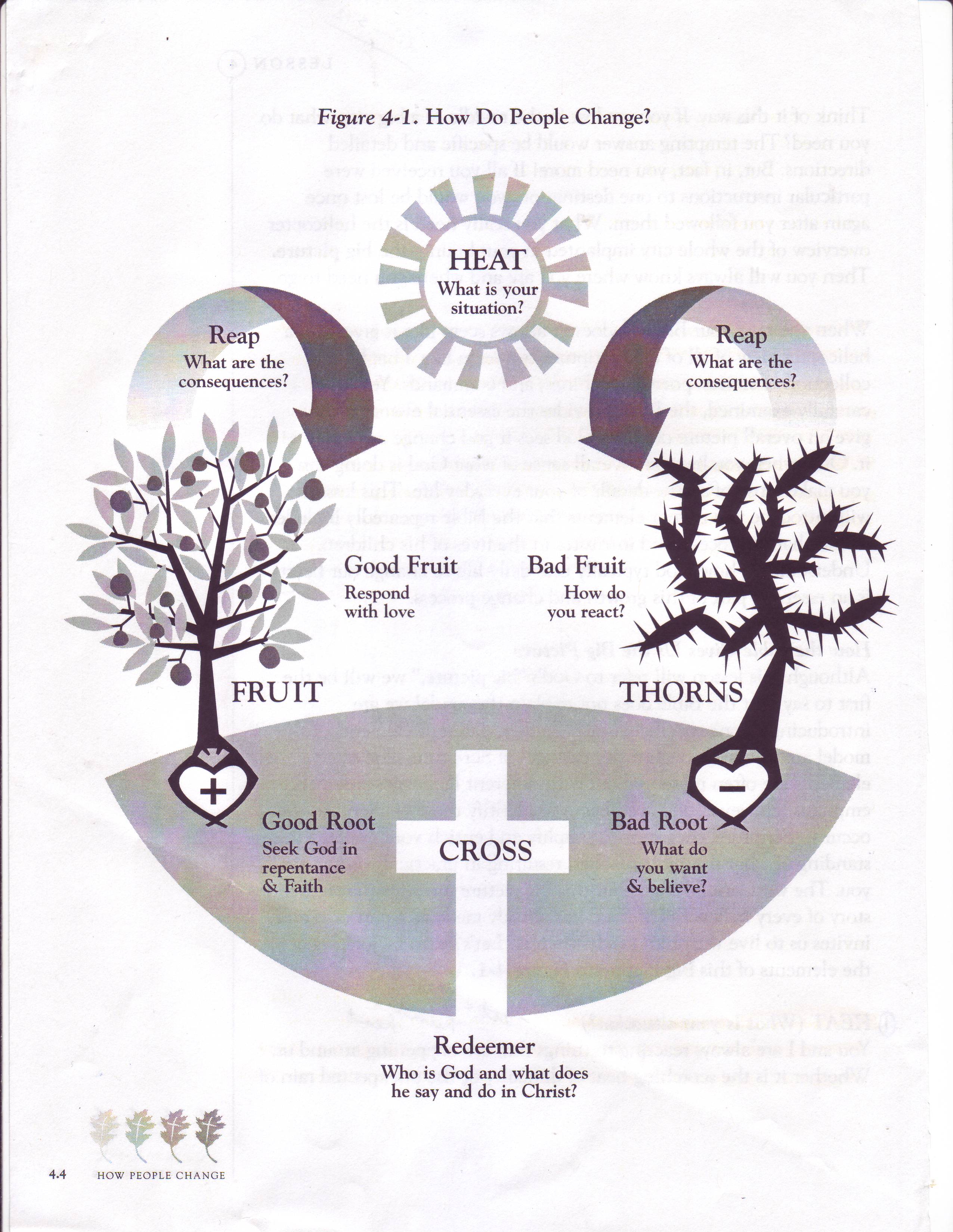
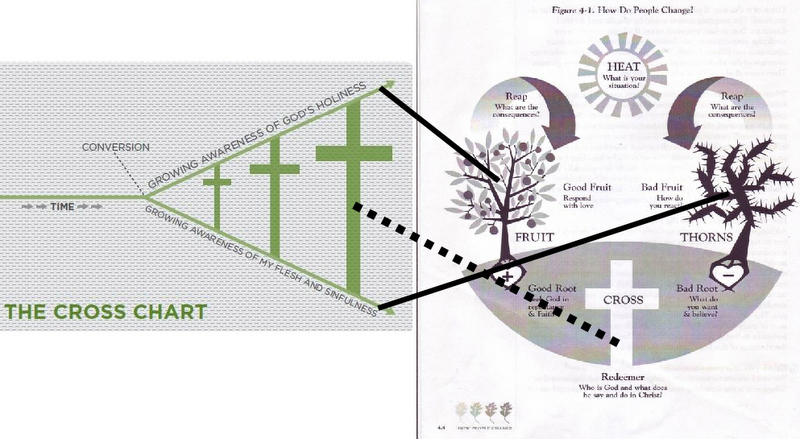
Right. As I have worn out multiple keyboards emphasizing here on PPT, New Calvinism is a dualist philosophy. Let’s go over this again. Below is THEIR illustration, NOT mine:

Note first that regardless of their verbiage, they don’t believe we really grow, it’s the cross (what it represents) that grows. That’s obviously job one. The endeavor thereof requires a primary focus on two goals and two goals only: a deeper and deeper UNDERSTANDING of our sinfulness, and absolutely nothing else, as set against God’s holiness. Part and parcel with this is also the idea of worthlessness on our part.
The cross represents bigger and bigger salvation which must be manifested more and more until the day when our “final justification” is “revealed.” This occurs as we are sanctified the same way we are saved, by partaking in the realizing of our sinful worthlessness before God and His holiness. The more we understand the difference between the two, the more our salvation is manifested. We don’t change, only the greatness of our salvation changes in order to glorify God. Of course, this obviously redefines the new birth and denies it.
As propagated in the satanic treatise “How People Change” by Paul David Tripp, ALL tragic and sinful events in life serve the bottom of the cross chart, and ALL good that occurs in our lives serves the top of the chart. As we contemplate the gospel narrative, the goodness of God is manifested which contributes to more understanding at the top of the chart. Goodness is not our fruit, its God’s fruit only for the purpose of aiding us in understanding His goodness—not ours. Hence, and don’t miss this, justice is not the point. The concept of justice and fairness digresses from Reformed Calvinistic dualism.
The next point is that in the neo-Calvinist gospel schema, the Scriptures serve as a Cross narrative to help us see this dualism in a clearer way. In the mind of the neo-Calvinist, the Scriptures do not define what is right and fair; the Scriptures define Luther’s “cross story.” Here is what the vast majority of Christians do not understand: six months after Luther’s 95 Theses launched the Reformation, the true magnum opus of the Reformation was written, his Heidelberg Disputation to the Augustinian Order. The document reflects Luther’s utter Platonist disdain for humanity.
In Luther’s Disputation, all reality must be seen through the cross story; i.e., the cross illustration at hand here, and ALL else is the “glory story” or anything at all to do with us—our glory, not the cross story that makes God bigger and mankind smaller. To any degree that we are in the equation, the cross story is diminished.
Now, let’s take this information and evaluate why Scott et al are completely indifferent to suffering and injustice. What did the Clearcreek elders do that is wrong? Nothing because the purpose of the Bible is not to judge the authority of Reformed elders, it is to show forth the cross story, not our story, and injustice is an Us Story kind of thing. Have former parishioners at Clearcreek suffered unjustly at the hands of the elders? Well, that’s a good thing! That suffering shows us the bottom of the chart. And besides, “justice”? If we got what we all deserved, there wouldn’t be any grace! Is this like Paul’s protest in Romans against propagating more evil that grace may abound? Yes, I think so. To the contrary in the minds of neo-Calvinists, we should bow down and thank God for bringing such abuse into our lives.
This is the gospel construct that rules the majority of biblical counseling in our day and is taking over the church in this country. It is a Platonist world view that set Europe on fire for hundreds of years with unspeakable horrors. And it is a story that is playing at a local church near you.
And this weekend, Stuart Scott brings his version of the show to Springboro, Ohio. A celebration of suffering in the name of Christ. But I have news for Scott: the sins of the Clearcreek elders does not cause grace to abound. And his appearance there has nothing to do with grace or love.
If there are any parishioners at Clearcreek (who may be reading this) who are presently there against their will for fear of public humiliation or things revealed in counseling —in your desperation, don’t slip Scott a note—he’s one of them.
paul

 Paul's Passing Thoughts
leave a comment