
Calvinism: The Manic False Gospel
 Isn’t freedom wonderful? You no longer have to argue with Calvinists about election and the myriad of other orthodox distractions that they proliferate. They need to be saved, and the news gets even better: the present-day Neo-Calvinist movement has created a huge mission field white unto harvest. And many evangelical pastors are fearfully close to apostasy because of this movement as well.
Simply stated, Calvinism is a gospel of daily re-salvation. The same gospel that saved us also sanctifies us—that’s what they plainly state; “We must preach the gospel to ourselves every day.” Sanctification is a vessel for maintaining our salvation by the same way we were saved: repentance and faith alone. Perseverance is overcoming our supposed tendency to please God by our “own efforts.” Calvin and Augustine believed that sanctification is represented by the Old Testament Sabbath of rest. In the same way that the Israelites were put to death for working on the Sabbath, we will be put to spiritual death for working in sanctification.
I like to call it the Bachman-Turner Overdrive gospel; according to their hit song, “Taking Care of Business,” we must work hard at doing nothing all day in order to keep ourselves saved. Problem is, we are doing something to keep our salvation; that’s a problem. What we are doing is what the Reformers call, mortification and vivification. As we focus on a deeper and deeper understanding of our total depravity, we die as in the original baptism that saved us. This leads to another resurrection, and joy, or vivification. According to Michael Horton in his systematic theology book popular in many seminaries, this is a “subjective….daily dying and raising” and what the Reformers referred to as the “living out of our baptism….again and again.” (p. 661).
So, as with manic depression, the depression of mortification is followed by the mania of vivification.
Face it—that’s Calvinism in a nutshell. A manic false gospel.
paul
Know Your Cuts of Calvinism
1. Total Depravity: Pertains to the saints also.
2. Justification by Faith Alone: Pertains to sanctification also.
3. Mortification and Vivification: Perpetual death and rebirth for living by faith alone in sanctification to maintain justification. The reliving of our baptism “again and again.”
4. Double Imputation: Christ’s passive obedience to the cross for justification, and His active obedience as a substitution for our obedience in sanctification.
5. Deep Repentance (aka Intelligent Repentance): Seeks the death of mortification in re-experiencing our new birth.
6. New Obedience (aka New Fruit): The experience of Christ’s active obedience in sanctification (vivification).
7. The New Birth: Perpetual mortification and vivification.
8. The Objective Gospel: All reality is interpreted through the redemptive works of Christ.
9. Christ for Us: Christ died for our justification, and lived a perfect life for our sanctification.
10. The Imperative Command is Grounded in the Indicative Event: Biblical commands show forth what Christ has accomplished for us and what we are unable to do in sanctification. Works are experienced only as they flow from the indicative event of the gospel.
11. Neo-Nomianism (New Law, aka New Legalism): The belief that we can please God by obeying the law in sanctification.
12. Progressive Sanctification: The progression of justification to glorification.
13. Progressive Imputation: Whatever is seen in the gospel narrative and meditated upon is imputed to our sanctification, whether mortification or vivification.
14. The Golden Chain of Salvation: See cut 12.
15. Good Repentance: Repenting of good works.
16. In-Lawed in Christ: Christ fulfilled the law perfectly and imputed it to our sanctification.
17. Redemptive Historical Hermeneutics (the Christocentric Hermeneutic, aka the Apostle’s Hermeneutic): The Bible as historical narrative for the sole purpose of showing forth Christ’s redemptive works.
18. Faith: A neutral entity within us with no intrinsic worth that is able to reflect the object of its focus outside of us. The object of focus can be experienced within, but remains outside of us.
19. The Heart: The residence of evil desires and faith. It can be reoriented (the “reorientation of the heart” or “reorientation of desires”) to reflect Christ via mortification and vivification.
20. Flesh: The world realm where evil is manifested and experienced.
21. Spirit: The Spirit realm where the imputed works of Christ are manifested and experienced (not applied through our actions).
22. Christian Hedonism: Seeks to experience the joy of vivification.
23. Obedience of Faith: New Obedience.
24. Christ in Us: “By faith,” and faith only has substance and reality to the degree of the object it is placed in; i.e., Christ outside of us.
25. Vital Union: Makes experiencing the gospel possible. Makes mortification and vivification possible.
26. Eclipsing the Son (aka the Emphasis Hermeneutic): Focusing on anything other than Christ. Anything that is not seen through a Christocentric prism creates shadows that we live in. The obstacles that create the shadows may be truth, but they aren’t the “best truth.” “They may be good things, but not the best thing.”
27. Sabbath Rest: Sanctification. We are to “rest and feed” on Christ for our Christian life. The primary day this is done is Sunday. Through preaching and the sacraments we “kill” (mortification, or the contemplation of our evil and misery) resulting in vivification throughout the rest of the week.
28. The Subjective Power of the Gospel: The manifestation of the gospel that flows from gospel contemplationism. We never know for certain whether it is a result of our efforts or the Spirit’s work (although the Spirit’s work is always experienced by joy); hence, the power of the objective gospel is subjective (Heidelberg Disputation: Thesis 24).
29. Mortal Sin: Good works by the Christian not attended by fear that they may be of one’s own effort (HD 7).
30. Venial Sin: Good works by the Christian attended with fear (HD 7).
31. Power of the Keys (aka Protestant Absolution): Reformed elders have the authority to bind or loose sin on earth (Calvin Institutes 3.4.12).
32. Redemptive Church Discipline: In all cases to convert one to cuts 1-31. This redeems them to the only one, true faith. This can be a long process, and said person is not free to leave a given church until the elders bind or loose.
33. Preach the Gospel to Yourself: See cuts 1-32.
Calvinists Pretend That They Think Salvation Changes Us: A Picture Story
 “This is why the present-day Reformed counseling culture led by the likes of David Powlison is the biggest scam ever perpetrated on Christianity.”
John Piper once stated in an interview that Protestants are not ready for the hard truth of the Reformed authentic gospel. And what is that truth? It is the “truth” that salvation doesn’t change us. They say, “We are transformed into Christ’s image, and “We are sanctified” etc., but they believe no such thing and for our sake lie about it because we are not “ready” for the “hard truth.” This is why the present-day Reformed counseling culture led by the likes of David Powlison is the biggest scam ever perpetrated on Christianity. Christians go to counseling because they think we can change with God’s help and for His glory, and the anticipation of happiness. Powlison has built an empire on allowing Christians to believe that initially like we allow our children to believe in Santa Clause. That way, he can draw them in and “help” them with his superior spiritual knowledge.
What is that knowledge? It is the “centrality of the objective gospel outside of us.” John Piper states it plainly: if any work of grace happens in us at all, it makes sanctification the ground of our justification. I document all of this in much detail in chapter four of The Truth About New Calvinism. Below is a picture that illustrates this. It was published by a Reformed think tank that Graeme Goldsworthy was involved in. Like the following pictures, you can click on it for a larger picture:

Let’s look at other Reformed illustrations that show clearly that they deliberately deceive by pretending they believe that Christians change. REMEMBER, these are their illustrations, NOT mine:


In the first chart, we only grow by the same two things that saved us: knowledge of our sin, and knowledge of God’s holiness. This is why we must “preach the gospel to ourselves every day.” But, in this chart, what is growing? Us? No, the cross. We don’t grow, the cross grows. Besides, if we grow, that circumvents the “growth” process right? If we get better, the other half of Reformed epistemology does not keep going down but becomes more level—making the cross smaller. No?
Look at the other chart that is really the same concept turned up instead of sideways. In the heart shape it claims transformation, but again, a second thought tells us that this couldn’t be what they are really thinking. If we get better, it destroys the Reformed metaphysical centrality of the objective gospel outside of us which is predicated on a deeper and deeper knowledge of how evil we are.
Furthermore, a good demonstration of the deliberate deception afoot is Paul David Tripp’s book, “How People Change.” They don’t believe we change, that’s a lie. Calvin’s total depravity also applies to the saints in Reformed theology. I document this in False Reformation. An illustration from Tripp’s book is integrated into the other illustrations by me to demonstrate this:
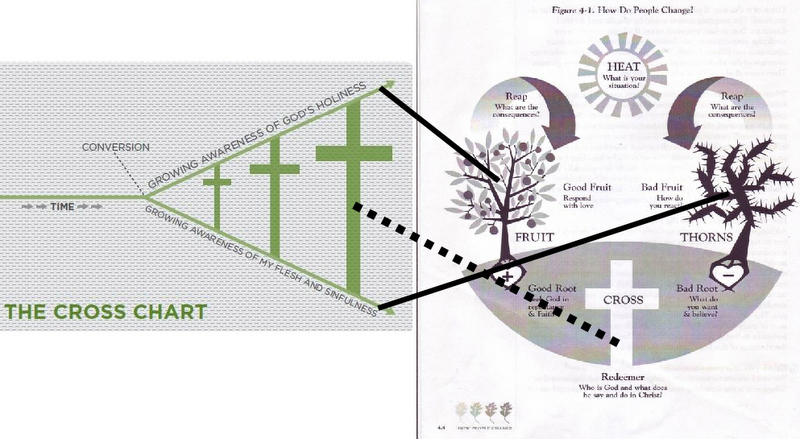
So then, what do these guys really believe about change? Well, it starts with gospel contemplationism which leads to “manifestations” of “the true and the good.” See the man in the first picture? See how he is meditating on all of the stuff outside of him? Through contemplationism, it is kinda like standing in the rain. The world sees the gospel, which in this illustration is the rain as a gospel “manifestation,” and as Christians we experience and feel the rain, but it has nothing to do with us or anything going on inside of us. For all practical purposes (in his general session address at the 2013 Shepherds’ Conference), John MacArthur likened it to a manifestation of the wind. You feel it and see its effects, but it is a force that is completely outside of us. He attributed Nicodemus’ later obedience after conversion to a mere blowing of the wind and not anything that Nicodemus could be credited with. We are talking MANEFESTATIONS here and not anything we do. It is similar to the concept of birthing the spiritual realm into the material realm.
In other words, when it gets right down to it—it’s Eastern mysticism. It began with the ancient paganism that saturated early civilization and morphed into Hinduism. Then Plato integrated the philosophy of Socrates with Hinduism. From there, it became Gnosticism which has all of the caste elements of Hinduism, and not by accident. The Reformed connections to Eastern mysticism are really no big secret and well-known among church historians.
Cults all come from the cradle of society and its spiritual caste. That’s why cults are innumerable and predicated on CONTROL. A characteristic not absent from Calvinism by any stretch of the imagination. The Gnostic Nicolaitans wreaked havoc on the first century church and the word means “conquerors of the lay people.” The name Nicodemus comes from Nicolaitans, so before his conversion, Nicodemus was probably guilty of what MacArthur said he wasn’t guilty of,
being a Calvinist.
paul

 Paul's Passing Thoughts
6 comments