The New Calvinist Anti-Apostle Paul Movement Comes With a T-Shirt
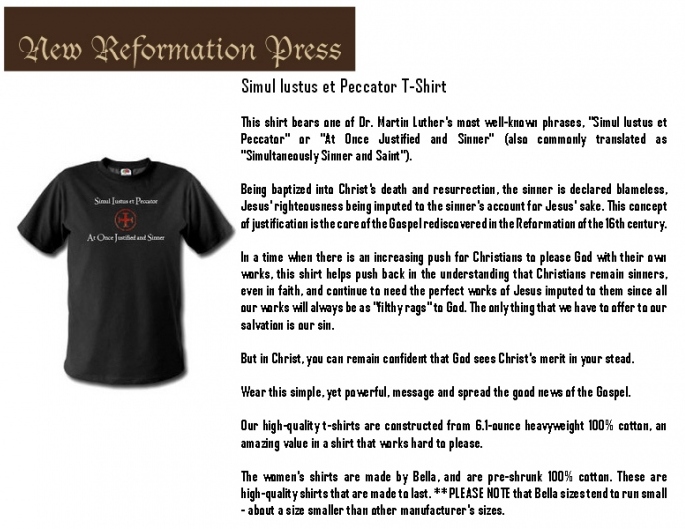
New Calvinist (like Al Mohler, John Piper, Jerry Bridges, John MacArthur, etc.) have a new t-shirt that can be proudly worn to protest what the apostle Paul wrote to the Corinthians:
“So we make it our goal to please him, whether we are at home in the body or away from it” (2Cor. 5:9).
New Calvinist will have no part of that! In Part, the ad reads as follows:
“In a time when there is an increasing push for Christians to please God with their own works, this shirt helps push back in the understanding that Christians remain sinners, even in faith, and continue to need the perfect works of Jesus imputed to them since all our works will always be as ‘filthy rags’ to God. The only thing that we have to offer to our salvation is our sin. But in Christ, you can remain confident that God sees Christ’s merit in your stead.”
Yes, that’s what the apostle Paul said. He said “we” (subjective personal pronoun) make (verb) it (direct object) “our” (possessive pronoun ) “goal” (predicate nominative) to please him (prepositional phrase). Yep, he said it’s our work in sanctification. Of course, any idiot should know that it must be either ALL the Spirit or ALL of us, it can’t be both; and surely, Christ must have misspoke when He called the Holy Spirit our “helper.”
The Sonship / New Calvinist / Gospel Sanctification crowd also apposes Paul’s idea that we don’t “remain sinners”:
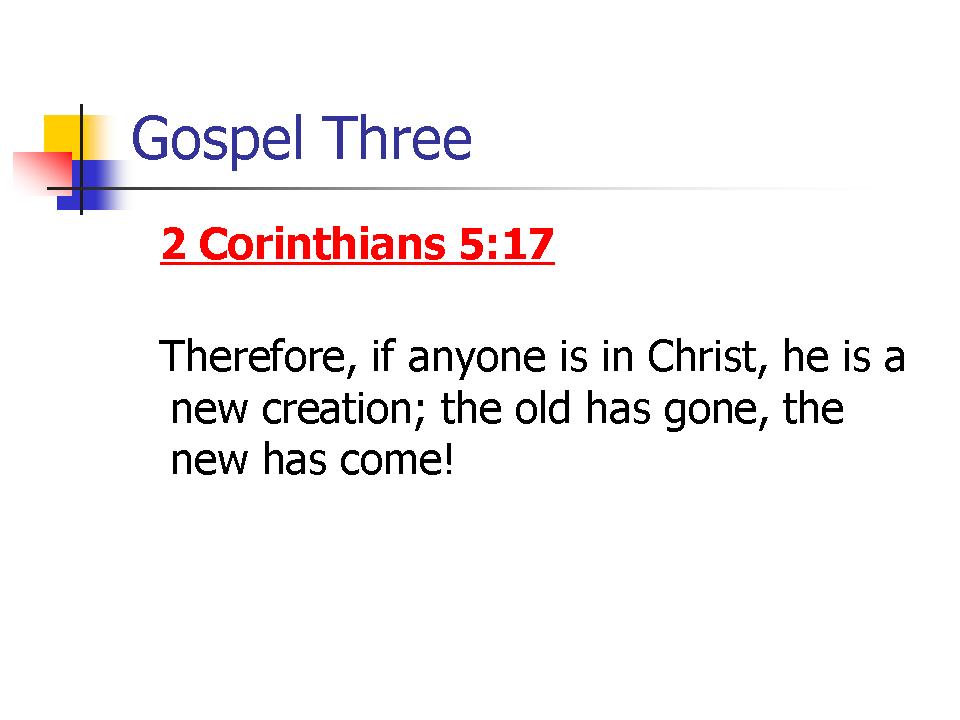
“Therefore, if anyone is in Christ, he is a new creation; the old has gone, the new has come!” (2Cor. 5:17).
And then there is Paul’s stupid idea that Christ will judge the works of Christians when they are really all His to begin with, and some of our supposed works will be good works! (the good works Tim Keller says we should repent of):
“For we must all appear before the judgment seat of Christ, that each one may receive what is due him for the things done while in the body, whether good or bad” (2Cor. 5:10).
Here is a jpeg representation of the ad:
Let’s Not Forget That Sonship / Gospel Sanctification / New Calvinism Is Not a Theological Discussion, But a Life Discussion
 I was recently sent a link for an article written for the Reformation 21 blog by William B. Evans. The article was a very apt articulation of Sonship theology in regard to showing its error. In the first paragraph, he cites one of the contemporary fathers of intestinal fortitude, Jason Hood, who has challenged New Calvinism by coining the phrase, “sanctification by justification.” Evans mentioned him in conjunction with Hood challenging Tullian Tchividjian’s assertion that being called an antinomian validates one’s gospel ministry. Welcome to our day. A day in which having a goal of being called an antinomian doesn’t necessarily mean you’re an antinomian. Apparently, when the apostles predicted there would be “many” false teachers in the last days, they never saw New Calvinism coming and the ushering in of “many” Tchividjian like “reformers” instead.
Tchividjian, supposedly an example of one of the worst Sonship offenders, seemed to be the subject of Evans’ post (Again, Evans did a great job of exposing the doctrine’s serious error and the post should be read by all: http://goo.gl/9AgD7 ). After summarizing Hood’s contention, he moved on to the back and forth between Tchividjian and New Calvinist Kevin DeYoung. Apparently, DeYoung thinks the movement may come across as thinking that “effort” is a four-letter word. Actually, “obey” is the word that DeYoung thinks has four letters, and he never mentioned any specific applications for “effort.” Nevertheless, Evans rightly points out that DeYoung presented good arguments for an overly passive approach to sanctification. But in the third and final exchange between the two New Calvinists, and unlike Hood in his follow-up exchanges, DeYoung clearly vacillated and patched things up with Tchividjian.
Which now brings me to my point. Evans cites DeYoung as saying the following: “In this context DeYoung the pastor speaks of those in the church ‘who are confused, wondering why sanctification isn’t automatically flowing from their heartfelt commitment to gospel-drenched justification.’” In other words, DeYoung knows the ramifications, but will not separate himself from the New Calvinist movement. Evans also wrote the following: “In other words, the questions raised in these blog exchanges are important; the contrast in views is rather stark, and the time is ripe for further discussion.” I like his use of the word “stark,” but further “discussion”?
This issue needs way more than discussion! Tchividjian is representative of the New Calvinist perspective, and with it the belief that views similar to the ones Hood espoused are a false gospel, leading to the loss of justification—being interpreted: your not saved. Want proof? Well, Evans mentioned that the issue needs to be further engaged because of the involvement of theological heavy-weights like Michael Horton, so I will quote him to make my point:
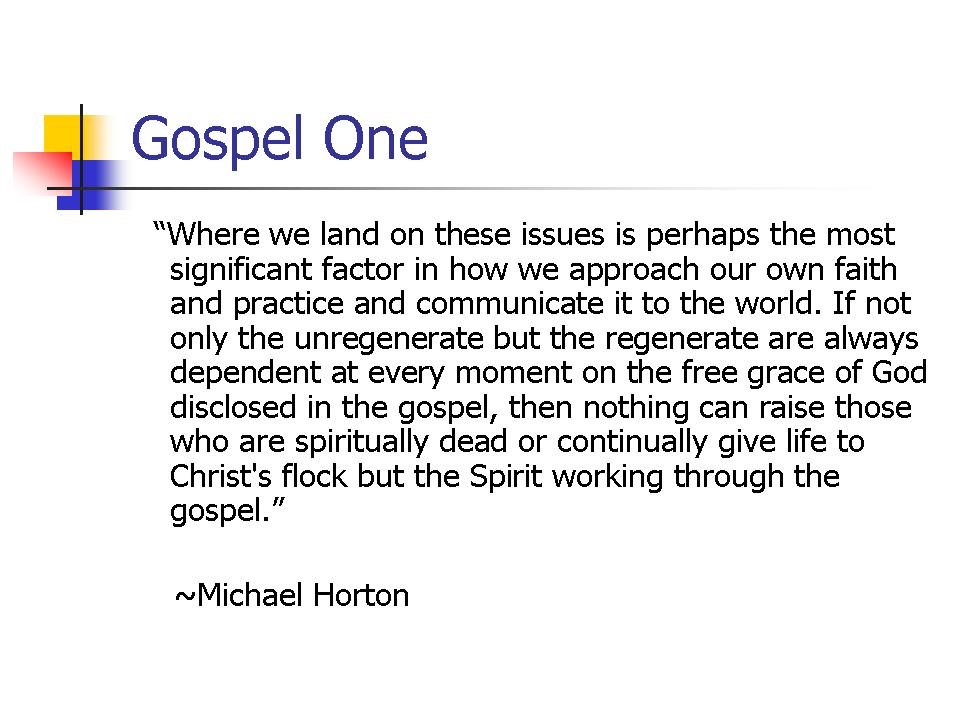
“If not only the unregenerate but the regenerate are always dependent at every moment on the free grace of God disclosed in the gospel, then nothing can raise those who are spiritually dead or continually give life to Christ’s flock but the Spirit working through the gospel. When this happens (not just once, but every time we encounter the gospel afresh), the Spirit progressively transforms us into Christ’s image. Start with Christ (that is, the gospel) and you get sanctification in the bargain; begin with Christ and move on to something else, and you lose both” (p. 62 Christless Christianity [emphasis mine]).
This dastardly belief among New Calvinist often leads to marriages in counseling situations being judged as mixed because one spouse will not accept Sonship theology. Do you think the “stark” contrast in these two theologies could cause problems in a marriage? And once in counseling, how much more damage will be done when one spouse is declared an unbeliever? The theology causes marriage problems, then the counseling formed by the theology makes the problem worse! Furthermore, change by putting off unbiblical wisdom and putting on biblical wisdom via obedience will not be the emphasis of this counseling, but rather a “beholding as a way of becoming.” It’s a recipe for disaster! How many spiritually maimed Christians are there who are told that the primary remedy is preaching the gospel to themselves everyday? Discussion? What the….are you kidding me?
Everybody admits this doctrine is causing confusion among Christians—even some New Calvinist themselves. That fact is talked about like it’s just no big deal. Well, tell Christ it’s no big deal, but don’t take me with you—just thinking about it makes me shudder. In addition, bad theology always profoundly effects the lives of Christians. Therefore, theological discussions of this magnitude should always have teeth, and if Tullian Tchividjian, or Michael Horton, or Al Mohler, or John Piper, or Mark Devers, or Tim Keller, or David Powlison, or Jerry Bridges, or DA Carson, or John MacArthur, or anyone else won’t repent, let them be treated like publicans and tax collectors. We are either in the ministry for people or to keep the peace with those obsessed with visions of grandeur. Discussion? Yes. But if necessary, separation also.
paul















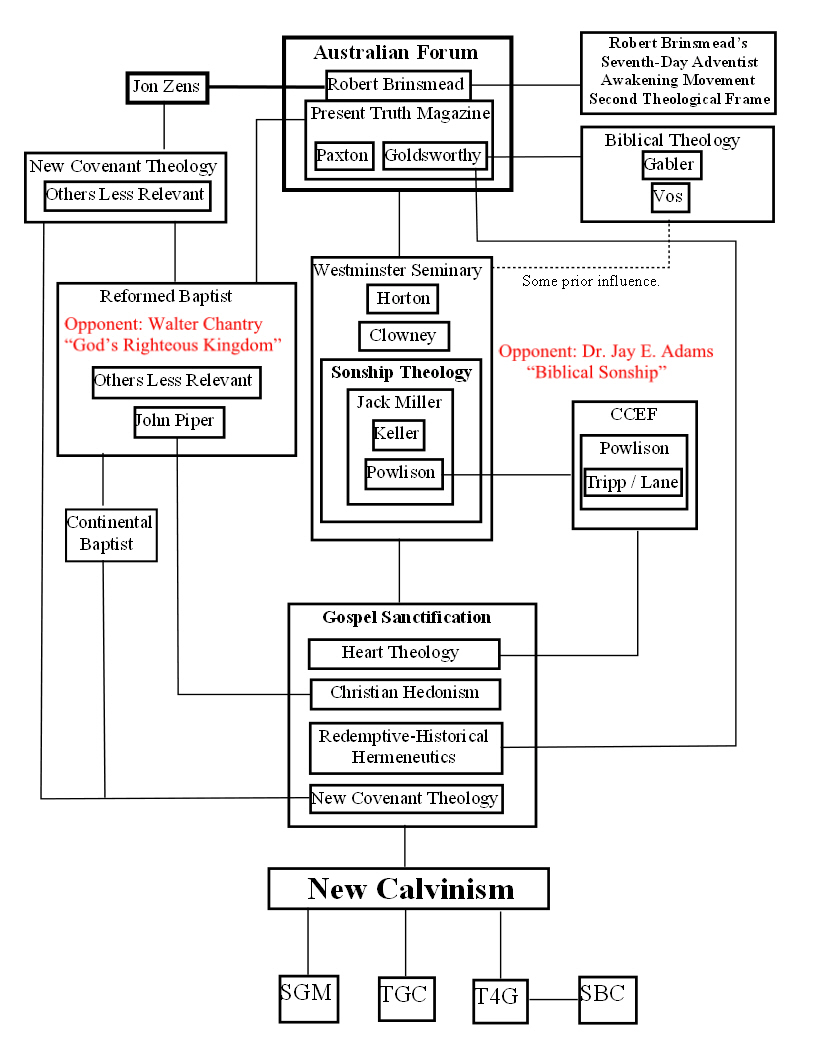
Brinsmead’s Second “Awakening” Framework is the Foundation of New Calvinism
 I recently read an article written by Martin L. Carey entitled, “Judged by the Gospel: The Progression of Brinsmead’s Awakening.” Carey was the son of Iris Carey, a staunch follower of Brinsmead during the Awakening movement of which he was the central figure.
According to Carey, this was no small movement within Adventist circles:
“For three decades, the ‘Brinsmead Agitation’ challenged Adventist leadership on several continents. During the years I was growing up, the conflict over his teachings became so intense that showing any agreement with Brinsmead’s heresy could get one expelled—and this I saw firsthand. Many pastors lost their jobs or left the ministry voluntarily because they espoused Brinsmead’s theology. For his followers, even mentioning the name of Brinsmead could put one’s membership at risk. Moreover, much Adventist literature published in the 1970’s was aimed at correcting Brinsmead’s influence.”
Carey does a good job of explaining Adventist doctrine and how Brinsmead interacted with it, but let me give you the short version: In justification, all of a saint’s past sins are forgiven, but then Christians have to work for moral perfection to be completely justified at the judgment. The first theological framework that laid the foundation for Brinsmead’s Awakening movement was borrowed from protestant beliefs; specifically, that we stand in the judgment clothed in Christ’s righteousness, not our own. This is what makes us fit for the judgment. Carey further explains:
“This was the original ‘Awakening Message.’ For many Adventists who had lived in dread of God’s judgment, this was good news. As Brinsmead later described,
‘…it was the most sweet and joyful news that many had ever heard. Neither time nor circumstances…can efface the memory of souls weeping for joy at the simple revelation that Christ is our righteousness in judgment’(Review of Awakening, Pt. 1).
Brinsmead decided to leave Avondale in 1958 to speak independently and to publish. His following soon became a significant movement in Australia. By 1960, they called themselves the ‘Sanctuary Awakening Fellowship.’ Even though the Australian Adventist leadership strenuously opposed the Awakening, the movement spread. Inevitably, on December 19, 1960, the Awakening message came to America, and the General Conference had no idea what was about to hit them.”
This is when Carey’s mother began to follow Brinsmead:
“In 1961, a young mother of three named Iris Carey was among those who heard and ‘wept for joy.’ She lived a few blocks from the Review and Herald building in Tacoma Park, and she began excitedly and widely circulating Brinsmead sermon tapes. Some caught that excitement, others strongly resisted. (Indifference was not a typical Adventist reaction to Brinsmead.) Meanwhile, for the three of us who were kids of Iris Carey, tension with our church and the world was a constant reality. In spite of its polarizing message and charismatic leader, the Awakening movement never tried to be a separate denomination. Indeed, Brinsmead’s purpose was not to destroy Adventism but to restore it to its original judgment day urgency [due to the fact that many knew in their heart that they could not obtain perfection on their own and preferred not to discuss it while playing along with a token recognition of the doctrine]. In the 1960’s, most Awakeners, as we called ourselves, remained members of Adventist churches—that is, as long as they would have us…. Iris was expelled from several churches for giving out Brinsmead literature and for holding unauthorized Bible studies. For her, this persecution confirmed the prophetic status of the Awakening message, and throughout the movement it unified Awakeners into a distinct Adventist subculture.”
Then Carey explains the following:
“The resulting abundance of literature and tapes galvanized our movement’s mission and kept it moving. Additionally, Bob Brinsmead was constantly adjusting his message. Whenever Awakeners would meet they would ask one another, ‘Have you heard the latest?’ We always looked for the next church-shaking new emphasis. Brinsmead had a genius for building elaborate theological structures, getting everyone excited, then tearing them down for a ‘new framework.’ He often said, ‘Like Abraham, Isaac, and Jacob, I keep moving my tent in faith.’ There was no resting for the devoted Awakener following Brinsmead’s mercurial leading.”
The second theological framework Brinsmead developed before he abandoned the Awakening movement lives on today in the form of New Calvinism. The doctrine was developed when Brinsmead began researching the Reformers:
“In 1971, Brinsmead scheduled a flurry of summer institutes to bring us his latest emphasis. There was more excitement than usual; the latest round of tapes had prepared us for something big. Bob had been studying the Reformation doctrine of justification by faith, comparing it to Roman Catholic doctrines. Reading Luther, he saw [supposedly] that justification is not just a means to the end of perfect sanctification. When we are justified by faith, not only does God impute Christ’s righteousness to us but we also possess Christ Himself—all His righteousness and all His perfection. Eternity flows from that fact. The apostle said,
‘And those whom he predestined he also called, and those whom he called he also justified, and those whom he justified he also glorified’ (Rom. 8:30).
The same ones he justified he also glorified. We began to realize we had inserted extra steps into Paul’s chain of salvation: sanctification and a final atonement brought about by blotting out sins. Those added steps, in fact, were the heart of the Awakening message—but we had ignored the heart of the real gospel: being justified by faith, we ‘rejoice in hope of the glory of God.’ Our righteousness is in heaven, said Brinsmead:
‘The righteousness by which we become just in God’s sight, remain just in His sight and will one day be sealed as forever just in His sight, is an outside righteousness. It is not on earth, but only in heaven…only in Jesus Christ.”
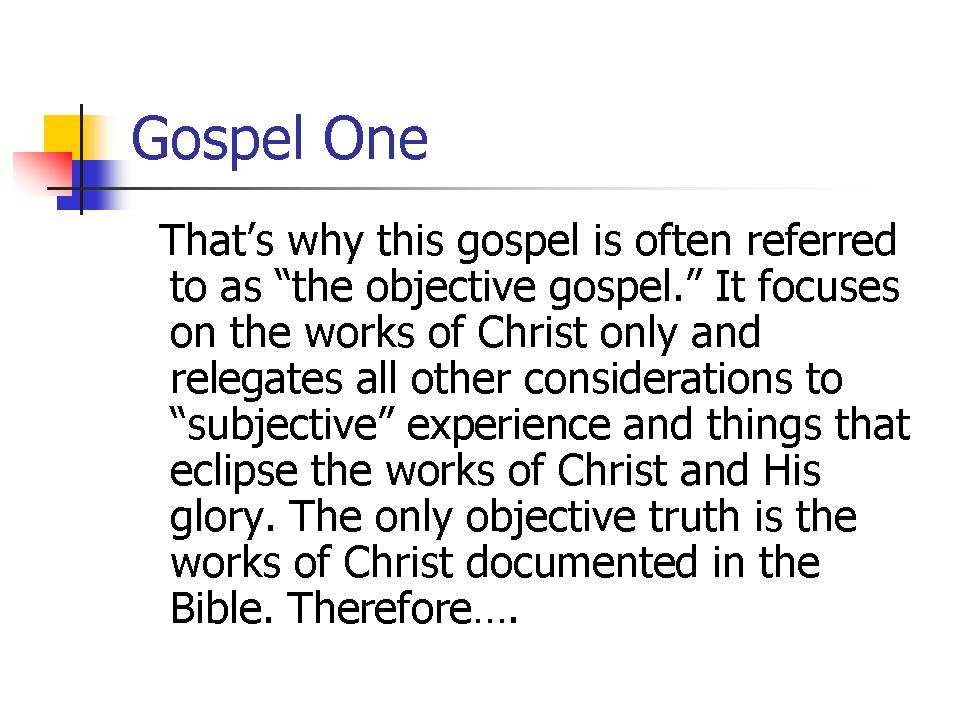
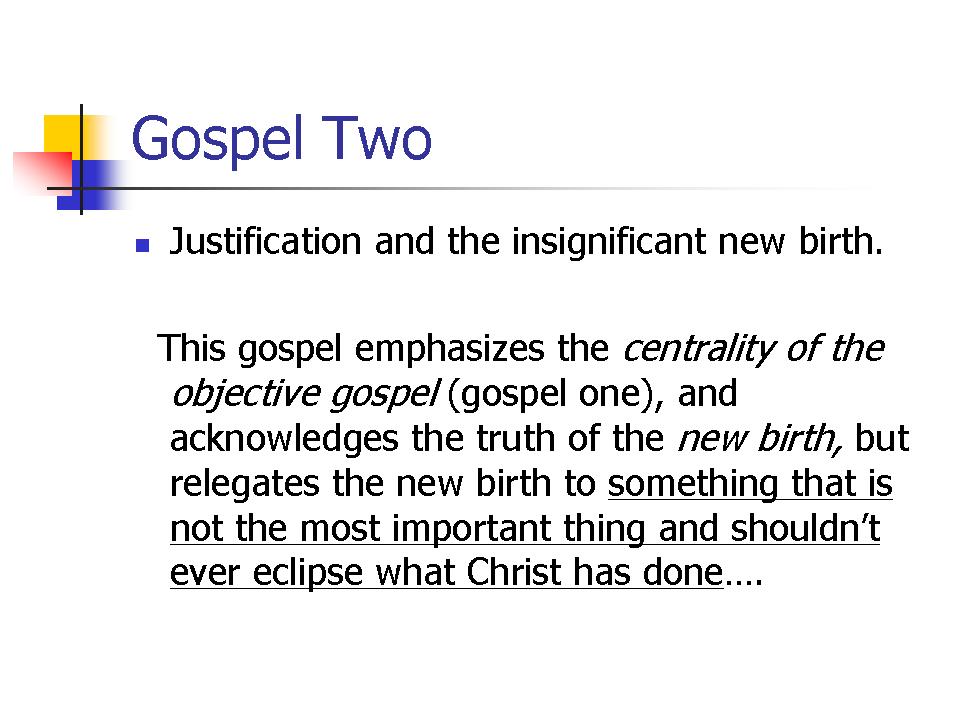
Brinsmead’s theological frame eliminated the extra “step” of sanctification from the gospel. Not only that, the gospel was completely objective and an “outside righteousness. It is not on earth, but only in heaven…only in Jesus Christ.” So, the believer does not (supposedly) experience a righteousness that he possesses through the new birth, in Brinsmead’s second frame, that’s “subjective”:
“True sanctification looks away from self and flows from the finished, objective work of Christ…. For many Christians, the glory of the crucified Christ is not their focus; instead they seek internal experiences that eclipse the cross. The Awakening rightly opposed the subjective, human-centered emphasis found among some groups within Christianity. Wrongly, they reacted with a cerebral, spiritless gospel. Brinsmead strongly opposed the charismatic movement’s emphasis on experiences as a return to the theology of Rome. However, going to another extreme, Present Truth magazine decried ‘the false gospel of the new birth,’ and offered a new birth that was merely a corporate, objective blessing, not an individual experience.”
Though mainline Adventist were at the other extreme, propagating a justification that you had to keep on your own, they rightly complained that Brinsmead’s new frame was a “justification-centered gospel” that “encouraged spiritual laziness.” During that time, the project that was solidifying this doctrine into a “consistent” theological framework was the Australian Forum. Their doctrinal publication was Plain Truth magazine mentioned by Carey. The primary Australian three were Brinsmead, Geoffrey Paxton, and Graeme Goldsworthy. The writings of Graeme Goldsworthy are a mainstay of contemporary New Calvinism, especially the “Goldsworthy Trilogy.” This “justification-centered gospel” can be seen among many New Calvinists like CJ Mahaney who continually claim that the gospel can be defined by five words: “Christ died for our sins.” Like the Australian Forum, New Calvinists believe that all of life flows from objective justification and deny the new birth as a subjective truth that is not relevant to the more important matter of the gospel. This regardless of the fact that Christ said, “You must be born again.” Hence, Sonship Theology, which is based on the centrality of the objective gospel and helped give birth to New Calvinism, propagates a total depravity of the saints. Well known New Calvinists David Powlison and Tim Keller were forefathers of that movement.
That’s pretty much the smoking gun: the hallmark of Brinsmead’s centrality of the objective gospel necessitates the denial of the new birth, and central figures of the New Calvinist movement clearly deny the new birth accordingly; for example, Graeme Goldsworthy and Michael Horton. Goldsworthy said this in an article he wrote in Plain Truth Magazine: “And the new-birth oriented ‘Jesus-in-my-heart’ gospel of evangelicals has destroyed the Old Testament just as effectively as nineteenth-century liberalism” (Obituary for the Old Testament Vol. 41-Article 2). Goldsworthy footnoted this statement by referencing an article by Paxton entitled “The False Gospel of the New Birth” (Present Truth Vol. 7 Article 3 June 1978 ps. 17-22). In that article, Paxton made the following statement: “It robs Christ of His glory by putting the Spirit’s work in the believer above and therefore against what Christ has done for the believer in His doing and dying.”
Compare that with what Michael Horton wrote in Receiving Christ (from his out of print book In the Face of God): “Is the ‘Good News’ no longer Christ’s doing and dying, but our own ‘Spirit-filled” life?’”
New Calvinists who do not plainly deny the new birth do so practically by advocating the total depravity of the saints and the idea that Christians are spiritually dead. Paul David Tripp states plainly that Christians are still spiritually dead on pages 64 and 65 of the 2006 printing of “How People Change.” Concerning a video that is a satire on total depravity entitled “John Piper is Bad,” Piper concurred in an interview that the point of the video was theologically true, Christians are still “bad” in regard to our behavior.
paul

 Paul's Passing Thoughts

4 comments