Repost: Comment on “Wolves” Post
|
Submitted on 2011/10/30 at 12:59 am
check out their church website and read their 60 page statement of belief. Some of the big names are in it. http://owensborochurch.com/ (under “about us”) “Seems to me if you are going to break fellowship with people, you should know what they are really guilty of.” Paul, I think people have a hard time putting their finger on it. After all, as you said, how can one go against the “Gospel” and the term “sovereignty of God”? But they are re-defining things and in their quest, their zeal is in your face. Their teaching is so convoluted they need 60 page belief statements. They speak in upside down infused grace justification/sanctification. It is all gobblygook that sounds so intellectually righteous. The weary, the poor in spirit, the uneducated don’t stand a chance with these guys. Perhaps the Association needs your book? So, the Association says, they have no kindness, humility, compassion, etc. Welcome to the world of Driscoll where you oust elders who dare disagree with you and form a coup to take over the church and install only few yes men elders. (My sources tell me it went from 30 elders to 4) Then declare in a sermon, you will go “old testament” on them for daring to speak out. http://www.thestranger.com/seattle/Content?oid=445277 Or where you send a cease and desist letter from your lawyers to a small church (without even calling them first!)in Calif that has the same name:Mars Hill. Acts 29 churches have the Driscoll “spirit”. because they learn church planting at their “bootcamp”. And, guess what? The SBC is funding some Acts 29 churches through NAMB. Our new NAMB president is Mohler’s old pastor who loves Acts 29. I can understand the Associations concern. But they failed to make the case. |
Robert Brinsmead’s Side of the Family Only Meets in the Desert
 Why doesn’t Robert Brinsmead’s side of the family ever get invited to the big dances? You know, T4G and TGC. I know, I know, a little too close to the illegitimate Adventist children nobody knows about. But the Emergent Church side of the family gets invited to the big family reunions all the time! You know, Mark Driscol, Darren Patrick, etc. (Dr. John Miller’s chidren). And Geez, some of the Charismatic side of the family are keynote speakers! Yes, yes, I know, they are “Reformed Charismatics” (huh?), but hey, Robert Brinsmead was Reformed too! Not fair, just not fair.
Well, bless DA Carson’s little heart—he is willing to party with Brinsmead’s side of the family now and then. Ya, out in the desert, but it’s a start. He will do a little reunion with Fred Zaspel at “Clarus 12” held annually at Desert Springs Church and sponsored by TGC.
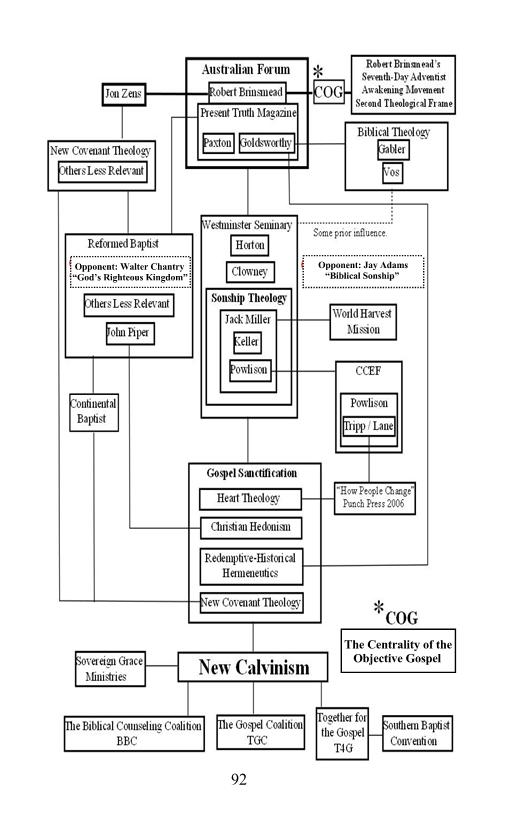
If you examine their family chart below, you only have Zaspel’s daddy, Jon Zens, between the New Covenant Theology clan (Zaspel would fall under “others less relevant” in the NCT box) and granddaddy Brinsmead’s Australian Forum. Jon Zens is known as the father of New Covenant Theology, and it is a well-documented fact that Brinsmead had a lot of input with Zens in the development of NCT. In 08, Carson did Clarus with Michael Horton and they discussed the Westminster offspring in a Q and A, but once again forgot to mention daddy Brinsmead. A shame.
NCT is the official position of New Calvinists but they won’t admit it due to the fact that Brinsmead and Zens concocted it. Brinsmead is now, as reported by many, an atheist, and Zens holds to Adventist-like beliefs. Though they put a good face on “all truth is God’s truth” they would rather not go there.
God’s people are not “ready” for that yet—the meeting and inclusion of all the family members.
paul
Dear Sherwood Baptist Church, Let Me Clarify
Are you confused by the White Horse Inn’s criticism (White Horse Inn) of your new movie, “Courageous”? Let me clarify. The criticism is driven by a doctrine that is antithetical to traditional evangelicalism. It is a doctrine that is perhaps the most covert in church history, using all of the same terminology and lingo, but with a totally different approach to issues of justification and sanctification.
The movement, known as, “New Calvinism” has been “roper doping” evangelicals for the past twenty-one years. It was primarily developed by two men in the early seventies—Jon Zens and Robert Brinsmead, a Seventh-Day Adventist. The doctrine they developed together split into two different directions under two different names: New Covenant Theology and The Centrality of the Objective Gospel.
Jon Zens tried to promote the doctrine in Reformed Baptist circles and met stiff resistance from Walter Chantry and others. Chantry rightly identified the doctrine as antinomianism. Antinomians don’t like the idea that Christians can play the robust role in sanctification as presented in your movie—especially as instructed from the word of God specifically. Chantry also wrote a book contending against the doctrine entitled “God’s Righteous Kingdom.” Chantry’s son wrote a defense of his father’s book against New Calvinist DA Carson who criticized the book because Jon Zens is New Calvinist family, though they don’t like to claim him because of his SDA connections. Of course, Carson was not honest about why he was really criticizing the book—just like White Horse Inn is not being honest about the criticism of your movie.
Robert Brinsmead propagated the doctrine in Presbyterian circles where it became known as Sonship Theology. But Presbyterians, most notably Jay E. Adams, also waged a spirited war against it. In fact, Adams also wrote a book to contend against the doctrine as well. The doctrine is banned in many Presbyterian churches. Its propagators therefore changed the label to “Gospel Transformation.” Gospel-driven this, gospel-centered that, gospel-you fill in the blank.
For ten years, few people realized the doctrine was the same as Sonship and NCT. In 2004, some people caught on and dubbed the movement “Gospel Sanctification.” Adams recently added a Gospel Sanctification archive to his blog and has said the doctrine is dangerous and must be stopped. Apparently, Reformed Baptists have not yet put two and two together on that one; probably because Jon Zens is no longer at the forefront of the movement and that’s who they identify as the center of the controversy.
In 2008, the movement was dubbed “New Calvinism.” Personally, I was never able to understand New Calvinism until I studied The Centrality of the Objective Gospel’s theological journal, Present Truth, later renamed, Verdict. Therefore, let me introduce you to the doctrine via Present Truth volume 16, article 13:
The Present, Continuous Nature of Justification. For all its strength, Reformed theology tends to relegate justification by faith to an initiatory action in the soteriological process. This is because it contends that the subjective (personal) justification of the believing sinner is a once-and-for-all, nonrepeatable act. Hence the relationship between justification and sanctification is seen as justification succeeded by sanctification.
And:
Unless sanctification is rooted in justification and constantly returns to justification, it cannot escape the poisonous miasma of subjectivism, moralism or Pharisaism.
And:
Since the life of holiness is fueled and fired by justification by faith, sanctification must constantly return to justification. Otherwise, the Christian cannot possibly escape arriving at a new self-righteousness. We cannot reach a point in sanctification where our fellowship with God does not rest completely on forgiveness of sins.
And:
Christian existence is gospel existence. Sanctification is justification in action.
Sanctification is justification in action? But Justification is by faith alone. Historically and biblically, evangelicals have embraced justification by faith alone but reject sanctification by faith alone. The characters in your movie are hardly faith alone / let go and let God kind of guys. Hence, the WHI criticism. The characters in your movie, like most evangelicals, would reject a gospel contemplationism that seeks a deeper understanding of justification/gospel first and then waits to see if God is going to do anything accordingly. Consider therefore this comment by WHI fellow Michael Horton:
Nothing can raise those who are spiritually dead or continually give life to Christ’s flock but the Spirit working through the gospel. When this happens (not just once, but every time we encounter the gospel afresh), the Spirit progressively transforms us into Christ’s image.
Yes, the characters in your movie wouldn’t be much for the idea of being resaved everyday—would they?
Neither do I think the Christian types portrayed in your movie would agree with the idea that Christians are totally depraved and that all of our works are as filthy rags before the Lord. Zens and Brinsmead on that:
The regenerate man is no whit different in substance from what He was before his regeneration.
Brinsmead had a colleague who helped him with a project that promoted said doctrine named Geoffrey Paxton. He wrote an article in Present Truth denying that the new birth was part of the gospel. It was entitled, “The False Gospel of the New Birth.” The thesis of the article was that the new birth is purely the work of justification, and not part of the gospel. They believe that “infusion of grace” (ie., the new birth) implies a capability to work with God in sanctification which is supposedly a false gospel. That’s also because their doctrine synthesizes justification and sanctification. Hence, the complaint that your movie didn’t have enough gospel. But of course, the movie isn’t primarily about the gospel, but rather the living out of the Christian faith—which they teach is done by continually returning to salvation. So, compare these two quotes, one from Geoffrey Paxton, and one from WHI’s Michael Horton:
It robs Christ of His glory by putting the Spirit’s work in the believer above and therefore against what Christ has done for the believer in His doing and dying.
~ Geoffrey Paxton
But to whom are we introducing people to, Christ or to ourselves? Is the “Good News” no longer Christ’s doing and dying, but our own “Spirit-filled” life?
~ Michael Horton
Your movie is important and I enjoyed it very much. The Bible says that spiritual cowards will not inherit the kingdom of God. Yes, a pity that this kind of teaching has to be in movie form because it’s not being taught in the local church. For that reason, I stopped short of the ovation that took place in the theater where Susan and I watched it. Nevertheless, keep-up the good work. Now reread the WHI critique and see if anything rings a bell.
paul
Interview With a New Calvinist: Part 3
Most NC are synergistic in their understanding of sanctification, therefore, most believe we participate in it. The doctrinal contention is, what “motivates” our post-conversion walk of faith? A wrong understanding of justification will contaminate the motive for sanctification. Hence, good works are the necessary fruits of justification, never causal to it. The Galatians were falling back into an understanding of lawful compliance (faith in Christ…plus works), as the grounds for their salvation, and for this reason, they had redefined justification and distorted the proper foundational understanding of sanctification.
Probably the biggest reason why NC’s view sanctification as being Gospel centered and “finished work of Christ motivated” primarily is because it takes a genuine gospel conversion, true work of the HS, for one to experience saving faith and conversion. All other professors of the faith, they are not motivated by the finished work of Christ. Their default motive in all of their life continues to be motivated by any/everything other than Christ and his glory. Some of these individuals, as Saul of Tarsus, retain an outward moral self-discipline that is quite impressive to the natural man, but filth and rags as when measured up to the motive that stems from a gospel centered, Christ centered motive. For this reason, it is a humanistic “walk of faith” to believe one can grow in their faith, apart from the gospel centrality of Christ, his glory and his grace.
Q: Is this not where New Calvinism and traditional evangelicalism part ways? In theological terms, evangelicals do not see sanctification as intrinsically related to justification. They see justification as a onetime legal declaration that guarantees glorification, and makes sanctification possible, but does not feed it. Along with justification comes the new birth, which enables the believer to participate in kingdom life and separation from this fallen world. But works in sanctification do not relate back to justification at all. Justification does not progress, only the spiritual life in sanctification progresses. New Calvinism teaches that sanctification must look back to justification and is given continual life by justification. Evangelicals reject that. They see justification as a guarantee and foundation to be built on. Evangelicals believe that works in sanctification have no relationship at all to justification because nothing done in sanctification can do anything to sustain it. Again, it’s a completely done deal, and everything it has to offer has been credited to our account in full.
….in other words, justification isn’t on an installment plan, it’s been paid in full. It’s not progressing forward and building toward glorification through sanctification. Again, can we agree that this is the fundamental difference? Not to debate the issue at hand, but to clarify what the debate actually is in all honesty. Again, the goal of this series is clarification, not persuasion.
I agree. We are clarifying, not persuading right now.
That being said, can you provide historic/fundamental predominant teachings that would concur with where you believe NC have departed?
Historically, NC’s view the sacraments not much different than the Jews viewed many of their Old Covenant rituals. Passover was to be used as a motivating memorial for the Jews to remember the freedom they were given. Because of the trust placed in the blood, salvation (justification) was secured. Type and anti-type for you and me. We are to reflect the joy and liberation of our justification as continual grounds for our sanctification. No different is the eucharist; proclaiming the Lord’s death until he comes. It is not a mere symbolic exercise so much as it is designed to remind us in order that it would motivate us towards holiness, via glory and grace.
What evangelicals would assert what you are saying? I’ve been a Christian for 38 years, “reformed” for over 20, but I have never once heard the concept that “justification…makes sanctification possible, but does not feed [motivate?] it.” What classical “reformers” who you would not classify as NC, have stated what you just said? I’m not saying they don’t exist, just that I’ve never heard/read anything like that.
Q: Good clarifying response. Let me therefore answer. First, because New Calvinism is relatively new on the scene and unique in its tenets, there wouldn’t be an abundant need for such a clarification, the former being assumed. But yet, there are examples. Secondly before I give an example, evangelicals don’t look to the Reformers as authority for truth. Jay Adams is considered to be a contemporary Reformer (and also a rabid Calvin buff), being known as “the father of the contemporary biblical counseling movement,” and he stated the following:
“The problem with Sonship [what New Calvinism was called in the 80’s and 90’s] is that it misidentifies the source of sanctification (or the fruitful life of the children of God) as justification. Justification, though a wonderful fact, a ground of assurance, and something never to forget, cannot produce a holy life through strong motive for it. As a declaration of forgiveness, pardon, and adoption into the family of God, it is (remember) a legal act. It changes the standing, but not the condition, of the person who is justified.
On the other hand, regeneration (quickening, or making alive; Ephesians 2:5) is the true source of sanctification. Justification deals with guilt; regeneration and sanctification deal with corruption. Regeneration, the true source of sanctification (growing out of sinful living into holy living)….”
Though Adams is Reformed, I would strongly contend that this is the traditional evangelical view of justification and sanctification. I would also add Floyd Barackman’s definitions of justification and regeneration. Again, Reformed, but agreeing with traditional evangelicalism:
“Justification is the act of God whereby He acquits the gospel believer of the divine verdict of condemnation and declares him to be righteous….Regeneration is the act of God whereby He cleanses the gospel believer, renews the immaterial part of his human nature , and imparts to him spiritual life. ”
After we are done with this part, I think another question worthy of investigation is the following: Is New Calvinism the same as Old Calvinism?
The Separation of Faith and Obedience is Anti-Gospel
“….faith is not faith until it does something”
While on sabbatical to write TTANC, Susan and I have been visiting Calvary Baptist Church in Xenia, Ohio pastored by David Conrad. By the way, our home used to be the building they worshiped in. Pastor David is preaching through the book of Romans, and 10:13-21 was on the plate for last Sunday. The focus of this post is verses 16 and 17:
But they have not all obeyed the gospel. For Isaiah says, “Lord, who has believed what he has heard from us?” So faith comes from hearing, and hearing through the word of Christ.
What does it mean to obey the gospel? This is so simple that it is easy to miss: verse 16 could rightfully be restated as, But they have not believed the gospel. The apostle Paul first frames acceptance of the gospel via obedience, then he quotes Isaiah who frames acceptance of the gospel via belief: “Lord, who has believed what he has heard from us?” Then Paul restates what Isaiah said in the context of faith: “So faith comes from hearing, and hearing through the word of Christ” Faith, belief, obedience—all the same. Obedience doesn’t come from faith or flow from faith, it is faith.
Let’s visit another passage that illustrates this. Christ said in John 3:36;
Whoever believes in the Son has eternal life; whoever does not obey the Son shall not see life, but the wrath of God remains on him.
Again, in this verse with two independent clauses linked by the same subject of eternal life, obedience and belief could be switched between the two clauses, or either one used for both.
Is this really that hard to understand? You can’t separate obedience and faith (the hindrance of sin will not be addressed in this post). Why? Because faith isn’t faith until it does something. What a pity that theologians have made the book of James so controversial in regard to the whole supposed works/faith issue. All James was saying is that faith isn’t faith until it does something:
Do you want to be shown, you foolish person, that faith apart from works is useless? (James 2:20).
You see that faith was active along with his works, and faith was completed by his works (James 2:22).
And what is the standard for the works of faith? What works? Again, James does not leave us without an answer:
But the one who looks into the perfect law, the law of liberty, and perseveres, being no hearer who forgets but a doer who acts, he will be blessed in his doing (James 1:25).
What about boasting? There isn’t any because faith is a gift from God. If God doesn’t grant it to us, we do not have it. But be sure of this: like all gifts, once one receives it—they own it. It is our faith, and we also own the obedience that is faith—it’s our obedience as well. And as James wrote, the blessings are in completing our faith with obedience to the truth (2:22). In the parable of the talents Christ warned against separating faith and works, calling those who do so “wicked, lazy servant[s].”
Christians can get in the middle of the Arminian/Calvinism fray if they want to, but both are guilty of distorting saving faith; both separate what is one, obedience and faith. Both brainwash our children with the faith alone mantra. Yes indeed, faith alone, but also obedience alone. You can obey the gospel or believe the gospel—pick one, they are both good. Say it anyway you want to; it’s all the same. Arminians separate the two by teaching faith alone without works. That’s simply not true. Once the gift is given, obedience comes with it. We are justified by the gift, but after that, faith works, or you don’t have it, or you are not working out what has been worked in.
The Reformed are a little more craftier in their damning lies. They concur with the proposition of this post, but in their endeavor to be the gatekeepers of God’s self-esteem, they devise complicated theological systems that make our faith and obedience Christ’s faith and obedience. No gift has really been granted, we are merely the prepositions of salvation. This comes from not only separating faith and obedience, or law/gospel, but then synthesizing justification and sanctification. Obviously, if there is no difference between the two, we must be sanctified the same way we are justified which is passive. Receiving a gift is passive, putting the gift to work is not. But if the same gospel that saved us sanctifies us, it’s all about receiving and no giving.
Even as an unbeliever I knew this truth intuitively—I think by the common grace of God. I was begged by an Arminian to just “say the prayer.” Bless his heart, when I wouldn’t, he wept. Better than a Reformed person who would have responded this way: “Oh well, just means you’re not chosen.” Of course, I wouldn’t have bought into that either. I wouldn’t profess because I knew I wasn’t willing to leave the old Paul behind. I still liked the old Paul. Even then, I wouldn’t have known how to word it, but I knew that there is no difference between faith and obedience.
Christ, the apostles, and the prophets used the two words interchangeably throughout the Scriptures. I wish we could pose a question to James: “James, can one be saved if he/she doesn’t understand that obedience and faith are the same thing?” Is love for God a requirement for saving faith? Ok, well, Christ said the following in John 14:
If you love me, you will keep my commandments.
Then immediately following that statement He said:
And I will ask the Father, and he will give you another Helper
Sure, we can’t do it without two “helpers,” Christ and the Holy Spirit, but I’m thinking with those two helping the job should get done! What kind of gospel displays a life that is no better than many others with both Christ and the Holy Spirit helping? But Michael Horton says that exerting our own effort in the process is trying to “be the gospel” rather than merely preaching the gospel. That’s a lie.
However, I have some truthful news for both Arminians and the Reformed alike. To the Arminian: No love for God—no salvation. To the Reformed: In your favorite Bible, the ESV, Christ called the Holy Spirit our “helper.” A helper doesn’t do it for us, they help. I thought you guys are educated? Even a child knows a helper helps and doesn’t do it all. And the fact that we do something in the process of sanctification is not “bad news.” Stop lying and start telling the truth for a change.
What faith is in regard to the gospel is obviously a critical question, and separating faith and obedience is a false gospel. The idea that obedience is optional or done by “Christ for us” is not the good news of salvation. True faith is a gift that we cannot earn, but once we have it, it is never without works, or it is not true faith—being alone. The devils merely believe only, and do tremble.
paul

 Paul's Passing Thoughts
leave a comment