Religious Tyranny: A Case Study; Introduction and Chapter One
Cover: Religious Tyranny; A Case Study
Preamble
I need another project right now like I need a hole in the head; nevertheless, recent events have impressed upon me the immediate need for this work. As I accomplish each part I will be posting it here on PPT and making all readers part of an editing committee. So, comment here, email me here mail@ttanc.com, and pass judgment on content, grammar, style or whatever else editors do. The compilation will be available in a free ebook or hardcopy book form that can be purchased.
Thank you for your input.
paul
Introduction
“…I have sworn upon the altar of god eternal hostility against every form of tyranny over the mind of man.” – Thomas Jefferson to Dr. Benjamin Rush, September 23, 1801
This book flows not from the winepress of sour grapes, but rather from thankfulness. Whether secular or religious tyranny, these endeavors always yield freedom. Tyranny was a usurper into God’s creation and challenges man’s innate need to be free. Therefore, sin finds itself in a quandary; it is utterly driven by a lust to enslave, but this will eventually drive men to a fight or flight. Tyranny is affliction, but it will always awaken man to his freedom duty. For this, we can be thankful.
This book is an in-depth look into religious tyranny using Clearcreek Chapel in Springboro, Ohio as a case study. However, this case study is a story that reads like most church experiences in our day, and the personal testimonies read the same as well. The information written within will come from the author’s firsthand experience and the testimonies of others, but there is no need to focus on a few people when this is the like testimony of many. Hence, the study will focus on common experiences and not particular individuals.
Most people are saved according to the experience described by the apostle Paul in 1Thessalonians 1:5,
For our gospel came not to you in word only, but also in power, and in the Holy Ghost, and in much assurance; as you know what manner of men we were among you for your sake (KJV).
Yet, most professing Christians doubt their salvation, and furthermore, most professing Christians know there is something fundamentally missing in church; something isn’t right, but they can’t put their finger on it. The present mass exodus from the institutional church is well documented while most people leaving the church don’t know specifically why they are leaving. They are leaving because something is missing, but they are not sure what that something is. The salvation that came with much power and assurance has faded into doubt and indifference.
On the other hand, the church, whether Catholic or Protestant, seems to be supported by many others who are unwavering despite tyranny, illogical contradictions, hypocrisy, and evils not even spoken of in the secular world. How can this be? How can a church like Clearcreek Chapel now embrace beliefs that would have been rejected out of hand with extreme prejudice by the same Chapel parishioners twenty years prior? How can the present leadership behave in a way that would not have been tolerated for a moment twenty years prior by the same people who now embrace it wholeheartedly?
This study proposes to answer all of these questions in no uncertain way, but one final question needs to be answered to complete the study; once the indictment is clarified, what should our response be? What is the solution?
So then, how can we have full assurance of salvation? What is wrong with church? Why is tyranny acceptable? And what should we do about it?
Because only truth sanctifies (John 17:17),
Paul M. Dohse Sr.
Chapter One: The Chapel’s Unique Place in Church History
Clearcreek Chapel in Springboro, Ohio played an important and telling role in contemporary church history. Founded by a young Dr. John D. Street in the latter 1980’s, it sought to be relevant in contemporary culture. Dr. Street often described the church at that time as “ministering to the present culture while wearing bellbottom pants.” Street also patterned the Chapel ministry after his mentor, Pastor John MacArthur Jr.
Dr. Street also made an emerging movement at that time a hallmark of the Chapel ministry; the biblical counseling movement founded by Dr. Jay Adams. The advent of said movement began with Adams’ controversial book, “Competent to Counsel” (1970). The Chapel became a training center for the biblical counseling movement founded by Adams, and in large part a face of the biblical counseling movement.
Adams, a Presbyterian minister, was provoked by his own confession that he was unable to help people with serious problems, and indicted the church as a whole in the same way. What made this indictment painfully obvious was the integration of secular Psychology into religious thought during the 1980s. This integration was a movement that peaked in the 80’s. Help could not be found in the church so people looked for help outside of the church. The biblical counseling movement peaked in the 1990’s and this is when it experienced a true biblical revival, and Clearcreek Chapel was one of the epicenters of that spiritual awakening.
It is now very important to explain what that revival looked like because the implications are profound. This is the first point in beginning to answer the questions presented in the introduction: what’s wrong with church? Why do so many Christians doubt their salvation? Why do so many embrace churches that practice open tyranny? And lastly, what should we do about it?
If most Christians are honest, they see very little progressive change in the people they attend church with. If most Christians are honest, they admit people who are saved from the outside secular world into an enduring life testimony are very few and far in-between. Yet, this was not what was going on at the Chapel during the 90s. In one year (1995) as a result of the biblical counseling focus, twelve people were saved in 1Thessalonians 1:5 fashion and stayed the course. During this time other churches influenced by the Chapel shared the same testimony.
But let’s back up for a moment; Jay Adams’ testimony is startling. As one who came from the elitist hallowed halls of Protestant brain trust, he openly admitted himself that he was clueless in regard to helping people with real life problems. Furthermore, this was his indictment against the church at large as well. We must pause and ponder this fact soberly; after more than 500 years and oceans of Protestant scholarly ink, it was commonly accepted that most ministers were unable to take the word of God and help people with serious problems. There is a very simple answer in regard to why that was the reality and still is, and we will arrive there in due process. But before we move on, it is interesting to note that while the Protestant brain trust openly confessed its inability to help people with deep personal problems, it wailed and screamed in sackcloth and ashes that the void was filled with secular Psychology.
The brainchild of Adams’ biblical counseling construct is even more startling. In beginning his quest for helping people with real problems, he sought out none other than O. Hobart Mowrer, a notable secular Psychiatrist who fathered a kind of responsibility therapy movement championed by the likes of Dr. Phil McGraw and Dr. Laura Schlessinger. Adams wrote in the introduction of Competent To Counsel,
Reading Mowrer’s book The Crisis in Psychiatry and Religion, as I said, was an earth-shaking experience. In this book Mowrer, a noted research psychologist who had been honored with the Presidency of the American Psychological Association for his breakthrough in learning theory, challenged the entire field of psychiatry, declaring it a failure, and sought to refute its fundamental Freudian presuppositions. Boldly he threw down the gauntlet to conservative Christians as well. He asked: “Has Evangelical religion sold its birthright for a mess of psychological pottage?”
In Crisis, Mowrer particularly opposed the Medical Model from which the concept of mental illness was derived. He showed how this model removed responsibility from the counselee. Since one is not considered blameworthy for catching Asian Flu, his family treats him with sympathetic understanding, and others make allowances for him. This is because they know he can’t help his sickness. He was invaded from without. Moreover, he must helplessly rely on experts to help him get well. Mowrer rightly maintained that the Medical Model took away the sense of personal responsibility. As a result, psychotherapy became a search into the past to find others (parents, the church, society, grandmother) on whom to place the blame. Therapy consists of siding against the too-strict Super-ego (conscience) which these culprits have socialized into the poor sick victim.
In contrast, Mowrer antithetically proposed a Moral Model of responsibility. He said that the “patient’s” problems are moral, not medical. He suffers from real guilt, not guilt feelings (false guilt). The basic irregularity is not emotional, but behavioral. He is not a victim of his conscience, but a violator of it. He must stop blaming others and accept responsibility for his own poor behavior. Problems may be solved, not by ventilation of feelings, but rather by confession of sin.
From my protracted involvement with the inmates of the mental institutions at Kankakee and Galesburg, I was convinced that most of them were there, as I said, not because they were sick, but because they were sinful. In counseling sessions, we discovered with astonishing consistency that the main problems people were having were of their own making. Others (grandmother, et al.) were not their problem; they themselves were their own worst enemies. Some had written bad checks, some had become entangled in the consequences of immorality, others had cheated on income tax, and so on. Many had fled to the institution to escape the consequences of their wrongdoing. A number had sought to avoid the responsibility of difficult decisions. We also saw evidence of dramatic recovery when people straightened out these matters. Humanistic as his methods were, Mowrer clearly demonstrated that even his approach could achieve in a few weeks what in many cases psychotherapy had been unable to do in years.
I came home deeply indebted to Mowrer for indirectly driving me to a conclusion that I as a Christian minister should have known all along, namely, that many of the “mentally ill” are people who can be helped by the ministry of God’s Word. I have been trying to do so ever since.
This experience was the breakthrough that launched the biblical counseling movement and its subsequent success. Without Mowrer’s observations, the biblical counseling movement never happens. Nevertheless, Adams then states the following in the same introduction:
Let me append one final word about Mowrer. I want to say clearly, once and for all, that I am not a disciple of Mowrer or William Glasser (a writer in the Mowrer tradition who has become popular recently through the publication of Reality Therapy,a book that has confirmed Mowrer’s contentions in a different context). I stand far off from them. Their systems begin and end with man. Mowrer and Glasser fail to take into consideration man’s basic relationship to God through Christ, neglect God’s law, and know nothing of the power of the Holy Spirit in regeneration and sanctification. Their presuppositional stance must be rejected totally. Christians may thank God that in his providence he has used Mowrer and others to awaken us to the fact that the “mentally ill” can be helped. But Christians must turn to the Scriptures to discover how God (not Mowrer) says to do it.
All concepts, terms and methods used in counseling need to be re-examined biblically. Not one thing can be accepted from the past (or the present) without biblical warrant. Biblical counseling cannot be an imposition of Mowrer’s or Glasser’s views (or mine) upon Scripture. Mowrer and Glasser have shown us that many of the old views were wrong. They have exposed Freud’s opposition to responsibility and have challenged us (if we read their message with Christian eyes) to return to the Bible for our answers. But neither Mowrer nor Glasser has solved the problem of responsibility. The responsibility they advocate is a relative, changing human responsibility; it is a non-Christian responsibility which must be rejected as fully as the irresponsibility of Freud and Rogers. At best, Mowrer’s idea of responsibility is doing what is best for the most. But social mores change; and when pressed as to who is to say what is best, Mowrer falls into a subjectivism which in the end amounts to saying that each individual is his own standard. In other words, there is no standard apart from God’s divinely imposed objective Standard, the Bible. Tweedie is correct, therefore, when he rejects Mowrer’s “projected solution” to the problem of sin as an “acute” disappointment.
During the years that followed, I have been engrossed in the project of developing biblical counseling and have uncovered what I consider to be a number of important scriptural principles. It is amazing to discover how much the Bible has to say about counseling, and how fresh the biblical approach is. The complete trustworthiness of Scripture in dealing with people has been demonstrated. There have been dramatic results, results far more dramatic than those I saw in Illinois.
In light of the entire context stated here, Adams’ paradoxical twist on Mowrer is both stunning and perplexing, but don’t miss the much larger point; Adams’ perspective as documented here is profoundly indicative of what is fundamentally wrong with church. Yes, it is the something that is wrong that few are able to put their finger on. However, we are still in the history stage of our study. In regard to why Clearcreek Chapel is a paramount case study for religious tyranny, we are still laying the historical groundwork.
Chapter Two: The Insurgency
PPT Will Pen an In-Depth Exposé on Clearcreek Chapel
 In the near future, PPT will publish an in-depth exposé on Clearcreek Chapel in Springboro, Ohio. This will include its history and an in-depth profile of past and present elders. Also, its litany of unresolved conflict with many Christian families will be documented in painstaking detail.
This is in response to the constant flow of longstanding emotional suffering flowing out of this “ministry” that refuses to cease or even slow down. Particular attention will be paid to the rabid lust for controlling others practiced by the Clearcreek elders.
And lastly, evangelical organizations, churches, individuals, and pastors who enable their behavior will also be profiled.
This project will surpass any level of in-depth research performed by TANC Ministries since 2009, and will be accompanied by aggressive widespread publication.
The goal is to temper the suffering foisted upon unsuspecting people by Clearcreek Chapel that is constantly brought to our attention by those seeking counsel.
How should such organizations be responded to? That question will be explored as well.
Paul Dohse
TANC Ministries
A Frank Discussion About Homosexuality, Church Membership, and Joy Wickholm Bennett Tyranny
 “This post isn’t so much about her, it is about the fact that she exemplifies a very important distinction in the realm of philosophical politics; that of the individualist versus the collectivist….That’s what we need to know about New Calvinists beyond the fact that they hold to a false gospel. They are collectivists.”
Tyranny always introduces itself with a kind understanding hand. Tyrants always feel your pain until the day that they inflict it. As a matter of necessity they also pose themselves as people who care about right and wrong. No, the only “right” is their collectivist doctrine. You can say sin is the cause for every drop of blood spilled on the earth, but past that, the question of the individual versus “the group” is the arena where that blood is spilled.
Until God Himself comes to rule the earth, two basic philosophies prevail about what is the best way to order society until that happens: confidence in the ability of the individual and a government that creates an environment where that can flourish, or confidence in an elite few who must rule over the incompetent, unenlightened masses. The elite few have always been those who claim access to a faraway enlightenment that is too difficult for the unenlightened masses to access. Plato, the undisputed psyche of Western culture, believed that only an elite few were willing to invest in the study necessary to obtain that enlightenment, and their ability to do so was predetermined within their particular pedigree. Plato, being a mentoree of the Hindus, believed that man’s soul reflected the ideal society, and each person was born a producer, a soldier, or a philosopher (spiritual or secular caste).
Moses and the apostle John disagreed on faraway enlightenment that needed to be mined by the spiritual or philosophical elite. Moses told the Israelites that no one needed to go up to heaven and bring the word down. He said it was very near to them and they were able to understand it. John said we have no need for anyone to teach us. John in particular was refuting the Gnosticism that was wreaking havoc on the early church, the same Gnosticism that has its origins in Plato.
Individualism is the arch enemy of collectivism. In collectivism, it is never about right or wrong, it is about being obedient to what’s best for “the group.” And don’t miss this: there is only one thing that is bad for the group; INDIVIDUALISM. This is the crux of the little tiff I had with blogger Joy Wickholm Bennett this week. I assume her and hubby Scott Bennett are still members of a…. or the…. New Calvinist church I last heard about. Her edgy public writing is no problem there because she is like many New Calvinists: they are allowed to play in their sandbox of ideas as long as they don’t do anything that unsettles the herd. And not keeping me on a short leash in regard to what “the group” did to me could jeopardize the freedom granted her at this time. We see this as a constant pattern in the testimonies we receive at TANC. It goes like this:
We were in marriage counseling and my spouse was being fingered for being the problem in our marriage. Then I started asking questions about doctrine. At the very next counseling session, I was all of a sudden the problem and not my spouse.
And let me throw my very own testimony on that heap. But the point here is the very valuable lesson I learned in regard to the fray. New Calvinists can play in their antinomian sandboxes as specified by their New Calvinist masters. They can be anything they want to pretend to be, just so it doesn’t reveal where any bodies are buried. While Bennett sells herself as a freethinking hipster, she is ultimately enslaved to the group and their tyranny. She is the personification of the SGM mentality.
Nevertheless, like so many of her liberal types, she accuses individualists of being “mandatory” in their thinking. The subject was homosexuality. This post isn’t so much about her, it is about the fact that she exemplifies a very important distinction in the realm of philosophical politics; that of the individualist versus the collectivist.
As a Biblicist, I am on a journey right now. How should separatism be defined? In the real world. As a Christian, if I have a boss that is gay, it is mandatory that you respect that boss. That’s the Bible. And by the way, homosexuals can be very good bosses. I doubt many care whether you are a Christian or not, there primary concern, if they are smart and many are, is how you make them look to their superiors. So, venue considerations are huge here. Moreover, I strongly contend that the Bible would teach a winning over by job performance alone in that venue.
Let me be clear here: I have friends and relatives who are homosexuals. Let me also be clear on this as well, they know where I stand on the issue. In these relationships, I think venue and mutual respect is the key here. Neither position is in the closet, nor is either thrown in the face of the other. They know that if they want a debate or counsel on the issue, they can readily find it with me. My duty is twofold: that my position is known, and that I then live out the substance of that position.
But there is also another angle here, collectivist versus individualist. In some collectivist societies not tempered by the American Constitution, homosexuals are executed. As Christians, are we up with that? Look, please, be a Biblicist like me, just don’t be an idiot about it. In regard to the upstart Potter’s House, would we allow homosexuals to be members? No, but on the other hand, The Potter’s House is a movement away from Protestant tradition, so we are still working through what true biblical membership really is to begin with. There are many, many unnecessary debates in the church because of Protestant tradition.
Would we allow a homosexual to attend our fellowship to hear our ideas while respecting our venue? Well, I look forward to hashing these things out as we grow, but right now, I would say, “yes.” But stop right now and put this in neon lights:
In collectivist societies, depending on the stripe, and there are many, what is deemed best for the group, is DICTATED by the few via civil law. And that may very well be homosexuality. In other words, the day may come when it would be against the law for the formal church to exclude, or include, homosexuality. And keep in mind, let me repeat that, “keep in mind,” an individualistic homosexual would be against mandatory inclusion.
The question is, how much tradition throws churches into this fray unnecessarily? And second, should Christians be more involved with social morality or the political philosophy that will dictate it to begin with? How we approach a problem is often smarter than a narrow focus on not compromising beliefs. Here is the danger, and please put this in neon lights as well:
“Moral” friends are often collectivists. And if they are put in power, that is something that has NEVER turned out well in all of human history.
Now, this brings me to the dangers of fleeing to those who share our same opinions. And worst yet, wanting them to have power. Are they collectivists, or are they individualists? One will allow you to have your own beliefs under reasonable constructs while being concerned for your wellbeing; the other will not tolerate a differing opinion because they believe it is a threat to society as a whole. Enforcing orthodoxy by the sword is a matter concerning the survival of mankind in their minds.
That’s what we need to know about New Calvinists beyond the fact that they hold to a false gospel. They are collectivists. And there is nothing “new” about it, Calvin was a collectivist extraordinaire. And that’s Joy Wickholm Bennett. She is the epitome of a collectivist. She lost the argument, so instead of being persuaded by the argument, she censored me. Siding with the collectivists that committed a criminal act against me was merely par. I was on a short leash for that reason to begin with. Her reaction was the result of two factors: one, she lost the argument; two, her sandbox was being threatened. Hence, we have a definition of collectivism:
Collectivism will not lose an argument or learn from it because it possesses an elitist knowledge that will save the world from itself.
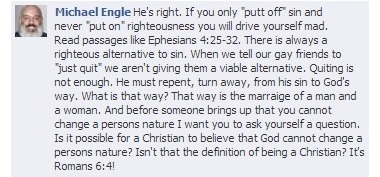
And let’s look at her argument. In regard to homosexuals, deterministic. Go figure. Homosexuals are born with the desires that they have and have no control over those desires. Nobody chooses their desires, they are born with them. During our little tiff, she asked me when I chose to lust after women. My argument was that no Christian is enslaved to any desire save those that please God. I specifically argued that her determinist view was ironically making the homosexual the judge over a pedophile. Both have a desire, but she was judging deterministic desires as having different moral values. One should change, the other can’t?
Don’t misconstrue my point: at issue is the ability to change if one so desires. At issue is the rejection of determinism. At issue is choice.
Game over. Bennett, like all collectivists, will not lose an argument. And if she has the authority, she will have you burned at the stake just like her Great Uncle Calvin. Liberals don’t worry me, collectivist liberals worry me. Bennett is a collectivist liberal Calvinist. I like conservatives better, but a collectivist conservative is no less a danger. And don’t miss the way her collectivist determinism transcends liberalism and conservatism.
Hope lies in individualistic Biblicism. It also sees any kind of individualism as offering more hope than any of Plato’s relatives. That is a legacy punctuated with fire and death. It is a philosophy that always comes selling itself as freedom that results in bondage. Like Bennett, it whispers to many that it was predetermined that they are that way, and in their elite wisdom happy hopelessness can be found.
paul
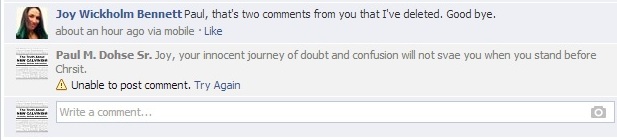
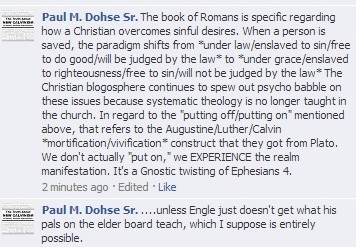
Some of the following are screen shots of what Bennett deleted. Other aforementioned arguments were deleted before I could screenshot them.
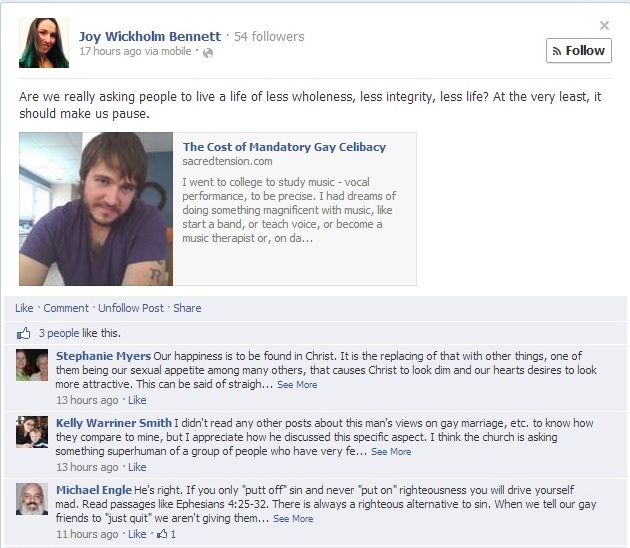



No Joy, as you know, they held me hostage to membership at CCC after I left biblically by letter under threat of ruining my reputation for months. That’s not a feud, it’s a criminal act. And that is ok with you because you are a tyrant just like they are.

The Joy Bennett Gospel: Salvation by a Confused, Doubtful Journey and the Conversation on Censorship Continues
“But journeys don’t save; a love for the truth saves (2THESS 2:10). Bennett isn’t looking for truth; she’s looking for more questions. But the greatest disappointment was her excuse for censoring me.”
As PPT readers know, I am on a journey of sorts to determine what I want to do about those of differing beliefs that comment on PPT. I had decided to just censor them, but then I was talked out of that by some folks I respect. Then I was almost talked into reversing my position by others that I also respect, until today. Now I want to think this through more because today I was on the other end of some really nasty censorship.
How do I perceive the person who censored me? Well, we will get to that, but for now, let’s just say it’s not how I want my message to be evaluated; i.e., it can’t withstand a fight in the arena of ideas.
That’s the rub. I put a different value on ideas than I normally would because America is so dumbed down in both secular and religious realms. That is the argument that is winning the day with me right now; folks don’t even know where to start looking for truth much less figuring it out. For certain, the Bible is no longer the authority that it once was, but I find that it produces arguments that are irrefutable.
Why has the blogosphere exploded among Christians? Because censorship is rampant in the church. The Neo-Calvinist movement has majority rule right now, and Calvin’s power of the keys come with it. The comment I hear most from church exiles are: “They don’t take challenges to what they teach well.” Or, “Geez, all I did was ask a question!” Couple that with the fact that Neo-Calvinist teachings produce massive confusion. It’s the eternal long car trip for the young child. This is why I am hesitant to censor PPT comments. It just smacks of tyranny. However, in order to turn challenges into the lemonade of persuasion I would have to be available to moderate most of the day, and that’s a huge problem. Unanswered ideas can reflect agreement.
All of that aside, we will now discuss Joy Bennett. Bennett is a blogger that enjoys widespread success as a writer on the blogosphere. She censored me on her Facebook page with a rude finality. Uh, Joy, I am a blogger too, so that’s not the way it works with me. I will now answer you publically and expose you for the rank hypocrite that you are. And Joy, as a rule when I comment, I do screenshots. You didn’t censor anything; I am going to publish the stream in massive fashion with plenty of tags.
Joy Bennett is married to the rabid New Calvinist Scott Bennett who is also a blogger. Hence, knowing that she was in those circles, I sympathized with her (until today) “journey of doubt.” She is a new breed of shock blogger that emphasizes writing about “real life.” She also postures herself as an advocate for the abused and downtrodden. Her self-aggrandizing “transparency” seems to be a gospel among her types. Apparently, God will smile on the journey of doubt because of sincerity. However, that pesky intruder named “truth” is found unwelcome.
Today, answers seemed to irritate Bennett because she exemplifies a gargantuan problem with the present-day blogosphere: answers are bad for business. The more answers, the shorter the journey. It’s really all about, “Joy in This Journey.” But journeys don’t save; a love for the truth saves (2THESS 2:10). Bennett isn’t looking for truth; she’s looking for more questions. But the greatest disappointment was her excuse for censoring me. I challenged the comments of someone in the stream that both of us used to attend church with. As many know, my 20-year membership there did not end well. Though my initial comments were left posted, she deleted them when I posed a certain argument regarding the subject at hand. Then came the disappointment:

Feud? So disappointing. While Bennett postures herself as an advocate for the downtrodden, she referred to the criminal act committed against me by Clearcreek Chapel as a tiff of some sort. She is indicative of the many in church today who are utterly indifferent to what is right and what is wrong. One of the many reasons for Christ’s return will be to display God’s justice among the nations. Bennett has no such love for justice while calling herself a “bleeding heart liberal.” She will discuss male erections, used tampon sandwiches (not a typo), and other such edgy subjects on her blog, but not my comments regarding the specific post by the former member (which was on topic and said NOTHING of the “feud” at all). So much for the blogger who writes, “naked” according to her.
For the first time, I saw Bennett for what she really is: just another run-of-the-mill New Calvinist tyrant. I don’t like censorship for that reason: it smells like tyranny and the anemic ideas that always come with it. Therefore, debate must be averted by silencing its enemies.
The journey for me continues on this issue, but all of life is not a journey of doubt. And ignorance of the truth is a choice. God is not in the hide and seek business.
paul

 Paul's Passing Thoughts
leave a comment