The Protestant Road to Salvation; Gaining Salvation with More and More Salvation by Using the Bible to be Brought Down to Hell
 The Heidelberg Disputation Series: Theses 15-18.
Listen to audio or download audio file.
Welcome truth lovers to Blog Talk radio.com/False Reformation, this is your host Paul Dohse. Tonight, part 10 of “The Magnum Opus of the Reformation: Martin Luther’s Heidelberg Disputation, Thesis 15 ff. The Protestant Road to Salvation; Gaining Salvation with More Salvation by Using the Bible to be Brought Down to Hell
Greetings from the Potters House and TANC ministries where we are always eager to serve all of your heterodox needs. Our teaching catalog can be found at tancpublishing.com.
If you would like to add to our lesson or ask a question, call (347) 855-8317. Remember to turn your PC volume down to prevent feedback. If you choose to use Skype to listen to the show, my advice is to just dial direct from your Skype account without using any of the Blogtalk links. 347-855-8317.
Per the usual, we will check in with Susan towards the end of the show and listen to her perspective.
Remember, you may remain anonymous. When I say, “This is your host; you are on the air, what’s your comment or question”—just start talking.
If you would like to comment on our subject tonight, you can also email me at paul@ttanc.com. That’s paul@Tom, Tony, Alice, Nancy, cat.com. I have my email monitor right here and can add your thoughts to the lesson without need for you to call in. You can post a question as well.
Tonight, we continue in our sentence by sentence evaluation of the HD (Heidelberg Disputation) starting with thesis 15. Yes, tonight, we really get into the meat of the Protestant gospel, and it ain’t pretty.
Due to the fact that I can’t decide where to stick this with a fork first tonight, let’s begin by reading the 15th thesis:
Thesis 15: Nor could free will remain in a state of innocence, much less do good, in an active capacity, but only in its passive capacity (subiectiva potentia).
The Master of the Sentences (Peter Lombard), quoting Augustine, states, »By these testimonies it is obviously demonstrated that man received a righteous nature and a good will when he was created, and also the help by means of which he could prevail. Otherwise it would appear as though he had not fallen because of his own fault.« He speaks of the active capacity (potentia activa), which is obviously contrary to Augustine’s opinion in his book ›Concerning Reprimand and Grace‹ (De Correptione et Gratia), where the latter puts it in this way: »He received the ability to act, if he so willed, but he did not have the will by means of which he could act.« By »ability to act« he understands the original capacity (potentia subiectiva), and by »will by means of which he could,« the active capacity (potentia activa).
The second part (of the thesis), however, is sufficiently clear from the same reference to the Master.
We discussed the two primary elements of Martin Luther’s bondage of the will in part 7. They are active will and passive will. Man has no active will, his will is passive. It’s like water; it just sits there until it is acted upon by something from the outside. In Luther’s bondage of the will construct, man is dead as a passive being. We normally think of death as a termination of life, but according to Luther, death is a realm where works can be performed, but they are dead works.
As often pontificated by the Reformed, their favorite illustration in regard to this is the resurrection of Lazarus in John 11. Supposedly, this is illustrative of sanctification (the Christian life). From there, the Reformed put metaphysical feet on it in various and sundry philosophical ways, but the major premise is the same.
A caution when studying Reformed ideology/philosophy: separate the major premises from the various applications or you will drive yourself nuts. The major premises such as the total inability of mankind are consistent, but the so-called life applications are not. Let me give an example.
Some of the Reformed believe that man is not active in any regard as far as the will. Everything that happens is because God acted upon man. Others believe man has a free will to do dead works in the material realm, but all manifestations of good works are the result of God acting upon man’s passive will. So, one view sees all human events as a result of God’s active will while others see the distinction in only good or evil acts. Man is passive in regard to good works, but has an active will in regard to all things evil.
Hence, it’s fine to go about your business and live life as it comes just so you believe that everything you do is evil. That qualifies you to be forgiven on Sunday. In the other application, you have no active will at all, but ALL things are preordained by God for His glory. Your goal is only to SEE and EXPERIENCE what God is doing. In the final analysis, these varying applications are not going to cause much of a rift in Reformed circles; the tie that binds is the total inability of man.
But here is another tie that binds: the idea that God created evil for His own glory. Most Protestants think that Protestants believe that Adam and Eve were sinless/holy/pure before the fall and they are just dead wrong in that idea, no pun intended. Authentic Protestant soteriology holds to the idea that Adam and Eve were created with passive wills as clearly stated by Luther in the thesis at hand. Either they had a propensity to do evil and God acted to prevent it until the appointed time, or God actively incited their fall as well.
It can be demonstrated clearly that the creation of evil by God is a Reformed mainstay, but the various philosophical applications make it possible for the Reformed to play all kinds of metaphysical shell games in order to keep people confused and controlled.
As stated before, the Reformation was first and foremost about philosophy and NOT theology. Clearly, the Reformation was about the integration of Dualism with the Bible. One aspect of Dualism insists that nothing can exist without a counterpart to define it. Without darkness, there can be no light, etc. When we get to thesis 28, we will see that Luther’s counterpart to love is evil. Since God is love, the only logical conclusion, other than the fact that Jonathan Edwards and many others have stated it directly, is that God Himself cannot exist without evil because He is the defining counterpart. Some suggest that God existed, but for all practical purposes was nonexistent until He created evil. This is nothing new. This is a resurgence of the exact same Platonist/Neo-Platonist/Gnostic doctrines that plagued the first century church. Take note of what James was pushing back against in that day:
James 1:13 – Let no one say when he is tempted, “I am being tempted by God,” for God cannot be tempted with evil, and he himself tempts no one. 14 But each person is tempted when he is lured and enticed by his own desire. 15 Then desire when it has conceived gives birth to sin, and sin when it is fully grown brings forth death.
16 Do not be deceived, my beloved brothers. 17 Every good gift and every perfect gift is from above, coming down from the Father of lights with whom there is no variation or shadow due to change. 18 Of his own will he brought us forth by the word of truth, that we should be a kind of firstfruits of his creatures.
Of course, the Reformed deny that they teach such things; specifically, that God created evil for His own glory, and dance around the fact with their shell-game communication skills. An example is the following excerpt from an article written by John MacArthur:
Evil originates not from God but from the fallen creature. I agree with John Calvin, who wrote,
. . . the Lord had declared that “everything that he had made . . . was exceedingly good” [Gen. 1:31]. Whence, then comes this wickedness to man, that he should fall away from his God? Lest we should think it comes from creation, God had put His stamp of approval on what had come forth from himself. By his own evil intention, then, man corrupted the pure nature he had received from the Lord; and by his fall drew all his posterity with him into destruction. Accordingly, we should contemplate the evident cause of condemnation in the corrupt nature of humanity-which is closer to us-rather than seek a hidden and utterly incomprehensible cause in God’s predestination. [Institutes, 3:23:8]
~ Is God Responsible for Evil? Grace to You catalogue #A189.
Ok, so it originates from the creature and not God as if that has nothing to do with how God created man. The only alternative is the idea that God created man in His holy image, and with a free will, but don’t hold your breath and wait for them to ever agree to that.
Note Calvin’s language very carefully. It wasn’t one, then another individual deceived by the serpent; it was a propensity inherent in the kind. Also, in the same section of 3.23.8, Calvin attributes the fall to God’s predestination for His glory. It is unclear if Calvin would have agreed with Luther’s bondage of the will via man’s passive will, but Calvin clearly believed that man was created with a level of integrity that could not obtain full fellowship with god even if man had not fallen:
Even If man had remained in his integrity, still his condition was too base for him to attain to God. How much less could he have raised himself so far, after having been plunged by his ruin into death and hell, after staining himself with so many defilements nay, even stinking in his corruption and all overwhelmed with misery?
~The Calvin Institutes 2.12.1. Henry Beveridge translation varies slightly.
Shockingly, the Henry Beveridge translation has it that man’s condition was too base to attain to God “without a Mediator” note capital “M.” Clearly, Calvin is saying that man needed a mediator before the fall.
Thesis 16: The person who believes that he can obtain grace by doing what is in him adds sin to sin so that he becomes doubly guilty.
On the basis of what has been said, the following is clear: While a person is doing what is in him, he sins and seeks himself in everything. But if he should suppose that through sin he would become worthy of or prepared for grace, he would add haughty arrogance to his sin and not believe that sin is sin and evil is evil, which is an exceedingly great sin. As Jer. 2:13 says, »For my people have committed two evils: they have forsaken me, the fountain of living waters, and hewed out cisterns for themselves, broken cisterns, that can hold no water,« that is, through sin they are far from me and yet they presume to do good by their own ability.
Now you ask: What then shall we do? Shall we go our way with indifference because we can do nothing but sin? I would reply: By no means. But, having heard this, fall down and pray for grace and place your hope in Christ in whom is our salvation, life, and resurrection. For this reason we are so instructed-for this reason the law makes us aware of sin so that, having recognized our sin, we may seek and receive grace. Thus God »gives grace to the humble« (1 Pet. 5:5), and »whoever humbles himself will be exalted« (Matt. 23:12). The law humbles, grace exalts. The law effects fear and wrath, grace effects hope and mercy. Through the law comes knowledge of sin (Rom. 3:20), through knowledge of sin, however, comes humility, and through humility grace is acquired. Thus an action which is alien to God’s nature (opus alienum dei) results in a deed belonging to his very nature (opus proprium): he makes a person a sinner so that he may make him righteous.
This thesis is a good summary of the Reformation gospel. Man remains unchanged accept for the ability to see how evil he is and his continued need for the same gospel that saved him. Any notion that there is anything in man that could choose God is double sin and hewing out cisterns for himself that cannot hold water.
Also assumed in the rhetoric is efficacious good works to maintain the law as a standard for justification.
Luther then states what “saved” sinning lost people are to do since they can do nothing but sin. One is to focus on their sin as a way to see a continued need for salvation resulting in more grace…for salvation and continued justification. Instead of being indifferent to sin, embrace it as a means of seeing your need for continued “grace,” herein a more nuanced word than outright “justification” or “salvation.” Again, this nuancing of words incessant with the Reformed began right here in the HD. Following is a contemporary example:
In the following video trailer from the 2011 Resolved Conference, Al Mohler states that the only purpose of the law in the life of a believer is to show us our ongoing need for salvation. Of course, he doesn’t word it that way. He states that believers have an ongoing need for Christ (which no Christian would refute), but note carefully: he is speaking in context of our initial salvation. So, instead of saying plainly that Christians need to be continually saved, or continually justified, he replaces that wording with “Christ.” However, again, the context is clearly salvation. He is saying that we need Christ in the same way that we needed Him for salvation.
Mohler is also saying that the law has the same relationship/purpose to unbelievers as it does believers: to show us our need for Christ. So, obviously, this is in contrast to any ability on the part of the believer to keep it. All the law can do is show NEED. Need for what? Well, what’s the context? Mohler also presents an either/or choice in regard to the law: it either shows us our need for Christ (again, what need specifically?), or we are using it to “rescue ourselves from sin.” Hmmm, what does it mean to “rescue ourselves from sin”? I believe Mohler deliberately uses the word “rescue” instead of “save” in order to add nuance to his point. “Rescue” is less direct, and could refer to a believer trying to overcome sin on his own. This is the same reason he replaces “salvation” with “Christ” in his prior point. It’s deliberate deception. Excluded is any mentioning that the law can be used by the believer to please God and glorify Him in all we do by “observing all that I have commanded.”
~Paul’s Passing Thoughts.com: Why Al Mohler is a Heretic; April 10, 2012
Thesis 17: Nor does speaking in this manner give cause for despair, but for arousing the desire to humble oneself and seek the grace of Christ.
This is clear from what has been said, for, according to the gospel, the kingdom of heaven is given to children and the humble (Mark 10:14,16), and Christ loves them. They cannot be humble who do not recognize that they are damnable whose sin smells to high heaven. Sin is recognized only through the law. It is apparent that not despair, but rather hope, is preached when we are told that we are sinners. Such preaching concerning sin is a preparation for grace, or it is rather the recognition of sin and faith in such preaching. Yearning for grace wells up when recognition of sin has arisen. A sick person seeks the physician when he recognizes the seriousness of his illness. Therefore one does not give cause for despair or death by telling a sick person about the danger of his illness, but, in effect, one urges him to seek a medical cure. To say that we are nothing and constantly sin when we do the best we can does not mean that we cause people to despair (unless we are fools); rather, we make them concerned about the grace of our Lord Jesus Christ.
Ok, so not much commentary needed here—this is pretty plain. As believers we are still sick, and hey, telling someone that they need a doctor continually is not bad news, but good news. All of the Christian life is seeking to be concerned about “grace.” Again, that means salvation. As we have discussed many times before, “grace” is a biblical word that has broad meaning including, for the most part, “help.” Though Luther calls any assertion that this would instill despair in people “foolish,” historical facts beg to differ.
Thesis 18: It is certain that man must utterly despair of his own ability before he is prepared to receive the grace of Christ.
The law wills that man despair of his own ability, for it »leads him into hell« and »makes him a poor man« and shows him that he is a sinner in all his works, as the Apostle does in Rom. 2 and 3:9, where he says, »I have already charged that all men are under the power of sin.« However, he who acts simply in accordance with his ability and believes that he is thereby doing something good does not seem worthless to himself, nor does he despair of his own strength. Indeed, he is so presumptuous that he strives for grace in reliance on his own strength.
Here we have it again. The sole use of the Bible is to show us our worthlessness so as to be brought down to hell in order to prepare ourselves to receive more salvation/justification. As Dr. Michael Horton has said, the sole Purpose of the Bible is to “drive us to despair of self-righteousness.” This is, of course, the mortification part of the Reformed doctrine of mortification and vivification.
With that, let’s go to the phones.
The Magnum Opus of the Reformation: Martin Luther’s Heidelberg Disputation, Part 7: Martin Luther’s Unveiling of the Bondage of the Will
Listen to, or download audio file.
Welcome truth lovers to Blog Talk radio.com/False Reformation, this is your host Paul M. Dohse Sr. Tonight, part 7 of “The Magnum Opus of the Reformation: Martin Luther’s Heidelberg Disputation, Martin Luther’s Unveiling of the Bondage of the Will.”
Greetings from the Potters House and TANC ministries where we are always eager to serve all of your heterodox needs. Our teaching catalog can be found at tancpublishing.com.
If you would like to add to our lesson or ask a question, call (347) 855-8317. Remember to turn your PC volume down to prevent feedback. If you choose to use Skype to listen to the show, my advice is to just dial direct from your Skype account without using any of the Blogtalk links. 347-855-8317.
Per the usual, we will check in with Susan towards the end of the show and listen to her perspective.
Remember, you may remain anonymous. When I say, “This is your host; you are on the air, what’s your comment or question”—just start talking.
If you would like to comment on our subject tonight, you can also email me at paul@ttanc.com. That’s Tom, Tony, Alice, Nancy, cat, paul@ttanc.com. I have my email monitor right here and can add your thoughts to the lesson without need for you to call in. You can post a question as well.
Tonight, we continue in our sentence by sentence evaluation of the HD [Heidelberg Disputation] after addressing some asides in parts five and six. We hear a lot about Martin Luther’s bondage of the will. Tonight, we are looking at the very conception of Luther’s beliefs on the human will. What we are going to find is that Luther’s explanation of human will derived from his position of mortal and venial sin.
Simply stated, if one believes that every act they perform is mortal sin, even their good works, their life is forgivable. Man must not believe he can do a good work. Let’s use theses 11 and 12 to segue into thesis 13 which is the first unveiling of Luther’s bondage of the will.
Thesis 11: Arrogance cannot be avoided or true hope be present unless the judgment of condemnation is feared in every work.
This is clear from Thesis 4. For it is impossible to trust in God unless one has despaired in all creatures and knows that nothing can profit one without God. Since there is no person who has this pure hope, as we said above, and since we still place some confidence in the creature, it is clear that we must, because of impurity in all things, fear the judgment of God. Thus arrogance must be avoided, not only in the work, but in the inclination also, that is, it must displease us still to have confidence in the creature.
Here is something that I haven’t talked about enough in this series: the Reformers were masters of doublespeak. So far, it is obvious that Luther disavowed any value in regard to human life. Yet, in some sentences, he sort of makes it sound like that the issue is life without God. This isn’t the case at all; this is a strict dichotomy between 100% evil and 100% good with nothing in-between.
In contrast, God makes new creatures of mortal men. This flies in the face of Reformed ideology and all of the theology that flows from it. Note that, like all good Gnostics, Luther saw impurity in “all things.” And of course, that includes mankind.
Hence, as stated in this thesis by Luther, man must not have any confidence in self. In other words, God’s creation of man has no inherent ability. The natural ability to do anything is the glory story. Anything that brings glory to man diminishes God. Listen, as one example, the Puritans didn’t dress like they did for no good reason. To wear something with a little color or style would have been the glory story. By the way, do you want to help people? Know this: EVERYTHING people do they do for a reason. Logic drives action. If you want to help people, find the logic behind the action.
So, Reformed ideology splits reality into a strict either/or dichotomy; it’s either the glory story or the cross story. The glory story, or the story of man, can only bring about arrogance.
Let’s pause here to look at the foundational ideology of the Reformation which deals primarily with metaphysics. Like I said, everything people believe and do flows from their logic, so what is the logic that all of this stuff flows from? This is a very simplified version, but it really boils down to this: God does everything that He does because of His self-love. And because God loves Himself, He created evil as a contrast to His holiness. In other words, evil helps to define His holiness by contrast.
This leads to the essence of state of being, or metaphysics, or why things are, or their state of being, according to the metaphysical narrative. What’s a metaphysical narrative? Simply stated: state of being is a story written by God. Everything that is happening in the world today, right down to what people decide to wear, is predetermined by God in His historical prewritten narrative.
All of this benefits God’s self-love. Everything is for His glory. And according to this story, man thinking that he has freedom of choice on any level is evil, and what is he doing? Right, he is writing his own story. If you think that it was your decision to wear what you wore today, you are writing your own glory story. Either you are writing your own life story, or God is writing your life story. You are either god writing your own reality, or God is writing your realty.
Of course you don’t have freedom of the will—that would be writing your own reality—that would be making yourself God. We can also stop here and talk about how the Bible fits into this. The Bible becomes a prototype or model for interpreting reality according to God’s story which is primarily about redemption. The Bible is therefore a tool for interpreting reality according to the cross story, or God’s prewritten metaphysical narrative. And folks, this is everywhere. This way of using the Bible saturates the institutional church.
An example, one of myriads, is the Bible Mesh study material. Listen carefully to what these guys are saying in this promo for the study:
Notice the constant theme of Bible as story, and everything in the Bible being about Christ; ie., redemption. Notice that the Bible is also “your story” and this study enables you to put yourself in the story. You have heard me talk often about the redemptive historical method of interpreting the Bible and this is what it is. They make the Bible a tool for interpreting all of reality according to Martin Luther’s cross story metaphysics. And frankly, 90% of the evangelicals occupying the pulpit in the institutional church take this approach to the Bible.
Thesis 12: In the sight of God sins are then truly venial when they are feared by men to be mortal.
This becomes sufficiently clear from what has been said. For as much as we accuse ourselves, so much God pardons us, according to the verse, »Confess your misdeed so that you will be justified« (cf. Isa. 43:26), and according to another (Ps. 141:4), »Incline not my heart to any evil, to busy myself with wicked deeds«.
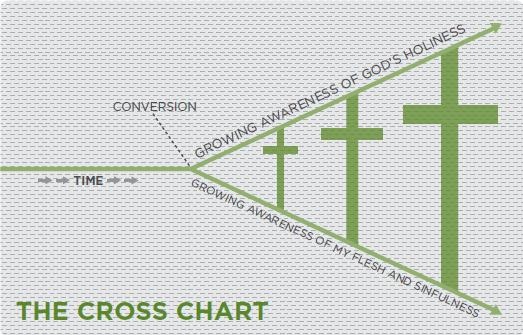
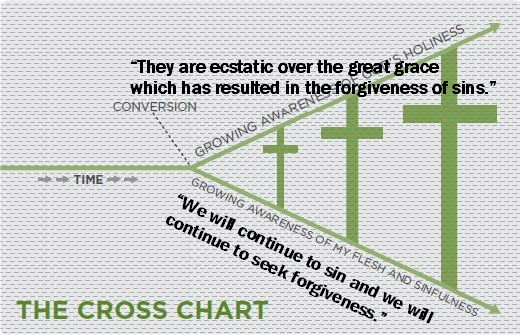
So, if you look at two slides on the program slide show, you see two contemporary illustrations published by the Reformed camp that explain where we have come to this point. The two man chart explains the metaphysics,


and the cross chart explains the application as stated in this thesis by Luther: “For as much as we accuse ourselves, so much God pardons us…” His use of Isaiah 43:26 pretty much puts it in a nutshell: confession of sin leads to ongoing justification which can only be found in the institutional church. If we believe man has no will to choose good, and that everything we do is sin, we qualify to be forgiven for purposes of ongoing justification. It’s not complicated.
Thesis 13: Free will, after the fall, exists in name only, and as long as it does what it is able to do, it commits a mortal sin.
The first part is clear, for the will is captive and subject to sin. Not that it is nothing, but that it is not free except to do evil. According to John 8:34,36, »Every one who commits sin is a slave to sin.« »So if the Son makes you free, you will be free indeed.« Hence St. Augustine says in his book ›The Spirit and the Letter‹: »Free will without grace has the power to do nothing but sin«; and in the second book of ›Against Julian‹, »You call the will free, but in fact it is an enslaved will,« and in many other places.
The second part is clear from what has been said above and from the verse in Hos. 13:9, »Israel, you are bringing misfortune upon yourself, for your salvation is alone with me,« and from similar passages.
Again, we will take note of something Luther was accustomed to in his doublespeak. Though he quotes Augustine saying that the will can do nothing but sin without grace, we know that Luther also believed that the will can do nothing but sin WITH grace. This is just another example of his doublespeak. This seems to be very indicative of Reformed teachers; they sow seeds of doubt that they are stating outrageous ideas, but after a space of time the outrageous, tempered by a contradictory statement, will be accepted through repetition. The doublespeak is a red herring until you are fully indoctrinated.
Luther is stating here that the will is “not free except to do evil.”
Thesis 14: Free will, after the fall, has power to do good only in a passive capacity, but it can always do evil in an active capacity.
An illustration will make the meaning of this thesis clear. Just as a dead man can do something toward life only in his original capacity (in vitam solum subiective), so can he do something toward death in an active manner while he lives. Free will, however, is dead, as demonstrated by the dead whom the Lord has raised up, as the holy teachers of the church say. St. Augustine, moreover, proves this same thesis in his various writings against the Pelagians.
Here is where we will employ some help from one of the leading Reformed scholars on Luther’s theology of the cross. This is from Gerhard O. Forde’s “On Being a Theologian of the Cross” which is a commentary on the HD.
Theses 14 and 15 are an attempt to define a little more closely what sort of ability may be ascribed to the will. If, as we have seen in thesis 13, the will is not nothing and is not forced or determined, and if, as we might say, we are not puppets, how then may the power of the will be described?
Pause.
Stop right there. This is the Reformed, “But of course we are not puppets, so how do we explain this?” But the only logical conclusion to Reformed ideology is that we are in fact puppets. In classic Reformed teaching protocol, the brainwashing technique is to deny the logical conclusion while hoping that you will function according to the very logical conclusion and goal that they are seeking.
Listen, according to their very own redemptive-historical hermeneutic, we are nothing but characters in a narrative. No, no, no, we are not puppets, rather, we are mere characters in a metaphysical narrative who are penciled in. And we have a choice, and this is a paraphrase, “…join the plot of the divine drama that includes your story, or attempt to be your own god and write your own glory story.” That’s it. That’s it in a nutshell.
I have been learning a lot from Susan about Jonathan Edwards, and she has so much data already accumulated that I don’t know whether she is going to be able to find this or not, but she was sharing with me about Edwards’ view of the will. Basically, he believed that before a person performs an action, God puts the thought, idea, will, and decision to act in one’s mind beforehand. This kind of goes hand and hand with Edwards’ belief that God is recreating reality at every moment. So, in essence, everything you do is a recreation of reality when it gets right down to it.
So this is how this works: the Reformed will continue to deny that we are puppets while teaching all of the elements of puppeteering. If you teach all of the elements constantly while never speaking of the logical conclusions, people will eventually function according to the logical conclusions which is what they are after. Functionality is the goal—not understanding. Reformation ideology is vehemently opposed to reason and understanding.
Here is another example: the official Reformed doctrine of already not yet. So classic. Sure, sure, you are already saved, of course you are! But not yet. So you think: “Well, sure, our salvation will be fully realized when we are resurrected. That makes total sense.” Well guess what? You just bought into progressive justification. See how this works? Salvation doesn’t have a beginning and an end. It’s a conception. Conception is a onetime final event that completes its work in an instant. You didn’t exist, now you do—end of story.
Let’s continue with Forde’s quotation.
If the claim is that we are to “do what is in us,” then the question quite naturally follows: What then is in us? What sort of capacity do we have?
Pause. Stop right there. Let me shortly answer that question according to 1John chapter 3 before we move on: God’s seed. God’s DNA. We are literally born of God and have His seed IN us. We are new creatures born of God.
To get at the question Luther here uses a distinction current in his day between what our translation has called a “passive capacity” and an “active capacity.” What does that mean? In its passive capacity the will can do good when it is acted upon from without but not on its own, not in an active capacity. A commonly used physical analogy is water. Water has a passive capacity to be heated, but it can’t heat itself. It has no active capacity to do that.
The example Luther uses in his proof is even more to the point because it deals with death and life. On the one hand, corpses could be said to have a passive capacity for life because they can be raised from the dead. But not, of course, on their own power, not in an active capacity, not even in the slightest. Not even by doing their best! The capacity they have is strictly passive. They can be raised, but only by divine power. On the other hand, it is of course true that while a people live they have the active capacity to do something about life and death. They can take life, either their own or some other, but they can’t create or give life. Yet, that only demonstrates that, after the fall, will in its active capacity can only do evil. Since will after the fall is dead and bound to do deadly sin, it can be rescued only from without, as indicated by the fact that it could not bring life out of death but could only be commanded from without by our Lord.
Thus, the fact that even after the fall the will is not nothing means that there is something there. What is it? It is a strictly passive capacity, not an active one. That means that it can be changed but it will not change itself. To be changed, it will have to be accessed “from without.” But it will take radical action. It will take death and resurrection. So we are again pointed toward the cross.
Here, we have plunged the depths of Martin Luther’s bondage of the will. Man is dead, and death is defined as the waters of mortal sin. The waters of mortal sin are not only what man dwells in, he is those waters. He is passively dead. The only active works he can do is dead works. The material realm is man’s glory story of death. He ebb and flows between dwelling in death and experiencing resurrection resulting from him being acted upon from the outside. Being acted upon is completely determined by God’s decision and good pleasure. The long and short of being saved is merely giving testimony to this fact and seeing it for what it is. Saving faith is giving testimony to what you see only, and not anything that you do.
To think you are not dead is mortal sin that cannot be qualified for forgiveness. And again, do see what these guys do? No, no, we are not puppets, right? A question: what do we know about puppets? Well, we know that they are dead. We know that they cannot do anything until they are acted upon, right? This Gerald Forde guy is just like all of the Reformed; he will deny that he is saying that we are mere puppets, and then will describe our Christian existence as puppetry.
This is what annoys me so deeply about people who listen to these yahoos because, “they say some good things.” Why would anybody spend any time investing in this intellectual dishonesty?
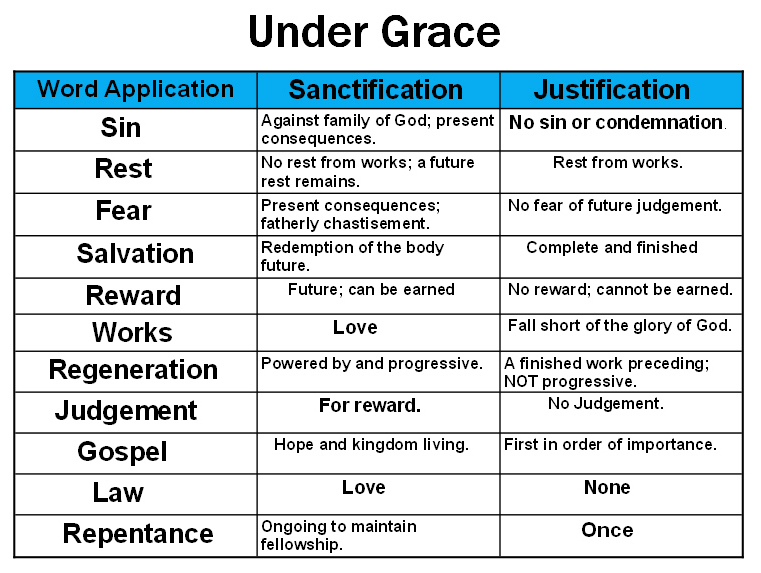
So, what is the biblical view of the will? Romans chapter 6. Before one is saved, they are enslaved to sinful desires and free to do good works. Slavery indicates the type of wages that the slave gets—only wages for death. Unsaved people are also indifferent to the law that they will be ultimately judged by. They do not love God’s law. But, they definitely have a free will to follow their God-given conscience and receive rewards for doing so. A person who lives a good common sense life will of course suffer fewer calamities than the foolish. But in the end, this only means less condemnation.
The saved person also has a free will. They are enslaved to righteousness, but unfortunately free to commit sin. However, they do not receive wages of death because they are no longer under the condemnation of the law. They can only receive wages for life. They are no longer indifferent to the law, but love God’s law and its truth. The chart below may help:
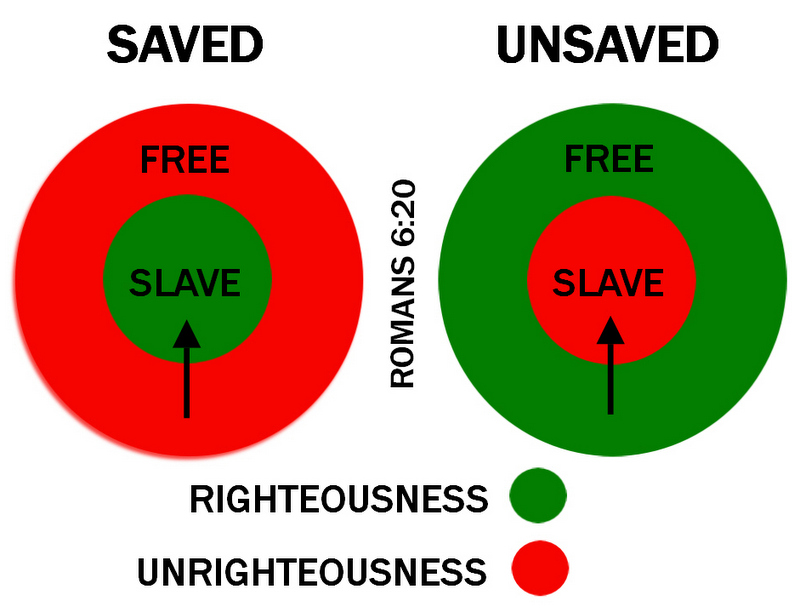
The new birth is a reversal of sin and slavery resulting in a change of direction. No one sins perfectly, and no one loves perfectly. It’s a direction, not perfection. But if you look at the Reformed cross chart again, neither is it a downward direction of sinful perfection resulting in making the cross bigger.
That’s the end of our lesson tonight—let’s go to the phones.
The Key to Revival: Stop Saying “Sins of the Flesh”. The Flesh is NOT Sinful
 Protestantism wasn’t born of Gnosticism; it was born of Neo-Platonism which became Gnosticism. Most Protestants would deny that they are Gnostics, but because the fruit doesn’t fall far from the tree, they often embrace ideology that is Gnostic. In other words, they are functioning Gnostics.
The prime example is the whole “sins of the flesh” Christian mantra. That’s not a biblical idea, and is essentially Gnostic.
A primary tenet of Gnosticism is Either/Or epistemology. If you pay attention to the words used in this Sunday’s sermon, more than likely, you will notice that everything is either/or with no middle ground. I realize that the Bible does contain sentences that refer to the “desires of the flesh” and “sins of the flesh,” but that refers to when the flesh, the bodily members, are used for sinful purposes. Please note that the Bible also states that we can use our members for holy purposes as well.
Furthermore, the Bible even states that as believers, our bodies are the temples of God. Moreover, a more careful examination reveals that the reference to “temple” in regard to our bodies actually refers to the Holy of Holies. If you think you can presently hear Calvin and Luther rolling and screaming in their graves in response to that assertion—the problem is not in your cranium set.
If you are actually free to present your body as a living sacrifice to God in the Holy of Holies, what do you need the vast Protestant industrial complex for? You don’t.
The flesh is NOT sinful, according to the Bible; it is “weak.” The idea that weakness is part and parcel with the evil material world is a Gnostic presupposition. For example, the holy angels are weaker than God, no?
Pastors, do you want revival? Stop telling your parishioners that they are “sinners saved by grace.” They are not sinners; they are literally a nation of holy priests.
“But we still sin.”
If you just said that, you are not fit for the ministry—you don’t even understand Biblical Law/Gospel 101.
Get with the program. You will never have revival with a bunch of sinners—that would seem evident. Grow up in Christ, and stop listening to men. You are like my adorable grandson, Blaine, who is 4 years old. He is a great listener and repeats everything he hears.
That’s just adorable, but when grown men who dare to call themselves pastors do the same thing—not so much.
paul
The Protestant Twisting of 1John: A Clarification, Part 1
Listen to audio or download audio file.
Welcome to Blogtalk Radio False Reformation this is your host Paul M. Dohse Sr. Tonight, we are going to attack and unravel interpretive abuses of 1John, particularly 1John 1:9 and 2:1. There is only one other text twisted for ill use more than these two verses, and that would be Galatians 2:20 and 3:1-3. Later, In part 2, I will toss in an exegesis of those verses as a bonus.
There may be a lot of different religions and even more denominations, but for all practical purposes they all have one thing in common: this whole idea that salvation is a process with a beginning and an end. This makes salvation a process that includes our present life.
So, the argumentation between religions and denominations involves the correct way of getting from point A to point B. But there is no point A and point B. When you believe God unto salvation, you get the complete package and the salvation part of your life is finished. It is an instantaneous quickening of the Spirit that transports you from one kingdom to another, from one master to another, from being under law to being under grace, from the old person to the new person, and from darkness to light. You don’t become a servant of righteousness on the installment plan, and you don’t become a kingdom citizen on an installment plan.
How is 1John used to argue for a progressive salvation, and what is John really saying in his epistle? That’s what we are discussing tonight. If you would like to add to our lesson or ask a question, call (347) 855-8317. We will check in with Susan towards the end of the show and listen to her perspective. If you would like to comment on our subject tonight, you can also email me at paul@ttanc.com. That’s Tom, Tony, Alice, Nancy, cat, paul@ttanc.com. I have my email monitor right here and can add your thoughts to the show.
Way back at the beginning of this ministry, I had this nailed down. If salvation is a process, and eternal life as opposed to eternal punishment is at stake, the Christian life is really a minefield. The focus isn’t being the best kingdom citizen; the focus is making sure you don’t mess up your salvation. The focus is salvation, not discipleship. The focus is fear of judgement, not love.
I realize many Christians hold to OSAS, once saved always saved, but the problem is how they are led by pastors trained in seminaries deeply grounded in Protestant tradition. That tradition looks to the institutional church as the primary way of getting God’s people from point A to point B in regard to their salvation. Whether OSAS or not, they are led to do the same things week in and week out. Be here at this time or that time; stand up; sing; sit down; listen to announcements; stand up; sing; sit down; listen to the special music presentation; put your tithe in the plate; listen to the sermon (always about the gospel just in case there are lost people present, wink, wink); stand up; sing “Just As I Am” until someone walks the isle so you can stop singing “Just As I Am”; pray; be dismissed; be cordial to people and tell them how much you love them; go home, and come back next week and do it again.
Why? Because all of that ritualism “imparts grace” and enables us to “grow in grace.” It enables us to “grow up in our salvation.” After all, discipleship is the “growing part of our salvation.” We have all said it, but salvation doesn’t grow. While believing in OSAS, most parishioners are led by pastors who believe in progressive salvation/justification which was clearly the foundational premise of Protestantism with the progression being overseen by the Protestant institutional church.
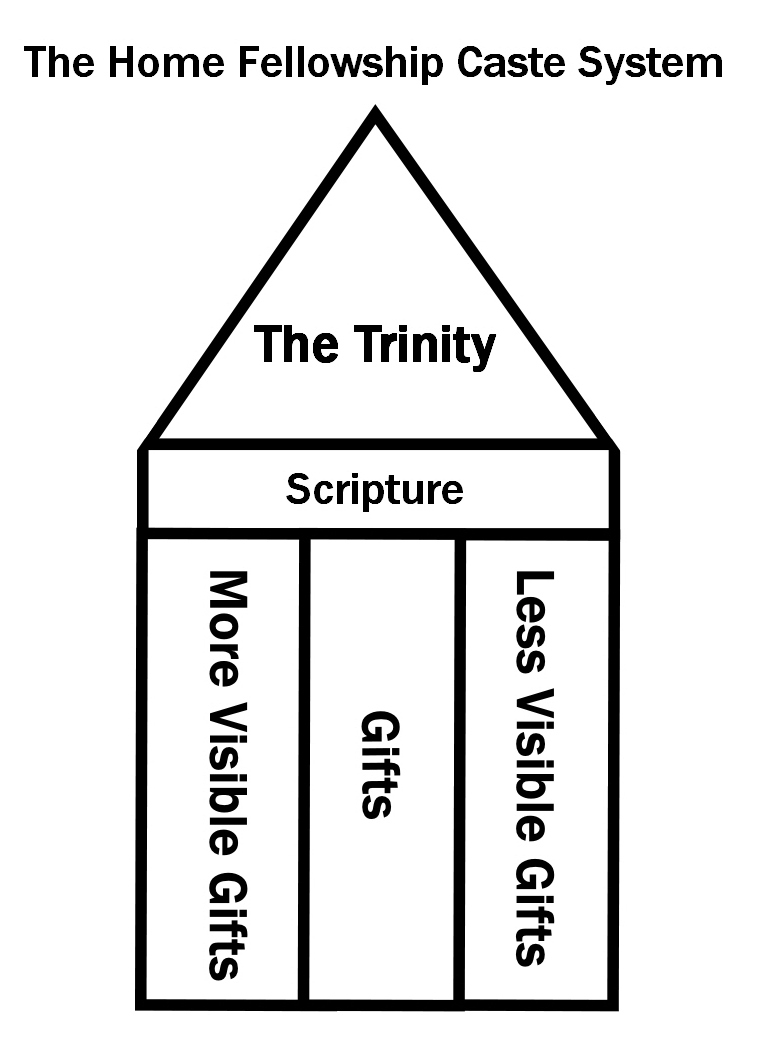
Moreover, let’s face it; while believing in OSAS, there is only one reason people put up with all of the nonsense and drama of the institutional church—OSAS means that if someone leaves the institutional church, they were never saved to begin with. Right? In other words, they function according to the idea that they are led by. It’s OSAS as long as you are “faithful” to the institution. Then each church has its own little “faithfulness” caste system. Those who show up for all of the services are the “core members” that run the church. Those “less faithful” that only come on Sunday mornings are a lower class of member in the caste system.
You have the pastors, staff and deacons, then the “faithful” that attend all of the services and tithe at least 10%, the “casual” attenders that tithe, and then the bottom of the caste strata, even lower than the serfs, the putrid “nonmembers.”
Whether Calvin or Luther, the two icons of Protestantism, these beliefs follow after the doctrine they established for the Protestant institutional church. Access to the institutional church was through water baptism, and the critical need according to the Reformers for formal church membership follows: as Christians, forgiveness for present and future sins can only be found in the institutional church, and those sins condemn us. Forgiveness for all sins does not occur at salvation, but only for past sins. Water baptism initiates us into church membership where forgiveness for present and future sins can be obtained through the sacraments; ie., “gospel preaching,” the Lord’s Table, and anything else deemed as acts of faithfulness to the institutional church not to exclude tithing by any means. Calvin states this explicitly in his institutes, 4.15.1.
All in all, you can say that in Protestantism, the status of sin does not change for the believer—it still condemns requiring perpetual resalvation for every sin committed.
Therefore, 1John 1:9 and 2:1 is interpreted in this light: “If we confess our sins, he is faithful and just to forgive us our sins and to cleanse us from all unrighteousness” (1:9). “My little children, I am writing these things to you so that you may not sin. But if anyone does sin, we have an advocate with the Father, Jesus Christ the righteous” (2:1).
These verses seem to bolster the authentic Protestant position on justification. Confession of sin in our Christian lives keeps us saved. And if we confess our sins, Jesus is up in heaven as our advocate with the Father continuing His work as a propitiation for our sins.
The problem is that this interpretation stands in stark contrast to what other Scriptures state about justification. Biblically, sin has a different classification after salvation—it can’t condemn; it can bring chastisement and present consequences, but it can’t condemn—its ability to condemn has been taken away. Hence, there is no need to have some institution that prevents future condemnation.
Nevertheless, it is easy to understand why the institutional church not only gets a pass on outrageous behavior, but the money keeps pouring in. What will people pay for their salvation and décor that glorifies the institution that saves them? Apparently, no price or compromise is too large. One can also appreciate the fear of so-called excommunication because the institutional church is the only place where one can receive continued forgiveness for present and future sins.
Before I move on, I will solidify my present point. Romans 8:1 states that there is presently NO condemnation for those who are in Christ. In Contrast, Calvin stated that “even saints cannot perform one work which, if judged on its own merits, is not deserving of condemnation” (CI 3.14.9, last sentence). Obviously, the focus is going to be avoiding condemnation, not our freedom to pursue aggressive love in discipleship.
So what are these verses in 1John really saying? Let’s begin to unpack that using the historical grammatical approach to interpretation as opposed to the traditional Protestant means of interpretation, the historical redemptive method. Since Protestantism sees salvation as a process, “redemptive” means that the Bible must be approached with a redemptive prism; ie., the Bible is about salvation. Clearly, this is eisegesis; going to the Bible with a presupposition.
In regard to the history part, this is the belief that history is an unfolding drama about salvation. Hence, all of reality is interpreted through salvation. All of history and the Bible continually reveals the one two-fold redemptive truth/reality: the sinfulness of man and the holiness of God. Salvation begins when we see or understand this reality, and the experience of that reality increases until final salvation.
In contrast, the historical grammatical method uses historical facts to bring more meaning to the text, and all truth is determined by what can be concluded by the grammar—this is known as exegesis. All meaning and truth comes out of the text without anything being read into the text except conclusions from other texts.
In fact, Protestant tradition holds to the idea that a historical grammatical approach to the Scriptures invariably leads to works salvation. Protestant tradition insists that the Scriptures must be interpreted through the prism of total depravity. In this year’s TANC conference, this is what I am going to be hitting on. Christians, save a few, have no idea that Protestant pastors that are leading them view reality in a totally different way than most parishioners. And this is why church looks like it does. And there is no salvaging it—it’s a completely broken system.
So, if you interpret said verses in 1John redemptively, it fits right into their narrative, right? You have to continue to repent for new sins in your Christian life in order to not be condemned and to keep your salvation. A good old fashioned Baptist lady who I am sure would hold OSAS stated this to my wife Susan in the grocery store a couple weeks ago. When Susan asked her why Christians need to go forward during alter calls, she answered, “they have sin that needs to be forgiven.” Well, why can’t they get that forgiveness by praying at home? You ought to see the reaction Susan and I get when we suggest her mother was saved even though not a member of a church.
Protestantism and all of its offshoots including the Baptists is nothing more or less than functioning Calvinism. Election isn’t the point, progressive salvation is the point. Protestants think salvation grows—salvation doesn’t grow—you are either forgiven once and for all time or you aren’t. Look, if you are going to stay in the institutional church, it makes absolutely no difference where you go. Please, stop driving 15 miles to the Baptist church when there is a Catholic Church right across the street—it’s a shameful waste of gas. It’s all progressive justification.
In contrast, we have to see 1John in its exegetical historical context. It must be interpreted according to what was going on during the time that prompted this letter. And what was that?
John was pushing back against the number-one nemesis of the assemblies during that time: Gnosticism. Now, there were many, many different veins of Gnosticism during that time, but like denominationalism, there are basics that are fundamentally the same. Denominationalism quibbles about how to get from point A to point B, but it is all progressive salvation.
When you understand the basics of Gnosticism, it is easy to see that John’s first epistle is a point by point rebuttal of Gnosticism, and NOT the proffering of progressive justification. Protestants can bicker with Catholics all they want to about how to get from point A to point B, but again, it’s all progressive justification. If it’s a religious institution, it’s selling final salvation, PERIOD.
If we follow John’s arguments in this epistle, it also apes the fundamental basics of Gnosticism, and that’s what we are going to do:
1John 1:1 – That which was from the beginning, which we have heard, which we have seen with our eyes, which we have looked upon, and our hands have handled, of the Word of life; 2 (For the life was manifested, and we have seen it, and bear witness, and shew unto you that eternal life, which was with the Father, and was manifested unto us;) 3 That which we have seen and heard declare we unto you, that ye also may have fellowship with us: and truly our fellowship is with the Father, and with his Son Jesus Christ. 4 And these things write we unto you, that your joy may be full. [KJV].
The Gnostics taught that it really wasn’t the spiritual Christ that died on the cross. Gnosticism holds to the idea that material is evil and only the invisible spiritual world is good. Gnosticism rejected the idea that the spiritual realm, or godhood can be one with the material. You must understand: the biblical concept of Godman is a direct affront to the foundation of all false religions, or the knowledge of good and evil. It is the idea that true knowledge cannot be one with the material. Knowledge is good, material is evil and is only a shadow of true knowledge. Knowledge of the material is enslaved and dependent on the five senses.
Now, stop right there. Let me simplify this for you. All false religion flows from the religion of the knowledge of good and evil presented to Eve in the garden. This is also the first sentence of the Calvin Institutes and all of the Calvin Institutes flow from the foundation of 1.1.1., first sentence, viz, ALL wisdom is the knowledge of man and the knowledge of God; man is inherently evil and God is inherently good.
Also, the first sentence of the Calvin Institutes is the primary theses of Luther’s Heidelberg Disputation which is the Magnum Opus of the Reformation. All fundamentals found in contemporary evangelicalism can be found in the Heidelberg Disputation and flow from it. Calvin’s Institutes further articulated the former. In contemporary evangelicalism, we hear constantly that true biblical knowledge is “the knowledge of our own sinfulness as set against God’s holiness.” This is also the pronounced fundamental foundation of the contemporary biblical counseling movement as constantly stated publically in no uncertain terms.
Why am I interjecting this? Because even though much of our knowledge concerning first century Gnosticism comes from the writings of the early church fathers and while they railed against Gnosticism, they themselves were also Gnostics. However, in the process of railing against Gnosticism, they confirm unequivocally that John’s letter addressed the Gnosticism of their day; it just wasn’t the Gnosticism that they preferred.
And by the way, according to some church fathers, John was addressing a Gnostic named Cerinthus who was a contemporary of John and a personal nemesis.
Cerinthus was a gnostic and to some, an early Christian, who was prominent as a heresiarch in the view of the early Church Fathers. Contrary to proto-orthodox Christianity, Cerinthus’s school followed the Jewish law, used the Gospel according to the Hebrews, denied that the Supreme God had made the physical world, and denied the divinity of Jesus. In Cerinthus’ interpretation, the Christ came to Jesus at baptism, guided him in his ministry, but left him at the crucifixion.
He taught that Jesus would establish a thousand-year reign of sensuous pleasure after the Second Coming but before the General Resurrection, a view that was declared heretical by the Council of Nicaea. Cerinthus used a version of the gospel of Matthew as scripture.
Cerinthus taught at a time when Christianity’s relation to Judaism and to Greek philosophy had not yet been clearly defined. In his association with the Jewish law and his modest assessment of Jesus, he was similar to the Ebionites and to other Jewish Christians. In defining the world’s creator as the demiurge, he emulated Platonic philosophy and anticipated the Gnostics.
Early Christian tradition describes Cerinthus as a contemporary to and opponent of John the Evangelist, who may have written the First Epistle of John and the Second Epistle of John to warn the less mature in faith and doctrine about the changes he was making to the original gospel. All that is known about Cerinthus comes from the writing of his theological opponents (Wikipedia).
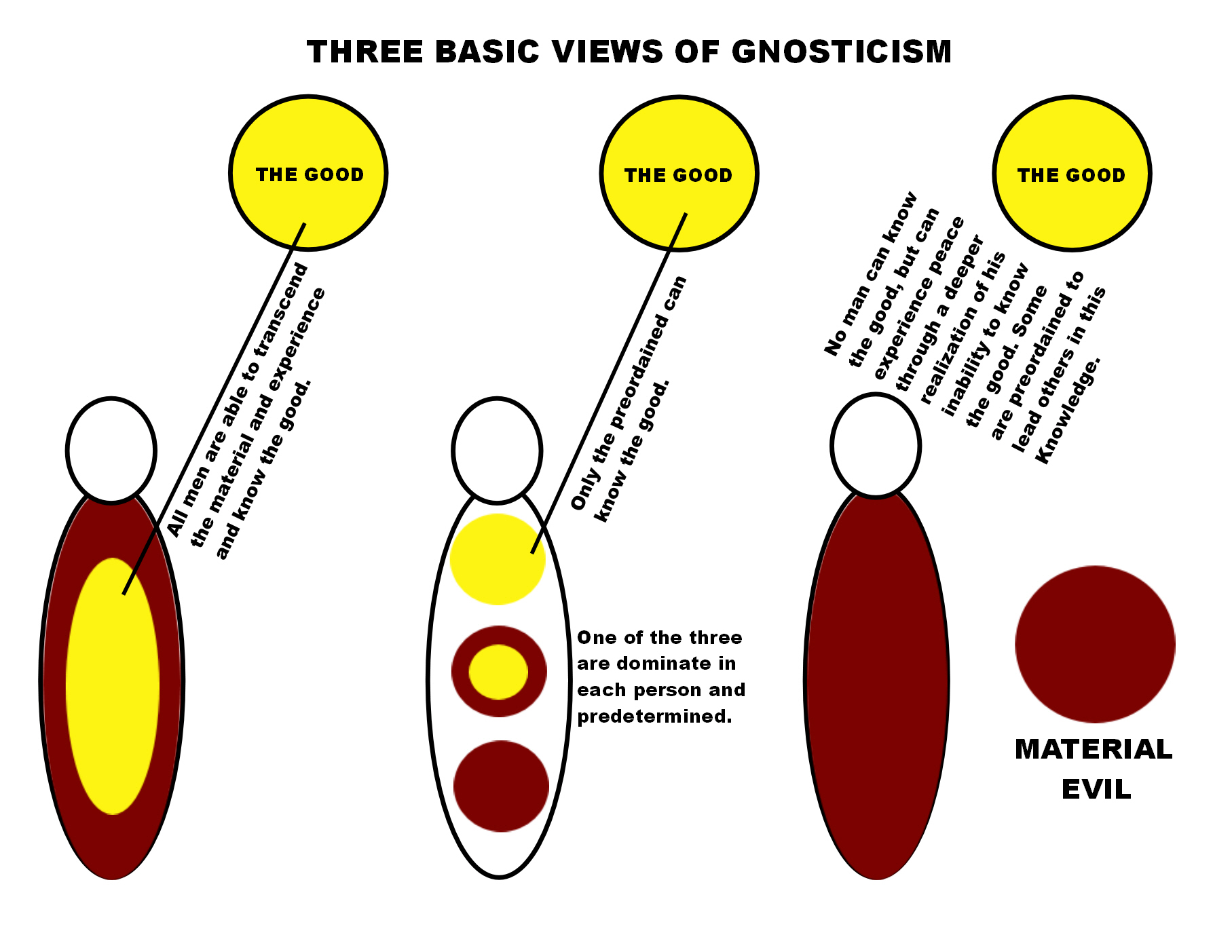
At any rate, the teachings of Cerinthus follow the basic fundamentals of 1st century Gnosticism of which there were two schools of thought unchanged from the cradle of society: intuitive knowledge within versus knowledge outside of man. While both schools held to the strict dichotomy of material being evil and the invisible good, and true knowledge being beyond the five senses, they disagreed on where that knowledge is found and whether or not it is intuitive among all men, or a select few preordained by nature or some supreme being.
Cerinthus followed the philosophical school of Idealism which holds to the belief that the one cosmic mind has an intuitive connection within every individual. Finding that knowledge is often a complex mind-numbing epistemology, but curiously, Luther and Calvin had their own angle that built on the Neo-Platonic teachings of St. Augustine.
This Gnostic bent actually allowed for Christ to be human, or at least some form of humanity. Apparently, God became exasperated with man’s penchant for trying to gain knowledge through the material world, and said in essence, “Ok, since you like to think you can know something and try to gain knowledge through the things that are seen, I am going to send my Son to die on the physical cross, and now all knowledge will only be gained through suffering—there mankind, take that!” This is the essence of the Heidelberg Disputation which is a philosophical treatise, not a theological one by any stretch of the imagination. Luther states plainly in the document that ALL knowledge is hidden in the suffering of the cross. Anyone who thinks they can understand Protestantism without a good grasp of world philosophy is sadly misguided. It is one of the historical necessities of historical grammatical hermeneutics.
Hence, in the Gnostic Protestant construct, Christ and His gospel is the only true objective knowledge and is outside of man. Man is not to seek any knowledge within himself, but all knowledge must be sought outside of him in contemplation of the gospel. All of reality is interpreted by the suffering of the cross. The cross is the epistemology from the material to the invisible, or from the evil to the good.
In contrast, other schools believe the epistemology is intuitive within all men because all men have a spiritual being separate from their material being, and the spiritual part of man is nonmaterial and therefore SINLESS. The material body of man is evil because it is material, but his invisible being is good and has a connection to the cosmic spiritual world that must be cultivated by transcending the material. This was key to the drug culture of the 60’s as LSD trips enabled the individual to transcend the five senses and see into the invisible spiritual world. Supposedly.
Other schools of thought believed that even though all men have a material and spiritual aspect, the spiritual anthropology has classifications in regard to who is able to see true knowledge and who isn’t as determined by the cosmos or cosmic mind; ie., determinism. And consequently, if utopia is to ever be achieved, those with the ability to see knowledge must rule over those who have the inability to transcend the material and are enslaved to it. How do you reason with people hopelessly enslaved to the material? They either understand that they can’t know reality and get with the program, or you kill them.
According to the Reformers, utopia is achieved by understanding that all reality is interpreted through the cross of redemption. This concept was established by Luther’s Heidelberg Disputation and is known as being a “theologian of the cross.” Theologians of the cross are able to know the “cross story,” or interpret reality through the cross, and all others are enslaved to the “glory story” or the story of man. This is the dichotomy of the knowledge of good and evil, or material versus spiritual.
Furthermore, the Reformers believed that the new birth entailed the gift of outward seeing only. All goodness remains outside of man. This is the pious distinction they claim over their fellow Gnostics. Unlike Cerinthus, who would be the modern equivalence of existentialism, no good can be in man, because that does not limit knowledge to suffering and the cross. Even though the early church fathers believed that material is evil and only the invisible is good like all ancient Gnostics, they labeled those heretics who believed that the invisible spirit within man was a connection to the good. That was heresy in their minds. And if you really understand what John Piper et al believe in our day, NOTHING HAS CHANGED.
The true Christians of that day had a different metaphysical take: the material realm is NOT evil, it’s weak. Something that is weak can still be good. The born again Christian struggles with sin because he/she is weak, not because the material realm is inherently evil. Christ really did come adorned in humanity in every since of the meaning because the material is not evil. This understanding of being fits together with the true gospel.
But what Cerinthus et al was teaching speaks directly to what John wrote in his first epistle, and we have addressed some of it in John’s introduction. John, in essence, said the following: Christ was 100% humanity and 100% God. We saw Him, we heard Him, we touched Him, we saw Him die on the cross, there isn’t two Christs, there is only one.
What Cerinthus et al taught explains everything John wrote in this epistle and why he wrote it. It not only explains why John wrote what he wrote in 1:9 and 2:1, it sheds light on why John wrote what he wrote in the rest of the book as well.
And that is what we will look at next week. We will do a point by point fly over of 1John while interpreting it according to this historical context of Gnosticism. John will address the definition of sin in contrast, the definition of knowledge and truth in contrast, the definition of the true gospel in context, the definition of love and hate in contrast, and the definition of the new birth in contrast.
See you next week.




 Paul's Passing Thoughts
leave a comment