Smoking Gun: ACBC is a Nationwide Divorce Mill
 Christ made it clear that what God has brought together NO man is to separate. Does this mean God predetermines every marriage in regard to particular spouses? I doubt it. This probably refers to God’s covenant of marriage and the theology of vows. At any rate, death, unrepentant adultery, and an unbeliever who abandons their believing spouse are the only exceptions.
How does one live happily with a spouse who has become difficult? For Protestants, that is a hard question because the focus has been on justification for 500 years with little emphasis on the biblical art of godly living (sanctification). When you are supposedly sanctified by a perpetual “return to the gospel afresh”… knowledge on how to repair a marriage is going to be what it is today, practically nonexistent. And of course, living by the same gospel that saves us (not saved us) is a very complex matter needing the ongoing “research and development” of gospel-centered experts.
Add to that: Protestants don’t even have justification right. Little wonder then that the institutional church is a train wreck after 500 years of scholarship and trillions of hard-earned laity dollars. What is the answer? The answer is a laity movement that will reclaim the priesthood of believers seized by Gnostic hacks dressed in biblical garb.
The answers will come through one Lord, and one word interpreted by individuals indwelt by the Spirit who gives all knowledge needed for life and godliness liberally. In case we forget the obvious, “I was only obeying the elders” will not cut it when you stand before Christ and His blazing eyes of fire. The Nazis were very good at being “subordinate,” and many were hanged accordingly. I realize Reformed elders claim God gave them His authority to rule on earth, but you may want to rethink that claim.
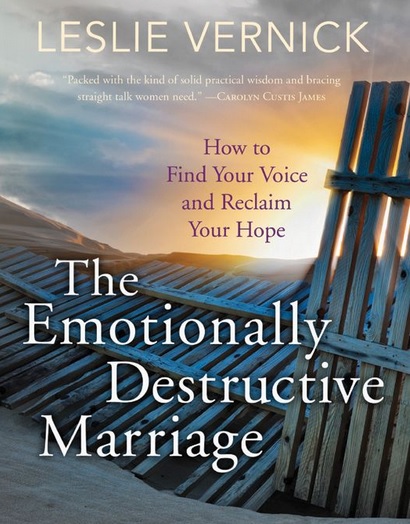
As predicted, the biblical counseling movement overseen primarily by the Association of Certified Biblical Counselors (ACBC) has become a divorce mill via its efforts to build marriages that “look like the gospel.” And the smoking gun is a book written by Leslie Vernick titled The Emotionally Destructive Marriage: How to Find Your Voice and Reclaim Your Hope that is widely used among ACBC counselors.
The obvious problems here are first seen in the title of the book. As Christians, is it really our goal to, “find our voice”? I thought it was our goal to please God in every circumstance. Secondly, the idea of emotional destruction is subjective at best and a ticket to do anything you want at worst. To make the point here, Google “American Civil Law.” In a culture judging anything that causes bad feelings to be abuse, such an approach to “biblical counseling” should give one pause.
Thirdly, why do Christians need a 240 page book written by a serial regurgitator of other people’s thoughts to FIND hope? You would think that by now Christians would be fairly certain about where hope is found.
Chilling is the examination of the 61-question survey found in the book that supposedly determines if one is in an abusive relationship or not. In the hands of a person that is unhappy in their marriage, the outcome will be a foregone conclusion. It’s like asking a chicken if Colonel Sanders is an emotional abuser.
The lynchpin becomes the ACBC’s loose interpretation of 1Corinthians 7:12-16. If the spouse is already an unbeliever, emotional abuse is tantamount to departing from the marriage even if they have not left physically or filed for divorce. Church discipline takes care of the pesky obstacle of the “abusive” spouse being a believer—they can be declared an unbeliever…actually MADE an unbeliever by elder authority supposedly vested to them by God. This paves the way for sanctified divorce.
It boils down to this: whoever is handed the book by the counselor is coronated as the abused spouse. Be sure of this: if both counselees in a bad marriage were handed the book, both would be guilty of the same thing. This is the smoking gun: it depends on who the ACBC “biblical counselor” wants to label abusive for whatever the motives might be.
I think a present situation that I am involved in says it all. I know enough about the situation to know that if the person I am talking with took the book’s survey, the other spouse would be judged as emotionally abusive hands down. The other spouse was handed the book because of who the ACBC counselor wanted to label “abusive.”
This is the niche service that Leslie Vernick now supplies to ACBC counselors.
paul
New Calvinism’s Dirty Little Secret: How They Practice “Redemptive” Church Discipline
 Don’t misunderstand, I’m not crazy about how most churches practice church discipline to begin with; for example, I don’t think Matthew 18:15-35 is a grid for church discipline—I think it’s a grid for resolving conflict among Christians. I also think the term is unbiblical as well; there is self discipline in the Bible, and there is God’s discipline, but there is no discipline practiced by the church. The church is to put certain procedures into motion that will pave the way for God to discipline, but the church does not perform the discipline. It’s an important distinction.
Nevertheless, churches need to be proactive in a biblical way in regard to resolving conflict and confronting sin. But the best kept secret of the New Calvinist movement (Gospel Sanctification / Sonship Theology, hereafter NCGSS) is its creepy, cultish way of practicing what they call “redemptive church discipline” (hereafter RCD). RCD is mostly practiced by Reformed elders in Baptist circles where local churches are not accountable to higher authorities. However, that will change as church hierarchies continue to show a lack of intestinal fortitude in regard to standing up against the big names of New Calvinism (hereafter NC).
It all begins with what is becoming clearer to me as I understand more, and more about this movement—everything is about an extreme form of justification, ie., being justified by Christ and His works alone. You would think that it would be impossible to take that belief to an extreme, but NC certainly does. Whether they will admit it or not, among other extremes, they teach that our present obedience was imputed to us by Christ in His atonement and presently performed by Him, and not us. They call this “the imputed active obedience of Christ.” They often speak of the necessity that Christ lived a perfect life while here in the flesh so that His perfect obedience could be imputed to us along with a legal declaration of righteousness. So, other than His death on the cross (what they call His “passive” obedience) and His resurrection being efficacious for the atonement—His perfect life (“active” obedience) is not assumed by virtue of the fact that He is Christ, and was also needed so that obedience could be imputed to us as well.
However, while pounding that point home, when you ask them if Christ’s obedience is still active, you get the deer in the headlight look. Why? Because if they say “yes” (and trust me, according to their doctrine, the answer is “yes”), that can only mean that He is presently obeying in our place. If you pay attention, you can see hints of this in their unguarded statements. In an informal document written by Jon Zens that recounts his conversations with Robert Brinsmead, the subject at hand was “the centrality of Christ in obedience.” A reader coined a phrase yesterday that may be apt: “imputed sanctification.”
This extreme view of justification also leads NC to deny the centrality of the Father and the new birth. Logical conclusions also point to unorthodox teachings such as daily justification, or the need to be resaved on a continual bases. This blog is replete with quotes that affirm these accusations.
It therfore stands to reason that church discipline must concern justification as well. The problem this poses for NC is the fact that orthodox church discipline calls for obedience on the part of the believer—which shifts the “emphasis to the believer and away from Christ” (what they call an erroneous subjective justification rather than an objective justification). Therefore, they had to come up with a church discipline that focuses away from demands upon the Christian and implements the works of Christ instead. Hence, “redemptive” church discipline.
How does it work? First, the sin really isn’t the issue per se. Elders may announce to any parishioner at any time that they have been placed into the process of RCD. In RCD, the “steps” are not the Matthew 18 steps that could lead to disfellowship, rather, the steps are part of the process of which you are either in or out of—via elder announcement. If the elders perceive that you have a cooperation or colaboring view of sanctification, you can be placed into the process to correct your view of redemption—that’s why they call it RDC. Therefore, a member could find him/herself in the process because of a theological discussion with an elder, and in fact, this has happened. Once in the process the parishioner is not free to vacate his membership until the elders determine “fruit meet for repentance.” The process can move from step to step (supposedly per Matthew 18) within the process if the individual in the process shows no acclimation to the “proper” view of redemption. Eventually, no movement in the desired direction (months, or even years later) can lead to the fourth and final step—disfellowship.
Those who try to leave that particular church in the midst of the process are also disfellowshipped—the congregation naturally assumes this happened because the member attempted to vacate membership before an offended party, or those confronting sin could confront him in a second or third step with witnesses in a traditional church discipline. In other words, parishioners in NC churches usually don’t know that their elders are practicing this kind of discipline, but rather assume the more traditional practice. Worse yet, the congregation also assumes sin of the baser sort as the reason for the excommunication.
Secondly, any kind of sin can be cause for RCD because sin really isn’t the issue; the sin is merely the result of the person’s view of redemption—fix his/her’s view of redemption, and Jesus will start obeying for them—problem solved. Furthermore, since redemption is the goal, elders who practice RCD can also (so they think) bring non-members into the process because the church has a mandate from Christ to make disciples of all nations. Therefore, a parishioner who pretends to be converted to NCGSS in order to escape a church without being disfellowshipped can still be excommunicated if they tattle on the elders to existing members after they leave. In fact, this has happened.
Lastly, this puts counselees in a very precarious situation. Many churches who are NANC certified practice RCD. Basically, counselees can find themselves held hostage at a church via threat of public humiliation. This ministry is aware of many testimonies accordingly: people being placed in RDC for tithing issues, priority issues—you name it, while discussion of this form of discipline is nowhere to found. A more vile consideration is marriage counseling where one spouse accepts Gospel Sanctification and the other spouse doesn’t—resulting in the conclusion that it is a mixed marriage (believer/unbeliever). This of course, puts the marriage in a very dangerous circumstance.
Would proponents of NC like to deny this? Well then, simply answer this question: “Why do you call it “redemptive” church discipline? Isn’t the word, “redemption” a little strong when we are talking about reconciliation? Please explain, and for once without hiding behind the word, “gospel.”
paul
Until Death Do Us Part…Unless: Job 2:9
I’m not much for pomp and circumstance; now that Susan and I are engaged, I say let’s go to the courthouse, gett’r done, and get on with the Lord’s business of being married. Susan has different ideas. She was sharing one of those ideas with me a couple of weeks ago; specifically, she would like us to kneel together at the alter at some point during the ceremony – a demonstration of humility before the Lord and witnesses.
At first, because of my general indifference to ceremonial subject matter, the idea didn’t exactly raise my pulse rate. But then I started thinking about Job’s wife, and good old-fashioned American wedding vows in general: “…to love and to cherish, in good times and bad, till death do us part.”
Ceremony. Why my disdain? Because of what it has become in this country, especially ceremonies involving vows, and all because the world doesn’t take God seriously. Psalm 15 describes those who are allowed to dwell with God; one of those characteristics is a person “…who keeps his oath even when it hurts…” (verse 4). God is very serious about vows because He doesn’t dwell with those who are not like Him. When God makes a promise – He is faithful, always.
But before we even get to the American wedding vow, you have to eliminate the following consideration: even among professing Christians, weddings have become a ceremony / party hybrid. For example (on Facebook), I read in disbelief as a recent convert confronted the wives of seasoned pastors (well known, and supposedly on the cutting edge of Reformed theology) because they applauded the posting of a video documenting a wedding that had all of the appearances of being traditional until the wedding participants suddenly sprang into a choreograph using a song that depicts illicit sex. Ha, ha, hee, hee, very funny, wow, how cool is that? Well, the pastor’s wives thought it was pretty cool, and encouraged other engaged ladies who were part of that Facebook group to do the same, or something similar. They also dismissed the protesting young lady as, you guessed it, “legalistic.” Go figure.
Now we move on to consider those who wouldn’t cheapen the ceremony in this way, but recite the same vow that Job’s wife recited (or as we may assume, something similar): “…to love and to cherish, in good times and bad, till death do us part, unless_____________”(fill in the blank with just about anything). Job was a good husband (Job 1:1), and when God took away what his wife might have loved most about him (Job 1:3), she said, “curse God and die” (Job 2:9). Job’s reply reveals one of his righteous characteristics; he didn’t accuse her of being characterized by foolishness, but said that she was speaking “like” one of the “foolish women” would speak. And in the context of marriage, and regarding spouses in general, both husbands and wives, what is that? Simply put, it is a spouse that doesn’t understand a major reality regarding wedding vows. Job stated it to her this way: “He replied, ‘You are talking like a foolish woman. Shall we accept good from God, and not trouble?’”
That would be the “in good times and bad” part of traditional marriage vows. It is the accepting of whatever God has for us in life as a married couple; good or bad, and faithfulness to each other following. Regarding the “to love and to cherish” part, Job had to minister to himself (Job 2:7,8). As far as the “till death do us part,” Job’s wife is nowhere mentioned by the time his three friends arrive to minister to him. In fact, she insisted that he would shorten that part: “Curse God and die.”
Christians forget that we are in the middle of a war between the kingdom of darkness and the kingdom of light (Job 2:2-6), and married couples are intimate partners in the midst of that warfare; they are to be ready for anything. It is also clear in Scripture that marriage is a major front in that warfare of which the kingdom of darkness is keenly interested (1Corinthians 7:5). Somehow, even among Christians, the marriage ceremony before God and witnesses marking the commitment to stand together in the midst of spiritual warfare, and for God’s glory, has become a flippant, lighthearted affair. At best, the vows are just ceremonial words to be looked at like flower arrangements around the alter, rather than soberly heard to drive the heart to deep resolve. At worst, a mere party where the god of innovation is called on to make the event a “special memory” that will last as long as a thrilling ride on a roller coaster.
Now Susan’s idea looks pretty good. In light of the fact that we do not know what God will call on us to do, we should kneel before God, the angels, and all the human witnesses to call on God to be with us, and to strengthen us in deep love, whether the days be good or evil, that we be found like Him: faithful.
paul
Jay Adams: Marriage is to Solve the Problem of Loneliness, and My Thoughts on Liberating Simplicity
Recently, I had reason to be concerned with the whole issue of divorce and remarriage. I’m just one of those strange guys that thinks God’s opinion matters in how we conduct our lives; in fact, I believe the Bible calls it “walking in the Spirit.” That is, I believe walking in the Spirit is the same as walking according to the will of God as revealed in the Scriptures. Also, I’m old enough to conclude, as I have observed the landscape of life over the past 53 years, that confusion and indecision is bad, and wisdom that leads to doubtless direction is good; you are usually at peace with yourself and the results are mostly favorable. And if the results are not favorable from a pragmatic perspective, our primary goal of pleasing God is still intact anyway; it is always a win / win proposition.
So why would I go out and buy a book (“Marriage, Divorce, And Remarriage In The Bible” by Jay Adams) instead of just looking in the Bible myself? Well, because God’s will in every situation is not always easy to ascertain in the Scriptures. Some life issues are complicated, and God has this really neat system where he pays certain men to study the Scriptures full-time and document what they find, so that layman like myself can get this all-important information in a timely fashion while confirming the conclusions with our own Bibles. Granted, in our day, most of the men that God has blessed with this privilege have squandered the call and continue to come up with better techniques in doing so, but Jay E. Adams is not among them. In fact, though my own situation is extremely unique, somehow, I assumed I would find his (Adams) book a useful tool in finding God’s will and I was right. Confusion bad. Clarity good. Me happy.
But this is really a post about simplicity that liberates. Over the years I have had the privilege of counseling people and watching their response as I unapologetically give them God’s solution from the Scriptures. I never get weary of seeing their response when they find out their dilemma is not nearly as complicated as the world and lame theologians made it out to be. They get this wide-eyed look, then they look down at what you showed them in the Bible on their lap, then they look up at you again, repeating this process several times in some cases. It’s called hope. It’s the halo data you see when a captive to confusion has been set free. It’s the look you get when a person realizes that God’s wisdom supplies a way out according to the Lord’s purposes.
I was reminded of all of this as I approached chapter two of Dr. J’s book. The very title of the chapter stopped me dead in my tracks: “What Marriage Is All About.” Oh my, If only I had a dime for every theory that attempts to answer that question! (why did a picture of Oprah appear in my mind? Weird). But what stopped me in my tracks even more was Dr. J’s biblical answer to the question: marriage is to solve the problem of loneliness. That’s it? Now I was the one with the before mentioned deer-in-the headlight look. Yes, in fact, Adams refers to it as a formal biblical covenant: “The Covenant of Companionship.” He cites Genesis 2:18 to make the point that man is not wired to be alone. By the way, as I was confirming this information I discovered that the English spelling for the Hebrew word “alone” in Gen. 2:18 is B-A-D (according to “E-sword”). That doesn’t mean anything, I just thought it was interesting. Furthermore, I found his assertion that this simple purpose for marriage was an actual covenant in the Bible to be rather bold as well, but in his typical mode of operation, he backed-up this assertion well with Proverbs 2:17 and Malachi 2:14; both of these references specifically link the idea of companionship with the marriage covenant.
So, on one page only, I was taken aback thrice. But now I confess, my surprise came from a bad memory. You see, though much truth in the Bible is simple, the ramifications are profound. The problem of loneliness is profound. Let me explain. I recently experienced the great joy and privilege of accompanying my son-in-law (David) and my daughter on a road trip in which he had several speaking engagements. One night, we stayed at a bed and breakfast owned by friends of David, and that night, several people were invited over for fellowship. As we sat around a large table after dinner, David suggested that every one present share their testimonies. One lady was single for reasons unknown to me, but after sharing how she came to know Christ she began to tell the strangers sitting there about a nemesis in her life: loneliness. As she began to share in regard to this her countenance quickly morphed into an expression of utter despair and she began to openly weep. When this event was brought back to mind as I pondered the Adams thesis I remember her face like I saw it yesterday and a portion of her pain is still with me.
But let’s talk about my failure that night as well. The healing, hope, and encouragement I could have given her that night from the simple truth of God’s word is an unfortunate omission that goes on way too much in Christianity. I could have told her why she felt the way she did, and what God wanted her to do about it. I could have also shared yet another simple, but profound truth that Adams shared on the very next page of that book: singleness and marriage are both gifts (1Cor. 7:6,7), and as Christians, we are commanded to practice our gifts. If one is called to be single, they need to practice that gift, if one is called to companionship, they are called to practice that gift as well. Yes, I could have explained her pain, and tempered her self-pity with God’s loving direction, but I sat in ignorance. Two simple pages – so much pain.
But more can be said of this in something I did right on another occasion. A single man approached me who was being counseled by a pastor in regard to his struggle with being single. Here is where I must practice restraint because I will inform you that I have been known to vent my frustration a time or two on this blog. The young man was being counseled by his pastor that his struggle was due to evil desires from an idol in his heart that was causing him to desire companionship with a woman more than Christ, and if he used Scripture to see more of Christ, his desires would be reoriented, or realigned with a proper desire for Christ, and thus eliminating the struggle at hand. Sigh. Do I really have to expound on the problem here? And how it effects the lives of Christians in profound ways? The desire didn’t come from an idol, the desire came from a void that the Bible fully explains in very simple terms. My counsel to him was to worship Christ by getting married immediately. He looked at me like I was crazy! It was just really all kinds of fun, especially when I told him it might be necessary to change churches because the church where he was attending lacked sufficient candidates, and his pastor was a bozo.
But I did fail on one wise. The young man honestly related his fear that he would fail at marriage. I could have told him that we are gifted at marriage / companionship; it’s a spiritual gift, and God has given us all the spiritual resources we need to be successful at it if we will only obey. Yet another simple, profound, biblical truth that is not always easy to accomplish – it takes effort on our part that goes way beyond the mystic management of heart idols.
By the way, he got married a short time later, and I wasn’t invited to the wedding! Oh well, such is ministry.
paul
“Gospel Driven Divorce”: Is Your Marriage in Imminent Danger?
Rush Limbaugh often says he knows liberals like every inch of his glorious naked body. I must confess, even with all of the study I have done on the *gospel driven life*, or *gospel driven sanctification*, I think I still know my body much better. New revelations concerning GDS are often so bizarre that it takes time to finally come to grips with the fact that its proponents actually advocate various elements. First, for those who are not familiar with GDS, here is a thumbnail of what it teaches:
The same gospel that saved us must be meditated upon every day in order to grow spiritually. The whole Bible is about the gospel and nothing else. According to John Piper: “That’s why the Bible is so big; there’s a gospel application to every event in life” (slight paraphrase-see video entitled “The Gospel in 6 Minutes” Sept. 12, 2007- Desiring God Ministries). Therefore, we meditate on the gospel through looking for it in the Scriptures, and as we meditate on the gospel as seen in the Scriptures, “we are changed from glory to glory,” or in other words: “Beholding as a way of becoming” (John Piper, “The Pleasures of God” pg 15 ). Also, according to John Piper, we should “never, never, never, never, never, never, never, think that the gospel saves us and then we move on to something else”(“The Gospel in 6 Minutes”). In fact, most proponents of GDS think that any “moving on to something else,” even if it falls under the category of discipleship, is a false gospel and you therefore forfeit both justification and sanctification. In other words, if you believe in synergistic sanctification- your lost.
So then, everything in the Bible must be seen in light of the gospel, and interpreted accordingly; marriage and divorce would not be an exception to this rule in any regard. In short, if you are a believing spouse, and your marriage doesn’t “look like the gospel” ( the relationship between Christ and his bride, the church) you are free to divorce your spouse. Buckle-up, here is an article that advocates this GDS view:
Gospel Love, Marriage & Divorce
“Recently, I have been studying the Scriptures and paying closer attention to how it is most of us as Christians have understood love, marriage and divorce. Surprisingly, although we say we believe that the most intimate of marriage relationships is to be modeled by Christ and his relationship to the Church, we do not, in our theology, really seem to believe or practice that.
We seem to have allowed our understanding and definition of marriage be something that is not a reflection of Christ and the Church. Marriage, we are told, is between a man and a woman. Agreed. That is a principle definition of marriage that definitely stems from God’s design of marriage back in the garden of Eden. However, that is only part of the formula for what constitutes a marriage. The most important ingredient that we as the Church have allowed our secular influences to omit is none other than God himself. Biblically, God is necessarily 1/3 of the relational equation in order for a marriage (or a church!) to be “joined together by God.” Likewise, apostate churches that do not properly include God, are not recognized by God. By definition, a true marriage or Church must include the one true God as a common denominator.
As the Church, we have then failed to see the legacies of Divine love, marriage and divorce throughout the Scriptures. And because we have embraced a marital world-view that can be devoid of God, we have found ourselves struggling with the whole subsequent understanding of how to understand divorce.
In Scripture, where divorce is sanctioned by God, the aim is always redemptive in some sense. It is always gospel driven.
Abraham divorced his 2nd wife, Hagar, because of gospel unbelief (Genesis 21:10-12; Galatians 4:29, 30).
Ezra, the prophet, counseled the entire nation of Israel to divorce their foreign/unbelieving wives…”according to the Law” (Ezra 9, 10).
God gave Israel a certificate of divorce for her antinomian apostasy: gospel rejection (Jeremiah 3; John 15; Romans 11).
The men who divorced their wives in Malachi were rebuked for doing so due to the fact that their wives remained faithful to God. These men divorced their “believing” wives only to marry non-believers. This, God hated.
Paul exhorts the believers in Corinth who are still in a mixed marriage to “Do not be yoked together with unbelievers…come out from among them and be separate” (2 Corinthians 6:14-18).
Again, Christ divorced the church of Laodicea for its gospel rejection, for embracing an antinomian apostasy as well (Revelation 3).
The common denominator that is found amongst every single divorce that was sanctioned by God was a HEART denominator, a GOD denominator that was identified as not being existent in the marriage.
So when we read the words of Jesus, “Except for fornication, a man must not divorce his wife,” we do not take his meaning of fornication (GK: pornea) as being literal. From the consistent revelation given elsewhere in Scripture, he was understandably speaking of a spiritual fornication: love for the world.
Once this God centered understanding of marriage and divorce is understood, we no longer have to struggle with the idea of “what kind of sins can qualify as “pornea”? We no longer have to tell married wives, “I know your husband beats you, occasionally, and perhaps he only beats your children. However, God never said it would be easy to be a follower of Jesus, so you need to understand that it is His will for you to remain married to your miserable and unbelieving husband (or apostate spouse).”
“I tell you the truth,” Jesus said to them, “no one who has left home or wife or brothers or parents or children for the sake of the kingdom of God will fail to receive many times as much in this age and, in the age to come, eternal life.” Luke 18:29, 30.”
Get the picture? The crux of the article is this excerpt: “In Scripture, where divorce is sanctioned by God, the aim is always redemptive in some sense. It is always gospel driven.” Basically, what it boils down to is this: in reformed circles where GDS is propagated, all bets are off; any marriage that doesn’t “look like the gospel” is possible fodder for divorce court. But who in the world would be the judge of that? No marriage is perfect; at what point would one decide that it is or isn‘t? Well, welcome to the nebulous world that is GDS.
However, in this environment, any mixed marriage (believer and unbeliever) would certainly be doomed to failure, for no unbelieving spouse could live up to a picture of God’s marriage with the church. The believing spouse, once in such a church, will have a green light to divorce the second the ink is dry on the membership application. But here is a problem as well: now you have a situation where the marriage is only valid if a certain standard is met. Isn’t that the antithesis of the gospel? Well, welcome to the contradictory world that is also GDS. But you say, “hey Paul, at least the other spouse has to be an unbeliever. If your both saved; and in such a church, your safe, right?” Yes you are, if you both are proponents of GDS. Remember, more traditional views of the relationship between justification and sanctification are deemed to be a false gospel in GDS circles.
The proof is in the pudding. I predict that divorce will soon become rampant in reformed churches, if it isn’t already. I know of a few that actually pride themselves in “building marriages that look like the gospel.” Unfortunately, this is often done through divorce and remarriage, with God’s supposed stamp of approval. Some of these churches, even small ones of 200 or 300 members, average a divorce and remarriage to the tune of one per year. I also predict that as the word gets out, spouses will begin to go to these churches with the ill intent of getting a church-sanctioned divorce. Stay tuned.
paul

 Paul's Passing Thoughts
2 comments