The Essence of Gnosticism and Why the Proof is NOT in the Pudding
 Originally published September 2, 2014
“To emphasize the shadows is to emphasize life itself.”
There is one proof that today’s church is saturated with Gnosticism, other than the tyranny that comes with it. For the most part, when you listen to any given message taught to Christians, you will notice that a neutral or third option is missing. It’s an either/or worldview. The essence of Gnosticism is known as “dualism.” All knowledge is either good or evil. In the case of Protestantism, it’s Luther’s cross story or glory story: the knowledge of good and evil; sound familiar? All reality falls into two categories only: it’s EITHER about you, OR it’s about the cross.
“_______…is not necessarily a bad thing (fill in the shadow element), it’s just not the best thing.” Yes my friend, why do you emphasize the shadows when it is only the Son that gives life? In Protestantism, “Son.” In Platonism, “Sun.” For both: shadows = life and the material realm. To emphasize the shadows is to emphasize life itself.
Shadows are true. Plato never said that shadows don’t exist—he just deemed them useless for true knowledge. The virtuous person does not live in the shadows, he/she lives according to the true,good, and beautiful aka Plato’s trinity. The shadows, viz, life and whatever may be going on, is irrelevant to the wellbeing experience of the true, good, and beautiful. In the same way, good Protestants are deemed happy regardless of their circumstances; it is well with our soul.
If ISIS raises their flag above the White House—it is well with our soul.
If there is a pedophile in our church—it is well with our soul.
“Justice!” you say? If you want self-justice, you are just as guilty as the one who followed his self-desire. Come now, use this preordained opportunity to be the bigger person, to show forth the cross of self-denial. If you deny yourself justice, you are showing forth the gospel to the one who should have denied himself the fulfillment of his self-desire. We must “bring grace to the situation.” We must “show forth the gospel.” We must show forth the self-death of the cross.
All of these things are just shadows after all. And to the Gnostic, whether an atheist or a good Protestant, the biggest shadow of all is capitalism. The profound spell of Plato is that he appeals to the social scientist and the religionist alike. Self-concept is the waters of the shadow world that we swim in. To the degree that we empty self and live solely for the sake of community, our individual soul is transformed. To the degree that individuals are transformed, society is transformed. Atheists and Protestants must not fuss; here now, hold hands and say, “ahhhmen.” After all, we all want the same thing: community wellbeing.
One is greatly mistaken if they point to the woes of societies living in the rotten fruits of Eastern mysticism as a contention. Those people are deemed virtuous because they are content in the shadows. If everyone would follow their example, the world would be balanced and the true, good, and beautiful would be manifested. The only reason that countries are poor is because capitalism’s greed takes from some and gives to others, and the earth is therefore unbalanced. The only way to a balanced, unified earth is collective self-death. This is where the liberal Democrat and the Neo-Calvinist both walk in the way of Martin Luther’s cross story.
Hence, the likes of ISIS is an unfortunate example of those who are a bit over-zealous. But they understand the importance of devaluing the life of the individual—they are just a bit extreme in demonstrating that truth. They are misguided, but yeah, if only the capitalist understood their child-like faith.
Bad results are no pudding test. Capitalism isn’t the cure, it’s the cause. This is where the contrast between Christ who said, “the poor will always be with you,” and the dominion theology of the Neo-Calvinist and the liberal democrat alike should strike terror in our hearts.
paul
Calvinism and the Problem with Perfection
 Originally published November 7, 2013
Augustine, Luther, and Calvin were first and foremost Platonists. They integrated the Bible with Platonism. Plato’s theory of forms posits the idea of two worlds; the mutable material world of illusion where reality can only be partially known, and another world where the immutable objective true forms exist. This material world is a shadow world; everything is shadows of the true forms. Therefore, man can only interpret and experience this world subjectively. The tendency is to interpret reality by observing the shadows. To the degree that mankind thinks the material world is reality according to the five senses, subjectivity and chaos will abound.
Therefore, Plato’s ethic was to improve the subjective experience of this life by accessing the true forms through ideas and mathematics—things that transcend the five senses (he believed math was an unchangeable rule and therefore not part of the shadow world). He believed that those who have the capability and willingness to bring more understanding of the objective into the subjective to be an elite minority. These were Plato’s philosopher kings whom he thought should rule society in order to decrease chaos as much as possible. Without philosopher kings, the world would be awash in a sea of subjectivity, everyone living by their own subjective presuppositions based on the shadows of this world. Hence, the arch enemy of the Platonic ideal is individualism.
Plato’s world of true objective forms was his trinity of the true, good, and beautiful. Experiencing the pure form of goodness in this world is impossible—only a shadow of good can be experienced subjectively. Plato’s social engineering has a doctrine, and to the degree that doctrine is applied, a higher quality of subjective existence occurs.
The Reformers put a slightly different twist on this construct. There is no doctrine to apply, only an orthodoxy that focuses on seeing and experiencing. Their version of Plato’s philosopher kings are pastors who possess the power of the keys. Orthodoxy is mediated truth determined by “Divines,” and passed down to the masses for the purpose of experiencing the objective power of the gospel subjectively. The Reformers made the true forms “the gospel,” and reality itself the gospel, ie., the work and personhood of Jesus Christ in particular.
Therefore, in the same way Plato envisioned a society that experiences the power of the true forms subjectively through ideas and immutable disciplines like mathematics, the Reformers sought a heightened subjective experience through a deeper and deeper knowledge of their own true, good, and beautiful—the gospel. And more specifically, instead of the gateway of understanding being reason, ideas, and immutable disciplines, they made the gospel itself the interpretive prism. So: life, history, the Bible, ie., everything, is a tool for experiencing true reality (the gospel) in a higher quality subjectivity. The Bible and all life events are a gospel hermeneutic. Salvation itself is the interpretive prism. All of reality is about redemption. Salvation itself is the universal hermeneutic.
But both constructs have this in common: Pure goodness and perfection cannot exist objectively in the material world. This is where Calvinism and Platonism kiss. The Bible only agrees with this if it is a “gospel narrative.” But if it is God’s full orbed philosophical statement to all men to be interpreted grammatically and exegetically, contradictions abound. To wit, if man possesses goodness and the ability to interpret reality objectively, Platonism and its Reformed children are found wanting. If Reformation orthodoxy is not evaluated biblically with the very theses of its own orthodoxy as a hermeneutic, even more wantonness is found.
The Apostles rejected Platonism because they believed goodness and perfection could indeed be found in this material world. There is no question of the quality of goodness inside of man that enables mankind to interpret reality objectively, the quantity of goodness notwithstanding. In contrast, a dominate theme in the Calvin Institutes is the idea that no person lost or saved can perform a good work. Like Plato’s geometric hermeneutics, the Reformers believed the Law lends understanding to man’s inability to do good because eternal perfection is the standard. The best of man’s works are tainted with sin to some degree, and therefore imperfect. Even if man could perform one perfect work, one sin makes mankind a violator of the whole law. The Reformers were adamant that no person could do any good work whether saved or lost.
Why all the fuss over this point? Why was Calvin dogmatic about this idea to the point of annoyance? Because he was first and foremost a Platonist. The idea that a pure form of good could be found within mankind was metaphysical heresy. Because such contradicts every page of the Bible, the Reformers’ Platonist theology was made the hermeneutic as well. Instead of the interpretation method producing the theology, they made the theology the method of interpretation. If all of reality is redemptive, it must be interpreted the same way.
For the Platonist, the coming of Jesus Christ in the flesh poses a huge problem. He is the truth. He came to the material world in a material body. Platonism became Gnosticism and wreaked havoc on the 1st century church. Notice how the first sentences of 1John are a direct pushback against the Gnosticism of that day:
1John 1:1 – That which was from the beginning, which we have heard, which we have seen with our eyes, which we looked upon and have touched with our hands, concerning the word of life— 2 the life was made manifest, and we have seen it, and testify to it and proclaim to you the eternal life, which was with the Father and was made manifest to us— 3 that which we have seen and heard we proclaim also to you, so that you too may have fellowship with us; and indeed our fellowship is with the Father and with his Son Jesus Christ. 4 And we are writing these things so that our joy may be complete.
Christ is the true, good, and beautiful, and He was touched, felt, seen, heard, and understood. Game over. This is the paramount melding of Plato’s two worlds resulting in a plenary decimation of his philosophy. Nevertheless, Calvin et al got around that by keeping mankind in a subjective realm while making the material world a gospel hermeneutic. Reality still cannot be understood unless it is interpreted by the gospel—everything else is shadows.
Martin Luther took Plato’s two worlds and made them two stories: our own subjective story, a self “glory story” that leads to a labyrinth of subjectivism, or the “cross story” which is the objective gospel. Luther made Plato’s two worlds two stories, but still, they are two realms: one objective and one subjective. In the final analysis mankind is still incompetent, and void of any good whether saved or lost.
Whether the Reformed gospel or Platonism, the infusion of objective goodness is the heresy. Man cannot have any righteousness in and of himself, whether lost or saved. The pushback against this idea can be seen throughout the New Testament. A few examples follow:
1John 2:4 – Whoever says “I know him” but does not keep his commandments is a liar, and the truth is not in him, 5 but whoever keeps his word, in him truly the love of God is perfected.
1John 2:20 – But you have been anointed by the Holy One, and you all have knowledge.21 I write to you, not because you do not know the truth, but because you know it, and because no lie is of the truth.
1John 2:26 – I write these things to you about those who are trying to deceive you. 27 But the anointing that you received from him abides in you, and you have no need that anyone should teach you. But as his anointing teaches you about everything, and is true, and is no lie—just as it has taught you, abide in him.
1John 2:29 – If you know that he is righteous, you may be sure that everyone who practices righteousness has been born of him.
1John 3:2 – Beloved, we are God’s children now, and what we will be has not yet appeared; but we know that when he appears[a] we shall be like him, because we shall see him as he is. 3 And everyone who thus hopes in him purifies himself as he is pure. 4 Everyone who makes a practice of sinning also practices lawlessness; sin is lawlessness. 5 You know that he appeared in order to take away sins, and in him there is no sin. 6 No one who abides in him keeps on sinning; no one who keeps on sinning has either seen him or known him. 7 Little children, let no one deceive you. Whoever practices righteousness is righteous, as he is righteous.
Romans 15:14 – I myself am satisfied about you, my brothers, that you yourselves are full of goodness, filled with all knowledge and able to instruct one another.
Christians can know goodness, and perform righteousness objectively. This speaks to the quality of the righteousness when it is performed—it is perfect and acceptable to God. We are not limited to a mere subjective experience in regard to righteousness. When we are resurrected, the quantity thereafter will be 100%, but our present righteousness is acceptable to God when it is performed by us. If it is accepted by God, it is perfect.
Even the unregenerate know good, and can perform it. The works of the law are written on their hearts, and their consciences either accuse or excuse them (Romans 2:12-15). Though enslaved to unrighteousness, they are free to perform righteousness (Romans 6:20). The very goodness of God can be understood from observing creation as well (Romans 1:20).
The only way the Reformers can make all goodness outside of man is to make the Bible a salvation hermeneutic. It is the only way they could integrate the Bible with their Platonist philosophy.
paul
The Magnum Opus of the Reformation: Martin Luther’s Heidelberg Disputation, Part 7: Martin Luther’s Unveiling of the Bondage of the Will
Listen to, or download audio file.
Welcome truth lovers to Blog Talk radio.com/False Reformation, this is your host Paul M. Dohse Sr. Tonight, part 7 of “The Magnum Opus of the Reformation: Martin Luther’s Heidelberg Disputation, Martin Luther’s Unveiling of the Bondage of the Will.”
Greetings from the Potters House and TANC ministries where we are always eager to serve all of your heterodox needs. Our teaching catalog can be found at tancpublishing.com.
If you would like to add to our lesson or ask a question, call (347) 855-8317. Remember to turn your PC volume down to prevent feedback. If you choose to use Skype to listen to the show, my advice is to just dial direct from your Skype account without using any of the Blogtalk links. 347-855-8317.
Per the usual, we will check in with Susan towards the end of the show and listen to her perspective.
Remember, you may remain anonymous. When I say, “This is your host; you are on the air, what’s your comment or question”—just start talking.
If you would like to comment on our subject tonight, you can also email me at paul@ttanc.com. That’s Tom, Tony, Alice, Nancy, cat, paul@ttanc.com. I have my email monitor right here and can add your thoughts to the lesson without need for you to call in. You can post a question as well.
Tonight, we continue in our sentence by sentence evaluation of the HD [Heidelberg Disputation] after addressing some asides in parts five and six. We hear a lot about Martin Luther’s bondage of the will. Tonight, we are looking at the very conception of Luther’s beliefs on the human will. What we are going to find is that Luther’s explanation of human will derived from his position of mortal and venial sin.
Simply stated, if one believes that every act they perform is mortal sin, even their good works, their life is forgivable. Man must not believe he can do a good work. Let’s use theses 11 and 12 to segue into thesis 13 which is the first unveiling of Luther’s bondage of the will.
Thesis 11: Arrogance cannot be avoided or true hope be present unless the judgment of condemnation is feared in every work.
This is clear from Thesis 4. For it is impossible to trust in God unless one has despaired in all creatures and knows that nothing can profit one without God. Since there is no person who has this pure hope, as we said above, and since we still place some confidence in the creature, it is clear that we must, because of impurity in all things, fear the judgment of God. Thus arrogance must be avoided, not only in the work, but in the inclination also, that is, it must displease us still to have confidence in the creature.
Here is something that I haven’t talked about enough in this series: the Reformers were masters of doublespeak. So far, it is obvious that Luther disavowed any value in regard to human life. Yet, in some sentences, he sort of makes it sound like that the issue is life without God. This isn’t the case at all; this is a strict dichotomy between 100% evil and 100% good with nothing in-between.
In contrast, God makes new creatures of mortal men. This flies in the face of Reformed ideology and all of the theology that flows from it. Note that, like all good Gnostics, Luther saw impurity in “all things.” And of course, that includes mankind.
Hence, as stated in this thesis by Luther, man must not have any confidence in self. In other words, God’s creation of man has no inherent ability. The natural ability to do anything is the glory story. Anything that brings glory to man diminishes God. Listen, as one example, the Puritans didn’t dress like they did for no good reason. To wear something with a little color or style would have been the glory story. By the way, do you want to help people? Know this: EVERYTHING people do they do for a reason. Logic drives action. If you want to help people, find the logic behind the action.
So, Reformed ideology splits reality into a strict either/or dichotomy; it’s either the glory story or the cross story. The glory story, or the story of man, can only bring about arrogance.
Let’s pause here to look at the foundational ideology of the Reformation which deals primarily with metaphysics. Like I said, everything people believe and do flows from their logic, so what is the logic that all of this stuff flows from? This is a very simplified version, but it really boils down to this: God does everything that He does because of His self-love. And because God loves Himself, He created evil as a contrast to His holiness. In other words, evil helps to define His holiness by contrast.
This leads to the essence of state of being, or metaphysics, or why things are, or their state of being, according to the metaphysical narrative. What’s a metaphysical narrative? Simply stated: state of being is a story written by God. Everything that is happening in the world today, right down to what people decide to wear, is predetermined by God in His historical prewritten narrative.
All of this benefits God’s self-love. Everything is for His glory. And according to this story, man thinking that he has freedom of choice on any level is evil, and what is he doing? Right, he is writing his own story. If you think that it was your decision to wear what you wore today, you are writing your own glory story. Either you are writing your own life story, or God is writing your life story. You are either god writing your own reality, or God is writing your realty.
Of course you don’t have freedom of the will—that would be writing your own reality—that would be making yourself God. We can also stop here and talk about how the Bible fits into this. The Bible becomes a prototype or model for interpreting reality according to God’s story which is primarily about redemption. The Bible is therefore a tool for interpreting reality according to the cross story, or God’s prewritten metaphysical narrative. And folks, this is everywhere. This way of using the Bible saturates the institutional church.
An example, one of myriads, is the Bible Mesh study material. Listen carefully to what these guys are saying in this promo for the study:
Notice the constant theme of Bible as story, and everything in the Bible being about Christ; ie., redemption. Notice that the Bible is also “your story” and this study enables you to put yourself in the story. You have heard me talk often about the redemptive historical method of interpreting the Bible and this is what it is. They make the Bible a tool for interpreting all of reality according to Martin Luther’s cross story metaphysics. And frankly, 90% of the evangelicals occupying the pulpit in the institutional church take this approach to the Bible.
Thesis 12: In the sight of God sins are then truly venial when they are feared by men to be mortal.
This becomes sufficiently clear from what has been said. For as much as we accuse ourselves, so much God pardons us, according to the verse, »Confess your misdeed so that you will be justified« (cf. Isa. 43:26), and according to another (Ps. 141:4), »Incline not my heart to any evil, to busy myself with wicked deeds«.
So, if you look at two slides on the program slide show, you see two contemporary illustrations published by the Reformed camp that explain where we have come to this point. The two man chart explains the metaphysics,


and the cross chart explains the application as stated in this thesis by Luther: “For as much as we accuse ourselves, so much God pardons us…” His use of Isaiah 43:26 pretty much puts it in a nutshell: confession of sin leads to ongoing justification which can only be found in the institutional church. If we believe man has no will to choose good, and that everything we do is sin, we qualify to be forgiven for purposes of ongoing justification. It’s not complicated.
Thesis 13: Free will, after the fall, exists in name only, and as long as it does what it is able to do, it commits a mortal sin.
The first part is clear, for the will is captive and subject to sin. Not that it is nothing, but that it is not free except to do evil. According to John 8:34,36, »Every one who commits sin is a slave to sin.« »So if the Son makes you free, you will be free indeed.« Hence St. Augustine says in his book ›The Spirit and the Letter‹: »Free will without grace has the power to do nothing but sin«; and in the second book of ›Against Julian‹, »You call the will free, but in fact it is an enslaved will,« and in many other places.
The second part is clear from what has been said above and from the verse in Hos. 13:9, »Israel, you are bringing misfortune upon yourself, for your salvation is alone with me,« and from similar passages.
Again, we will take note of something Luther was accustomed to in his doublespeak. Though he quotes Augustine saying that the will can do nothing but sin without grace, we know that Luther also believed that the will can do nothing but sin WITH grace. This is just another example of his doublespeak. This seems to be very indicative of Reformed teachers; they sow seeds of doubt that they are stating outrageous ideas, but after a space of time the outrageous, tempered by a contradictory statement, will be accepted through repetition. The doublespeak is a red herring until you are fully indoctrinated.
Luther is stating here that the will is “not free except to do evil.”
Thesis 14: Free will, after the fall, has power to do good only in a passive capacity, but it can always do evil in an active capacity.
An illustration will make the meaning of this thesis clear. Just as a dead man can do something toward life only in his original capacity (in vitam solum subiective), so can he do something toward death in an active manner while he lives. Free will, however, is dead, as demonstrated by the dead whom the Lord has raised up, as the holy teachers of the church say. St. Augustine, moreover, proves this same thesis in his various writings against the Pelagians.
Here is where we will employ some help from one of the leading Reformed scholars on Luther’s theology of the cross. This is from Gerhard O. Forde’s “On Being a Theologian of the Cross” which is a commentary on the HD.
Theses 14 and 15 are an attempt to define a little more closely what sort of ability may be ascribed to the will. If, as we have seen in thesis 13, the will is not nothing and is not forced or determined, and if, as we might say, we are not puppets, how then may the power of the will be described?
Pause.
Stop right there. This is the Reformed, “But of course we are not puppets, so how do we explain this?” But the only logical conclusion to Reformed ideology is that we are in fact puppets. In classic Reformed teaching protocol, the brainwashing technique is to deny the logical conclusion while hoping that you will function according to the very logical conclusion and goal that they are seeking.
Listen, according to their very own redemptive-historical hermeneutic, we are nothing but characters in a narrative. No, no, no, we are not puppets, rather, we are mere characters in a metaphysical narrative who are penciled in. And we have a choice, and this is a paraphrase, “…join the plot of the divine drama that includes your story, or attempt to be your own god and write your own glory story.” That’s it. That’s it in a nutshell.
I have been learning a lot from Susan about Jonathan Edwards, and she has so much data already accumulated that I don’t know whether she is going to be able to find this or not, but she was sharing with me about Edwards’ view of the will. Basically, he believed that before a person performs an action, God puts the thought, idea, will, and decision to act in one’s mind beforehand. This kind of goes hand and hand with Edwards’ belief that God is recreating reality at every moment. So, in essence, everything you do is a recreation of reality when it gets right down to it.
So this is how this works: the Reformed will continue to deny that we are puppets while teaching all of the elements of puppeteering. If you teach all of the elements constantly while never speaking of the logical conclusions, people will eventually function according to the logical conclusions which is what they are after. Functionality is the goal—not understanding. Reformation ideology is vehemently opposed to reason and understanding.
Here is another example: the official Reformed doctrine of already not yet. So classic. Sure, sure, you are already saved, of course you are! But not yet. So you think: “Well, sure, our salvation will be fully realized when we are resurrected. That makes total sense.” Well guess what? You just bought into progressive justification. See how this works? Salvation doesn’t have a beginning and an end. It’s a conception. Conception is a onetime final event that completes its work in an instant. You didn’t exist, now you do—end of story.
Let’s continue with Forde’s quotation.
If the claim is that we are to “do what is in us,” then the question quite naturally follows: What then is in us? What sort of capacity do we have?
Pause. Stop right there. Let me shortly answer that question according to 1John chapter 3 before we move on: God’s seed. God’s DNA. We are literally born of God and have His seed IN us. We are new creatures born of God.
To get at the question Luther here uses a distinction current in his day between what our translation has called a “passive capacity” and an “active capacity.” What does that mean? In its passive capacity the will can do good when it is acted upon from without but not on its own, not in an active capacity. A commonly used physical analogy is water. Water has a passive capacity to be heated, but it can’t heat itself. It has no active capacity to do that.
The example Luther uses in his proof is even more to the point because it deals with death and life. On the one hand, corpses could be said to have a passive capacity for life because they can be raised from the dead. But not, of course, on their own power, not in an active capacity, not even in the slightest. Not even by doing their best! The capacity they have is strictly passive. They can be raised, but only by divine power. On the other hand, it is of course true that while a people live they have the active capacity to do something about life and death. They can take life, either their own or some other, but they can’t create or give life. Yet, that only demonstrates that, after the fall, will in its active capacity can only do evil. Since will after the fall is dead and bound to do deadly sin, it can be rescued only from without, as indicated by the fact that it could not bring life out of death but could only be commanded from without by our Lord.
Thus, the fact that even after the fall the will is not nothing means that there is something there. What is it? It is a strictly passive capacity, not an active one. That means that it can be changed but it will not change itself. To be changed, it will have to be accessed “from without.” But it will take radical action. It will take death and resurrection. So we are again pointed toward the cross.
Here, we have plunged the depths of Martin Luther’s bondage of the will. Man is dead, and death is defined as the waters of mortal sin. The waters of mortal sin are not only what man dwells in, he is those waters. He is passively dead. The only active works he can do is dead works. The material realm is man’s glory story of death. He ebb and flows between dwelling in death and experiencing resurrection resulting from him being acted upon from the outside. Being acted upon is completely determined by God’s decision and good pleasure. The long and short of being saved is merely giving testimony to this fact and seeing it for what it is. Saving faith is giving testimony to what you see only, and not anything that you do.
To think you are not dead is mortal sin that cannot be qualified for forgiveness. And again, do see what these guys do? No, no, we are not puppets, right? A question: what do we know about puppets? Well, we know that they are dead. We know that they cannot do anything until they are acted upon, right? This Gerald Forde guy is just like all of the Reformed; he will deny that he is saying that we are mere puppets, and then will describe our Christian existence as puppetry.
This is what annoys me so deeply about people who listen to these yahoos because, “they say some good things.” Why would anybody spend any time investing in this intellectual dishonesty?
So, what is the biblical view of the will? Romans chapter 6. Before one is saved, they are enslaved to sinful desires and free to do good works. Slavery indicates the type of wages that the slave gets—only wages for death. Unsaved people are also indifferent to the law that they will be ultimately judged by. They do not love God’s law. But, they definitely have a free will to follow their God-given conscience and receive rewards for doing so. A person who lives a good common sense life will of course suffer fewer calamities than the foolish. But in the end, this only means less condemnation.
The saved person also has a free will. They are enslaved to righteousness, but unfortunately free to commit sin. However, they do not receive wages of death because they are no longer under the condemnation of the law. They can only receive wages for life. They are no longer indifferent to the law, but love God’s law and its truth. The chart below may help:
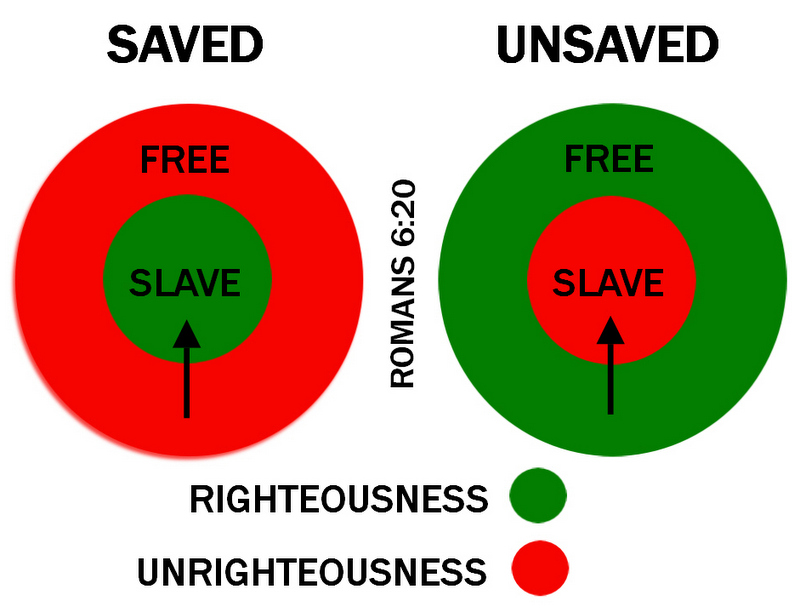
The new birth is a reversal of sin and slavery resulting in a change of direction. No one sins perfectly, and no one loves perfectly. It’s a direction, not perfection. But if you look at the Reformed cross chart again, neither is it a downward direction of sinful perfection resulting in making the cross bigger.
That’s the end of our lesson tonight—let’s go to the phones.
Sabbath “Rest” Soteriology
Just more evidence of the error of Reformed theology. Sorry boys, the Christian life is not equal to the sabbath “rest”. We are to work! Our “rest” comes when we receive our rewards at the Bema of Christ!
Andy

If You Don’t Have “A Righteousness of Your Own,” You Are Condemned
 “And frankly, that’s exactly what Protestantism teaches: that righteousness is on loan from Jesus.”
In vogue among evangelicals is the idea that we have no righteousness of our own. If we lay claim to a good work that pleases God, we must sanctify it with, “It wasn’t I who did it—it was Jesus working through the Spirit.”
To take credit for a good work is to steal the glory from God, and lay claim to a “righteousness of our own.” This idea is rooted in Martin Luther’s alien righteousness. It is the belief that all righteousness remains outside of the believer.
The result is a confused endeavor to do Christianity without doing anything; after all, “The just shall live by faith.” Therefore, Protestantism still struggles in the clarification of how we do Christianity without doing anything; after all, “It’s not about our doing, it’s about what He has done.” Protestantism is fraught with these doing it without doing it truisms.
Actually, Luther and Calvin articulated how the Christian life is done without doing, but Protestantism wouldn’t be any more popular than the Branch Davidians if Protestants knew the true tenets of Protestantism.
But here is the primary problem: Protestantism is a slick works salvation gospel. Basically, it turns doing nothing into a work; you do nothing to keep yourself saved. People assume that doing nothing with intentionality to obtain an objective is not doing anything. In reality, doing nothing is still doing something; it’s a “choice,” and deciding to do something or not do something is doing something in both cases.
The linchpin is Protestantism’s redefinition of the new birth which is redefined as an ability to better see what we can’t do, rather than a new creature who does things because of who we are.
Hence, if we have no righteousness of our own, we are condemned. If you are the least bit familiar with the New Testament, you know of the interpretive duo of “gift” and “reward.” Once you receive a gift, you own it, right? Salvation and the righteousness that comes with it is a GIFT. Rewards come in this life and the life to come as a result of how we put the gift that we now own into use. Primarily, the Bible calls that “love.”
But now think with me for a moment. If something is not a gift, what is it? Right, it’s a loan, and what do we know about loans? Right, you have to pay them back. And frankly, that’s exactly what Protestantism teaches: that righteousness is on loan from Jesus. We have no righteousness of our own; we only have the righteousness of Jesus. The gift of righteousness is really righteousness on loan from Jesus, and we receive the benefits by antinomian faith alone payments (doing nothing).
Let’s clarify the Protestant payments a little more. Because of this construct, Protestants have to categorize works into two categories: works of self-righteousness, and faith alone works. Faith alone works usually consist of praying, faithfulness to church attendance, tithing, and behaving well at church. Works of self-righteousness are pretty much everything else, but particularly thinking that you know something well enough to debate the pastor.
Because Protestantism denies that we own the gift of righteousness, they must now define REWARD as final salvation, and they most certainly do in no uncertain terms. Think about that: the final equation of Luther’s alien righteousness is salvation as reward for living by faith alone. That’s a huge problem.
One of the keys to understanding all of this is Hebrews 6:10,
“For God is not unjust so as to overlook your work and the love that you have shown for his name in serving the saints, as you still do.”
Why would it be “unjust” for God to “overlook” YOUR “work”? Because you have earned it. This isn’t complicated: salvation/righteousness is a gift that you can’t earn, but nevertheless this righteousness is part and parcel with your new being, and you are rewarded for how you put it to use for love’s sake.
The conclusion of the matter is simple: Protestantism is a false gospel that circumvents love because we supposedly have no righteousness of our own. It makes ownership synonymous with being the originators of righteousness which also defies the reality of a “gift” as well.
paul


 Paul's Passing Thoughts
leave a comment