Predestination and Fatalism: “How Much?” is the Question that Only Leaves Two Choices

Originally published May 30, 2014
“This speaks to conditional and unconditional promises by God, cause and effect, and hope. What is at stake is our very understanding of reality itself.”
“What am I saying? A am saying that predeterminism is not a paradox in and of itself, I am suggesting that we consider the idea in our study that predeterminism is a slippery slope to making all of life a paradox. In other words, it makes objective truth unknowable.”
This is part 6 of our series on predestination. We are in the process of evaluating predestination from the viewpoint of love, promises, judgment, cause and effect, hope, commandments, obedience, fear, foreknowledge, freewill, choice, ability, total depravity, evangelism, the gospel, Bible doctrine, paradox, and salvation. In most cases, determinism creates a strained understanding of what some of these words mean to us in real life.
For instance, if God loves the world and man does not have the ability to choose, why does God choose some and not others? He is impartial, no? Why will God judge those who never had a chance to escape judgment? Would God really command us to do things that He knows we are not able to do? How is God’s love really defined? Paradox is a reality, but to what extent do we except paradox as a replacement for the common understanding of life concepts and the words that describe them? Are the simple concepts of commands, love, and choice really a paradox in spiritual matters but necessarily taken literally in the milieu of life? Does whosoever will really mean whosoever has been chosen? And if it does, why doesn’t God simply state that accordingly?
In part one, we established an important starting point: the doctrine of predestination has always been primarily framed and assimilated by Reformed theologians. That’s a problem because they had/have the gospel wrong. This is a matter of simple theological math; they were on the wrong side of the law and gospel. Therefore, the doctrine must be reexamined.
In part 2, we examined God’s will in regard to the lost and the relationship of evangelism and paradox. Evangelism is another word that becomes paradoxical in light of predestination. Obedience is a paradox, love is a paradox, judgment is a paradox, and evangelism as well because the legitimacy of the offer of salvation is called into question. Whosoever will becomes whosoever has been elected. If election is a paradox, all of the concepts connected to it are paradoxical as well.
In part 2, we established that God does not desire that any person perish. He does not take pleasure in the death of the wicked. Which brings up another paradox: does God plead and exhort man to be saved while knowing that he is unable to respond? When God states, “come, let us reason together,” is he saying that while knowing that man is unable to reason?
At any rate, we concluded in part 2 that God does not desire the death of the wicked—He desires that all would be saved.
In part 3, we established that predestination was not unique with the Reformers. In fact, determinism is an ancient concept that has dominated human history. We also examined the historical bad fruit produced by its ideology, and biblical contradictions as well.
In part 4, we looked at the means by which God seeks man. Man is created with intuitive knowledge of God, man begins life in the book of life and must be blotted out if he/she perishes, and Christ died for all men, not just the elect. Though not in the study, the fact that all sins are imputed to the Old Covenant, and belief in Christ eradicates the Old Covenant and all of the sin imputed to it, it implies a readiness and desire of God to vanquish one’s sin. The imputation of all sin to a covenant is sort of the opposite of starting life in the Book of Life; God wants to keep you in the one book and get rid of the other one.
Moreover, God sent the Holy Spirit to convict the world of sin and the judgment to come while the works of God’s law are already written on the heart of every person. On the one hand, God has set up a gargantuan infrastructural reality to facilitate the salvation of man, but in all of this, who enters in is ultimately predetermined by Him. Why all the drama? Why all of the paradox? Why all of the confusion? Yet, another paradox that could be added is the Holy Spirit’s warning in regard to judgment along with all of God’s prophets; why offer this incentive to escape judgment to those who are unable to respond? This speaks to conditional and unconditional promises by God, cause and effect, and hope. What is at stake is our very understanding of reality itself.
In part 5, we begin to answer the question, “How much?” Let’s say that man is unable to choose God initially, but what about post new birth? Is man then able to make choices? Curiously, the Reformers say, “no.” We looked at the Reformed redemptive-historical hermeneutic that interprets all reality as a gospel metaphysical narrative. We simply put ourselves in the narrative by believing everything in life points to a truth about Christ and is predetermined. We called this plenary determinism. Also, while discussing this, we introduced the possibility that certain things are predetermined by God, while other things are not. We used the following chart to illustrate this:

Granted, we want some things to be predetermined by God. We want a happy ending. We want justice. We want the good guys to win. We want everyone to live happily ever after. In times of danger, we want our fears tempered by knowing that God is control. In the book of Revelation, for certain, the opening of the six seals will make it seem like the earth is in complete chaos and spinning out of control, but the fact will be that God is in control of every bit of that. Will that temper the fear of those who know that at the time? Sure it will.
But is everything predetermined? Does man have any role in reality at all? The main source for predestination doctrine has always been the Reformers, at least in Western culture, and they disavow choice in both the saved and unsaved state. Consequently, from an eschatological view, there is only one judgment in which both believers and unbelievers stand in to determine one’s eternal fate. Opposing eschatological views posit a separate judgment for believers and unbelievers, one for reward (believers), and one that condemns (unbelievers).
Obviously, the idea of reward strongly suggests that the reward is for something earned by making a right choice. In Reformed circles, rewards spoken of in the Bible are attributed to salvation (the reward[s] is salvation), but now we have yet another paradox because it is not really a reward that we get for something that we did! What am I saying? I am saying that predeterminism is not a paradox in and of itself, I am suggesting that we consider the idea in our study that predeterminism is a slippery slope to making all of life a paradox. In other words, it makes objective truth unknowable.
However, the Reformers state that truth can be known, and that there is no paradox at all: Man and history were created to glorify God. Everything that happens is predetermined by God (cause), and everything that happens is for God’s glory, and in fact, does glorify Him (effect). Hence, man has no ability to choose in being the cause for anything that happens. Judgment reflects God’s glory alone in simply revealing what God has preordained via good or evil. If this is not true, then how much choice does man have? That must be determined. If true, then how much choice does man not have? This must be determined as well.
At the T4G 2008 conference, John MacArthur stated the following:
The sum is that man is evil and selfish, unwilling and unable because he is dead. He loves his sin. He loves the darkness. He thrives on selfish lust. He’s happy to make a god of his own, manufacturing and convinced himself that he is good enough to satisfy that god. He may see his sin in his sin, but he does not see his sin in his goodness, and he does not see his sin in his religion, and it is his sin in his goodness that is most despicable for there is the deception and it is his sin in his religion that is most blasphemous because there it is that he worships a false god…
The contemporary idea today is that there’s some residual good left in the sinner. As this progression came from Pelagianism to Semipelagianism and then came down to sort of contemporary Arminianism and maybe got defined a little more carefully by Wesley who was a sort of a messed up Calvinist because Wesley wanted to give all the glory to God, as you well know, but he wanted to find in men some place where men could initiate salvation on his own will. That system has literally taken over and been the dominant system in evangelical Christianity. It is behind most revivalism. It is behind most evangelism. That there’s something in the sinner that can respond.
Notice how MacArthur combines ability with goodness. Ability is made to be a moral issue. Why does an ability to choose something, or make a wise choice, or desire to have something that is rooted in anthropology, have to be an issue of inherent goodness? If unregenerate man can make wise choices, or at least correct choices, and certainly he can, why couldn’t one of those wise choices be that of salvation? Yes, certainly the Bible teaches that man’s inclination is away from God, but once God seeks him out and confronts him, does he have the ability to be persuaded? Why is man able to choose to stop at a red light (cause) to prevent an accident (effect), but unable to choose God?
Throughout the same message, MacArthur asserts the following like points:
Wesley wanted to give all the glory to God, as you well know, but he wanted to find in men some place where men could initiate salvation on his own will.
Here, MacArthur makes an ability to choose equal with initiating the means of salvation and initially seeking God. Our previous lessons assert that man doesn’t initially seek God, but once God seeks him by various means, man has the ability to choose. Man has many abilities that are morally neutral, even in his weakness, why can’t the ability to choose be one of them when he/she is aided by God and convicted by the Holy Spirit? In Scripture, we have instances of men being nearly persuaded (Mark 12;34, Acts 26:25-32); what are we to surmise from this, that man has the ability to be partially persuaded, but not the ability to be fully persuaded? James suggested that some men can believe in God, but fall short of believing in a saving way (2:19). This means man has an ability to believe in God intellectually, but is unable to understand saving truth about God and make his own choice? Why would man then have the ability to believe in God at all?
According to MacArthur,
A new wave followed as people struggled to hang on to human freedom which said that Adam’s sin had “in some measure” affected and disabled all men, but sinners were left with just enough freedom of the will to make the first move of faith toward God. And then God’s grace kicked in. But sinners made the first move, and that’s what became known as semi-Pelagianism. Some would call it prevenient grace. There’s a component of grace in all human beings that gives them in the freedom of their own will the ability to initiate salvation. The idea is that depravity is real, but it is not total. Saving grace from God then becomes a divine response rather than the efficient cause of our salvation. This view is denounced, as you know, by several councils starting around 529.
How does an ability to choose equal the initiation of salvation? How does an ability to choose, or the freedom of the will to choose equal us making the first move? We by no means made the first move! Clearly, God made the first move by supplying the means of salvation, and the second move by calling all men unto salvation. After this, how does our abilty to choose constitute the “first move”? It’s not the first move, it’s a response to God’s love. And in regard to the point of our first lesson, throughout his message, MacArthur validates his points by citing St. Augustine; that is very problematic in and of itself. MacArthur then moves on in the same message to make the new birth synonymous with our ability to choose. If we have an ability to be persuaded, that is supposedly like giving birth to ourselves:
When the Bible speaks about the condition of the sinner, with what words does it speak? Well, when the Bible speaks of the sinner’s condition, it is usually in the language of death, sometimes darkness, sometimes blindness, hardness, slavery, incurable sickness, alienation, and the Bible is clear that this is a condition that affects the body, the mind, the emotion, the desire, the motive, the will, the behavior. And it is a condition that is so powerful no sinner unaided by God can ever overcome it… John 3, you are very familiar with it, Nicodemus, and no one is going to be able to see the kingdom of God unless he’s born again, Jesus said in verse 3, very interesting. Nicodemus said to him, “How can a man be born when he is old? He cannot enter a second time into his mother’s womb and be born, can he?” He is not stupid. He’s a teacher in Israel. He’s speaking metaphorically. He’s picking up on Jesus’ born again metaphor and asking the question, how does that happen? How does it happen? You can’t do it on your own. You can’t birth yourself. That’s his point. He gets it. He understands that man has no capability to bring birth to himself. Jesus follows up by saying, “Truly, truly, I say to you, unless one is born of water and the spirit,”
First, MacArthur’s concession, perhaps unwittingly, that “it is a condition that is so powerful no sinner unaided by God can ever overcome it” is exactly what we are saying, and not by any means that man can choose God solo. God supplies the means of salvation and seeks after man with the conviction of the Holy Spirit and the word of God. But in the end, man is able to neglect this great salvation, and to his own eternal detriment. Also, the new birth is part of the means of salvation totally out of man’s control; the new birth is a promise to those who believe, and obviously not man giving birth to himself.
When you start thinking about these things apart from Reformed orthodoxy, some observations become interesting. MacArthur used the following proof texts to make one of his points:
But let me just work you through John for a minute, John 1:12-13. “But as many as received him, to them he gave the right to become the children of God even to those who believed in his name who were born, not of blood nor of the will of the flesh nor of the will of men, but of God.” That is unmistakable. Unmistakable. Salvation being the work of God.
First, notice that man’s role is simply to receive, and then man is “given” the “right” to become the children of God. Then MacArthur bemoans the following:
It is behind most revivalism. It is behind most evangelism. That there’s something in the sinner that can respond. And this is sort of like the right in a free country. You have to have this right. This wouldn’t be fair if God didn’t give the sinner the right to make his own decision so that the sinner unaided by the Holy Spirit must make the first move. That’s essentially Arminian theology. The sinner unaided must make the first move. And God then will respond when the sinner makes the first move.
This is exactly what the proof text that MacArthur stated says, that those who receive Christ do in fact have the “right” to become part of God’s kingdom. Also, in stating his Reformed logic in another way, he suggested that hearing the gospel message and receiving it was the same thing as preaching ourselves:
What can remedy that? We do not preach ourselves, verse 5, we preach Christ Jesus as Lord and ourselves as your slaves for Jesus’ sake. We preach the gospel of Christ as lord and ourselves as slaves. And what happens? Verse 6, God who said light shall shine out of darkness, that’s taking you back to creation, God who created, who spoke light into existence is the one who has shown in our hearts to give the light of the knowledge of the glory of God in the face of Christ.
Aside from the fact that having the ability to be persuaded is not preaching ourselves rather than Christ, note that MacArthur equates creation with the gospel which insinuates that the fall was built into creation itself. This is part and parcel with the supralapsarianism that we discussed in previous lessons.
But the thrust of this lesson centers on the “how much” when it comes to any role at all for man in salvation and the logical end of it, and in the final analysis how God’s love is defined. This is a sobering consideration. In both the 2013 Shepherds’ Conference and T4G 2008, MacArthur presents the idea that John 3, regarding the new birth, is something that is done to the individual without any participation on the part of the believer. The clear message in both cases was that any decision or belief on the part of the believer was excluded also. It was very much like the following rendition of the same text:
When we consider the great teachings of Scripture, they are not there just to give us information and they are not to teach us what we can do in our own strength. In Musings 34 (http://www.godloveshimself.org/?p=2018) we looked at how believing that the doctrine of justification is true is not the same thing as being justified. The new birth was also mentioned at the end. In the passage above (John 3:3-5) Jesus speaks pointedly and with power in a way that reflects on the issue being mused on here. Jesus did not tell Nicodemus that he must know the truth about the new birth in order to enter the kingdom. Jesus also did not tell Nicodemus that he must believe the truth about the new birth in order to enter the kingdom. Instead of that, Jesus told Nicodemus that he must actually be born again in order to enter the kingdom. There is a huge difference between believing what is true and what is true actually happening to you.
If we take this as a picture or even as an example of the teachings of Scripture, we can view what it means to believe something with different eyes or with a different perspective. Neither Jesus or Paul declared that a person must believe the facts about justification in order to be justified, but simply that a person must be justified (God Loves Himself .wordpress .com: Musing 35; February 10, 2014).
So, if reality is a prewritten metaphysical narrative for the sole purpose of glorifying God in all that happens in the narrative, it only stands to reason that God is motivated by self-glorification and self-love as the highest purpose for all that he does:
Perhaps this concept that Edwards gives just above cannot be stated too strongly or emphasized too much since all true Christianity depends on the truth of it. If God is not centered upon Himself and He does not do all for His own glory, then God Himself is not holy and acts against the perfection of His own nature, wisdom, holiness, and perfect rectitude. If God Himself does not love Himself and do all He does out of love for Himself (as triune), then He does not keep the same standard that He commands all others to do. If God does not love Himself and do all He does out of love for Himself, then the both the great Commandments and the Ten Commandments are not a transcript of the character of God. If God Himself does not love Himself and do all He does out of love for Himself (as triune), then He does not do what He requires of others in the first three petitions in the Lord’s Prayer. If God Himself does not love Himself and do all He does out of love for Himself (as triune), then He does not do all in His own name as He requires others to do so. If God Himself does not love Himself and do all He does out of love for Himself (as triune), then He does not do all for His own glory which He requires others to do (God Loves Himself .wordpress .com: Edwards on the God Centeredness of God; 11 December 7, 2013).
Add yet another paradox in regard to love. God didn’t send His Son to the cross because he loves mankind, he sent His Son to the cross because He loves Himself. The list of commonly understood words in a grammatical reality that have been redefined by the doctrine of determinism is now very lengthy. Why indeed did God even bother to write the Bible in a grammatical format? No wonder that Rick Holland, a former associate of John MacArthur has stated that good grammar makes bad theology. No kidding? Add yet another paradox: the idea that God is not a God of confusion. Of course, the Reformed would say that there is no confusion at all—ALL things are predetermined for God’s glory and completely out of our control—end of story.
Let’s pad this point a little more with some quotes from John Piper:
I would like to try to persuade you that the chief end of God is to glorify God and enjoy himself forever. Or to put it another way: the chief end of God is to enjoy glorifying himself.
The reason this may sound strange is that we tend to be more familiar with our duties than with God’s designs. We know why we exist – to glorify God and enjoy him forever. But why does God exist? What should he love with all his heart and soul and mind and strength? Whom should he worship? Or will we deny him that highest of pleasures? It matters a lot what God’s ultimate allegiance is to! (Desiring God .org: Is God for Us or for Himself?; October 23, 1984).
Actually, the Bible states that the chief end of man is to obey God, and that God takes more pleasure in obedience than sacrifice (Ecc 12:13,14 1Sam 15:22). I am not sure that the Bible ever states any “chief end” of God. Really? God’s life has a primary purpose that we can understand? And its narcissism?
Though there seems to be many Scriptures that bolster determinism, it requires the redefining of many commonly understood word meanings, and inevitably leads to an unavoidable illogical outcome. If the doctrine of predetermination in and of itself was the only paradox, that would be different, but the problem we see here is that it makes all of reality a paradox unless you accept the mythological Reformed metaphysical narrative.

Weird, but True: Obedience is Love

Originally published February 23, 2011
John 14:15 has always provoked me to rumination: “If you love me, keep my commands.” Too simple, and it doesn’t compute. Christ is the Lord of lords and King of kings; therefore, it goes without saying that He wants to be obeyed, but kings usually don’t want love—they want respect, and demand obedience according to the laws of the land. The sentence is only seven words, but provokes all kinds of deep theological discussion. Could loving the creator of the universe really be that simple? Is He saying that we know that we love Him by watching our own life ( “If you love me, [you will] keep my commandments”), or is loving Him this way a choice? What does it look like? And what does it feel like? Could accepting this verse at face value get me in trouble by “trying to love God by my own efforts?” Weighty considerations, especially in our day.
Before we answer those questions, let’s look at the biblical correlation between obedience and love. First, Christ’s obedience to the Father is a major component of their love for each other. This is astounding, but no less true: “I will not say much more to you, for the prince of this world is coming. He has no hold over me, 31 but he comes so that the world may learn that I love the Father and do exactly what my Father has commanded me” (John 14:30,31). This is a deeply profound portion of Scripture. We see that evil in the world only serves God’s purposes, and in this case, to show the world that Christ loves the Father through His obedience to the Father’s will; namely, the cross. Likewise, evil comes into our life so that our love for the Father is shown through our obedience as well. Also, if obedience is a standard of love between the Father and the Son, what are the implications for us? That is definitely a rhetorical question.
Secondly, obedience is paramount in our relationship with the Son and the Father: “Whoever has my commands and keeps them is the one who loves me. The one who loves me will be loved by my Father, and I too will love them and show myself to them” (John 14:23). “If you keep my commands, you will remain in my love, just as I have kept my Father’s commands and remain in his love” (John 15:10). Clearly, obedience is critical to being “shown” the Son and “remaining” in His love. There can be no legitimate relationship with God and His Son apart from Obedience. I do not believe that we have to obey to keep our salvation, but I do believe that a life pattern of obedience is indicative of a heart that loves God; it is also critical in regard to having assurance of salvation. That can be drawn from this passage and others such as 2Peter 1:10 and 1John 3:16-24.
I had a light bulb moment while counseling someone the other day. Our conversation incited me to think, “What’s the big deal? Everybody has to obey, I obey Susan all the time.” Then I said to myself, “Did I just say that?” Sure, do that, go to church and tell everyone that you obey your wife. However, the fact of the matter is that I rarely tell her “no” when she asks me to do something for her. I do not always feel like it, and often there are other things I would rather be doing; so, why do I do it? Answer: love. It would seem that the very definition of love is self-sacrifice: “For God so loved the world that he gave his one and only Son, that whoever believes in him shall not perish but have eternal life.” God “gave His one and only Son.” While on the cross, Christ cried out, “Eli, Eli, lema sabachthani?” (which means “My God, my God, why have you forsaken me?”). With love comes a plethora of emotions. Certainly, many times we are full of joy when we love, but agony often walks hand in hand with love, albeit temporarily.
So what’s my point? There is a very fine line between a love that submits to the needs of others and obedience, that’s my point. I would contend that the words are used interchangeably in the Bible and the Holy Spirit uses the word that best fits overall truth In context. Obedience, love, submission; practically the same thing. We are commanded to submit to the needs of others: “….submit to such people and to everyone who joins in the work and labors at it.” (1Cor 16:16). “Submit to one another out of reverence for Christ”(Ephesians 5:21). Observe the very close correlation between love and obedience in Ephesians 5:24,25: “Now as the church submits to Christ, so also wives should submit to their husbands in everything. Husbands, love your wives, just as Christ loved the church and gave himself up for her.”
Yet, Philippians 2:8 states that Christ was “obedient to death—even death on the cross.” Wives submit the same way the church obeys Christ, and husbands should be obedient to self-sacrifice as Christ was accordingly. It’s mutual submission, and I contend that it is a fine line. Again, remember that God and the Son themselves set the example in their love for each other: “….but he comes so that the world may learn that I love the Father and do exactly what my Father has commanded me” (John 14:31). “If you keep my commands, you will remain in my love, just as I have kept my Father’s commands and remain in his love” (John 15:10).
Yes, I know, authority is in the mix here; but authority, for the most part, takes a backseat to love. After all, didn’t Christ say the greatest among us will be our servants? Didn’t God Himself wash the feet of the disciples? Christ came as a king, and indeed He is the King, but He primarily came to serve: “For even the Son of Man did not come to be served, but to serve, and to give his life as a ransom for many” (Mark 10:45).
My next point is this: the law is the standard for our love. “If you love me, keep my commands.” Theologians have done Christians little good by creating excessively wide dichotomies between “law,” “commands,” “teachings,” “law and the prophets,” “Sacred writings,” “Moses,” “Scripture,” “Ten Commandments”(not a biblical term), “Decalogue”(also not a biblical term), “word,” etc., etc., etc. These are all interchangeable terms used for the whole or specific parts of God’s closed cannon of Scripture, ie., the whole Bible. Good examples of this are Matthew 5 and Luke 24 where Christ uses many of these terms to refer to His word in the same discourse. Really, it only takes a child to argue this. Did the Ten Commandments come from God’s mouth? Well then, “Jesus answered, It is written: ‘Man shall not live on bread alone, but on every word that comes from the mouth of God.’” Are the Ten Commandments in the closed cannon of Scripture? Well then, “All Scripture is God-breathed and is useful for teaching, rebuking, correcting and training in righteousness, so that the servant of God may be thoroughly equipped for every good work.” And this we can be sure of: the goal of all “teaching,” “rebuking,” “correcting,” and “training in righteousness” is LOVE!
To close on this point we can note Romans 8:7, “The mind governed by the flesh is hostile to God; it does not submit to God’s law, nor can it do so.” Notice the word “submit,” and the fact that an inability to submit to God’s law refers to the unregenerate. The Bible is the standard for love’s obedience.
Lastly, if we now consider some of my opening questions that have not yet been answered above, this love is not so simple after all. It requires a mutual submission in every direction and in every relationship. Regarding those who have no authority over us, we are still require to submit to their needs (1John 3:16-24). If Christ came to be a servant to the world, then how much more should we be also? Paul told the Corinthians they should seek to please all people: “Do not cause anyone to stumble, whether Jews, Greeks or the church of God— 33 even as I try to please everyone in every way. For I am not seeking my own good but the good of many, so that they may be saved”(1Corinthians 10:32,33). The Bible is saturated with this whole idea of submitting to each other in love. Note Matthew 18:15-17:
“If your brother or sister sins, go and point out their fault, just between the two of you. If they listen to you, you have won them over. 16 But if they will not listen, take one or two others along, so that ‘every matter may be established by the testimony of two or three witnesses.’ 17 If they still refuse to listen, tell it to the church; and if they refuse to listen even to the church, treat them as you would a pagan or a tax collector.”
The word used twice in verse 17 for “listen” is parakoo’o, which according to Strong’s Greek dictionary means the following: “To mishear, that is (by implication), to disobey.” This whole idea of humble submission to all is difficult for us to swallow, especially in American culture. It goes against the fallen mortality that we are still clothed in. To constantly submit/love, will at times be a joy, but will also be difficult. And yes, it will take effort, our effort, but it will be a loving act to please God and others in legitimate love relationships.
paul
Romans 13:14B; Part 1, “Overcoming Sin and Living Righteously, a Righteous Life of Real and Lasting Change”

“I only have ONE comment concerning all of the drama that is part and parcel with the institutional church: ‘under law.’ That’s it. To be under law is to be cut off from bearing fruit for God. To be under law is to be cut off from its life and love.”
“This whole idea dominating the institutional church that Jesus keeps the law for us or, ‘Christ 100% for us,’ cuts off ‘life and peace’ from God’s people…The idea that we are still sinners and need to return to the cross daily to keep our sins covered is the blue chip of satanic gospels.”
“We are NOT sinners, we are saints. If we do not know this, sin will rein in our lives—it will be empowered by condemnation. The first step to living a life of change is to know that we are no longer condemned.”
As I reviewed Romans 13:14 in preparation to move on in our Romans study via 14:1, I noticed that the primary focus of our last study was the first part of 13:14 and we emphasized putting off sin and putting on Christ. In this study, I want to pause and focus on the second part of 13:14: Paul’s command to not “gratify” the “desires” of the “flesh.”
Let’s be clear and concise: what distinguishes the home fellowship movement from the institutional church follows: we believe that Christians are not only declared righteous, we are in fact personally righteous. We are perfect because there is no law to condemn us, and we possess the same desires of the Holy Spirit. The sin we commit in our Christian lives is sin against the fellowship of our heavenly family, and cannot remove us from our sonship. We only sin because we remain in these mortal bodies that tempt us with contrary desires which we sometimes “gratify.”
The institutional church, by and large does not believe this. Because Christians supposedly remain unrighteous, their sins need to be covered until the return of Christ, and the institutional church supplies that covering. Of course, there are varied doctrinal opinions regarding the “correct” process for keeping our sins covered, but it is usually referred to as “absolution.” The vast majority of institutional churches came from either Catholicism or Protestantism, and though most professing Christians assume that Protestantism is not predicated on absolution, this is NOT true at all. Both are clearly salvation by an institution given authority on earth by God to forgive sins. John Calvin and Martin Luther, the undisputed co-fathers of Protestantism state this fact throughout their writings in no uncertain terms.
Home fellowships believe our sins are ended, not merely covered. The institutional church believes that we need a continued covering because we are still sinners because we sin. This keeps Christians under [the] law which is the biblical definition of a lost person. Protestants think that is ok because Christ fulfilled/fulfills the law for us, but Christ didn’t come to uphold justification by law-keeping, He came to end the law and all of the sin that is imputed to it—justification is apart from the law.
This fact also clears up a lot of confusion about the Old Covenant versus the New Covenant. The Old Covenant, though passing away (Hebrews 8:13), still has a function: all sin that condemns is imputed to it. When someone believes in the death, burial, and resurrection of Christ; the law, its condemnation, and all of the sin imputed to it are ended for that individual. They are no longer under law, but under grace (Romans 6:14).
Another very important thing to know about being under law follows: it is where sin gets its power over people. Of course, if we believe Christians can overcome sin and live righteously, the belief that we are no longer under law is vital. The law’s ability to condemn is what gives sin its power:
1Corinthians 15:56 – The sting of death is sin, and the power of sin is the law. 57 But thanks be to God, who gives us the victory through our Lord Jesus Christ. 58 Therefore, my beloved brothers, be steadfast, immovable, always abounding in the work of the Lord, knowing that in the Lord your labor is not in vain.
Romans 7:4 – Likewise, my brothers, you also have died to the law through the body of Christ, so that you may belong to another, to him who has been raised from the dead, in order that we may bear fruit for God. 5 For while we were living in the flesh, our sinful passions, aroused by the law, were at work in our members to bear fruit for death. 6 But now we are released from the law, having died to that which held us captive, so that we serve in the new way of the Spirit and not in the old way of the written code.
7 What then shall we say? That the law is sin? By no means! Yet if it had not been for the law, I would not have known sin. For I would not have known what it is to covet if the law had not said, “You shall not covet.” 8 But sin, seizing an opportunity through the commandment, produced in me all kinds of covetousness. For apart from the law, sin lies dead. 9 I was once alive apart from the law, but when the commandment came, sin came alive and I died. 10 The very commandment that promised life proved to be death to me. 11 For sin, seizing an opportunity through the commandment, deceived me and through it killed me. 12 So the law is holy, and the commandment is holy and righteous and good.
What does it mean that the law “held us captive” before we were saved? That is answered from the book of Galatians:
Galatians 3:21 – Is the law then contrary to the promises of God? Certainly not! For if a law had been given that could give life, then righteousness would indeed be by the law. 22 But the Scripture imprisoned everything under sin, so that the promise by faith in Jesus Christ might be given to those who believe.
23 Now before faith came, we were held captive under the law, imprisoned until the coming faith would be revealed. 24 So then, the law was our guardian until Christ came, in order that we might be justified by faith. 25 But now that faith has come, we are no longer under a guardian, 26 for in Christ Jesus you are all sons of God, through faith. 27 For as many of you as were baptized into Christ have put on Christ.
So, the idea of being enslaved to the law is to be under its condemnation. Sin feeds on the ability to condemn. It is interesting to note that regardless of the fact that there is “now no condemnation” (Rom 8:1) for Christians, Satan is the “accuser of the brethren.”
Look, the issue of condemnation is a big deal. This is where sin gets its power. Watch out for condemnation. Gospels that keep people under the law will often be predicated by lots of condemnation. Do you now understand why, as a Protestant, primarily of the Baptist variety, that you go to church week after week and hear about what a bad person you are even as a Christian? That’s because you are still under the law.
Listen, it doesn’t matter if Jesus supposedly keeps the law for you, if you can’t keep it, you are still under it (See Romans 8, nothing is clearer). Any doctrine that indicates that all bets are off if you can’t keep the law perfectly, or that you can’t please God on any wise save obedience to the one idea that the former is true, is an under law/under condemnation very bad news gospel. In fact, many in the Reformed camp are often heard saying the following: the idea that you can please God by keeping the law is just, “more bad news,” “pretending,” and “trying to gain merit with God” etc.
But another bad angle on being under law and its condemnation is the fact that Christians are cut off from the life of the law. I only have ONE comment concerning all of the drama that is part and parcel with the institutional church: “under law.” That’s it. To be under law is to be cut off from bearing fruit for God. To be under law is to be cut off from its life and love. Please note the following:
Romans 7:7 – What then shall we say? That the law is sin? By no means! Yet if it had not been for the law, I would not have known sin. For I would not have known what it is to covet if the law had not said, “You shall not covet.” 8 But sin, seizing an opportunity through the commandment, produced in me all kinds of covetousness. For apart from the law, sin lies dead. 9 I was once alive apart from the law, but when the commandment came, sin came alive and I died. 10 The very commandment that promised life proved to be death to me. 11 For sin, seizing an opportunity through the commandment, deceived me and through it killed me. 12 So the law is holy, and the commandment is holy and righteous and good.
When Paul states, “The very commandment that promised life proved to be death to me,” that isn’t a hypothetical or the law promising a pipe dream, it is a statement of fact: the law does promise life, and in fact gives life to those who are not under it. When you are under grace, the law gives life, when are under law, the law only bears fruits of death. What is more obvious in the Scriptures?
Romans 7:4 – Likewise, my brothers, you also have died to the law through the body of Christ, so that you may belong to another, to him who has been raised from the dead, in order that we may bear fruit for God.
Romans 8:1 -There is therefore now no condemnation for those who are in Christ Jesus. 2 For the law of the Spirit of life has set you free in Christ Jesus from the law of sin and death. 3 For God has done what the law, weakened by the flesh, could not do. By sending his own Son in the likeness of sinful flesh and for sin, he condemned sin in the flesh, 4 in order that the righteous requirement of the law might be fulfilled in us, who walk not according to the flesh but according to the Spirit. 5 For those who live according to the flesh set their minds on the things of the flesh, but those who live according to the Spirit set their minds on the things of the Spirit. 6 For to set the mind on the flesh is death, but to set the mind on the Spirit is life and peace. 7 For the mind that is set on the flesh is hostile to God, for it does not submit to God’s law; indeed, it cannot. 8 Those who are in the flesh cannot please God.
This whole idea dominating the institutional church that Jesus keeps the law for us or, “Christ 100% for us,” cuts off “life and peace” from God’s people. This is why church is at worst boring, repressive, and depressing, and at best repetitious. You can dress it up with contemporary décor, programs, and praise music all you want to, but it will eventually go the way of Mark Driscoll’s Mars Hill dynasty. Why is it like this? Because you are under law and cut off from the law’s life and peace that comes from being under grace. Your sin is not ENDED, it is only covered by allegiance to the institutional church and its bogus authority.
Be sure of this: all of the rage about Joel Osteen is a pushback against 500 years of incessant condemnation. For the first time since anybody can remember, you can actually go to church without getting your weekly dose of deserved condemnation. Sure, he offers a cheap substitute for discipleship, and only time will tell where that will end up, but for now, this is what you are seeing. Susan and I went to an institutional church yesterday for a school project she is working on and we received our weekly dose of condemnation through the whole worn-out “forgive others as Christ forgave you” motif. It’s blank check forgiveness written on funds from the bank of moral equivalency. Basically, it teaches that all of humanity is equally evil; i.e., here we go again, “under law.” That’s where all of these ideas come from fundamentally. A transfer from death to life only regards a position in Christ and not a practical application in Christ other than the one obedience to the idea that we can’t keep the law perfectly so all bets are off.
There has been a lot of conversations recently on PPT regarding T-shirts, a lot of it is just pun, but seriously, let me recommend a T-shirt that will give you massive opportunities to present the gospel—especially to the Reformed. In big letters, “Yes, as a matter of fact, I AM PERFECT,” or simply, “I’m Perfect.” This will invoke comments from the Reformed like vultures are attracted to road kill. The conversations will go something like this:
Them: “That’s an interesting T-shirt you are wearing, what exactly do you mean by it?”
You: “Pretty much what it says, ‘I’m perfect.’”
Them: “Oh, you mean to say that you are ‘perfect in Christ.’”
You: “No, I am not only perfect in Christ, I am in fact perfect.”
Them: “Oh, so you didn’t sin today?”
You: “See, that statement right there tells me that you believe a false gospel.”
Them: “How so?”
You: “Because obviously, you believe perfection to the law is what justifies us when in reality we are justified apart from the law, and where there is no law there is no sin.”
Them: “No, I agree with you, there is no law in Christ.”
You: “No, you do not agree with me, you are saying that there is no law for us to keep because Jesus keeps it for us, but we are still under it; yet, it doesn’t matter who keeps it, we are either under law or under grace. Your very statement about sin indicates that you see sin against justification and sin against God’s family (or grieving the Holy Spirit; Eph 4:30) as the same thing—we are still under law in your mind. Sin for us is not ended, it is only covered by Christ’s obedience and not ours which also separates us from the life, peace, and fruits of the Spirit received as those under grace.
If Satan cannot hoodwink us into remaining under law, he will at least try to empower sin within us through condemnation. Be careful my friends, a critical spirit towards others is often the spirit of condemnation seeking to inflame sin within others. In the Old Testament, we have a very vivid picture of this:
Zechariah 3:1 – Then he showed me Joshua the high priest standing before the angel of the Lord, and Satan standing at his right hand to accuse him. 2 And the Lord said to Satan, “The Lord rebuke you, O Satan! The Lord who has chosen Jerusalem rebuke you! Is not this a brand plucked from the fire?” 3 Now Joshua was standing before the angel, clothed with filthy garments. 4 And the angel said to those who were standing before him, “Remove the filthy garments from him.” And to him he said, “Behold, I have taken your iniquity away from you, and I will clothe you with pure vestments.” 5 And I said, “Let them put a clean turban on his head.” So they put a clean turban on his head and clothed him with garments. And the angel of the Lord was standing by.
Presently, Satan is allowed access to heaven and he uses the privilege to condemn us. He is called the “accuser of the brethren.” The Bible states that Christ intercedes for us in regard to these accusations. Not only do we see this type of activity by Satan clearly in the book of Job, but we see Christ interceding for Peter while he was among the disciples (Luke 22:31,32). This is a ministry of intercession that Christ presently performs for us in heaven and is often confused with intercession concerning justification which is a finished work.
There is NOW no condemnation for us, and beware of spiritual bumper stickers that condemn us: “We are all just sinners saved by grace.” These are satanic ploys meant to condemn us and empower sin within us. Sin is empowered by the law’s condemnation.
We are NOT sinners, we are saints. If we do not know this, sin will reign in our lives—it will be empowered by condemnation. The first step to living a life of change is to know that we are no longer condemned. The idea that we are still sinners and need to return to the cross daily to keep our sins covered is the blue chip of satanic gospels.
Next week, we will look at the other concrete elements critical to the subject at hand. We have looked at “condemnation,” “perfection,” “life,” “love,” “peace,” and “law” this morning, we will also, Lord willing, look at “sin,” “flesh,” “weakness,’ “love,” and the primary crux, “desire.”
Aggressive Love Without Fear
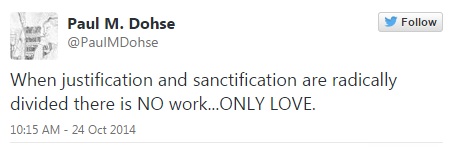
 It’s a matter of being free to aggressively love without fear. The whole problem with the church is it’s preoccupation with the uncertainty of eternal life. Calvinism’s way of dealing with it is, “Jesus does it for you.” The anti-Lordship way of dealing with it is “no commitment.” Jesus’ way of dealing with it is…”It is finished!” Doing keeps a clear conscience. Doing feeds the soul. We were created to do. My motives are pure…Jesus finished the work of salvation…this is all about love. But both camps tell us to cure our conscience and fear with more trust, with more faith alone because they see salvation as unfinished.
We have all said it: “Santifcation is the growing part of salvation.” No it isn’t. Salvation does not grow–the Chrsitian grows. Supposedly, work in sanctification is a work for justification. Yes, doing sanctification right so that we don’t mess up our justification is very tricky business. Doing by faith alone is very complicated. That’s why you need them. That’s why you pay the temple tax. That’s why you pay the philosopher kings. Just trust them and all will be well. People say to me…”Paul we all doubt our salvation.” Yes, and what a pity…for there is no fear in love. We doubt our salvation because we are closet progressive salvationists.
Stop “living by the gospel.” Stop preaching the gospel to youself. Stop talking about the gospel at church, and encourage eachother unto good works. Come out from among them and be free. Come out from among them and love.
paul

 Paul's Passing Thoughts
leave a comment