The Calvinist Grand Quandary
 “At any rate, the very attempt by Calvinists to evangelize places them in a twofold grand quandary that requires the abandonment of rudimentary logic.”
“But in contrast, if God’s choice over our choice is the crux of the gospel, that crux must be explained in order for the presentation itself to be a true gospel.”
At the 2008 T4G conference, John MacArthur Jr. officially came out of the closet as a bonafide New Calvinist. He did this because he was convinced by John Piper and others that New Calvinism is Old Calvinism. MacArthur signed up because it’s true, and he was unwilling to reject Reformation tradition. Apparently, only other-than Anglo Saxon can be deceived en masse.
MacArthur’s keynote address was titled, The Sinner Neither Able Nor Willing: The Doctrine of Absolute Inability. MacArthur was converted from his Lordship Salvation escapades of the late 80’s by the New Calvinist camp. According to a pastor I knew at the time, Michael Horton and others challenged MacArthur to rethink the controversy he had started. The result is MacArthur still affirming Lordship, but as a manifestation rather than actions of new creaturehood. I recently completed a series explaining all of the confused controversy in regard to the Lordship Salvation issue.
At any rate, the very attempt by Calvinists to evangelize places them in a twofold grand quandary that requires the abandonment of rudimentary logic.
I have written before about the Gospel of Sovereignty. Any ability at all on the part of mankind is a slight against God’s sovereignty. This is the hypothesis of MacArthur’s aforementioned messages. Hence, the “good news” is man’s “absolute” inability and God’s sovereignty. MacArthur’s primary text was John 3:1-8…
Now there was a man of the Pharisees named Nicodemus, a ruler of the Jews. 2 This man came to Jesus by night and said to him, “Rabbi, we know that you are a teacher come from God, for no one can do these signs that you do unless God is with him.” 3 Jesus answered him, “Truly, truly, I say to you, unless one is born again he cannot see the kingdom of God.” 4 Nicodemus said to him, “How can a man be born when he is old? Can he enter a second time into his mother’s womb and be born?” 5 Jesus answered, “Truly, truly, I say to you, unless one is born of water and the Spirit, he cannot enter the kingdom of God. 6 That which is born of the flesh is flesh, and that which is born of the Spirit is spirit. 7 Do not marvel that I said to you, ‘You must be born again.’ 8 The wind blows where it wishes, and you hear its sound, but you do not know where it comes from or where it goes. So it is with everyone who is born of the Spirit.”
MacArthur stated during his messages that when the gospel is presented we must make it clear that people can only do one thing in response to the gospel: ask for salvation, and then wait to see if the wind blows or not. So, it is not a decision, often maligned in Reformed circles as “decisionism,” or a choice. Either suggests ability on the part of the individual to make a decision for God or to choose God; ability and God’s sovereignty are mutually exclusive. If man can choose, or make a decision, God ceases to be God.
This qualifies a fair challenge to all Calvinists: “Do you make it absolutely clear in your gospel presentation that people have no ability to choose God?” If they do not do this, if this is not qualified, they are presenting a false gospel by their own definition. Why? The truthfulness of their gospel must be verified by the certainty that the individual does not assume they have a choice or can make a decision.
Most Calvinists get around this by replying that people are being called on to believe only, not make a decision or a choice. However, it also stands to reason that belief itself is a choice. When we are presented with a proposition, we DECIDE to believe it or not believe it. In all fairness, according to their own definitions, Calvinists must make this distinction clear in their gospel presentation. Let’s face it; few do if they evangelize at all. In fact, when Calvinists are cornered with this question, they immediately start acting like a toddler who needs to use the bathroom. Basically, they know that the lack of this distinction in their actual gospel presentation is telling. Their presentation is supposedly purified by the absence of information.
On another wise, Calvinists are also admitting that they are asking for a mere mental assent to acknowledging that God saves people. The Bible states that part and parcel with belief is the acceptance that God exists and is a rewarder of those who seek Him. Obviously, among the unbelieving, there are those who reject the existence of God altogether, and those who believe in His existence, but don’t want anything to do with Him. Is the wind only blowing halfway in those cases? Are there three different wind advisories? None, moderate, and gale force? Furthermore, if people have no ability to choose, is a decision to choose Buddha over Allah made for them? The logic seems to be that man can indeed choose, but will only choose other gods unless God intervenes—if they understand that they have no ability to choose.
If we give this whole construct merit to this point, we further find that the definition of faith must be a mere mental accent to the facts of the gospel with an intentional non-response; any response must be from the blowing wind. MacArthur stated in the same messages that we know Nicodemus was saved because “the wind blew” referring to his righteous actions.
Hence, if the Calvinist gospel is not false by their own definition, it must be presented as follows:
“God saves people, and you may be one of them and you may not be one of them, but if you are able to choose, God is not sovereign, and you are trusting in your own ability to choose.”
Unwittingly, some Calvinists say it is alright if people initially think they are able to choose, but later understand that it wasn’t their choice. So, it is alright if they initially trust in their decision in order to receive the gift of salvation from God, but later realize this was not the case at all. So at what point were they really saved? And would not sooner be better than later? Why not tell them from the get-go? This implies a cult-like procedure that misrepresents the truth, and then slowly indoctrinates the individual to a just standing. Others suggest that the evangelist should never state that it is their decision, but rather cite Scriptures that imply such—that way, apparently, it is the Holy Spirit lying instead of you. But nevertheless, what the individual believes about choice is uncertain unless clarified.
In the final analysis, everyone but the recipient of the gospel knows they have no real choice, but thinking they have a choice might be necessary to get them into the kingdom. But in contrast, if God’s choice over our choice is the crux of the gospel, that crux must be explained in order for the presentation itself to be a true gospel.
Add to this the definition of “believe” in the Bible. In the Bible, “believe” is never defined as a mere mental assent to the facts of the gospel; it also involves a commitment to kingdom living. More than not, it was the “gospel of the kingdom” that was preached by Christ and the apostles. As I explained in the Lordship series, it is impossible for the execution of the commitment to save you because justification and sanctification are completely separate. But clearly, a response to the gospel must include a decision to leave life A for life B. The follow-through doesn’t save you, the decision saves you. Because of the weakness of the flesh, love for God’s ways will vary in application, but you are not only choosing a savior; He is also Lord.
Consequently, Calvinists insist that repentance be left out of the gospel presentation for this reason—it calls on the individual to choose a different way. In the book of Acts, Christianity is referred to as “The Way” in several places. This is more information that must be excluded from the Calvinist gospel in order to make it true by their own definition. Therefore, in order for their gospel to be truthfully presented by their own definition…
“God saves people. If He saved you, you will live differently. The wind will blow, but it’s not your choice, do you believe this? And by the way, don’t change your life to prove to yourself God saved you, that’s fruit stapling. If you believe, that’s great, but now you must wait to see if the wind blows. The Christian life is a Sabbath rest.”
Anything less than this in a Calvinist gospel presentation is a false gospel by their own definition.
And let us not forget, in Calvinist post salvation status, the wind keeps on blowing, or not. It is undeniable that Calvin himself believed in three classes of people: the non-elect, the called, and those who persevere. Said another way: no wind at all, those who are temporarily enlightened (the wind stops), and the ones who get a steady wind to the end.
There is only one way Calvinism can be feasible; logic must be completely divorced from the Bible.
paul
A Doctrinal Evaluation of the Anti-Lordship Salvation Movement: Part 2
The root of all controversy: the golden chain of salvation.
Before we start part 2, we have a little unfinished business from part 1. The astute observer will ask, “If Jay Adams had the right idea about sanctification while misunderstanding what Calvin really believed, what of his biblical counseling movement that moved from mere generalities to the finer points of Christian living?” Answer: it WAS a revival…probably the only real revival the church has seen since the previous focus on practical application of the Scriptures versus redemptive focus/meditation. And when was that? I have no idea.
You remember my mention of the John “Jack” Miller disciple David Powlison. He started a contra biblical counseling movement against the Jay Adams movement. This is often referred to as first generation biblical counseling versus second generation biblical counseling. The second generation effectively wiped out the first. The crux of that civil war is relevant to this study. One model sees salvation and sanctification as separate. Salvation is completely vertical, but sanctification is mostly horizontal. Jay Adams argued in his aforementioned book against Sonship theology that the source of power in the Christian life is not salvation, but regeneration. In other words, justification is a finished work and a static declaration while the Christian life flows from the “quickening” of the new birth. We don’t return to the cross for power in the Christian life, we learn and obey the Spirit’s instrument for changing us, the law of the Spirit of life. What Adams didn’t realize is that this whole idea of life coming from a perpetual revisitation of our justification is in fact authentic Reformed dogma (see the Calvin Institutes 3.14.9-11).
Every Christian controversy from the Reformation till the present finds its roots in the golden chain. Reformed pastors wax eloquent in regard to who builds the links in the chain between justification and glorification: it’s either us, or the Holy Spirit using “what Jesus has done, not anything we do.”
From the latter 40’s to 1970, the first gospel wave (Billy Graham et al) ruled the Christian scene via EB. Cogous pushed back with a vengeance from 1970 till the present with the second gospel wave. The first wave saw a commitment to obedience as synonymous with keeping yourself saved because of the golden chain idea. To say that they overemphasized the gospel would be a gargantuan understatement. Obviously, they saw a commitment to obedience as transposed upon the Christian life. The second gospel wave demanded a commitment, and recognition of Christ as Lord, but also demanded a life of faith alone to keep the law satisfied with Christ’s perfect obedience. Again, the ALS camp misunderstands the Reformed on this point. Both camps hold to sanctification by faith alone. This is the very idea that James rudely pushed back against in his epistle.
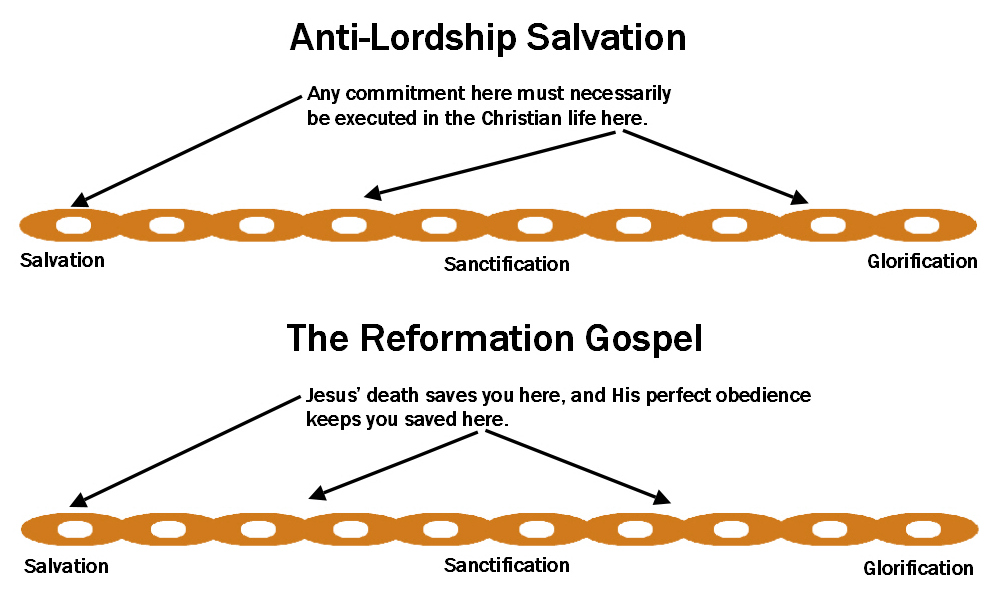
The issue made simple: Romans 8:30.
In Romans 8:30 we read the following:
And those whom he predestined he also called, and those whom he called he also justified, and those whom he justified he also glorified.
Notice that sanctification is missing from this verse even though the context spans the beginning of our salvation to our resurrection. This is the distinction between all golden chain gospels and the real gospel, the kingdom gospel. Jesus came preaching the “gospel of the kingdom.” Hereafter, KG. The golden chain gospel says that sanctification is missing from this verse because justification and sanctification are the same thing. The KG says that sanctification is missing from this verse because justification and sanctification are mutually exclusive. The context is assurance of salvation (see verses 31ff.).
Curiously, the golden chain gospel which includes both ALS and LS/Calvinism, teaches us to remind ourselves of God’s grace alone regardless of anything we do. If our behavior brings doubt, this is evidence of a fundamental misunderstanding of God’s grace and we should therefore remind ourselves of such. ALS says that concern over behavior suggests that you believe behavior finishes justification and not grace alone. With the KG, that consideration is not even on the radar screen because justification and sanctification are completely separate; finishing a finished work is impossible. You can’t have that mentality if you understand it to be an impossible reality. I might also add that simply returning to the same gospel that saved us to cure a troubled conscience instead of changing behavior sears the consequence over time. This is ill advised.
In other words, the KG says it is impossible to unwittingly attempt to please God to gain justification because that work is finished. One is free to aggressively obey God without any fear that they are unwittingly attempting to earn their justification. ALS and LS/Calvinism do not have this convenience because justification is both finished and not finished. The Reformed, already, but not yet construct that relates to predestination cannot be discussed here for lack of room and fear of confusion, but suffice to say for this study that the convenience is not there for either ALS or LS because justification is not finished. You must continue to remind yourself of free grace because you are in a continuum where unwitting works salvation can take place, and the only solution is to disavow good behavior as an evidence of conversion. Obedience must be completely optional. This used to be criticized as “Let go and let God” theology. According to the KG, such a continuum is impossible and not reality.
Consider some dialogue I have had recently with ALS proponents:
Paul, While you ponder my answer, I’d like to ask you, if you’d identify what you believe you must do, before, during and after, in order to be given eternal life. Thank you, In Him, Holly
“Before, during, and after”? to… “be given eternal life.”? The implied answer is: nothing in justification; nothing in sanctification; and nothing in glorification. But again “during” shouldn’t even be deemed possible.
LS in Cogous form already states that perpetual double imputation is needed, so bad behavior is actually a good thing because it “shows forth the gospel.” In contrast, advocates of the KG are concerned with evidence of the new birth, not the overcoming of a propensity to misunderstand the grace of God because all doing in the Christian life is attached to justification somehow. Advocates of the KG understand that nothing they do in the Christian life has anything at all to do with justification. Much assurance comes from that. However, lazy discipleship forfeits assurance because it violates the conscience, and judgment begins in the household of God regarding consequences for bad behavior in this life. The fear generated from that can get confused with fear of eternal judgment.
But don’t miss my main point here: the solution for a lack of assurance in both ALS and LS are the same: preach the gospel to yourself. Remind yourself that works done by us are completely irrelevant to our salvation which also includes sanctification (the Christian life). Both camps woefully devalue the new birth and its expectations. In effect, we have no righteousness and obedience is not really performed by us, but performed by the Holy Spirit if we are “abiding” in Christ. This is a passive sanctification of our works in sanctification in order to categorize them as living by faith alone. ANY work we do is accredited to the justification process, so it must be sanctified by the right process. In the final analysis, Christians must only EXPERIENCE an obedience imputed to us by Christ. Citations by the Reformed abound, and I can cite one from the aforementioned conversation with advocates of ALS:
We can have righteousness of our own, that is self-righteousness. I didn’t notice, did you answer any of the questions? Do you sin? How much? Or not? Are you sinless?
Park on the fact that both camps assert that the Christian has no righteousness. To have any righteousness is a “righteousness of our own.” It’s either ALL us or ALL Christ. Therefore, we can only EXPERIENCE righteousness imputed to us, but it really isn’t us performing it; hence, in relationship to the same conversation:
This passage has nothing to do with becoming saved or providing evidence through our works that we are saved. The passage is about living experientially in a manner that is consistent with our position on [sic] Christ.
Notice that the Christian lives “experientially” according to “our position [i]n Christ.” In other words, Christians only experience their position, they don’t actually perform obedience themselves. In addition, when talking to either camp, one is challenged with the question, “Did you sin today?” And in both cases, when you qualify the question with, “In justification or sanctification?”…without exception they are thrown for a loop. Why? Because they see sin in justification as no different than sin in sanctification—that’s why they ask the question in the first place. If you believe the Christian is personally righteous as well as positionally righteous, you are immediately challenged by both camps with, “Did you sin today?” Why? Because the same assumption is that righteousness and sin are mutually exclusive. For the world, this is true, but not for Christians.
Another fact of the Reformation gospel is “righteousness” is defined as a perfect keeping of the law. To remove the law’s perfect standard, and its demands for perfection from justification is the very definition of antinomianism according to the Reformers. A perfect law keeping must be maintained for each believer if they are to remain justification.
If you remember, this is a direct quote from part one. ALS and LS/Calvinism both define righteousness by perfect law keeping. Again, why the air of profundity in the terse rhetorical question designed to end the argument on the spot by coup de grace? The very essence of the question reveals a profound misunderstanding of law and grace.
Let’s get a little more full circle now with part one. Because the Christian, according to both camps, cannot be righteous if he/she sins even once (“Do you sin? How much? Or not? Are you sinless?”), the good old Reformed mainstay of double imputation is needed for both of these applications of the same golden chain gospel. From part one:
Thirdly, this requires what is known as double imputation. Christ not only died for our sins so that our sins could be imputed to Him, He lived a life of perfect obedience to the law so that His obedience could be imputed to our sanctification.
The windsock of double imputation is the idea that the righteousness of Christ is imputed to our sanctification. He died for our justification, and His perfect obedience to the law was imputed to our sanctification to keep justification rolling forward:
Model A asserts that since we cannot keep the law perfectly, we must invoke the double imputation of Christ by faith alone in order to be saved and stay saved (part 1).
Now let’s look again at the same recent conversation with ALS proponents:
Thanks Mark, I agree. We are qualified as saints, because of Christ’s righteousness imputed to us, but we still sin,..
Therefore, we only “qualify” as saints because we still sin, in order to keep our sainthood the righteousness of Christ must be imputed to us daily. Yes, that would be daily salvation. In the quote immediately prior, “Holly” was responding to this statement:
Hope you don’t mind me adding a thought, I think Paul is saying we were sinners but we are now saints (forgive me if I am wrong), it is true of course that we are saints but I believe it is also still true that we are sinners saved by grace because the Apostle Paul said, “Christ Jesus came into the world to save sinners; of whom I am chief”, present tense.
So, if Christians are still sinners, because we sin, and Christ came to save sinners, it would only make since that our need for salvation is still ongoing. Direct citations that agree with that point by John Calvin and Martin Luther is abundant low hanging fruit, but granted, such statements from the ALS camp are somewhat surprising. To further the point, I might add that “Holly” referred me to a message taught by a notable figure in the ALS movement who interpreted Romans 7:24 as a daily salvation. This is a very common rendering of that verse by the Reformed as well. The verse obviously refers to the redemption of the body and not a daily salvation.
Both are guilty of the same thing: a false double imputation construct must be applied to the Christian life by faith alone and the subjective experience thereof is optional. Like ALS—like Calvinism.
What is wrong with this gospel?
The golden chain gospel misrepresents the Trinity. The Father is removed from His role in salvation because it is His righteousness imputed to the believer before the foundation of the world. According to Romans 8:30, this guarantees glorification. The Holy Spirit is also misrepresented in regard to His role in salvation. His setting us apart before the foundation of the world is confused with His work in regeneration. Christ’s role is redefined beyond His death for our sins as a onetime act that ended sin. This is not a covering—it’s an ending. Even though the Reformed and ALS both concur that Christ died once, His death is perpetually reapplied to sins we commit as Christians when there is no such need. Neither is there a need to impute Christ’s righteousness to us perpetually. At the Bema event, it will not be God the Father looking at us and only seeing Jesus, it will be Jesus Himself judging His righteous followers. He will not be judging His own righteousness. The golden chain gospel is an egregious distortion of the Trinity.
True double imputation is our sins being imputed to Christ, and the Father’s righteousness imputed to us apart from the law. Christ came to end the law. It is because of this, and the new birth, that we are truly righteous in and of ourselves, but of course not apart from God’s power and plan of salvation. We have God’s seed in us, are no longer under any law that can judge us, and are able to please God with our lives. We are new creatures who are sinless according to justification because even if the old us that died with Christ was exhumed and brought into court, there would be no law to condemn us.
This gospel not only distorts the Trinity, rejects the new birth, and distorts double imputation, it misrepresents sonship. The sins we commit as a family member are considered to be sin against justification: “Did you sin today?” Again, if you ask them, “Sin in justification or sanctification?” all you will here is crickets, or the babblings of confused narcissists.
The golden chain gospel also strips the Christian of ability to love Christ and others by keeping Christians under the law of sin and death that Christ came to end. Said gospel makes that law the standard for righteousness. However, there is no law standard in justification, it is APART from any law—it is God’s righteousness imputed to us. Those under grace serve the law of the Spirit of life which is fulfilled by loving Christ and others:
“If you love me, keep my commandments.”
It is impossible to love Christ by keeping the law of sin and death. Besides, that law is ended when we believe. All of our sins committed before faith were against that law and in essence imputed to it. Before we were saved, we were enslaved to that law and it provoked us to sin. Consider two spouses: we were the spouse that was under the law of sin and death until we died with Christ, now we are free to serve another. Sins we now commit are against family relationship, not sins that fall short of the law of sin and death.
Said gospel prevents us from making a commitment to God’s kingdom because the commitment would have to be executed perfectly in kingdom living to maintain our citizenship. Said gospel demands that we only recognize Christ in a one-way relation while ignoring His kingdom, its law, and the king. Yea, we can only accept Him as savior in a one-way relationship. This assumes that a decision to flee the present kingdom of darkness for the kingdom of light cannot be a commitment totally separate from the kingdom citizenship. If we make a commitment, the commitment must be executed perfectly in order to remain a citizen. No, the commitment is totally separate from our citizenship in the same way justification is totally separate from sanctification.
I realize that only repentance was emphasized to the Jews, but they were already saturated with the concept of God’s kingdom. From the beginning, Abraham looked for a city built by God. As we see Gentiles coming into the church, they must be brought up to speed on their new Jewishness. We should read the Bible with this in mind and the way it affected the presentation of the gospel, and the very definition of the word “gospel” itself.
The golden chain gospel rejects the new birth by ignoring the difference in slavery between two different laws: the law of sin and death that will condemn the world, and the law of the kingdom; the law of the Spirit of life. It makes the law of the Spirit of life a fulfilment of the law of sin and death that is in fact ended. In essence we remain enslaved to a law of condemnation as “sinners.” This is a rejection of the new birth.
It also adds another seed to the covenant of promise. If the law of sin and death could impart life, it would be a second seed from which life would come to the world. It doesn’t matter who obeys it, it cannot impart life.
The golden chain gospel distorts the Trinity, distorts double imputation, misrepresents sonship, strips the Christian of ability to love Christ and others, rejects a biblical definition of the new birth, keeps Christians under the law of sin and death, distorts the atonement, perpetually reapplies the death of Christ to salvation, replaces the righteousness of God with a law standard, propagates a one-way relationship with God, makes sin as a kingdom citizen the same as condemning sin, enslaves us as a spouse still under the law of sin and death, calls for us to accept Christ as savior in a one-way relationship while ignoring His Lordship.
Do Christians have two natures? This will be examined in part 3.
paul
Indeed, Christianity can be VERY Annoying
 How annoying is American Christianity to me right now? Well, being a Christian in Iraqi is looking pretty good to me right now. Instead of dying the death of a thousand cuts from theological debate, I could get my head blown off by the Middle Eastern version of Calvinism. Those ISIS guys are surprisingly ignorant in the ways of the European ideology of spiritual caste and determinism that drives their religion. Thank goodness they partake in the elementary ways of execution and have never studied Puritan history.
TANC and PPT are working hard at solidifying our Biblicism so that we can work on home fellowship networks and get on with the Lord’s business. Meanwhile, let’s ask the right question: 2000 years later, why is there so much confusion about what the gospel is?
I am totally convinced that the source of the confusion is the foundational idea that justification is not a finished work. God has eliminated any excuses here by stating that justification was finished before He even created the earth, but leave it to Gnostic brainiacs with four or five titles after their name to make the simplest of facts confusing. If they didn’t, what would you need them for? This is their greatest fear…not being needed. Nothing strikes more fear in their souls than the day that you discover that you can determine truth on your own (1John 2:27).
Lou I am ever learning but never coming to the truth Priolo stated it best: justification is like a computer program that runs in the background of the Christian’s life. Justification is not seen as an ended work with the Christian life (sanctification) being completely separate. Hence, you have the likes of John MacArthur Jr. stating that justification (salvation) and sanctification are “never separate, but distinct.” Mark it: that ancient idea is the very crux of the whole problem. That is the one and only reason for Jerry Springer blogosphere Christianity that presently dominates American Christianity. When we are not waiting with bated breath at the golden doors of The Gospel Coalition for the next spiritual unction from on high, we are at a spiritual Amway convention hosted by mystics like Beth Moore and Francis Chan.
We need them to guide us through the very tricky waters of maneuvering through a justification running in the background of sanctification. So, if we do not do sanctification just right, it will mess up our justification. We are not free to aggressively pursue love in sanctification; we must make sure we will “stand in the judgment.”
American Christianity is full of fear and paralyzed for this very reason. Instead of being about the Lord’s business, we are frantically running about on the internet and to conferences to make sure we are not “making the fruit of sanctification the ground of our justification.” Justification and sanctification are “never separate, but distinct.” What does that mean? It means they are fused, but justification has a beginning, and is distinct from sanctification because sanctification is justification that is running in the background.
Therefore, Christians ask all of the wrong questions, and work on all of the wrong problems, and remove no obstacle of confusion. While the fathers of Protestantism wrote outrageous anti-gospel statements in treatises like the Calvin Institutes that clearly point to the problem with their Progressive Justification, the debates center on “election” and bad behavior. And, the latest pain in my butt…
The lordship salvation debate.
For eight years, I have pretty much stayed away from this debate even though it has cost me some friends, and when you are in the process of declaring the institutional church and Protestantism in general illegitimate, you don’t have many of those to spare. The cure for the American church is a mass exodus from the institution back to what church was always meant to be, a fellowship of believers meeting informally in each other’s homes. This is also combined with good organization for targeted purposes; the concept is very efficient and powerful. It is the dismantling and utter rejection of spiritual caste. I don’t understand why Christians don’t want to be free. Why are we letting arrogant men dictate the relationship we have with the Christ who died for us? The arrogant bozo with the degree didn’t die for you—Christ died for you. Who made these guys Chief Shepherd?
Can you imagine seeking Christ together without spiritual caste and being free from all of the institutional drama? I hope you can. Almost four years ago, Susan and I left the institutional church and began an independent verse by verse study of the Book of Romans on our own. In the first six months, we learned more about Christ than both of us had ever been taught in the institutional church. That’s a combined eighty years of Christian experience. This is just the plain fact of the matter. We have been sold an institutional bill of orthodoxy written by spiritual tyrants. Even though the behavior of the Westminster “Divines” is historical fact, we follow there doctrine because “God’s anointed” say they are the exception to “by their fruits you will know them.” Why do we accept these contradictions? Because the “anointed” have replaced Christ.
And at least in one particular camp of the anti-lordship salvation crowd (ALS), listening to men apart from independent study has created quite the spectacle. Portending to be on the cutting edge of anti-Calvinism, their soteriology is no whit different from Calvinism whatsoever. I will continue to state that the problem with Calvinism is progressive justification. So, what we have here is a group of likeminded Christians who are bashing Calvinism while believing the exact same gospel of progressive justification.
I think it is time to start calling out this sort of confusion among God’s people.
paul
Why I Saw Life in Jay Adams’ First Generation Counseling and Why Second Generation Counseling Will Only Lead to Death
 “The Reformed gospel therefore circumvents the law of life by keeping the Christian under the law of sin and death, and denies that the Christian can have life, and have it more abundantly through obedience.”
“The law of sin and death is not a schoolmaster that leads the believer back to the cross—the schoolmaster is dead. We are set free to serve the law of the Spirit of life .”
I was saved in 1983, became a pastor in 1986, and found myself sitting in pastor John Street’s office circa 1990 in the throes of deep depression. This wasn’t supposed to happen to a Christian zealot. I was confused, and shell-shocked. I had suffered deep depression as an unbeliever, but this wasn’t supposed to happen to a believer.
John Street was on the cutting edge of Dr. Jay E. Adams’ biblical counseling movement that had begun in 1970 with his controversial book, Competent to Counsel. Street was the founding pastor of Clearcreek Chapel (Springboro, Ohio) which was also a pastoral training center for the movement. Street had some earthshaking assessments in regard to me:
1. My primary goal in life was not to please God.
2. I had changed little as a believer.
3. Hence, I brought the same sinful attitudes and thinking into my life which resulted in
the same depression I suffered as a believer.
4. I needed to understand that the power for Christian living was “in the doing.”
Because as a new Christian I was stupefied by the open sin displayed in the conservative evangelical church; viz, the first conservative church I joined had members living together out of wedlock, were openly hostile to African Americans, and some were drunkards, I was a rabid fan of John MacArthur Jr and his so-called “Lordship Salvation.” So, Street’s four-point assessment of me was a shocking revelation.
How could this be? Simply stated, I lived by biblical generalities and was woefully ignorant of how to live as a mature Christian. This is a Protestant thing which has traditionally emphasized salvation (justification), and not Christian living/sanctification/discipleship. Stop here for a moment. According to entrepreneur Herman Cain, leadership has three primary principles:
W. Work on the right problem.
A. Ask the right questions
R. Remove obstacles.
W. The problem is lack of emphasis of discipleship.
A. Why is there a lack of emphasis on discipleship?
R. What is the obstacle?
Dr. Adams didn’t ask the right question, but he did work on the right problem: weak sanctification, and a lack of emphasis on obedience to the Scriptures. The results were dramatic. In one year at Clearcreek Chapel, there were twelve solid conversions. Accounts of people being snatched from the jaws of suicide were commonplace. I eventually broke free from depression and discontinued taking anti-depressant medications. But my case needs some additional discussion.
During one appointment with Street, I began by giving a report on how hard I was working on my problem: “I have been in the Scriptures all week and prayed for three hours today! And the reply:
Paul, I am not going to tell you to not do those things, but the power is in the doing.
“Really?” I thought, “I can actually do something about my problem?” The counseling involved homework. I liked to go out to MacDonalds and do my homework, and while doing so one day, I pondered the following: “The Bible does indeed promise blessings (happiness) for being obedient. This is very hopeful, that I can actually do something to get my happiness back.”
Meanwhile, guess who walked in as I was thinking these thoughts? Street. I struggled with posing the question, perhaps due to the radical nature of it, but Street helped me out: “Paul, are you asking me if obedience to God’s word is curative?” My reply, “Yes.” He paused, I waited. I think we both thought that we were in danger of fire being rained down from heaven. Finally, he reluctantly replied: “Yes.”
Let’s ask the right question, shall we? Why is the concept of Christian obedience and the discussion of it so fearful, more taboo than sexual preferences? As a result of a nemesis that comes my way every now and then, specifically the anti-Lordship Salvation crowd, I think I now know. Usually akin to my disdain for Calvinism, they have accused me of works salvation because of my supposed proffering of Lordship Salvation. This is very annoying, but I have never stopped to investigate the logic behind their accusation, until now. My conclusions are applicable to thoughts I have on biblical counseling and are the subject of this post. But first, let’s revisit my fears as a former counselee.
Indeed, the Bible tells us to obey, but that raises a seemingly serious problem. If I obey as a Christian, how do I know for certain that my obedience really isn’t an attempt to justify myself? Until this week, I have always somewhat doubted that my “victory” over depression was legitimate. Let’s ask the right question, “Why the doubt?”
Because during the aforementioned trial, I perceived the law of God as one law, that’s why. I also had a fundamental misunderstanding about what the gospel really is as well. I saw salvation as believing that Christ died for my sins—end of story. Believe that, and then wait and see what happens. Well, in many cases, depression happens. In many cases, suicide happens. In many cases, a falling away from the Christian faith happens. And as poignantly expressed by my wife Susan at the 2012 TANC Conference, we hear, “Oh well, at least he was saved.” Her close to that stunning presentation on sanctification is worth repeating:
So Lovell lived like the devil, but at least he had his fire insurance policy, made effective because he walked the aisle, said the sinner’s prayer, and was baptized in the Big Sandy River. But I will have to agree with my dad. Only God really knows if Lovell was genuinely saved or not and resting in the bosom of Abraham. At my funeral, I hope more will be said about me than “at least, she was saved.”
However, we deem such unglorified testimonies for the Lord a small price to pay in exchange for robbing Christ of glory by thinking we can do something. Confusion on this issue is absolutely rampant, and I think the time has come for the confusion to stop.
Who will argue that there is not mass confusion in our day on the relationship of the law to salvation? Yes, let’s tell the world that we do not worship a God of confusion. Good luck with that; we don’t even know what the gospel is! The theses of this post lays blame for all of this confusion at the feet of the idea that there is only one law in the Bible. This misunderstanding then leads to confusion as to what people are called to—in regard to the “good news.” We want to work on the right problem by asking the right question and then removing the obstacle. The obstacle is the idea that there is one law, and making that idea consistent with the rest of Scripture is like trying to stick a round peg in a square hole. When the discussion is about how to make that work, good luck with obtaining any solutions—we are discussing the wrong questions.
The Fundamental Problem
…is that the law of God is only seen as death. In Romans 8:2, we clearly have two laws:
For the law [nomos] of the Spirit of life has set you free in Christ Jesus from the law [nomos] of sin and death.
For certain, the Reformers only recognized one law: the law of sin and death. They saw the one law as a perfect standard that defined justification—righteousness, or justification, is defined by a perfect keeping of the law. Since we cannot keep the law perfectly, it is only good for revealing our sin. According to Protestantism, the law…
1. Shows us our sin, thus ever increasing our gratitude for Christ’s death and obedient life
which fulfilled the law for us.
2. Will condemn unbelievers at the final judgment who are not “covered” by Christ’s
perfect obedience.
3. The Spirit gives us ongoing life in response to our continued living by faith alone.
Christ’s obedience is then perpetually imputed to our lives to keep us saved because a
continued satisfying of the law is needed. (See The Calvin Institutes 3.14.9-11).
What immediately comes to mind is Galatians 3:21;
Is the law then contrary to the promises of God? Certainly not! For if a law had been given that could give life, then righteousness would indeed be by the law.
The fact that the law cannot give life for “righteousness” i.e., justification, does not mean that the law cannot give life on any wise. Clearly it can, and does:
Matthew 4:4 – Man shall not live by bread alone, but by every word that comes from the mouth of God.
Ephesians 6:1 – Children, obey your parents in the Lord, for this is right. 2 “Honor your father and mother” (this is the first commandment with a promise), 3 “that it may go well with you and that you may live long in the land.”
Psalms 1:1 – Blessed is the man who walks not in the counsel of the wicked, nor stands in the way of sinners, nor sits in the seat of scoffers; 2 but his delight is in the law of the Lord, and on his law he meditates day and night. 3 He is like a tree planted by streams of water that yields its fruit in its season, and its leaf does not wither. In all that he does, he prospers. 4 The wicked are not so, but are like chaff that the wind drives away.
The fundamental problem is that the law of sin and death is THE standard, or rule for being justified. This is the essence of Reformed thought: Christ not only died for our sins, but He lived a perfect life so that the demands of the law would be satisfied. This makes the law intrinsic with justification. Hence, believers must keep themselves saved by living by faith alone throughout their Christian lives. If they do this, the perfect obedience of Christ (His fulfilling of the law) is continually applied to the Christian life and the saint therefore remains justified. The Reformed think tank that spawned the present-day Neo-Calvinist movement stated it best:
The flesh, or sinful nature of the believer is no different from that of the unbeliever. “The regenerate man is no whit different in substance from what He was before his regeneration.” — Bavinck. The whole church must join the confession, “Have mercy upon us miserable sinners.” The witness of both Testaments is unmistakably clear on this point.
No work or deed of the saints in this life can meet the severity of God’s law. Apart from God’s merciful judgment, the good works of the saints would be “mortal sin” (Luther), and nothing is acceptable to God unless mediated through the covering cloud of Christ’s merits. Because of “indwelling sin,” we need mercy at the end as much as at the beginning, for the old nature is as evil then as ever. Growth in grace, therefore, does not mean becoming less and less sinful, but on the contrary, it means becoming more and more sinful in our own estimation.
It is this conviction of the wretchedness of even our sanctified state—which conviction comes by the law—that keeps sanctification from the rocks of self-righteousness. It keeps the Christian’s little bark constantly pointed toward his only star of hope—justification by faith in a righteousness that stands for him in heaven. The refuge of the sinner must ever also be the refuge of the saint.
The Holy Spirit gives the sinner faith to accept the righteousness of Jesus. Standing now before the law which says, “I demand a life of perfect conformity to the commandments,” the believing sinner cries in triumph, “Mine are Christ’s living, doing, and speaking, His suffering and dying; mine as much as if I had lived, done, spoken, and suffered, and died as He did . . . ” (Luther). The law is well pleased with Jesus’ doing and dying, which the sinner brings in the hand of faith. Justice is fully satisfied, and God can truly say: “This man has fulfilled the law. He is justified.”
We say again, Only those are justified who bring to God a life of perfect obedience to the law of God. This is what faith does—it brings to God the obedience of Jesus Christ. By faith the law is fulfilled and the sinner is justified.
We are united to Christ in whom we are counted as perfectly righteous because of his righteousness, not ours. The demand for obedience in the Christian life is undiminished and absolute. If obedience does not emerge by faith, we have no warrant to believe we are united to Christ or justified (Matthew 6:15; John 5:28-29; Romans 8:13; Galatians 6:8-9; 2 Thessalonians 2:13;James 2:17; 1 John 2:17; 3:14). But the only hope for making progress in this radical demand for holiness and love is the hope that our righteousness before God is on another solid footing besides our own imperfect obedience as Christians. We all sense intuitively-and we are encouraged in this intuition by the demands of God-that acceptance with God requires perfect righteousness conformity to the law (Matthew5:48; Galatians 3:10; James2:10). We also know that our measures of obedience, even on our best days, fall short of this standard.
This is the fatal Achilles’ heel of Reformed thought: it makes the law intrinsic with justification when in fact we are justified APART from the law. This is what the apostle Paul meant when he said there is no law that can give life—it’s a justification issue, not an issue of Christian living. Secondly, it rejects the idea that the believer’s former self literally died with Christ and has been resurrected to new life. The apostle made it clear that the law of sin and death can only condemn those who are living and have not yet died with Christ (Romans 7:1-6). It denies the new birth, which has been a reality for the believer even before the cross (John 3:1-15).
The Reformed gospel therefore circumvents the law of life by keeping the Christian under the law of sin and death, and denies that the Christian can have life, and have it more abundantly through obedience. It denies blessings and cursings, fruits of life versus fruits of death, and the Christian’s ability to choose more life rather than suffering death for no good reason:
Due. 30:11 – “For this commandment that I command you today is not too hard for you, neither is it far off. 12 It is not in heaven, that you should say, ‘Who will ascend to heaven for us and bring it to us, that we may hear it and do it?’ 13 Neither is it beyond the sea, that you should say, ‘Who will go over the sea for us and bring it to us, that we may hear it and do it?’ 14 But the word is very near you. It is in your mouth and in your heart, so that you can do it.15 “See, I have set before you today life and good, death and evil. 16 If you obey the commandments of the Lord your God that I command you today, by loving the Lord your God, by walking in his ways, and by keeping his commandments and his statutes and his rules, then you shall live and multiply, and the Lord your God will bless you in the land that you are entering to take possession of it. 17 But if your heart turns away, and you will not hear, but are drawn away to worship other gods and serve them, 18 I declare to you today, that you shall surely perish. You shall not live long in the land that you are going over the Jordan to enter and possess. 19 I call heaven and earth to witness against you today, that I have set before you life and death, blessing and curse. Therefore choose life, that you and your offspring may live, 20 loving the Lord your God, obeying his voice and holding fast to him, for he is your life and length of days, that you may dwell in the land that the Lord swore to your fathers, to Abraham, to Isaac, and to Jacob, to give them.”
Nothing has ever changed here. For the believer, obedience to the law brings life. The same law that condemns the unbeliever brings life to the believer…
Ephesians 6:1-3 – Children, obey your parents in the Lord, for this is right. 2 “Honor your father and mother” (this is the first commandment with a promise), 3 “that it may go well with you and that you may live long in the land.”
That’s Paul using an Old Testament command to illustrate a New Testament promise of life through obedience. For the unbeliever, the sins they commit against the law are held captive by the law, but when they believe, that law is ended when faith comes; the law that could only condemn now gives life:
Galatians 3:21 – Is the law then contrary to the promises of God? Certainly not! For if a law had been given that could give life, then righteousness would indeed be by the law. 22 But the Scripture imprisoned everything under sin, so that the promise by faith in Jesus Christ might be given to those who believe.
23 Now before faith came, we were held captive under the law, imprisoned until the coming faith would be revealed. 24 So then, the law was our guardian until Christ came, in order that we might be justified by faith. 25 But now that faith has come, we are no longer under a guardian, 26 for in Christ Jesus you are all sons of God, through faith. 27 For as many of you as were baptized into Christ have put on Christ. 28 There is neither Jew nor Greek, there is neither slave nor free, there is no male and female, for you are all one in Christ Jesus. 29 And if you are Christ’s, then you are Abraham’s offspring, heirs according to promise.
The idea that “guardian” means a “schoolmaster” who continually leads us back to Christ, and the foot of the cross by showing us our inability to keep the law perfectly is a popular Reformed rendering of this text, but that is not what is in view here. The Old Covenant imprisons all of the sin committed by those under it, and when they believe, that law is ENDED:
Romans 10: 4 – For Christ is the end of the law for righteousness to everyone who believes.
Christ didn’t come to cover our sins, He came to end our sins. The Old Covenant covered our sin, it was our guardian. But when we believe in Christ, the law of sin and death is abolished and we are set free to SERVE the law of the Spirit of life. This is the abundant love of Christ who did not come to condemn the world: even the law of condemnation is a guardian beckoning the unbeliever to flee the wrath to come by casting that law as far as the east is from the west—along with all of our sin committed against that covenant. The law of sin and death is not a schoolmaster that leads the believer back to the cross—the schoolmaster is dead. We are set free to serve the law of the Spirit of life.
Jay Adams didn’t ask the right question: “Where did all of this anemic Protestant sanctification come from?” But he did work on the right problem: living by biblical generalities rather than in-depth discipleship through learning and application. The results spoke for themselves.
Furthermore, the anti-Lordship Salvation crowd is probably asking the wrong questions as well as working on the wrong problem. They seem to strongly insinuate that a commitment to obedience within the gospel presentation is works justification because the subject is required to do something (agree to a commitment) in order to obtain eternal life.
This threatens to be the same law problem as Reformed thought; the idea that obedience does not bring life. If unbelievers are still under the law of sin and death, and every violation of that law is fruits for death, and we are calling them to flee that death for life, does that not necessarily include obedience that leads to life more abundantly? This seems to demand that only half of Romans 8:2 be presented in our gospel presentation lest it be a gospel of works justification. The cross sets us free to SERVE another master; Christ as opposed to the kingdom of darkness:
Romans 7:4 – Likewise, my brothers, you also have died to the law through the body of Christ, so that you may belong to another, to him who has been raised from the dead, in order that we may bear fruit for God. 5 For while we were living in the flesh, our sinful passions, aroused by the law, were at work in our members to bear fruit for death. 6 But now we are released from the law, having died to that which held us captive, so that we serve in the new way of the Spirit and not in the old way of the written code.
“So that.” “So that…” what? What is the purpose of calling people from darkness into the light? The purpose is “so that” we SERVE the new way of the Spirit. Consider what the word for “serve” is…
g1398. δουλεύω douleuō; from 1401; to be a slave to (literal or figurative, involuntary or voluntary):— be in bondage, (do) serve (- ice). AV (25)- serve 18, be in bondage 4, do service 3; to be a slave, serve, do service.
The gospel is a call to be set free from enslavement under the law of sin and death, and to enslavement to the law of the Spirit of life. Consequently, a call to a commitment to be enslaved to the law of the Spirit through obedience as a way to love God and others is a gospel of works righteousness? To notify the subject that they are set free from the fruits of death is ok, but to notify them that they will be a slave to righteousness is works salvation? What is the called out assembly called to? Are we called to holiness, or a label that enables us to yet be enslaved to darkness? Is enslavement to the law of the Spirit of life optional lest it be works righteousness? A jingle that we hear often from the Reformed crowd is the following: “When you are justified, you get sanctification in the bargain.” I wonder if it shouldn’t rather be: “When you are sanctified, you get justification in the bargain.” Justification is free, holiness is what we are called to from our former lawless master. What part of, “You cannot serve two masters” do we not understand? Granted, I say this to make a point, but I wonder if the church wouldn’t be better served as it is mostly populated with the unholy, unslaved saved.
And who are we being called to serve? Is Christ savior only? Or is He also a Lord? To inform a salvation candidate that Christ is not only a savior, but also a Lord is works righteousness? To insist that Christ be recognized for who He is—is a gospel of works? Nay, to love Christ is to recognize Him for who He is…
If you love me, keep my commandments.
You can be saved by Christ, but you don’t have to love Him? You can be saved by Him, but abundant life is optional? You can remain a slave to fruits of death, but enslavement to Christ is optional?
The Metaphysical Anomaly of Non-Works
I also fear that the anti-Lordship Salvation crowd has a kinship to the Reformed in regard to this whole business of defining what is a work and what isn’t a work. Mankind is created to work, and when people are alive, they are also working. Life is synonymous with work, man never ceases to work in this life unless he is dead. Hence, man is either producing fruits for death or fruits for life. Either way, he is producing. In regard to the biblical command to “repent and believe the gospel,” or to “obey the gospel,” the ALS crowd insists that this is not an action or a commitment to obey, but a mere “change of mind.” Granted, that is what the word means. But since when is a change of mind not a work? In order to have a change of mind, you must ponder and think—that’s not passive. It is simply impossible to get around the fact that something is required of man in order to be saved. At the very least, a choice is required; specifically, choosing life over death. But choosing life necessarily involves a commitment to obedience—there can be no life without it. The choice to choose life necessarily includes a commitment to future obedience and recognition of who Christ is.
Likewise, in the Reformed crowd, works and non-works are divided by “faith” and “obedience.” Since obedience cannot bring life, or produce fruits of righteousness, and perfect law-keeping by Christ must be imputed to our sanctification by faith alone to keep us saved, certain activities are classified as non-works (by faith) and works. Going to church, meditation, seeking to understand how depraved we are, and prayer are classified as faith while obedience is work. If we live by “faith alone,” primarily through gospel contemplationism, the perfect obedience of Christ will be imputed to our Christian life and we will remain justified. This is behind the contemporary mantras, “We must preach the gospel to ourselves every day,” and “living by the gospel” etc. Sorry, but preaching to yourself is a work, and in this case, to keep yourself saved because revisiting the cross supposedly imputes someone else’ s obedience to your sanctification. The only problem is…you have to do something for that to happen. Rather, Justification must be a finished work, period. Neither does it, “run in the background.”
In the same way, the ALS camp redefines repentance as a non-work of faith alone. This simply is not reality. Everything is a work. In addition, it would seem that a “change of mind” has nothing to do with what it means to be a Christian moving forward. To acknowledge any future expectations by the Lord, or a recognition of trading one slavery for another is a works gospel. If I tell them they are going to be a slave to righteousness, that’s works righteousness? That’s not a commitment to a new master? And if I tell them that it is, I’m propagating a works gospel? Leaving one master for another isn’t a commitment?
This is barely different than the Reformed gospel that they seemingly reject. In all of this discussion, I often hear that the gospel should be simple. I agree, and I would also ask how much more simplistic could “choose life” be? Ironically, it’s the unbelievers who have no problem with the simple concept of choosing to leave where they are for something else. Things get complicated because of the following idea: suggesting to an unbeliever that they can no longer serve their present master is a works gospel. To suggest that they have to move from point A where death resides, to point B, where life resides, is works righteousness.
The Day the Music Died
I witnessed a microcosm of the day that the “first generation” biblical counseling movement died. Pastor Street, with my clueless blessings as a Clearcreek Chapel elder, enrolled in the biblical counseling post graduate program at Westminster Theological Seminary East. The program curriculum was authored by a follower of John “Jack” Miller who was the father of the Sonship discipleship program. The author of the program, and also the director, Dr. David Powlison, is one of the forefathers of the present-day Neo-Calvinist movement.
Street used what he learned there to add a second level to the training program called “Theology of the Heart.” While the first level predicated on the in-depth discipleship principles of Adams was prolific, this second level was a monstrosity of confusion. The consensus of pastors leaving level one was, “Where has this information been all of my life” while no one really knew what to make of the second level. Some years later, a Clearcreek elder told me what Street thought of what he learned at Westminster: “This is where we have been missing it.” I don’t know if this particular elder, who is of ill character, was telling the truth, but the idea that Powlison’s construct was a better “second generation” version of the first was not a unique mentality in 1998.
Also, first generation biblical counseling leaders naïvely allowed disciples of Powlison to teach in their schools. By 2006, first generation biblical counseling was all but completely discredited. The stories of changed lives that came out of that revival were relegated to narratives about “super Pharisees.” Pastor Randy Patton once described the first generation as a movement that only “made people better Pharisees.” When I heard him say it, all of the saved marriages, saved lives, and salvation testimonies that I knew of, including my own, that came out of that movement flashed before my eyes, and then went up in flames before me. As one who grew up on mean streets, I can tell you that I had never experienced a more insensitive statement that brushed away years of joy with one stroke. Unfortunately, the second generation biblical counseling that now dominates the American church is characterized by this same insufferable arrogance.
What is this “second generation” biblical counseling? It is simply a counseling construct based on the original Reformed gospel stated in this post with emphasis on its denial that Christian obedience produces life, and life more abundantly. In the latter 90’s many, many pastors left Westminster and returned to their local churches proclaiming, “This is where we have been missing it.”
What is really missing is the life produced by the first generation biblical counseling. Life and love through intelligent biblical obedience has been replaced with David Powlison’s fruits of death. This is not complicated, in a seminar taught at John Piper’s church, Powlison plainly stated the difference between the first generation biblical counseling and the second: one promotes Christian living by returning to the cross for a refueling of Christ’s perfect obedience in order to satisfy the law, and the other leaves the foot of the cross for mature Christian living. The one returns to the cross to keep the law of sin and death satisfied—the other fulfills the law of the Spirit of life with acts of loving obedience.
Our Lord prefers obedience over sacrifice—this is something that the second generation purveyors of death will never understand. Mankind is always working. A choice to do nothing is not faith—it’s a choice that will either produce death or life. And it doesn’t matter who obeys the law in our place to keep us justified—there is no law that can give life no matter who keeps it. So, how do we know for certain that we are not trying to justify ourselves by obedience in our Christian life? Because law and justification are mutually exclusive to begin with, and justification is a finished work accomplished by God only. As Andy Young said in this year’s TANC Conference, “The law is for sanctification.” Indeed, especially since we have already been justified “apart from the law.”
Second generation counseling cannot therefore produce life. It can only produce death. All it is doing is making us better antinomians, and the judgment against it slumbers not. Do not be a participant with it on any level. It is only producing wages for death that will be paid in full. Instead, let us forge ahead in learning the Lord’s instruction and applying it to our lives. let us build lives that will withstand the storms of life. Let us meet together apart from vile antinomians and encourage each other unto good works. Let us love the Lord with all of our being.
paul
Addendum
Since everything man does is a work, let me suggest that the biblical definition of works righteousness, or salvation by works, is the idea that justification is not a finished work. If justification progresses into sanctification (the Christian life), or if the work of the cross continues, then our life and works are juxtaposed onto justification. This makes us colaborers in justification by default.
If there is a beginning justification, subjective justification (the experience of being justified), and a final justification, some sort of role in justification for the believer is unavoidable. For the Reformed, it’s the same faith alone that saved you which requires a decision to not do certain things lest it be works which is in fact doing something. As one pastor stated to me: “New Calvinists tell us: ‘Don’t live by do’s and don’ts.’” See the point? If works salvation is defined by unfinished or unrealized justification, definitions of supposed non-works and works become necessary. I contend that differentiating such is impossible.
However, if we are saved by merely believing in a finished work, even though believing could be considered a work, it is believing in a finished work. The work that saved you is finished. Any idea that justification is not finished, or is “running in the background” of our Christian life must be works salvation.
Therefore, works salvation is defined by the idea that justification is not finished. Admittedly, the question of commitment becomes a difficult question at this point. But, a commitment to do something in the Christian life, in no way finishes the finished work. It is merely a commitment to love Him who first loved us.

 Paul's Passing Thoughts
8 comments