Achieving Total Conquest Over Depression, Part 1: Paul and Susan Christian Living Series on Blogtalk Radio Program 3
 Introduction for all parts:
Everyone wants to be happy. Happiness is the essence of a quality life. Closely akin to happiness is peace; a relaxed and tranquil state of mind. Clinical depression prevents both and thrusts one into the pits of darkness and despair. Trouble in life can put people into a day by day survival mode, clinical depression puts people into an hour by hour survival mode.
This type of depression is an oppression of the soul that often torments people with out of control thoughts coming from a racing mind. The person may experience psychopathic thoughts that are totally out of character for the individual. Interests and enjoyments vanquish—the depressed person loses all self confidence and believes they are losing their mind.
Depression’s greatest ploy is how it is experienced; it seems to be a foe that attacks from outside of us and oppresses whomever it chooses. In fact, the medical model of depression does nothing to lessen that fear. Can depression come upon us in the same way that we catch a cold? What are its causes, and what is the cure? Is there a cure? Is there hope for those stricken with major depression?
Susan and Paul will speak from their own experiences with clinical depression, and how it has stricken others. The topic of depression has been a focus of Paul’s studies for 35 years, and he has experienced it as an unbeliever and believer. But, ideas that come from experience alone are not adequate; facts must explain why life is experienced in the way that it is.
Don’t give depression another year; join Paul and Susan live and contribute to the discussion.
Achieving Total Conquest Over Depression: Part 1; Audio Podcast Link
Greetings truth lovers from the Potter’s House in Xenia, Ohio. This is Paul and Susan Dohse broadcasting live from blogtalkradio.com/falsereformation. Tonight, part 3 of our Christian Living series: “Achieving Total Conquest Over Depression.” [This is part 1 in regard to the subject of depression.]
If you want to join in the discussion, call 937-855-8317—you may remain anonymous—when you hear me say, “This is Paul and Susan, what is your comment or question” just start talking. You can also add to the program by emailing a comment or question to paul@ttanc.com that’s paul@ tyrant, tulip, Alice, Nancy, cat .com. We keep an eye on the email during the program. You can also find our published materials at tancpublishing.com.
So, of course, we are a pretty small-time ragtag operation here at blogtalk, so let me give you instructions on how to listen to the program over your phone if you don’t want to be patched in live to discuss this issue on the air. Call in, wait till you hear the show live; then hangup and call back. That’s our signal that you only want to listen to the show over your phone. If you want to be patched in to discuss the topic with Susan and me live, just call in and wait for us to patch you in. If your PC or MAC is near by, turn down the speakers to prevent feedback.
Let me begin tonight with this: even though depression has been a significant interest of mine for 35 years, it goes without saying that there is a lot about depression and related struggles that I do not know. Tonight is about what I do know, and how you can use it to help others who are in a state of depression.
First, here is what I know about depression’s most formidable weapon in its arsenal: the idea that depression is [always] a chronic medical problem is a lie. Depression is curable…always. I know this from personal study, personal experience, and my experience with helping others with depression. No, just because I am using the nomenclature, “clinical depression,” doesn’t mean I buy into the medical model. With that being said, I know from personal experience that depression can be caused by physiological conditions. Some medications can cause depression, and it is said that thyroid problems can cause depression as well. As far as the latter—don’t know, but in regard to the former—I do know from experience with other people.
Here is the first thing you do when you get depression: you go to the doctor. Doctors are an efficacious ally in the fight against depression, but many get some important things wrong; specifically, the idea that depression is a chronic medical problem—that’s just wrong.
Ok, so, let’s take my own case with depression for example. My doctor at the time was an awesome doctor, but he and I had some disagreement on this whole “chemical imbalance” thing. Undoubtedly part of God’s plan, I joined a church at the time pastored by a disciple of Dr. Jay Adams. And we have much to say tonight in regard to the infamous Dr.J., but suffice to say for now that I had bought into his idea that depression is not hopeless—there is something you can do about it.
Now, no doubt, people with severe depression probably have a chemical imbalance. And no doubt, medication makes the patient feel better. But here is the question: “Which comes first; the cause or the symptoms?” There is no doubt that causes of depression can lead to symptoms that all but totally disable the depressed person. Listen to me, lack of sleep alone will totally put you down. So here is what I decided early on: Adams’ counseling model was the ticket, but I needed the drugs to help me through the physiological symptoms caused by the depression.
At first, I took the doses prescribed by the doctor, and no doubt, the stuff works. But as I improved, I began cutting the doses back without telling the doctor. Of course, he believed that the medication was making me better, but I believed my change of thinking and lifestyle was making me better and the drugs were just taking care of the debilitating symptoms. He would often say, “Wow, this is great, we are finding just the right balance in the dosage” while in reality I was cutting in half whatever he told me to take. See the problem here? And, was that whole experience kinda fun? Yes it was.
But here is the problem: any sane person is going to naturally assume that because the medication is making them feel better, that the “cure” confirms the diagnosis and this is just not true. Listen, here is something else that we know…long term use of psychotropic drugs will mess your body up bad. Drugs are not the cure.
So, the most formidable weapon of depression is this whole idea that it has a medical cause. You get depression like you catch a cold or something. This leads to the medication whack-a-mole game and the real cause is never addressed. This leads to depression’s second greatest weapon: hopelessness. Um, I suppose people can live without hope, but it ain’t pretty. Who wants to hear a doctor say, “There is nothing we can do”? Second to that, “All we can do is help you cope.” However, whenever you can do something, well, obviously, that gives hope. Here is something about hope and please don’t miss this: the Bible makes hope synonymous with TRUTH. If a “truth” has no hope, it’s probably not true. This whole thing with DOING is big in regard to our discussion about Jay Adams which we will get to shortly.
Thirdly, another big weapon of depression follows: the gravity of it is only understood by those who have suffered from it. Those who have never experienced depression seem to assume that it is an overreaction to the blues or merely being bummed out. To the contrary, depression is a debilitating oppression. Imagine not having any interest in anything, or finding no enjoyment in anything that you formally enjoyed. In fact, things that you formally enjoyed like music may disturb and agitate you. The mind races with uncontrolled and disturbing thoughts. Though most of these thoughts are not accompanied by a desire or motive to carry them out, they are yet very disturbing and will involve hurting one’s self or others. Women will often put their children in the care of others because the presence of the children incite thoughts of hurting them. Of course, because one thinks they are losing their mind because of all of this, sleep deprivation follows which only further inflames the situation.
This is what I mean by the term, “clinical depression.”
A fourth weapon of depression is isolation. The depressed person believes that no one but them can understand what they are going through, and therefore, no one can help them. This will often lead the depressed person to suffer alone and not seek help.
The fifth weapon of depression is the downward spiral. Thoughts and actions create certain feelings, BUT feelings also produce thoughts. The depressed person’s worst enemy is thinking provided by feelings, and worse yet, when those thoughts are believed to be true. The depressed person will sometimes say, “I feel like I am losing my mind.” Note: their feelings are telling them something, leading to fear that such might happen. This think, feel, think, feel, think, feel, downward spiral is a very dangerous thing. [Thoughts (fears) produced by feelings accompanied by depression are lies].
Yet a sixth weapon of depression is the idea that depression comes from the outside and inflicts whomever it will. Depression is seen as an ominous force that comes from without and cannot be defeated or controlled. Many depressed people wonder if depression is demon oppression, and in fact I believe this to be the case in many instances. Worse yet however is the belief that Christians can be demon possessed, which definitely adds another recipe for disaster to the situation.
But the beginning of complete victory over depression starts with these facts: You are NOT losing your mind, your depression has a cause or causes, and when you find those causes, there are solutions that overcome the causes. In other words, HOPE. Without hopelessness, depression is dead in the water. Hopelessness is the food that feeds the depression beast. Depression has no greater ally than the medical model. This is not to say that depression doesn’t become a medical problem, this is saying the following idea is proven to be a lie: depression is caused by a chronic medical problem that requires medication throughout the remainder of the person’s life. This robs the depressed of hope as they are continually returning to doctors to get their medication adjusted.
Let’s pause here to make a point based on the obvious. Those who have lost a loved one or suffered some other sort of tragedy may become depressed. The cause is obviously grief. The cure is wisdom in regard to grief. The Bible has a lot to say about the proper way to grieve. We are not to grieve as those who have no hope [1Thess 4:13]. Also, we are created to be social beings; people can become depressed because they are lonely. Now look, I am not that much of a social being, so I don’t relate that much to people who are struggling with loneliness, but let me tell you something…I have seen loneliness utterly destroy people. It can be a very strong emotion. This is where I will point to one of many advantages of home fellowships versus the institutional church. Being around lots of people doesn’t cure loneliness, but can rather merely remind you of how lonely you are. Being around lots of people engaging in superficial conversation doesn’t cure loneliness, real friendships are the cure, not people gathered together to pay their salvation dues by participating in institutional sacraments.
Let’s look at another cause and effect depression issue. The Bible teaches that our heart will be where we invest. This is kind of in the area of preventative medicine regarding what we call a “balanced life.” You have an over-investment in a particular area of your life, and then you lose whatever that is. With women, it’s usually children; with men, it’s usually their careers. When the loss happens, it leaves a huuuuuge empty void in the person’s being. Empty nest syndrome can cause very severe depression in women.
These are easily defined types of depression. Tonight, we are dealing with oppressive types of depression which I described earlier—this type of depression seems to come out of nowhere.
What am I saying in all of this? Debilitating depression (not the depression all of us are bound to experience from time to time) is BOTH preventable and curable. And in both cases, practicality and wise living is the key.
So, we have three areas yet to visit tonight in regard to this issue of depression that is of the oppressive type: history, cause, and cure. As Christians, contemporary church history is very relevant to the subject of mental wellbeing among Christians and depression in particular.
When I became a Christian in 1983, one of the things I assumed was that Christians would be experts in good living. I thought, “I am saved, now it is time to get on with this living godly thing.” Boy, was I ever in for a surprise. Secondly, I assumed that no life problem was too big for God, and that the Bible had the answers for all of them. Again, I was in for a really big surprise. From the outset, I was perplexed about all of the discussion surrounding the same gospel that saved us.
Here is what I didn’t understand: Protestantism, hereafter, “church,” was/is predicated on the idea that salvation is a process that is maintained by faithfulness to church and its sacraments. Catholics are pretty upfront about this; Protestants and their “means of grace” are less so. You get saved by faith alone, but then faithfulness to the “means of grace” (grace refers to salvation) keeps the salvation process moving forward.
Both Catholics and Protestants (authentic Protestantism) believe that salvation is an ongoing process, aka progressive justification. Catholics believe in a literal new birth which qualifies one to do good works as one of the sacraments that progress salvation forward. Protestants cry foul on that and deem it works salvation. How then does Protestantism get around the works salvation charge? Well, since mere belief in the gospel that saved you is not a work, you keep yourself saved by returning to the same gospel that saved you over and over again. The likes of Dr. Micheal Horton call this, “revisiting the gospel afresh.”
So, how exactly do you return to the gospel? Well, how were you originally saved? Right, you repented and were forgiven of sin. Think about this: if you keep yourself saved by returning to the gospel, you must still need the gospel and salvation, right? Paul David Tripp calls this a “lifestyle of repentance.” Right, because of “present sin”, Christians still need ongoing forgiveness. Beginning salvation took care of all of our past sin while “preaching the gospel to ourselves every day” takes care of the “present sin.” IF we live our “Christian” lives by faith alone well enough, we will be able to stand in the final judgment covered by the righteousness of Christ and not a “righteousness of our own.” But take note: there is only ONE place where you can receive forgiveness for present sin and keep your salvation moving forward; that’s right, your good ol’ local institutional Protestant church. Look, this is documented Protestant orthodoxy. This is irrefutable.
But over the course of years from the Protestant Reformation, primarily from people reading the Bible grammatically within the Protestant camp, that gospel began to get integrated with other ideas like OSAS (once saved always saved) and ideas of obedience to the law, but not to the point where it had any real significance. As far as Protestants go, this led to living by biblical generalities. Yet, churchians functioned according to original Protestant tenets, but verbally professed things like OSAS and obedience to the law. As always, real life problems were farmed out to secular “experts” because the church’s business is keeping people saved, not solving life problems. I heard a pastor recently commend himself for not counseling in order to not be distracted from what really matters: the gospel.
In 1970, a Presbyterian pastor, Dr. Jay Adams, decided to pushback against the church’s inability to help people with the word of God. Dr. Adams was like most Protestants of that day; they really didn’t understand what the Reformation was really about. Adams is what we call a grammatical Calvinist; he interprets reality literally, and interprets the Bible grammatically. Much of Adams’ theology is predicated on the plain sense of Scripture, but that’s NOT Calvin and Luther, nor is it Augustine who Calvin and Luther followed. The big three of Protestant soteriology, Augustine, Luther, and Calvin, held to a redemptive view of reality (cross metaphysics) and a redemptive interpretation of Scripture.
These are also two different gospels. A grammatical Calvinist believes that salvation is a finished work and the Christian life, or sanctification, is completely separate from justification. The grammatical interpretation of Scripture and reality begins to formulate a hybrid theology with the redemptive fundamentals of Reformed doctrine. But this is not what the Reformers believed. Adams did not understand why the church was so passive in regard to helping people change, but nevertheless, he sought to apply his studies to changing that mode of operation.
In 1970, his book, Competent to Counsel, launched the biblical counseling movement. Let me also say this: Adams wanted this to be a laity movement. Adams was not the founder of CCEF or NANC. He was not in favor of certifying counselors. This is one of the many things he is to be commended for. His movement resulted in a real revival. I believe this movement, primarily in the 90s when it really picked up steam, was one of the few true revivals, if not the only true one post-Reformation. And don’t bring up the Great Awakening as an argument though that is a great example of many, many pseudo Reformed revivals claimed by that camp. The Great Awakening was a product of the American Revolution and its ideas concerning freedom. Then you have Edwards/Whitefield et al riding in on their mangy horses and taking credit for it. They shared the exact same Puritan soteriology that incited the American Revolution. At any rate, the biblical counseling movement was a true revival in that people’s lives were being changed dramatically. I was there and witnessed it with my own eyes, and was an avid supporter of the movement.
Also in 1970, a Seventh Day Adventist theologian named Robert Brinsmead launched a movement that revealed the real and original tenets of the Protestant Reformation. This movement led to several other movements resulting in a massive resurgence of Reformation soteriology known as the New Calvinism movement. Born out of the New Calvinism movement was an alternative to Adams’ counseling construct known as “second generation biblical counseling.” At first, both movements got along ok with Psychology being the primary whipping boy for both movements, but eventually their conflicting gospels would collide. While Jay Adams is the primary personification of first generation biblical counseling, Dr. David Powlison is such for second generation biblical counseling. While speaking at pastor John Piper’s church (the “elder statesmen of the New Calvinism”), Powlison admitted openly that the difference between the two counseling movements is a contrary gospel.
Now, let me make this as simple as I can. In change and problem solving, if you can do something, there is hope—if you can’t do something, there isn’t hope. If the doctor comes to you and says, “There is nothing we can DO,” that is NOT hopeful. If the doctor says, “There is something we can do,” there is hope. This would seem fairly evident. Listen to what Jay Adams told me himself face to face: when he was traveling about speaking at churches regarding his counseling movement, his talks were treated as if they were a “strange new gospel” because he was saying that we could DO something about our problems. A title of a book Adams wrote during that time is “More Than Redemption.” Say what?!! That title and the idea of it is completely antithetical to the Protestant Reformation which contended that justification is the whole enchilada from beginning to end. The point of all of this? In considering where to go for help in the evangelical church, what gospel is the counseling based on? Can one be helped by a false gospel? I think not.
In addressing the causes and biblical cures of oppressive types of depression we cannot discuss everything tonight, but we can discuss the most important things. In the case of my depression, I was never able to pinpoint a specific cause…until recently. I guess the cause is now so obvious that it escaped recognition as the obvious sometimes does—you are looking for something deeper rather than what is right in front of you.
Like most unbelievers, I believe I had an intuitive understanding of the new birth. I think most unbelievers know salvation means being saved from your present life. And that’s exactly the reason that unbelievers resist; even in the face of imminent disaster there is something about their life that they don’t want to give up. Perhaps they think they are free and the Lord’s commands are “burdensome.” At any rate, in my childlike state of mind as a new believer, I was shocked to realize that I was still sinning. You see, I assumed a radical transformation would take place. Sure, my life greatly improved, but I didn’t want to sin at all! I read book after book and agonized over the Scriptures in order to find out what was going on. And of course, no one in the institutional church could correctly explain it to me. The lame explanations that I received didn’t ring true to me [especially the “two natures” fighting against each other motif].
Bottom line: how could I be absolutely sure that anything I did for God in my life wasn’t an effort to justify myself? This threw cold water on any attempts to love God and kept me in constant doubt and turmoil.
Consequently, I doubted my salvation. Not only that, there were sins in my life that I just couldn’t overcome. Here is what I believe led to my depression: fear of condemnation, AND being under law. That’s where it began, and then some of the other factors we have discussed tonight all joined in resulting in a colossal downward spiral. If you doubt your salvation, your hope is greatly diminished. A basic fear of condemnation and judgment, I have come to believe, prefaces the massive list of phobias that exist in our society. The Bible states that fear and death go hand in hand, and the terror of death is defined by the fear of judgment that follows [Hebrews 2:15].
Moreover, a single perspective on law leading to a mentality verbalized to me just the other day, “sin is sin,” leads to slavery to sin because you are still under law and provoked by it leading to even more fear of condemnation [Romans 7:1-11]. I believe my former depression was the result of my defective understanding of law and gospel and justification specifically.
The Bible states that mature love casts out fear, but this does not speak of acts of love per se [acts of love however do bring peace and joy], but a state of being. Working out our love to the point of maturity is the antithesis of being under law and its condemnation—condemnation is impossible, and all that is left is the wages of life as opposed to the wages of death. We are under grace where love fulfills the whole law. If we still need the gospel, that means we still need salvation from the law’s condemnation. In fact, Calvin and Luther both stated that fear of condemnation is the catalyst for sanctification—they plainly said it! Hence, more depression should be expected in the church than anywhere else! [See the booklet, “It’s Not About Election” @ tancpublishing.com].
Fear is a really really big deal, and is more times than not a perquisite to depression. Please note the following from the Anxiety and Depression Association of America:
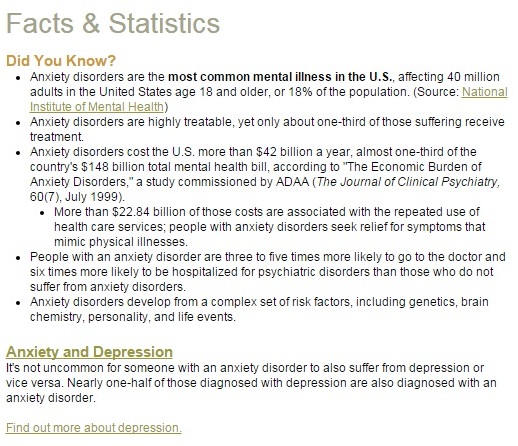


 [Note that fear/anxiety is associated with almost every mental illness that there is.]
I have come to believe that helping people with the deepest needs of life begins with a biblically accurate view of justification and its relationship to sanctification. This is where it begins, let’s go to the phones.
Escaping Church and its Culture of Death
 Originally published August 19, 2015
“This isn’t a technique for boosting our spiritual growth; this is a means of re-salvation because we are still technically lost and under law. ‘Under grace’ merely qualifies us for perpetual re-salvation. That’s Protestantism…period!”
Week in, and week out, and days in-between, professing Christians meet at a local institutional church to further indoctrinate their families in the Protestant culture of death. It doesn’t seem like death as families cheerfully socialize together and lift up their hands as the hipster praise bands make a joyful noise to the Lord. In addition, charismatic orators speak of things that are clearly in the Bible.
But let’s talk about good old fashioned theological math found in the Bible. The Bible addresses the only two people groups that exist in the world: the lost and the saved. As professing Christians, we want to be biblically defined as saved people, no? Can a case be made in this post that present-day evangelicals define themselves according to what the Bible defines as “lost”? Yes. All in all I am sure you will agree; any religion that defines itself as unregenerate is a really bad idea.
Here is how the Bible defines the two people groups:
Romans 6:14 – For sin will have no dominion over you, since you are not under law but under grace.
Every person living in the world is under law or under grace, lost or saved. Protestants define themselves as under law with under grace as a covering. Romans 6:14 is defined this way:
We are under grace because the righteousness of Christ continually saves us from being under law.
So, with Protestantism, it’s both. Under grace means we are still under law but progressively saved by grace. Under law is who we are, while we “experience” grace. Under law is what we do, under grace is what we experience. Supposedly, when Paul stated that we are “not” under law, what he really meant to say is under law is the absence of grace. The lost are only under law, but the saved are under both.
Hence, we are still under the “righteous demands of the law,” but if we are under grace, Jesus keeps the law for us. This is achieved by focusing on our sinfulness against the law, and returning to the same gospel that originally saved us out of gratitude. Objections to this idea are met with accusations of indifference to Christ’s sacrifice. Therefore, the “Christian” must live a “lifestyle of repentance” and constantly seek a “greater revelation of self” which is inherently sinful. The goal is to plunge the depths of our supposed total depravity. And if you are paying attention, our sin and the original gospel that saved us are the constant drumbeats we hear in the institutional church week in and week out.
Consequently, our goal is to see more and more of our reality of being under law resulting in an increased joy regarding our original salvation. Mainline evangelical Paul Washer states it this way:
At conversion, a person begins to see God and himself as never before. This greater revelation of God’s holiness and righteousness leads to a greater revelation of self, which, in return, results in a repentance or brokenness over sin. Nevertheless, the believer is not left in despair, for he is also afforded a greater revelation of the grace of God in the face of Christ, which leads to joy unspeakable. This cycle simply repeats itself throughout the Christian life. As the years pass, the Christian sees more of God and more of self, resulting in a greater and deeper brokenness. Yet, all the while, the Christian’s joy grows in equal measure because he is privy to greater and greater revelations of the love, grace, and mercy of God in the person and work of Christ. Not only this, but a greater interchange occurs in that the Christian learns to rest less and less in his own performance and more and more in the perfect work of Christ. Thus, his joy is not only increased, but it also becomes more consistent and stable. He has left off putting confidence in the flesh, which is idolatry, and is resting in the virtue and merits of Christ, which is true Christian piety (Paul Washer: The Gospel Call and True Conversion; Part 1, Chapter 1, heading – The Essential Characteristics Of Genuine Repentance, subheading – Continuing and Deepening Work of Repentance).
This not only turns the Bible completely upside down, but leaves the Christian in a lifestyle of death while rejoicing in it. This is a true celebration of death, and church is the culture thereof. Romans 6 is clear about what it means to remain under law:
3 Do you not know that all of us who have been baptized into Christ Jesus were baptized into his death? 4 We were buried therefore with him by baptism into death, in order that, just as Christ was raised from the dead by the glory of the Father, we too might walk in newness of life.
5 For if we have been united with him in a death like his, we shall certainly be united with him in a resurrection like his. 6 We know that our old self was crucified with him in order that the body of sin might be brought to nothing, so that we would no longer be enslaved to sin. 7 For one who has died has been set free from sin. 8 Now if we have died with Christ, we believe that we will also live with him. 9 We know that Christ, being raised from the dead, will never die again; death no longer has dominion over him. 10 For the death he died he died to sin, once for all, but the life he lives he lives to God. 11 So you also must consider yourselves dead to sin and alive to God in Christ Jesus.
Obviously, if we believe our formal sinful self has been “brought to nothing,” Paul Washer’s sanctification construct is impossible, and his statement speaks to the authentic soteriology of the Protestant Reformation. How do you achieve a greater revelation of your sinful self when your former sinful self has been “brought to nothing”?
You don’t, which leaves the “believer” yet under law and in need of salvation. The “believer” needs to continually return to the same gospel that saved him/her in order to remain saved. Instead of the new birth being a onetime event that brings the former sinner to “nothing,” the new birth is defined as a joy experience resulting from revisiting the gospel afresh for forgiveness of sin that still condemns us.
This cycle simply repeats itself throughout the Christian life. As the years pass, the Christian sees more of God and more of self, resulting in a greater and deeper brokenness. Yet, all the while, the Christian’s joy grows in equal measure because he is privy to greater and greater revelations of the love, grace, and mercy of God in the person and work of Christ (Ibid).
We are asking the question, How does the gospel save believers?, not, How does the gospel get people to be believers?… Believers need to be saved. The gospel is the instrument of God’s power to save us. And we need to know how the gospel saves us believers so that we make proper use of it (John Piper: Part 2 of a series titled, “How Does the Gospel Save Believers”).
Progressive sanctification has two parts: mortification and vivification, ‘both of which happen to us by participation in Christ,’ as Calvin notes….Subjectively experiencing this definitive reality signified and sealed to us in our baptism requires a daily dying and rising. That is what the Reformers meant by sanctification as a living out of our baptism….and this conversion yields lifelong mortification and vivification ‘again and again.’ Yet it is critical to remind ourselves that in this daily human act of turning, we are always turning not only from sin but toward Christ rather than toward our own experience or piety (Michael Horton: The Christian Faith; mortification and vivification, pp. 661-663 [Calvin Inst. 3.3.2-9]).
…by new sins we continually separate ourselves, as far as we can, from the grace of God… Thus it is, that all the saints have need of the daily forgiveness of sins; for this alone keeps us in the family of God (John Calvin: Commentaries on the Catholic Epistles; The Calvin Translation Society 1855. Editor: John Owen, p. 165 ¶4).
Moreover, the message of free reconciliation with God is not promulgated for one or two days, but is declared to be perpetual in the Church (2 Cor. 5:18, 19). Hence believers have not even to the end of life any other righteousness than that which is there described. Christ ever remains a Mediator to reconcile the Father to us, and there is a perpetual efficacy in his death—viz. ablution, satisfaction, expiation; in short, perfect obedience, by which all our iniquities are covered (The Calvin Institutes: 3.14.11).
Where we land on these issues is perhaps the most significant factor in how we approach our own faith and practice and communicate it to the world. If not only the unregenerate but the regenerate are always dependent at every moment on the free grace of God disclosed in the gospel, then nothing can raise those who are spiritually dead or continually give life to Christ’s flock but the Spirit working through the gospel. When this happens (not just once, but every time we encounter the gospel afresh), the Spirit progressively transforms us into Christ’s image. Start with Christ (that is, the gospel) and you get sanctification in the bargain; begin with Christ and move on to something else, and you lose both (Michael Horton: Christless Christianity; p. 62).
Nor by remission of sins does the Lord only once for all elect and admit us into the Church, but by the same means he preserves and defends us in it. For what would it avail us to receive a pardon of which we were afterwards to have no use? That the mercy of the Lord would be vain and delusive if only granted once, all the godly can bear witness; for there is none who is not conscious, during his whole life, of many infirmities which stand in need of divine mercy. And truly it is not without cause that the Lord promises this gift specially to his own household, nor in vain that he orders the same message of reconciliation to be daily delivered to them (The Calvin Institutes: 4.1.21).
Therefore, “under grace” is defined as a mere qualification to return to the same gospel that saved us; in other words, “We must preach the gospel to ourselves every day” in order to keep ourselves saved. How prevalent is this idea in the contemporary church? Consider this laundry list from Peter Lumpkins .com:
“As Pastors we must first preach the gospel to ourselves before we proclaim to the world the necessity of a Savior” (Scott Thomas, President of Acts 29 Network).
“Yet even when we understand that our acceptance with God is based on Christ’s work, we still naturally tend to drift back into a performance mindset. Consequently, we must continually return to the gospel. To use an expression of the late Jack Miller, we must ‘preach the gospel to ourselves every day’ (Jerry Bridges, Reformed author).
“We must preach the Gospel to ourselves and one another every day” (Ashland Avenue Baptist Church Distinctives, Lexington, KY).
“The Gospel must be central to our lives and central to our message. Strive to keep the Gospel in the center of your worship ministry. Jerry Bridges tell us that we must preach the Gospel to ourselves everyday. It has been said that we never move on from the Cross, only to a more profound understanding of the Cross” (Dr. Greg Brewton, Associate Dean for Music and Worship Leadership at The Southern Baptist Theological Seminary).
“We must preach the Gospel to ourselves” (Francis Chan, Passion 2011).
“Yesterday was a powerful moment in the Word of God as we studied Romans 8:1-4. I challenged those present to learn to preach the gospel to ourselves daily. Why? If we do not preach the gospel to ourselves daily, we will return to sin, bondage, guilt, the Law, and legalism…You see, this is why we must preach the gospel to ourselves daily” (Ronnie Floyd, former Chairman of the Great Commission Resurgence Task Force).
“I’ve been re-reading Jerry Bridges’ excellent book The Discipline of Grace…Bridges reminded me of just how important it is to ‘preach the gospel to ourselves everyday’ if we are going to be transformed into the likeness of Christ” (Tullian Tchividjian, Senior Pastor, Coral Ridge Presbyterian Church).
“…I once assumed…that the gospel was simply what non-Christians must believe in order to be saved… But I’ve come to realize that once God rescues sinners, his plan isn’t to steer them beyond the gospel, but to move them more deeply into it. The gospel, in other words, isn’t just the power of God to save you, it’s the power of God to grow you once you’re saved… . This idea that the gospel is just as much for Christians as it is for non-Christians may seem like a new idea to many but, in fact, it is really a very old idea” (Tullian Tchividjian, Senior Pastor, Coral Ridge Presbyterian Church).
“We must preach the gospel to ourselves everyday… . As we preach the gospel to ourselves, we should be both encouraged and overwhelmed with gratitude, and both should give us a desire to deal with the sin in our lives” (Casey Lewis, student, Southwestern Baptist Theological Seminary).
“A Prayer for Preaching the Gospel to Ourselves… . …Most gracious Lord Jesus, even as Paul was eager to preach the gospel to believers in Rome, so I’m eager to preach it to my own heart today…” (Scotty Smith, Guest blogger at Justin Taylor’s The Gospel Coalition site and Pastor, Christ Community Church, Franklin, TN).
“We must constantly be preaching the gospel to ourselves, filling our hearts with your beauty and bounty, Lord Jesus… . Dear heavenly Father, it’s not about “mind over matter,” or the power of positive thinking, or the pragmatic good of cognitive therapy. It’s all about preaching the gospel to ourselves every opportunity we get…” Scotty Smith, Pastor, Christ Community Church, Franklin, TN (here and here, respectively)
“We must constantly be preaching the gospel to ourselves, filling our hearts with your beauty and bounty, Lord Jesus… . Dear heavenly Father, it’s not about “mind over matter,” or the power of positive thinking, or the pragmatic good of cognitive therapy. It’s all about preaching the gospel to ourselves every opportunity we get…” Scotty Smith, Pastor, Christ Community Church, Franklin, TN (here and here, respectively)
“How can we not shift from the hope of the Gospel? By preaching the Gospel to ourselves daily… . ‘Preaching the Gospel to yourself’ is a phrase I first ran across in ‘The Discipline of Grace’ by Jerry Bridges, and have observed for years in the life of my good friend, C.J. Mahaney. C.J. has written persuasively, biblically, and practically on this topic in his new book, ‘Living the Cross Centered Life’… . Don’t take a day off from preaching the Gospel to yourself” (Bob Kaulfin, Director of Worship Development for Sovereign Grace Ministries and worship leader at Covenant Life Church led by Josh Harris).
“Far too many Christians are passive in their fight for joy…. What can I do? ‘Well, God does not mean for us to be passive. He means for us to fight the fight of faith the fight for joy. And the central strategy is to preach the gospel to yourself’…” (John Piper, When I Don’t Desire God, p.81, as quoted by Bob Kauflin).
“I am thoroughly engrossed with Joe Thorn’s personal mediations on preaching the gospel to oneself” (Tom J. Nettles, Professor of Historical Theology, Southern Baptist Theological Seminary, promoting Joe Thorn’s book, Note to Self: the Discipline of Preaching to Oneself).
“In the few months prior to Verge God was really working on me. I’ve been doing a lot of repenting of the idols in my heart. I’ve been preaching the gospel to myself” (Steve McCoy, SBC Pastor).
“This may sound really selfish, but faithfully preaching the gospel to myself is actually what enables me to share it faithfully to others” (Timmy Brister, SBC Associate Pastor).
“I chose not to include the response to the gospel…but just tried to focus on what the gospel actually is. I edit it regularly as I try to grasp and preach the gospel to myself” (Ed Stetzer, LifeWay).
This isn’t a technique for boosting our spiritual growth; this is a means of re-salvation because we are still technically lost and under law. “Under grace” merely qualifies us for perpetual re-salvation. That’s Protestantism…period!
And the culture that will result is defined in the Bible:
Romans 6:15 – What then? Are we to sin because we are not under law but under grace? By no means! 16 Do you not know that if you present yourselves to anyone as obedient slaves,[c] you are slaves of the one whom you obey, either of sin, which leads to death, or of obedience, which leads to righteousness? 17 But thanks be to God, that you who were once slaves of sin have become obedient from the heart to the standard of teaching to which you were committed, 18 and, having been set free from sin, have become slaves of righteousness. 19 I am speaking in human terms, because of your natural limitations. For just as you once presented your members as slaves to impurity and to lawlessness leading to more lawlessness, so now present your members as slaves to righteousness leading to sanctification.
20 For when you were slaves of sin, you were free in regard to righteousness. 21 But what fruit were you getting at that time from the things of which you are now ashamed? For the end of those things is death. 22 But now that you have been set free from sin and have become slaves of God, the fruit you get leads to sanctification and its end, eternal life. 23 For the wages of sin is death, but the free gift of God is eternal life in Christ Jesus our Lord.
Christ said, “You must be born again.” This is clearly a doctrine that redefines the new birth by defining the “believer” as unchanged and yet under law. Along with that is an unavoidable conclusion that this also includes a fruits unto death existence that is part and parcel with being under law.
This will, and does make sin and condemnation the focus and theme of church while the Bible emphasizes ADDING virtue to our faith in contrast to a continual re-visitation of our supposed depravity.
1Peter 4:8 – Above all, keep loving one another earnestly, since love covers a multitude of sins.
2Peter 1:3 – His divine power has granted to us all things that pertain to life and godliness, through the knowledge of him who called us to his own glory and excellence, 4 by which he has granted to us his precious and very great promises, so that through them you may become partakers of the divine nature, having escaped from the corruption that is in the world because of sinful desire. 5 For this very reason, make every effort to supplement your faith with virtue, and virtue with knowledge, 6 and knowledge with self-control, and self-control with steadfastness, and steadfastness with godliness, 7 and godliness with brotherly affection, and brotherly affection with love. 8 For if these qualities are yours and are increasing, they keep you from being ineffective or unfruitful in the knowledge of our Lord Jesus Christ. 9 For whoever lacks these qualities is so nearsighted that he is blind, having forgotten that he was cleansed from his former sins.
Romans 15:14 – I myself am satisfied about you, my brothers, that you yourselves are full of goodness, filled with all knowledge and able to instruct one another.
Hebrews 10:24 – And let us consider how to stir up one another to love and good works.
In the past, Protestants were confused enough about their own soteriological traditions that the fruits unto death were minimal, but during this Neo-Reformed resurgence that we are witnessing presently, such is not the case; the institutional church is a blatant culture of death. And those who would expose their children to it are woefully undiscerning. Ask yourself this simple question: do I leave church better equipped to see something that the Bible states isn’t there or better equipped to love God and others? Am I better at seeing my own depravity, or have I learned new ways to love which covers a multitude of sins anyway?
The remedy for this malady is a return to where the gathering of believers belongs: in home fellowships where believers are equipped to love God and others as a lifestyle, NOT a “lifestyle of repentance.” The institutional church was first called “church” when it was founded in the 4th century, and it was founded on the same idea that believers remain under law. Therefore, an authoritative institution was created that supplied official re-salvation for those under law. The institutional church goes hand in glove with the idea that it supplies a place for re-salvation, i.e., those qualified to receive it by being “under grace.”
To impart this blessing to us, the keys have been given to the Church (Mt. 16:19; 18:18). For when Christ gave the command to the apostles, and conferred the power of forgiving sins, he not merely intended that they should loose the sins of those who should be converted from impiety to the faith of Christ; but, moreover, that they should perpetually perform this office among believers” (The Calvin Institutes: 4.1.22).
Secondly, This benefit is so peculiar to the Church, that we cannot enjoy it unless we continue in the communion of the Church. Thirdly, It is dispensed to us by the ministers and pastors of the Church, either in the preaching of the Gospel or the administration of the Sacraments, and herein is especially manifested the power of the keys, which the Lord has bestowed on the company of the faithful. Accordingly, let each of us consider it to be his duty to seek forgiveness of sins only where the Lord has placed it. Of the public reconciliation which relates to discipline, we shall speak at the proper place (Ibid).
Come out from among them and be separate.
The Protestant Twisting of 1John: A Clarification, Part 2
 Originally published March 31, 2015
Listen to show or download audio here.
Listen or download full show uninterrupted.
Welcome to Blogtalk Radio False Reformation this is your host Paul M. Dohse Sr. Tonight, part 2 of “The Protestant Twisting of 1John: A Clarification.”
How is 1John used to argue for a progressive salvation, and what is John really saying in his epistle? That’s what we are discussing tonight. If you would like to add to our lesson or ask a question, call (347) 855-8317. Per the usual, we will check in with Susan towards the end of the show and listen to her perspective.
If you would like to comment on our subject tonight, you can also email me at paul@ttanc.com. That’s Tom, Tony, Alice, Nancy, cat, paul@ttanc.com. I have my email monitor right here and can add your thoughts to the lesson.
Ok, so this whole idea is very Protestant, that we must keep going back to the same gospel that saved us in order to keep ourselves saved. But, it’s all good because we are going back to the “gospel” and the “gospel” is by faith alone so going back to the gospel is a faith alone work which isn’t really a work. So, it’s ok to do something to keep ourselves saved as long as it’s a faith alone work.
As we discussed last week, here is where the home fellowship movement stands apart from the institutional church: salvation is a finished work; salvation is NOT a progression from point A to point B. The new birth is a onetime instantaneous quickening of the believer. The believer then in fact does move on to something completely different—kingdom living, or discipleship. Central to Protestantism is the idea that moving on from the gospel to doctrinal maturity is an abomination. The who’s who of Protestantism can be cited many times in stating this in no uncertain terms.
The home fellowship movement is not a mere preference over the institutional church—it is an anti-progressive justification movement. It is a return to the true gospel of Christ. All of the institutional church either embraces progressive justification or is willing to fellowship with it and is therefore altogether guilty.
Last week, we also introduced the fact that 1John must be interpreted according to its historical context. The number one nemesis of the 1st century assemblies was Gnosticism and 1John is a treatise against it. We covered John’s introduction which was a direct pushback against the Gnostic idea that the spiritual Christ did not die on the cross. We believe that John was specifically addressing the Gnostic teachings of Cerinthus. He taught that there was more than one Christ; one born naturally of human parents that will be resurrected with all other men in the last days, and the spiritual Christ who dwells in heaven. Elsewhere, John wrote:
1John 4:1 – “Beloved, do not believe every spirit, but test the spirits to see whether they are from God, for many false prophets have gone out into the world. 2 By this you know the Spirit of God: every spirit that confesses that Jesus Christ has come in the flesh is from God, 3 and every spirit that does not confess Jesus is not from God. This is the spirit of the antichrist, which you heard was coming and now is in the world already.”
The very definition of antichrist teachings is the denial that the true Christ (Messiah) was part of the material world, or actually came in the flesh. Gnostic systems of thought are very complex, but the cardinal principle is that material is evil and the spiritual or invisible is good.
The important distinction is that biblically, the material creation is not inherently evil, but weak. This is an important distinction because Christ coming as man makes it possible for men to be literally recreated and part of God’s literal family. The teaching that “denies Jesus is the Christ” (Messiah: 1Jn 2:22) circumvents the new birth. Throughout this epistle, John refers to the recipients as “little offsprings”(teknion; little children). I want to dig into this a little deeper; the new birth and its relationship to apostolic succession, but first, let me address the crux issue here.
John was also addressing an aspect of Gnosticism that believed the following: sin only resides in the material, and the spiritual part of man is sinless and has never sinned. In essence, it doesn’t matter what we do in the body because the spiritual part of man is sinless and has never sinned, and that is the only part of man that is eternal anyway. Many scholars concur that this was a common form of Gnosticism. Of course, this disavows any need for Christ to die on the cross and makes the knowledge of this supposed lie salvation itself. Salvation by being made into something new is out—coming to grips with the gnosis regarding man’s inner spark of divinity is in. This backdrop now explains exactly what John was getting at in 1John 1:7-10 and 2:1,2.
1John 1:7 – “But if we walk in the light, as he is in the light, we have fellowship with one another, and the blood of Jesus his Son cleanses us from all sin. 8 If we say we have no sin, we deceive ourselves, and the truth is not in us. 9 If we confess our sins, he is faithful and just to forgive us our sins and to cleanse us from all unrighteousness. 10 If we say we have not sinned, we make him a liar, and his word is not in us.”
1John 2:1 – “My little children, I am writing these things to you so that you may not sin. But if anyone does sin, we have an advocate with the Father, Jesus Christ the righteous. 2 He is the propitiation for our sins, and not for ours only but also for the sins of the whole world.”
“We” in these verses should be viewed as speaking to mankind in general while including both saved and unsaved individuals. Recognizing that Christ came to deal with man’s sin problem is efficacious to the gospel.
John is NOT stating the Protestant gospel of “deep repentance” which teaches that we keep ourselves saved (or washed) via a “lifestyle of repentance.” That would be a perpetual return to the same gospel that saved us for relief from “present sin.” That flies in the face of biblical justification. This makes “if” in these verses a conditional conjunction. That would mean that our sins continue to be forgiven, or washed, or cleansed “if” we “walk in the light” and continue to repent. That’s clearly works salvation, and clearly a reapplication of Christ’s sacrifice to present sin. As actually taught in Protestant circles, the sacrifice only happened once, but the remembrance of it continues to cleanse present and future sins.
This is the whole deal behind, “We must preach the gospel to ourselves every day” and the vital union doctrine. Living a “lifestyle of repentance” or deep repentance “keeps us in the love of Jesus.” This is salvation by Jesus + deep repentance to keep ourselves saved. The Reformed say, “No, it’s not works because repentance is a faith alone work,” but not even a so-called faith alone work can keep you born again—you can’t unborn yourself by not doing something. Look, here is the money point on all of this: the needed present and future forgiveness can only be found in the Protestant institutional church via baptism/formal membership. And we will be addressing that a little further along.
One of the many problems with this is, in regard to believers, follows: in order for present sin to exist, there has to be a law, and the blood of Christ ended the law—it’s a onetime cleansing. To have some need to reapply the blood of Christ to present sin implies that there is still sin, and there is not because where there is no law—there is no sin, and Christ died on the cross to end the law. This fact is found in Romans 3:19,20, 4:15, 5:13, 7:8, 10:4.
Some insist that John’s context here is fellowship, and since fellowship is the context, John is writing about repentance that is necessary to keep us in proper family relationship with God, and not a repentance that keeps us in the family of God; ie., John is talking about sanctification and not justification. Frankly, that’s the view that I used to hold to as well.
But John is talking about the onetime cleansing that justifies. Note that throughout these verses that it is a forgiveness that cleanses from “all sin” and “all unrighteousness.” That has to be justification. What John is saying is that no matter who you are in humanity, you have need to be forgiven of sin by believing that Jesus is the Christ and died for you. Note the subjects of these verses: “He is the propitiation for our sins, and not for ours only but also for the sins of the whole world.”
However, John is also saying that this fact doesn’t give us a license to sin any more than the Gnostics, “I am writing these things to you so that you may not sin.” But watch this: “But if anyone does sin, we [everyone] have an advocate with the Father.” Ok John, an advocate for what purpose? Answer: “He is the propitiation for our sins, and not for ours only but also for the sins of the whole world.” Who are the subjects? It’s obvious who the subjects are.
If this isn’t speaking to a onetime cleansing of sin, the world doesn’t need the new birth any more than Christians—they only need to ask forgiveness so the blood of Christ will be applied to the particular sin. Not only that, the new birth is also disavowed through the denial of a new creaturehood displayed by people who have passed from death to life. And John is speaking directly towards this issue as well. You see, who the “we” are and what the “if” is—is critical to interpreting these verses properly. The “we” are the “anyone.” The “if” is a cause and effect conjunction and not a conditional conjunction.
And let me tell you something, Protestant theologians rarely have any qualms about saying that God’s promises are conditional. I mean, what’s the paramount example? Replacement theology/supersessionism, right? This whole idea that Israel’s election was conditional on them holding up their end of the covenant. I just don’t know what can be more obvious, and this is their exact take on justification as well.
This is the crux. John is saying that if we walk in the light, it’s because we have been born again, not that we keep ourselves born again if we do our part by walking in the light. Walking in the light is not our part of the so-called vital union, we walk in the light because that’s what new creatures do; cows like hay and ducks like water—it’s a cause and effect conjunction not a conditional conjunction.
Now, here is where we really struggle with these verses: in verse 7, the English word in the plural strongly suggests a present continuous action. Verse 9 really isn’t that much of a problem as it’s merely saying that anyone that confesses their sin is cleansed of all unrighteousness. Note the following verse 10 that can be rendered this way: “If we say we have not [never] sinned.” The English “ed’ on the end of sin indicates past tense like, “I sinned.” That’s past tense. If John is speaking to the present continuance, why would he have not written, “if we say that we do not sin.” Right? Verse 9 simply fits into the Gnostic motif that John was arguing against.
Neither is 1John 2:1, 2 a problem. John is simply stating that anyone who recognizes their sin and wants to do something about it has an advocate in Christ who cleanses all sin. And by the way, the rest of John’s letter backs up my Pauline argument to the hilt. Just, all over the place in the rest of the letter, for example,
1John 3:3 – “And everyone who thus hopes in him purifies himself as he is pure. 4 Everyone who makes a practice of sinning also practices lawlessness; sin is lawlessness. 5 You know that he appeared in order to take away sins, and in him there is no sin.”
He came to “take away sin,” not to cover it with His own righteousness and to continue to forgive it. Christ came to end sin altogether. Are we “in Christ”? Well, in Him there is NO sin. So if we are in Him, why would we need forgiveness for present or future sin in regard to justification? In 1John 2:12-14, forgiveness of sin and overcoming the evil one is spoken of in the past tense.
The only matter at hand is the word “cleanses” in verse 7. Let me point something out to you. Most of the English translations that we have come out of the Protestant Reformation. Therefore, and there are myriads of examples of this, the translations are tainted with progressive justification presuppositions. And unfortunately, this includes the Greek word-study helps. Here is something I read in one:
Every encounter with a command to obey, is our opportunity to jettison self-reliance and to yield to the enabling power of the Holy Spirit. Supernatural commands from the supernatural God can only be carried out with reliance on His supernatural power! The Spirit is called the Helper, but don’t let His Name mislead you. To say that we need His help is to imply we have some ability of our own to obey and are in need of a little “push” so to speak.
See the problem? You can know the Greek backwards and forwards, but what good does it do if “help” doesn’t mean “help”? Look, what good have all of the Protestant Greek scholars done for us? I came to realize the problem of progressive justification by my own independent study in Romans. The basic concept easily understood regardless of the language, “where there is no law there is no sin.” That statement astounded me, but was the key to unraveling the whole mystery. Once you understand that fundamental, the rest of the Bible, when taken in context, fits together perfectly in every way. How much did any knowledge of Greek aid me in this understanding? Nada. Goose egg. Zilch. Loco zippo.
Greek can be confirming, and helpful, but the Bible is written in definitive structures that mean the same thing in all languages and that is no accident. You can translate the fact that Christ died on the cross to end the law, and where there is no law there is no sin, any way you want to—it’s going to mean the same thing in any language. Then you start seeing where the concept fits together with everything else in the Bible which enables you to nail down what the anomalies are. And a lot of the anomalies are bias towards a certain worldview.
Notice in the example I gave there is no room given for an authentic colaboring between us and the Holy Spirit. It is either all us or all of the Holy Spirit. My friends, that is the Protestant redemptive-historical worldview to a T and it is fundamentally Gnostic in its premise. Hence, when you use Greek word-study helps, you are often dealing with the same bias. This is why I eventually threw away my Kenneth Wuest expanded New Testament translation. I started seeing clear bias in how he processed the Greek verbs and I was totally done with him at that point.
I spent the better part of yesterday researching 1John 1:7 and the word “cleanses” therein. We know from biblical context that this verse cannot be saying that the one sacrifice of Christ continues to rewash us IF we continue to walk in the light; ie., Protestantism. And let me give you the thumbnail: if you remain faithful to the institutional church and its sacraments/ordinances, that keeps you saved. Even if the Greek usage indicates a present continual action there is no way to distinguish that from the simple reality of being washed once and remaining clean thereafter. In other words, there is no way to definitively distinguish between two intents: a required reapplication to reinstate a status or an unchanged status that continues in the same state without any further action.
Though “cleanses” appears to be some kind of continuing action in the ESV version of 1John 1:7 as well as many other versions, we know that this same cleansing of regeneration is clearly stated as a onetime final act in many, many other Bible passages. For example,
1 Corinthians 6:11- “And that is what some of you were. But you were washed, you were sanctified, you were justified in the name of the Lord Jesus Christ and by the Spirit of our God.”
Ok, you have “were” in there four times with sinful lifestyles being in the past tense, and sanctified, justified, and “washed” being in the present tense. It is one event that happens one time and transforms us into an immutable state. Period. This is irrefutable. And by the way, if you do a New Testament word search on the exact form of the Greek word “cleanses” (other translations “cleanseth”) in 1John 1:7, it is almost always used as a onetime ceremonial cleansing.
Matthew 8:2 – “And behold, a leper came to him and knelt before him, saying, ” Lord, if you will, you can make me clean.” 3 And Jesus stretched out his hand and touched him, saying, “I will; be clean.” And immediately his leprosy was cleansed.” [Here in Mathew 8:2, the same exact form of the Greek word is used for past, present, and future tense. “Ed” is added to the English word “cleansed” to indicate past tense].
Note how Young’s Literal Translation has 1John 1:7.
“and if in the light we may walk, as He is in the light — we have fellowship one with another, and the blood of Jesus Christ His Son doth cleanse us from every sin;”
Now, not only does this simply state the fact that the blood of Christ cleanses us from every sin with a much less conditional translation, it’s interesting that the YLT picks up on something that Andy related to me yesterday in regard to the word “may”:
What is interesting is that all of the examples that John uses where he says “if” are all 3rd class conditions. All the key verbs are in the subjunctive mood.
Here is an excerpt regarding 3rd class conditions…
“The third class condition often presents the condition as uncertain of fulfillment, but still likely. There are, however, many exceptions to this…The third class condition encompasses a broad range of potentialities in Koine Greek. It depicts what is likely to occur in the future, what could possibly occur, or even what is only hypothetical and will not occur” (Wallace, p. 696).
So John is really posing a series of future hypothetical situations. Any place where it says “if” you should read it as “if ever in the future…” or “if at any time in the future…”
It would appear that this seems to be an exercise in reason using hypothetical examples to refute the gnostics that were among them in those assemblies. Notice that the present tense verbs are present tense because they are in the conclusion (apodosis) to the proposed hypothetical conditional premise (protasis). But the verbs in the premise (protasis) are in the subjunctive mood.
Also, you cannot read verse 7 without verse 6. Verse 7 is an antithetical conclusion of verse 6. In other words, you can’t properly interpret vs 7 without vs 6. In fact, notice how 7 contrasts 6, AND vs 9 contrasts vs 8 also! They are parallel arguments, and then vs 10 kind of sums it up.
This bolsters my contention that John is addressing people in general regarding the ramifications of their beliefs about sin in contrast to Gnosticism. That’s the crux here: the backdrop is the Gnosticism John is addressing. If you say that you have no sin, for whatever reason, you are making God out to be a liar. But if you confess your sin, God will cleanse you from all unrightousness. And, that will have an effect on your life because you have been cleansed. John does not hone-in on the new birth right here, but does so in chapter 3 bigtime. Really, chapter 3 clarifies exactly what is being stated in the first two chapters.
In addition, John is saying that even though those who confess their sin are cleansed of all sin, that is not a different kind of license to sin without ramifications. Hence, “…I am writing these things to you so that you may not sin.” But if you do recognize that you have sin, we have an advocate with the Father that is a propitiation for all sin, those who confess that they have sin, and those who may in the future confess that they have sin—this is what is going on in this passage. And by the way, this is another refutation of limited atonement as well.
Let me give another example that might help clarify all of this. One Reformed fellow (a disciple of Paul David Tripp) arguing against me in regard to all of this stated the following:
In John 4, we are to drink once, but that one drink becomes a reserve that refreshes continually. The substance that refreshes is the same (Christ’s salvation, in an ongoing manner)…For Calvin, the cleaning is ongoing, because there WILL be new sins, and 1 John tells us there are new sins. WERE IT NOT FOR the ongoing cleaning and forgiveness, we would exit the family of God, but the faithful know of a certainty that this cleansing is ongoing and present.
See the problem with not interpreting this passage in its historical context? John isn’t talking about “new sins,” he is talking about SIN period. Where is there anything stated in this passage in regard to “new sins”? What relevance does “new sins” have with the unsaved world that is one of the subjects of this passage? The unsaved have “new sins”?
Also, Christians do not have “new sins” because Christ ended the law and where there is no law there is no sin. This is exactly why the Protestant gospel keeps people under law—the whole concept of “new sin.”
In addition, notice what he states about John 4 that is a common Reformed position:
“In John 4, we are to drink once, but that one drink becomes a reserve that refreshes continually.”
This statement is a common smoking gun that damns Protestantism. In that passage, Jesus said that those who drink of the water will never… (what?) again? Right, they will NEVER “thirst” again. Christians may need refreshment against the weakness of the flesh, but we never need our justification to be refreshed—that’s just a blatant false gospel.
Moreover, note, “WERE IT NOT FOR the ongoing cleaning and forgiveness, we would exit the family of God, but the faithful know of a certainty that this cleansing is ongoing and present.” This is where the “if(s)” of 1John totally shoot Protestantism in its gospel foot. If you take this approach, the if(s) of 1John 1:7-2:2 are conditional upon confessing “new sins.” This clearly makes the cleansing of sin that makes us part of God’s family conditional. It makes the new birth conditional. “If” we don’t confess, we can be unborn.
Doesn’t it make much more sense if John is saying that we (people in general) have to recognize that men have sin in order to receive a cleansing from it? Sure it does. John is pushing back against a philosophy that taught the following: man is spirit and therefore without sin; only the material world has sin. Therefore, it doesn’t matter what people do in the body, it’s all just part of the material world that is passing away. This also rejects the new birth and its righteous lifestyle that walks in the light as Christ is in the light and there is no darkness in Him. Those who walk in the light are born of the light and they are of the light because they recognized the need to confess their sin in order to be cleansed. Hence…
John 3:2 – “Beloved, we are God’s children now, and what we will be has not yet appeared; but we know that when he appears we shall be like him, because we shall see him as he is. 3 And everyone who thus hopes in him purifies himself as he is pure.”
Next week, we are going to look at how the rest of the book of 1John fits into this Pauline soteriological schema perfectly. Why does John follow our passage at hand with a discussion of love and then the new birth? How do we get from the gospel anomaly of “new sins” to “love,” and what does that have to do with the new birth? How does all of this make walking in the light synonymous with the new birth?
See you next, and now let’s go to the phones.
Escaping Church and its Culture of Death
 “This isn’t a technique for boosting our spiritual growth; this is a means of re-salvation because we are still technically lost and under law. ‘Under grace’ merely qualifies us for perpetual re-salvation. That’s Protestantism…period!”
Week in, and week out, and days in-between, professing Christians meet at a local institutional church to further indoctrinate their families in the Protestant culture of death. It doesn’t seem like death as families cheerfully socialize together and lift up their hands as the hipster praise bands make a joyful noise to the Lord. In addition, charismatic orators speak of things that are clearly in the Bible.
But let’s talk about good old fashioned theological math found in the Bible. The Bible addresses the only two people groups that exist in the world: the lost and the saved. As professing Christians, we want to be biblically defined as saved people, no? Can a case be made in this post that present-day evangelicals define themselves according to what the Bible defines as “lost.” Yes. All in all I am sure you will agree; any religion that defines itself as unregenerate is a really bad idea.
Here is how the Bible defines the two people groups:
Romans 6:14 – For sin will have no dominion over you, since you are not under law but under grace.
Every person living in the world is under law or under grace; lost or saved. Protestants define themselves as under law with under grace as a covering. Romans 6:14 is defined this way:
We are under grace because the righteousness of Christ continually saves us from being under law.
So, with Protestantism, it’s both. Under grace means we are still under law but progressively saved by grace. Under law is who we are, while we “experience” grace. Under law is what we do, under grace is what we experience. Supposedly, when Paul stated that we are “not” under law, what he really meant to say is under law is the absence of grace. The lost are only under law, but the saved are under both.
Hence, we are still under the “righteous demands of the law,” but if we are under grace, Jesus keeps the law for us. This is achieved by focusing on our sinfulness against the law, and returning to the same gospel that originally saved us out of gratitude. Objections to this idea are met with accusations of indifference to Christ’s sacrifice. Therefore, the “Christian” must live a “lifestyle of repentance” and constantly seek a “greater revelation of self” which is inherently sinful. The goal is to plunge the depths of our supposed total depravity. And if you are paying attention, our sin and the original gospel that saved us are the constant drumbeats we hear in the institutional church week in and week out.
Consequently, our goal is to see more and more of our reality of being under law resulting in an increased joy regarding our original salvation. Mainline evangelical Paul Washer states it this way:
At conversion, a person begins to see God and himself as never before. This greater revelation of God’s holiness and righteousness leads to a greater revelation of self, which, in return, results in a repentance or brokenness over sin. Nevertheless, the believer is not left in despair, for he is also afforded a greater revelation of the grace of God in the face of Christ, which leads to joy unspeakable. This cycle simply repeats itself throughout the Christian life. As the years pass, the Christian sees more of God and more of self, resulting in a greater and deeper brokenness. Yet, all the while, the Christian’s joy grows in equal measure because he is privy to greater and greater revelations of the love, grace, and mercy of God in the person and work of Christ. Not only this, but a greater interchange occurs in that the Christian learns to rest less and less in his own performance and more and more in the perfect work of Christ. Thus, his joy is not only increased, but it also becomes more consistent and stable. He has left off putting confidence in the flesh, which is idolatry, and is resting in the virtue and merits of Christ, which is true Christian piety (Paul Washer: The Gospel Call and True Conversion; Part 1, Chapter 1, heading – The Essential Characteristics Of Genuine Repentance, subheading – Continuing and Deepening Work of Repentance).
This not only turns the Bible completely upside down, but leaves the Christian in a lifestyle of death while rejoicing in it. This is a true celebration of death, and church is the culture thereof. Romans 6 is clear about what it means to remain under law:
3 Do you not know that all of us who have been baptized into Christ Jesus were baptized into his death? 4 We were buried therefore with him by baptism into death, in order that, just as Christ was raised from the dead by the glory of the Father, we too might walk in newness of life.
5 For if we have been united with him in a death like his, we shall certainly be united with him in a resurrection like his. 6 We know that our old self was crucified with him in order that the body of sin might be brought to nothing, so that we would no longer be enslaved to sin. 7 For one who has died has been set free from sin. 8 Now if we have died with Christ, we believe that we will also live with him. 9 We know that Christ, being raised from the dead, will never die again; death no longer has dominion over him. 10 For the death he died he died to sin, once for all, but the life he lives he lives to God. 11 So you also must consider yourselves dead to sin and alive to God in Christ Jesus.
Obviously, if we believe our formal sinful self has been “brought to nothing,” Paul Washer’s sanctification construct is impossible, and his statement speaks to the authentic soteriology of the Protestant Reformation. How do you achieve a greater revelation of your sinful self when your former sinful self has been “brought to nothing”?
You don’t, which leaves the “believer” yet under law and in need of salvation. The “believer” needs to continually return to the same gospel that saved him/her in order to remain saved. Instead of the new birth being a onetime event that brings the former sinner to “nothing,” the new birth is defined as a joy experience resulting from revisiting the gospel afresh for forgiveness of sin that still condemns us.
This cycle simply repeats itself throughout the Christian life. As the years pass, the Christian sees more of God and more of self, resulting in a greater and deeper brokenness. Yet, all the while, the Christian’s joy grows in equal measure because he is privy to greater and greater revelations of the love, grace, and mercy of God in the person and work of Christ (Ibid).
We are asking the question, How does the gospel save believers?, not: How does the gospel get people to be believers?… Believers need to be saved. The gospel is the instrument of God’s power to save us. And we need to know how the gospel saves us believers so that we make proper use of it (John Piper: Part 2 of a series titled, “How Does the Gospel Save Believers”).
Progressive sanctification has two parts: mortification and vivification, ‘both of which happen to us by participation in Christ,’ as Calvin notes….Subjectively experiencing this definitive reality signified and sealed to us in our baptism requires a daily dying and rising. That is what the Reformers meant by sanctification as a living out of our baptism….and this conversion yields lifelong mortification and vivification ‘again and again.’ Yet it is critical to remind ourselves that in this daily human act of turning, we are always turning not only from sin but toward Christ rather than toward our own experience or piety (Michael Horton: The Christian Faith; mortification and vivification, pp. 661-663 [Calvin Inst. 3.3.2-9]).
…by new sins we continually separate ourselves, as far as we can, from the grace of God… Thus it is, that all the saints have need of the daily forgiveness of sins; for this alone keeps us in the family of God (John Calvin: Commentaries on the Catholic Epistles; The Calvin Translation Society 1855. Editor: John Owen, p. 165 ¶4).
Moreover, the message of free reconciliation with God is not promulgated for one or two days, but is declared to be perpetual in the Church (2 Cor. 5:18, 19). Hence believers have not even to the end of life any other righteousness than that which is there described. Christ ever remains a Mediator to reconcile the Father to us, and there is a perpetual efficacy in his death—viz. ablution, satisfaction, expiation; in short, perfect obedience, by which all our iniquities are covered (The Calvin Institutes: 3.14.11).
Where we land on these issues is perhaps the most significant factor in how we approach our own faith and practice and communicate it to the world. If not only the unregenerate but the regenerate are always dependent at every moment on the free grace of God disclosed in the gospel, then nothing can raise those who are spiritually dead or continually give life to Christ’s flock but the Spirit working through the gospel. When this happens (not just once, but every time we encounter the gospel afresh), the Spirit progressively transforms us into Christ’s image. Start with Christ (that is, the gospel) and you get sanctification in the bargain; begin with Christ and move on to something else, and you lose both (Michael Horton: Christless Christianity; p. 62).
Nor by remission of sins does the Lord only once for all elect and admit us into the Church, but by the same means he preserves and defends us in it. For what would it avail us to receive a pardon of which we were afterwards to have no use? That the mercy of the Lord would be vain and delusive if only granted once, all the godly can bear witness; for there is none who is not conscious, during his whole life, of many infirmities which stand in need of divine mercy. And truly it is not without cause that the Lord promises this gift specially to his own household, nor in vain that he orders the same message of reconciliation to be daily delivered to them (The Calvin Institutes: 4.1.21).
Therefore, “under grace” is defined as a mere qualification to return to the same gospel that saved us; in other words, “We must preach the gospel to ourselves every day” in order to keep ourselves saved. How prevalent is this idea in the contemporary church? Consider this laundry list from Peter Lumpkins .com:
“As Pastors we must first preach the gospel to ourselves before we proclaim to the world the necessity of a Savior” Scott Thomas, President of Acts 29 Network.
“Yet even when we understand that our acceptance with God is based on Christ’s work, we still naturally tend to drift back into a performance mindset. Consequently, we must continually return to the gospel. To use an expression of the late Jack Miller, we must “preach the gospel to ourselves every day” Jerry Bridges, Reformed author.
“We must preach the Gospel to ourselves and one another every day” Ashland Avenue Baptist Church Distinctives, Lexington, KY
“The Gospel must be central to our lives and central to our message. Strive to keep the Gospel in the center of your worship ministry. Jerry Bridges tell us that we must preach the Gospel to ourselves everyday. It has been said that we never move on from the Cross, only to a more profound understanding of the Cross”
Dr. Greg Brewton, Associate Dean for Music and Worship Leadership at The Southern Baptist Theological Seminary.
“We must preach the Gospel to ourselves” Francis Chan, Passion 2011
“Yesterday was a powerful moment in the Word of God as we studied Romans 8:1-4. I challenged those present to learn to preach the gospel to ourselves daily. Why? If we do not preach the gospel to ourselves daily, we will return to sin, bondage, guilt, the Law, and legalism…You see, this is why we must preach the gospel to ourselves daily” Ronnie Floyd, former Chairman of the Great Commission Resurgence Task Force
“I’ve been re-reading Jerry Bridges’ excellent book The Discipline of Grace…Bridges reminded me of just how important it is to “preach the gospel to ourselves everyday” if we are going to be transformed into the likeness of Christ” Tullian Tchividjian, Senior Pastor, Coral Ridge Presbyterian Church
“…I once assumed…that the gospel was simply what non-Christians must believe in order to be saved… But I’ve come to realize that once God rescues sinners, his plan isn’t to steer them beyond the gospel, but to move them more deeply into it. The gospel, in other words, isn’t just the power of God to save you, it’s the power of God to grow you once you’re saved… . This idea that the gospel is just as much for Christians as it is for non-Christians may seem like a new idea to many but, in fact, it is really a very old idea” Tullian Tchividjian, Senior Pastor, Coral Ridge Presbyterian Church
“We must preach the gospel to ourselves everyday… . As we preach the gospel to ourselves, we should be both encouraged and overwhelmed with gratitude, and both should give us a desire to deal with the sin in our lives” Casey Lewis, student, Southwestern Baptist Theological Seminary
“A Prayer for Preaching the Gospel to Ourselves… . …Most gracious Lord Jesus, even as Paul was eager to preach the gospel to believers in Rome, so I’m eager to preach it to my own heart today…” Scotty Smith, Guest blogger at Justin Taylor’s The Gospel Coalition site and Pastor, Christ Community Church, Franklin, TN
“We must constantly be preaching the gospel to ourselves, filling our hearts with your beauty and bounty, Lord Jesus… . Dear heavenly Father, it’s not about “mind over matter,” or the power of positive thinking, or the pragmatic good of cognitive therapy. It’s all about preaching the gospel to ourselves every opportunity we get…” Scotty Smith, Pastor, Christ Community Church, Franklin, TN (here and here, respectively)
“We must constantly be preaching the gospel to ourselves, filling our hearts with your beauty and bounty, Lord Jesus… . Dear heavenly Father, it’s not about “mind over matter,” or the power of positive thinking, or the pragmatic good of cognitive therapy. It’s all about preaching the gospel to ourselves every opportunity we get…” Scotty Smith, Pastor, Christ Community Church, Franklin, TN (here and here, respectively)
“How can we not shift from the hope of the Gospel? By preaching the Gospel to ourselves daily… . “Preaching the Gospel to yourself” is a phrase I first ran across in The Discipline of Grace by Jerry Bridges, and have observed for years in the life of my good friend, C.J. Mahaney. C.J. has written persuasively, biblically, and practically on this topic in his new book, Living the Cross Centered Life… . Don’t take a day off from preaching the Gospel to yourself” Bob Kaulfin, Director of Worship Development for Sovereign Grace Ministries and worship leader at Covenant Life Church led by Josh Harris.
“Far too many Christians are passive in their fight for joy…. What can I do?’ Well, God does not mean for us to be passive. He means for us to fight the fight of faith t he fight for joy. And the central strategy is to preach the gospel to yourself… . John Piper, When I Don’t Desire God, p.81, as quoted by Bob Kauflin
I am thoroughly engrossed with Joe Thorn’s personal mediations on preaching the gospel to oneself” Tom J. Nettles, Professor of Historical Theology, Southern Baptist Theological Seminary, promoting Joe Thorn’s book, Note to Self: the Discipline of Preaching to Oneself
“In the few months prior to Verge God was really working on me. I’ve been doing a lot of repenting of the idols in my heart. I’ve been preaching the gospel to myself” Steve McCoy, SBC Pastor
“This may sound really selfish, but faithfully preaching the gospel to myself is actually what enables me to share it faithfully to others” Timmy Brister, SBC Associate Pastor.
“I chose not to include the response to the gospel…but just tried to focus on what the gospel actually is. I edit it regularly as I try to grasp and preach the gospel to myself” Ed Stetzer, LifeWay
This isn’t a technique for boosting our spiritual growth; this is a means of re-salvation because we are still technically lost and under law. “Under grace” merely qualifies us for perpetual re-salvation. That’s Protestantism…period!
And the culture that will result is defined in the Bible:
Romans 6:15 – What then? Are we to sin because we are not under law but under grace? By no means! 16 Do you not know that if you present yourselves to anyone as obedient slaves,[c] you are slaves of the one whom you obey, either of sin, which leads to death, or of obedience, which leads to righteousness? 17 But thanks be to God, that you who were once slaves of sin have become obedient from the heart to the standard of teaching to which you were committed, 18 and, having been set free from sin, have become slaves of righteousness. 19 I am speaking in human terms, because of your natural limitations. For just as you once presented your members as slaves to impurity and to lawlessness leading to more lawlessness, so now present your members as slaves to righteousness leading to sanctification.
20 For when you were slaves of sin, you were free in regard to righteousness. 21 But what fruit were you getting at that time from the things of which you are now ashamed? For the end of those things is death. 22 But now that you have been set free from sin and have become slaves of God, the fruit you get leads to sanctification and its end, eternal life. 23 For the wages of sin is death, but the free gift of God is eternal life in Christ Jesus our Lord.
Christ said, “You must be born again.” This is clearly a doctrine that redefines the new birth by defining the “believer” as unchanged and yet under law. Along with that is an unavoidable conclusion that this also includes a fruits unto death existence that is part and parcel with being under law.
This will, and does make sin and condemnation the focus and theme of church while the Bible emphasizes ADDING virtue to our faith in contrast to a continual re-visitation of our supposed depravity.
1Peter 4:8 – Above all, keep loving one another earnestly, since love covers a multitude of sins.
2Peter 1:3 – His divine power has granted to us all things that pertain to life and godliness, through the knowledge of him who called us to his own glory and excellence, 4 by which he has granted to us his precious and very great promises, so that through them you may become partakers of the divine nature, having escaped from the corruption that is in the world because of sinful desire. 5 For this very reason, make every effort to supplement your faith with virtue, and virtue with knowledge, 6 and knowledge with self-control, and self-control with steadfastness, and steadfastness with godliness, 7 and godliness with brotherly affection, and brotherly affection with love. 8 For if these qualities are yours and are increasing, they keep you from being ineffective or unfruitful in the knowledge of our Lord Jesus Christ. 9 For whoever lacks these qualities is so nearsighted that he is blind, having forgotten that he was cleansed from his former sins.
Romans 15:14 – I myself am satisfied about you, my brothers, that you yourselves are full of goodness, filled with all knowledge and able to instruct one another.
Hebrews 10:24 – And let us consider how to stir up one another to love and good works.
In the past, Protestants were confused enough about their own soteriological traditions that the fruits unto death were minimal, but during this Neo-Reformed resurgence that we are witnessing presently, such is not the case; the institutional church is a blatant culture of death. And those who would expose their children to it are woefully undiscerning. Ask yourself this simple question: do I leave church better equipped to see something that the Bible states isn’t there or better equipped to love God and others? Am I better at seeing my own depravity, or have I learned new ways to love which covers a multitude of sins anyway?
The remedy for this malady is a return to where the gathering of believers belongs: in home fellowships where believers are equipped to love God and others as a lifestyle, NOT a “lifestyle of repentance.” The institutional church was first called “church” when it was founded in the 4th century, and it was founded on the same idea that believers remain under law. Therefore, an authoritative institution was created that supplied official re-salvation for those under law. The institutional church goes hand in glove with the idea that it supplies a place for re-salvation, i.e., those qualified to receive it by being “under grace.”
To impart this blessing to us, the keys have been given to the Church (Mt. 16:19; 18:18). For when Christ gave the command to the apostles, and conferred the power of forgiving sins, he not merely intended that they should loose the sins of those who should be converted from impiety to the faith of Christ; but, moreover, that they should perpetually perform this office among believers” (The Calvin Institutes: 4.1.22).
Secondly, This benefit is so peculiar to the Church, that we cannot enjoy it unless we continue in the communion of the Church. Thirdly, It is dispensed to us by the ministers and pastors of the Church, either in the preaching of the Gospel or the administration of the Sacraments, and herein is especially manifested the power of the keys, which the Lord has bestowed on the company of the faithful. Accordingly, let each of us consider it to be his duty to seek forgiveness of sins only where the Lord has placed it. Of the public reconciliation which relates to discipline, we shall speak at the proper place (Ibid).
Come out from among them and be separate.
What Your Sanctification Says About Your Justification: Is Your Gospel True or False?
 Originally posted February 27, 2015
“The law is the standard for love, not justification. In all of the aforementioned systems of sanctified justification by works, faith doesn’t work because it can’t lest salvation be lost. In the Christian life faith works because it can for the sake of love without condemnation.”
“Knowing that justification is a settled issue that has nothing to do with the law anyway, the true Christian only sees law-keeping as an opportunity to love. Christians not only have the anthropologic law of conscience written on the heart, the new birth writes the Bible there as well. In other words, we love the law.”
“Obviously, those who must focus on faith alone works in order to remain justified cannot focus on aggressive obedience to the law that defines love.”
What do you believe about salvation? Your Christian life will tell you. Therefore, the parable of the talents in Matthew 25:14-30 should not confuse us. The “wicked” servant was not cast into outer darkness because he didn’t put his talents to work, but rather what he thought it meant to be a servant. In other words, in order to be saved, you need to know what a Christian is. That should be fairly evident.
Do you live your Christian life by “faith alone”? That is a statement in regard to what you believe about salvation, or what happened to justify you, viz, justification.
This is not complicated. Don’t complain that I am making your touchy-feely “simple” gospel a theological treatise. I am sure you concur that some Bible words have to be understood in order to be saved. The Bible splits humanity into two categories: saved and unsaved, i.e., “under law” or “under grace” (Romans 6:14).
“Under law” is the biblical nomenclature for the unregenerate lost. Under law means that sin rules you. Not in a plenary sense, because man’s conscience and fear of punishment from civilian law restrains people. Yet, they are under the condemnation of God’s law and every violation is documented. Unless they are saved, they will be judged according to their works in the final judgment. Though some who followed their conscience more than others will receive a lesser condemnation, it is still eternal separation from God. They are under law, and enslaved to sin. The last judgment DOES NOT determine justification; it ONLY determines the degree of eternal condemnation. It doesn’t determine justification; it only determines the wages of sin.
Moreover, sin uses the condemnation of the law to provoke people to sin. Primarily, sin uses desires to tempt people, but sin’s incentive is the law because it condemns. Sin lives for the purpose of condemning people, and uses desire to get people to sin against God’s law. This leads to present and eternal death. Sin’s desire is to bring death. When the Bible speaks of “the desires of the flesh” it is referring to instances when the flesh is serving the desires of sin.
The flesh can also be used to serve the desires of the Spirit (Romans 12:1). The flesh has NO desires; it is used by the dweller for good or evil purposes. We will either use our bodies to serve the desires of sin or the desires of the Spirit. Of course, people have their own desires, but unfortunately, the unregenerate are guided by the desires of sin. They assume sinful desires are their own desire which is true. In contrast, sinful desires are not part and parcel with the regenerate soul.
Said another way: among the lost, the desires of sin are very much the same desires possessed by the individual who are indifferent to the law of God. A desire for God’s law is absent while their life is continually building a death and condemnation dividend. Some of that dividend is paid in this life until the full wages of death are paid at the final judgment.
Under grace is not void of law. The law (same as “Scripture” or same as “Bible”) has a different relationship to the saved, or those under grace. A literal baptism of the Holy Spirit takes place, as symbolized in water baptism, which puts to death the old person under law and resurrects the new person under grace. The saved person is now a new creature created by the Spirit of God. The person under grace is literally born of God—he/she is God’s literal offspring.
Therefore, the old person is no longer under the condemnation of the law in the same way a dead person cannot be brought under indictment for a crime. Consequently, the motivation for sin is gone. The power of sin is the law’s condemnation that leads to death (1Corintians 15:56, 57). In addition, the person under grace has been given a new heart that loves God’s law and its way of life. The book that could only bring death is now a book that brings life. Either way, it is the Spirit’s law; He uses it to condemn those that are under it, or uses it to sanctify those who are under grace (John 17:17).
THEREFORE, how you see the law determines what you believe about salvation. If you believe that you can somehow obey the law in a way that unwittingly seeks to be justified by law-keeping, you are still under law. If you believe justification is defined by perfect law-keeping, you are still under law. Those who believe this also believe they need a salvation system that filters all their works into a category of faith alone. The Christian life is categorized or departmentalized into works that attempt to be counted for justification and faith alone works that qualify as “living by faith alone.” Do not miss the point that this also includes abstaining from certain things that aren’t necessarily sin as defined by the Bible.
Yes, hypothetically, a person would need to keep the law perfectly to be justified by the law, but that doesn’t make perfect law-keeping the standard for righteousness. If that were the case, the law is a co-life-giver with the Holy Spirit, and a death would not be necessary. We are justified APART from the law—law has NO part in justification. The Bible defines justification, but it’s not a standard of justification (Rom 3:21, Gal 2:19, 4:21). Law-keeping by anyone does not justify.
If one is trusting in a system that fulfills the law for justification, particularly if it calls for not doing something in order that the law is fulfilled in our place, that is works salvation through some kind of intentionality whether passive or active. These kinds of systems are always indicative of being under law rather than under grace. One such system that has several variances calls for doing certain things or not doing certain things on the Sabbath which can be Saturday or Sunday depending on the stripe of system. If you follow the system on the Sabbath, all works done by you during the week are considered to be by faith alone.
In Reformed theology, particularly authentic Calvinism, contemplation on your sin leading to a return to the same gospel that saved you imputes the perfect law-keeping of Christ to your life. Notice that a fulfillment of the law is required to keep you saved, but we do faith alone works in order that Christ’s perfect law-keeping is imputed to our account. The problem here is that a fulfillment of the so-called “righteous demands of the law” is the standard for justification. Hence, clearly, this keeps so-called “Christians” UNDER LAW. In addition, a so-called faith alone work is still a work.
Not so with under grace. We are now free to follow our new desire to obey the law out of love without fear of condemnation. The law is the standard for love, not justification. In all of the aforementioned systems of sanctified justification by works, faith doesn’t work (or love) because it can’t lest salvation be lost. In the Christian life (sanctification) faith works because it can for the sake of love without condemnation (Galatians 5:6).
Knowing that justification is a settled issue that has nothing to do with the law anyway, the true Christian only sees law-keeping as an opportunity to love. Christians not only have the anthropologic law of conscience written on the heart, the new birth writes the Bible there as well. In other words, they love the law. Obviously, those who must focus on faith alone works in order to remain justified cannot focus on aggressive obedience to the law that defines love.
This is exactly what the books of James and 1John are about. Faith is not afraid to work because there is no condemnation. Faith without works is dead, “being alone” (James 2:17 KJV).
Are you in a religious system that propagates faith “alone” in the Christian life? Your faith is not only dead, it speaks to what you believe about justification. You believe justification has a progressive aspect and is not completely finished. Secondly, you believe the law has a stake in justification. Thirdly, your system categorizes works as faith alone works (an oxymoron of sorts) or works that are unfiltered in some way and therefore are efforts to “self-justify.”
If you believe the right gospel, you know that it is impossible to unwittingly partake in an endeavor to justify yourself. It’s a metaphysical impossibility—it’s not in the realm of reality. No false religion teaches that you earn your justification by perfect law-keeping—there is always a system that prescribes sanctified do’s and don’ts that in turn fulfill the law for you, otherwise known as “the traditions of men.”
It’s the fallacy of faith alone works for justification. But any work for justification is justification by works whether doing nothing (abstinence is still doing something), something passive (contemplationism or prayer is also a work) or anything active.
Law and justification are mutually exclusive, and true faith is “faith working through love” (Galatians 5:6). Faith works because there is no fear in love (1John 4:18). Don’t be like the servant who was afraid and hid his talents in the ground. Christ said it best:
“If you love me, keep my commandments.”
paul

 Paul's Passing Thoughts
leave a comment