Why the Hope of Home Fellowship is Desperately Needed
 I suppose it shouldn’t surprise me; recent changes in my life have taught me things I need to know as I strive to see a vibrant network of home fellowships come to volition. This week, I was made aware of a vast reality that most of us do not think about often. I found myself in a situation with my new employment were I was subject to a person in the realm of psychosis. Though, in the final analysis, I have choices, in regard to some employees who had to deal with this guy, not so much, if at all. In the realm of unskilled labor in an employer’s market, if you don’t want to endure the hardship, someone is waiting in line to take your place, and the food that you put in the mouths of your children.
So, I endured working for a client with Passive Aggressive Personality Disorder for about four days, and during that time I had the New Testament on my mind. During New Testament times, workers were literally and legally owned by people just like this. Quitting was not an option. If you quit, you were a fugitive—slaves had no rights in that culture. The only known culture where slaves had rights was in Judea during the Old Testament era. By the way, the Sabbath was part of that.
Evil desire is a most unfortunate human reality. The Bible states that sin starts with a desire, and when the desire is obeyed, sin results. Unfortunately, the desire to control others, torture others, and kill others falls into the realm of these desires. Be sure of this: in regard to organizations like ISIS, religion is an excuse to fulfill these types of evil desires. In my situation, I could only imagine what it is like when people like this have the right to flog you.
At some point this week, I exercised my right as a free man and clocked out; the Bible lesson was complete enough in my mind. And by the way, this guy is a member in good standing at a local institutional church. During my time there in his home, he was very inquisitive about my church life. He was incredulous that our home fellowship meetings do not have “praise and worship.”
Full stop…
…this is the difference between true home fellowship, NOT cell groups of an institutional church posing as home fellowship, and the institutional church: what I was doing for him IS our praise and worship. The problem is the placard over many double doors of the institutional church: “Enter to Worship, Leave to Serve.” The single biggest issue with the institutional church is exactly that—the dichotomy between service and worship. And it is also disingenuous if you understand the core ideology of church; it is only our job to worship, and “service” flows naturally from that in the form of manifestations not really performed by us lest we have a “righteousness of our own.” And trust me, this guy had no righteousness of his own. And of course, what church is complete without one or two such as this fellow accused of being a pedophile.
So, what does the institutional church have to offer for slaves? Well, if I was a member of his church, it was clear that I would have been brought up on church discipline, and that according to him. Should we laugh or cry? Neither, we should consider why the home fellowships of the first century turned the whole world upside down. I went with this guy to deliver something at the home of a church member, and of course, he was a totally different person. Church enables people to live double lives, and have their cake and eat it too. Salvation is by being a member in good standing, ie., the elders say your in. If I did go to this guy’s church, I suck it up, repent, and make it “right” or I lose my salvation because the guy tithes more than I do. This is just the way it works.
No, slaves don’t need more slavery, they need people who gather where they live under the authority of truth and not men. They need to gather where the banner over the door is love. In the first century, Christian slaves had hope. There was much need in that culture, and this is probably why Christians assembled every day of the week. In fact, every home probably had an evening meal at roughly the same time and was open for a gathering nightly. The gatherings would have been small, and focused on need. Though the general format was a meal, Lord’s Table, some sort of spiritual discussion around the word, and encouragement towards good works, the method is and was incredibly fluid and adaptive to any situation. Christians in the worst of situations found love, purpose, encouragement, wisdom, hope, and endurance. This is particularly relevant in our culture because people in bondage of all sorts can find encouragement in a system that God designed to meet individual need.
And the last thing we need in that system is what we find everywhere in the world and its evil desires:
more authority.
paul
The Institutional Church is NOT a Body, an Authority, or a Kingdom
 Don’t get me wrong, Christians need to fellowship together on a regular basis. It is not enough to leave the institutional church; there should be a replacement. The members of Christ’s body should get together wherever we can and do what Christ wants us to do as His hands and feet. When members get together, wherever they gather is an expression of the body, or body of Christ. That could be in a field, in the woods, at a MacDonald’s restaurant, or someone’s home. To the degree that members gather, a body is expressed. The members are believers who have gifts. The gifts have no authority, and there is not a quorum of gifts that make a body fellowship legitimate.
With that said, the body of Christ assembled together has only the sky as its limit. While it is true that there is only one head and one authority, that being Christ, that doesn’t exclude the organizing of gifts to accomplish astounding things for the glory of God. Believers have too much big government mentality in their spirituality, whether the nanny state or the nanny institutional church, lack of confidence in the individual always has ill results. The body of Christ has far more reason to have confidence in individual members: we are a nation of holy priests indwelt by the Holy Spirit.
In contrast, purveyors of the institutional church speak to the complete inability of the individual as opposed to Peter calling us a “holy priesthood.” Below, I have posted an example video clip. Leaders of the institutional church make it clear that individual members are toast without God’s “shepherds.” Christ said he would send us “another Helper” (the Holy Spirit) who will lead us in all truth, and that is in addition to Himself, so how could these “shepherds” possibly be so efficacious?
Another thing claimed by the institutional church is that Christ has given it authority over individual lives and all other authorities. Before the American idea came along, institutional churches of all stripes under the auspices of Catholic or Protestant maintained standing armies. Until America came along, the vast majority of wars, especially in Europe, were religious wars. It is a historical convenience for parishioners of the Institutional church to suggest obedience for unity sake, but historically, the religious authorities that they submit to have never gotten along with others until American jurisprudence arrived. In fact, the present-day face of the institutional church to a large degree, the Neo-Calvinist movement, disdains the Americanism that prevents them from subduing “every corner of the earth.” Their well publicized lack of temperance for those who disagree with them are expressed as desires for said subjects to be run over by buses, thrown into wood chippers, and launched high into the air with catapults.
That brings me to the next point. God’s kingdom is not on earth. We are not only a holy priesthood, we are “ambassadors,” “aliens,” and “sojourners.” Our kingdom is yet in heaven. The institutional church is not God’s kingdom.
Don’t submit yourselves to delusional men who have visions of grandeur regarding a bogus authority granted by a kingdom that doesn’t exist. And their institution is not the body of Christ. Rather, find actual members to fellowship and serve with. The apostle John said such fellowship is also with the Father and Son who are always present. That’s who our fellowship is with, and the Bible is the standard for it—not the delusional musings of those obsessed with power and renown among other men. We are called to real body fellowship where the focus is individual gifts, not the glory of mystic despots.
paul
TANC 2015: Paul Dohse Session 1 – Introduction to Biblicism
Session 1: Introduction to Biblicism
Who do we think we are? Why would Western culture be immune from populous deception? In fact, history, even recent history reveals the dangers of collective logic whether by tradition or some sort of neo-movement. Moreover, examples of bad fruit coming from collective logic can be taken from the best of what Western culture has to offer.
There is one constant that shapes culture; change occurs as a result of bad fruit. The collective pain threshold begins to surpass the threshold of life value. Society then becomes split into two types of people: those with new ideas and those willing to listen.
Tyranny has always been a foolish endeavor by virtue of God’s design of things. The reason is simple: the people always outnumber the rulers, and the rulers need people to have a government, and you can only kill so many people. This is why controlling the way people think is so important; this taps into the human resource without killing the donor.
From the cradle of society, caste was the norm. Unfortunately, the consensus had always been that bad fruit had nothing to do with the system, but only those running it. The American experiment was the first successful challenge to collectivism. The definition of the words and the understanding of them are a matter of life and death on a massive scale. For example, “individualism” does not exclude cooperation and organization for the common good, but rather, asks who will determine what the common good is and how one reaches that conclusion. The assumption that individualism leads to societal chaos has in fact produced chaos in incomprehensible proportions.
Once again, history is repeating itself in many ways, but the particular aspect that TANC focuses on is Protestantism. Once again, fruit demands reevaluation because of the threshold of pain. But this time of historical reevaluation is utterly unique because it is post American Revolution. For the first time in over 500 years, Protestantism faces a reevaluation without the force of state at its disposal.
Nevertheless, Protestantism has done its job well. It yet has no fear of replacement because those who have given up on it believe there is no alternative. Hence, its utter failure has produced no competitors. The Nones and the Dones are just that, none and done. Yet, lest Protestantism would break from protocol and show mercy to its detractors, the Nones and the Dones are declared damned to hell on their way out to the wilderness of hopelessness because being a member in good standing in the institutional church is synonymous with loving Christ and being a legitimate part of His body.
We at TANC reject such an arrogant notion with extreme prejudice, and believe we understand a legitimate alternative—a return to the assembly of Christ and its priesthood of believers. A return to individual gifts, not spiritual collectivism; fellowship, not membership; leadership, not dictatorship; organization, not institutionalization; not many masters, but only one; a body, not a corporation, and finally, freedom of conscience. Individual saints with one word, one Lord, and one body. It’s a body, not a spiritual caste system, and we have but one mediator—the Lord Jesus Christ.
Biblicism
The alternative to Protestant orthodoxy is Biblicism. What is it? Let’s begin with a definition from Wikipedia. This is by far the best definition of Biblicism that I have ever found, and unfortunately listed under an alternative name for Biblicism, “Biblical Literalism.” And, as rightfully noted by Wikipedia, often used as a pejorative. Don’t you know, any Biblicist that has read Matthew 5:30 has cut off his right hand or feels guilty that he hasn’t. Let’s examine the definition:
Alternatively, the term can refer to the historical-grammatical method, a hermeneutic technique that strives to uncover the meaning of the text by taking into account not just the grammatical words, but also the syntactical aspects, the cultural and historical background, and the literary genre. It emphasizes the referential aspect of the words in the text without denying the relevance of literary aspects, genre, or figures of speech within the text (e.g., parable, allegory, simile, or metaphor).
Let me add that Biblicism starts with literalism and the plain sense of the text first, and then utilizes the elements of the historical-grammatical methods as needed to make the rendering consistent with the rest of Scripture. As one person has said, “When the plain sense of Scripture makes common sense, seek no other sense.” Let me also add that Biblicists would normally be impressed with a method of interpretation known as Occam’s razor. Again, we are indebted to Wiki for a definition:
…a problem-solving principle devised by William of Ockham (c. 1287–1347). It states that among competing hypotheses, the one with the fewest assumptions should be selected. Other, more complicated solutions may ultimately prove correct, but—in the absence of certainty—the fewer assumptions that are made, the better.
In context of the lay person, learning is a jigsaw puzzle. I want to use this example of a jigsaw puzzle that is a map of Xenia, Ohio. Let’s say the map, to the degree that it is fitted together, represents knowledge of Xenia. Until the puzzle is completely fitted together with all of the pieces, what do we do with the pieces that we can’t get to fit into the map presently? Answer: we lay those pieces aside for the time being. Dear layman, you don’t need the scholars. In fact, please remember that we live in the Information Age. Study to show yourself approved as a “workman.”
As a parenthesis regarding interpretation, let me offer all the proof you need to know that every verse of Scripture must be interpreted in context of justification or sanctification; Christians, throughout the New Testament, are referred to as “workman.” If justification is not a finished work, the fact that we are participants in it is unavoidable, either by direct participation or intentional non-participation. Intentional non-participation is doing something. If justification is not a finished work, invariably, religious formulas for work works and faith alone works emerge. The problem here is evident: if you can lose your salvation, what do you have to do, or not do, in order to keep it?
The Dirty Little Secret
What we are talking about here is deductive/inductive study of the Bible that begins with the presupposition that man is able to reason. Here is where we must stop and state a huge historical fact in this matter that is irrefutable. Historically, there have only been two schools of thought on Bible interpretation: the historical-grammatical method, and the historical-redemptive method.
But please, if you don’t take anything else away from this first session, please know the dirty little secret in all of this: these are ALSO two different ways of interpreting reality itself. Listen: the Protestant Reformers started first with their interpretation of reality, and then extrapolated that method onto the Bible as well.
If you have been following our TANC series on the first and foundational doctrinal statement of the Reformation, the Heidelberg Disputation, you know that Martin Luther laid the foundations in that document for the historical-redemptive method of interpreting reality and consequently the Bible as well. Luther believed that all of reality is a redemptive metaphysical narrative written by God. Look out the window right now. See that car driving down the street? The only reason that just happened is because God wrote it into the script of the metaphysical narrative, what many of the Reformed call the “divine drama.” Reality is nothing but a story written by God.
Hence, salvation is only an ability to perceive or “see” the story. The unregenerate are defined by those who think they have ANY measure of freewill. To have freewill is the ability to write your own reality. Luther’s assessment of freewill is therefore called “the glory story of man.” Either one confesses that God wrote the story of history and reality, or man is foolishly trying to write his own reality.
Luther received this idea primarily from Saint Augustine and Saint Gregory, established the Protestant Reformation with its premise, and John Calvin later articulated its supposed life application in the Calvin Institutes of the Christian Religion. It called for a repeat of our spiritual baptism throughout the Christian life by progressively seeing/perceiving two things: the depravity of man and the holiness of God. Plunging the depths of our sinfulness supposedly brings about humbleness and self-death resulting in a resurrection of joy regarding our original salvation. Therefore, the joy of our salvation is progressively increased throughout our Christian lives regardless of circumstance. In fact, tragedy only facilitates our ability to see our depravity and the judgement that we deserve. Tragedy is merely a part of God’s prewritten gospel narrative.
Consequently, Spirit baptism is not a onetime event, but is repeated throughout our Christian life. The Bible has one purpose and one purpose only: to aid the “believer” in continually revisiting salvation and the perpetual revisiting of Spirit baptism. This is an official Protestant doctrine called mortification and vivification. Several Protestant organizations use the chart below to illustrate this doctrine and the historical-redemptive use of the Bible:
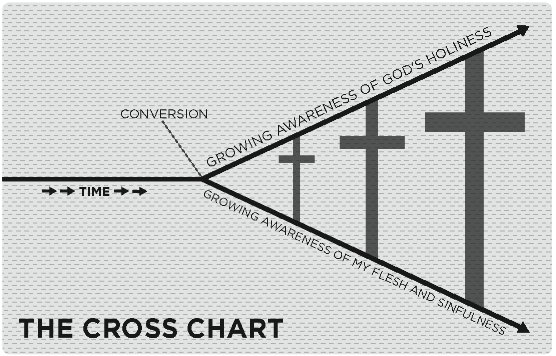
Therefore, God uses circumstances and the Bible to help us in the downward trajectory illustrated by this chart. A contrary perspective on reality is illustrated by another chart widely published by Protestant organizations:
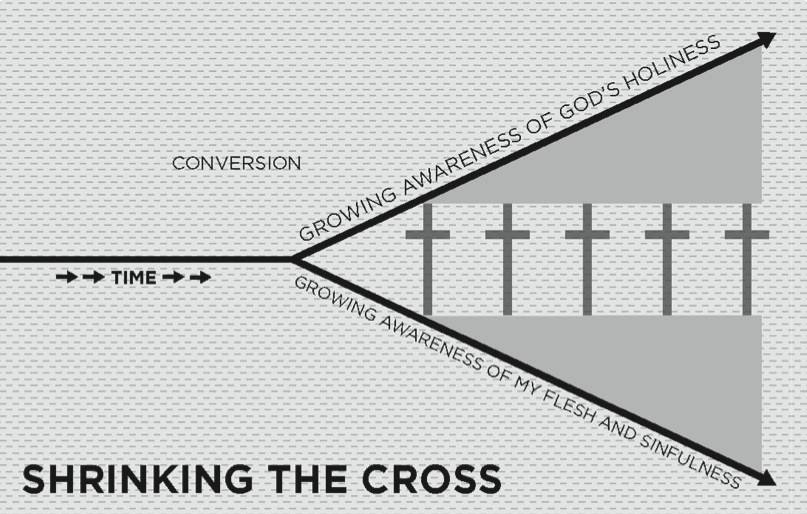
What is behind the popularity of this worldview? Simply, an ability to live a carefree life without fear of unknown circumstances (with the only exception being your eternal destiny). We all know that investing in life can set us up for enhanced disappointments and suffering. This is a worldview that completely separates us from the responsibilities of life and its suffering. Don’t worry, be happy, it’s a just a divine video tape anyway, and what will be, will be. If one of your loved ones dies tragically, don’t sweat it, it’s just part of God’s divine drama prewritten before the foundation of the earth. Besides, God is using this to make the gospel bigger and you smaller. Listen, even Protestants who don’t get this function according to the same worldview: “It’s God’s will.” “I didn’t do it! God did it!” “We are all just sinners saved by grace.” All of these Protestant truisms fit the downward trajectory of the above cross chart.
As far as Biblicism, there is a huge pushback against it. A focal point of the pushback is a book written by Protestant turned Catholic Prof. Christian Smith titled, The Bible Made Impossible: Why Biblicism is Not a Truly Evangelical Reading of Scripture. I must credit the Christian Research Institute with the following review of the book which is endorsed by many evangelical heavyweights such as Rachel Held Evans, and will help us further define Biblicism:
Smith asserts that biblicism is the constellation of ten different assumptions or beliefs: (1) The words of the Bible are identical with God’s words written inerrantly in human language. (2) The Bible represents the totality of God’s will for humanity. (3) The divine will for all issues relevant to Christian life is contained in the Bible. (4) Any reasonable person can correctly understand the plain meaning of the text. (5) The way to understand the Bible is to look at the obvious, literal sense. (6) The Bible can be understood without reliance on creeds, confessions, or historic church traditions. (7) The Bible possesses internal harmony and consistency. (8) The Bible is universally applicable for all Christians. (9) All matters of Christian belief and practice can be learned through inductive Bible study. (10) The Bible is a kind of handbook or textbook for Christian faith and practice.
While some evangelicals may downplay or deny some of these points, Smith suggests as long as you hold to some of these points, you are still a biblicist (pp. 4–5).
Before we address these points for a clearer understanding of what Biblicism is, it shouldn’t surprise us that the only alternative in the book is the Christocentric hermeneutic which is the same thing as the historical-redemptive hermeneutic. It sees the gospel or Jesus in every verse of the Bible as a result of interpreting reality itself through the suffering of the cross. It should be noted that this hermeneutic is crossing over into Catholicism as well.
(1) The words of the Bible are identical with God’s words written inerrantly in human language.
A Biblicist believes no such thing. God used fallible humans to write the Bible over 1600 years in many different languages. Because Christ warned that there would be serious consequences for tampering with God’s word, we can assume many have in fact tampered with it.
The key follows: the Bible is God’s statement on being including metaphysics, epistemology, ethics, and politics. The Bible is not without error in the transmission of these truths, but none of the truths are lost due to God’s oversight and assistance. Included is the way that the Bible was written, or its overall structure of checks and balances. As the “workman” studies to show himself approved, God’s principles become more and more apparent.
(2) The Bible represents the totality of God’s will for humanity.
This point is vague, but one assumes it speaks to the accusation that Biblicists believe the Bible speaks to every detail of life like how to fix our cars etc. While the notion is absurd, the Bible does tell us what kind of car-fixer we should be—not the details of a how-to-manual. The Bible is a manual for how we should love God and others, so while it does not give specific instructions on how to fix our wife’s Toyota, it does convey a principle of love that would prevent us from taking shortcuts on safety issues in order to save money. If it’s our wife’s car, we don’t repair the brake lines with duct tape, etc.
(3) The divine will for all issues relevant to Christian life is contained in the Bible.
This is true, and the reason for the contention is evident: the sole purpose of the Bible should be to show us how wicked we are, not instruction on loving God and others.
(4) Any reasonable person can correctly understand the plain meaning of the text.
True, with the exclusion of the straw man argument that the meaning in every text is always “plain.” The Bible states that individual study is required, and acknowledges that obtaining understanding can be difficult work.
(5) The way to understand the Bible is to look at the obvious, literal sense.
This is true as the primary organizing principle, but gain, the straw man is the assertion that Biblicists believe this is true of every verse.
(6) The Bible can be understood without reliance on creeds, confessions, or historic church traditions.
This is absolutely true because Biblicism rejects spiritual caste systems of all kinds. Teachers are a help, they are a gift to the church for purposes of equipping, NOT an office. But when it gets right down to it, in context of the apostle John addressing the Gnosticism that was wreaking havoc on the 1st century church, he stated, “You have no need for anyone to teach you.” Biblicism is predicated on collective individualism, not group-think overseen by an elite class of those who supposedly possess the “gnosis.”
(7) The Bible possesses internal harmony and consistency.
Absolutely. Again, the complexities of the Bible are used to argue against human reason as a valid epistemology for reasons of selling a redemptive interpretation of all reality.
(8) The Bible is universally applicable for all Christians.
Sure it is. Loving God and others pertains to principles that are universal.
(9) All matters of Christian belief and practice can be learned through inductive Bible study.
In regard to loving God and others, absolutely.
Note the continual distinction being made between love and law. There is a specific reason for that which we will see more of later.
(10) The Bible is a kind of handbook or textbook for Christian faith and practice.
The word “practice” factors in huge here. As previously noted, Protestantism defines salvation as an ability to see/perceive/experience APART from practice. Therefore, the Christocentric approach to interpretation of reality, and consequently the Bible as well, will reject any practice by man to be of any value to God. Therefore, the sole purpose of the Bible is to aid mankind is seeing that all righteousness is an alien righteousness completely outside of man.
So, this is an introduction to Biblicism. In the next session, we will look at the Biblicist gospel, its evaluation of law/gospel, the nature of God, the nature of man, evangelism, and the nature of sin. In the fourth session, we will examine Protestantism and the extreme contrast that it presents. I will conclude this first session with a few more principles of interpretation:
Deuteronomy 29:29 – The secret things belong to the Lord our God, but the things that are revealed belong to us and to our children forever, that we may do all the words of this law.
Deuteronomy 30:11 – For this commandment that I command you today is not too hard for you, neither is it far off. 12 It is not in heaven, that you should say, ‘Who will ascend to heaven for us and bring it to us, that we may hear it and do it?’ 13 Neither is it beyond the sea, that you should say, ‘Who will go over the sea for us and bring it to us, that we may hear it and do it?’ 14 But the word is very near you. It is in your mouth and in your heart, so that you can do it.
Two basic interpretative principles can be drawn from these verses. First, some things we cannot know, but what we can know we are responsible for. Second, we have no need for interpretive mediators between us and God. There is only ONE mediator between God and man—Christ.
Escaping Church and its Culture of Death
 “This isn’t a technique for boosting our spiritual growth; this is a means of re-salvation because we are still technically lost and under law. ‘Under grace’ merely qualifies us for perpetual re-salvation. That’s Protestantism…period!”
Week in, and week out, and days in-between, professing Christians meet at a local institutional church to further indoctrinate their families in the Protestant culture of death. It doesn’t seem like death as families cheerfully socialize together and lift up their hands as the hipster praise bands make a joyful noise to the Lord. In addition, charismatic orators speak of things that are clearly in the Bible.
But let’s talk about good old fashioned theological math found in the Bible. The Bible addresses the only two people groups that exist in the world: the lost and the saved. As professing Christians, we want to be biblically defined as saved people, no? Can a case be made in this post that present-day evangelicals define themselves according to what the Bible defines as “lost.” Yes. All in all I am sure you will agree; any religion that defines itself as unregenerate is a really bad idea.
Here is how the Bible defines the two people groups:
Romans 6:14 – For sin will have no dominion over you, since you are not under law but under grace.
Every person living in the world is under law or under grace; lost or saved. Protestants define themselves as under law with under grace as a covering. Romans 6:14 is defined this way:
We are under grace because the righteousness of Christ continually saves us from being under law.
So, with Protestantism, it’s both. Under grace means we are still under law but progressively saved by grace. Under law is who we are, while we “experience” grace. Under law is what we do, under grace is what we experience. Supposedly, when Paul stated that we are “not” under law, what he really meant to say is under law is the absence of grace. The lost are only under law, but the saved are under both.
Hence, we are still under the “righteous demands of the law,” but if we are under grace, Jesus keeps the law for us. This is achieved by focusing on our sinfulness against the law, and returning to the same gospel that originally saved us out of gratitude. Objections to this idea are met with accusations of indifference to Christ’s sacrifice. Therefore, the “Christian” must live a “lifestyle of repentance” and constantly seek a “greater revelation of self” which is inherently sinful. The goal is to plunge the depths of our supposed total depravity. And if you are paying attention, our sin and the original gospel that saved us are the constant drumbeats we hear in the institutional church week in and week out.
Consequently, our goal is to see more and more of our reality of being under law resulting in an increased joy regarding our original salvation. Mainline evangelical Paul Washer states it this way:
At conversion, a person begins to see God and himself as never before. This greater revelation of God’s holiness and righteousness leads to a greater revelation of self, which, in return, results in a repentance or brokenness over sin. Nevertheless, the believer is not left in despair, for he is also afforded a greater revelation of the grace of God in the face of Christ, which leads to joy unspeakable. This cycle simply repeats itself throughout the Christian life. As the years pass, the Christian sees more of God and more of self, resulting in a greater and deeper brokenness. Yet, all the while, the Christian’s joy grows in equal measure because he is privy to greater and greater revelations of the love, grace, and mercy of God in the person and work of Christ. Not only this, but a greater interchange occurs in that the Christian learns to rest less and less in his own performance and more and more in the perfect work of Christ. Thus, his joy is not only increased, but it also becomes more consistent and stable. He has left off putting confidence in the flesh, which is idolatry, and is resting in the virtue and merits of Christ, which is true Christian piety (Paul Washer: The Gospel Call and True Conversion; Part 1, Chapter 1, heading – The Essential Characteristics Of Genuine Repentance, subheading – Continuing and Deepening Work of Repentance).
This not only turns the Bible completely upside down, but leaves the Christian in a lifestyle of death while rejoicing in it. This is a true celebration of death, and church is the culture thereof. Romans 6 is clear about what it means to remain under law:
3 Do you not know that all of us who have been baptized into Christ Jesus were baptized into his death? 4 We were buried therefore with him by baptism into death, in order that, just as Christ was raised from the dead by the glory of the Father, we too might walk in newness of life.
5 For if we have been united with him in a death like his, we shall certainly be united with him in a resurrection like his. 6 We know that our old self was crucified with him in order that the body of sin might be brought to nothing, so that we would no longer be enslaved to sin. 7 For one who has died has been set free from sin. 8 Now if we have died with Christ, we believe that we will also live with him. 9 We know that Christ, being raised from the dead, will never die again; death no longer has dominion over him. 10 For the death he died he died to sin, once for all, but the life he lives he lives to God. 11 So you also must consider yourselves dead to sin and alive to God in Christ Jesus.
Obviously, if we believe our formal sinful self has been “brought to nothing,” Paul Washer’s sanctification construct is impossible, and his statement speaks to the authentic soteriology of the Protestant Reformation. How do you achieve a greater revelation of your sinful self when your former sinful self has been “brought to nothing”?
You don’t, which leaves the “believer” yet under law and in need of salvation. The “believer” needs to continually return to the same gospel that saved him/her in order to remain saved. Instead of the new birth being a onetime event that brings the former sinner to “nothing,” the new birth is defined as a joy experience resulting from revisiting the gospel afresh for forgiveness of sin that still condemns us.
This cycle simply repeats itself throughout the Christian life. As the years pass, the Christian sees more of God and more of self, resulting in a greater and deeper brokenness. Yet, all the while, the Christian’s joy grows in equal measure because he is privy to greater and greater revelations of the love, grace, and mercy of God in the person and work of Christ (Ibid).
We are asking the question, How does the gospel save believers?, not: How does the gospel get people to be believers?… Believers need to be saved. The gospel is the instrument of God’s power to save us. And we need to know how the gospel saves us believers so that we make proper use of it (John Piper: Part 2 of a series titled, “How Does the Gospel Save Believers”).
Progressive sanctification has two parts: mortification and vivification, ‘both of which happen to us by participation in Christ,’ as Calvin notes….Subjectively experiencing this definitive reality signified and sealed to us in our baptism requires a daily dying and rising. That is what the Reformers meant by sanctification as a living out of our baptism….and this conversion yields lifelong mortification and vivification ‘again and again.’ Yet it is critical to remind ourselves that in this daily human act of turning, we are always turning not only from sin but toward Christ rather than toward our own experience or piety (Michael Horton: The Christian Faith; mortification and vivification, pp. 661-663 [Calvin Inst. 3.3.2-9]).
…by new sins we continually separate ourselves, as far as we can, from the grace of God… Thus it is, that all the saints have need of the daily forgiveness of sins; for this alone keeps us in the family of God (John Calvin: Commentaries on the Catholic Epistles; The Calvin Translation Society 1855. Editor: John Owen, p. 165 ¶4).
Moreover, the message of free reconciliation with God is not promulgated for one or two days, but is declared to be perpetual in the Church (2 Cor. 5:18, 19). Hence believers have not even to the end of life any other righteousness than that which is there described. Christ ever remains a Mediator to reconcile the Father to us, and there is a perpetual efficacy in his death—viz. ablution, satisfaction, expiation; in short, perfect obedience, by which all our iniquities are covered (The Calvin Institutes: 3.14.11).
Where we land on these issues is perhaps the most significant factor in how we approach our own faith and practice and communicate it to the world. If not only the unregenerate but the regenerate are always dependent at every moment on the free grace of God disclosed in the gospel, then nothing can raise those who are spiritually dead or continually give life to Christ’s flock but the Spirit working through the gospel. When this happens (not just once, but every time we encounter the gospel afresh), the Spirit progressively transforms us into Christ’s image. Start with Christ (that is, the gospel) and you get sanctification in the bargain; begin with Christ and move on to something else, and you lose both (Michael Horton: Christless Christianity; p. 62).
Nor by remission of sins does the Lord only once for all elect and admit us into the Church, but by the same means he preserves and defends us in it. For what would it avail us to receive a pardon of which we were afterwards to have no use? That the mercy of the Lord would be vain and delusive if only granted once, all the godly can bear witness; for there is none who is not conscious, during his whole life, of many infirmities which stand in need of divine mercy. And truly it is not without cause that the Lord promises this gift specially to his own household, nor in vain that he orders the same message of reconciliation to be daily delivered to them (The Calvin Institutes: 4.1.21).
Therefore, “under grace” is defined as a mere qualification to return to the same gospel that saved us; in other words, “We must preach the gospel to ourselves every day” in order to keep ourselves saved. How prevalent is this idea in the contemporary church? Consider this laundry list from Peter Lumpkins .com:
“As Pastors we must first preach the gospel to ourselves before we proclaim to the world the necessity of a Savior” Scott Thomas, President of Acts 29 Network.
“Yet even when we understand that our acceptance with God is based on Christ’s work, we still naturally tend to drift back into a performance mindset. Consequently, we must continually return to the gospel. To use an expression of the late Jack Miller, we must “preach the gospel to ourselves every day” Jerry Bridges, Reformed author.
“We must preach the Gospel to ourselves and one another every day” Ashland Avenue Baptist Church Distinctives, Lexington, KY
“The Gospel must be central to our lives and central to our message. Strive to keep the Gospel in the center of your worship ministry. Jerry Bridges tell us that we must preach the Gospel to ourselves everyday. It has been said that we never move on from the Cross, only to a more profound understanding of the Cross”
Dr. Greg Brewton, Associate Dean for Music and Worship Leadership at The Southern Baptist Theological Seminary.
“We must preach the Gospel to ourselves” Francis Chan, Passion 2011
“Yesterday was a powerful moment in the Word of God as we studied Romans 8:1-4. I challenged those present to learn to preach the gospel to ourselves daily. Why? If we do not preach the gospel to ourselves daily, we will return to sin, bondage, guilt, the Law, and legalism…You see, this is why we must preach the gospel to ourselves daily” Ronnie Floyd, former Chairman of the Great Commission Resurgence Task Force
“I’ve been re-reading Jerry Bridges’ excellent book The Discipline of Grace…Bridges reminded me of just how important it is to “preach the gospel to ourselves everyday” if we are going to be transformed into the likeness of Christ” Tullian Tchividjian, Senior Pastor, Coral Ridge Presbyterian Church
“…I once assumed…that the gospel was simply what non-Christians must believe in order to be saved… But I’ve come to realize that once God rescues sinners, his plan isn’t to steer them beyond the gospel, but to move them more deeply into it. The gospel, in other words, isn’t just the power of God to save you, it’s the power of God to grow you once you’re saved… . This idea that the gospel is just as much for Christians as it is for non-Christians may seem like a new idea to many but, in fact, it is really a very old idea” Tullian Tchividjian, Senior Pastor, Coral Ridge Presbyterian Church
“We must preach the gospel to ourselves everyday… . As we preach the gospel to ourselves, we should be both encouraged and overwhelmed with gratitude, and both should give us a desire to deal with the sin in our lives” Casey Lewis, student, Southwestern Baptist Theological Seminary
“A Prayer for Preaching the Gospel to Ourselves… . …Most gracious Lord Jesus, even as Paul was eager to preach the gospel to believers in Rome, so I’m eager to preach it to my own heart today…” Scotty Smith, Guest blogger at Justin Taylor’s The Gospel Coalition site and Pastor, Christ Community Church, Franklin, TN
“We must constantly be preaching the gospel to ourselves, filling our hearts with your beauty and bounty, Lord Jesus… . Dear heavenly Father, it’s not about “mind over matter,” or the power of positive thinking, or the pragmatic good of cognitive therapy. It’s all about preaching the gospel to ourselves every opportunity we get…” Scotty Smith, Pastor, Christ Community Church, Franklin, TN (here and here, respectively)
“We must constantly be preaching the gospel to ourselves, filling our hearts with your beauty and bounty, Lord Jesus… . Dear heavenly Father, it’s not about “mind over matter,” or the power of positive thinking, or the pragmatic good of cognitive therapy. It’s all about preaching the gospel to ourselves every opportunity we get…” Scotty Smith, Pastor, Christ Community Church, Franklin, TN (here and here, respectively)
“How can we not shift from the hope of the Gospel? By preaching the Gospel to ourselves daily… . “Preaching the Gospel to yourself” is a phrase I first ran across in The Discipline of Grace by Jerry Bridges, and have observed for years in the life of my good friend, C.J. Mahaney. C.J. has written persuasively, biblically, and practically on this topic in his new book, Living the Cross Centered Life… . Don’t take a day off from preaching the Gospel to yourself” Bob Kaulfin, Director of Worship Development for Sovereign Grace Ministries and worship leader at Covenant Life Church led by Josh Harris.
“Far too many Christians are passive in their fight for joy…. What can I do?’ Well, God does not mean for us to be passive. He means for us to fight the fight of faith t he fight for joy. And the central strategy is to preach the gospel to yourself… . John Piper, When I Don’t Desire God, p.81, as quoted by Bob Kauflin
I am thoroughly engrossed with Joe Thorn’s personal mediations on preaching the gospel to oneself” Tom J. Nettles, Professor of Historical Theology, Southern Baptist Theological Seminary, promoting Joe Thorn’s book, Note to Self: the Discipline of Preaching to Oneself
“In the few months prior to Verge God was really working on me. I’ve been doing a lot of repenting of the idols in my heart. I’ve been preaching the gospel to myself” Steve McCoy, SBC Pastor
“This may sound really selfish, but faithfully preaching the gospel to myself is actually what enables me to share it faithfully to others” Timmy Brister, SBC Associate Pastor.
“I chose not to include the response to the gospel…but just tried to focus on what the gospel actually is. I edit it regularly as I try to grasp and preach the gospel to myself” Ed Stetzer, LifeWay
This isn’t a technique for boosting our spiritual growth; this is a means of re-salvation because we are still technically lost and under law. “Under grace” merely qualifies us for perpetual re-salvation. That’s Protestantism…period!
And the culture that will result is defined in the Bible:
Romans 6:15 – What then? Are we to sin because we are not under law but under grace? By no means! 16 Do you not know that if you present yourselves to anyone as obedient slaves,[c] you are slaves of the one whom you obey, either of sin, which leads to death, or of obedience, which leads to righteousness? 17 But thanks be to God, that you who were once slaves of sin have become obedient from the heart to the standard of teaching to which you were committed, 18 and, having been set free from sin, have become slaves of righteousness. 19 I am speaking in human terms, because of your natural limitations. For just as you once presented your members as slaves to impurity and to lawlessness leading to more lawlessness, so now present your members as slaves to righteousness leading to sanctification.
20 For when you were slaves of sin, you were free in regard to righteousness. 21 But what fruit were you getting at that time from the things of which you are now ashamed? For the end of those things is death. 22 But now that you have been set free from sin and have become slaves of God, the fruit you get leads to sanctification and its end, eternal life. 23 For the wages of sin is death, but the free gift of God is eternal life in Christ Jesus our Lord.
Christ said, “You must be born again.” This is clearly a doctrine that redefines the new birth by defining the “believer” as unchanged and yet under law. Along with that is an unavoidable conclusion that this also includes a fruits unto death existence that is part and parcel with being under law.
This will, and does make sin and condemnation the focus and theme of church while the Bible emphasizes ADDING virtue to our faith in contrast to a continual re-visitation of our supposed depravity.
1Peter 4:8 – Above all, keep loving one another earnestly, since love covers a multitude of sins.
2Peter 1:3 – His divine power has granted to us all things that pertain to life and godliness, through the knowledge of him who called us to his own glory and excellence, 4 by which he has granted to us his precious and very great promises, so that through them you may become partakers of the divine nature, having escaped from the corruption that is in the world because of sinful desire. 5 For this very reason, make every effort to supplement your faith with virtue, and virtue with knowledge, 6 and knowledge with self-control, and self-control with steadfastness, and steadfastness with godliness, 7 and godliness with brotherly affection, and brotherly affection with love. 8 For if these qualities are yours and are increasing, they keep you from being ineffective or unfruitful in the knowledge of our Lord Jesus Christ. 9 For whoever lacks these qualities is so nearsighted that he is blind, having forgotten that he was cleansed from his former sins.
Romans 15:14 – I myself am satisfied about you, my brothers, that you yourselves are full of goodness, filled with all knowledge and able to instruct one another.
Hebrews 10:24 – And let us consider how to stir up one another to love and good works.
In the past, Protestants were confused enough about their own soteriological traditions that the fruits unto death were minimal, but during this Neo-Reformed resurgence that we are witnessing presently, such is not the case; the institutional church is a blatant culture of death. And those who would expose their children to it are woefully undiscerning. Ask yourself this simple question: do I leave church better equipped to see something that the Bible states isn’t there or better equipped to love God and others? Am I better at seeing my own depravity, or have I learned new ways to love which covers a multitude of sins anyway?
The remedy for this malady is a return to where the gathering of believers belongs: in home fellowships where believers are equipped to love God and others as a lifestyle, NOT a “lifestyle of repentance.” The institutional church was first called “church” when it was founded in the 4th century, and it was founded on the same idea that believers remain under law. Therefore, an authoritative institution was created that supplied official re-salvation for those under law. The institutional church goes hand in glove with the idea that it supplies a place for re-salvation, i.e., those qualified to receive it by being “under grace.”
To impart this blessing to us, the keys have been given to the Church (Mt. 16:19; 18:18). For when Christ gave the command to the apostles, and conferred the power of forgiving sins, he not merely intended that they should loose the sins of those who should be converted from impiety to the faith of Christ; but, moreover, that they should perpetually perform this office among believers” (The Calvin Institutes: 4.1.22).
Secondly, This benefit is so peculiar to the Church, that we cannot enjoy it unless we continue in the communion of the Church. Thirdly, It is dispensed to us by the ministers and pastors of the Church, either in the preaching of the Gospel or the administration of the Sacraments, and herein is especially manifested the power of the keys, which the Lord has bestowed on the company of the faithful. Accordingly, let each of us consider it to be his duty to seek forgiveness of sins only where the Lord has placed it. Of the public reconciliation which relates to discipline, we shall speak at the proper place (Ibid).
Come out from among them and be separate.
An Introduction to TANC 2015: Why the Protestant Reformation is a Lie

Protestants don’t know anything. That’s not a derogatory remark, it’s merely a staple of Reformed ideology. It’s who we are supposed to be. Protestantism is predicated on the idea of spiritual caste as an accepted norm. The average Protestant parishioner is not supposed to know anything, and again, this is an accepted norm. In fact, many Protestant laymen who didn’t get the memo will concur; knowing something in the institutional church will usually get you in trouble. If you know something, you lack humbleness, and are trying to undermine… The Pastor.
This should not surprise us at all if we understand our authentic roots and the ideology of our spiritual heroes. Though Martin Luther’s 95 Theses is credited with launching the Reformation, its first and defining doctrinal statement came six months later in the form of the Heidelberg Disputation to the Augustinian Order. In the 22nd thesis of that document, Luther declared knowledge to be a vice that does nothing but puff people up, and like with all lust, it can never be satisfied. Luther’s disdain for reason is well documented, referring to it as…
Reason is the Devil’s greatest whore; by nature and manner of being she is a noxious whore; she is a prostitute, the Devil’s appointed whore; whore eaten by scab and leprosy who ought to be trodden under foot and destroyed, she and her wisdom … Throw dung in her face to make her ugly. She is and she ought to be drowned in baptism… She would deserve, the wretch, to be banished to the filthiest place in the house, to the closets.
Reason is the greatest enemy that faith has; it never comes to the aid of spiritual things, but more frequently than not struggles against the divine Word, treating with contempt all that emanates from God.
Reason must be deluded, blinded, and destroyed. Faith must trample underfoot all reason, sense, and understanding, and whatever it sees must be put out of sight and … know nothing but the word of God.
There is on earth among all dangers no more dangerous thing than a richly endowed and adroit reason… Reason must be deluded, blinded, and destroyed.
Reason should be destroyed in all Christians.
Whoever wants to be a Christian should tear the eyes out of his Reason.
To be a Christian, you must “pluck out the eye of reason.”
In our day, this fruit doesn’t fall far from the tree as reflected in this quote by a pastor sent to our ministry by one of his former parishioners:
Paul told the Corinthian church that “‘knowledge’ puffs up but love builds up” (1Cor 8:1). So, if you love knowledge and look into the word of God to gain mere knowledge and you absolutely love doing it to the exclusion or ignoring of everything else, you may be “puffed up” and indeed not “building up.”…. Puffiness rips and tears. Puffiness pushes people away. Puffiness divides. Perhaps even more critical is the fact that puffiness portrays a small gospel and devastatingly distorts God’s glory.
To the puffy I say, “Stop studying your Bible.” Go on a quest for Jesus. He is the Word! Study Him, not it.
Studying Jesus and not any knowledge regarding Jesus is the most popular rendering of 1Corithians 2:2 in our day: we are supposed to make every effort to know NOTHING but Christ and him crucified. After all, according to another popular truism in our day, “He is a person—not a precept.”
Of course, most Protestants would deny all of this out of hand when confronted, but the roots and foundation of Protestant ideology has at least resulted in a lax view of knowledge while leaving the thinking to Protestant academia. Some well-known evangelicals such as Dr. Jay Adams have stated the obvious: Protestants are biblically illiterate, and have no wisdom in regard to Christian living other than God-given commonsense and even that is at an all-time low.
Christians, who strive for wisdom and spiritual maturity in the institutional church, if they don’t give up, will eventually find themselves in turmoil and at a crossroads. Striding towards commonsense spiritual objectives will continually put them at odds with the Protestant herd. I was certainly no exception. As someone who was always considered knowledgeable wherever I attended church as a Baptist, in reality, I knew nothing. The knowledge that I had accumulated in various seminaries and Bible colleges was all but worthless. Though I read and studied my Bible more than most, I understood little of it. Most of what I read made no sense at all. Nevertheless, I deemed myself knowledgeable relative to the environment, yet in my heart, I knew the Christian life made no sense and I was for the most part confused. In reality, I was good at constructing Protestant sentences with orthodox bumper stickers and pithy truisms.
So, I set out on a journey eight years ago to search for clarity after 23 years of confusion and strife. The part of my journey that really made everything come together began in 2011 when I embarked on a personal study of Paul’s letter to the Romans. I was determined to make this the time—the endeavor that would reveal once and for all what I was searching for: why my God seemed to be a God of confusion. I prayed earnestly at the beginning of the study that I would just let Paul’s words say what they plainly said. If something he wrote was definitive, I would use that as a building block of understanding.
Though I stayed true to the plan, not much happened until Romans 4:15. That’s the day my life came to a full stop.
For the law brings wrath, but where there is no law there is no transgression.
What in the world did Paul mean by that? NO law, NO sin: especially in the context; speaking of Christians. I kept it mind and continued to work through the letter. Then I came to Romans 5:13…
for sin indeed was in the world before the law was given, but sin is not counted where there is no law.
There it was again: no law, no sin. I stopped there in my verse by verse study and read through the rest of the letter and found the following:
Romans 7:6 – But now we are released from the law, having died to that which held us captive, so that we serve in the new way of the Spirit and not in the old way of the written code. 7 What then shall we say? That the law is sin? By no means! Yet if it had not been for the law, I would not have known sin. For I would not have known what it is to covet if the law had not said, “You shall not covet.” 8 But sin, seizing an opportunity through the commandment, produced in me all kinds of covetousness. For apart from the law, sin lies dead.
Apart from the law sin lies dead. There it is again. No law, no sin. Then I read the following as well:
Romans 10:4 – For Christ is the end of the law for righteousness to everyone who believes.
Conclusion: Christ died on the cross to end the law, and where there is no law, there is no sin. That’s how Christ took my sins away: He died on the cross to end the law. The true Christian is free from any judgement or condemnation—we are not under the jurisdiction of the law.
I wasn’t the least bit sure where this left the law in regard to the Christian life, but pondering the simple fact that we are no longer condemned was exhilarating and freeing. The old self that was under the law of sin and death died with Christ; you can’t indict a dead person, they are no longer under the law. And even if you exhumed my body and presented it in court, the judge has no law in which to convict me (Rom 7:1-6). There is NOW no condemnation for those in Christ (Rom 8:1).
Again, I was not sure where this left the law in regard to the believer’s life, but I had my building block; part of the pieces fit together which would lead to more pieces fitting and an increased understanding of the bigger picture.
Then I came to Romans 8:2.
For the law of the Spirit of life has set you free in Christ Jesus from the law of sin and death.
Remember, I had committed to simply letting the words say what they say. As a result, I saw something in this verse that I had never seen before; clearly, Paul wrote of two separate laws…the law of the Spirit, which I had always thought of as the Spirit’s realm of influence, and the law of sin and death.
“Wait a minute here,” I thought to myself. “If the law of sin and death refers to the written law that condemns mankind, and the two laws spoken of here are the same Greek word, and they are, why would one refer to a realm while the other one referred to a written law? Could it be that this is two perspectives on the same law?” I knew that a literal take on this verse would demand that, and then John 17:17 came to mind:
Sanctify them in the truth; your word is truth.
Then another verse came to mind:
And when he comes, he will convict the world concerning sin and righteousness and judgment (Jn 16:8).
That’s when I realized that the law has two different applications/perspectives: one for the lost and one for the saved. But verses were not done coming to mind:
Love does no wrong to others, so love fulfills the requirements of God’s law (Rom 13:10).
For in Christ Jesus neither circumcision nor uncircumcision counts for anything, but only faith working through love (Gal 5:6).
So, the Christian is free to aggressively love God and others through obedience without ANY fear of condemnation:
There is no fear in love, but perfect [mature] love casts out fear. For fear has to do with punishment, and whoever fears has not been perfected [matured, or growing] in love (1Jn 4:18).
Therefore, why the Reformation is a lie is not complicated at all. This SIMPLE fact makes Protestant theology a house of cards: it keeps so-called believers under the law of sin and death; its very definition of a Christian is the Bible’s definition of a lost person…under law (Rom 6:14). Protestantism is predicated on a single perspective on the law that Christians remain under; they remain under condemnation. This condemnation is covered by Christ’s righteousness as the “Christian” lives by faith alone. Living by faith alone works (usually some kind of ritual like “preaching the gospel to ourselves everyday”) imputes the obedience of Christ to our Christian lives as a way to keep ourselves justified. The Reformed call this “double imputation.”
Once one gets past all of the theological Protestant-speak, it boils down to extremely simple theological math: a Christian is NOT free to love—Jesus must love for us lest it be works salvation. And it almost goes without saying that there is a love famine in the institutional church for this very reason. The Protestant is not free to love, but must focus on a convoluted life formula that supposedly imputes the righteousness of Christ to our lives and thereby keeps us saved. Yes, this is the dirty little secret: total depravity doesn’t merely apply to the unregenerate, but also to the “saints.”
Yes, yes, many a Protestant doth protest against this accusation because few Protestants know what Protestantism is. Nevertheless, it is a false gospel that denies the new birth and keeps people under law and not under grace—a grace that frees the individual to aggressively love without fear of condemnation and the mire of unhealthy introspection.
We are saved APART from the law of sin and death…period (Rom 3:21), and it does NOT matter who keeps the law, the law of sin and death itself is the issue. Salvation is accomplished by the ENDING of the law of sin and death—not the fulfilling of it. Christ came to fulfill the law of the Spirit of life (and love) through us (Rom 8:4)…NOT the law of sin and death.
That would make the law of sin and death a co-life-giver with Christ. The law cannot give life unto salvation. If Christ fulfilled the law of sin and death with loving obedience to the Father, that law is a co-life-giver. That is Paul’s entire point in Galatians chapter 3. There is only ONE seed. If we are still under the law, the law is an additional seed that can give life…but there is only ONE!
Hence, Protestantism goes the way of most other false religions; some ritual or tradition fulfills the law of sin and death and separates the individual from the freedom to love without condemnation and according to the law of the Spirit of life. Love is replaced by obeying men and faithfulness to their institutions. The law of love is replaced with the traditions of men and their orthodoxy.
Consequently, we are in a Protestant dark age. In the same way that secular America has awakened to the failure of the elitist political class, Christians must awaken to realize the failure of Protestant academia. The assembly of Christ was a laity movement, and only the laity can return God’s people to the truth of the gospel. This is a repeat of history when God’s elect where continually troubled by the 1st century Gnostic elitists. Paul wrote to them…
For consider your calling, brothers: not many of you were wise according to worldly standards, not many were powerful, not many were of noble birth.
Likewise, the beloved James addressed the problem as well:
Listen, my beloved brothers, has not God chosen those who are poor in the world to be rich in faith and heirs of the kingdom, which he has promised to those who love him? But you have dishonored the poor man. Are not the rich the ones who oppress you, and the ones who drag you into court? Are they not the ones who blaspheme the honorable name by which you were called?
This is our mission at TANK, to aid the priesthood of believers in rediscovering the truth of the gospel and kingdom living robbed from us by 500 years of Protestant orthodoxy. The light has been covered by the Protestant basket long enough, and this is a matter of simple theological math: the new birth is the standard of righteousness, NOT the law of sin and death, and it matters not who keeps it—it CANNOT give life.
So, the speakers at this year’s conference are partaking in this journey in the arena of ideas. This is an issue that addresses every area of life and culture. Other than the gospel of first importance stated here, everything is being examined and revisited. It’s not group think, it’s collective truth made up of individuals seeking the one mind of Christ, not the traditions of men.
Let all be convinced according to their own conscience. Protestant elitists will not stand in our stead regardless of their claims, but each person will give an account for the sum and substance of their own lives. Let us do it with trembling and fear; not any fear of condemnation, but a fear of trading the life of Christ for the death of tyranny.
Because only truth sanctifies,
Paul M. Dohse

 Paul's Passing Thoughts
leave a comment