An Introduction to TANC 2015: Why the Protestant Reformation is a Lie

Protestants don’t know anything. That’s not a derogatory remark, it’s merely a staple of Reformed ideology. It’s who we are supposed to be. Protestantism is predicated on the idea of spiritual caste as an accepted norm. The average Protestant parishioner is not supposed to know anything, and again, this is an accepted norm. In fact, many Protestant laymen who didn’t get the memo will concur; knowing something in the institutional church will usually get you in trouble. If you know something, you lack humbleness, and are trying to undermine… The Pastor.
This should not surprise us at all if we understand our authentic roots and the ideology of our spiritual heroes. Though Martin Luther’s 95 Theses is credited with launching the Reformation, its first and defining doctrinal statement came six months later in the form of the Heidelberg Disputation to the Augustinian Order. In the 22nd thesis of that document, Luther declared knowledge to be a vice that does nothing but puff people up, and like with all lust, it can never be satisfied. Luther’s disdain for reason is well documented, referring to it as…
Reason is the Devil’s greatest whore; by nature and manner of being she is a noxious whore; she is a prostitute, the Devil’s appointed whore; whore eaten by scab and leprosy who ought to be trodden under foot and destroyed, she and her wisdom … Throw dung in her face to make her ugly. She is and she ought to be drowned in baptism… She would deserve, the wretch, to be banished to the filthiest place in the house, to the closets.
Reason is the greatest enemy that faith has; it never comes to the aid of spiritual things, but more frequently than not struggles against the divine Word, treating with contempt all that emanates from God.
Reason must be deluded, blinded, and destroyed. Faith must trample underfoot all reason, sense, and understanding, and whatever it sees must be put out of sight and … know nothing but the word of God.
There is on earth among all dangers no more dangerous thing than a richly endowed and adroit reason… Reason must be deluded, blinded, and destroyed.
Reason should be destroyed in all Christians.
Whoever wants to be a Christian should tear the eyes out of his Reason.
To be a Christian, you must “pluck out the eye of reason.”
In our day, this fruit doesn’t fall far from the tree as reflected in this quote by a pastor sent to our ministry by one of his former parishioners:
Paul told the Corinthian church that “‘knowledge’ puffs up but love builds up” (1Cor 8:1). So, if you love knowledge and look into the word of God to gain mere knowledge and you absolutely love doing it to the exclusion or ignoring of everything else, you may be “puffed up” and indeed not “building up.”…. Puffiness rips and tears. Puffiness pushes people away. Puffiness divides. Perhaps even more critical is the fact that puffiness portrays a small gospel and devastatingly distorts God’s glory.
To the puffy I say, “Stop studying your Bible.” Go on a quest for Jesus. He is the Word! Study Him, not it.
Studying Jesus and not any knowledge regarding Jesus is the most popular rendering of 1Corithians 2:2 in our day: we are supposed to make every effort to know NOTHING but Christ and him crucified. After all, according to another popular truism in our day, “He is a person—not a precept.”
Of course, most Protestants would deny all of this out of hand when confronted, but the roots and foundation of Protestant ideology has at least resulted in a lax view of knowledge while leaving the thinking to Protestant academia. Some well-known evangelicals such as Dr. Jay Adams have stated the obvious: Protestants are biblically illiterate, and have no wisdom in regard to Christian living other than God-given commonsense and even that is at an all-time low.
Christians, who strive for wisdom and spiritual maturity in the institutional church, if they don’t give up, will eventually find themselves in turmoil and at a crossroads. Striding towards commonsense spiritual objectives will continually put them at odds with the Protestant herd. I was certainly no exception. As someone who was always considered knowledgeable wherever I attended church as a Baptist, in reality, I knew nothing. The knowledge that I had accumulated in various seminaries and Bible colleges was all but worthless. Though I read and studied my Bible more than most, I understood little of it. Most of what I read made no sense at all. Nevertheless, I deemed myself knowledgeable relative to the environment, yet in my heart, I knew the Christian life made no sense and I was for the most part confused. In reality, I was good at constructing Protestant sentences with orthodox bumper stickers and pithy truisms.
So, I set out on a journey eight years ago to search for clarity after 23 years of confusion and strife. The part of my journey that really made everything come together began in 2011 when I embarked on a personal study of Paul’s letter to the Romans. I was determined to make this the time—the endeavor that would reveal once and for all what I was searching for: why my God seemed to be a God of confusion. I prayed earnestly at the beginning of the study that I would just let Paul’s words say what they plainly said. If something he wrote was definitive, I would use that as a building block of understanding.
Though I stayed true to the plan, not much happened until Romans 4:15. That’s the day my life came to a full stop.
For the law brings wrath, but where there is no law there is no transgression.
What in the world did Paul mean by that? NO law, NO sin: especially in the context; speaking of Christians. I kept it mind and continued to work through the letter. Then I came to Romans 5:13…
for sin indeed was in the world before the law was given, but sin is not counted where there is no law.
There it was again: no law, no sin. I stopped there in my verse by verse study and read through the rest of the letter and found the following:
Romans 7:6 – But now we are released from the law, having died to that which held us captive, so that we serve in the new way of the Spirit and not in the old way of the written code. 7 What then shall we say? That the law is sin? By no means! Yet if it had not been for the law, I would not have known sin. For I would not have known what it is to covet if the law had not said, “You shall not covet.” 8 But sin, seizing an opportunity through the commandment, produced in me all kinds of covetousness. For apart from the law, sin lies dead.
Apart from the law sin lies dead. There it is again. No law, no sin. Then I read the following as well:
Romans 10:4 – For Christ is the end of the law for righteousness to everyone who believes.
Conclusion: Christ died on the cross to end the law, and where there is no law, there is no sin. That’s how Christ took my sins away: He died on the cross to end the law. The true Christian is free from any judgement or condemnation—we are not under the jurisdiction of the law.
I wasn’t the least bit sure where this left the law in regard to the Christian life, but pondering the simple fact that we are no longer condemned was exhilarating and freeing. The old self that was under the law of sin and death died with Christ; you can’t indict a dead person, they are no longer under the law. And even if you exhumed my body and presented it in court, the judge has no law in which to convict me (Rom 7:1-6). There is NOW no condemnation for those in Christ (Rom 8:1).
Again, I was not sure where this left the law in regard to the believer’s life, but I had my building block; part of the pieces fit together which would lead to more pieces fitting and an increased understanding of the bigger picture.
Then I came to Romans 8:2.
For the law of the Spirit of life has set you free in Christ Jesus from the law of sin and death.
Remember, I had committed to simply letting the words say what they say. As a result, I saw something in this verse that I had never seen before; clearly, Paul wrote of two separate laws…the law of the Spirit, which I had always thought of as the Spirit’s realm of influence, and the law of sin and death.
“Wait a minute here,” I thought to myself. “If the law of sin and death refers to the written law that condemns mankind, and the two laws spoken of here are the same Greek word, and they are, why would one refer to a realm while the other one referred to a written law? Could it be that this is two perspectives on the same law?” I knew that a literal take on this verse would demand that, and then John 17:17 came to mind:
Sanctify them in the truth; your word is truth.
Then another verse came to mind:
And when he comes, he will convict the world concerning sin and righteousness and judgment (Jn 16:8).
That’s when I realized that the law has two different applications/perspectives: one for the lost and one for the saved. But verses were not done coming to mind:
Love does no wrong to others, so love fulfills the requirements of God’s law (Rom 13:10).
For in Christ Jesus neither circumcision nor uncircumcision counts for anything, but only faith working through love (Gal 5:6).
So, the Christian is free to aggressively love God and others through obedience without ANY fear of condemnation:
There is no fear in love, but perfect [mature] love casts out fear. For fear has to do with punishment, and whoever fears has not been perfected [matured, or growing] in love (1Jn 4:18).
Therefore, why the Reformation is a lie is not complicated at all. This SIMPLE fact makes Protestant theology a house of cards: it keeps so-called believers under the law of sin and death; its very definition of a Christian is the Bible’s definition of a lost person…under law (Rom 6:14). Protestantism is predicated on a single perspective on the law that Christians remain under; they remain under condemnation. This condemnation is covered by Christ’s righteousness as the “Christian” lives by faith alone. Living by faith alone works (usually some kind of ritual like “preaching the gospel to ourselves everyday”) imputes the obedience of Christ to our Christian lives as a way to keep ourselves justified. The Reformed call this “double imputation.”
Once one gets past all of the theological Protestant-speak, it boils down to extremely simple theological math: a Christian is NOT free to love—Jesus must love for us lest it be works salvation. And it almost goes without saying that there is a love famine in the institutional church for this very reason. The Protestant is not free to love, but must focus on a convoluted life formula that supposedly imputes the righteousness of Christ to our lives and thereby keeps us saved. Yes, this is the dirty little secret: total depravity doesn’t merely apply to the unregenerate, but also to the “saints.”
Yes, yes, many a Protestant doth protest against this accusation because few Protestants know what Protestantism is. Nevertheless, it is a false gospel that denies the new birth and keeps people under law and not under grace—a grace that frees the individual to aggressively love without fear of condemnation and the mire of unhealthy introspection.
We are saved APART from the law of sin and death…period (Rom 3:21), and it does NOT matter who keeps the law, the law of sin and death itself is the issue. Salvation is accomplished by the ENDING of the law of sin and death—not the fulfilling of it. Christ came to fulfill the law of the Spirit of life (and love) through us (Rom 8:4)…NOT the law of sin and death.
That would make the law of sin and death a co-life-giver with Christ. The law cannot give life unto salvation. If Christ fulfilled the law of sin and death with loving obedience to the Father, that law is a co-life-giver. That is Paul’s entire point in Galatians chapter 3. There is only ONE seed. If we are still under the law, the law is an additional seed that can give life…but there is only ONE!
Hence, Protestantism goes the way of most other false religions; some ritual or tradition fulfills the law of sin and death and separates the individual from the freedom to love without condemnation and according to the law of the Spirit of life. Love is replaced by obeying men and faithfulness to their institutions. The law of love is replaced with the traditions of men and their orthodoxy.
Consequently, we are in a Protestant dark age. In the same way that secular America has awakened to the failure of the elitist political class, Christians must awaken to realize the failure of Protestant academia. The assembly of Christ was a laity movement, and only the laity can return God’s people to the truth of the gospel. This is a repeat of history when God’s elect where continually troubled by the 1st century Gnostic elitists. Paul wrote to them…
For consider your calling, brothers: not many of you were wise according to worldly standards, not many were powerful, not many were of noble birth.
Likewise, the beloved James addressed the problem as well:
Listen, my beloved brothers, has not God chosen those who are poor in the world to be rich in faith and heirs of the kingdom, which he has promised to those who love him? But you have dishonored the poor man. Are not the rich the ones who oppress you, and the ones who drag you into court? Are they not the ones who blaspheme the honorable name by which you were called?
This is our mission at TANK, to aid the priesthood of believers in rediscovering the truth of the gospel and kingdom living robbed from us by 500 years of Protestant orthodoxy. The light has been covered by the Protestant basket long enough, and this is a matter of simple theological math: the new birth is the standard of righteousness, NOT the law of sin and death, and it matters not who keeps it—it CANNOT give life.
So, the speakers at this year’s conference are partaking in this journey in the arena of ideas. This is an issue that addresses every area of life and culture. Other than the gospel of first importance stated here, everything is being examined and revisited. It’s not group think, it’s collective truth made up of individuals seeking the one mind of Christ, not the traditions of men.
Let all be convinced according to their own conscience. Protestant elitists will not stand in our stead regardless of their claims, but each person will give an account for the sum and substance of their own lives. Let us do it with trembling and fear; not any fear of condemnation, but a fear of trading the life of Christ for the death of tyranny.
Because only truth sanctifies,
Paul M. Dohse
The Imputation of Christ’s Righteousness Denies God as Father
 Originally published March 10, 2015
One of the most popular truisms in our day is the often-heard “righteousness of Christ” mantra. “We have the righteousness of Christ,” “The imputation of Christ’s righteousness,” etc. The mantra is indicative of the rampant last-day’s false gospel propagated by the institutional church.
The Bible never states that the righteousness of Christ is imputed to us or covers us, but rather states that we have the righteousness of God. Why is this seemingly technical difference all-important? Because the notion distorts the identity of the Trinity. God is no longer a father, and Christ is no longer our brother.
Have you ever wondered why God is called the Father? Because a father is able to give life—the same kind of life that makes up his own essence; in this case, righteousness. Because we are fathered by God through the Holy Spirit via the new birth, we are not merely declared righteous, we are MADE righteous. Therefore, the Reformation’s forensic justification gospel denies the Trinity and the new birth.
The idea that we can’t really be righteous and are only declared righteous further denies that God is a true father. How? It denies that we are truly born of God because we fall short of keeping the law perfectly. In his letter to the Galatians, Paul argues that this replaces the seed of God with the law and actually makes the law a life-giving seed. Paul states that only one seed was promised to Abraham and his offspring (Christ), not two, and “God is one.”
The primary point of Galatians 3:10-20 is that God the Father is the only one who gives life, He is the one seed. “The promise” spoken of is the promise of the new birth through the one seed. If you note the passage carefully, “the promise” was made to Abraham and Christ. No law can give life, nor can an “intermediary” (verse 20) which probably speaks to Moses or the angels or both.
Christ’s role was/is that of Brother.
“Both the one who makes people holy and those who are made holy are of the same family. So Jesus is not ashamed to call them brothers and sisters” (NIV).
“For he who sanctifies and those who are sanctified all have one source. That is why he is not ashamed to call them brothers” (ESV).
The “one source” is God the Father, and because of Him, Christ is not ashamed to call us brothers and sisters. Christ died for us, and God’s promise to Abraham and Christ was that many would be raised to glory with Christ. The impartation of righteousness was not Christ’s role in salvation—His role was to pay the penalty for our sins.
Notice in the aforementioned citations from Hebrews 2:11 that we are “made” holy and “are” holy. If that is negated by an inability to keep the law perfectly, that makes the law a co-life-giver with God the Father. But there is only one God and only one seed.
What makes a believer holy is the regeneration of the heart through the new birth. The saved person is literally born of God’s seed (1John 3:9). Because of our mortal state, this results in a change of direction, not perfection. The Bible describes it as a reversal of slavery and freedom (Romans 6:20). But at any rate, Christ came to end the law for judging our holiness (Romans 10:4). If it wasn’t for the weakness of our mortal bodies, we would not sin and therefore we long for resurrection (Romans 7:23-25).
The idea that Christ kept the law perfectly so His righteousness can be imputed to us makes the law a co-life-giver with God, makes Christ both father and brother, denies that the Holy Spirit raised Christ from the dead per “the promise,” and makes the law part of the Trinity.
It’s a really, really bad idea and an egregious false gospel. God is one, not many. There is only one life-giver, and that’s why we call Him “Father.”
paul
Why the Five Solas are an Anti-Love Abomination: Romans 12:1

Originally published October 4, 2014
The biblical way of living life is pretty straightforward in the Scriptures. The sacrifice of Christ on the cross saved us, and then we move on to the “living sacrifice.” Calvinism propagates a perpetual return to the onetime sacrifice of Christ for all sin and insists that this onetime act must be continually reapplied to our lives by “faith alone” in order to keep ourselves saved. This is what “preaching the gospel to ourselves every day” is all about. It’s a contemporary term, but it is grounded in the doctrinal foundations of the Protestant Reformation.
This is also what is behind the sacred sola fide (faith alone) of the five solas of the Protestant Reformation. But, “faith alone” means literally faith alone in both salvation and sanctification (Christian living). James railed against sanctification by faith alone in no uncertain terms, and thus, his epistle wasn’t exactly Luther’s favorite. In the same way that we assume total depravity of the five points of Calvinism only applies to the unregenerate, ignorant Protestants assume much and think little. When they read or listen to orthodoxy, their minds are programmed to receive only. In Protestant churches everywhere, the five solas are proudly displayed at the front of the church while in reality this clarion cry of Protestantism is a biblical abomination. Hence, from heaven’s viewpoint, this worldwide collective mockery on Sunday morning must be a beholding of unimaginable proportions.
Why is this? Well, because “Christians” “still sin.” And hey, if we still sin, we must need forgiveness every day. And hey, if we still need forgiveness, we can only get it from the original source—the cross. So, the Christian life becomes an endeavor to keep our new sins covered by a continual return to the same gospel that saved us.
This is a result of an egregiously flawed view of the law that has eternal consequences. Christ died on the cross to end the law, and the law NEVER had any connection to justification. Christ died on the cross to reveal the righteousness of God APART from the law. Calvinism makes the law to be justification’s standard, and it NEVER was. Calvinism makes the law something that must be fulfilled in order to maintain and define righteousness (justification). Therefore, Christians remain under law which is the very biblical definition of a lost person. One is either under law, or under grace. Lost, or saved. Calvin and Luther defined “Christians” as under law.
According to their doctrine, Christ ended the law by fulfilling it while he lived on earth and obeying the law perfectly. This is an “ending” defined by an ending to us keeping it, not Christ. This makes the law the definition and standard of God’s righteousness. That’s a huge problem. Christians are then still under law, and must return to the cross so that the law continues to be satisfied by reapplying the death and life of Christ by faith alone (sola fide).
This is nothing new, and is the same Galatian error that Paul stood against. What was his argument? He argued that if a perfect fulfillment of the law defined righteousness (justification), there is life in the law, and the promise was by two seeds, and not just one…that is, Christ. However, Paul made the point that there is only one seed, and therefore NO life in the law…for righteousness. That’s the key, “for righteousness.”
Christ ended the law for righteousness, and our sins are not merely COVERED by a supposed need to return to the cross—our sins are ENDED.
Calvinism’s anti-gospel view of the law is not only a false gospel, but sucks all of the life out of sanctification. Why? It places sanctification under the precarious auspices of the law for justification making justification a process rather than a finished work. Protestants do not know what it means to be under grace. “Under grace” means that Christ fulfills the demands of the law in our stead—that’s a false gospel.
In his letter to the Romans, Paul begins 12:1 with, “I appeal to you therefore….” This appeal was based on everything he had written in the first eleven chapters. The Reformed assert that this is Paul’s call to fulfill the imperatives that follow by returning to the first eleven chapters daily; in essence, a return to the sacrifice of Christ and the cross. Not so, this is an appeal by Paul to move from Christ’s sacrifice to our sacrifice…
…to present your bodies as a living sacrifice, holy and acceptable to God, which is your spiritual worship.
Paul then proceeds with instruction on how to do that. Key to understanding this is knowing that the body, or members, are NOT inherently evil. We sin because the body is “weak,” and mortal, not inherently evil. Notice from the citation above that the body can be used for holy purposes. Also note that we are the presenters to God, and this presentation is “spiritual worship.” Worship is using our minds and bodies to love God and others according to Scripture 24/7:
Romans 13:8 – Owe no one anything, except to love each other, for the one who loves another has fulfilled the law. 9 For the commandments, “You shall not commit adultery, You shall not murder, You shall not steal, You shall not covet,” and any other commandment, are summed up in this word: “You shall love your neighbor as yourself.” 10 Love does no wrong to a neighbor; therefore love is the fulfilling of the law.
Galatians 5:6 – For in Christ Jesus neither circumcision nor uncircumcision counts for anything, but only faith working through love.
Notice in Galatians 5:6 that faith works. This speaks against the anti-gospel lie of sola fide of which all of the five solas stand in the same way that all five points of Calvinism stand or fall on total depravity. Faith is not alone in sanctification in the same way that faith is alone in justification. When that view is proffered, it is telling that such also proffers a gospel that keeps people under law and thus makes justification progressive instead of a finished work. This was James’ very contention against a faith without works in sanctification; in essence, it reveals what you believe about justification.
Moreover, a faith alone that does not work completely circumvents the primary purpose of the living saint: love. In the same way that being under law violates every point of the law when one point is violated (James 2:10), the one under grace fulfills the whole law with one act of love:
for the one who loves another has fulfilled the law. For the commandments, “You shall not commit adultery, You shall not murder, You shall not steal, You shall not covet,” and any other commandment, are summed up in this word: “You shall love your neighbor as yourself.” Love does no wrong to a neighbor; therefore love is the fulfilling of the law.
Is this meant to be literal? Perhaps not, BUT for certain, it demonstrates that the Christian cannot sin against the finished work of justification in anyway because where there is no law, there is no sin (Romans 5:13). Christ’s death on the cross ended the law FOR justification—while we fulfill the law by acts of love and…
Romans 6:12 – Let not sin therefore reign in your mortal body, to make you obey its passions. 13 Do not present your members to sin as instruments for unrighteousness, but present yourselves to God as those who have been brought from death to life, and your members to God as instruments for righteousness. 14 For sin will have no dominion over you, since you are not under law but under grace.
It is now our choice to allow sin to reign in our mortal bodies because the ending of the law strips sin of condemnation. Sin’s ability to condemn through the law has been ended, and therefore, sin has no power over us:
1Corithians 15:56 – The sting of death is sin, and the power of sin is the law. 57 But thanks be to God, who gives us the victory through our Lord Jesus Christ.
We have victory over sin because Christ ended the law and stripped sin of its ability to condemn—Christians do not sin in regard to justification and never needed Christ to fulfill the law of sin and death in our stead; in the present, or the past. He died to end the law. We are now free to fulfill the law of the Spirit of life through love which are actions done by us and described by Paul in Romans chapters 12-16. We can only sin against love, not justification, and Christ never came to fulfill the law of sin and death, but to enable us to fulfill the law of the Spirit of life through faith working in love (See Romans 8:1-17).
There can be no confusion here or questioning of motives, when Christians obey the law, it is for love, not justification: “If you love me, keep my commandments.”
The supposed necessity of Christ to fulfill the law for us while we live the Christian life by “faith alone” is the essence of antinomianism ([anti-law]“anomia”). And consequently, someone else obeying the law for us, or more accurately, loving God and others in our place; i.e., Christ, will , and always does lead to cold heartedness:
Matthew 24:12 – And because lawlessness [anomia] will be increased, the love of many will grow cold.
Psalm 119:70 – their heart is unfeeling like fat, but I delight in your law.
There is no place where you will hear “I love you” more than a Reformed church, yet, it is a lie and indicative of cultic love-bombing. The often-seen five banners of each sola displayed prominently at the front of many churches are banners of heresy over that “church.”
They are banners representing those still under law while falsely proclaiming that they are under grace. These banners mock the cross over raised hands praising to the sounds of contemporary rock music. Deception and damnation never had a happier face.
paul
Are Calvinists Saved?
Originally published October 6, 2012
The begging of the question has a sound Scriptural argument.
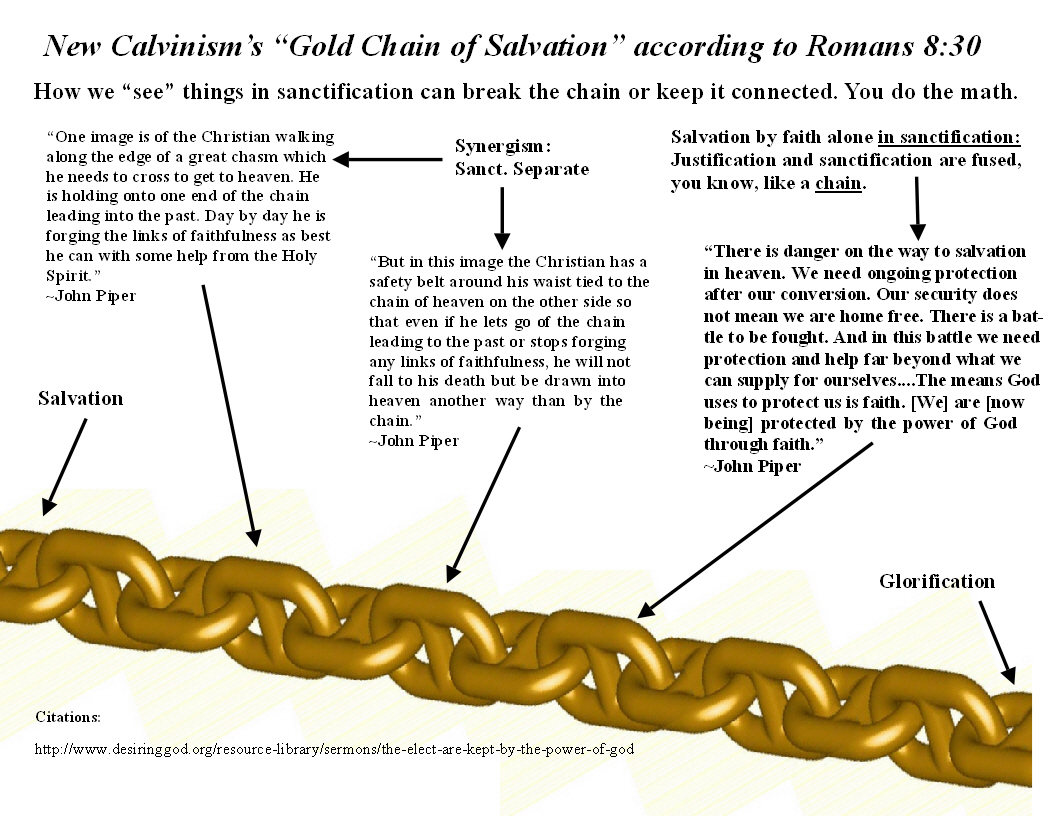
This ministry has made much of the critical importance of separating justification (salvation) and sanctification (growth in holiness, or kingdom living). The Reformed (Calvin/Luther Reformation doctrine/gospel) “never separate, but distinct” doublespeak doesn’t cut it in the arena of truth, and we will see why. “Never separate” =’s false gospel. If you get a little lost in the first part of my argument which gives the lay of the land, don’t worry, when I get into the specific Scriptural argument, it will clear things up and make it all come together for you. It must delight the ghosts of the Reformation that the argument has always been in the arena of freewill verses predestination. It’s the primary thrust of this ministry to change that argument. This isn’t a quibbling about semantics in the mainstream—this is about the truth of the gospel. As New Calvinist Russ Kennedy once thundered from the pulpit in his mousy voice: “Any separation of justification and sanctification is an abomination!” I have often argued from the standpoint of this issue. If sanctification is the middle of the Reformed “golden chain of salvation” then sanctification is part of finishing justification. This means that what happens in sanctification determines whether or not justification is properly finished. What’s a chain? John Piper even preached a message about the eternal importance of our contribution to the “links” in just the right way. In essence, sanctification becomes a spiritual minefield. This is exactly the same thing that the Reformed crowd has always accused Rome of: the fusing together of justification and sanctification. However, as we shall see, they are both guilty of the exact same heresy/false gospel. As we shall see, both teach that sanctification finishes justification. This is a linear gospel (one unified chain from salvation to resurrection (glorification) versus a parallel gospel with salvation on one plane as a finished work before the foundation of the world, and kingdom living that runs parallel with the finished work and reflects the reality of our salvation until glorification. Typical in the linear gospel is the idea that Christ died for all of our past sins, but we must now finish the work (with the Holy Spirit’s help [sanctified works salvation]) until glorification when we are completely transformed into complete holiness. This is the often-heard bemoaning of “Christ PLUS something.” 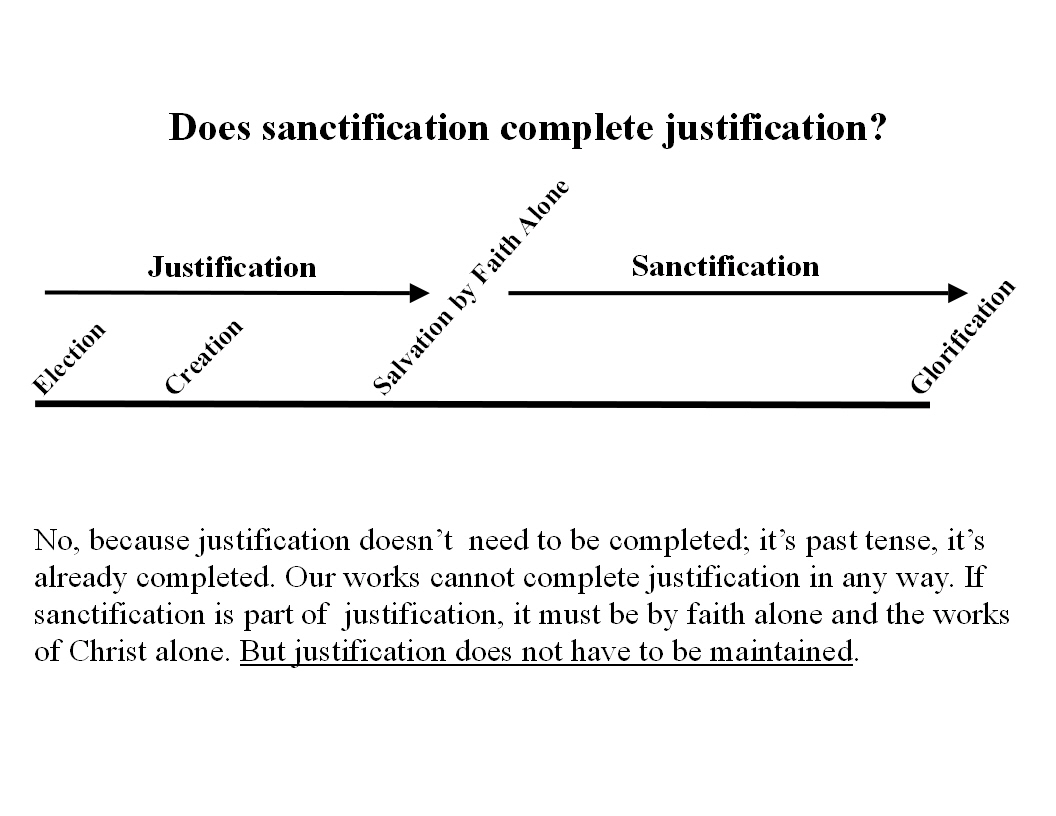 An excellent example is some strains of Freewill Baptists who teach that Christ died for all of our past sins, but with the help of the Holy Spirit, we must confess and repent of every sin we commit until the resurrection, e.g., Christ plus salvation by repentant prayer for sins committed after we are “saved.” My grandparents were saved out of this tradition. When my grandfather asked my grandmother if she thought that God could ever forgive him of all the sins he committed, she answered: “Yes, but you are going to have to pray awful hard!” Praise God that through the ministry of several individuals my grandparents eventually abandoned that gospel for the true one of salvation by faith alone as a finished work. Likewise, Rome teaches that you must let the Catholic Church finish your justification through ritual, e.g., Christ plus Catholic ritual. The Reformation gospel is also Christ plus something else, but the something else is ever-so-subtle. In both cases, sin must be dealt with in sanctification in order for the saint to remain justified until the final judgment. In other words, the righteous standard of justification must be maintained on our behalf. Like all other proponents of a linear gospel, the Reformed crowd contends that anything less than the perfection demanded of the law (“all sin is transgression of the law”) is “legal fiction.” So both Rome and the Reformers agree: justification must be maintained by sanctification, and in the case of the Reformers specifically, they believe that the perfect standard of the law must be maintained until glorification; otherwise, our justification is “legal fiction.” Here is where Reformed subtlety is uncanny: Christ keeps the law for us in sanctification. He maintains the perfect standard. All the fruit of sanctification (obedience/good works) flows from the life He lived on Earth and His death on the cross. Christ plus the works of Christ to finish salvation. “But Paul, what in the world is wrong with that?!” Here is what is wrong with it: works are still required to maintain justification. That is a huge problem, even if it is Christ doing the work. What did the Hebrew writer say about Christ’s work for justification not being complete? And even more subtle is the following Reformed idea: believing that the law is no longer a standard for maintaining justification is antinomianism. Antinomianism =’s legal fiction. Their definition of antinomianism is the removal of the law from justification as the standard for maintaining it. Traditionally, among Biblicists, antinomianism is the removal of the law from sanctification, and herein lays even further steroidal subtlety: the Reformed theologians would refute a removal of the law from sanctification as well, not only because they think justification and sanctification are the same thing, but because its perfect keeping is required to maintain a true declaration of the just that is not “legal fiction.”
  However, the Biblicist believes that the law is a standard for kingdom living and is no longer a standard for justification. Therefore, if we attempt to obey it with the Holy Spirit’s help, and to please/serve the Lord, it can have no bearing on our just state. While the Biblicists think they are therefore joint contenders with the Reformers against antinomianism, such is far from the truth. The Reformed mind believes the Biblicist is either a legalist or an antinomian, or both. The Biblicist is supposedly an antinomian because he/she has removed the law from justification as a just standard, or is a legalist because they think they should strive to keep the law in sanctification. Since sanctification finishes justification’s perfect standard of law keeping, our “own” attempts to keep the law in sanctification is an attempt to finish justification. Hence, what the Biblicist fails to understand is the Reformers belief that Christ must maintain the law for us in sanctification because justification and sanctification are not separate. Anything more or less is supposedly works salvation. On the other hand, because it is vital that Christ obeys the law for us in sanctification, the likes of John Piper and Tullian Tchividjian contend that those who are really preaching the Reformed gospel will indeed be accused of antinomianism. All in all, their position is easy to see if you pay attention. John Piper and many other Calvinists often state that, “Good works are the fruit of justification.” And, “Justification is the root, and sanctification is the fruit.” Well, the average Biblicist then thinks, “Yes, but of course, our salvation makes good works in sanctification possible.” But that’s not what they are saying. If you pay closer attention, they are saying that justification is a tree that produces its own fruit. Justification is the root, and whatever happens in true sanctification is the fruit of the root of the justification tree. Problem is, justification doesn’t grow. Justification is a finished work. What Calvinists refer to as “progressive sanctification” is really the fruit of the root: progressive justification. Another name for this that they throw around is “definitive sanctification.” The word “definitive” refers back to the definite completion of justification.
  Revision: this ministry now rejects the idea that orthodoxy is truth; orthodoxy is the traditions of men. Never in Scripture do we find premise for a body of teaching that explains the teaching. The above illustration is valuable for demonstrating that the fruit of justification is glorification, NOT sanctification. This brings us to the Scriptural argument which begins with a question I asked myself just this morning: “Paul, you are always harping about the crucial importance of the separation of justification and sanctification—a parallel gospel versus a linear one. But where does the Bible say specifically that this is critical?” First, the very definition of a lost person in the Bible is one who is “under the law”:
Romans 3:19 Now we know that whatever the law says it speaks to those who are under the law, so that every mouth may be stopped, and the whole world may be held accountable to God. Romans 6:14 For sin will have no dominion over you, since you are not under law but under grace. Romans 6:15 What then? Are we to sin because we are not under law but under grace? By no means! 1 Corinthians 9:20 To the Jews I became as a Jew, in order to win Jews. To those under the law I became as one under the law (though not being myself under the law) that I might win those under the law. Romans 7:1 Or do you not know, brothers —for I am speaking to those who know the law—that the law is binding on a person only as long as he lives? Romans 7:2 For a married woman is bound by law to her husband while he lives, but if her husband dies she is released from the law of marriage. Romans 7:3 Accordingly, she will be called an adulteress if she lives with another man while her husband is alive. But if her husband dies, she is free from that law, and if she marries another man she is not an adulteress.
The unsaved are “under the law” and will be judged by it in the end. This is the very definition of the unsaved. Calvinists define Christians the same way—we are supposedly still under the law and will be judged by it in the end. That’s why Christ must keep the law for us—because we are still under it. If not this position, why do many in the Reformed tradition hold to the idea that Christ’s perfect obedience is imputed to our sanctification? His death justifies us, and His perfect life sanctifies us. Hence, His death pays the penalty for past sins, and then His perfect life imputed to our sanctification keeps us justified. Why would an imputation to our sanctification be necessary if we are no longer under the law? This is known as the Reformed view of “double imputation” and has been called out as heresy by many respected theologians for this very reason: it implies that Christians are still under the law. In regard to sustaining the law in our stead, why? It has been totally abolished in regard to our just standing:
Romans 3:20 For by works of the law no human being will be justified in his sight, since through the law comes knowledge of sin. Romans 3:21 But now the righteousness of God has been manifested apart from the law, although the Law and the Prophets bear witness to it— Romans 4:15 For the law brings wrath, but where there is no law there is no transgression.
The keeping of the law by anybody DOES NOT do anything to justify mankind:
Romans 3:28 For we hold that one is justified by faith apart from works of the law.
Here is where the separation of justification and sanctification is vital on this first point: we ARE NOT under the law for justification, but rather UPHOLD THE LAW in sanctification. The two must be separate because of the differing relationships to the law:
Romans 3:31 Do we then overthrow the law by this faith? By no means! On the contrary, we uphold the law. Romans 6:15 What then? Are we to sin because we are not under law but under grace? By no means!
Furthermore, if we are still under the law (whether or not Christ obeys it for us to keep us in a just standing), this means we are still under the power of sin. Being under the law and also under its spell to provoke sin in the unregenerate is spoken of as being synonymous in the Bible. Those who are “under the law” are also under the power of sin and enslaved to it:
Romans 7:4 Likewise, my brothers, you also have died to the law through the body of Christ, so that you may belong to another, to him who has been raised from the dead, in order that we may bear fruit for God. Romans 7:5 For while we were living in the flesh, our sinful passions, aroused by the law, were at work in our members to bear fruit for death. Romans 7:6 But now we are released from the law, having died to that which held us captive, so that we serve in the new way of the Spirit and not in the old way of the written code. Romans 7:8 But sin, seizing an opportunity through the commandment, produced in me all kinds of covetousness. For apart from the law, sin lies dead.
If we are still under the law, and will be judged by it, whether or not Christ stands in the judgment for us with His own works, we are still enslaved to sin by virtue of being under the law…. for justification. And Calvinists know this to be true, that’s why they say we are still…. what? Right, even as Christians, “totally depraved.” And, “enemies of God.” Of course, throughout the Bible, Christians are spoken of as being friends of God and no longer His enemies. Our status as enemies of God is stated in the past tense. But the Reformed crew continually state that Christians are vile enemies of God and are enslaved to sin. They realize that this goes hand in hand with being under the law. To the contrary, dying to the law in the death of Christ….for justification—sets us free to be enslaved to the righteousness that is defined by the law. We are dead to the law for justification and alive to obey truth….for sanctification:
Romans 8:2 For the law of the Spirit of life has set you free in Christ Jesus from the law of sin and death. Romans 8:3,4 [emphasis by author] For God has done what the law, weakened by the flesh, could not do. By sending his own Son in the likeness of sinful flesh and for sin, he condemned sin in the flesh,….in order that the righteous requirement of the law might be fulfilled in us, who walk not according to the flesh but according to the Spirit. Romans 8:7 For the mind that is set on the flesh is hostile to God, for it does not submit to God’s law; indeed, it cannot. Romans 9:31 but that Israel who pursued a law that would lead to righteousness did not succeed in reaching that law. John 17:17 Sanctify them in the truth; your word is truth. James 1:25 But the one who looks into the perfect law, the law of liberty, and perseveres, being no hearer who forgets but a doer who acts, he will be blessed in his doing.
So, that is the separation that must be for the true Christian: Justification has no law for which we are judged, and we live by the law of blessings in sanctification. This brings us to another important separation in the two: the judgments. Those under the law and sin will stand in a final judgment which will be according to the law. Again, because Calvinists believe that we are still under the law, albeit that Christ obeyed/obeys it for us, Christians will supposedly stand in the same judgment as the damned who are under the law and enslaved to it. At that time, the children of God, according to Calvinists, will be “made manifest.” But because Christians are not under the law and cannot be judged by it, they will stand in a judgment for rewards and not a judgment that determines a perfect keeping of the law by Christ in our stead. Hence, there will be two different resurrections: one for those under the law and another for those under grace, and two different judgments for the same two groups. One for rewards, and one to determine if those under the law kept it perfectly. The latter judgment doesn’t go well for any standing in it.
Luke 14:12-14 He said also to the man who had invited him, “When you give a dinner or a banquet, do not invite your friends or your brothers or your relatives or rich neighbors, lest they also invite you in return and you be repaid. 13 But when you give a feast, invite the poor, the crippled, the lame, the blind, 14 and you will be blessed, because they cannot repay you. For you will be repaid at the resurrection of the just.” [Notice that this is a resurrection for the “just.” They are already determined to be just before they are resurrected]. 2Corinthians 5:9,10 So whether we are at home or away, we make it our aim to please him. 10 For we must all appear before the judgment seat of Christ, so that each one may receive what is due for what he has done in the body, whether good or evil. 1Corintians 3:11-15 For no one can lay a foundation other than that which is laid, which is Jesus Christ. 12 Now if anyone builds on the foundation with gold, silver, precious stones, wood, hay, straw— 13 each one’s work will become manifest, for the Day will disclose it, because it will be revealed by fire, and the fire will test what sort of work each one has done. 14 If the work that anyone has built on the foundation survives, he will receive a reward. 15 If anyone’s work is burned up, he will suffer loss, though he himself will be saved, but only as through fire. Hebrews 6:10 For God is not unjust so as to overlook your work and the love that you have shown for his name in serving the saints, as you still do. Revelation 20:6 Blessed and holy is the one who shares in the first resurrection! Over such the second death has no power, but they will be priests of God and of Christ, and they will reign with him for a thousand years. Revelation 20:11-15 Then I saw a great white throne and him who was seated on it. From his presence earth and sky fled away, and no place was found for them. 12 And I saw the dead, great and small, standing before the throne, and books were opened. Then another book was opened, which is the book of life. And the dead were judged by what was written in the books, according to what they had done. 13 And the sea gave up the dead who were in it, Death and Hades gave up the dead who were in them, and they were judged, each one of them, according to what they had done. 14 Then Death and Hades were thrown into the lake of fire. This is the second death, the lake of fire. 15 And if anyone’s name was not found written in the book of life, he was thrown into the lake of fire.
Don’t let anyone tell you that eschatology is a “secondary” or “nonessential” consideration. Your eschatology is your gospel. It will state your position regarding whether or not you fuse justification and sanctification together; ie, likening Christians to those under the law.
Yet another vital difference in sanctification and justification is repentance. Repentance for salvation (when you are justified) is different from our repentance in sanctification. Among many in the Reformed tradition where the “same gospel that saved you also sanctifies you,” the repentance is the same. Repentance unto salvation is not a onetime “washing,” but rather a means to continue “in the gospel” through what they call “deep repentance.” Biblicism holds to repentance in sanctification that restores his/her fellowship and communion with God as His children. They would see repentance unto salvation as differing, and only necessary for salvation—a onetime decision to take one’s life in a new direction by following Christ, and believing in his death, burial, and resurrection. Reformed repentance, according to the likes of Paul David Tripp and others is a “daily rescue.” Our original repentance was for rescue, and we need rescue today as much as we needed rescue when we were saved. Again, this indicates their belief that we are still under the curse of the law and need to be continually rescued from it while remaining under the bondage of sin. However, Christ made it clear to Peter (John 13:6-11) that those who have been washed (1Corinthians 6:11, Romans 8:30) do not need another washing. Those who drink of the living water do not thirst again (John 4:13,14). Lastly, though many other separations could be discussed, why saints can be considered just while they still sin at times is of paramount importance. There is no sin in our justification because there is no law, and where there is no law, there is no sin. Though unfortunate, there can be sin in our sanctification because it is totally separate from justification and can’t affect our just standing with God. Basically, all of the aforementioned makes it of necessity to deny the new birth. If we have God’s seed in us, and we do (1John 3:9), that dispels total depravity, and without total depravity, justification and sanctification cannot be fused together. The new birth is a huge problem for Reformed theology. If the old man that was under the law is dead (Romans 7:1ff), and the seed of God is in the saved person, and the sin due to our weakness in the flesh cannot be laid to our account for justification, then our justification is not “legal fiction” because we do not exhibit perfect obedience to the law. This is another grave consideration because Christ said, “You must be born again.” Obviously, despite their denials that they deny the new birth—you can’t be both totally depraved and born again. Reformation doctrine is clearly a false gospel. Its version of justification does not void the law, and denies the new birth while distorting everything in-between. Freewill verses predestination is hardly the issue, the very gospel itself is the issue.
paul
Answering the Baby’s Question
 The answer to the Baby’s question, according to Protestantism and all its various and sundry stripes including the Baptists is “yes.” Since the law is the standard for justification and Christians cannot keep the law perfectly, yes, Christ supposedly came to keep the law perfectly in order to fulfil it, and then died for all of our past sins. Instead of the resurrection being a prelude to our own resurrection and a totally different relationship to the law, Christ’s resurrection is said to “confirm that God was satisfied with His sacrifice.”
Hence, if “Christians” live their life by “faith alone in the same gospel that saved them,” the perfect obedience of Jesus will continue to be credited to our account in order to keep the “righteous demands of the law satisfied,” and we will receive continued forgiveness for “present sin” that violates the same law. So, according to Protestantism, Christ didn’t come to end the law for justification, He came to fulfill it through obedience so that His obedience and sacrifice can continue to be applied to our lives by faith alone. Therefore, His justification work is not finished. Yes, they concur that it only happened once, but the one act must be continually reapplied to the “believer’s” life.
Let’s evaluate this according to the new birth since it’s a baby asking the question. In this system, Christ’s resurrection is not imparted to the new believer, but was merely a confirmation that God was satisfied with Christ’s sacrifice. Technically, Christ’s death and obedience continues to be imparted to the “believer” IF they continue to live by faith alone in the same gospel that originally saved them. Now you know why there is so much emphasis on “the gospel” at “church” and why sanctification has always been so weak in the institutional church.
Protestantism is about keeping yourself saved by faith alone in the same gospel that saved you. Rather than honoring God with a mature life as one of His literal children, the attempt is to spend our whole lives honoring God by what He did to save us. It’s all about what “He did, not anything we do.” But not emphasizing what we do is actually denying the new birth and jettisoning our responsibility to love others back onto Christ.
And by the way, this efficacious reapplication of the same gospel that saved us, according to Protestant orthodoxy, can only be found and applied in formal institutional church membership.
What is the true gospel? Christ came to end the law for justification. As the law was increased, more and more sin was imputed to it. Violating the law is the very definition of sin. So, when Christ paid the penalty for our sins on the cross it also effectively ENDED the law. When a person believes on Christ’s death, they literally die with Him, and all sins they committed against the law are vanquished. They were “under the law” of “sin and death.”
On the other hand, the believer is also resurrected to a completely new life (under grace). Christ was NOT resurrected to validate His sacrifice; He was resurrected so that we could also be resurrected after dying with Him. This is the significance of also believing in His resurrection—not that it was a confirmation, but that we are also resurrected with Him as completely new creatures where “all things are new.”
This now places the resurrected believer under a different relationship to the law. What used to be the “law of sin and death” is now “the law of the Spirit of life.” In other words, instead of the law condemning us, the Spirit of life uses the law to change us (John 17:17). It is our responsibility to obey the law with the aid of the Holy Spirit, and that is the very definition of how we love God and others: “If you love me, keep My commandments.”
To define our obedience as an attempt to “justify ourselves” shirks what should be our natural desire to love God and others through obedience which is a result of the new birth. It is eerily reminiscent of the parable of the talents. The whole convoluted Protestant system that supposedly sanctifies our obedience lest it be works is a denial of the new birth and a false assessment of law/gospel.
When Protestant soteriology is accurately assessed, we should expect to find the following in the institutional church: weak sanctification; an overemphasis on the gospel to the exclusion of personal obedience; convoluted theories on how Christ’s obedience is imputed to our lives; overall doctrinal ignorance in regard to wise and powerful living; poor testimonies; a lack of genuine love; cliques; an overemphasis on following men; total dependence on extra-biblical writings; a laity/clergy caste system, and efforts to protect the institution at all cost.
And that is exactly what we find.
paul

 Paul's Passing Thoughts
leave a comment