Bad Marriages and the Simple Side of Tyranny
 The Bible isn’t complicated; to the contrary, its simplicity often escapes us as we look for something more complicated in the text. The journey in understanding the Bible begins with the stepping stones that you understand. You are simply looking to increase your understanding by building truth with one objective fact at a time. Pieces that fit together in the jigsaw puzzle lead to the fitting of more pieces. For some, the pieces take longer to find, and the journey is longer, but what they really know is more than most Protestant scholars who are ever learning but never coming to the knowledge of the truth. They are blind guides leading the blind.
Be sure of this: scholars make the Bible complicated because they want to control you. When it gets right down to it, “You have no need of anyone to teach you.” Teachers are gifted people who accelerate your learning; they are not seers or mediators between you and truth. If they ask you, “Did God really say…” you are to answer, “Yes, that’s exactly what He said.”
Hence, the simplicity of a very important fundamental truth found in Genesis:
4:6 – The Lord asked Cain, “Why are you angry? Why do you look so unhappy [has your face/countenance fallen; 4:5]? 7 If you do things well [correctly; appropriately], I will [will I not…?] accept you, but if you do not do them well [correctly; appropriately], sin is ready to attack you [crouching at the door]. Sin wants [desires to control; 3:16] you, but you must rule over it” (EXB).
We also know from the New Testament that sin is a master that pays death wages, while Christ came to purchase us with His blood from that master. We are now free to serve another master who only pays life wages. A slave that dies (through the baptism of the Spirit) is no longer under the authority of the sin master, and is a new creature resurrected to life and free to serve another (Rom 7:4).
But lest we are careful, the simple truths of this passage and a wiser life will escape us. Sin is described as an entity that has a desire; specifically, a desire to control others. One of the fundamental characteristics of sin is a desire to control others.
Secondly, in this verse, sin’s means of doing so are also described: sin is crouching at the door waiting for us to fail. Sin then seeks to exploit that sin for purposes of control. At least to some degree, sin seeks to use the failure to destroy a true self-assessment and make a case for needed lordship. Certainly, this is how the serpent approached Eve. He wanted to convince her that she was unable to understand God without a mediator. Has God really said…?
At this point, this truth needs more development, but here is a basic building block that we can be sure of: the sin master uses condemnation to enslave, and pays death wages for one’s work:
1 Corinthians 15:56 – Death’s power to hurt [sting] is sin, and the power of sin is the law. 57 But we thank God! He gives us the victory through our Lord Jesus Christ.
58 So my dear [beloved] brothers and sisters, stand strong. Do not let anything move you. Always give yourselves fully to [excel in] the work of the Lord, because you know that your work in the Lord is never wasted [not useless/in vain] (EXB).
This is why Christ came to end the law. Sin crouches at the door waiting to seize the opportunity to condemn, and the more law, the better. The “law of sin and death” empowers sin because the power of sin and its ability to pay death wages is condemnation. When Christ died to end the law, He stripped sin of its power to enslave and pay wages.
Don’t misunderstand; being in Christ does NOT mean that we are not under a law, but it is the “law of the Spirit of life.” Why is it called that? Because the new Master pays life wages for the obedience of love, and that has never been any different:
Deuteronomy 30:15 – “See, I have set before you today life and good, death and evil. 16 If you obey the commandments of the Lord your God that I command you today, by loving the Lord your God, by walking in his ways, and by keeping his commandments and his statutes and his rules, then you shall live and multiply, and the Lord your God will bless you in the land that you are entering to take possession of it. 17 But if your heart turns away, and you will not hear, but are drawn away to worship other gods and serve them, 18 I declare to you today, that you shall surely perish. You shall not live long in the land that you are going over the Jordan to enter and possess. 19 I call heaven and earth to witness against you today, that I have set before you life and death, blessing and curse. Therefore choose life, that you and your offspring may live, 20 loving the Lord your God, obeying his voice and holding fast to him, for he is your life and length of days, that you may dwell in the land that the Lord swore to your fathers, to Abraham, to Isaac, and to Jacob, to give them.”
Nothing has ever been different in regard to the law. When we serve God, it is the law of love that brings life wages; when we “serve other gods” it is the law of sin and death that pays death wages accordingly…
Romans 6:16 – Do you not know that if you present yourselves to anyone as obedient slaves, you are slaves of the one whom you obey, either of sin, which leads to death, or of obedience, which leads to righteousness?
With all of this said, consider the lion’s share of bad marriages. It never fails. Two people, at war, and each with a laundry list of the other’s faults. Check that. Better said, a condemnation list. And of course backed up with many Bible verses; the Bible is either the law of sin and death that condemns, or the law of the Spirit of life that loves.
What’s going on? Answer: sin, and its desire to control using condemnation.
Genesis 3:16 – “I will surely multiply your pain in childbearing; in pain you shall bring forth children. Your desire shall be for your husband, and he shall rule over you.”
This is the same exact grammatical construction found in Genesis 4:6 concerning sin’s desire to control Cain. Sin will manifest its desire in marriages by each spouse desiring to control the other, and using failure to do so. When the failure of a spouse presents itself, the other spouse will use it to make a case for ruling over the other spouse. In essence, “Since you are stupid, I should be running the show in this marriage.”
In Reformed circles, elders make a case for being the rulers because we are all…what? Right, “totally depraved.” Same deal.
If you know this simple Bible fact, you know more than most “expert” counselors. In most bad marriages, both spouses need to repent of being tyrants. They need to stop using the Bible to condemn each other, and start using the Bible to love each other. After all, “love covers a multitude of sins.”
Go and do likewise…you are now an expert Bible counselor.
paul
The False Protestant Gospel of “How Much?”
 “At any moment, any lost person can choose to have their sins ended. It is not a question of whether or not they are elected, it is a question of whether or not they are under the law—and they are.”
The Protestant gospel effectively denies the biblical interpretation of the new birth. Because of its Platonist metaphysical presuppositions, it denies the treasure of God’s seed dwelling in weak vessels. Hence, the new birth is redefined and confined to the ability to perceive realm manifestations apart from any ability to do a good work of any kind. As stated by some, “Sanctification is done TO you, not BY you.”
In the biblical good news schema, Christ does ONE act of obedience as His part in God’s reconciliation plan. There is no question of “how much?” because His death was all that was required.
Now enter the heinous “Reformation” gospel of confusion. A cursory observation of Reformation history reveals that the dust-up between Rome and the “Reformers” was over metaphysics first. The very first and foundational doctrinal statement of the Reformation contained 12 theses of philosophical metaphysics. Luther was miffed that Rome was moving away from its Augustinian/Platonist roots and coming under the spell of Thomism. This shift began in the 13th century via St. Thomas Aquinas and eventually incited the Reformation. The assertion that the Reformation was driven by sola scriptura is absurd.
Martin Luther introduced his metaphysical answer to Thomism and foisted his theses that supported it onto Scripture. The centerpiece eventually came to be known as double imputation. To Luther’s credit, he created a timeless soteriology based on metaphysics that continues to turn the world upside down. John Calvin articulated Luther’s foundation in the Institutes of the Christian Religion. Both were dedicated to returning the church to its Augustinian roots.
What is double imputation? Basically, it’s the idea that Christ’s role in the gospel of first importance (as set apart from God’s full counsel which is also good news) was twofold as opposed to ONE single act. This was necessary as a “biblical” doctrine that keeps the material being of man separate from Plato’s trinity: the good, true, and beautiful, ie., the invisible. The true gospel turned dualism philosophy completely on its head by infusing good into weakness and defining the true definitions of God’s creation and the state of being.
The idea that God infused His righteousness into the being of mankind is repugnant to the Reformed mindset. How repugnant? The colonial Puritans executed Quakers for even asserting an errant view of the idea.
Therefore, distorting Christ’s role in God’s elected plan of reconciliation was necessary. Christ’s redefined soteriological role removes all goodness from mankind proper and “Christians” in particular. Christ not only came to die for the sins of particular persons preselected by God, but He also came to live a perfect life in obedience to the law so that His obedience could be imputed to the “elect.”
Now the questions are begged: “How much suffering was necessary to pay the penalty for sins committed by the preselected, and how much obedience was necessary for righteousness to be imputed to the preselected as well. When a false doctrine is predicated on errant presuppositions, not only do these kinds of questions arise, but the attempted answers give rise to more questions.
And displays of nonsense. An example is the weird and embarrassing ad lib “Scream of the Damned” propagated by John Piper and CJ Mahaney at a conference hosted by John MacArthur Jr.’s Grace Community Church.* The sheer weirdness of it all even raised eyebrows within Reformed circles by the likes of Steve Camp. The premise was an adolescent-like attempt to explain how much? in regard to Christ’s death. Imagining the response from my older than dirt and probably dead father in the faith, Pastor Richard Peacock, put me on the floor rolling around while laughing uncontrollably. Only the thought of thousands of attending pastors supported by the hard work and sweat of the laity watching without a blink shocked me into the horror of reality and put an end to my shameless response.
When are people going to stop and say to themselves, “Wait a minute here; what drives this stuff? This kind of stuff just doesn’t happen for any or no reason.”
Likewise, in regard to how much?, how long did Christ have to live and how much of the law did He have to obey for the elect? Theories abound because the question itself flows from the false presuppositions of Platonism foisted on the Scriptures resulting in the doctrine of double imputation.
Christ did ONE thing to secure reconciliation for mankind: He died. How much? Answer: enough for ALL mankind. How? Answer: by ending the law. How is that possible? Answer: because all sin is against the law and imputed to the law, and Christ died to end it. Sin is not covered by Christ’s law–keeping; no, sin is not covered, it is ENDED. At any moment, any lost person can choose to have their sins ended. It is not a question of whether or not they are elected, it is a question of whether or not they are under the law—and they are.
What else did Christ do to secure our reconciliation? Answer: nothing. But wasn’t He resurrected? Answer: yes, but He didn’t do that, that was the Holy Spirit’s role in God’s plan of reconciliation. The fact that Christ would be resurrected was a promise made TO Christ and Abraham BY God. That surprises many Christians who don’t read their own Bibles for themselves, viz, most.
In other words, this is the gospel: Christ DIED to END sin. The Spirit resurrected Christ as the first fruits of those who would also be resurrected to new life and justification which is NOT merely a legal declaration, but a metaphysical fact. It does of course have a legal aspect, but it is adoption court where the Holy Spirt bears witness with us that we are the children of God. Christ was “resurrected” for our justification” by the Holy Spirit. “Forensic Justification” does have a legal aspect, but not only in the halls of criminal court, but just as much in the court of adoption with the Holy Spirit appearing as a witness.
Obedience to the law by Christ does not justify us, the new birth justifies us because we are in fact righteous. The resurrection justifies us, not law-keeping by anyone including Christ.
True resurrection with Christ is “under grace,” but that by no means states that we are no longer under a law. It means that we are no longer under a law that condemns us. This is what strips sin of its power. This is what strips death of its sting. We must remember that the law is the Spirit’s law. He will use it to convict the world of sin and warn of the judgment to come, or he will use it to sanctify God’s children. The law is a savor of death to those who do not believe, and a savor of life as we walk in it as God’s children.
The time has come to stop dwelling in the Protestant metaphysical narrative of death, and to follow Christ in our duty to write a narrative of life.
How much? That will depend on OUR obedience as children of God. The Spirit gave us life and opportunity to use His law to love God and others. “Do’s and don’ts” are not the issue, LOVE is the issue. We do not stay at the foot of the cross while Christ loves for us; we will be rewarded for the narrative of life that we write by using the gifts granted to us when Christ sat down beside the Father and rested from justifying all who will believe in Him.
We zealously write our narrative of life without fear of condemnation because of Christ’s love for us. And our love will never be enough because of the freedom we feel. The freedom purchased by His blood that freed us from the condemnation of the law and the Master empowered by it, and the freedom to love by obeying the law of the Spirit—the perfect law of liberty. When God looks at us, He sees more than Christ, he sees one that Christ is not ashamed to call a brother—He sees one of His children. Christ doesn’t cover us, He presents us.
He is not ashamed of us. His death was enough for our life.
paul
* “Apparently, they got the concept from RC Sproul, who used to be rock solid, but now it would appear that senility has opened his mind to the nonsensical theological acrobatics of our day. Likewise, the same consideration might apply to John MacArthur who spoke at the conference and also sponsored it; he is getting up in years as well. I offer this as a possible excuse for both of them though the vision of my heart longs to see them as the gray-haired stalwarts of the faith that I thought they were. Here is what Sproul said:
‘Once the sin of man was imputed to Him, He became the virtual incarnation of evil. The load He carried was repugnant to the Father. God is too holy to even look at iniquity. God the Father turned His back upon the Son, cursing Him to the pit of hell while on the cross. Here was the Son’s ‘descent into hell.’ Here the fury of God raged against Him. His scream was the scream of the damned. For us’ (Tabletalk magazine, My God, My God, Why Hast Thou Forsaken Me? April 1990, p. 6).
Steve Camp, on his blog, wrote a tame but thoroughly convincing argument against such a notion. But the fact that Camp thought such a significant expenditure of effort was needed is indicative of our day; surely, only ten years ago, such a thesis would have invoked a horrendous outcry among God’s people” (The New Calvinist License To Kill: And Did God Really Condemn Christ To Hell?, Paul’s Passing Thoughts blog, Paul Dohse, Sr., September 2, 2011).
Why the Five Solas are an Anti-Love Abomination: Romans 12:1

Originally published October 4, 2014
The biblical way of living life is pretty straightforward in the Scriptures. The sacrifice of Christ on the cross saved us, and then we move on to the “living sacrifice.” Calvinism propagates a perpetual return to the onetime sacrifice of Christ for all sin and insists that this onetime act must be continually reapplied to our lives by “faith alone” in order to keep ourselves saved. This is what “preaching the gospel to ourselves every day” is all about. It’s a contemporary term, but it is grounded in the doctrinal foundations of the Protestant Reformation.
This is also what is behind the sacred sola fide (faith alone) of the five solas of the Protestant Reformation. But, “faith alone” means literally faith alone in both salvation and sanctification (Christian living). James railed against sanctification by faith alone in no uncertain terms, and thus, his epistle wasn’t exactly Luther’s favorite. In the same way that we assume total depravity of the five points of Calvinism only applies to the unregenerate, ignorant Protestants assume much and think little. When they read or listen to orthodoxy, their minds are programmed to receive only. In Protestant churches everywhere, the five solas are proudly displayed at the front of the church while in reality this clarion cry of Protestantism is a biblical abomination. Hence, from heaven’s viewpoint, this worldwide collective mockery on Sunday morning must be a beholding of unimaginable proportions.
Why is this? Well, because “Christians” “still sin.” And hey, if we still sin, we must need forgiveness every day. And hey, if we still need forgiveness, we can only get it from the original source—the cross. So, the Christian life becomes an endeavor to keep our new sins covered by a continual return to the same gospel that saved us.
This is a result of an egregiously flawed view of the law that has eternal consequences. Christ died on the cross to end the law, and the law NEVER had any connection to justification. Christ died on the cross to reveal the righteousness of God APART from the law. Calvinism makes the law to be justification’s standard, and it NEVER was. Calvinism makes the law something that must be fulfilled in order to maintain and define righteousness (justification). Therefore, Christians remain under law which is the very biblical definition of a lost person. One is either under law, or under grace. Lost, or saved. Calvin and Luther defined “Christians” as under law.
According to their doctrine, Christ ended the law by fulfilling it while he lived on earth and obeying the law perfectly. This is an “ending” defined by an ending to us keeping it, not Christ. This makes the law the definition and standard of God’s righteousness. That’s a huge problem. Christians are then still under law, and must return to the cross so that the law continues to be satisfied by reapplying the death and life of Christ by faith alone (sola fide).
This is nothing new, and is the same Galatian error that Paul stood against. What was his argument? He argued that if a perfect fulfillment of the law defined righteousness (justification), there is life in the law, and the promise was by two seeds, and not just one…that is, Christ. However, Paul made the point that there is only one seed, and therefore NO life in the law…for righteousness. That’s the key, “for righteousness.”
Christ ended the law for righteousness, and our sins are not merely COVERED by a supposed need to return to the cross—our sins are ENDED.
Calvinism’s anti-gospel view of the law is not only a false gospel, but sucks all of the life out of sanctification. Why? It places sanctification under the precarious auspices of the law for justification making justification a process rather than a finished work. Protestants do not know what it means to be under grace. “Under grace” means that Christ fulfills the demands of the law in our stead—that’s a false gospel.
In his letter to the Romans, Paul begins 12:1 with, “I appeal to you therefore….” This appeal was based on everything he had written in the first eleven chapters. The Reformed assert that this is Paul’s call to fulfill the imperatives that follow by returning to the first eleven chapters daily; in essence, a return to the sacrifice of Christ and the cross. Not so, this is an appeal by Paul to move from Christ’s sacrifice to our sacrifice…
…to present your bodies as a living sacrifice, holy and acceptable to God, which is your spiritual worship.
Paul then proceeds with instruction on how to do that. Key to understanding this is knowing that the body, or members, are NOT inherently evil. We sin because the body is “weak,” and mortal, not inherently evil. Notice from the citation above that the body can be used for holy purposes. Also note that we are the presenters to God, and this presentation is “spiritual worship.” Worship is using our minds and bodies to love God and others according to Scripture 24/7:
Romans 13:8 – Owe no one anything, except to love each other, for the one who loves another has fulfilled the law. 9 For the commandments, “You shall not commit adultery, You shall not murder, You shall not steal, You shall not covet,” and any other commandment, are summed up in this word: “You shall love your neighbor as yourself.” 10 Love does no wrong to a neighbor; therefore love is the fulfilling of the law.
Galatians 5:6 – For in Christ Jesus neither circumcision nor uncircumcision counts for anything, but only faith working through love.
Notice in Galatians 5:6 that faith works. This speaks against the anti-gospel lie of sola fide of which all of the five solas stand in the same way that all five points of Calvinism stand or fall on total depravity. Faith is not alone in sanctification in the same way that faith is alone in justification. When that view is proffered, it is telling that such also proffers a gospel that keeps people under law and thus makes justification progressive instead of a finished work. This was James’ very contention against a faith without works in sanctification; in essence, it reveals what you believe about justification.
Moreover, a faith alone that does not work completely circumvents the primary purpose of the living saint: love. In the same way that being under law violates every point of the law when one point is violated (James 2:10), the one under grace fulfills the whole law with one act of love:
for the one who loves another has fulfilled the law. For the commandments, “You shall not commit adultery, You shall not murder, You shall not steal, You shall not covet,” and any other commandment, are summed up in this word: “You shall love your neighbor as yourself.” Love does no wrong to a neighbor; therefore love is the fulfilling of the law.
Is this meant to be literal? Perhaps not, BUT for certain, it demonstrates that the Christian cannot sin against the finished work of justification in anyway because where there is no law, there is no sin (Romans 5:13). Christ’s death on the cross ended the law FOR justification—while we fulfill the law by acts of love and…
Romans 6:12 – Let not sin therefore reign in your mortal body, to make you obey its passions. 13 Do not present your members to sin as instruments for unrighteousness, but present yourselves to God as those who have been brought from death to life, and your members to God as instruments for righteousness. 14 For sin will have no dominion over you, since you are not under law but under grace.
It is now our choice to allow sin to reign in our mortal bodies because the ending of the law strips sin of condemnation. Sin’s ability to condemn through the law has been ended, and therefore, sin has no power over us:
1Corithians 15:56 – The sting of death is sin, and the power of sin is the law. 57 But thanks be to God, who gives us the victory through our Lord Jesus Christ.
We have victory over sin because Christ ended the law and stripped sin of its ability to condemn—Christians do not sin in regard to justification and never needed Christ to fulfill the law of sin and death in our stead; in the present, or the past. He died to end the law. We are now free to fulfill the law of the Spirit of life through love which are actions done by us and described by Paul in Romans chapters 12-16. We can only sin against love, not justification, and Christ never came to fulfill the law of sin and death, but to enable us to fulfill the law of the Spirit of life through faith working in love (See Romans 8:1-17).
There can be no confusion here or questioning of motives, when Christians obey the law, it is for love, not justification: “If you love me, keep my commandments.”
The supposed necessity of Christ to fulfill the law for us while we live the Christian life by “faith alone” is the essence of antinomianism ([anti-law]“anomia”). And consequently, someone else obeying the law for us, or more accurately, loving God and others in our place; i.e., Christ, will , and always does lead to cold heartedness:
Matthew 24:12 – And because lawlessness [anomia] will be increased, the love of many will grow cold.
Psalm 119:70 – their heart is unfeeling like fat, but I delight in your law.
There is no place where you will hear “I love you” more than a Reformed church, yet, it is a lie and indicative of cultic love-bombing. The often-seen five banners of each sola displayed prominently at the front of many churches are banners of heresy over that “church.”
They are banners representing those still under law while falsely proclaiming that they are under grace. These banners mock the cross over raised hands praising to the sounds of contemporary rock music. Deception and damnation never had a happier face.
paul
Are Calvinists Saved?
 Originally published October 6, 2012
The begging of the question has a sound Scriptural argument.
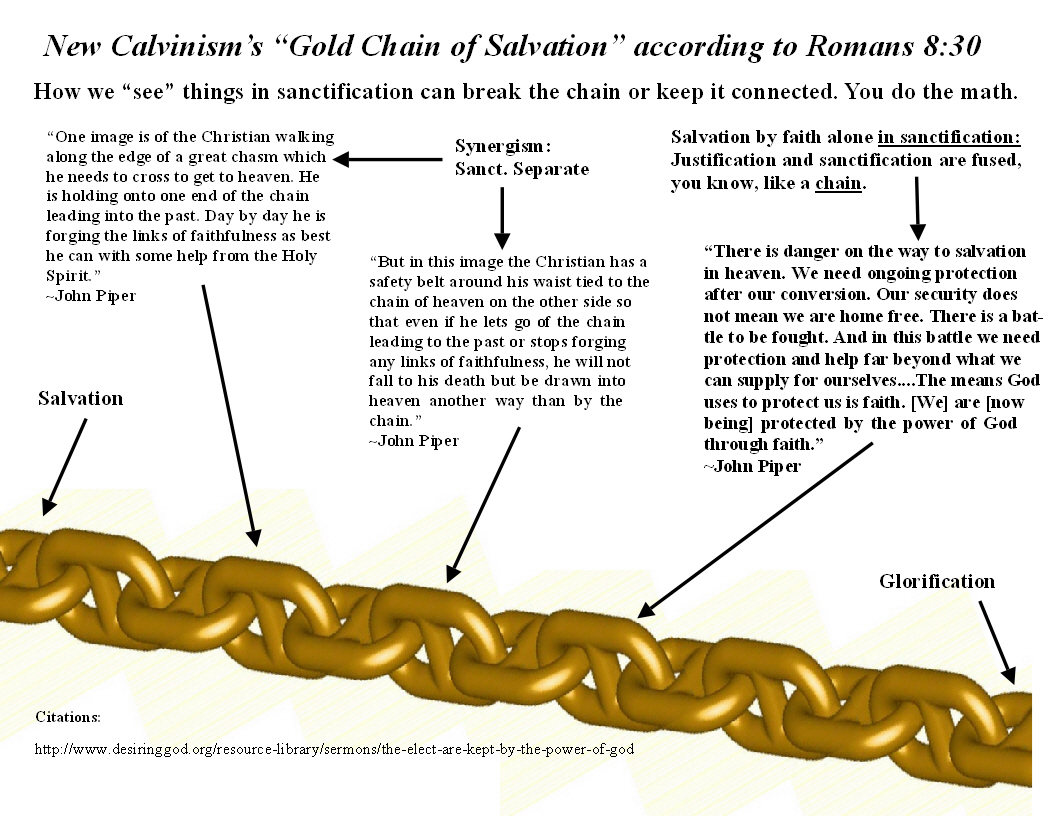
This ministry has made much of the critical importance of separating justification (salvation) and sanctification (growth in holiness, or kingdom living). The Reformed (Calvin/Luther Reformation doctrine/gospel) “never separate, but distinct” doublespeak doesn’t cut it in the arena of truth, and we will see why. “Never separate” =’s false gospel. If you get a little lost in the first part of my argument which gives the lay of the land, don’t worry, when I get into the specific Scriptural argument, it will clear things up and make it all come together for you. It must delight the ghosts of the Reformation that the argument has always been in the arena of freewill verses predestination. It’s the primary thrust of this ministry to change that argument. This isn’t a quibbling about semantics in the mainstream—this is about the truth of the gospel. As New Calvinist Russ Kennedy once thundered from the pulpit in his mousy voice: “Any separation of justification and sanctification is an abomination!” I have often argued from the standpoint of this issue. If sanctification is the middle of the Reformed “golden chain of salvation” then sanctification is part of finishing justification. This means that what happens in sanctification determines whether or not justification is properly finished. What’s a chain? John Piper even preached a message about the eternal importance of our contribution to the “links” in just the right way. In essence, sanctification becomes a spiritual minefield. This is exactly the same thing that the Reformed crowd has always accused Rome of: the fusing together of justification and sanctification. However, as we shall see, they are both guilty of the exact same heresy/false gospel. As we shall see, both teach that sanctification finishes justification. This is a linear gospel (one unified chain from salvation to resurrection (glorification) versus a parallel gospel with salvation on one plane as a finished work before the foundation of the world, and kingdom living that runs parallel with the finished work and reflects the reality of our salvation until glorification. Typical in the linear gospel is the idea that Christ died for all of our past sins, but we must now finish the work (with the Holy Spirit’s help [sanctified works salvation]) until glorification when we are completely transformed into complete holiness. This is the often-heard bemoaning of “Christ PLUS something.” 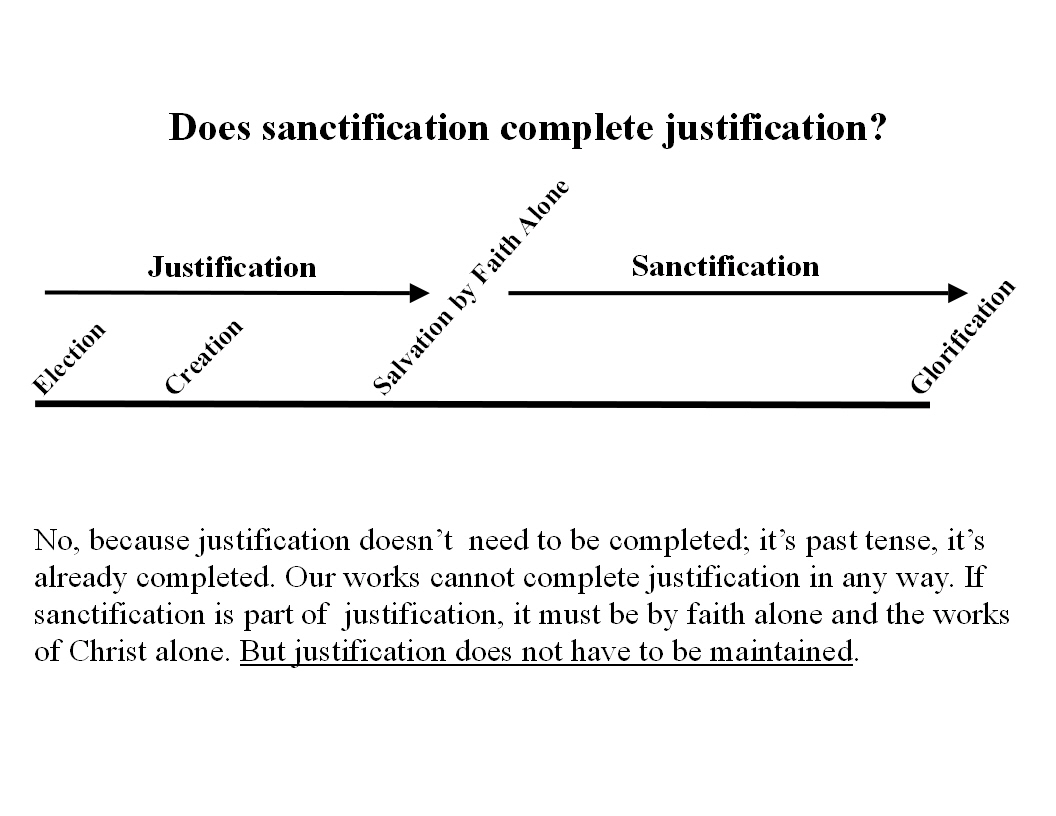 An excellent example is some strains of Freewill Baptists who teach that Christ died for all of our past sins, but with the help of the Holy Spirit, we must confess and repent of every sin we commit until the resurrection, e.g., Christ plus salvation by repentant prayer for sins committed after we are “saved.” My grandparents were saved out of this tradition. When my grandfather asked my grandmother if she thought that God could ever forgive him of all the sins he committed, she answered: “Yes, but you are going to have to pray awful hard!” Praise God that through the ministry of several individuals my grandparents eventually abandoned that gospel for the true one of salvation by faith alone as a finished work. Likewise, Rome teaches that you must let the Catholic Church finish your justification through ritual, e.g., Christ plus Catholic ritual. The Reformation gospel is also Christ plus something else, but the something else is ever-so-subtle. In both cases, sin must be dealt with in sanctification in order for the saint to remain justified until the final judgment. In other words, the righteous standard of justification must be maintained on our behalf. Like all other proponents of a linear gospel, the Reformed crowd contends that anything less than the perfection demanded of the law (“all sin is transgression of the law”) is “legal fiction.” So both Rome and the Reformers agree: justification must be maintained by sanctification, and in the case of the Reformers specifically, they believe that the perfect standard of the law must be maintained until glorification; otherwise, our justification is “legal fiction.” Here is where Reformed subtlety is uncanny: Christ keeps the law for us in sanctification. He maintains the perfect standard. All the fruit of sanctification (obedience/good works) flows from the life He lived on Earth and His death on the cross. Christ plus the works of Christ to finish salvation. “But Paul, what in the world is wrong with that?!” Here is what is wrong with it: works are still required to maintain justification. That is a huge problem, even if it is Christ doing the work. What did the Hebrew writer say about Christ’s work for justification not being complete? And even more subtle is the following Reformed idea: believing that the law is no longer a standard for maintaining justification is antinomianism. Antinomianism =’s legal fiction. Their definition of antinomianism is the removal of the law from justification as the standard for maintaining it. Traditionally, among Biblicists, antinomianism is the removal of the law from sanctification, and herein lays even further steroidal subtlety: the Reformed theologians would refute a removal of the law from sanctification as well, not only because they think justification and sanctification are the same thing, but because its perfect keeping is required to maintain a true declaration of the just that is not “legal fiction.”
  However, the Biblicist believes that the law is a standard for kingdom living and is no longer a standard for justification. Therefore, if we attempt to obey it with the Holy Spirit’s help, and to please/serve the Lord, it can have no bearing on our just state. While the Biblicists think they are therefore joint contenders with the Reformers against antinomianism, such is far from the truth. The Reformed mind believes the Biblicist is either a legalist or an antinomian, or both. The Biblicist is supposedly an antinomian because he/she has removed the law from justification as a just standard, or is a legalist because they think they should strive to keep the law in sanctification. Since sanctification finishes justification’s perfect standard of law keeping, our “own” attempts to keep the law in sanctification is an attempt to finish justification. Hence, what the Biblicist fails to understand is the Reformers belief that Christ must maintain the law for us in sanctification because justification and sanctification are not separate. Anything more or less is supposedly works salvation. On the other hand, because it is vital that Christ obeys the law for us in sanctification, the likes of John Piper and Tullian Tchividjian contend that those who are really preaching the Reformed gospel will indeed be accused of antinomianism. All in all, their position is easy to see if you pay attention. John Piper and many other Calvinists often state that, “Good works are the fruit of justification.” And, “Justification is the root, and sanctification is the fruit.” Well, the average Biblicist then thinks, “Yes, but of course, our salvation makes good works in sanctification possible.” But that’s not what they are saying. If you pay closer attention, they are saying that justification is a tree that produces its own fruit. Justification is the root, and whatever happens in true sanctification is the fruit of the root of the justification tree. Problem is, justification doesn’t grow. Justification is a finished work. What Calvinists refer to as “progressive sanctification” is really the fruit of the root: progressive justification. Another name for this that they throw around is “definitive sanctification.” The word “definitive” refers back to the definite completion of justification.
  Revision: this ministry now rejects the idea that orthodoxy is truth; orthodoxy is the traditions of men. Never in Scripture do we find premise for a body of teaching that explains the teaching. The above illustration is valuable for demonstrating that the fruit of justification is glorification, NOT sanctification. This brings us to the Scriptural argument which begins with a question I asked myself just this morning: “Paul, you are always harping about the crucial importance of the separation of justification and sanctification—a parallel gospel versus a linear one. But where does the Bible say specifically that this is critical?” First, the very definition of a lost person in the Bible is one who is “under the law”:
Romans 3:19 Now we know that whatever the law says it speaks to those who are under the law, so that every mouth may be stopped, and the whole world may be held accountable to God. Romans 6:14 For sin will have no dominion over you, since you are not under law but under grace. Romans 6:15 What then? Are we to sin because we are not under law but under grace? By no means! 1 Corinthians 9:20 To the Jews I became as a Jew, in order to win Jews. To those under the law I became as one under the law (though not being myself under the law) that I might win those under the law. Romans 7:1 Or do you not know, brothers —for I am speaking to those who know the law—that the law is binding on a person only as long as he lives? Romans 7:2 For a married woman is bound by law to her husband while he lives, but if her husband dies she is released from the law of marriage. Romans 7:3 Accordingly, she will be called an adulteress if she lives with another man while her husband is alive. But if her husband dies, she is free from that law, and if she marries another man she is not an adulteress.
The unsaved are “under the law” and will be judged by it in the end. This is the very definition of the unsaved. Calvinists define Christians the same way—we are supposedly still under the law and will be judged by it in the end. That’s why Christ must keep the law for us—because we are still under it. If not this position, why do many in the Reformed tradition hold to the idea that Christ’s perfect obedience is imputed to our sanctification? His death justifies us, and His perfect life sanctifies us. Hence, His death pays the penalty for past sins, and then His perfect life imputed to our sanctification keeps us justified. Why would an imputation to our sanctification be necessary if we are no longer under the law? This is known as the Reformed view of “double imputation” and has been called out as heresy by many respected theologians for this very reason: it implies that Christians are still under the law. In regard to sustaining the law in our stead, why? It has been totally abolished in regard to our just standing:
Romans 3:20 For by works of the law no human being will be justified in his sight, since through the law comes knowledge of sin. Romans 3:21 But now the righteousness of God has been manifested apart from the law, although the Law and the Prophets bear witness to it— Romans 4:15 For the law brings wrath, but where there is no law there is no transgression.
The keeping of the law by anybody DOES NOT do anything to justify mankind:
Romans 3:28 For we hold that one is justified by faith apart from works of the law.
Here is where the separation of justification and sanctification is vital on this first point: we ARE NOT under the law for justification, but rather UPHOLD THE LAW in sanctification. The two must be separate because of the differing relationships to the law:
Romans 3:31 Do we then overthrow the law by this faith? By no means! On the contrary, we uphold the law. Romans 6:15 What then? Are we to sin because we are not under law but under grace? By no means!
Furthermore, if we are still under the law (whether or not Christ obeys it for us to keep us in a just standing), this means we are still under the power of sin. Being under the law and also under its spell to provoke sin in the unregenerate is spoken of as being synonymous in the Bible. Those who are “under the law” are also under the power of sin and enslaved to it:
Romans 7:4 Likewise, my brothers, you also have died to the law through the body of Christ, so that you may belong to another, to him who has been raised from the dead, in order that we may bear fruit for God. Romans 7:5 For while we were living in the flesh, our sinful passions, aroused by the law, were at work in our members to bear fruit for death. Romans 7:6 But now we are released from the law, having died to that which held us captive, so that we serve in the new way of the Spirit and not in the old way of the written code. Romans 7:8 But sin, seizing an opportunity through the commandment, produced in me all kinds of covetousness. For apart from the law, sin lies dead.
If we are still under the law, and will be judged by it, whether or not Christ stands in the judgment for us with His own works, we are still enslaved to sin by virtue of being under the law…. for justification. And Calvinists know this to be true, that’s why they say we are still…. what? Right, even as Christians, “totally depraved.” And, “enemies of God.” Of course, throughout the Bible, Christians are spoken of as being friends of God and no longer His enemies. Our status as enemies of God is stated in the past tense. But the Reformed crew continually state that Christians are vile enemies of God and are enslaved to sin. They realize that this goes hand in hand with being under the law. To the contrary, dying to the law in the death of Christ….for justification—sets us free to be enslaved to the righteousness that is defined by the law. We are dead to the law for justification and alive to obey truth….for sanctification:
Romans 8:2 For the law of the Spirit of life has set you free in Christ Jesus from the law of sin and death. Romans 8:3,4 [emphasis by author] For God has done what the law, weakened by the flesh, could not do. By sending his own Son in the likeness of sinful flesh and for sin, he condemned sin in the flesh,….in order that the righteous requirement of the law might be fulfilled in us, who walk not according to the flesh but according to the Spirit. Romans 8:7 For the mind that is set on the flesh is hostile to God, for it does not submit to God’s law; indeed, it cannot. Romans 9:31 but that Israel who pursued a law that would lead to righteousness did not succeed in reaching that law. John 17:17 Sanctify them in the truth; your word is truth. James 1:25 But the one who looks into the perfect law, the law of liberty, and perseveres, being no hearer who forgets but a doer who acts, he will be blessed in his doing.
So, that is the separation that must be for the true Christian: Justification has no law for which we are judged, and we live by the law of blessings in sanctification. This brings us to another important separation in the two: the judgments. Those under the law and sin will stand in a final judgment which will be according to the law. Again, because Calvinists believe that we are still under the law, albeit that Christ obeyed/obeys it for us, Christians will supposedly stand in the same judgment as the damned who are under the law and enslaved to it. At that time, the children of God, according to Calvinists, will be “made manifest.” But because Christians are not under the law and cannot be judged by it, they will stand in a judgment for rewards and not a judgment that determines a perfect keeping of the law by Christ in our stead. Hence, there will be two different resurrections: one for those under the law and another for those under grace, and two different judgments for the same two groups. One for rewards, and one to determine if those under the law kept it perfectly. The latter judgment doesn’t go well for any standing in it.
Luke 14:12-14 He said also to the man who had invited him, “When you give a dinner or a banquet, do not invite your friends or your brothers or your relatives or rich neighbors, lest they also invite you in return and you be repaid. 13 But when you give a feast, invite the poor, the crippled, the lame, the blind, 14 and you will be blessed, because they cannot repay you. For you will be repaid at the resurrection of the just.” [Notice that this is a resurrection for the “just.” They are already determined to be just before they are resurrected]. 2Corinthians 5:9,10 So whether we are at home or away, we make it our aim to please him. 10 For we must all appear before the judgment seat of Christ, so that each one may receive what is due for what he has done in the body, whether good or evil. 1Corintians 3:11-15 For no one can lay a foundation other than that which is laid, which is Jesus Christ. 12 Now if anyone builds on the foundation with gold, silver, precious stones, wood, hay, straw— 13 each one’s work will become manifest, for the Day will disclose it, because it will be revealed by fire, and the fire will test what sort of work each one has done. 14 If the work that anyone has built on the foundation survives, he will receive a reward. 15 If anyone’s work is burned up, he will suffer loss, though he himself will be saved, but only as through fire. Hebrews 6:10 For God is not unjust so as to overlook your work and the love that you have shown for his name in serving the saints, as you still do. Revelation 20:6 Blessed and holy is the one who shares in the first resurrection! Over such the second death has no power, but they will be priests of God and of Christ, and they will reign with him for a thousand years. Revelation 20:11-15 Then I saw a great white throne and him who was seated on it. From his presence earth and sky fled away, and no place was found for them. 12 And I saw the dead, great and small, standing before the throne, and books were opened. Then another book was opened, which is the book of life. And the dead were judged by what was written in the books, according to what they had done. 13 And the sea gave up the dead who were in it, Death and Hades gave up the dead who were in them, and they were judged, each one of them, according to what they had done. 14 Then Death and Hades were thrown into the lake of fire. This is the second death, the lake of fire. 15 And if anyone’s name was not found written in the book of life, he was thrown into the lake of fire.
Don’t let anyone tell you that eschatology is a “secondary” or “nonessential” consideration. Your eschatology is your gospel. It will state your position regarding whether or not you fuse justification and sanctification together; ie, likening Christians to those under the law.
Yet another vital difference in sanctification and justification is repentance. Repentance for salvation (when you are justified) is different from our repentance in sanctification. Among many in the Reformed tradition where the “same gospel that saved you also sanctifies you,” the repentance is the same. Repentance unto salvation is not a onetime “washing,” but rather a means to continue “in the gospel” through what they call “deep repentance.” Biblicism holds to repentance in sanctification that restores his/her fellowship and communion with God as His children. They would see repentance unto salvation as differing, and only necessary for salvation—a onetime decision to take one’s life in a new direction by following Christ, and believing in his death, burial, and resurrection. Reformed repentance, according to the likes of Paul David Tripp and others is a “daily rescue.” Our original repentance was for rescue, and we need rescue today as much as we needed rescue when we were saved. Again, this indicates their belief that we are still under the curse of the law and need to be continually rescued from it while remaining under the bondage of sin. However, Christ made it clear to Peter (John 13:6-11) that those who have been washed (1Corinthians 6:11, Romans 8:30) do not need another washing. Those who drink of the living water do not thirst again (John 4:13,14). Lastly, though many other separations could be discussed, why saints can be considered just while they still sin at times is of paramount importance. There is no sin in our justification because there is no law, and where there is no law, there is no sin. Though unfortunate, there can be sin in our sanctification because it is totally separate from justification and can’t affect our just standing with God. Basically, all of the aforementioned makes it of necessity to deny the new birth. If we have God’s seed in us, and we do (1John 3:9), that dispels total depravity, and without total depravity, justification and sanctification cannot be fused together. The new birth is a huge problem for Reformed theology. If the old man that was under the law is dead (Romans 7:1ff), and the seed of God is in the saved person, and the sin due to our weakness in the flesh cannot be laid to our account for justification, then our justification is not “legal fiction” because we do not exhibit perfect obedience to the law. This is another grave consideration because Christ said, “You must be born again.” Obviously, despite their denials that they deny the new birth—you can’t be both totally depraved and born again. Reformation doctrine is clearly a false gospel. Its version of justification does not void the law, and denies the new birth while distorting everything in-between. Freewill verses predestination is hardly the issue, the very gospel itself is the issue.
paul
Answering the Baby’s Question
 The answer to the Baby’s question, according to Protestantism and all its various and sundry stripes including the Baptists is “yes.” Since the law is the standard for justification and Christians cannot keep the law perfectly, yes, Christ supposedly came to keep the law perfectly in order to fulfil it, and then died for all of our past sins. Instead of the resurrection being a prelude to our own resurrection and a totally different relationship to the law, Christ’s resurrection is said to “confirm that God was satisfied with His sacrifice.”
Hence, if “Christians” live their life by “faith alone in the same gospel that saved them,” the perfect obedience of Jesus will continue to be credited to our account in order to keep the “righteous demands of the law satisfied,” and we will receive continued forgiveness for “present sin” that violates the same law. So, according to Protestantism, Christ didn’t come to end the law for justification, He came to fulfill it through obedience so that His obedience and sacrifice can continue to be applied to our lives by faith alone. Therefore, His justification work is not finished. Yes, they concur that it only happened once, but the one act must be continually reapplied to the “believer’s” life.
Let’s evaluate this according to the new birth since it’s a baby asking the question. In this system, Christ’s resurrection is not imparted to the new believer, but was merely a confirmation that God was satisfied with Christ’s sacrifice. Technically, Christ’s death and obedience continues to be imparted to the “believer” IF they continue to live by faith alone in the same gospel that originally saved them. Now you know why there is so much emphasis on “the gospel” at “church” and why sanctification has always been so weak in the institutional church.
Protestantism is about keeping yourself saved by faith alone in the same gospel that saved you. Rather than honoring God with a mature life as one of His literal children, the attempt is to spend our whole lives honoring God by what He did to save us. It’s all about what “He did, not anything we do.” But not emphasizing what we do is actually denying the new birth and jettisoning our responsibility to love others back onto Christ.
And by the way, this efficacious reapplication of the same gospel that saved us, according to Protestant orthodoxy, can only be found and applied in formal institutional church membership.
What is the true gospel? Christ came to end the law for justification. As the law was increased, more and more sin was imputed to it. Violating the law is the very definition of sin. So, when Christ paid the penalty for our sins on the cross it also effectively ENDED the law. When a person believes on Christ’s death, they literally die with Him, and all sins they committed against the law are vanquished. They were “under the law” of “sin and death.”
On the other hand, the believer is also resurrected to a completely new life (under grace). Christ was NOT resurrected to validate His sacrifice; He was resurrected so that we could also be resurrected after dying with Him. This is the significance of also believing in His resurrection—not that it was a confirmation, but that we are also resurrected with Him as completely new creatures where “all things are new.”
This now places the resurrected believer under a different relationship to the law. What used to be the “law of sin and death” is now “the law of the Spirit of life.” In other words, instead of the law condemning us, the Spirit of life uses the law to change us (John 17:17). It is our responsibility to obey the law with the aid of the Holy Spirit, and that is the very definition of how we love God and others: “If you love me, keep My commandments.”
To define our obedience as an attempt to “justify ourselves” shirks what should be our natural desire to love God and others through obedience which is a result of the new birth. It is eerily reminiscent of the parable of the talents. The whole convoluted Protestant system that supposedly sanctifies our obedience lest it be works is a denial of the new birth and a false assessment of law/gospel.
When Protestant soteriology is accurately assessed, we should expect to find the following in the institutional church: weak sanctification; an overemphasis on the gospel to the exclusion of personal obedience; convoluted theories on how Christ’s obedience is imputed to our lives; overall doctrinal ignorance in regard to wise and powerful living; poor testimonies; a lack of genuine love; cliques; an overemphasis on following men; total dependence on extra-biblical writings; a laity/clergy caste system, and efforts to protect the institution at all cost.
And that is exactly what we find.
paul

 Paul's Passing Thoughts
leave a comment