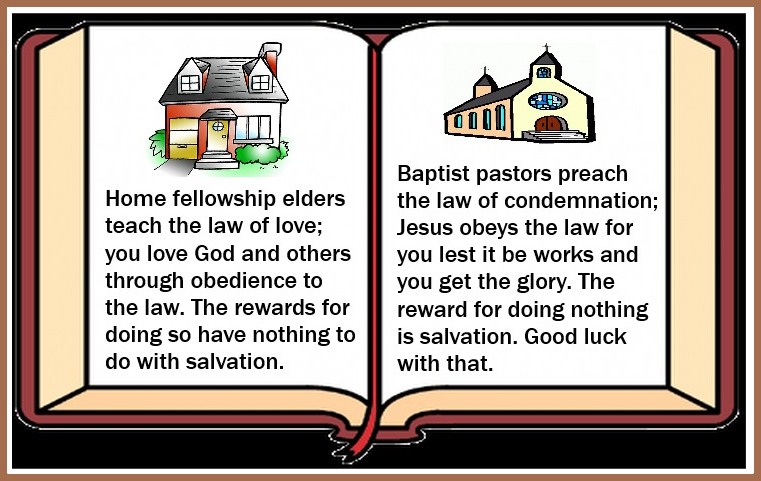
Spurgeon’s False Gospel
 Meme Post #4
Where to start in all the ways that this meme contradicts Scripture and denies the new birth and true gospel? Let’s start with a few blatant contradictions.
Our faith does NOT rest. Our faith WORKS through love (Gal 5:6). Faith is a GIFT, but that doesn’t mean we don’t put the gift to work. In fact, the belief that our faith doesn’t work suggests that we must continue to keep ourselves saved through “rest.” Spurgeon, like most lying Calvinist heretics, held to the Reformation’s Sabbath Rest Salvation. It holds to the idea that the Old Testament Sabbath rest is New Testament sanctification and we must continue to live by faith alone in our Christian lives to keep ourselves saved. This, according to Calvin, happens through receiving continued forgiveness for “present sin” through church membership.
And remember, Spurgeon once said that Calvinism isn’t “just a nickname,” but “is the gospel” itself.
True faith doesn’t rest–it works. There is no true love in a faith that rests.
Secondly, the Bible makes it clear that we grow spiritually through obtaining knowledge; what’s up with the idea that knowledge doesn’t define who we are as believers? Frankly, I don’t care how many people think this guy is a spiritual icon–you know, kinda like the Bereans who held Paul accountable to Scripture.
Thirdly, the idea that who we are doesn’t point to the legitimacy of our faith and is therefore not a resting faith contradicts a vast number of Scriptures and Hebrews 11 in particular.
Fourthly, how we feel is most certainly important because the Bible says that faith not working in love will cause the believer to be full of fear.
Why is it ok for Spurgeon to blatantly contradict Scripture? Because Baptists have a longstanding tradition of being man-followers, that’s why.
Furthermore, note that we supposedly rest in the idea that who we are is NOT who Christ is! HUH!!!! Say what???? If Jesus is your big brother because you are literally born into the same family, you had better be like Him or you aren’t born again (see 1John).
And finally, note that we rest in what Christ has both DONE and is DOING. This is the Reformed doctrine of Double Imputation. It teaches that Christ came to secure our salvation by both dying for sin and keeping the law in our stead. It teaches that justification is based on perfect law-keeping rather than the new birth. Jesus could die for us because He lived up to the standard of the law, and presently keeps the law for us if we are “resting” in what He has “done and is doing.” This is a blatant contradiction to Galatians chapter 3. This is the very idea that Paul is refuting in that chapter.
This makes the law a co-life-giver with God and promotes an additional seed (offspring), but their is only ONE SEED (see Gal 3). In essence, Paul was arguing that this very idea makes the law a fourth member of the Trinity. And in fact, Calvinists state this openly when they say that “the empty hand of faith presents the doing and dying of Christ to the law and the law is satisfied.”
So, instead of God electing the means of salvation, Christ dying to end the law, and the Spirit fulfilling “The Promise” of resurrection and baptism to Abraham and Christ, we now have that added fourth element of the law being the standard for justification instead of new birth obtained by faith alone in The Promise. The contrary view of this meme keeps the so-called believer under law rather than under grace, and that’s supposedly ok because Jesus keeps the law for us.
But this also keeps the believer from performing the purpose of the law for sanctification, faith working through love. Instead, we must rest because Jesus is the only one that can keep the law perfectly as the law supposedly gives salvific life when fulfilled. In contrast, the Old Covenant kept sin captive until Christ came and ended it. The law was ended by Christ’s death in regard to its ability to condemn, and we are now free to serve the law in regard to love (Rom 7 and Heb 6:10). The Old Covenant still holds all sin captive that is committed against it (“all sin is against the law”) until a person believes in Christ resulting in the law being ended for condemnation and the person being set free to “use the law lawfully” (1Tim 1:8ff.) for purposes of loving God and others. Those who do not believe on Christ will be condemned by the law, but there is “NOW NO condemnation for those in Christ.” Rather, true believers are free to fulfill the law in aggressive love for God and others (Rom 8).
For the outcome of Spurgeon’s “rest” see the Parable of the Talents. Resting in love that Christ supposedly fulfills for us evokes this response from Him: “You lazy, wicked servant.”
Clarification From Galatians 3: The Trinity is Not a Paradox, Christians Don’t Live by Faith Alone, and the Covenant of Promise Defined
 “Again, it’s the same gospel with Jesus added as perfect law-keeper; it fuses law with gospel. That’s what the Judaizers did, and that’s what Protestant elders do…There is no law in perfection; there is only law in love.”
“All of true Israel will be saved. That’s the promise made to Abraham, and from that promise all the nations find their salvation as well. Any denial of a future redemption of national Israel according to its original identity is a plenary rejection of the gospel.”
“Do you believe a gospel that makes the New Covenant a fulfillment of the Old Covenant rather than an ending of it for those who believe? Have you substituted the fulfillment of the New Covenant via love for a substitutionary fulfillment of the covenant of death? This is what sets the covenant of promise apart from all other gospels. If you are a true Christian, you don’t live by faith alone, you live by love alone, and you are the one doing the loving because you are free from condemnation. Your love is not a substitution; Christ’s death is the only substitution that sets you free to love without fear of condemnation.”
Galatians chapter 3 corrects some significant misnomers that routinely plague those who have to listen to incessant Christian blathering coming from the same who are completely comfortable with contradictions. Faith has become a license for mindlessness, and paradox is now a legitimate hermeneutic.
Since the Bible says God is one person, and also three persons, and the Bible cannot contradict itself, gee whiz, that’s a paradox, and gee whiz, there must be other paradoxes in the Bible as well, and gee whiz, only our “leaders” (dictators) know what a paradox is or isn’t. So, another paradox is the idea that Christians do things by faith alone. We do stuff, but we are not really the ones doing it. “Christians” are very comfortable with this lingo: we didn’t do it, when clearly we did do it, but supposedly, Jesus really did it, lest we get credit for the deed even though Jesus does assign merit for good deeds, but to whom is unclear since we didn’t do it.
And of course, supposedly, people don’t buy into this nonsense because it’s nonsense, but are rather “totally depraved” and will accept the offer of salvation if it is really a promise made to them even though God tells us to tell them that the promise is to them though it may not be. And so it goes; we will pay someone 85,000 dollars a year with a hefty medical package to say things like, “You don’t keep the law by keeping the law.”1 Our job is to say “amen” in between sips of coffee served up from the large vat in the lobby. If the coffee has a little burn in the taste, we wonder, “Is this the day, or just another dry run?”
I am not going to get into the trinity debate, but rather, the point of this post is that the Bible isn’t making a statement about the trinity when it states that God is one. The biblical idea is a statement that makes it clear that there are no other mediators between God and man other than God Himself. Galatians chapter 3 makes this clear. Hence, Protestant popes love to keep the masses distracted with debates about paradoxes lest we figure out that God was drawing a contrast between Himself and them who will travel land, sea, and air to make someone three times the child of hell that they are. And of course, paid for by the Protestant peasantry enslaved to the material world and its knowledge. And of course, from that perspective, spiritual truth can be expected to appear as paradox. In fact, those who demand a logical exegesis of Scripture are deemed as lacking faith, and making Jesus a “precept rather than a person.” By the way, the idea of faith over logic/reason was a major clarion call of the Nazi party during its formative years and expressly Lutheran in origin.2
Galatians chapter 3 is a vivid clarification of the relationship between law and gospel—or better stated biblically, the relationship between law and promise which also excludes every kind of mediator other than God Himself. This is one of the major points of Galatians 3. Paul begins by stating the following in his epistle to the Galatians:
Galatians 3:1 – O foolish Galatians! Who has bewitched you? It was before your eyes that Jesus Christ was publicly portrayed as crucified. 2 Let me ask you only this: Did you receive the Spirit by works of the law or by hearing with faith? 3 Are you so foolish? Having begun by the Spirit, are you now being perfected by the flesh? 4 Did you suffer so many things in vain—if indeed it was in vain? 5 Does he who supplies the Spirit to you and works miracles among you do so by works of the law, or by hearing with faith—6 just as Abraham “believed God, and it was counted to him as righteousness”?
The dictators of the Protestant super-cult focus on the words, “Are you so foolish? Having begun by the Spirit, are you now being perfected by the flesh?” The case is therefore made that we must be perfected the same way we began. This is the Protestant false gospel of progressive justification in a nutshell. It begins with the idea that perfection, viz, justification, is a process. And next, we keep that process going by faith alone. And next, if we live by some sort of faith-alone formula, the same formula that originally saved us, the Holy Spirit will continue to keep us justified. In other words, we have to live by the same gospel that saved us in order to keep ourselves saved which is backdoor works salvation.
What is Paul really saying? His rhetorical question focuses on the erroneous idea that “perfection” (justification) is based on a process. The crux is any kind of process period, but in this case, the process involves the law of Moses. Protestantism uses this text to make the exact case that Paul is arguing against. Except, they add the law to the process in the same way that the Judaizers did albeit in a less direct way. Take note: the very false gospel that Paul is arguing against in Galatians 3 is the same gospel propagated by Protestantism in our day, and the exact same gospel that the Judaizers propagated with Jesus added. In this letter, Paul argues that law cannot be part of the gospel because that would make the law a co-mediator/life-giver with God, and only God can give life. The Judaizers taught that the law does give life, and that “believers” have to continue to draw life and justification from the law.3
But we must now stop and define what Paul meant by “law” in context of keeping it for justification. Judaizer-like false gospels never promote a truthful and perfect keeping of the law in order to remain justified because they know that’s impossible. So, the traditions of men are added as a Cliff Notes keeping of the law that fulfills the “righteous demands of the law.”4 Men are mediators between God and mankind that determine the sub-law that satisfies the holy law, and supposedly, they are appointed by God. Luther and Calvin merely added Jesus to this idea. If we obey the “Christ-centered,” “gospel-centered,” orthodoxy of Protestant elders, Jesus’ perfect obedience to the law of Moses will be imputed to our account, and we will remain “perfect” or justified. Again, it’s the same gospel with Jesus added as perfect law-keeper; it fuses law with gospel. That’s what the Judaizers did, and that’s what Protestant elders do.
Let’s nail this down a little more before we progress further. It entails an understanding of what Paul meant by the receiving of the Spirit. That’s the new birth. That’s the baptism of the Holy Spirit. That changes the believers relationship to the law. Paul’s protest regards the fusion of the law of Moses with perfection which takes place upon the receiving of the Spirit. Paul is protesting a progression or process of perfection by law-keeping. The Judaizers propagated a fulfilling of the law for righteousness via adherence to their traditions5 whereas Protestants demand an adherence to their traditions which supposedly results in Jesus’ perfect law keeping being imputed to the “believer.”
Paul said, in essence, “No, if you want to be justified (perfected) by the law of Moses (the law of sin and death), you have to keep it perfectly. No, circumcision and the observance of days is not a substitution for fulfillment of the law. The law has no part in justification, one is justified (perfected) by the new birth that is received by faith alone. The justified are not justified by the law—law-keeping is what they do, but it is not the law of sin and death for purposes of law-keeping, it is the law of the Spirit of life for purposes of love. There is no law in perfection; there is only law in love.” Hence…
Galatians 4:10 – You observe days and months and seasons and years! 11 I am afraid I may have labored over you in vain…21 Tell me, you who desire to be under the law, do you not listen to the law?…5:2 Look: I, Paul, say to you that if you accept circumcision, Christ will be of no advantage to you. 3 I testify again to every man who accepts circumcision that he is obligated to keep the whole law. 4 You are severed from Christ, you who would be justified by the law; you have fallen away from grace…6 For in Christ Jesus neither circumcision nor uncircumcision counts for anything, but only faith working through love.
In addition, the law being the standard for justification rather than the receiving of the Spirit always leads to a “relaxing of the law” (Matt 5:19). Why? Because some dumbing down of the law as a replacement for true law-keeping for love, or faith working through love, always leads to neglect of the law and true love accordingly. Hence…
Galatians 2:17 – But if, in our endeavor to be justified in Christ, we too were found to be sinners, is Christ then a servant of sin? Certainly not! 18 For if I rebuild what I tore down, I prove myself to be a transgressor. 19 For through the law I died to the law, so that I might live to God…5:7 You were running well. Who hindered you from obeying the truth? 8 This persuasion is not from him who calls you…13 For you were called to freedom, brothers. Only do not use your freedom as an opportunity for the flesh, but through love serve one another. 14 For the whole law is fulfilled in one word: “You shall love your neighbor as yourself.” 15 But if you bite and devour one another, watch out that you are not consumed by one another.
The fulfillment of Moses’ law, the law of sin and death (Romans 8:2), cannot be fulfilled for justification, but said false gospel (Gal 1:6ff.) attempts to do so through mediation in addition to God. This always leads to a dumbing down of the law for purposes of justification. The traditions of men end up being a cloak for unrighteousness under the auspices of being friends of the law. Tradition fulfills the law as a standard for righteousness when the real standard for righteousness is the new birth resulting in the loving of God’s law for purposes of loving God and others, not justification. Justification is a finished work totally apart from the law of sin and death; the only work left is “faith working through love.”
Sure, we don’t do that perfectly, but in regard to justification, so what? The motives of those born of God are love because part and parcel with the new birth is a love for the truth (2Thess 2:10). The law’s ability to condemn was ended by Christ (Rom 10:4) and where there is no law there is NO sin (Rom 4:15). If you now say: “So, the law is the Spirit’s law, and for those who are under law, He uses it to condemn them, but to those who have received Him, He uses it to lead them”; you rightly assess with an additional caveat…Moses’ law of sin and death, while being a ministry of death, still serves the same purpose for New Testament unbelievers as it did for Old Testament believers, that is, it holds sin captive until they believe in Christ, then their sins are ended along with the law that the old them was under, but one who is dead is no longer under the jurisdiction of law that can condemn6 (Romans 7:1-6). Those who receive the Spirit are now free to “serve another” (Rom 6:6). The “new life of the Spirit” enables us to fulfill the law in our acts of love (Rom 8:1-8). The apostle Paul develops these same ideas as we move along in Galatians 3.
Galatians 3:7 – Know then that it is those of faith who are the sons of Abraham. 8 And the Scripture, foreseeing that God would justify the Gentiles by faith, preached the gospel beforehand to Abraham, saying, “In you shall all the nations be blessed.” 9 So then, those who are of faith are blessed along with Abraham, the man of faith.
This is set against what the Judaizers were telling the Galatians. They were telling the Galatians that in order to be a true son of Abraham, you have to follow the recognition of days and circumcision; traditions that supposedly satisfied the law of Moses. Paul wrote this letter to set them straight. Paul wrote the letter to explain how one becomes a true son of Abraham, the man of faith. Note that the baptism of the Spirit is somewhat different from the new birth. As we will see in chapter 3 of this letter, the law of Moses had a particular purpose: to hold all sin captive. As the law increased, so did sin, but all sin is against the law (1Jn 3:4) and imputed to the law; the law of sin and death holds sin captive.
Old Testament believers were born again and ministered to by the Spirit, but their sins were still held captive by the law because the promise of the Spirit had not yet come. The promise of the Spirit would resurrect Christ from the grave who had already ended the law and its condemnation by dying on the cross, and baptize Jew and Gentile into one body.7 The promise of the Spirit was therefore to Abraham and Christ both (Gal 3:16). As King David had prophesied, God would not leave Christ in the grave to see corruption (Acts 2:27, 31, Ps 16:10).
Until then, Old Testament believers dwelt in a place called Hades which was divided into two parts with a gulf separating them (Luke 16:19-31). One side was occupied by those under law and its condemnation, and the other side was occupied by “the captives.” Why were they called “the captives”? Because Jesus had not yet ended the law’s condemnation, and the saints were yet held captive by the law. While Christ was in the grave, he went to Hades and proclaimed victory to the captives, and when the Spirit resurrected Him, according to the promise, He led the captives out of captivity because the law was ended (Eph 4:8, Ps 68:18, 1Pet 3:19). This is the gospel that God preached to Abraham face to face.
Galatians 3:10 – For all who rely on works of the law are under a curse; for it is written, “Cursed be everyone who does not abide by all things written in the Book of the Law, and do them.” 11 Now it is evident that no one is justified before God by the law, for “The righteous shall live by faith.” 12 But the law is not of faith, rather “The one who does them shall live by them.” 13 Christ redeemed us from the curse of the law by becoming a curse for us—for it is written, “Cursed is everyone who is hanged on a tree”— 14 so that in Christ Jesus the blessing of Abraham might come to the Gentiles, so that we might receive the promised Spirit through faith.
Paul is telling the Gentile Galatians, as a Jew of the Jews, that they were part of the gospel from the beginning, and are given access to the commonwealth of elect Israel (Eph 2:12) in the same way that Abraham was saved, by faith alone completely apart from the law. Paul will go on to argue that if the law is justification’s standard, the law is an additional seed, or offspring. In other words, the law is a co-life-giver with God. This is the crux of “one God.” However, don’t misunderstand and think that the law cannot give life to anyone for it can, but not those who are under its condemnation. It is impossible as Paul stated in Romans 8 for anyone under the curse of the law to find life in the law. That’s what Paul is stating here in Gal 3:10-14. Believers “live” (are justified) by faith alone in the free gift of the promise completely apart from the law. Those under grace love God’s law (Ps 119) and it can, in fact, give life to those who are born again (Jn 17:17, 1Pet 2:2).8
Those under the law can only find condemnation in the law. They can only receive the free gift by faith alone in the death and resurrection of Christ.9 When they believe, the Spirit falls on them,10 puts them to death with Christ, and thereby ending the law that all of their sins are against and imputed to, and resurrects them to new life in Christ where they walk according to the Spirit and find life in obedience to the Spirit’s law… “If you love me, keep my commandments.”11 The believer does not question motives in obedience—they know they cannot be justified by the law. They know they are justified by the new birth apart from the law. Paul furthers the point this way:
Galatians 3:15 – To give a human example, brothers: even with a man-made covenant, no one annuls it or adds to it once it has been ratified. 16 Now the promises were made to Abraham and to his offspring. It does not say, “And to offsprings,” referring to many, but referring to one, “And to your offspring,” who is Christ. 17 This is what I mean: the law, which came 430 years afterward, does not annul a covenant previously ratified by God, so as to make the promise void. 18 For if the inheritance comes by the law, it no longer comes by promise; but God gave it to Abraham by a promise.
It simply boils down to this: justification is completely void of law (Rom 3:19, 21, 28). Salvation and new birth come by believing the promise of miraculous new birth:
Romans 9:9 – For this is what the promise said: “About this time next year I will return, and Sarah shall have a son.” 10 And not only so, but also when Rebekah had conceived children by one man, our forefather Isaac,
And…“For what does the Scripture say? ‘Abraham believed God, and it was counted to him as righteousness.’” What did he believe exactly? He believed that God would bring about miraculous new birth demonstrated in Sarah, make his descendants like the sand of the sea, bless the Gentiles through him as well, and that his offspring would live forever in a city built by God (Heb 11:8-12). The miraculous conceptions of Sarah, Rebekah, Elizabeth, and Mary are not mere fodder for mystery, but speak of miraculous new birth and God’s elected means for the promised free gift. It’s by new birth, not law. There is no law in justification; the law is a protector that holds our sin captive until faith comes. Faith only believes in the promise like Abraham—the law did not come until 430 years after God made a covenant with him; the free gift—the promise. The law in NO WAY “ratified” the original covenant which had no law, but was based on the promise to Abraham and the ONE seed, Christ.
Why then the law?
Galatians 3:19 – Why then the law? It was added because of transgressions, until the offspring should come to whom the promise had been made, and it was put in place through angels by an intermediary. 20 Now an intermediary implies more than one, but God is one.
This brings us almost full circle. The law of Moses was put into place by angels on Mount Sinai in the apocalyptic event recorded in the Old Testament. Moses was the mediator, but he was the mediator for a ministry of death:
2Corinthians 3:7 – Now if the ministry of death, carved in letters on stone, came with such glory that the Israelites could not gaze at Moses’ face because of its glory, which was being brought to an end, 8 will not the ministry of the Spirit have even more glory? 9For if there was glory in the ministry of condemnation, the ministry of righteousness must far exceed it in glory. 10Indeed, in this case, what once had glory has come to have no glory at all, because of the glory that surpasses it. 11For if what was being brought to an end came with glory, much more will what is permanent have glory.
Note that Moses’ ministry of death has not completely ended, but is in the process of being abolished (Heb 8:13). Why? Because it still serves a purpose. It will be used to condemn those under it if they do not rid themselves of it. Meanwhile, all sin is imputed to it:
Hebrews 9:15 – Therefore he is the mediator of a new covenant, so that those who are called may receive the promised eternal inheritance, since a death has occurred that redeems them from the transgressions committed under the first covenant. 16 For where a will is involved, the death of the one who made it must be established. 17 For a will takes effect only at death, since it is not in force as long as the one who made it is alive. 18 Therefore not even the first covenant was inaugurated without blood. 19 For when every commandment of the law had been declared by Moses to all the people, he took the blood of calves and goats, with water and scarlet wool and hyssop, and sprinkled both the book itself and all the people, 20 saying, “This is the blood of the covenant that God commanded for you.” 21 And in the same way he sprinkled with the blood both the tent and all the vessels used in worship. 22 Indeed, under the law almost everything is purified with blood, and without the shedding of blood there is no forgiveness of sins.
Note that “a death has occurred that redeems them from the transgressions committed under the first covenant.” That’s because all sin is committed under the first covenant. If the first covenant is completely abolished, there is no sin for anyone. This is why unbelievers are “under law” (Rom 6:14). However, note that Christ has already ended the sin under that covenant for those who believe. The law, both that of the conscience written on every heart (Rom 2:14-16) and the Bible, is a “guardian” (protector) of which all sin is imputed and held captive, and also drives people towards a solution to its condemnation; that solution being the mediator of a better covenant. Again, this brings us full circle to the meaning of God being one, it refers to ONE MEDIATOR: “Now an intermediary implies more than one, but God is one.” Also, it refers to the idea that God is the only life-giver as well:
Galatians 3:21 – Is the law then contrary to the promises of God? Certainly not! For if a law had been given that could give life, then righteousness would indeed be by the law. 22 But the Scripture imprisoned everything under sin, so that the promise by faith in Jesus Christ might be given to those who believe.
23 Now before faith came, we were held captive under the law, imprisoned until the coming faith would be revealed. 24 So then, the law was our guardian until Christ came, in order that we might be justified by faith. 25 But now that faith has come, we are no longer under a guardian, 26 for in Christ Jesus you are all sons of God, through faith. 27 For as many of you as were baptized into Christ have put on Christ. 28 There is neither Jew nor Greek, there is neither slave nor free, there is no male and female, for you are all one in Christ Jesus. 29 And if you are Christ’s, then you are Abraham’s offspring, heirs according to promise.
Even though the law has no part of new birth or justification, viz, perfection, it is not contrary to the promise. Why? Because it takes all sin captive until faith comes, and its condemnation drives one to the mediator of the better covenant, the ONE mediator, Christ. Moses is not a mediator of a covenant that can give life, but yet he is not a mediator of a covenant that is contrary to the promise.
On the flip side, once a person receives the Spirit apart from the law (Gal 3:2), the law can in fact give life:
Ephesians 6:1 – Children, obey your parents in the Lord, for this is right. 2 “Honor your father and mother” (this is the first commandment with a promise), 3 “that it may go well with you and that you may live long in the land.” 4 Fathers, do not provoke your children to anger, but bring them up in the discipline and instruction of the Lord.
Of course, the new birth guarantees eternal life and cancels the law’s ability to condemn, but the believer can “love life and see good days” in the present via love, or obedience to the law (1Pet 3:10). In other words, one must use the law of God “lawfully” (1Tim 1:8). Not in any regard for justification, but for love. The law cannot under any circumstance give life for justification, but as the law of the Spirit of life (Romans 8:2), it enables us to serve God in the new way of the Spirit found in the Bible (Rom 7:6, 25).
Due to the weakness of the flesh, NOT the inherent evil of the flesh which is a Gnostic misnomer,12 the Christian can still be tempted to sin through “sinful desires.” The power of sin is broken because sin is empowered by its ability to condemn13 through the use of the law of sin and death:
1Corinthians 15:56 – The sting of death is sin, and the power of sin is the law. 57 But thanks be to God,who gives us the victory through our Lord Jesus Christ.
Before one is saved and under the condemnation of the law, the law that the unsaved have no love for provokes them to sin with strong desires lending assistance as well. The law, for them, actually makes sin come alive leading to death (Rom 7:7ff.). In the believer, sin is no longer empowered by the condemnation of the law, but sinful desires still exist. However, obeying sinful desires as opposed to the desires of the Spirit defined by Scripture can enslave a Christian to a particular sin (Rom 6:16). Providing provisions to sin can produce overwhelming desires that can control us (Rom 13:14). Wrong thinking or beliefs, in short, false doctrine, also contributes to God’s children leading confused and defeated lives.
What is the New Covenant?
The New Covenant is the second part of the covenant of promise. The Old Covenant was the first part, the New Covenant is the second part of the same covenant of promise.14 The promises (plural) are the other covenants that are the building blocks of the covenant of promise (Eph 2:12). The New Covenant was made to Israel and the father of that nation from which all other nations will be blessed. The Old Covenant proclaimed the New Covenant and held sin captive until Christ came to die. In this way, the Old Covenant was the family will executed upon Christ’s death. Old Testament believers were written into the will/inheritance:
Hebrews 9:15 – Therefore he is the mediator of a new covenant, so that those who are called may receive the promised eternal inheritance, since a death has occurred that redeems them from the transgressions committed under the first covenant.16 For where a will is involved, the death of the one who made it must be established. 17 For a will takes effect only at death, since it is not in force as long as the one who made it is alive. 18 Therefore not even the first covenant was inaugurated without blood. 19 For when every commandment of the law had been declared by Moses to all the people, he took the blood of calves and goats, with water and scarlet wool and hyssop, and sprinkled both the book itself and all the people, 20 saying, “This is the blood of the covenant that God commanded for you.” 21 And in the same way he sprinkled with the blood both the tent and all the vessels used in worship. 22 Indeed, under the law almost everything is purified with blood, and without the shedding of blood there is no forgiveness of sins.
Moses was the mediator of the Old Covenant, and Christ is the mediator of the New, but it is only the New Covenant that gives life. The Old is in no way contrary to the promise (Gal 3:21), but is a ministry of death that serves two purposes: it holds sin captive until faith comes, and will judge those who are under it. The angels are the enforcers of both covenants. They enforced the Old Covenant on Mount Sinai, and will enforce the New Covenant as detailed in the book of Revelation towards completion of the one covenant of promise. The angels are also ministers to the overall covenant of promise throughout time. Hence, their emphasis in regard to the tabernacle etc.
The New Covenant was made to Israel specifically (Jeremiah 31) because they are God’s elect people/nation from which all nations will be blessed. The New Covenant fulfilled the Old Covenant will, and baptized the Gentiles into the commonwealth of Israel. Part of the New Covenant plan was to use the baptism of the Gentiles into the family of God and its commonwealth to make the Jews jealous:
Deuteronomy 32:21 – They have made Me jealous with what is not God; They have provoked Me to anger with their idols. So I will make them jealous with those who are not a people; I will provoke them to anger with a foolish nation,
However, the New Covenant, which promises Israel eternal peace and safety in their own land, will finally be consummated after the fullness of the Gentiles come in:
Romans 11:25 – Lest you be wise in your own sight, I do not want you to be unaware of this mystery, brothers: a partial hardening has come upon Israel, until the fullness of the Gentiles has come in. 26 And in this way all Israel will be saved, as it is written, “The Deliverer will come from Zion, he will banish ungodliness from Jacob”; 27 “and this will be my covenant with them when I take away their sins.”
All of true Israel will be saved. That’s the promise made to Abraham, and from that promise all the nations find their salvation as well. Any denial of a future redemption of national Israel according to its original identity is a plenary rejection of the gospel.
The covenant of promise is a gospel that stands in contrast to all other gospels which make the law of sin and death the standard for righteousness and a co-life-giver with God. There is only one mediator of life. Christ did not come to fulfill the law of sin and death, the Old Covenant, which holds sin captive. He came to end that law for those who believe. Nor did Christ come to be a substitute for that law in the lives of believers for that law is for the unbelieving—not the saved.15 Instead, Christ came to set the captives free from that law in order to serve the righteousness of the law in loving service with no fear of condemnation. There is no fear in love because fear has to do with judgment (1Jn 4:16-19). However, there is a fear of present consequences for obeying sinful desires as we work out our other “salvation” so to speak: the saving of ourselves from potential death that still dwells in the mortal body, and from which we will be saved from in the future, also known as “redemption.”16 Justification and obedience in sanctification ending in redemption should not be confused.
Do you believe a gospel that makes the New Covenant a fulfillment of the Old Covenant rather than an ending of it for those who believe? Have you substituted the fulfillment of the New Covenant via love for a substitutionary fulfillment of the covenant of death? This is what sets the covenant of promise apart from all other gospels.
If you are a true Christian, you don’t live by faith alone, you live by love alone, and you are the one doing the loving because you are free from condemnation. Your love is not a substitution; Christ’s death is the only substitution that sets you free to love without fear of condemnation.
_______________________________________________________________________
1Pastor Jon Young: Dayton Avenue Baptist Church, Xenia, OH.
2https://paulspassingthoughts.com/2014/12/15/something-more-virtuous-than-reason-and-the-road-to-holocaust-2/
3https://paulspassingthoughts.com/2015/01/04/the-potters-house-biblical-covenants-an-overview-and-relevance-to-the-gospel-parts-1-2/ Note citation about perpetually offering the obedience of Christ to God for the satisfying of the law.
4In the Protestant case, rituals that satisfy the law by imputing Christ’s perfect obedience to the law. One of these is church membership which is considered to be one of the “means of grace” found in the institutional church.
5This was an often cited indictment by Jesus against the Pharisees who were rank antinomians for that very reason.
6This is also the real point behind Galatians 2:20 which is a justification verse, not a sanctification verse.
7The book of Acts is the historical account of what Paul is writing about in Galatians 3.
8For the unbeliever the law is death, for the believer it is life.
9Note that Paul emphasizes Christ’s death in the receiving of the Spirit, not Christ’s law-keeping (Gal 3:1ff.).
10As seen all through the book of Acts per the order of salvation: 1. The hearing of the word 2. Faith 3. The baptism of the Spirit.
11Love also fulfills the law. Christ’s ONE act of love makes it possible for us to fulfill the Spirit’s law apart from the law of sin and death. The law is for love—not justification.
12Romans 12:1 along with many other texts makes it clear that the body can be used for holy purposes. In fact, it’s a biblical imperative. It is a weak vessel, but not inherently evil.
13Therefore, be leery of condemnation motifs in any sanctification context.
14The Old and New covenants should not be viewed in a dispensational sense at all, but rather merely two parts of the same covenant. This is a progression of one covenant, not economies.
15Note in 1Tim 1:8-11 and Rom 2:12-16 that the law of Moses is also the gospel. This is because the OT law is a PART of the covenant of promise NOT a dispensation or different plan.
16Phil 2:13, Rom 7:24,25, Lk 21:28. Phil 2:13 is not about justification; it’s about choosing life over death in sanctification with God’s help which is available and leaves us without excuse.
Albert Mohler: “Christians” Retain Their Salvation by Sitting Under Pastoral Preaching
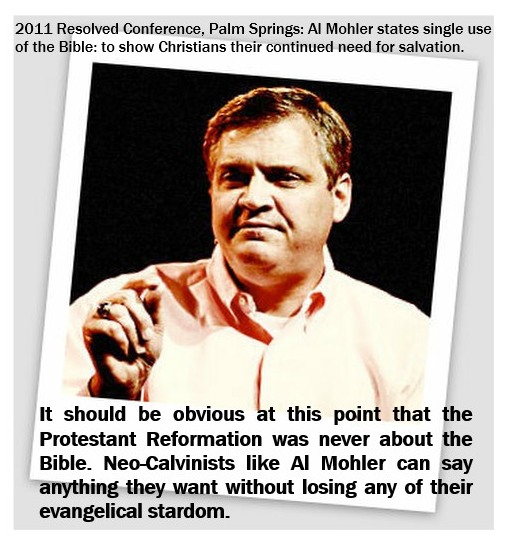 This ministry has documented extensively through the words of Protestant evangelical pundits what the true soteriology of authentic Protestantism is: it is the false gospel of progressive justification. One is saved through the institutional church and its hierarchical priesthood, and then must remain faithful to the institution and its “means of grace” in order to retain salvation. Though evangelicals vehemently deny salvation by church membership, the facts are irrefutable.
Let’s review the major tenets of this false gospel propagated by Protestants and their many offshoots such as Baptists etc. Though they claim salvation by new birth, the biblical definition is denied. In contrast to the biblical definition, justification is a mere “forensic declaration.” Instead of the saint being literally made righteous, they are only declared righteous. This attempts to reconcile their error concerning law and gospel.
In the soteriology of Protestantism, the law only has one purpose instead of two: it only serves to show one’s sin.1 Therefore, the law is justification’s standard. Hence, the simple biblical concept of justification being apart from the law is totally missed.2 Now more error must be added to cover for the fundamental error: their definition of justification as a legal declaration. Now, the law is unwittingly added as something that can give life.3 And since it is seated on a throne beside God and the Son, “its righteous demands must be continually fulfilled.” This necessarily requires even more error: the idea that Christ not only died for our sins, but that He also lived a perfect life in obedience to the law so that His obedience can be continually imputed to the law in the believer’s stead. This is known as “double imputation.”
Enter even more error. Since justification is only a legal declaration and didn’t put the old us to death through Spirit baptism, and we are therefore still under the law’s condemnation instead of Christ’s death ending that aspect of the law, our sins are only COVERED and not ENDED which means continued imputation of Christ’s death and righteousness is needed. However, we don’t need Christ’s obedience to the law imputed to us in order to keep us saved because we were made righteousness in being resurrected with Him4—also in Spirit baptism. This frees us from all condemnation under the law and frees us to serve according to the positive aspects of the law…love.5
And consequently due to this error, “saints” only remain covered by double imputation through faithfulness to the institutional church and its “means of grace” or what really boils down to means of continued salvation.6 These “means of grace” can only be found in the institutional church, and there are many, but one is the hearing of pastoral preaching. Faith comes by hearing the word of God, we know that, but in context of Protestantism, that’s an ongoing need that is only found in the institutional church. If we don’t continually hear the word from those “under the authority of the church” we lose our faith and subsequently our salvation.
In the following video link, Albert Mohler expresses these ideas starting at mark 1:14:00. Yes, he throws in some red herrings in regard to individual study of the word, but take note towards the end regarding his statement that salvation is for the lost as well as the saved. In other words, the “saved” need continued means of salvation that can only be found in the church. This ministry has documented many statements by evangelical leaders plainly stating that Christians continue to need salvation. Where the confusion often comes in is with the citation of verses referring to the saving of the mortal body, viz, redemption which is NOT salvation in the justification sense. Both only happen once.
paul
1Romans 8:2
2Romans 3:21
3Galatians 3
4Romans 5 and 6
5Romans 7 and Galatians 5:6
Calvinism and the Problem with Perfection
 Originally published November 7, 2013
Augustine, Luther, and Calvin were first and foremost Platonists. They integrated the Bible with Platonism. Plato’s theory of forms posits the idea of two worlds; the mutable material world of illusion where reality can only be partially known, and another world where the immutable objective true forms exist. This material world is a shadow world; everything is shadows of the true forms. Therefore, man can only interpret and experience this world subjectively. The tendency is to interpret reality by observing the shadows. To the degree that mankind thinks the material world is reality according to the five senses, subjectivity and chaos will abound.
Therefore, Plato’s ethic was to improve the subjective experience of this life by accessing the true forms through ideas and mathematics—things that transcend the five senses (he believed math was an unchangeable rule and therefore not part of the shadow world). He believed that those who have the capability and willingness to bring more understanding of the objective into the subjective to be an elite minority. These were Plato’s philosopher kings whom he thought should rule society in order to decrease chaos as much as possible. Without philosopher kings, the world would be awash in a sea of subjectivity, everyone living by their own subjective presuppositions based on the shadows of this world. Hence, the arch enemy of the Platonic ideal is individualism.
Plato’s world of true objective forms was his trinity of the true, good, and beautiful. Experiencing the pure form of goodness in this world is impossible—only a shadow of good can be experienced subjectively. Plato’s social engineering has a doctrine, and to the degree that doctrine is applied, a higher quality of subjective existence occurs.
The Reformers put a slightly different twist on this construct. There is no doctrine to apply, only an orthodoxy that focuses on seeing and experiencing. Their version of Plato’s philosopher kings are pastors who possess the power of the keys. Orthodoxy is mediated truth determined by “Divines,” and passed down to the masses for the purpose of experiencing the objective power of the gospel subjectively. The Reformers made the true forms “the gospel,” and reality itself the gospel, ie., the work and personhood of Jesus Christ in particular.
Therefore, in the same way Plato envisioned a society that experiences the power of the true forms subjectively through ideas and immutable disciplines like mathematics, the Reformers sought a heightened subjective experience through a deeper and deeper knowledge of their own true, good, and beautiful—the gospel. And more specifically, instead of the gateway of understanding being reason, ideas, and immutable disciplines, they made the gospel itself the interpretive prism. So: life, history, the Bible, ie., everything, is a tool for experiencing true reality (the gospel) in a higher quality subjectivity. The Bible and all life events are a gospel hermeneutic. Salvation itself is the interpretive prism. All of reality is about redemption. Salvation itself is the universal hermeneutic.
But both constructs have this in common: Pure goodness and perfection cannot exist objectively in the material world. This is where Calvinism and Platonism kiss. The Bible only agrees with this if it is a “gospel narrative.” But if it is God’s full orbed philosophical statement to all men to be interpreted grammatically and exegetically, contradictions abound. To wit, if man possesses goodness and the ability to interpret reality objectively, Platonism and its Reformed children are found wanting. If Reformation orthodoxy is not evaluated biblically with the very theses of its own orthodoxy as a hermeneutic, even more wantonness is found.
The Apostles rejected Platonism because they believed goodness and perfection could indeed be found in this material world. There is no question of the quality of goodness inside of man that enables mankind to interpret reality objectively, the quantity of goodness notwithstanding. In contrast, a dominate theme in the Calvin Institutes is the idea that no person lost or saved can perform a good work. Like Plato’s geometric hermeneutics, the Reformers believed the Law lends understanding to man’s inability to do good because eternal perfection is the standard. The best of man’s works are tainted with sin to some degree, and therefore imperfect. Even if man could perform one perfect work, one sin makes mankind a violator of the whole law. The Reformers were adamant that no person could do any good work whether saved or lost.
Why all the fuss over this point? Why was Calvin dogmatic about this idea to the point of annoyance? Because he was first and foremost a Platonist. The idea that a pure form of good could be found within mankind was metaphysical heresy. Because such contradicts every page of the Bible, the Reformers’ Platonist theology was made the hermeneutic as well. Instead of the interpretation method producing the theology, they made the theology the method of interpretation. If all of reality is redemptive, it must be interpreted the same way.
For the Platonist, the coming of Jesus Christ in the flesh poses a huge problem. He is the truth. He came to the material world in a material body. Platonism became Gnosticism and wreaked havoc on the 1st century church. Notice how the first sentences of 1John are a direct pushback against the Gnosticism of that day:
1John 1:1 – That which was from the beginning, which we have heard, which we have seen with our eyes, which we looked upon and have touched with our hands, concerning the word of life— 2 the life was made manifest, and we have seen it, and testify to it and proclaim to you the eternal life, which was with the Father and was made manifest to us— 3 that which we have seen and heard we proclaim also to you, so that you too may have fellowship with us; and indeed our fellowship is with the Father and with his Son Jesus Christ. 4 And we are writing these things so that our joy may be complete.
Christ is the true, good, and beautiful, and He was touched, felt, seen, heard, and understood. Game over. This is the paramount melding of Plato’s two worlds resulting in a plenary decimation of his philosophy. Nevertheless, Calvin et al got around that by keeping mankind in a subjective realm while making the material world a gospel hermeneutic. Reality still cannot be understood unless it is interpreted by the gospel—everything else is shadows.
Martin Luther took Plato’s two worlds and made them two stories: our own subjective story, a self “glory story” that leads to a labyrinth of subjectivism, or the “cross story” which is the objective gospel. Luther made Plato’s two worlds two stories, but still, they are two realms: one objective and one subjective. In the final analysis mankind is still incompetent, and void of any good whether saved or lost.
Whether the Reformed gospel or Platonism, the infusion of objective goodness is the heresy. Man cannot have any righteousness in and of himself, whether lost or saved. The pushback against this idea can be seen throughout the New Testament. A few examples follow:
1John 2:4 – Whoever says “I know him” but does not keep his commandments is a liar, and the truth is not in him, 5 but whoever keeps his word, in him truly the love of God is perfected.
1John 2:20 – But you have been anointed by the Holy One, and you all have knowledge.21 I write to you, not because you do not know the truth, but because you know it, and because no lie is of the truth.
1John 2:26 – I write these things to you about those who are trying to deceive you. 27 But the anointing that you received from him abides in you, and you have no need that anyone should teach you. But as his anointing teaches you about everything, and is true, and is no lie—just as it has taught you, abide in him.
1John 2:29 – If you know that he is righteous, you may be sure that everyone who practices righteousness has been born of him.
1John 3:2 – Beloved, we are God’s children now, and what we will be has not yet appeared; but we know that when he appears[a] we shall be like him, because we shall see him as he is. 3 And everyone who thus hopes in him purifies himself as he is pure. 4 Everyone who makes a practice of sinning also practices lawlessness; sin is lawlessness. 5 You know that he appeared in order to take away sins, and in him there is no sin. 6 No one who abides in him keeps on sinning; no one who keeps on sinning has either seen him or known him. 7 Little children, let no one deceive you. Whoever practices righteousness is righteous, as he is righteous.
Romans 15:14 – I myself am satisfied about you, my brothers, that you yourselves are full of goodness, filled with all knowledge and able to instruct one another.
Christians can know goodness, and perform righteousness objectively. This speaks to the quality of the righteousness when it is performed—it is perfect and acceptable to God. We are not limited to a mere subjective experience in regard to righteousness. When we are resurrected, the quantity thereafter will be 100%, but our present righteousness is acceptable to God when it is performed by us. If it is accepted by God, it is perfect.
Even the unregenerate know good, and can perform it. The works of the law are written on their hearts, and their consciences either accuse or excuse them (Romans 2:12-15). Though enslaved to unrighteousness, they are free to perform righteousness (Romans 6:20). The very goodness of God can be understood from observing creation as well (Romans 1:20).
The only way the Reformers can make all goodness outside of man is to make the Bible a salvation hermeneutic. It is the only way they could integrate the Bible with their Platonist philosophy.
paul

 Paul's Passing Thoughts
leave a comment