Are Calvinists Saved?
 Originally published October 6, 2012
The begging of the question has a sound Scriptural argument.
This ministry has made much of the critical importance of separating justification (salvation) and sanctification (growth in holiness, or kingdom living). The Reformed (Calvin/Luther Reformation doctrine/gospel) “never separate, but distinct” doublespeak doesn’t cut it in the arena of truth, and we will see why. “Never separate” =’s false gospel. If you get a little lost in the first part of my argument which gives the lay of the land, don’t worry, when I get into the specific Scriptural argument, it will clear things up and make it all come together for you. It must delight the ghosts of the Reformation that the argument has always been in the arena of freewill verses predestination. It’s the primary thrust of this ministry to change that argument. This isn’t a quibbling about semantics in the mainstream—this is about the truth of the gospel. As New Calvinist Russ Kennedy once thundered from the pulpit in his mousy voice: “Any separation of justification and sanctification is an abomination!” I have often argued from the standpoint of this issue. If sanctification is the middle of the Reformed “golden chain of salvation” then sanctification is part of finishing justification. This means that what happens in sanctification determines whether or not justification is properly finished. What’s a chain? John Piper even preached a message about the eternal importance of our contribution to the “links” in just the right way. In essence, sanctification becomes a spiritual minefield. This is exactly the same thing that the Reformed crowd has always accused Rome of: the fusing together of justification and sanctification. However, as we shall see, they are both guilty of the exact same heresy/false gospel. As we shall see, both teach that sanctification finishes justification. This is a linear gospel (one unified chain from salvation to resurrection (glorification) versus a parallel gospel with salvation on one plane as a finished work before the foundation of the world, and kingdom living that runs parallel with the finished work and reflects the reality of our salvation until glorification. Typical in the linear gospel is the idea that Christ died for all of our past sins, but we must now finish the work (with the Holy Spirit’s help [sanctified works salvation]) until glorification when we are completely transformed into complete holiness. This is the often-heard bemoaning of “Christ PLUS something.” 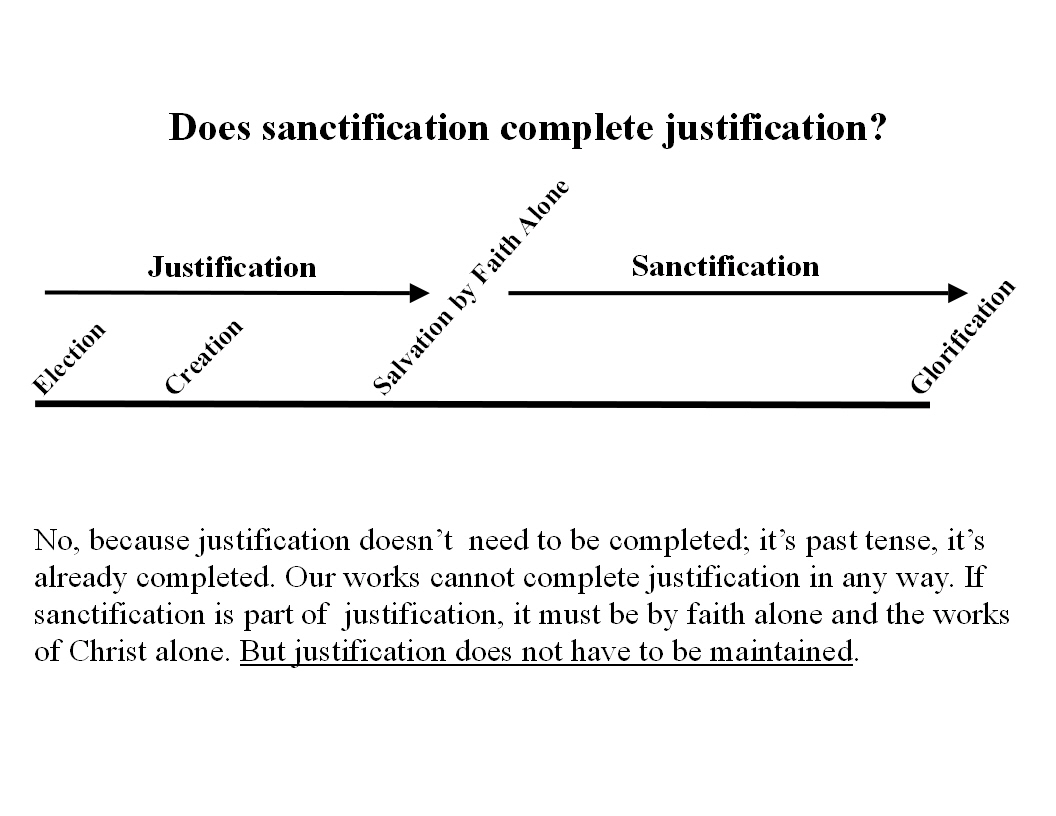 An excellent example is some strains of Freewill Baptists who teach that Christ died for all of our past sins, but with the help of the Holy Spirit, we must confess and repent of every sin we commit until the resurrection, e.g., Christ plus salvation by repentant prayer for sins committed after we are “saved.” My grandparents were saved out of this tradition. When my grandfather asked my grandmother if she thought that God could ever forgive him of all the sins he committed, she answered: “Yes, but you are going to have to pray awful hard!” Praise God that through the ministry of several individuals my grandparents eventually abandoned that gospel for the true one of salvation by faith alone as a finished work. Likewise, Rome teaches that you must let the Catholic Church finish your justification through ritual, e.g., Christ plus Catholic ritual. The Reformation gospel is also Christ plus something else, but the something else is ever-so-subtle. In both cases, sin must be dealt with in sanctification in order for the saint to remain justified until the final judgment. In other words, the righteous standard of justification must be maintained on our behalf. Like all other proponents of a linear gospel, the Reformed crowd contends that anything less than the perfection demanded of the law (“all sin is transgression of the law”) is “legal fiction.” So both Rome and the Reformers agree: justification must be maintained by sanctification, and in the case of the Reformers specifically, they believe that the perfect standard of the law must be maintained until glorification; otherwise, our justification is “legal fiction.” Here is where Reformed subtlety is uncanny: Christ keeps the law for us in sanctification. He maintains the perfect standard. All the fruit of sanctification (obedience/good works) flows from the life He lived on Earth and His death on the cross. Christ plus the works of Christ to finish salvation. “But Paul, what in the world is wrong with that?!” Here is what is wrong with it: works are still required to maintain justification. That is a huge problem, even if it is Christ doing the work. What did the Hebrew writer say about Christ’s work for justification not being complete? And even more subtle is the following Reformed idea: believing that the law is no longer a standard for maintaining justification is antinomianism. Antinomianism =’s legal fiction. Their definition of antinomianism is the removal of the law from justification as the standard for maintaining it. Traditionally, among Biblicists, antinomianism is the removal of the law from sanctification, and herein lays even further steroidal subtlety: the Reformed theologians would refute a removal of the law from sanctification as well, not only because they think justification and sanctification are the same thing, but because its perfect keeping is required to maintain a true declaration of the just that is not “legal fiction.”
  However, the Biblicist believes that the law is a standard for kingdom living and is no longer a standard for justification. Therefore, if we attempt to obey it with the Holy Spirit’s help, and to please/serve the Lord, it can have no bearing on our just state. While the Biblicists think they are therefore joint contenders with the Reformers against antinomianism, such is far from the truth. The Reformed mind believes the Biblicist is either a legalist or an antinomian, or both. The Biblicist is supposedly an antinomian because he/she has removed the law from justification as a just standard, or is a legalist because they think they should strive to keep the law in sanctification. Since sanctification finishes justification’s perfect standard of law keeping, our “own” attempts to keep the law in sanctification is an attempt to finish justification. Hence, what the Biblicist fails to understand is the Reformers belief that Christ must maintain the law for us in sanctification because justification and sanctification are not separate. Anything more or less is supposedly works salvation. On the other hand, because it is vital that Christ obeys the law for us in sanctification, the likes of John Piper and Tullian Tchividjian contend that those who are really preaching the Reformed gospel will indeed be accused of antinomianism. All in all, their position is easy to see if you pay attention. John Piper and many other Calvinists often state that, “Good works are the fruit of justification.” And, “Justification is the root, and sanctification is the fruit.” Well, the average Biblicist then thinks, “Yes, but of course, our salvation makes good works in sanctification possible.” But that’s not what they are saying. If you pay closer attention, they are saying that justification is a tree that produces its own fruit. Justification is the root, and whatever happens in true sanctification is the fruit of the root of the justification tree. Problem is, justification doesn’t grow. Justification is a finished work. What Calvinists refer to as “progressive sanctification” is really the fruit of the root: progressive justification. Another name for this that they throw around is “definitive sanctification.” The word “definitive” refers back to the definite completion of justification.
  Revision: this ministry now rejects the idea that orthodoxy is truth; orthodoxy is the traditions of men. Never in Scripture do we find premise for a body of teaching that explains the teaching. The above illustration is valuable for demonstrating that the fruit of justification is glorification, NOT sanctification. This brings us to the Scriptural argument which begins with a question I asked myself just this morning: “Paul, you are always harping about the crucial importance of the separation of justification and sanctification—a parallel gospel versus a linear one. But where does the Bible say specifically that this is critical?” First, the very definition of a lost person in the Bible is one who is “under the law”:
Romans 3:19 Now we know that whatever the law says it speaks to those who are under the law, so that every mouth may be stopped, and the whole world may be held accountable to God. Romans 6:14 For sin will have no dominion over you, since you are not under law but under grace. Romans 6:15 What then? Are we to sin because we are not under law but under grace? By no means! 1 Corinthians 9:20 To the Jews I became as a Jew, in order to win Jews. To those under the law I became as one under the law (though not being myself under the law) that I might win those under the law. Romans 7:1 Or do you not know, brothers —for I am speaking to those who know the law—that the law is binding on a person only as long as he lives? Romans 7:2 For a married woman is bound by law to her husband while he lives, but if her husband dies she is released from the law of marriage. Romans 7:3 Accordingly, she will be called an adulteress if she lives with another man while her husband is alive. But if her husband dies, she is free from that law, and if she marries another man she is not an adulteress.
The unsaved are “under the law” and will be judged by it in the end. This is the very definition of the unsaved. Calvinists define Christians the same way—we are supposedly still under the law and will be judged by it in the end. That’s why Christ must keep the law for us—because we are still under it. If not this position, why do many in the Reformed tradition hold to the idea that Christ’s perfect obedience is imputed to our sanctification? His death justifies us, and His perfect life sanctifies us. Hence, His death pays the penalty for past sins, and then His perfect life imputed to our sanctification keeps us justified. Why would an imputation to our sanctification be necessary if we are no longer under the law? This is known as the Reformed view of “double imputation” and has been called out as heresy by many respected theologians for this very reason: it implies that Christians are still under the law. In regard to sustaining the law in our stead, why? It has been totally abolished in regard to our just standing:
Romans 3:20 For by works of the law no human being will be justified in his sight, since through the law comes knowledge of sin. Romans 3:21 But now the righteousness of God has been manifested apart from the law, although the Law and the Prophets bear witness to it— Romans 4:15 For the law brings wrath, but where there is no law there is no transgression.
The keeping of the law by anybody DOES NOT do anything to justify mankind:
Romans 3:28 For we hold that one is justified by faith apart from works of the law.
Here is where the separation of justification and sanctification is vital on this first point: we ARE NOT under the law for justification, but rather UPHOLD THE LAW in sanctification. The two must be separate because of the differing relationships to the law:
Romans 3:31 Do we then overthrow the law by this faith? By no means! On the contrary, we uphold the law. Romans 6:15 What then? Are we to sin because we are not under law but under grace? By no means!
Furthermore, if we are still under the law (whether or not Christ obeys it for us to keep us in a just standing), this means we are still under the power of sin. Being under the law and also under its spell to provoke sin in the unregenerate is spoken of as being synonymous in the Bible. Those who are “under the law” are also under the power of sin and enslaved to it:
Romans 7:4 Likewise, my brothers, you also have died to the law through the body of Christ, so that you may belong to another, to him who has been raised from the dead, in order that we may bear fruit for God. Romans 7:5 For while we were living in the flesh, our sinful passions, aroused by the law, were at work in our members to bear fruit for death. Romans 7:6 But now we are released from the law, having died to that which held us captive, so that we serve in the new way of the Spirit and not in the old way of the written code. Romans 7:8 But sin, seizing an opportunity through the commandment, produced in me all kinds of covetousness. For apart from the law, sin lies dead.
If we are still under the law, and will be judged by it, whether or not Christ stands in the judgment for us with His own works, we are still enslaved to sin by virtue of being under the law…. for justification. And Calvinists know this to be true, that’s why they say we are still…. what? Right, even as Christians, “totally depraved.” And, “enemies of God.” Of course, throughout the Bible, Christians are spoken of as being friends of God and no longer His enemies. Our status as enemies of God is stated in the past tense. But the Reformed crew continually state that Christians are vile enemies of God and are enslaved to sin. They realize that this goes hand in hand with being under the law. To the contrary, dying to the law in the death of Christ….for justification—sets us free to be enslaved to the righteousness that is defined by the law. We are dead to the law for justification and alive to obey truth….for sanctification:
Romans 8:2 For the law of the Spirit of life has set you free in Christ Jesus from the law of sin and death. Romans 8:3,4 [emphasis by author] For God has done what the law, weakened by the flesh, could not do. By sending his own Son in the likeness of sinful flesh and for sin, he condemned sin in the flesh,….in order that the righteous requirement of the law might be fulfilled in us, who walk not according to the flesh but according to the Spirit. Romans 8:7 For the mind that is set on the flesh is hostile to God, for it does not submit to God’s law; indeed, it cannot. Romans 9:31 but that Israel who pursued a law that would lead to righteousness did not succeed in reaching that law. John 17:17 Sanctify them in the truth; your word is truth. James 1:25 But the one who looks into the perfect law, the law of liberty, and perseveres, being no hearer who forgets but a doer who acts, he will be blessed in his doing.
So, that is the separation that must be for the true Christian: Justification has no law for which we are judged, and we live by the law of blessings in sanctification. This brings us to another important separation in the two: the judgments. Those under the law and sin will stand in a final judgment which will be according to the law. Again, because Calvinists believe that we are still under the law, albeit that Christ obeyed/obeys it for us, Christians will supposedly stand in the same judgment as the damned who are under the law and enslaved to it. At that time, the children of God, according to Calvinists, will be “made manifest.” But because Christians are not under the law and cannot be judged by it, they will stand in a judgment for rewards and not a judgment that determines a perfect keeping of the law by Christ in our stead. Hence, there will be two different resurrections: one for those under the law and another for those under grace, and two different judgments for the same two groups. One for rewards, and one to determine if those under the law kept it perfectly. The latter judgment doesn’t go well for any standing in it.
Luke 14:12-14 He said also to the man who had invited him, “When you give a dinner or a banquet, do not invite your friends or your brothers or your relatives or rich neighbors, lest they also invite you in return and you be repaid. 13 But when you give a feast, invite the poor, the crippled, the lame, the blind, 14 and you will be blessed, because they cannot repay you. For you will be repaid at the resurrection of the just.” [Notice that this is a resurrection for the “just.” They are already determined to be just before they are resurrected]. 2Corinthians 5:9,10 So whether we are at home or away, we make it our aim to please him. 10 For we must all appear before the judgment seat of Christ, so that each one may receive what is due for what he has done in the body, whether good or evil. 1Corintians 3:11-15 For no one can lay a foundation other than that which is laid, which is Jesus Christ. 12 Now if anyone builds on the foundation with gold, silver, precious stones, wood, hay, straw— 13 each one’s work will become manifest, for the Day will disclose it, because it will be revealed by fire, and the fire will test what sort of work each one has done. 14 If the work that anyone has built on the foundation survives, he will receive a reward. 15 If anyone’s work is burned up, he will suffer loss, though he himself will be saved, but only as through fire. Hebrews 6:10 For God is not unjust so as to overlook your work and the love that you have shown for his name in serving the saints, as you still do. Revelation 20:6 Blessed and holy is the one who shares in the first resurrection! Over such the second death has no power, but they will be priests of God and of Christ, and they will reign with him for a thousand years. Revelation 20:11-15 Then I saw a great white throne and him who was seated on it. From his presence earth and sky fled away, and no place was found for them. 12 And I saw the dead, great and small, standing before the throne, and books were opened. Then another book was opened, which is the book of life. And the dead were judged by what was written in the books, according to what they had done. 13 And the sea gave up the dead who were in it, Death and Hades gave up the dead who were in them, and they were judged, each one of them, according to what they had done. 14 Then Death and Hades were thrown into the lake of fire. This is the second death, the lake of fire. 15 And if anyone’s name was not found written in the book of life, he was thrown into the lake of fire.
Don’t let anyone tell you that eschatology is a “secondary” or “nonessential” consideration. Your eschatology is your gospel. It will state your position regarding whether or not you fuse justification and sanctification together; ie, likening Christians to those under the law.
Yet another vital difference in sanctification and justification is repentance. Repentance for salvation (when you are justified) is different from our repentance in sanctification. Among many in the Reformed tradition where the “same gospel that saved you also sanctifies you,” the repentance is the same. Repentance unto salvation is not a onetime “washing,” but rather a means to continue “in the gospel” through what they call “deep repentance.” Biblicism holds to repentance in sanctification that restores his/her fellowship and communion with God as His children. They would see repentance unto salvation as differing, and only necessary for salvation—a onetime decision to take one’s life in a new direction by following Christ, and believing in his death, burial, and resurrection. Reformed repentance, according to the likes of Paul David Tripp and others is a “daily rescue.” Our original repentance was for rescue, and we need rescue today as much as we needed rescue when we were saved. Again, this indicates their belief that we are still under the curse of the law and need to be continually rescued from it while remaining under the bondage of sin. However, Christ made it clear to Peter (John 13:6-11) that those who have been washed (1Corinthians 6:11, Romans 8:30) do not need another washing. Those who drink of the living water do not thirst again (John 4:13,14). Lastly, though many other separations could be discussed, why saints can be considered just while they still sin at times is of paramount importance. There is no sin in our justification because there is no law, and where there is no law, there is no sin. Though unfortunate, there can be sin in our sanctification because it is totally separate from justification and can’t affect our just standing with God. Basically, all of the aforementioned makes it of necessity to deny the new birth. If we have God’s seed in us, and we do (1John 3:9), that dispels total depravity, and without total depravity, justification and sanctification cannot be fused together. The new birth is a huge problem for Reformed theology. If the old man that was under the law is dead (Romans 7:1ff), and the seed of God is in the saved person, and the sin due to our weakness in the flesh cannot be laid to our account for justification, then our justification is not “legal fiction” because we do not exhibit perfect obedience to the law. This is another grave consideration because Christ said, “You must be born again.” Obviously, despite their denials that they deny the new birth—you can’t be both totally depraved and born again. Reformation doctrine is clearly a false gospel. Its version of justification does not void the law, and denies the new birth while distorting everything in-between. Freewill verses predestination is hardly the issue, the very gospel itself is the issue.
paul
So Far, This is What I Know by Andy Young
So far this is what I know:
- Belief in Jesus = belief in God (Matthew 10:32-33; Mark 8:38; Luke 9:26; John 5:23, 24, 38-47; 6:29; 8:19, 42, 49, 52; 10:25, 38; 14:7 [actually, just about all of John 14!]; 15:23; 16:3, 27)
- Belief in God = righteousness = justification (Romans 3:21-26; Romans 4:3, 5, 11, 20-22; 9:30; 10:4, 10; Galatians 3:6; Philippians 3:9; Hebrews 11:4, 7; James 2:23)
- Righteousness = justification = new birth (John 5:24; 1 John 2:29, 2 Corinthians 5:17; Galatians 6:15; Colossians 3:10, 1 Peter 1:23, 1 John 3:9)
- New Birth = ending of the law (John 5:24; Romans 6:14; 10:4)
- Ending of the law = no condemnation (John 3:18; 5:24; Romans 4:15; 5:13; 8:1)
- No condemnation = freedom to show love by obedience to the law in sanctification. (John 13:34; 15:12; 15:17; Romans 8:2; 12:10; 13:8, 10; 14:13; Galatians 5:1, 13, 22-26; 6:2; Ephesians 4:1-2, 28-32; Colossians 3:10-17; Titus 3:7-8; Hebrews 10:22-24; James 1:22-25; 1 Peter 1:22; 2:13-16; 1 John 3:11, 14, 22; 4:7; 2 John 5)
There may be a few more steps in there (and these references are by no means exhaustive), but that’s pretty much the gist of it.
Andy
Protestantism: So Many Flavors, but It’s All Ice Cream
 Protestantism has many different denominations and interpretations of the Bible, and let me explain why that’s the case. Protestantism was founded on the idea that the law of God has a single dimension. That’s the foundation, and that fleshes itself out in one way or the other across all denominational lines.
For purposes of keeping this simple, we will focus on how this applies according to what is in vogue presently: the law can only condemn; the law can only provoke us to sin; the law demands perfection or all bets are off; the standard for being justified is perfect law-keeping.
What to do about law? That fundamental question is what divides all sects of Protestantism. It is what drives all the bickering between Calvinists, Arminians, free grace (Zane Hodges), and the anti-lordship salvation crowd which is mostly made up of the free grace crowd
This is why Protestants can’t seem to get it together on Christian living. Trying to make a single dimension law work in the Christian life causes all kinds of confusion. Staying in the same vein of simplicity, let’s use Romans 8:2 in an attempt to understand the problem:
Romans 8:2 – For the law of the Spirit of life has set you free in Christ Jesus from the law of sin and death.
That’s two different relationships to the same law. To the born again believer, the Spirit uses the law to sanctify the believer (John 17:17). To walk in the Spirit is to learn and obey the word of God which is life. This is a colaboring with the Spirit in the truest sense.
To the unbeliever, the law can only condemn, and sin within uses the law to provoke the unbeliever to sin. To the unbeliever, the law can only bring death. Hence, “the law of sin and death.”
In what way does the law set us free to “serve another”? When we believe its testimony, it sets us free from being condemned by it, and frees us to obey it as a way of loving God and others. This isn’t a difficult concept: if we listen to wisdom we live; if we reject wisdom we die, but it’s the same wisdom.
Again, for purposes of making a simple point in this post, I am not going into how this all fits together with the believer being truly righteous, and able to please God through obedience while falling short of perfection. You aren’t going to understand any of that till you get this basic point anyway.
The following prompted this post: I stumbled upon an anti-lordship salvation kind of guy named Jack Smack who believes Calvinists, Arminians, and proponents of lordship salvation are all going to hell. Again, this all boils down to differences in how you get the square peg of a single dimension law into the round hole of Christian living and the gospel. Note what he states in the video:
Now what is Lordship salvation? It’s the idea that you have to live a certain way, you have to prove you are saved by your works. You got to obey God; you got to repent of your sins, and it’s all of this jargon. And there’s a lot, there’s a few other things they say: the lot of them will tell you, you know, you can’t live any way you want to and all this, well, they’re trying to control you. They’re trying to put you under the law. They’re doing exactly what these Jews were doing. It says, “why compest thou the Gentiles to live as do the Jews?” Okay…
15 We who are Jews by nature, and not sinners of the Gentiles,
16 Knowing that a man is not justified by the works of the law, but by the faith of Jesus Christ, even we have believed in Jesus Christ, that we might be justified by the faith of Christ, and not by the works of the law: for by the works of the law shall no flesh be justified. 17 But if, while we seek to be justified by Christ, we ourselves also are found sinners, is therefore Christ the minister of sin? God forbid.
Now look at this: Lordship Salvation, they’re people trying to get you to sin – they want you to sin! They teach lawless, that lewd antinomianism, because if you get down to it, they’re trying to put you back under a law. And all the law can do is cause you to sin.
18 For if I build again the things which I destroyed, I make myself a transgressor.
So actually, in all reality, ironically, a Lordship Salvationist claims like they don’t want people to keep on sinning, but the reality of what they teach, it’s going to make you go on sinning, according to that verse. So yes, Lordship Salvation proponents are antinomian. Regardless of whether or not they will admit this, the bible says they are. Any time you try to put somebody under a law, you are making them into a bigger sinner PERIOD.
19 For I through the law am dead to the law, that I might live unto God.
So, it’s all I have. Lordship Salvation makes you into a bigger sinner because you’re imposing laws on people that they just can’t obey on their own, and um…that’s exactly what these people are doing. So I , you know, believe in, I teach Free Grace. I teach that we’re justified freely by His grace through the redemption that is in Christ Jesus.
Now you have to understand Free Grace, or you cannot serve God; and you cannot, you know, obey God. You have to understand what’s been done on your behalf: Jesus Christ died for your sins. He was buried and rose again. He gives eternal life as a free gift. So, on the basis of that, we should want to serve God and to live right. And that’s what I teach. People that are teaching law, lordship, they’re the antinomians because the reality of what they teach leads to uh..transgression.
In the Bible, there are only two kinds of people: under law (lost), and under grace (saved). But what is missed in Protestantism is that being under grace doesn’t exclude being under law, it’s just not the law of sin and death. The law informs us as to what people need to do to be free from being condemned by the law, resulting in being free to use the law for loving God and others. If we want to know what to do in order to not die for lack of wisdom, we go and ask Lady Wisdom, right?
When we are saved by believing the law’s testimony about Christ, we are set free from its condemnation in a one time, completed transformation from death to life. We are now free to serve the law unto life more abundantly. Freedom from the law of condemnation is a gift, but obedience to the law as a born again believer yields rewards in the present life and the life to come. Hence, “For I through the law am dead to the law, that I might live unto God.” But living to God doesn’t exclude the law; Matthew 4:4 couldn’t be clearer on that.
Nevertheless, notice how Smack states that the relationship of the law of sin and death remains the same for the believer. This keeps believers “under law,” which is the very definition of a lost person. He states that a demand for Christians to obey the law only causes them to sin more! Woe! But frankly, this take on law is the same problem with Protestantism in general across the board.
The obvious question becomes: how do I obey the law as a Christian in a way that won’t cause me to sin more or condemn me? Of course, this has caused much confusion among Protestants. The remedy is usually a confusing system of some sort that imputes the perfect obedience of Jesus to our life in the same way His righteousness was imputed to us by faith alone. These systems range from outright denial of the law in the Christians life to a “relaxing of the law.”
Here is what Christians need to come to grips with: the two uses of the law in Romans 8:2. That is the key.
paul
Counseling the Unsaved
 “Salvation is not a mere mental assent to the death and resurrection of Christ; it is joining Christ in that death and resurrection through the Holy Spirt.”
We live in a day of Christian impotency in regard to living that glorifies God. The glory of megachurches and dynamic multimedia presentations cannot cover for the fact that Christians have no answers for life’s toughest problems. This shouldn’t surprise us because our spiritual forefathers didn’t believe mankind possesses the faculties that comprehend reality itself. Martin Luther considered reason to be man’s foremost deception.
Few Christians understand our Protestant roots, and therefore are confused about its present-day rotten fruits. The assumption is that we still don’t have something right while the source is assumed impeccable. For purposes of this post, the introduction can be boiled down to this: for 500 years, Protestantism has emphasized salvation and not Christian living because Protestantism views salvation as a process, not a finished work. Hence, the goal is to be able to “stand in the judgment” rather than a focus on Christian living, and frankly, Christian loving. For the most part, the laity doesn’t even understand how most Protestant pastors process reality itself.
Christian living is uncharted territory. Don’t be deceived by all the literature proffering a Christian living that is sanctification by justification. Christian living that is salvation in process is a fundamental principle of Protestant thought.
Regardless, the answer is to get busy and reverse the trend. Let’s not worry too much about what we don’t know in regard to Christian living which is not much, but let’s start somewhere and continue to learn. So, if an unsaved person unwittingly comes to us for help, how should that person be guided?
If that person wants to change, they have come to the right place because our wisdom should come from the One who created us. He who created us knows how to fix us. However, keep in mind that the vast majority of Protestant counselors don’t believe that people can be fixed whether they are Christians or not. The use of the word “change” among Protestant counselors is outright deception; Protestant ideology does not endorse people-change in the literal sense. “Change” is really “heart change” which is a mere capacity to SEE reality differently for the purpose of wellbeing, not well-doing that glorifies God. For an example of that, watch this clip very carefully and think about what this “Christian” bestselling author is really saying.
Hence, Protestants point to “saints” in perfect peace as the goal while their own lives and the world around them are burning down, but is that peace from God, or their Gnostic worldview?
So be encouraged; if someone comes to you—you don’t know much, but you at least believe people can change. Now to the subject at hand: how should we counsel an unsaved person?
A good start is to tell the unsaved person that God’s wisdom can change his/her life for the better. In fact, many secular organizations use many wise principles that help people change for the better, and these principles are common to all people because of how creation is wired. But we offer something more: forgiveness in Jesus Christ (Aside: “Christ” is a term for “Messiah”).
You see, a person can stop doing a sin, but unfortunately, they are still accountable for the sin. The fact that they stopped doing it will improve their present life, but they will still be condemned for the act committed. The Bible states this to be the fact because they are still “under law.” The law keeps a record of every violation against it and God will condemn according to those violations accordingly. It is not true that an unsaved person cannot change, they most certainly can, but they are still under condemnation.
Jesus Christ died to end the law. If they believe in Christ, they not only have temporary change for the better, they have forgiveness for every sin they ever committed. What about really, really bad sins? Is the really bad sin in the law? Then it’s taken away. Is it not in the law? Where there is no law there is no sin. What about future sin? Where there is no law there is no sin.
So, if they believe in Christ, they can sin unabated without condemnation? No, because Christ was also resurrected by the Holy Spirit. They are not only believing in Christ’s death, they are believing the old them that was under law also dies with Christ, and is also resurrected with Christ in the “new way of the Spirit.” Instead of temporary change, they can have real change: the old self dies and is resurrected into a new person; now that’s change! Salvation is not a mere mental assent to the death and resurrection of Christ; it is joining Christ in that death and resurrection through the Holy Spirt.
What is the “new way of the Spirit”? Simply stated, the law that formerly condemned the person they were is now the guide to love God and others. In addition, fear of death is not necessary because fear of death has to do with judgment under the law when it formerly condemned us. Sin also uses the condemnation of the law to enslave people because it cannot be used to please God by those who are under its condemnation.
Said another way; we are offering eternal life rather than a more comfortable condemnation. But also, life more abundant in the here and now.
What about future change for the glory of God? Well, you have now gained a brother or sister—that’s a journey that you will now take together. You are now two counselees sharing the mutual experience of God’s instruction and leading by the Holy Spirt who has sealed us until the day of redemption. We know Him because he will never leave us or forsake us. Neither of you know much, but you will learn it to together for the glory of God.
And salvation is not a process, growing in love is a process, and there is no fear in love. Salvation is a settled issue, and Protestantism is not salvation.
paul


 Paul's Passing Thoughts
leave a comment