Book Review: “The Race Set Before Us: A Biblical Theology of Perseverance & Assurance”; Part 1, the Introduction
 Confusion reigns in Christianity regarding salvation and its relationship to the Christian life. In other words, the Christian academia of Western culture has failed to clarify the issue. Christians have bought into the idea that truth must be certified by graduates from institutions of “higher learning.” What the average Christian learns on their own is apparently “lower learning.” Yet, why the confusion? We have had 2000 years to straighten all of this out. It just feeds the idea among the lost that truth can’t be known. A reader sent me some information on yet another Reformed yearly conference. The focus of the conference is a conglomerate of Reformed dead guys. Classic. And so it goes. Dating myself, I will say, “The beat goes on.”
Thomas R. Schreiner and Ardel B. Caneday wrote a book in 2001 that seeks to clarify the issue. I have read the introduction thus far and find it dazzling enough to push a book review into my schedule that I don’t have time to do. Don’t tell Susan.
The introduction is pretty beefy and it over-fulfills the rule of setting the parameters of a book in the introduction. But yet, though they show their hand completely, a well-orchestrated and interesting argument is anticipated. Their arguments are concrete, and respect the intelligence of the reader. As someone who has suffered through the massive droning of Reformed mystic despots, both ancient and contemporary, I find my initial perusing of the book engaging, honest, definitive, and propositional. The usual attitude that nuance and ambiguity is necessary because most are not ready for deep, hard, Reformed truth seems to be completely absent. I heard a comment the other day: because John Piper is on a much higher spiritual plane than us—it is alright if we don’t understand everything he is teaching. The reason that this book is the antithesis of that gagathon is uncertain. They are college professors and obviously love to teach—perhaps that’s the reason.
This is not entirely surprising. Christians who know something of Caneday (and I do) are aware that he has a sincere love for others. The other author I cannot speak for other than the fact that he graduated from Southern Seminary which is a bastion of evil. Nevertheless, already, I would recommend the book because it posits a compelling argument. I hold to the idea that salvation is already, and already, not “already—not yet.” Our race in sanctification is for rewards in this life (one being assurance) and the life to come; salvation is not the reward of the race. From the introduction, I get the idea that they may not agree with that, but I welcome an intelligent, objective, and definitive challenge to my present position. That’s just a healthy thing to do—If you can find such an argument among the mass of young, arrogant, petulant, “pastors” of our day. This book promises to be different.
The introduction has some problems, but still poses substantial challenges for someone who holds my position (per the usual, I have scanned the whole book and have returned to the beginning for the detailed pondering thereof). Not only that, it presents a concrete, substantive argument for the rest though substantially flawed in regard to doctrinal correctness. But all in all, what I am trying to say is that this book poses an important and dignified argument in the debate. Buy the book if you want an intelligent analysis from that perspective.
First problem: the authors say that they wrote the book from the “Biblical Theology” perspective. Uh, that’s usually the Redemptive Historical hermeneutic (see chapter 3 of The Truth About New Calvinism vol. 1). Second, according to the introduction, the book is based on eight types of Scriptures that indicate salvation must be finished by perseverance. I do not believe that seven of their eight types present that idea biblically. However, it would seem that one of the types presented does, and that must be reconciled, so read on I will. Third, they speak of the“obedience of faith” which is a creep alert. That MIGHT indicate a sanctification by faith alone that results in Jesus persevering for us and thereby finishing our salvation. Fourth, they quote Augustine (no secret that he was a neo-Platonist) favorably in regard to the “obedient faith” thing. Creep alert just went from blue to yellow. Fifth, justification can’t be a race in the athletic motif that the authors present because righteousness, faith, salvation, and justification are apart from any kind of standard, or law. Yes, the apostle Paul said that he could be “disqualified,” but he couldn’t have been talking about a race to a finish-line where the prize is final salvation. Salvation has no standard—it is “apart from the law.” The question of how much? perseverance would be a problem in, and of itself except for the fact that there is no measure or standard to begin with. Sixth, they speak of assurance as having “three legs” (God’s promises, fruit of the Spirit and His witness) and OBEDIENCE is NOT one. How can this be? Why the exclusion of the undeniable link between our obedience and assurance?
Nevertheless, the book is causing me to take a closer look at what I believe about these things. I believe the authors are sincere and have the hearts of teachers. I do not believe they are a part of the Reformed mystic despot wolf pack. I believe the book will help sharpen and clarify my thinking on this issue.
Honest debate always does.
paul
Are Calvinists Saved?
 The begging of the question has a sound Scriptural argument.
This ministry has made much of the critical importance of separating justification (salvation) and sanctification (growth in holiness, or kingdom living). The Reformed (Calvin/Luther Reformation doctrine/gospel) “never separate, but distinct” doublespeak doesn’t cut it in the arena of truth, and we will see why. “Never separate” =’s false gospel. If you get a little lost in the first part of my argument which gives the lay of the land, don’t worry, when I get into the specific Scriptural argument, it will clear things up and make it all come together for you.
It must delight the ghosts of the Reformation that the argument has always been in the arena of freewill verses predestination. It’s the primary thrust of this ministry to change that argument. This isn’t a quibbling about semantics in the mainstream—this is about the truth of the gospel. As New Calvinist Russ Kennedy once thundered from the pulpit in his mousy voice: “Any separation of justification and sanctification is an abomination!”
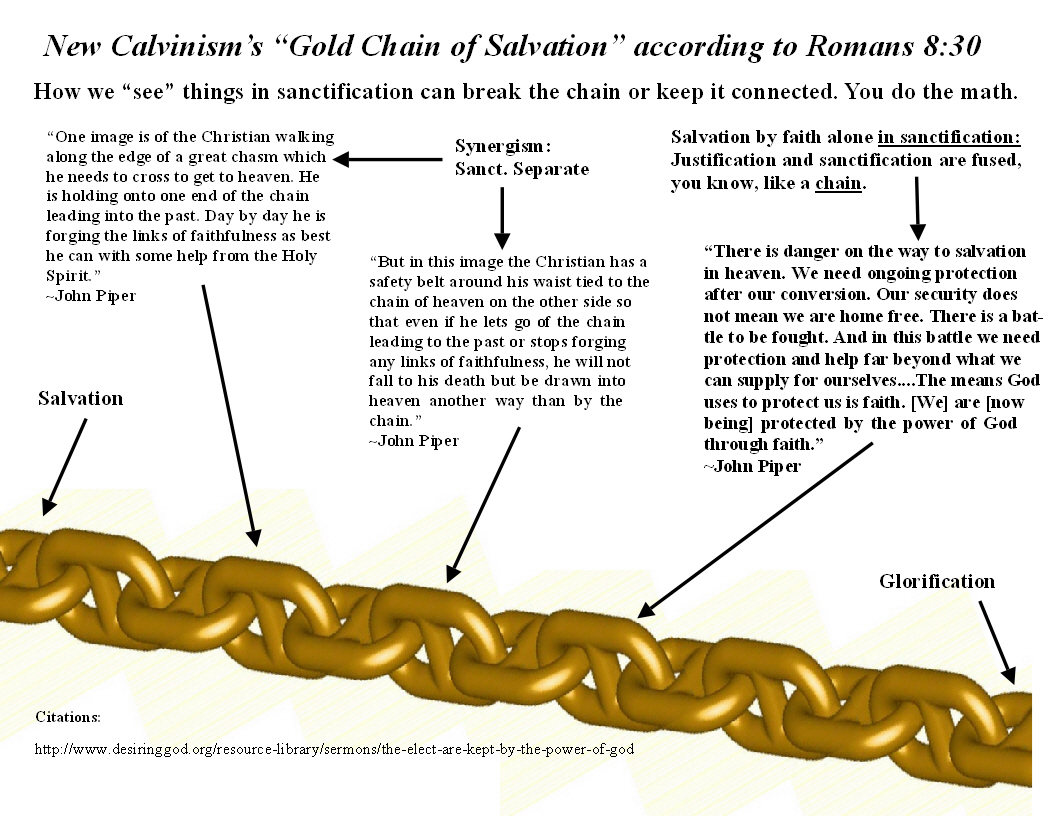
I have often argued from the standpoint of this issue. If sanctification is the middle of the Reformed “golden chain of salvation” then sanctification is part of finishing justification. This means that what happens in sanctification determines whether or not justification is properly finished. What’s a chain? John Piper even preached a message about the eternal importance of our contribution to the “links” in just the right way. In essence, sanctification becomes a spiritual minefield.
This is exactly the same thing that the Reformed crowd has always accused Rome of: the fusing together of justification and sanctification. However, as we shall see, they are both guilty of the exact same heresy/false gospel. As we shall see, both teach that sanctification finishes justification.
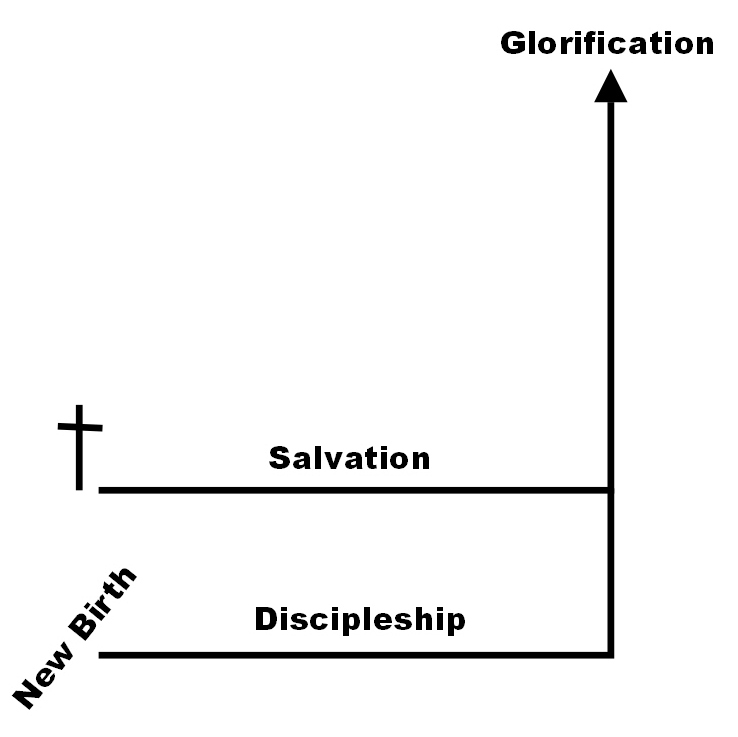
This is a linear gospel (one unified chain from salvation to resurrection (glorification) versus a parallel gospel with salvation on one plane as a finished work before the foundation of the world, and kingdom living that runs parallel with the finished work and reflects the reality of our salvation until glorification. Typical in the linear gospel is the idea that Christ died for all of our past sins, but we must now finish the work (with the Holy Spirit’s help [sanctified works salvation]) until glorification when we are completely transformed into complete holiness. This is the often-heard bemoaning of “Christ PLUS something.”
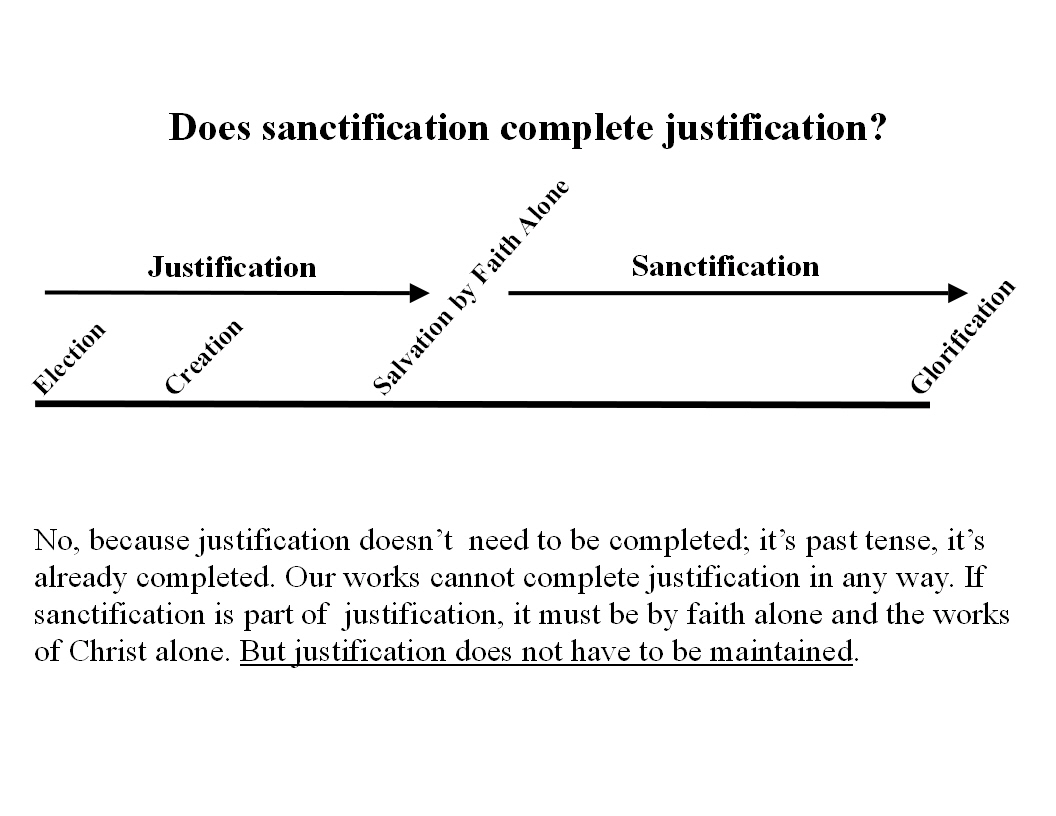
An excellent example is some strains of Freewill Baptists who teach that Christ died for all of our past sins, but with the help of the Holy Spirit, we must confess and repent of every sin we commit until the resurrection; e.g., Christ plus salvation by repentant prayer for sins committed after we are “saved.” My grandparents were saved out of this tradition. When my grandfather asked my grandmother if she thought that God could ever forgive him of all the sins he committed, she answered: “Yes, but you are going to have to pray awful hard!” Praise God that through the ministry of several individuals my grandparents eventually abandoned that gospel for the true one of salvation by faith alone as a finished work.
Likewise, Rome teaches that you must let the Catholic Church finish your justification through ritual; e.g., Christ plus Catholic ritual. The Reformation gospel is also Christ plus something else, but the something else is ever-so-subtle. In both cases, sin must be dealt with in sanctification in order for the saint to remain justified until the final judgment. In other words, the righteous standard of justification must be maintained on our behalf. Like all other proponents of a linear gospel, the Reformed crowd contends that anything less than the perfection demanded of the law (“all sin is transgression of the law”) is “legal fiction.” So both Rome and the Reformers agree: justification must be maintained by sanctification, and in the case of the Reformers specifically, they believe that the perfect standard of the law must be maintained until glorification; otherwise, our justification is “legal fiction.”
Here is where Reformed subtlety is uncanny: Christ keeps the law for us in sanctification. He maintains the perfect standard. All the fruit of sanctification (obedience/good works) flows from the life He lived on Earth and His death on the cross. Christ plus the works of Christ to finish salvation. “But Paul, what in the world is wrong with that!” Here is what is wrong with it: works are still required to maintain justification. That is a huge problem, even if it is Christ doing the work. What did the Hebrew writer say about Christ’s work for justification not being complete?
And even more subtle is the following Reformed idea: believing that the law is no longer a standard for maintaining justification is antinomianism. Antinomianism =’s legal fiction. Their definition of antinomianism is the removal of the law from justification as the standard for maintaining it. Traditionally, among Biblicist, antinomianism is the removal of the law from sanctification, and herein lays even further steroidal subtlety: the Reformed theologians would refute a removal of the law from sanctification as well, not only because they think justification and sanctification are the same thing, but because its perfect keeping is required to maintain a true declaration of the just that is not “legal fiction.”

However, the Biblicist believes that the law is a standard for kingdom living and is no longer a standard for justification. Therefore, if we attempt to obey it with the Holy Spirit’s help, and to please/serve the Lord, it can have no bearing on our just state. While the Biblicists think they are therefore joint contenders with the Reformers against antinomianism, such is far from the truth. The Reformed mind believes the Biblicist is either a legalist or an antinomian, or both. The Biblicist is supposedly an antinomian because he/she has removed the law from justification as a just standard, or is a legalist because they think they should strive to keep the law in sanctification. Since sanctification finishes justification’s perfect standard of law keeping, our “own” attempts to keep the law in sanctification is an attempt to finish justification. Hence, what the Biblicist fails to understand is the Reformers belief that Christ must maintain the law for us in sanctification because justification and sanctification are not separate. Anything more or less is supposedly works salvation.
On the other hand, because it is vital that Christ obeys the law for us in sanctification, the likes of John Piper and Tullian Tchividjian contend that those who are really preaching the Reformed gospel will indeed be accused of antinomianism. All in all, their position is easy to see if you pay attention. John Piper and many other Calvinists often state that, “Good works are the fruit of justification.” And, “Justification is the root, and sanctification is the fruit.”
Well, the average Biblicist then thinks, “Yes, but of course, our salvation makes good works in sanctification possible.” But that’s not what they are saying. If you pay closer attention, they are saying that justification is a tree that produces its own fruit. Justification is the root, and whatever happens in true sanctification is the fruit of the root of the justification tree. Problem is, justification doesn’t grow. Justification is a finished work. What Calvinists refer to as “progressive sanctification” is really the fruit of the root: progressive justification. Another name for this that they throw around is “definitive sanctification.” The word “definitive” refers back to the definite completion of justification.

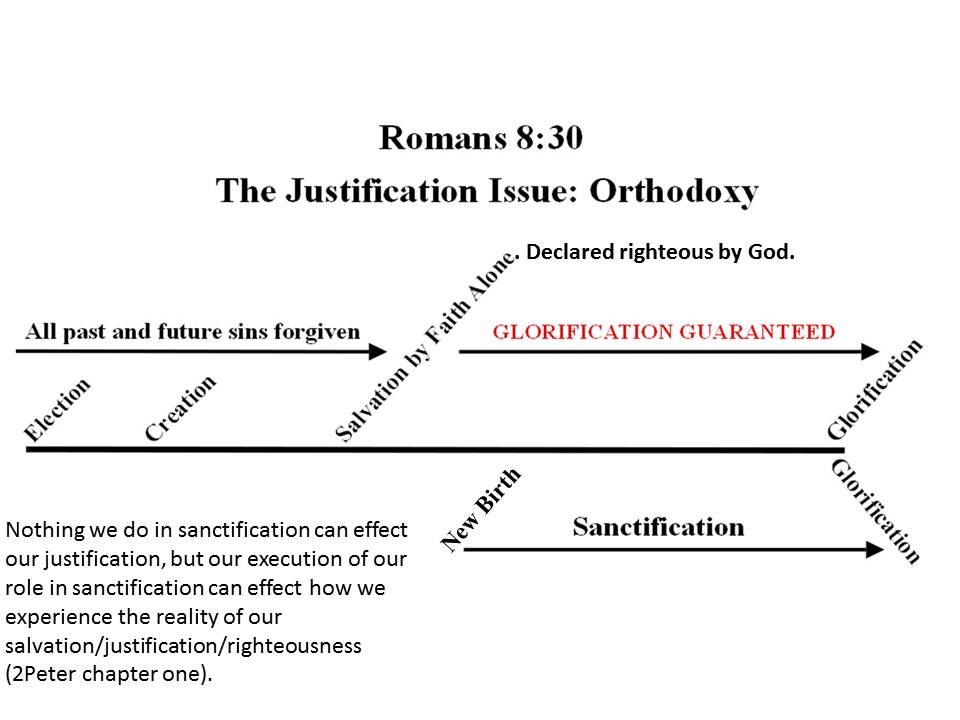
Revision: this ministry now rejects the idea that orthodoxy is truth; orthodoxy is the traditions of men. Never in Scripture do we find premise for a body of teaching that explains the teaching. The above illustration is valuable for demonstrating that the fruit of justification is glorification, NOT sanctification.
This brings us to the Scriptural argument which begins with a question I asked myself just this morning: “Paul, you are always harping about the crucial importance of the separation of justification and sanctification—a parallel gospel versus a linear one. But where does the Bible say specifically that this is critical?”
First, the very definition of a lost person in the Bible is one who is “under the law”:
Romans 3:19
Now we know that whatever the law says it speaks to those who are under the law, so that every mouth may be stopped, and the whole world may be held accountable to God.
Romans 6:14
For sin will have no dominion over you, since you are not under law but under grace.
Romans 6:15
What then? Are we to sin because we are not under law but under grace? By no means!
1 Corinthians 9:20
To the Jews I became as a Jew, in order to win Jews. To those under the law I became as one under the law (though not being myself under the law) that I might win those under the law.
Romans 7:1
Or do you not know, brothers —for I am speaking to those who know the law—that the law is binding on a person only as long as he lives?
Romans 7:2
For a married woman is bound by law to her husband while he lives, but if her husband dies she is released from the law of marriage.
Romans 7:3
Accordingly, she will be called an adulteress if she lives with another man while her husband is alive. But if her husband dies, she is free from that law, and if she marries another man she is not an adulteress.
The unsaved are “under the law” and will be judged by it in the end. This is the very definition of the unsaved. Calvinists define Christians the same way—we are supposedly still under the law and will be judged by it in the end. That’s why Christ must keep the law for us—because we are still under it.
If not this position, why do many in the Reformed tradition hold to the idea that Christ’s perfect obedience is imputed to our sanctification? His death justifies us, and His perfect life sanctifies us. Hence, His death pays the penalty for past sins, and then His perfect life imputed to our sanctification keeps us justified. Why would an imputation to our sanctification be necessary if we are no longer under the law? This is known as the Reformed view of “double imputation” and has been called out as heresy by many respected theologians for this very reason: it implies that Christians are still under the law.
In regard to sustaining the law in our stead, why? It has been totally abolished in regard to our just standing:
Romans 3:20
For by works of the law no human being will be justified in his sight, since through the law comes knowledge of sin.
Romans 3:21
But now the righteousness of God has been manifested apart from the law, although the Law and the Prophets bear witness to it—
Romans 4:15
For the law brings wrath, but where there is no law there is no transgression.
The keeping of the law by anybody DOES NOT do anything to justify mankind:
Romans 3:28
For we hold that one is justified by faith apart from works of the law.
Here is where the separation of justification and sanctification is vital on this first point: we ARE NOT under the law for justification, but rather UPHOLD THE LAW in sanctification. The two must be separate because of the differing relationships to the law:
Romans 3:31
Do we then overthrow the law by this faith? By no means! On the contrary, we uphold the law.
Romans 6:15
What then? Are we to sin because we are not under law but under grace? By no means!
Furthermore, if we are still under the law (whether or not Christ obeys it for us to keep us in a just standing), this means we are still under the power of sin. Being under the law and also under its spell to provoke sin in the unregenerate is spoken of as being synonymous in the Bible. Those who are “under the law” are also under the power of sin and enslaved to it:
Romans 7:4
Likewise, my brothers, you also have died to the law through the body of Christ, so that you may belong to another, to him who has been raised from the dead, in order that we may bear fruit for God.
Romans 7:5
For while we were living in the flesh, our sinful passions, aroused by the law, were at work in our members to bear fruit for death.
Romans 7:6
But now we are released from the law, having died to that which held us captive, so that we serve in the new way of the Spirit and not in the old way of the written code.
Romans 7:8
But sin, seizing an opportunity through the commandment, produced in me all kinds of covetousness. For apart from the law, sin lies dead.
If we are still under the law, and will be judged by it, whether or not Christ stands in the judgment for us with His own works, we are still enslaved to sin by virtue of being under the law…. for justification. And Calvinists know this to be true, that’s why they say we are still…. what? Right, even as Christians, “totally depraved.” And, “enemies of God.” Of course, throughout the Bible, Christians are spoken of as being friends of God and no longer His enemies. Our status as enemies of God is stated in the past tense. But the Reformed crew continually state that Christians are vile enemies of God and are enslaved to sin. They realize that this goes hand in hand with being under the law.
To the contrary, dying to the law in the death of Christ….for justification—sets us free to be enslaved to the righteousness that is defined by the law. We are dead to the law for justification and alive to obey truth….for sanctification:
Romans 8:2
For the law of the Spirit of life has set you free in Christ Jesus from the law of sin and death.
Romans 8:3,4 [emphasis by author]
For God has done what the law, weakened by the flesh, could not do. By sending his own Son in the likeness of sinful flesh and for sin, he condemned sin in the flesh,….in order that the righteous requirement of the law might be fulfilled in us, who walk not according to the flesh but according to the Spirit.
Romans 8:7
For the mind that is set on the flesh is hostile to God, for it does not submit to God’s law; indeed, it cannot.
Romans 9:31
but that Israel who pursued a law that would lead to righteousness did not succeed in reaching that law.
John 17:17
Sanctify them in the truth; your word is truth.
James 1:25
But the one who looks into the perfect law, the law of liberty, and perseveres, being no hearer who forgets but a doer who acts, he will be blessed in his doing.
So, that is the separation that must be for the true Christian: Justification has no law for which we are judged, and we live by the law of blessings in sanctification.
This brings us to another important separation in the two: the judgments. Those under the law and sin will stand in a final judgment which will be according to the law. Again, because Calvinists believe that we are still under the law, albeit that Christ obeyed/obeys it for us, Christians will supposedly stand in the same judgment as the damned who are under the law and enslaved to it. At that time, the children of God, according to Calvinists, will be “made manifest.”
But because Christians are not under the law and cannot be judged by it, they will stand in a judgment for rewards and not a judgment that determines a perfect keeping of the law by Christ in our stead. Hence, there will be two different resurrections: one for those under the law and another for those under grace, and two different judgments for the same two groups. One for rewards, and one to determine if those under the law kept it perfectly. That judgment doesn’t go well for any standing in it.
Luke 14:12-14
He said also to the man who had invited him, “When you give a dinner or a banquet, do not invite your friends or your brothers or your relatives or rich neighbors, lest they also invite you in return and you be repaid. 13 But when you give a feast, invite the poor, the crippled, the lame, the blind, 14 and you will be blessed, because they cannot repay you. For you will be repaid at the resurrection of the just.” [Notice that this is a resurrection for the “just.” They are already determined to be just before they are resurrected].
2Corinthians 5:9,10
So whether we are at home or away, we make it our aim to please him. 10 For we must all appear before the judgment seat of Christ, so that each one may receive what is due for what he has done in the body, whether good or evil.
1Corintians 3:11-15
For no one can lay a foundation other than that which is laid, which is Jesus Christ. 12 Now if anyone builds on the foundation with gold, silver, precious stones, wood, hay, straw— 13 each one’s work will become manifest, for the Day will disclose it, because it will be revealed by fire, and the fire will test what sort of work each one has done. 14 If the work that anyone has built on the foundation survives, he will receive a reward. 15 If anyone’s work is burned up, he will suffer loss, though he himself will be saved, but only as through fire.
Hebrews 6:10
For God is not unjust so as to overlook your work and the love that you have shown for his name in serving the saints, as you still do.
Revelation 20:6
Blessed and holy is the one who shares in the first resurrection! Over such the second death has no power, but they will be priests of God and of Christ, and they will reign with him for a thousand years.
Revelation 20:11-15
Then I saw a great white throne and him who was seated on it. From his presence earth and sky fled away, and no place was found for them. 12 And I saw the dead, great and small, standing before the throne, and books were opened. Then another book was opened, which is the book of life. And the dead were judged by what was written in the books, according to what they had done. 13 And the sea gave up the dead who were in it, Death and Hades gave up the dead who were in them, and they were judged, each one of them, according to what they had done. 14 Then Death and Hades were thrown into the lake of fire. This is the second death, the lake of fire. 15 And if anyone’s name was not found written in the book of life, he was thrown into the lake of fire.
Don’t let anyone tell you that eschatology is a “secondary” or “nonessential” consideration. Your eschatology is your gospel. It will state your position regarding whether or not you fuse justification and sanctification together; ie, likening Christians to those under the law.
Yet another vital difference in sanctification and justification is repentance. Repentance for salvation (when you are justified) is different from our repentance in sanctification. Among many in the Reformed tradition where the “same gospel that saved you also sanctifies you,” the repentance is the same. Repentance unto salvation is not a onetime “washing,” but rather a means to continue “in the gospel” through what they call, “deep repentance.” Biblicism holds to repentance in sanctification that restores his/her fellowship and communion with God as His children. They would see repentance unto salvation as differing, and only necessary for salvation—a onetime decision to take one’s life in a new direction by following Christ, and believing in his death, burial, and resurrection.
Reformed repentance, according to the likes of Paul David Tripp and others is a “daily rescue.” Our original repentance was for rescue, and we need rescue today as much as we needed rescue when we were saved. Again, this indicates their belief that we are still under the curse of the law and need to be continually rescued from it while remaining under the bondage of sin.
However, Christ made it clear to Peter (John 13:6-11) that those who have been washed (1Corinthians 6:11, Romans 8:30) do not need another washing. Those who drink of the living water do not thirst again (John 4:13,14).
Lastly, though many other separations could be discussed, why saints can be considered just while they still sin at times is of paramount importance. There is no sin in our justification because there is no law, and where there is no law, there is no sin. Though unfortunate, there can be sin in our sanctification because it is totally separate from justification and can’t affect our just standing with God.
Basically, all of the aforementioned makes it of necessity to deny the new birth. If we have God’s seed in us, and we do (1John 3:9), that dispels total depravity, and without total depravity, justification and sanctification cannot be fused together. The new birth is a huge problem for Reformed theology. If the old man that was under the law is dead (Romans 7:1ff), and the seed of God is in the saved person, and the sin due our weakness in the flesh cannot be laid to our account for justification, then our justification is not “legal fiction” because we do not exhibit perfect obedience to the law. This is another grave consideration because Christ said, “You must be born again.” Obviously, despite their denials that they deny the new birth—you can’t be both totally depraved and born again.
Reformation doctrine is clearly a false gospel. Its version of justification does not void the law, and denies the new birth while distorting everything in-between. Freewill verses predestination is hardly the issue, the very gospel itself is the issue.
paul
The True Gospel Verses Calvinism: Part 1
 “The difference between Calvinism and the true gospel is a fine line of distinction with eternal consequences.”
“Justification is a finished work that guarantees glorification apart from anything that happens in progressive sanctification….Justification is a finished work that guarantees glorification completely apart from progressive sanctification.”
“All bible verses must be interpreted by, verse….for justification, or verse….for sanctification.”
This post is actually in reply to the following question posted in the comment section of this blog:
Paul, please explain in layman’s terms how Calvinism views justification and sanctification. I am trying to understand this. Does this have anything to do with the saint’s persevering?
My initial response was several hundred words which were deleted somehow when I was near completion; I must have hit a wrong key or something, but this time I will be smart and type it on Microsoft Word first.
Let me begin by addressing this part of the reader’s question first: “Does this have anything to do with the saints persevering?” No. Please, let’s just focus on the foundation—you can address all of the many other issues later, but you will be unable to address them definitively until you have an understanding in regard to the first part of your question: “….how Calvinism views justification and sanctification.”
Short answer: It views them as being the same thing, and that’s a false gospel, and I will explain why (the forthcoming long answer). But first, know this: election does not necessarily mean that God predetermined before creation who was/is going to be saved and not saved. How God weaves His sovereignty together with our choices is a mystery. For example, “The heart of man plans his way, but the Lord establishes his steps (Proverbs 16:9).” Does this mean that we shouldn’t bother planning because the Lord has already determined our steps? Hardly. Proverbs 16:9 is speaking of the mystery/paradox of God’s weaving together of what we do and His sovereign will. Does prayer change things? Certainly it does. When we present the gospel to someone, do we say, “I am just here to find out whether you are one of God’s chosen or not. So, I am going to present the gospel to you, and if you believe and repent, you are one of the chosen, if you don’t, you are toast for eternity.” No, we persuade with all diligence and knowledge (like the apostle Paul did) as if it depends on us, because to some degree, it does. Bottom line:
How then will they call on him in whom they have not believed? And how are they to believe in him of whom they have never heard? And how are they to hear without someone preaching? (Romans 10:14).
God’s offer of salvation is a legitimate offer.
Justification 101 (For now, forget about sanctification, this concerns justification only!)
Nevertheless, when they/we believe, we know it’s because of Romans 8:30, which will be the focus of my explanation/long answer. Let’s now observe Romans 8:30:
And those whom he predestined he also called, and those whom he called he also justified, and those whom he justified he also glorified.
Done deal. Finished before the creation of the world. He predestined us, then called us, then justified us, and finally, glorified us. The word “justified” is dikaioo. It is a legal declaration of innocence that sets one free. Christians are declared righteous before creation, and glorification (when we will be instantly transformed completely at the resurrection) is guaranteed. We cannot mess that up. It’s a finished work by God before we were born. How can we possibly mess that up? We can’t.
Law/Justification [Gospel]
Also, the law can’t touch us. Why? We are already declared righteous, that’s why. Stop everything you are thinking about and take note of this: the law is no longer the standard for maintaining our salvation/justification. Do not turn your mind off here because of familiarity—this is not what you think it is. Pay attention! The difference between Calvinism and the true gospel is a fine line of distinction with eternal consequences. Caution: this is a concept that it so simple that it escapes us. We are no longer ….key word alert,….UNDER the law. In the book of Romans, Chapter 7, Paul compares our relationship to the law as a marriage covenant that is no longer valid because one of the spouses died:
Do you not know, brothers —for I am speaking to men who know the law—that the law has authority over a man only as long as he lives? 2 For example, by law a married woman is bound to her husband as long as he is alive, but if her husband dies, she is released from the law of marriage. 3 So then, if she marries another man while her husband is still alive, she is called an adulteress. But if her husband dies, she is released from that law and is not an adulteress, even though she marries another man.4 So, my brothers, you also died to the law through the body of Christ, that you might belong to another, to him who was raised from the dead, in order that we might bear fruit to God.
Now, I will slightly digress and bring danger of confusion, but will then quickly return to the subject of justification. Paul is talking about justification in this passage, and then finishes the thought with a mention of justification’s purpose; sanctification: “….in order that we might bear fruit to God.” BUT, as we shall see, other than the fact that justification makes sanctification (our kingdom living) possible, the two are totally separate, and the separation of the two is the key to understanding the issue at hand, and the true gospel in general.
….for justification.
We, as Christians, are dead to the law. It can’t touch us. We are no longer UNDER it:
Romans 2:12
All who sin apart from the law will also perish apart from the law, and all who sin under the law will be judged by the law.
But not us. The law can’t judge us, we are no longer under it:
Romans 3:19
Now we know that whatever the law says, it says to those who are under the law, so that every mouth may be silenced and the whole world held accountable to God.
Note that the world is under the law, but we are not. We have no regard for the law whatsoever, ….for justification.
Slavery/Justification
Paul also described our relationship to the law in regard to not being enslaved by it. To be evaluated by the law is to be in bondage to it:
Romans 6:14
For sin shall no longer be your master, because you are not under the law, but under grace.
Galatians 4
21 Tell me, you who want to be under the law, are you not aware of what the law says? 22 For it is written that Abraham had two sons, one by the slave woman and the other by the free woman. 23 His son by the slave woman was born according to the flesh, but his son by the free woman was born as the result of a divine promise.
In fact, Paul said for us Christians, ALL things are lawful!
1 Corinthians 6:12
All things are lawful for me, but not all things are profitable. All things are lawful for me, but I will not be mastered by anything.
All things are lawful, but not all things are profitable. All things are lawful, but not all things edify.
But not expedient, or profitable….
….for sanctification. Sanctification 101
There are two kinds of sanctification, but only one kind of justification, and the two sanctification are totally separate from justification. If not, we are eternally doomed. Justification must be a finished work that we have no part in except for showing others how they can be justified like we are; saved, if you will. Note: Romans 8:30, the epic verse of justification, does not include the subject of sanctification because the two must be separate. One is a finished work (justification), the other, sanctification (or, kingdom living) is progressive. In fact, Dr. Jay E. Adams states well that sanctification (our Christian life) does not in any way draw it’s life or power from justification because justification is a legal declaration that determines our POSITION:
The problem with Sonship™ [same thing as New Calvinism prior to 2008] is that it misidentifies the source of sanctification (or the fruitful life of the children of God) as justification. Justification, though a wonderful fact, a ground of assurance, and something never to forget, cannot produce a holy life through strong motive for it. As a declaration of forgiveness, pardon, and adoption into the family of God, it is (remember) a legal act. It changes the standing, but not the condition, of the person who is justified.
That’s because justification is a finished work, and discipleship (sanctification) is not; it’s progressive. But, there is also a positional sanctification that is also a finished work that even preceded justification. But like justification, it is a finished work and cannot produce progressive life, because for crying out loud, a finished work doesn’t continue to produce a progression. This would seem evident. Remember this: sanctification is a word that merely means, “to set apart.” So, sanctification is a progressive separating from the world. As we progress in our sanctification, we look more like Christ, and less like the world. But there is also a positional separation from the world that is also a finished work that includes predestination, election, calling, justification, and a setting apart:
Such were some of you; but you were washed, but you were sanctified, but you were justified in the name of the Lord Jesus Christ and in the Spirit of our God (1Corinthians 6:11).
Notice the past tense of the verse. Our position is a finished work. We were washed, set apart, and justified. Peter asked Jesus to wash him. But Christ told him that there was no need for him to be washed because it had already been done, he only needed a daily washing of his feet:
The evening meal was being served, and the devil had already prompted Judas Iscariot, son of Simon, to betray Jesus. Jesus knew that the Father had put all things under his power, and that he had come from God and was returning to God; so he got up from the meal, took off his outer clothing, and wrapped a towel around his waist. After that, he poured water into a basin and began to wash his disciples’ feet, drying them with the towel that was wrapped around him. He came to Simon Peter, who said to him, “Lord, are you going to wash my feet?” Jesus replied, “You do not realize now what I am doing, but later you will understand.” “No,” said Peter, “you shall never wash my feet.” Jesus answered, “Unless I wash you, you have no part with me.” “Then, Lord,” Simon Peter replied, “not just my feet but my hands and my head as well!” Jesus answered, “A person who has had a bath needs only to wash his feet; his whole body is clean. And you are clean, though not every one of you.” For he knew who was going to betray him, and that was why he said not everyone was clean (John 13:2-11).
Justification and the New Birth
Though justification is a finished work, it passes the torch to something that is a mark of true salvation. This is where sanctification draws its power. This element of sanctification is a Proof of Purchase Seal that you and I have been purchased by God with the price of His Son. It is the new birth. We are born of the Holy Spirit into new creatures. Our spiritual growth is now a colaboring with the Holy Spirit who indwells us. He also colabored with saints of old, but His permanent indwelling of New Testament believers is probably related to the engrafting of the Gentiles. But whatever the reasons, remember that the saints of old were also justified by faith alone, and like us, they were not UNDER the law….for justification.
Paul makes this point in Galatians 3:13-18:
Christ redeemed us from the curse of the law by becoming a curse for us, for it is written: “Cursed is everyone who is hung on a tree.” He redeemed us in order that the blessing given to Abraham might come to the Gentiles through Christ Jesus, so that by faith we might receive the promise of the Spirit.
Brothers, let me take an example from everyday life. Just as no one can set aside or add to a human covenant that has been duly established, so it is in this case. The promises were spoken to Abraham and to his seed. The Scripture does not say “and to seeds,” meaning many people, but “and to your seed,” meaning one person, who is Christ. What I mean is this: The law, introduced 430 years later, does not set aside the covenant previously established by God and thus do away with the promise. For if the inheritance depends on the law, then it no longer depends on a promise; but God in his grace gave it to Abraham through a promise.
Hence, the law CANNOT be our standard…. for justification. Paul makes that clear by pointing out that the law didn’t come for 430 years after Abraham was justified according to the covenant of promise. Nevertheless, we must be born again (new birth). Again, the new birth is proof of Justification, but is not powered by it. The new birth is the indwelling Holy Spirit colaboring with His new creatures. Theologians call this, regeneration. We, like the saints of old, MUST BE BORN AGAIN. Before the cross, and before Pentecost, Christ made this clear to Nicodemus in the present tense, and expressed surprise that he was ignorant of the new birth (John, chapter 3).
And this is very, very important: regeneration does not work towards/for glorification. Sanctification (the progressive type) is NOT a link to glorification. Remember, glorification is a finished work. Romans 8:30 speaks of it in the past tense. It is the guarantee of our justification. Both happened before the creation of the world. Some theologians call glorification, “final sanctification.” Perish the thought! Glorification is the manifestation of positional sanctification (both are final, finished works), NOT the completion of progressive sanctification. Though the completion of progressive sanctification happens at the same time as glorification—glorification is a finished work, and therefore is not the culmination of progressive sanctification’s progressive work; it is rather, redemption. Redemption is the manifestation of glorification when God cashes in on his purchase:
There will be signs in the sun, moon and stars. On the earth, nations will be in anguish and perplexity at the roaring and tossing of the sea. People will faint from terror, apprehensive of what is coming on the world, for the heavenly bodies will be shaken. At that time they will see the Son of Man coming in a cloud with power and great glory. When these things begin to take place, stand up and lift up your heads, because your redemption is drawing near (Luke 21: 25-28).
Though the Bible speaks of glorification as a future event, Romans 8:30 refers to it in the past tense. This is because it does not need progressive sanctification to complete it (again, progressive sanctification is not included in the list of Rom. 8:30), and the past tense usage points to the guarantee that accompanies justification.
Justification and progressive sanctification are totally separate. Progressive sanctification DOES NOT link justification to glorification. Justification is a finished work that guarantees glorification apart from anything that happens in progressive sanctification. This is why progressive sanctification is excluded from this paramount justification verse….for justification, and speaks of justification and glorification in the past tense. Justification is a finished work that guarantees glorification completely apart from progressive sanctification.
One Law; Three Relationships/Standards
Hence, the law, which includes all of Scripture (see Matthew 4:4, 2Timothy 3:16) must always be read in this context: ….for justification, or….for sanctification. The standard/relationship…. for [our] justification is ZERO LAW. The standard/relationship….for [our] sanctification is….100% law! Why not? It’s not related to our justification anyway! Therefore:
Do not think that I have come to abolish the Law or the Prophets; I have not come to abolish them but to fulfill them. For truly I tell you, until heaven and earth disappear, not the smallest letter, not the least stroke of a pen, will by any means disappear from the Law until everything is accomplished. Therefore anyone who sets aside one of the least of these commands and teaches others accordingly will be called least in the kingdom of heaven, but whoever practices and teaches these commands will be called great in the kingdom of heaven. For I tell you that unless your righteousness surpasses that of the Pharisees and the teachers of the law, you will certainly not enter the kingdom of heaven (Matthew 5:17-20).
The word for “set aside” is lou. It means to “relax” or loosen. That is, in regard to the “least of these commandments.” So, do we interpret this way: “Whoever practices and teaches these commands”….for justification; or, ….for sanctification ? The framing of a house and the rightness of its foundation will determine its quality. Are the frame and the foundation going to be perfect? No. But is that the standard? One would hope so. We should strive for perfection in sanctification for many reasons, but most of all, because it has no bearing on our justification which is a settled issue. However, Christ links a poor attitude towards the law in sanctification to an absence of the new birth/ new creaturehood:
For I tell you that unless your righteousness surpasses that of the Pharisees and the teachers of the law, you will certainly not enter the kingdom of heaven.
Unfortunately, the relationship/standard in regard to the unregenerate is perfection ….for justification because they are UNDER the law and in bondage to it. Christians are free from the law for justification and “uphold” (Romans 3:31) it…. for sanctification. That is why James refers to it as the “perfect law of liberty” in James 1:25. All Bible verses must be interpreted by, verse….for justification, or verse….for sanctification.
Eschatology and Justification
This is why in the study of biblical last things (eschatology), we find two resurrections and two judgments. One resurrection and judgment for the saved, and a separate resurrection and judgment for the unsaved. Unfortunately, the standard for the second set will be perfection, and nobody will measure up (Revelation 20:4-6; 11,12). We will be a part of the “resurrection of the just” (Luke 14:14) and will not stand in such a judgment because we have already been declared just. Our judgment will be for rewards:
For we must all appear before the judgment seat of Christ, so that each of us may receive what is due us for the things done while in the body, whether good or bad (2 Corinthians 5:10).
Obviously, we can’t do this: 2Cor 5:10…. for justification. That would be a huge problem.
I will conclude with a visual chart to help clarify the above. In the second part, we will examine the difference between this and Calvinism.
Jerry Bridges Proffers Gospel-Driven Bondage
“….they’re going to show pastors how to *see justification only* throughout the whole Bible. If they were forthright, that’s how they would state it.”
“’Jesus / gospel‘ replaces ‘justification,’ and masks the real intent: to make every verse in the Bible about justification and thereby eradicating the use of the Law in sanctification.”
Let me begin with some groundwork. As John MacArthur said in his book “Truth War,” to fight error in our day takes determination, perseverance, and tenacity. This is because today’s propagators of false doctrine are masters of nuance. In regard to those who propagate the antinomian doctrine of Gospel Sanctification, the goal is to eliminate application of biblical imperatives by referring to such a use of God’s word as “living by lists,” “reducing the Bible to a book of rules,” etc. Of course, they don’t mention that the Bible has “rules” that are often stated in list form. Therefore, they carefully word their presentation so you will assume they are talking about people who use the Bible in a legalistic way. Meanwhile, they ignore practical application of the Scriptures while heavily emphasizing grace. Soon our particular efforts in sanctification will be buried and forgotten (out of sight, out of mind) while subtle / negative references to the application of biblical imperatives slowly throws one more shovel-full of dirt on the hole that obedience is buried in.
This method is also accompanied by synthesizing justification and sanctification. Obviously, if we are sanctified by the same monergistic gospel that saved us, we can’t do anymore with the Law in sanctification than we did with it in justification. After all, one of the Gospel Sanctification mantras is “the same gospel that saved you also sanctifies you.” D.A. Carson, in an interview with Tim Keller concerning the T4G 2011 conference, shared that the main thrust of that conference will be to teach pastors how to “drive toward Christ and the gospel” and to show what “Biblical Theology [ie., Geerhardus Vos hermeneutics] looks like” in order to “read the Bible in such a way that you [always] get to Jesus.” Let me rephrase that. What D.A. Carson really means is they’re going to show pastors how to *see justification only* throughout the whole Bible. If they were forthright, that’s how they would state it. If the “same” gospel that saved us also sanctifies us, then sanctification is monergistic. If it’s not monergistic, then it’s not the same gospel that saved us. They can only have it both ways until people start asking questions. Later in the interview, D.A. Carson disingenuously notes that several perspectives on preaching will be presented at the same conference; supposedly, unlike other conferences (who only present the Grammatical Historical perspective). In saying this, he assumes the listeners will not associate the term “Biblical Theology” with hermeneutics. Let me also add that it’s not really about always getting to Jesus; it’s about always getting to “what Jesus has done, not what we have done” (another GS mantra often used by Micheal Horton). “Jesus / gospel” replaces “justification,” and masks the real intent: to make every verse in the Bible about justification and thereby eradicating the use of the Law in sanctification.
This now brings me to the significance of an excerpt from the Jerry Bridges book, “Transformed by Grace.” Jerry Bridges (who coined the phrase, “we must preach the gospel to ourselves everyday”) is not any different from most GS advocates; it’s difficult to find definitive grounds for argument in their nuanced approach. Most of the time you will have to read several pages in order to find clear statements that reflect what they really believe. In this case, another blogger supplied the following excerpt from the above mentioned book. My comments are in brackets:
“Paul’s call to stand firm in our freedom in Christ and not let ourselves be burdened by a yoke of slavery is just as valid today with our rules as it was in the Galatians’ day with the Mosaic law… God gave us our spiritual Magna Charta.
[Paul’s call to freedom in Christ regards freedom from being justified by the Law. Here, Bridges extrapolates that idea into the realm of sanctification. As I mentioned above in my introduction, we see Bridges slight the idea of applying biblical rules to life, but doing so subtly by calling them “our” rules. But since the Mosaic Law is part of scripture, and he makes that comparison, he is really talking about the application of the Mosaic Law (where applicable, ie., Ephesians 6:1) to life. Also, though Jesus’ yoke is light, we, in fact, are His slaves and were “bought with a price.” ]
Through Paul, He called us to be free: ‘You, my brothers, were called to be free.’ In fact, God doesn’t just call us to freedom, he actually exhorts us to stand firm in our freedom – to resist all efforts to abridge or destroy it.
[Yes, in regard to justification, BUT as Christians, we actually find our freedom in aligning our lives with God’s law:
James 1:25
“But the man who looks intently into the perfect law that gives freedom, and continues to do this, not forgetting what he has heard, but doing it—he will be blessed in what he does.”
James 2:12
“Speak and act as those who are going to be judged by the law that gives freedom….”
Furthermore, Jesus said that the “truth will set you free,” and “thy word is truth.” Freedom comes from applying God’s word to life. We are set free by being slaves to Christ’ lordship, that isn’t the same as being in bondage to the Law in an attempt to be justified by it.]
Despite God’s call to be free and His earnest admonition to resist all efforts to curtail it, there is very little emphasis in Christian circles today on the importance of Christian freedom. Just the opposite seems to be true.
[But we are called to freedom on two fronts: freedom from the Law for justification, and freedom from the bondage of sin by obeying the perfect Law of liberty. Bridges only refers to the one. Why? Because in his mind, they are both the same, that’s why. However, in our day, the freedom that is not being emphasized is freedom for the believer by PROPERLY aligning his or hers life with the word of God.]
Instead of promoting freedom, we stress our rules of conformity.
[They’re not OUR rules, they are the Lord’s rules. Please note that a “lord” usually has rules he wants you to follow.]
Instead of preaching living by grace, we preach living by performance. Instead of encouraging new believers to be conformed to Christ, we subtly insist that they be conformed to our particular style of Christian culture. Yet, that’s the bottom line effect of most of our emphases in Christian circles today.
[ Living to love Christ by keeping His Law and striving to please Him accordingly is not “living by performance,” that is a typical GS red herring. Paul said whether in the body or apart, “we make it our goal to please Him,” and obviously, the word of God is the standard for that. Also, notice the *us against them* mentality in the suggestion that supposed graceless living is a “Christian culture” in most “Christian circles today.” This is indicative of the GS mentality that believes they are on a mission from God to save the church from the Dark Ages of synergistic sanctification.]
For example, many people would react negatively to my quoting only part of Galatians 5:12, ‘You, my brothers, were called to be free.’ Despite the fact that this statement is a complete sentence, they would say, ‘But that’s not all of the verse. Go on to quote the remainder: ‘But do not use your freedom to indulge the sinful nature; rather, serve one another in love.’…
[Jerry, Jerry, Jerry, the Galatians were being tempted to go back to a system that taught you had to keep the Law to maintain your salvation, NOT the idea that you keep the Law to love Christ and to please Him. We believe that we are kept by the power of God, but that does not negate our call to uphold the Law of God!]
The person who reacts this way has made my point. We are much more concerned about someone abusing his freedom than we are about his guarding it. We are more afraid of indulging the sinful nature than we are of falling into legalism.
[Here, Bridges makes the shocking suggestion that being concerned with keeping the Law is not “guarding” our freedom, and that being more afraid of indulging in the sinful nature than guarding our “freedom” is legalism. This troubling assertion should speak for itself.]
Yet legalism does indulge the sinful nature because it fosters self-righteousness and religious pride. It also diverts us from the real issues of the Christian life by focusing on external and sometimes trivial rules.” – Jerry Bridges, Transforming Grace, pp. 121-122
[ In this last statement, Bridges notes another GS staple often propagated by Paul Tripp and David Powlison; namely, our efforts as Christians to uphold the Law leads to self-righteousness and religious pride, and to make such an effort is “focusing on external and sometimes trivial rules.” Instead, we should supposedly only focus on “what Jesus has DONE rather than our OWN efforts,” which supposedly leads to an automatic kind of obedience earmarked by a willing and joyful spirit / attitude.]
How can bridges talk so strongly about one freedom without at least mentioning the other? Because that’s the freedom (through the Law in sanctification) he doesn’t want to emphasize even though his audience is Christian. Therefore, what Bridges is actually teaching is a gospel-driven bondage that averts Christians away from an effort to apply God’s word to life. Not only that, we now have conferences that are teaching leaders to propagate this approach wholesale throughout the church; true freedom as bondage. Buyer beware.
paul

 Paul's Passing Thoughts
1 comment