Does the Law Really Lead People to Christ by Revealing Sin Only?
 Originally published October 14, 2013
The insanely celebrated return to our Reformed roots teaches the following about the law:
We are unable to keep the law perfectly. And since a perfect keeping of the law is the standard for righteousness required to live with God forever, our inability to keep the law perfectly leads us to Christ who must keep/fulfill it for us. As Christians, we continue to use the law in this way to “preach the gospel to ourselves.” The more we use the law to show our innate sinfulness, the more we experience “vivification” (a joyful, perpetual rebirth).
The bogus idea that perfect law-keeping is justification’s standard aside, the most popular text that supposedly supports this idea is Galatians 3:24 –
So then, the law was our guardian until Christ came, in order that we might be justified by faith.
To make that verse work, “guardian” (paidagōgos) is often translated as “tutor.” That’s a stretch. The word is better translated “protector”:
Among the Greeks and the Romans the name was applied to trustworthy slaves who were charged with the duty of supervising the life and morals of boys belonging to the better class. The boys were not allowed so much as to step out of the house without them before arriving at the age of manhood (Strong’s Dictionary).
Furthermore, the Reformed gospel teaches that the law is used by the Christian for this same purpose in our Christian walk—to continually lead us closer and closer to Christ by showing forth sin. This blatantly contradicts the context of the passage:
Galatians 3:25 – But now that faith has come, we are no longer [added] under a guardian,
Reformed doctrine clearly teaches that Christians are still under the law’s purpose to show us a deeper and deeper need for Christ and His grace as we see our own sinfulness in a deeper and deeper way. In other words, for Christians, God’s word still has a redemptive purpose. This is the basis for Historic Redemptive hermeneutics. However, even in regard to the lost, the showing forth of sin is only one purpose for the law, but far from being the only one.
Primarily, the law shows forth life. This is by far the primary theme of law throughout the Scriptures. The law shows forth the wisdom of God, and the wellbeing (blessings) of those who follow it. The law is also framed in the context of promise much more than it is judgment.
This gets into the major crux of the Reformed false gospel; the fusion of justification and sanctification concepts. The blessings of law-keeping can be experienced by unbelievers and believers alike, but such cannot obtain eternal life. The point is that the law shows forth life as much as it does death. It shows both. Again, this is a constant theme throughout the Scriptures. Who will deny that unbelievers will have a higher quality of life to the degree that they follow God’s law? No, it can’t gain salvation for them, but the law brings horizontal blessings by virtue of its wisdom.
Point in case:
1Peter 3:1 – Likewise, wives, be subject to your own husbands, so that even if some do not obey the word, they may be won without a word by the conduct of their wives, 2 when they see your respectful and pure conduct.
In this passage, the husband is not won over by the wife demonstrating how sinful we are and our subsequent need for Christ; she is showing forth the blessings of being a believer. These are blessings that he is also experiencing because the home is sanctified by her presence:
1Corinthians 7:14 – For the unbelieving husband is made holy because of his wife, and the unbelieving wife is made holy because of her husband. Otherwise your children would be unclean, but as it is, they are holy. 15 But if the unbelieving partner separates, let it be so. In such cases the brother or sister is not enslaved. God has called you to peace. 16 For how do you know, wife, whether you will save your husband? Or how do you know, husband, whether you will save your wife?
So, there is a sense in which the unbelieving spouse is blessed by the believing one. The law not only shows forth sin, but also shows forth life. The latter is the way the law leads people to Christ just as much as the former.
paul
Good Works, Sin, and the Law
 “Tullian Tchividjian once said that his assurance, as far as he could have it, was based on the fact that he has never done a good work; that’s just good solid Protestant soteriology.”
“ Sin has a foe in both the lost and the saved…Child psychologists say their deepest challenges abide with children who have no conscience.”
Truth be known, most professing Christians are uncomfortable with the idea that salvation is a mere legal declaration by God based on a signed contract. According to the contract, we are declared legal by God if we denounce all self worth, declare all of our works and the works of others as “filthy rags,” and submit ourselves to “godly authority.” According to Luther and Calvin, we are in breach of contract if we think we can do a good work. And because of our supposed natural pertinacity to think we have some goodness within us, we can never be sure that we are upholding our end of the bargain. Tullian Tchividjian once said that his assurance, as far as he could have it, was based on the fact that he has never done a good work; that’s just good solid Protestant soteriology. Of course, this so-called gospel is couched in spiritual sounding terms like “covenant” and “grace” and “justification,” etc.
Most Christians are uncomfortable with what goes on in the institutional church, but what else is there? Protestantism, like all doctrines of tyranny, seeks to dumb down the masses they seek to control. Why? Because one of the major essences of sin is a desire to control. Collectivist doctrines and Sin have always walked closely together, and always will, be driven by low information. Protestants can make no sense of the world at all without paradox as a primary hermeneutic; and in fact, paradox is the primary hermeneutic of orthodoxy. Funny, if not so sad, would be the Protestant assertion that “walk by faith and not by sight” means that it is perfectly alright that life makes no sense at all. After all, we are “totally depraved,” and cannot really know anything except “Christ and Him crucified.”
The Catholic Church has never been shy about stating that information in the hands of the great unwashed is like handing a toddler a loaded gun, but Protestant academics skinned the cat a different way: knowledge about the fact that you can’t know anything is really, really deep, and shame on any saint that does not “study [this fact] to show yourself approved.” And, but of course there is work in the Christian life; as Tullian Tchividjian also said, seeking to see your depravity in a deeper and deeper way IS hard work! Again, because of our “natural” tendency to think we can do something good.
So, a knowledgeable Protestant will interpret the following event this way: a garage mechanic finds 10,000 dollars left in a car, and the former owner was unaware that her dead husband left it there to surprise her. He turned in the money to his manager; seemingly a good deed. But, this auto mechanic is going to hell because he thinks he did a good work. According to Luther and Calvin, believing you can do a good work is “mortal sin,” and the belief that one can fulfill any aspect of the law perfectly. Less knowledgeable Protestants are merely confused by these kinds of events because they, by design, have no real knowledge of biblical law/gospel.
First of all, we must begin with a very, very short philosophy lesson that dumbed-down Protestants don’t think they need. But, fact is, if you don’t have at least a basic knowledge of Gnosticism, you will be unable to understand little going on in the church today, if anything. However, I am going to make this very simple: holiness can dwell with weakness. The present creation, though fallen, is not inherently evil, but rather weak. Weakness does not equal evil. Let me demonstrate. Are the angels weaker than God? Yes, but are they also “holy”? Yes.
Our mortality makes us weak, and Sin abides in our mortal bodies, but Sin does not define mortality. We have the treasure of the new birth in clay (weak) vessels. Sin has a foe in both the lost and the saved. In the lost who are not born again, Sin’s foe is the law written upon the heart’s of every individual born into the world. The conscience is the judge that sits over this law and either accuses the individual or excuses them. Child psychologists say their deepest challenges abide with children who have no conscience. If the conscience (judge) has no law, there is no condemnation.
Hence, lack of a developed moral compass via teaching will generally determine the potency of a child’s conscience, and also determine one’s moral compass into adulthood. A judge without a law sits silently. We see this dynamic at work in the aforementioned article cited by the embedded link. Christ often noted that the law written on every person’s heart is a sort of thumbnail version of the more specific law that is the Bible. It is not uncommon for the secular “Golden Rule” to be biblically consistent. This is why the mechanic said he gave back the money; it’s the way he was raised (learned common decency that gives the conscience [judge] a law to work with), and he imagined how he would have felt if the money was his and he lost it (do unto others as you would have others do to you).
So did he do a good work? Yes, of course he did. He obeyed the law written on his heart by God. Will that good work save him? No, of course not. The conscience may temporarily reward him with good feelings, but that will not save him either. This is where we must segue into a little more philosophy. What is your perception of God? Is He an invisible aloof God that disdains everything material? Should we be amazed that He would even acknowledge our existence on any level? Or is He a God that makes Himself known and wishes to see all people saved? Does He actively push all to the precipice of salvation through the very design of His gospel? I think it is the latter, and this is where freewill comes into play: God creates a conscience and a law within us, but it is up to us to develop the conscience through choices. If parents understand this biblical dynamic, they have a clear choice in how they raise their children including the acceptance of contrary philosophies regarding the conscience.
So, God sought to further define what we will call the common heart law with the Old Covenant law, or the law of Moses. There are two laws being dealt with here, and Sin is against both laws. Therefore, the increase of law gives Sin more opportunity to condemn. Sin came into the world as an enemy of good, and its mode of operation is to incite rebellion for purposes of condemnation. Sin seeks the destruction of God’s creation on all counts. More law gives Sin more opportunity to condemn through sinful desires. Sin appeals to the individual through sinful desires, and those desires will prevail according to the strength of one’s developed conscience. Have no doubt: there is a warfare going on inside the unbeliever. Remember, the mechanic acknowledged that keeping the money was a desirable thought, but he knew that would be wrong, was not how he was raised, and wouldn’t be treating others the way he wants to be treated. Moreover, he probably knew his conscience would not allow him to enjoy the booty anyway.
The law is also good. The more law the better. The law is the standard for loving God and others. What if God ended the law’s ability to condemn and only made it useful for love? This would disarm Sin; if sin cannot condemn, it has no power, purpose, or incentive. This is where we talk a little bit about the gospel of Moses. The law can condemn leading to death, and it can love leading to life. As far as those born under the law, they can choose life or death, but ultimately, their end is death. They will suffer lesser death to the degree that they obey their consciences.
This is where the true gospel comes in according to the new birth. The law of Moses not only defines all sin leading to death, but it also defines all love leading to life. Until Christ came, all sin was imputed to the law as a possible indictment. The law held sin “captive” until “faith” came. Of course, the law could still be used to love as well. Christ’s primary gospel role was to die on the cross to pay the penalty of sin, and thereby ending it. Sin or the law? Both. Christ’s death ended the law’s ability to condemn. His death on the cross paves the way for the Spirit to baptize a believer in His death, and resurrect the believer in the same way He resurrected Christ. The new creature born of God cannot be condemned by the law, and therefore, Sin is stripped of its power. That is, IF the believer knows this. Sin can still make an appeal through desires, but the new birth counters that with NEW DESIRES infused by the new birth, specifically, a love for the law that did not previously exist. A believer can still experience the consequences of temporary death from disobedience and the fear thereof, but not the fear of eternal death because there is now no condemnation for those who are in Christ, viz, born into His literal family with God the Father.
So, yes, everyone does good works, but for the unsaved it is lesser death; for the believer it is more life. The unbeliever is still under the condemnation of the law, has an indifference to God’s law, and doesn’t see God’s law as the definition of love. This is why unbelievers often distort the meaning of the word, for one example among myriad, “I love you, but I am divorcing you.” This makes the unbeliever captive to sin. Depending on one’s upbringing, and consequently the strength of their conscience and good habits, their life will be commended by lesser death, but not more life.
In contrast, the born again believer is free from all eternal condemnation, thus stripping Sin of its power, is given a new-found love for the law and truth, and experiences life more abundantly unless he or she obeys sinful desires still present leading to death albeit temporary consequences.
BUT, if so-called believers are taught that they cannot obey the law “perfectly” (which is not the point to begin with) which is supposedly the standard for being truly justified, and thereby leading to a relaxing of the law, you can now easily understand why secular people often live better than church members: their lesser death looks better than lesser life. In other words, the lost world can obey their consciences better than “God’s people” can obey the Bible because they don’t believe they can.
Moreover, so-called saints can also see the law written on their hearts as equally futile because law is law either way—law can only condemn. This totally eliminates the concept of justice which is not absent from the law written on the hearts of all born into the world. This means that the world will have more of a concept of justice than the church. Sound familiar?
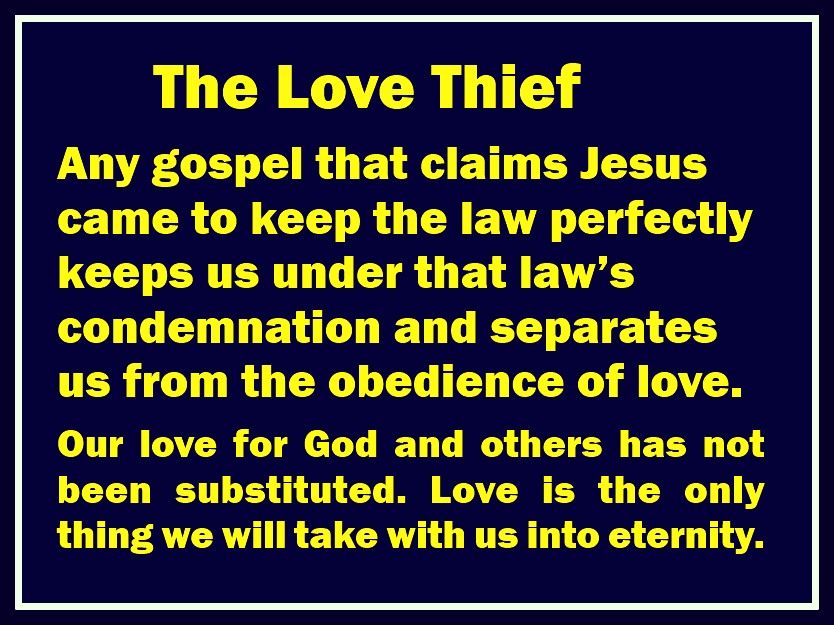
Justification is not a mere “legal declaration.” In fact, law has not one wit anything to do with justification. The law either condemns or loves depending on whether a person is saved or unsaved. For the true believer, the law is for love—not justification. The belief that Christ keeps the law for us, because all are unable, accomplishes nothing because the law cannot justify—it can only love.
paul
Is The Baptist Tithe Nothing More or Less Than a Catholic Indulgence?
“Christians” need to understand church isn’t what it used to be. It was ok for about a 100 years due to a mixture of Scriptural truth and Protestant orthodoxy, but once again, the church is returning to authentic Protestantism—Protestantism was ok when it was misinformed by grammatical vestiges of Scripture, but those days are gone; Protestantism is returning to the original article at breakneck speed.
And few misinformed sanctified pastors of the old school are standing their ground; yes indeed, everybody is doin’ it.
The likes of John Piper and John MacArthur Jr., who clearly represent mainline evangelicalism, have said in no uncertain terms that being a church member is synonymous with being part of the body of Christ (8:25 mark). Ministries like 9 Marks aka Mark Dever make it clear that church leaders, according to them, have authority over salvation on earth via John Calvin’s “power of the keys.” TANC Ministries has written on these facts extensively with accompanied citations numbering in the hundreds.
Also in vogue by church leadership is bringing people up on church discipline for not tithing. This is heavily endorsed by the who’s who of the Southern Baptist Convention like Al Mohler and David Platt. Church discipline is the Catholic version of excommunication. It’s their way or the highway, and in this case, a highway to hell according to them. While attending a local SBC pastors conference some time ago in Springboro, Ohio, I got into a serious tiff with one of the workshop teachers over tithing cash. In other words, somebody who merely puts cash directly into the golden plate or sacred basket without personal identification. His argument at the time to me follows: “That’s not being accountable to the church leaders.”
As a longtime SBC pastor, let me share the paramount SBC pastor fib: “I don’t know what the members tithe.” And the same SBC pastor hacks that would tell you that will also stick out their chests and say, “I am on my way to the hospital to visit ________, God put him there to extract the tithes he has been robbing from God.” In the past, half pregnant Protestant pastors used fear, the kickback of prestige, and the allurement of tax deductions to get the tithe, now in keeping with a more accurate Protestantism, they will take away your salvation if you don’t pony up. Shockingly, many evangelical churches require a financial statement in lieu of membership, and people actually cooperate accordingly.
How can this be? While the populous is becoming more and more irreligious, the church infrastructure that continues to be supported by private funds defies belief in light of the church’s steroidal hypocrisy and indifference to justice. One example among myriad follows: while the church doth protest abortion contentiously, statistics show that abortions are higher in number among evangelicals than those of the secular realm. Regardless of outrages perpetrated by both churches, Catholic and Protestant, the money keeps pouring in. There is only one answer that makes any sense at all: the church brokers salvation. And the linchpin of the deal is good ole’ fashioned forgiveness of “present sin.”
Whether Protestant or Catholic, the brokerage of forgiveness knows no bounds. In medieval times, Catholics could purchase forgiveness for premeditated murder before they committed the act in case fate would prevent one from making it to the parish after the deed was accomplished. The price list for Catholic indulgences is fairly easy to find online via Google. TANC possesses some actual cash receipts for indulgences from the 1940’s. Actually holding them in one’s hand and reading them is downright creepy. The concept certainly gives new meaning to the truism, “It’s easier to get forgiveness than permission.”
Protestants are a little bit more discreet in brokering forgiveness for “present sin.” The idea here is that justification is defined by fulfilling the “righteous demands of the law” instead of new birth into the literal family of God. Think about it: if we are once born again always born again and sealed by the Holy Spirit until redemption, what do we need the institutional church for? Trust me, merely being better informed on how to love God and others does not raise the stakes high enough to support four million dollar aquariums in the church lobby; no my friends, it is our very salvation that must be at stake—that’s what brings in the big greenbacks. In an envelope with your name on it of course, and studiously recorded lest you not get a tax deduction (wink, wink).
But should I pay the 10% temple tax on net or gross income? According to everyone, gross, who knew? When you give saint to saint you give from net income because that’s all you have realistically to contribute to a specific need, but when it comes to tithing so the church can decide how to use your money to “meet need,” it’s based on gross income. Go figure.
Luther and Calvin both were huge on the present sin going against our justification gig, and forgiveness of present sin, according to them and Protestant orthodoxy, can only be found where “God has assigned it,” namely, your local Protestant church. So, is this nothing more or less than a Catholic indulgence? The rhetorical answers follow: Did you sin today? Will you sin tomorrow? Is forgiveness only found in the church? Can the church take away your salvation? Can you be brought up on church discipline for not tithing? Or the short version: Does a bear poop in the woods?
Justification has NOTHING to do with “present sin.” We can suffer present consequences for sinning against our father in regard to family sin, and such sin is not love as articulated in the Bible, but in regard to sin against justification, there is NO law and no sin accordingly which means we don’t need the church for any reason whatsoever except to support the egos of the rich and famous.
All we need is like-minded fellowship that encourages us unto good works and the giving of our money to N-E-E-D, not institutions. We are a holy nation of priests with ONE authority ONLY: Christ the King. Our unity comes through agreement on the truth we love—not shameless Protestant orthodoxy. We are guided by the indwelling of the Spirit, not lovers of filthy lucre. We are slaves to no man save Christ…
…come out from among them and be free.
paul
John Piper Proclaims “Christians” Condemned and in Need of Continued Salvation
 One of the major truths that will be emphasized in the present TANC book project is that the Protestant Reformation was NOT based on the Bible. The Protestant kerfuffle with Rome concerned differences in world philosophy—not theology. Sola scriptura is a blatant falsehood. Martin Luther concocted a contending worldview in opposition to an increased influence of Thomism in the Catholic Church. Luther then dressed up his philosophy in Bible verses. Actually, to be more specific, he dressed up Neo-Platonism in biblical garb. This is hardly some deep, dark secret; a cursory observation of church history reveals this, unless you get your church history from a Protestant seminary.
Since the Protestant Reformation was really based on Plato’s Republic, the necessary theological fit was/is progressive justification for those who are preselected and the last to know if they are really selected or not. They get the news at the final judgment. Until then, EVERYBODY is presently under condemnation and in need of continued justification because we have “present sin.” In order to be perpetually rejustified, we must “preach the gospel to ourselves every day,” obey the pastors, and be a faithful church member.
Due to the fact that sola scriptura is a farce, the present-day expression of authentic Protestantism via New Calvinists routinely contradicts the plain sense of Scripture in insane fashion, and nobody blinks an eye. Moreover, cowardly pastors who know better even as confused Protestants allow the New Calvinists to be named and quoted among their sheep.
Let’s talk about one example, the one that prompted this post. On August 22, 2015, John Piper prayed at a Christian anti-abortion rally at a Planned Parenthood location in St. Paul, Minnesota. In that prayer, he stated:
And we acknowledge in the face of your holiness and power that we are sinners. Everyone standing here in this gathering is a sinner in desperate need of salvation that you offer in Jesus Christ. We know that our conscience condemns us, and if our own consciences do, how much more your holy law. So we have not lived up even to our own standards, let alone to your standards. And we confess our sins corporately before you as individuals.
In direct conflict to the Bible’s clear definition of a believer, Piper proclaimed everyone at the gathering as condemned under the law; this is the Bible’s succinct definition of a lost person. In addition, Piper clearly proclaimed in the prayer that Christians are still in need of salvation.
How does he get away with this and stand as one of the most beloved evangelicals of our day? Because he supposedly has authority, and we the believers have no real ability to perceive truth. Clearly, if it comes down to what we understand our Bibles to say versus what John Piper says, he will win the day every time.
So then, for all practical purposes, he speaks for God.
paul

 Paul's Passing Thoughts
leave a comment