The Magnum Opus of the Reformation: Martin Luther’s Heidelberg Disputation, Part 7: Martin Luther’s Unveiling of the Bondage of the Will
Listen to, or download audio file.
Welcome truth lovers to Blog Talk radio.com/False Reformation, this is your host Paul M. Dohse Sr. Tonight, part 7 of “The Magnum Opus of the Reformation: Martin Luther’s Heidelberg Disputation, Martin Luther’s Unveiling of the Bondage of the Will.”
Greetings from the Potters House and TANC ministries where we are always eager to serve all of your heterodox needs. Our teaching catalog can be found at tancpublishing.com.
If you would like to add to our lesson or ask a question, call (347) 855-8317. Remember to turn your PC volume down to prevent feedback. If you choose to use Skype to listen to the show, my advice is to just dial direct from your Skype account without using any of the Blogtalk links. 347-855-8317.
Per the usual, we will check in with Susan towards the end of the show and listen to her perspective.
Remember, you may remain anonymous. When I say, “This is your host; you are on the air, what’s your comment or question”—just start talking.
If you would like to comment on our subject tonight, you can also email me at paul@ttanc.com. That’s Tom, Tony, Alice, Nancy, cat, paul@ttanc.com. I have my email monitor right here and can add your thoughts to the lesson without need for you to call in. You can post a question as well.
Tonight, we continue in our sentence by sentence evaluation of the HD [Heidelberg Disputation] after addressing some asides in parts five and six. We hear a lot about Martin Luther’s bondage of the will. Tonight, we are looking at the very conception of Luther’s beliefs on the human will. What we are going to find is that Luther’s explanation of human will derived from his position of mortal and venial sin.
Simply stated, if one believes that every act they perform is mortal sin, even their good works, their life is forgivable. Man must not believe he can do a good work. Let’s use theses 11 and 12 to segue into thesis 13 which is the first unveiling of Luther’s bondage of the will.
Thesis 11: Arrogance cannot be avoided or true hope be present unless the judgment of condemnation is feared in every work.
This is clear from Thesis 4. For it is impossible to trust in God unless one has despaired in all creatures and knows that nothing can profit one without God. Since there is no person who has this pure hope, as we said above, and since we still place some confidence in the creature, it is clear that we must, because of impurity in all things, fear the judgment of God. Thus arrogance must be avoided, not only in the work, but in the inclination also, that is, it must displease us still to have confidence in the creature.
Here is something that I haven’t talked about enough in this series: the Reformers were masters of doublespeak. So far, it is obvious that Luther disavowed any value in regard to human life. Yet, in some sentences, he sort of makes it sound like that the issue is life without God. This isn’t the case at all; this is a strict dichotomy between 100% evil and 100% good with nothing in-between.
In contrast, God makes new creatures of mortal men. This flies in the face of Reformed ideology and all of the theology that flows from it. Note that, like all good Gnostics, Luther saw impurity in “all things.” And of course, that includes mankind.
Hence, as stated in this thesis by Luther, man must not have any confidence in self. In other words, God’s creation of man has no inherent ability. The natural ability to do anything is the glory story. Anything that brings glory to man diminishes God. Listen, as one example, the Puritans didn’t dress like they did for no good reason. To wear something with a little color or style would have been the glory story. By the way, do you want to help people? Know this: EVERYTHING people do they do for a reason. Logic drives action. If you want to help people, find the logic behind the action.
So, Reformed ideology splits reality into a strict either/or dichotomy; it’s either the glory story or the cross story. The glory story, or the story of man, can only bring about arrogance.
Let’s pause here to look at the foundational ideology of the Reformation which deals primarily with metaphysics. Like I said, everything people believe and do flows from their logic, so what is the logic that all of this stuff flows from? This is a very simplified version, but it really boils down to this: God does everything that He does because of His self-love. And because God loves Himself, He created evil as a contrast to His holiness. In other words, evil helps to define His holiness by contrast.
This leads to the essence of state of being, or metaphysics, or why things are, or their state of being, according to the metaphysical narrative. What’s a metaphysical narrative? Simply stated: state of being is a story written by God. Everything that is happening in the world today, right down to what people decide to wear, is predetermined by God in His historical prewritten narrative.
All of this benefits God’s self-love. Everything is for His glory. And according to this story, man thinking that he has freedom of choice on any level is evil, and what is he doing? Right, he is writing his own story. If you think that it was your decision to wear what you wore today, you are writing your own glory story. Either you are writing your own life story, or God is writing your life story. You are either god writing your own reality, or God is writing your realty.
Of course you don’t have freedom of the will—that would be writing your own reality—that would be making yourself God. We can also stop here and talk about how the Bible fits into this. The Bible becomes a prototype or model for interpreting reality according to God’s story which is primarily about redemption. The Bible is therefore a tool for interpreting reality according to the cross story, or God’s prewritten metaphysical narrative. And folks, this is everywhere. This way of using the Bible saturates the institutional church.
An example, one of myriads, is the Bible Mesh study material. Listen carefully to what these guys are saying in this promo for the study:
Notice the constant theme of Bible as story, and everything in the Bible being about Christ; ie., redemption. Notice that the Bible is also “your story” and this study enables you to put yourself in the story. You have heard me talk often about the redemptive historical method of interpreting the Bible and this is what it is. They make the Bible a tool for interpreting all of reality according to Martin Luther’s cross story metaphysics. And frankly, 90% of the evangelicals occupying the pulpit in the institutional church take this approach to the Bible.
Thesis 12: In the sight of God sins are then truly venial when they are feared by men to be mortal.
This becomes sufficiently clear from what has been said. For as much as we accuse ourselves, so much God pardons us, according to the verse, »Confess your misdeed so that you will be justified« (cf. Isa. 43:26), and according to another (Ps. 141:4), »Incline not my heart to any evil, to busy myself with wicked deeds«.
So, if you look at two slides on the program slide show, you see two contemporary illustrations published by the Reformed camp that explain where we have come to this point. The two man chart explains the metaphysics,


and the cross chart explains the application as stated in this thesis by Luther: “For as much as we accuse ourselves, so much God pardons us…” His use of Isaiah 43:26 pretty much puts it in a nutshell: confession of sin leads to ongoing justification which can only be found in the institutional church. If we believe man has no will to choose good, and that everything we do is sin, we qualify to be forgiven for purposes of ongoing justification. It’s not complicated.
Thesis 13: Free will, after the fall, exists in name only, and as long as it does what it is able to do, it commits a mortal sin.
The first part is clear, for the will is captive and subject to sin. Not that it is nothing, but that it is not free except to do evil. According to John 8:34,36, »Every one who commits sin is a slave to sin.« »So if the Son makes you free, you will be free indeed.« Hence St. Augustine says in his book ›The Spirit and the Letter‹: »Free will without grace has the power to do nothing but sin«; and in the second book of ›Against Julian‹, »You call the will free, but in fact it is an enslaved will,« and in many other places.
The second part is clear from what has been said above and from the verse in Hos. 13:9, »Israel, you are bringing misfortune upon yourself, for your salvation is alone with me,« and from similar passages.
Again, we will take note of something Luther was accustomed to in his doublespeak. Though he quotes Augustine saying that the will can do nothing but sin without grace, we know that Luther also believed that the will can do nothing but sin WITH grace. This is just another example of his doublespeak. This seems to be very indicative of Reformed teachers; they sow seeds of doubt that they are stating outrageous ideas, but after a space of time the outrageous, tempered by a contradictory statement, will be accepted through repetition. The doublespeak is a red herring until you are fully indoctrinated.
Luther is stating here that the will is “not free except to do evil.”
Thesis 14: Free will, after the fall, has power to do good only in a passive capacity, but it can always do evil in an active capacity.
An illustration will make the meaning of this thesis clear. Just as a dead man can do something toward life only in his original capacity (in vitam solum subiective), so can he do something toward death in an active manner while he lives. Free will, however, is dead, as demonstrated by the dead whom the Lord has raised up, as the holy teachers of the church say. St. Augustine, moreover, proves this same thesis in his various writings against the Pelagians.
Here is where we will employ some help from one of the leading Reformed scholars on Luther’s theology of the cross. This is from Gerhard O. Forde’s “On Being a Theologian of the Cross” which is a commentary on the HD.
Theses 14 and 15 are an attempt to define a little more closely what sort of ability may be ascribed to the will. If, as we have seen in thesis 13, the will is not nothing and is not forced or determined, and if, as we might say, we are not puppets, how then may the power of the will be described?
Pause.
Stop right there. This is the Reformed, “But of course we are not puppets, so how do we explain this?” But the only logical conclusion to Reformed ideology is that we are in fact puppets. In classic Reformed teaching protocol, the brainwashing technique is to deny the logical conclusion while hoping that you will function according to the very logical conclusion and goal that they are seeking.
Listen, according to their very own redemptive-historical hermeneutic, we are nothing but characters in a narrative. No, no, no, we are not puppets, rather, we are mere characters in a metaphysical narrative who are penciled in. And we have a choice, and this is a paraphrase, “…join the plot of the divine drama that includes your story, or attempt to be your own god and write your own glory story.” That’s it. That’s it in a nutshell.
I have been learning a lot from Susan about Jonathan Edwards, and she has so much data already accumulated that I don’t know whether she is going to be able to find this or not, but she was sharing with me about Edwards’ view of the will. Basically, he believed that before a person performs an action, God puts the thought, idea, will, and decision to act in one’s mind beforehand. This kind of goes hand and hand with Edwards’ belief that God is recreating reality at every moment. So, in essence, everything you do is a recreation of reality when it gets right down to it.
So this is how this works: the Reformed will continue to deny that we are puppets while teaching all of the elements of puppeteering. If you teach all of the elements constantly while never speaking of the logical conclusions, people will eventually function according to the logical conclusions which is what they are after. Functionality is the goal—not understanding. Reformation ideology is vehemently opposed to reason and understanding.
Here is another example: the official Reformed doctrine of already not yet. So classic. Sure, sure, you are already saved, of course you are! But not yet. So you think: “Well, sure, our salvation will be fully realized when we are resurrected. That makes total sense.” Well guess what? You just bought into progressive justification. See how this works? Salvation doesn’t have a beginning and an end. It’s a conception. Conception is a onetime final event that completes its work in an instant. You didn’t exist, now you do—end of story.
Let’s continue with Forde’s quotation.
If the claim is that we are to “do what is in us,” then the question quite naturally follows: What then is in us? What sort of capacity do we have?
Pause. Stop right there. Let me shortly answer that question according to 1John chapter 3 before we move on: God’s seed. God’s DNA. We are literally born of God and have His seed IN us. We are new creatures born of God.
To get at the question Luther here uses a distinction current in his day between what our translation has called a “passive capacity” and an “active capacity.” What does that mean? In its passive capacity the will can do good when it is acted upon from without but not on its own, not in an active capacity. A commonly used physical analogy is water. Water has a passive capacity to be heated, but it can’t heat itself. It has no active capacity to do that.
The example Luther uses in his proof is even more to the point because it deals with death and life. On the one hand, corpses could be said to have a passive capacity for life because they can be raised from the dead. But not, of course, on their own power, not in an active capacity, not even in the slightest. Not even by doing their best! The capacity they have is strictly passive. They can be raised, but only by divine power. On the other hand, it is of course true that while a people live they have the active capacity to do something about life and death. They can take life, either their own or some other, but they can’t create or give life. Yet, that only demonstrates that, after the fall, will in its active capacity can only do evil. Since will after the fall is dead and bound to do deadly sin, it can be rescued only from without, as indicated by the fact that it could not bring life out of death but could only be commanded from without by our Lord.
Thus, the fact that even after the fall the will is not nothing means that there is something there. What is it? It is a strictly passive capacity, not an active one. That means that it can be changed but it will not change itself. To be changed, it will have to be accessed “from without.” But it will take radical action. It will take death and resurrection. So we are again pointed toward the cross.
Here, we have plunged the depths of Martin Luther’s bondage of the will. Man is dead, and death is defined as the waters of mortal sin. The waters of mortal sin are not only what man dwells in, he is those waters. He is passively dead. The only active works he can do is dead works. The material realm is man’s glory story of death. He ebb and flows between dwelling in death and experiencing resurrection resulting from him being acted upon from the outside. Being acted upon is completely determined by God’s decision and good pleasure. The long and short of being saved is merely giving testimony to this fact and seeing it for what it is. Saving faith is giving testimony to what you see only, and not anything that you do.
To think you are not dead is mortal sin that cannot be qualified for forgiveness. And again, do see what these guys do? No, no, we are not puppets, right? A question: what do we know about puppets? Well, we know that they are dead. We know that they cannot do anything until they are acted upon, right? This Gerald Forde guy is just like all of the Reformed; he will deny that he is saying that we are mere puppets, and then will describe our Christian existence as puppetry.
This is what annoys me so deeply about people who listen to these yahoos because, “they say some good things.” Why would anybody spend any time investing in this intellectual dishonesty?
So, what is the biblical view of the will? Romans chapter 6. Before one is saved, they are enslaved to sinful desires and free to do good works. Slavery indicates the type of wages that the slave gets—only wages for death. Unsaved people are also indifferent to the law that they will be ultimately judged by. They do not love God’s law. But, they definitely have a free will to follow their God-given conscience and receive rewards for doing so. A person who lives a good common sense life will of course suffer fewer calamities than the foolish. But in the end, this only means less condemnation.
The saved person also has a free will. They are enslaved to righteousness, but unfortunately free to commit sin. However, they do not receive wages of death because they are no longer under the condemnation of the law. They can only receive wages for life. They are no longer indifferent to the law, but love God’s law and its truth. The chart below may help:
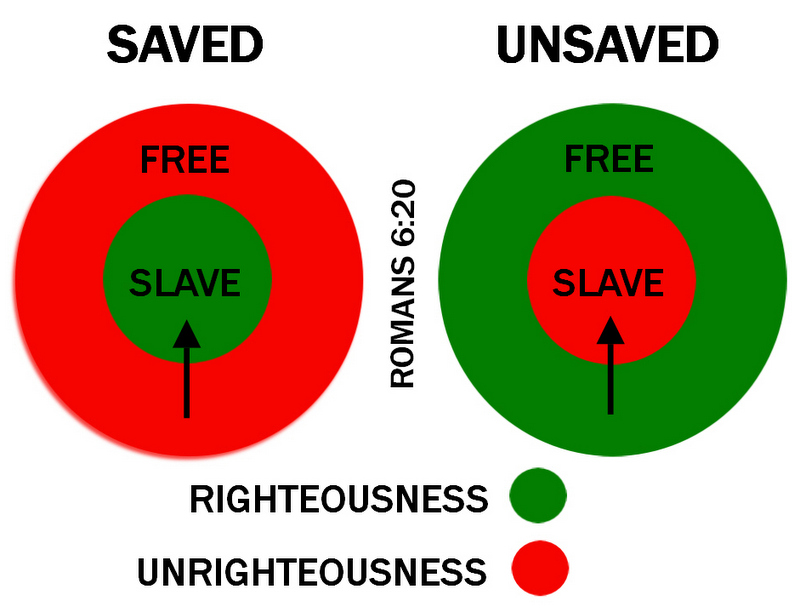
The new birth is a reversal of sin and slavery resulting in a change of direction. No one sins perfectly, and no one loves perfectly. It’s a direction, not perfection. But if you look at the Reformed cross chart again, neither is it a downward direction of sinful perfection resulting in making the cross bigger.
That’s the end of our lesson tonight—let’s go to the phones.
The Magnum Opus of the Reformation: Martin Luther’s Heidelberg Disputation; Part 4
 Listen to Show or download audio file.
Welcome truth lovers to Blog Talk radio .com/False Reformation, this is your host Paul M. Dohse Sr. Tonight, part 4 of “The Magnum Opus of the Reformation: Martin Luther’s Heidelberg Disputation.”
Greetings from the Potter’s House and TANC ministries where we are always eager to serve all of your heterodox needs. Our teaching catalog can be found at tancpublishing.com.
If you would like to add to our lesson or ask a question, call (347) 855-8317. Remember to turn your PC volume down to prevent feedback.
Per the usual, we will check in with Susan towards the end of the show and listen to her perspective.
Remember, you may remain anonymous. When I say, “This is your host; you are on the air, what’s your comment or question”—just start talking.
If you would like to comment on our subject tonight, you can also email me at paul@ttanc.com. That’s Tom, Tony, Alice, Nancy, cat, paul@ttanc.com. I have my email monitor right here and can add your thoughts to the lesson without need for you to call in. You can post a question as well.
Ok, so last week we only covered thesis 7, and as discussed, sometimes these Reformed guys are as clear as mud. Where the confusion comes in regards Luther’s position on mortal versus venial sin. Per Susan’s contribution last week, we know that Luther and Calvin never left the Catholic Church, and Susan assessed the Catholic position on mortal and venial sin. With that said, what was Luther’s position?
Look, here is the same advice I gave Susan in regard to her research on Jonathan Edwards: sometimes, there is just no way of knowing what these guys are trying to say, so you have to look for the places that can be defined and draw conclusions accordingly. The way Luther goes about thesis 7 could be debated until the second coming. So what’s he saying definitively? Well, let’s go to thesis 12:
In the sight of God sins are then truly venial when they are feared by men to be mortal.
This becomes sufficiently clear from what has been said. For as much as we accuse ourselves, so much God pardons us, according to the verse, »Confess your misdeed so that you will be justified« (cf. Isa. 43:26), and according to another (Ps. 141:4), »Incline not my heart to any evil, to busy myself with wicked deeds«.
Bingo. That’s pretty clear. For all practical purposes, according to Luther, the deeds of the saved and unsaved alike are all mortal sins. Even if Luther makes room for sins being authentically venial in the subjective Christian life, it makes no difference because mankind cannot do a good deed or any work that would be meritorious before God. In order to be saved, an individual must disavow the possibility of good works and assume every act is a mortal sin.
Susan is in the midst of some very heavy research, and has been sharing some of it with me. At times she will read excerpts from Edwards and there is no way in hades to know what the guy is saying. But, according to the subject, you can draw from what the guy has said in other places and draw your conclusions. And that’s what we are doing here.
While we are on thesis 12, let’s note this:
For as much as we accuse ourselves, so much God pardons us, according to the verse, »Confess your misdeed so that you will be justified« (cf. Isa. 43:26).
Bingo—that’s the Reformation gospel in a nutshell. You are still a wretched unregenerate sinner, and a perpetual return to the same repentance that saved you keeps you justified. The saving death of Christ is continually reapplied to your life along with His imputed obedience as well. This is what Paul David Trip et al call “A lifestyle of repentance” echo, echo, echo, echo.
And by the way, if you have any complaint at all about the way your church is run, this is what you will probably hear: “Who are you to judge? You should be busy accusing yourself rather than others lest you fall from grace.” And I don’t have a problem with that and nether should you. Why? Well at least they know what Protestantism is about. They are just being good Protestants, it is what it is.
And here’s another thing; I claim a liberty for myself that I think is biblical. I refuse to pass judgement on who is going to hell and who isn’t. Not only is hell a terrible place of eternal torment that I would not literally wish on anybody, but I choose to leave that assessment where it belongs; in the hands of God. Do you know why people want me to draw the hell conclusion from my assessment of true gospel versus false gospel? Here’s why: they want to use that to shut down discussion and subsequent discovery. See, when TANC ministries comes up, they want to say, “Ya, Dohse believes that Martin Luther and John Calvin are burning in hell.” See, that shuts down discussion. But if they tell the truth and say, “Dohse believes the Reformation gospel is progressive justification,” well, now that induces curiosity and discovery.
Listen, who am I to be going around saying that this guy is going to hell and that guy is going to hell? That’s not my place, but the bigger point is that such behavior becomes the topic and not the substantive discussion of true gospel versus false gospel. The former utilizes a jump from presuppositions to conclusion so that the substantive is circumvented. Don’t fall for that garbage.
Let’s now proceed to thesis eight:
Thesis 8: By so much more are the works of man mortal sins when they are done without fear and in unadulterated, evil self-security.
The inevitable deduction from the preceding thesis is clear. For where there is no fear there is no humility. Where there is no humility there is pride, and where there is pride there are the wrath and judgment of God, »for God opposes the haughty. Indeed, if pride would cease there would be no sin anywhere.
This thesis supplies a couple of major hallmarks of the Reformation. But I better pause here to head off a danger at the pass. Don’t be tempted to think that this point by point assessment of the FIRST Reformation doctrinal statement is redundant. It’s not. In all of this, I am becoming more and more appreciative of Luther’s genius. Throughout this document, Luther is not only putting forth a foundational doctrinal statement, he is teaching people how to think and what to think about the finer points of life. Luther isn’t saying the same things in a different way, he is redefining the elements of collective thinking that are possible exits out of the foundational premise. At the end of this study, one could put together a counter disputation, and maybe I will.
Here, he defines “pride.” What is that according to Luther, and frankly every Reformer after him? Pride, according to Luther, is the heart of sin: “Indeed, if pride would cease there would be no sin anywhere.” Here we see two major epistemologies or metaphysical hermeneutics of the Reformation: First, the common man cannot only do anything that would find favor with God, the common man cannot know reality. Second, every truth has a counter truth. Said another way, opposites define each other. In Plato’s theory of forms, reality descends from the immutable objective to the mutable and shadowy subjective. Ascent to the objective begins by finding those things that are immutable in the subjective shadow world.

For Plato, that was math among other things, but along this same line of epistemology is dualism, or what’s called “co-eternal binary opposition, a meaning that is preserved in metaphysical and philosophical duality discourse but has been more generalized in other usages to indicate a system which contains two essential parts.” Do you see this in thesis 8? It’s pride and humility. We also refer to this as the either/or hermeneutic. There is no in-between, it’s either/or. There is no taking pride in what you do without being prideful. There is no taking of satisfaction from a job well done; you are either humble or prideful.
And, this is also key, what is humbleness’ key attribute? Right, fear; specifically fear of condemnation…”For where there is no fear there is no humility. Where there is no humility there is pride, and where there is pride there are the wrath and judgment of God.”
Your only chance of getting into heaven in the end is doubts that you will. Luther and Calvin both equated eternal security with damning pride. Tullian Tchividjian once joked that Presbyterians differ from Baptists because Presbyterians don’t call each other “brothers” because no one knows for certain whether that’s the case or not. The joke bought the house down, but as the saying goes, the truth in a joke is what often makes it funny.
Once again, this is also right out of the Calvin Institutes:
Let us, therefore, embrace Christ, who is kindly offered to us, and comes forth to meet us: he will number us among his flock, and keep us within his fold. But anxiety arises as to our future state. For as Paul teaches, that those are called who were previously elected, so our Savior shows that many are called, but few chosen (Mt. 22:14). Nay, even Paul himself dissuades us from security, when he says, “Let him that thinketh he standeth take heed lest he fall,” (1 Cor. 10:12). And again, “Well, because of unbelief they were broken off, and thou standest by faith. Be not high-minded, but fear: for if God spared not the natural branches, take heed lest he also spare not thee,” (Rom. 11:20, 21). In fine, we are sufficiently taught by experience itself, that calling and faith are of little value without perseverance, which, however, is not the gift of all (CI 3.24.6).
As we have discussed before, Calvin’s election construct has three categories: the non-elect, the temporary elect, and those who persevere. No one knows whether they make it or not until they are revealed as such in the final judgement. This is known as “final justification when the sons of God are made manifest.” Apparently, they are made manifest by their “accompanied good works” which were really performed by Jesus and not them. This aversion to eternal security is also demonstrated by the likes of John Piper:
There is danger on the way to salvation in heaven. We need ongoing protection after our conversion. Our security does not mean we are home free. There is a battle to be fought (John Piper: Bethlehem Baptist Church Minneapolis, Minnesota; The Elect Are Kept by the Power of God October 17, 1993).
Of course, the apostle John’s stated purpose for writing the book of 1John directly contradicts this idea. Let’s move on to thesis 9:
Thesis 9: To say that works without Christ are dead, but not mortal, appears to constitute a perilous surrender of the fear of God.
For in this way men become certain and therefore haughty, which is perilous. For in such a way God is constantly deprived of the glory which is due him and which is transferred to other things, since one should strive with all diligence to give him the glory-the sooner the better. For this reason the Bible advises us, »Do not delay being converted to the Lord.« For if that person offends him who withdraws glory from him, how much more does that person offend him who continues to withdraw glory from him and does this boldly! But whoever is not in Christ or who withdraws from him withdraws glory from him, as is well known.
Luther here has a problem with the idea that good works can be performed by the unbelieving or believing and such works do not condemn, but are merely dead works that cannot earn merits for justification. This now brings us to what the Reformers believe is the sole purpose for all existence: God’s glory. Any concession that man can do anything good robs God of glory.
Man can indeed do good works, but in regard to the unsaved, it is true that in the end that only results in less condemnation, but Luther isn’t even willing to conceded that. If people can do good works resulting in less condemnation—that robs God of glory. Furthermore, it removes fear of condemnation from some works which also robs God of glory.
This is why Luther’s disputation is said to be the cross story versus the glory story: any glory not given to God is claimed by man; hence, the glory story, or the story of man. It can’t be a story about God and man, All glory must be granted to God. You are either living in the cross metaphysical narrative or the glory of man metaphysical narrative.
Thesis 10: Indeed, it is very difficult to see how a work can be dead and at the same time not a harmful and mortal sin.
This I prove in the following way: Scripture does not speak of dead things in such a manner, stating that something is not mortal which is nevertheless dead. Indeed, neither does grammar, which says that »dead« is a stronger term than »mortal«. For the grammarians call a mortal work one which kills, a »dead« work not one that has been killed, but one that is not alive. But God despises what is not alive, as is written in Prov. 15:8, »The sacrifice of the wicked is an abomination to the Lord.«
Second, the will must do something with respect to such a dead work, namely, either love or hate it. The will cannot hate a dead work since the will is evil. Consequently the will loves a dead work, and therefore it loves something dead. In that act itself it thus induces an evil work of the will against God whom it should love and honor in this and in every deed.
This thesis makes another argument against the idea that good works can be performed by mankind, but they are dead works in regard to justification. If mankind can perform a good deed, if mankind is competent, if mankind has some sort of ability, then why would that not include the ability to choose? This speaks to the Reformed doctrine of total inability. The Reformed continually claim this doctrine as uniquely Reformed and contrary to all other religions throughout history. This is not true; in fact, the total depravity of mankind coupled with determinism of some sort has been the overwhelming norm from the beginning of time. We delved into this historical fact in our Romans series (lessons 55-64).
What I would like to focus on in this thesis is Luther’s mention of grammar and the “grammarians.” What is a grammarian? A grammarian is someone who studies world linguistics. A grammarian also studies the connections between linguistics and the interpretation of reality. By and large, a grammarian is going to take a literal approach to interpreting reality; ie., things are as they appear. Another way of stating it: reality can be understood empirically. Hence, man can reason and understand reality.
This is going to be my subject at this year’s conference. The Reformers did not hold to a literal interpretation of realty. Obviously, St. Augustine was heavily steeped in allegory. This is what most Christians don’t understand: the Reformation was about the interpretation of reality itself, and how the Bible should be used for that purpose.
The Reformers didn’t reject biblical grammarianism, but made it secondary to the redemptive view of reality, or the idea that all of reality should be interpreted by “the gospel.” If the use of grammar leads to a redemptive outcome, wonderful. If it doesn’t, you use allegory to insure a redemptive outcome. The Reformed therefore often claim to be grammarians which is blatantly disingenuous. And look, the Reformed camp is not the least bit shy about all of this. We can see in this thesis how Luther was willing to use the grammar for the outcome he desired. In essence, he is saying: look, if the simpleton grammarians even think that something dead cannot contribute anything to life, how much more should we believe it as well?
And look, the Reformed camp is not the least bit shy about all of this. In his book, “Uneclipsing The Son,” by John MacArthur confidant and rumored heir apparent Rick Holland, he states that “bad grammar makes good theology” (page 39). The who’s who of American evangelicalism endorsed the book, and John MacArthur wrote the forward. As should be surmised by the title, the book is an in-your-face Gnostic treatise. The whole eclipsing the sun motif is a well-traveled illustration in Neo-Platonist/Gnostic circles. In the forward, MacArthur makes shocking statements that include the following idea: the subordination of God the Father and the Spirit to the Son.
If one does not interpret the Bible as a grammarian, all bets are off. While the Catholics made printing the Bible illegal, the Protestants merely took away individual interpretation and made biblical knowledge “the Gnosis.” Also, here is an aside: why did Christ emphasize the new birth to Nicodemus? The guy was “the” teacher in Israel and had never even heard of the new birth. Why? because Judaism was saturated with Gnostic philosophy and the infusion of divinity into a mortal being was unthinkable. The guy’s very name even reflects the Gnostic politic: nico; victory; demus; people; or, victory over the people. The most prominent Gnostic sect of the day was the Nicolaitans which means “victory over the laity.”
Now, next week, we are going to use theses 11 and 12 as an introduction to thesis 13 and following where Luther gets into the foundational position of free will according to the Reformation. We have heard lots of discussion about freewill for many years; next week, we will define the issue.
Susan Dohse: Colonial Puritanism; TANC 2014 Sessions 1-3
SUSAN 2014 SESSION 1
Do any of you remember the popular show Myth Busters? Well, Myth Busters was a popular show at our house, and the goal of that team of men was to disprove popular myths by using a scientific, investigative approach. And often, they would take legend, superstition, or even a stunt that had been re-done on television to see if it could really happen without the effects of Hollywood. And they would break it up into a scientific investigative approach and then determine if the myth was definitely a myth, could probably happen or that it would occur all the time.
Now I would like to provoke you to take on the role of a myth buster and rather than accept what’s in our textbooks or what you read on your online blog spots and what you hear from the pulpit, rather than accept that as factual, biblical or true. And this is why we call TANC a discernment ministry. It’s a ministry that encourages believers to become Bereans, searching the Scripture daily to verify what is taught from the authority of God’s word.
Well, the topic that I have chosen to present to you is based on a historical research approach, and I have selected three myths that I would like to try to bust. And I assure you that I could have and should have delved deeper into my topic, but I allowed time restraints to hinder me–cooking, cleaning, playing with the grandbaby. But I did read eight books and twelve inches of material that I printed from online resources. But what I want to do really is just to plant a seed. I want to plant a seed and hopefully provoke you to germinate that seed. You take my point of view, you look at my references, and then you go and research for yourself and see if you come up with the same or similar conclusions that I have.
Well, there’s a plethora of myth surrounding the early history of America, some from secular humanist research, many from the Christian historians, but you have to be careful. You have to be careful when you elevate historical figures to the rank of hero and you begin hero-worshiping historical figures without knowledge. Or you hold a group of people in such high regard that we are encouraged or we are told to encourage our children to emulate them. So therefore, it was important for me to frame any research that I did with dependable historical records, direct quotes from personal writings, sermons and speeches. Now the word “dependable” is – I glean that from a colonial historian who wrote the book The Times of Their Lives: The Life, Love, and Death in Plymouth Colony by James Deetz – Now he said that if three or more historical documentations from firsthand accounts–court and church records, personal diaries, pamphlets and books–if three or more of those documentations agree fully or mostly, then the assumption can be made that that source is probably reliable, more reliable than not reliable. So I try to do the same as Mr. Deetz in preparation for this talk. I tried to look at historical documents, church and court records, personal diaries, pamphlets and books.
There is a resurgence of interest and emphasis on the Puritans today–their beliefs and their practices. In our Christian schools, heavy in the homeschool movement, and in our churches, there is a push to pattern how we study the Bible, their theology and how to contend for the truth from the Puritans in order to make significant changes that will reap eternal results. I quote from a professor at Southern Baptist Seminary, “No greater tribute to them could be made than to follow their example in this regard.” And “in this regard” is referring to how to study the Bible, their theology and how to contend for the truth. Well, that emphasis is causing me to have some grave concern, because there is a lack of foundation based on fact and true historical perspective. Myths are being presented as facts, and the same criticism that’s heaped upon those secular humanists who want to shape America’s history by eliminating and covering its Christian roots need to apply to those who try to shape America’s history by eliminating and covering its Calvinist roots.
Here are the three myths that I would like to bust. And if I don’t bust them, at least poke a hole in the balloon. Myth number one: “The Puritans came to New England because of religious persecution and a desire for religious freedom.” Myth number two: “God could make any people his chosen.” And myth number three: “The Puritans have a biblical worldview.” These are three key foundational truths to what the Puritans believed. They believe they – why they came to New England, that God could make them his chosen, and what their worldview was.
Well, myth number one, the Puritans came to the New World because of religious persecution and a desire for religious freedom. The Puritans immigrated to establish God’s commonwealth on earth, a community of visible saints following the Bible and to found churches on a congregational model. The king gave permission for the migration in order for England to acquire new materials, to check the power of Spain, to find a new route to the Orient, and to convert the Indians. It’s very important to remember what was in their charter, the Massachusetts charter that was given to those colonial-minded people. Acquire new materials, particularly gold and silver, to check the power of Spain, to find a new route to the Orient, and to convert the Indians.
Now English history reports that the Puritans back in England wanted to purify the Church, the Church of England. And that’s how they got that nickname “Puritans.” The pilgrims, who were called separatists, chose to break away from the Church of England and many even left England for Holland. The pilgrims of Plymouth are not the same as the Puritans of Massachusetts. Both were Calvinists, but they were not the same. The pilgrims of Plymouth were Puritans, seeking to reform their church, and the Puritans of Massachusetts were innocent pilgrims who moved to this land because of religious conviction, not persecution. The name Puritan, it was initially an insulting moniker, very much like when the believers in the New Testament were first called Christians. It was really not a praiseworthy title. It was to make fun of them. Well, the same was the title Puritans. That title was to poke fun at them. (more…)
Helping Tim Challies and Other Calvinists with Evangelism
 Yesterday, I was sent the following article about Calvinist evangelism written by blogger Tim Challies: How To Offend a Room Full of Calvinists. Miffed by the suggestion that somebody knows better than me how to offend Calvinists, I immediately read the article.
Apparently, according to Challies, Calvinists get offended when people suggest that their soteriology hinders evangelism. According to Challies, the argument goes like this:
Many people are firmly convinced that there is a deep-rooted flaw embedded within Reformed theology that undermines evangelistic fervor. Most blame it on predestination. After all, if God has already chosen who will be saved, it negates at least some of our personal responsibility in calling people to respond to the gospel. Or perhaps it’s just the theological-mindedness that ties us down in petty disputes and nuanced distinctions instead of freeing us to get up, get out, and get on mission.
Protestants en masse think Calvinism’s greatest sin is weak evangelism, and of course, that makes them very angry because it’s supposedly the last criticism standing. I could start with the fact that Calvinism is works salvation under the guise of faith alone, or progressive justification, or salvation by antinomianism. Pick one; any of the three will work. But I have a mountain of data on that subject already; let’s do something different. Yes, let’s use Challies’ own words in the post to refute his argument. Before we call on Challies to refute his own protest, we will address his take on church history.
We go to history to show that the great missionaries, great preachers, and great revivalists of days past were Calvinists, and that Reformed theology was what fueled their mission… There are only so many times I can point to Jonathan Edwards, George Whitefield and the Great Awakening, or William Carey and the great missionary movement of the nineteenth century, or Charles Spurgeon and the countless thousands saved under his ministry. Sooner or later I have to stop looking at my heroes and look to myself. I can’t claim their zeal as my own. I can’t claim their obedience as my own.
In the post, Challies argues that we know that a straight line can be found from Reformed theology to evangelistic zeal because of history. Supposedly, Calvinists throughout history were driven directly by this deterministic gospel to reach thousands. It is very interesting when you consider the examples given which will aid in making my point.
The Great Awakening had absolutely nothing to do with Reformed soteriology. We should know this as a matter of common sense to begin with because the Holy Spirit doesn’t colabor with a false gospel. The Great Awakening was fueled by the ideology of the American Revolution and was expressed to a great degree in churches, especially among African Americans. Fact is, guys like Edwards and Whitefield then got on their horses and rode around the countryside bloviating and taking credit for the freedom movement tagged with “The Great Awakening” nomenclature.
Fact is, the Great Awakening was a pushback against the Puritan church state driven by Reformed soteriology that came across the pond as a European blight on American history. I would liken Challies’ assessment to our present President taking credit for things he is against when the results are positive.
What about Spurgeon? That example is just too rich because it makes the last point for me. Spurgeon, who once said Calvinism was no mere nickname but the very gospel itself, was the poster boy for getting people to come to church in order to get them saved. That’s important, hold on to that because it’s our last point.
But before we get to the last point, let’s look at the major point: Challies argues against the idea that fatalism hinders evangelism, and then confesses that he doesn’t evangelize like all of the great Calvinists in history because of…fatalism. Calvinism doesn’t cause fatalism resulting in lame evangelism, but Challies doesn’t evangelize because of fatalism.
After all, if God has already chosen who will be saved, it negates at least some of our personal responsibility in calling people to respond to the gospel… We go to the pages of Scripture to show that God’s sovereignty and human responsibility are not incompatible, but that people truly are both free and bound, that God both chooses some while extending the free offer of the gospel to all.
So why does Challies not evangelize according to him? First, because he just doesn’t, but secondly, he is responsible:
It is my conviction—conviction rooted in close study of God’s Word—that Calvinism provides a soul-stirring motivation for evangelism, and that sharing the gospel freely and with great zeal is the most natural application of biblical truth. But it is my confession—confession rooted in the evidence of my own life—that my Calvinism too rarely stirs my soul to mission. The truths that have roared in the hearts and lives of so many others, somehow just whisper in me. The fault, I’m convinced, is not with God’s Word, or even with my understanding of God’s Word; the fault is with me.
He is responsible, but not often stirred. And what’s his solution? There isn’t one, it is what it is; he is responsible, but not called to evangelism. No corrective solution is offered in the post. Why not? Because, as he said, we are responsible, but unable. Responsibility and inability are not incompatible. So, Calvinism doesn’t hinder evangelism, but if you don’t evangelize, there is no solution. Others did it, and you don’t, the end. Well, I suppose that approach doesn’t prevent evangelism either!
And funny he should cite Edwards. Susan is doing a session on Edwards for TANC 2015 and is studying his sermon Sinners in the Hands of an Angry God. She approached me and wanted to discuss something about the sermon that she was perplexed about. Edwards spent the better part of an hour addressing the total hopelessness of man and his likelihood of ending up in an eternal hell, but in the end offers no counsel on how to escape. Why? Because if God is going to do something, he is going to do it, and man is responsible either way.
This now brings us to the final point with a bonus; we are going to help Challies with his evangelism shortcomings. There is, in fact, a solution for Tim’s lack of evangelistic zeal. He doesn’t properly understand Calvinism and its history. This isn’t about saving Tim from the false gospel of Calvinism, this is about being a good evangelist in the context of Calvinism. If I can’t save a Calvinist, I can at least teach them how to be a better Calvinist. Really, it’s disheartening when Calvinists don’t properly understand Calvinism.
This is how we will help the Challies. We will bring him back to the historical significance of Spurgeon using some of his own observations. First, let’s get a lay of the land; how does true Calvinistic evangelism work? First, it is the “sovereign” gospel which means the subject must not be told that they have a choice. This is some fun you can have with Calvinists. Ask them if they tell the recipients of their gospel message that they have a choice. Most will avoid answering because they don’t want to admit the answer is, “no.” By their own definition, that would be a false gospel speaking to man’s ability to choose God.
Secondly, if God does do something, if “the wind blows,” that puts the subject in two categories according to Calvin: the called and those who persevere. The called are those that God temporarily illumines, but later blinds resulting in a greater damnation. Those of the perseverance class are the truly elect. So, the “good news” is that you have a chance to make it. But, if you don’t make it according to God’s predetermined will, your damnation is greater than the non-elect. God has either chosen you for greater damnation or the jackpot, but I guess it’s worth a try if God so chooses.
But hold on, and this is huge: all of that can be bypassed by Calvin’s “power of the keys.” What’s that? If you are a formal member of a Reformed church, and the elders like you, whatever they bind on earth is bound in heaven and whatever they loose on earth is loosed in heaven.
Furthermore, according to Calvin, sins committed in the Christian life remove us from salvation, but membership in the local church and receiving the “impartations of grace” that can only be found in church membership supply a perpetual covering for sin. And here is the crux: one of those “graces” is sitting under “gospel preaching” of which Spurgeon was chief. In one way or the other, Spurgeon sold this wholesale and the results speak for themselves.
See, the solution for Challies is simple. There is a solution for the disobedience he himself is responsible for: simply invite people to church in order to “get them under the gospel.” And that often looks like this…
Or perhaps it’s just the theological-mindedness that ties us down in petty disputes and nuanced distinctions instead of freeing us to get up, get out, and get on mission.
Problem solved. That’s how Calvinism is a straight line from its theology to evangelism—you are saved by being a formal member of a Reformed church, and your salvation is sustained by remaining a faithful member of that church and obeying everything the elders tell you to do and think. But let’s not call it intellectual rape, let’s call it “keeping ourselves in the love of Jesus.” Let’s call it “preaching the gospel to ourselves every day.” Let’s call it “being faithful to the church every time the doors are opened.” Let’s call it “putting ourselves under the authority of Godly men.” Let’s call it “trusting God with our finances.”
You’re welcome Tim, glad I could help.
paul
Jonathan Edwards: The Homeboy of Eastern Mysticism
A prerequisite for Gnostic Watch Weekly 10/31/2014:

Materials for discussion:
http://en.wikipedia.org/wiki/Idealism
Comment thread: https://paulspassingthoughts.com/2014/10/24/tweet-tweet-authority/

 Paul's Passing Thoughts
2 comments