Critical Review of TTANC is Confirming
 “RS does state in his review that I fail to ‘connect the dots’ between historical events that he doesn’t refute, but then states in another part of the review that the magnum opus of the Australian Forum is the true gospel!”
“But get this: while denying any connection between New Covenant Theology and New Calvinism, he is a New Covenant Theologian that believes in unadulterated New Calvinist theology; specifically, we are not saved by justification alone (‘justification is only one part of God’s salvation’) and Gospel Sanctification.”
The honeymoon is over after the 5 Point Salt review. But all is well from where I am looking. As I shared with an advisor before “The Truth About New Calvinism” was completed, it was not written to persuade anybody; it was written as prevention. The book was written to show the danger behind the red flags flying around in people’s minds, and to show them that everybody isn’t doing New Calvinism. No, it’s not you. No, you do get it. No, you haven’t lost your mind, they have. Yes, all of these hip people who appear so intelligent fell for the musings of a Seventh-Day Adventist who is now an atheist. Brilliant.
Randy Seiver (Th.M from Westminster Theological Seminary) is a New Covenant Theologian and missionary in Costa Rica. His review will be printed in full following my response. His review confirms, thus far, that the Primary goals of TTANC were achieved:
1. The book is easy to understand.
2. The position is stated clearly.
Therefore, the fact that RS strongly disagrees with me, and also thinks the book is laughable, is really irrelevant. The goal of the book was to unravel a complex theological issue of our day and let Christians decide for themselves, and from everything I can see so far, especially from this review, mission accomplished. Look, the biggest problem with this movement is the unavailability of information from which people can make an overall assessment. The book seeks to change that.
1. History Documented in TTANC Not Refuted.
Unfortunately, the best comments I can make are that the book is well written, easy to read, and provides interesting information about the history of Jon Zen’s association with Brinsmead, Westminster Seminary etc….I studied Church History under the Fundamentalist, Dr. George W. Dollar and his sidekick Dr. Robert Delney.
RS is a graduate of Westminster and is acquainted with many of the early movers and shakers of the movement, especially Ernest Reisinger (“I knew Ernest Reisinger”). He is also a student of church history. In all of his contentions against my writings as the most formidable member of PPT’s peanut gallery, he has never refuted my historical account concerning New Calvinism and the Australian Forum. So it boils down to the following: does God reveal long-lost doctrinal truth via the unregenerate or not?
1 Corinthians 2:14
The natural person does not accept the things of the Spirit of God, for they are folly to him, and he is not able to understand them because they are spiritually discerned.
Based on 1Corintians 2:14, I’m thinking, “No.” And let me get this straight from the proponents: “Yes, Brinsmead was an atheist not yet revealed, but he got his ideas from Luther.” So, all of the hordes of New Calvinist brainiacs who have been studying Owens, Calvin, and Luther all of these years had to be pointed to the real crux of the Reformation by a Seventh-Day Adventist who is now an atheist? Really? RS does state in his review that I fail to “connect the dots” between historical events that he doesn’t refute, but then states in another part of the review that the magnum opus of the Australian Forum is the true gospel!
2. The New Covenant Theology Connection
When I first began to post on Paul’s blog, he learned that I believed in New Covenant Theology. From that point on, Paul began to tell me what I believed. It did not matter that I didn’t believe what he thought I believed. I had to believe what he thought I believed because it was the only thing that would fit his preconceived model.
Paul views everything from his narrow understanding of Theology and his preconceived notions about New Covenant Theology and its supposed relationship with New Calvinism. The reality is that though the two may have some doctrines in common, they are neither dependent on one another nor synonymous with one another. In Paul’s world, if they use any of the same vocabulary, they must be the same.
It’s high time somebody said: “This movement, after forty years, still refuses to be honest about who they are. So yes, the right to be heard is now lost, and rightfully so.” Secondly, my evaluation of the connections between New Covenant Theology and New Calvinism are clearly understood by RS. Mission accomplished. Disagreement; irrelevant, let the readers decide for themselves.
3. Anomia
Thus, the charge of antinomianism is an unfounded charge unless it is made against a person who argues that we are absolutely without obligation to obey God’s revealed will.
RS doesn’t fully reveal my argument in the book. The argument is substantiated in two different chapters. He only addresses one of them. The crux of the matter is the following: can we be considered those who believe in an obligation to obey the law while believing that Jesus obeys it for us, and we are completely unable to do so? New Calvinists believe they have an obligation to the law via “offering the obedience of Christ by faith.” Let the reader decide after reading both chapters.
4. I believe New Calvinist doctrine, but I’m not a New Calvinist.
Let me be clear. I do not consider myself a New Calvinist. In fact, were it not for what I believe the Scriptures teach I would not consider myself a Calvinist at all. There are probably as many areas of the Reformed Faith with which I find disagreement as there areas in which I agreement. I am not even an advocate for New Calvinism. Frankly, all I know about New Calvinism is what I have read in magazine articles.
But then he states in the same paragraph:
He regularly confuses justification and sanctification. Somehow, he has the idea that justification is salvation. It is something that happens to us, and then we get beyond it. Anyone who has the most casual acquaintance with theology understands that justification is only one part of God’s salvation.
Justification alone is not salvation; sanctification and glorification are also salvation. And we don’t “get beyond” justification, and justification is “only one part of God’s salvation.” Again, mission accomplished. He understands one of the major points of the book. Look, I have said it before, again and again: New Calvinists believe that sanctification maintains justification, and glorification completes it. Therefore, we are obviously out of the loop because any law-keeping on our part in sanctification would be efforts on our part to maintain justification. Just this morning pastor David Conrad could not have said it better: “Romans 13:11 isn’t talking about getting our salvation when we get to heaven, we are already saved. It’s talking about the full experience of a past event [paraphrase].” Spot on. What RS states here can be reiterated via the New Calvinist mantras, “The same gospel that saved you also sanctifies you,” and “We must preach the gospel to ourselves every day.”
RS, in the past, has also stated that he is a proponent of “Gospel Sanctification” which speaks for itself. Gospel Sanctification is now widely recognized as a New Calvinist doctrine. But get this: while denying any connection between New Covenant Theology and New Calvinism, he is a New Covenant Theologian that believes in unadulterated New Calvinist theology; specifically, we are not saved by justification alone (“justification is only one part of God’s salvation”) and Gospel Sanctification.
5. The Magnum Opus of New Calvinism
For some strange reason, Paul has a problem with the rectitude by which we are declared righteous in God’s sight being an alien righteousness, a righteousness that is totally outside of us–an objective righteousness. The truth is, this is simply the gospel. If we believe we are justified by our improvement on an infused righteousness that flows to us as a result of Jesus’ death, we don’t understand the gospel at all. Additionally, Paul has a problem with the idea that our sanctification is accomplished by the redemptive work of Christ as much as our justification was accomplished by his redemptive work. He talks about people fusing justification and sanctification because he doesn’t seem to understand the biblical teaching about either justification or sanctification.
Again, mission accomplished. What RS has stated above harkens back to my interview with Robert Brinsmead:
Author: What do you think the unique theological findings of the Forum were in light of history? Robert Brinsmead: “Definitely the centrality and all sufficiency of the objective gospel understood as an historical rather than an experiential event, something wholly objective rather than subjective – an outside of me event and the efficacy of an outside-of-me righteousness.”
6. Just because Jesus obeys for us doesn’t mean we are not expected to obey.
He regularly confuses the idea that we are motivated by God’s love in justifying us with the idea that there is now no need for us to obey God since Jesus obeys for us. We are justified because Jesus obeyed for us. That does not mean we are not expected to obey him.
This speaks for itself.
7. Ernest Reisinger didn’t believe in the fusion of justification and sanctification, he
believed the two are always joined.
There are at least three ridiculous statements in the book. One has to do with Ernest Reisinger’s supposed fusion of justification and sanctification. p. 157 “The Lordship teaching puts the order of salvation as follows: 1) Regeneration, 2) Faith (which includes repentance), 3) Justification, 4). Sanctification (distinct from but always joined to justification), and 5) Glorification.”
How does that “fuse” justification and sanctification (It states that sanctification is distinct from justification)? There can be no question at all that both justification and sanctification result from Christ’s redemptive. A person who is not being sanctified has never been justified.
Classic New Calvinist double speak: fusion doesn’t mean joining. The “distinction” that Reisinger was talking about is the supposed idea that sanctification is justification in action, or progressive justification. A boy standing, and a boy running are distinct, but the same boy. In the last sentence quoted, RS makes no distinction between justification making sanctification possible, and spiritual growth in sanctification. If it moves, it must be justification.
I knew Ernest Reisinger and he was neither a New Calvinist nor a New Covenant Theologian.
But for some reason, Reisinger’s understudy and heir apparent to Founders Ministries, Thomas Ascol, is a consummate New Calvinist. Ascol himself claims that Founders was established on the Reformed theology of his “mentor,” Ernest Reisinger, and Founders Ministries is the epitome of New Calvinism.
8. Redemptive church discipline doesn’t have anything to do with regeneration.
The second concerns a resolution that was offered by Tom Ascol to the Southern Baptist Convention in 2008. It urges the churches of the Southern Baptist Convention to repent of the failure among us to live up to our professed commitment to regenerate church membership. . . . p. 160. Granted, the statement would have been clearer if Ascol had inserted an “a” before regenerate church membership, i. e. a regenerate church membership. Baptist have always believed not in a sacral society but in a regenerate membership. Paul, wrongly interprets this statement to mean that church discipline regenerates. In other words he understands the word “regenerate” as a verb rather than as an adjective. Ascol was talking about the kind of church membership to which Baptist have always been committed, not to what regenerates the church membership. A man with any understanding of Baptist churches and of theology would have known this. Instead, Paul wrote, “Notice the implication that church discipline regenerates.” It is just ignorance on fire. I pointed this out to him before he went to press, but he published it anyway.
Ignorance on fire? I have firsthand knowledge concerning why New Calvinists call church discipline, “redemptive church discipline.” Accepting verbal repentance in a Matthew 18 situation “doesn’t get to the heart of the matter.” In this synergistic Dark Age, stuff happens because people believe in a subjective gospel inside of us rather than the objective gospel outside of us. “Redemptive” church discipline focuses on redeeming professing Christians by saving them from a belief that Christ does a work in them as opposed to Christ being formed in them by trusting in a righteousness completely outside of us. To believe that we possess righteousness within us is to, in John Piper’s words, “reverse justification and sanctification” which “imperils our soul.”
Therefore, concerning Ascol’s resolution on church discipline, I strongly suspect his wording was careful, but deliberate:
RESOLVED, That we urge the churches of the Southern Baptist Convention to repent of the failure among us to live up to our professed commitment to regenerate church membership and any failure to obey Jesus Christ in the practice of lovingly correcting wayward church members (Matthew 18:15-18).
The resolution concerns church discipline. So if what I say is true, the “a” is probably missing for a reason.
More could be discussed, but again, the review confirms that the book’s goals have been met. The rest is just rhetoric as far as I am concerned. It is important that the book can be understood by those who want to decide for themselves.
RS concludes with a hallmark of New Calvinism: having the audacity to tell the saints what to read, and not to read. That’s not a good idea.
paul
I just finished reading The Truth About New Calvinism by Paul M. Dohse Sr. The author was kind enough to send it to me for review. Given his kindness, I would be delighted to be able to say very nice things about what he has written. Unfortunately, the best comments I can make are that the book is well written, easy to read, and provides interesting information about the history of Jon Zen’s association with Brinsmead, Westminster Seminary etc.
In the interest of full disclosure, I was reared in a Fundamentalist Baptist home. I studied Church History under the Fundamentalist, Dr. George W. Dollar and his sidekick Dr. Robert Delney. Dr. Dollar used to claim he and Dr. Charles Woodbridge were the only two real Fundamentalist left. He was clearly struck with the same club that Elijah had encountered. I never was sure where that left his friend and colleague Dr. Delney. At the time, the enemy of God and truth was a new movement called, “neo-evangelicalism.” We were taught certain catch phrases to look for. Anyone who used these phrases was to be castigated and avoided as an enemy of the truth. We were able to pigeon hole most anyone we met just by listening to the phrases they used. It didn’t actually matter if they really didn’t believe what we had detected. We knew they must be guilty if for no other reason than that they associated with people who, had some sort of nebulous relationship with someone who had eaten breakfast with someone who was associated with anti-fundamentalism. I cannot shake the feeling that the spirit of George Dollar’s Fundamentalism has risen from the grave and inhabited the body of Paul Dohse.
When I first began to post on Paul’s blog, he learned that I believed in New Covenant Theology. From that point on, Paul began to tell me what I believed. It did not matter that I didn’t believe what he though I believed. I had to believe what he thought I believed because it was the only thing that would fit his preconceived model.
Paul views everything from his narrow understanding of Theology and his preconceived notions about New Covenant Theology and its supposed relationship with New Calvinism. The reality is that though the two may have some doctrines in common, they are neither dependant on one another nor synonymous with one another. In Paul’s world, if they use any of the same vocabulary, they must be the same.
He is convinced that the Greek word “anomia” refers to antinominism. He brands anyone who understands that God’s eternal and universal law has been given different expressions under different divine covenants as an antinomian. Somehow he has convinced himself that when the New Testament writers spoke about lawlessness, they were speaking about antinomianism. There is a difference between a nomia and anti nomia [n]. One is a doctrine that may or may not manifest itself in lawless behavior , the other is a lawless attitude that manifests itself in rebellious acts against God. In order for one to be truly an antinomian in the theological sense, he would have to declare that a believer has no duty to obey God’s eternal and universal righteous standard. The apostle Paul makes it clear that the Mosaic expression of that Law was neither universal nor eternal. Otherwise, he could not have spoken of the Gentiles who “do not have the Law,” and who “have sinned without the Law” and “will be judged without the Law.” It seems to me, that leaves us with two exegetical choices: 1. The Gentiles were without God’s law altogether, or 2. The Gentiles were without the Mosaic codified expression of that Law. Since the apostle also tells the Law entered at a specific point (“the Law came in alongside so that the offense might overflow” Rom 5 “It [the Mosaic Law] was added for the sake of transgressions” Gal. 3) and was given “til the Seed [Christ] came to whom the promises were made.” Gal 3), it could not have been eternal.
If a person argues that that covenantal expression of God’s eternal and universal righteous standard has been replaced by a new expression of the same standard, that does not mean he is against God’s Law or will encourage people to break God’s Law. Thus, the charge of antinomianism is an unfounded charge unless it is made against a person who argues that we are absolutely without obligation to obey God’s revealed will.
Let me be clear. I do not consider myself a New Calvinist. In fact, were it not for what I believe the Scriptures teach I would not consider myself a Calvinist at all. There are probably as many areas of the Reformed Faith with which I find disagreement as there areas in which I agreement. I am not even an advocate for New Calvinism. Frankly, all I know about New Calvinism is what I have read in magazine articles. What I do know is that the evidence Paul Dohse has compiled is not convincing. His book is woefully deficient in the area of documentation. He offers many endnotes, but his references usually do not say what he claims they say. He regularly confuses justification and sanctification. Somehow, he has the idea that justification is salvation. It is something that happens to us, and then we get beyond it. Anyone who has the most casual acquaintance with theology understands that justification is only one part of God’s salvation.
For him, sanctification is simply a matter of obedience. In his view, we are given the equipment in regeneration and the rest is up to us. Once we are underway, God will help us, but the idea that any desire for obedience or ability to obey comes from God seems foreign to his concept of sanctification. He regularly confuses the idea that we are motivated by God’s love in justifying us with the idea that there is now no need for us to obey God since Jesus obeys for us. We are justified because Jesus obeyed for us. That does not mean we are not expected to obey him.
For some strange reason, Paul has a problem with the rectitude by which we are declared righteous in God’s sight being an alien righteousness, a righteousness that is totally outside of us–an objective righteousness. The truth is, this is simply the gospel. If we believe we are justified by our improvement on an infused righteousness that flows to us as a result of Jesus’ death, we don’t understand the gospel at all. Additionally, Paul has a problem with the idea that our sanctification is accomplished by the redemptive work of Christ as much as our justification was accomplished by his redemptive work. He talks about people fusing justification and sanctification because he doesn’t seem to understand the biblical teaching about either justification or sanctification.
Paul is muddled in this thinking. He spins statements to make them say what he wants them to say. He totally misrepresents New Covenant Theology and insists that anyone who subscribes to it must be a New Calvinist. He gives a great deal of interesting history, but fails to accurately connect the dots. There are at least three ridiculous statements in the book. One has to do with Ernest Reisinger’s supposed fusion of justification and sanctification. p. 157 “The Lordship teaching puts the order of salvation as follows: 1) Regeneration, 2) Faith (which includes repentance), 3) Justification, 4). Sanctification (distinct from but always joined to justification), and 5) Glorification.”
How does that “fuse” justification and sanctification. (It states that sanctification is distinct from justification). There can be no question at all that both justification and sanctification result from Christ’s redemptive. A person who is not being sanctified has never been justified. This is neither a New Calvinist position nor a New Covenant Theology position. It is a biblical position. I doubt there was a single old Calvinist who didn’t believe this truth. Additionally, I knew Ernest Reisinger and he was neither a New Calvinist nor a New Covenant Theologian.
The second concerns a resolution that was offered by Tom Ascol to the Southern Baptist Convention in 2008. It urges the churches of the Southern Baptist Convention to repent of the failure among us to live up to our professed commitment to regenerate church membership. . . . p. 160. Granted, the statement would have been clearer if Ascol had inserted an “a” before regenerate church membership, i. e. a regenerate church membership. Baptist have always believed not in a sacral society but in a regenerate membership. Paul, wrongly interprets this statement to mean that church discipline regenerates. In other words he understands the word “regenerate” as a verb rather than as an adjective. Ascol was talking about the kind of church membership to which Baptist have always been committed, not to what regenerates the church membership. A man with any understanding of Baptist churches and of theology would have known this. Instead, Paul wrote, “Notice the implication that church discipline regenerates.” It is just ignorance on fire. I pointed this out to him before he went to press, but he published it anyway.
The third is the claim that Piper encourages meditation on pictures of Jesus. p. 99. From the statement, one would conclude that Piper might be advocating some sort of veneration of or at least contemplation of icons. What a horrible thing, right? Such would be a clear violation of God’s commandments. “My little children, keep yourself from icons.” What Piper was actually talking about was literary portraits of Jesus given us by the four biblical evangelists. I confronted Paul about this prior to publication but he insisted on publishing this nonsense anyway.
Paul continues to interpret the following statements improperly: (see p. 97).
1. “This meant the reversal of the relationship of sanctification to justification. Infused grace, beginning with baptismal regeneration, internalized the Gospel and made sanctification the basis of justification. This is an upside down Gospel. Jn. Piper
2. When the ground of justification moves from Christ outside of us to the work of Christ inside of us, the gospel (and the human soul) is imperiled. It is an upside down gospel.”
Anyone who understands theology, even marginally, would understand that Piper is talking about the basis of our justification. Paul claims Piper is, by these statements, denying the necessity and reality of regeneration.
These statements have nothing whatsoever to do with regeneration. This is the kind of misrepresentation that characterizes the entire book.
There may be many problems with New Calvinism, but Paul has lost all credibility by his prodigious misrepresentations. I know this personally since he has misrepresented my views on many occasions. For all I know, New Calvinism may be fraught with problems. If so, someone needs to write a book that exposes them. Actual quotations in context would be very helpful. If someone is telling us we do not have to be obedient to Christ, we must reject them. If someone is telling us we may do what we like because he is obeying for us, we may safely reject their message. If someone is teaching that believers continue to be totally depraved, they need to be corrected. If someone is abusing their authority in church discipline, they need to stop abusing the sheep and return to a bibilical pattern. Still, we must not “throw the baby out with the bath water.” We need to accept the truth the New Calvinists are teaching and reject whatever we cannot find substantiated in the Bible. “Prove all things; hold fast that which is good.” Unless you need a good laugh, don’t waste you money on this book.
The New Calvinist Takeover of Southwood Presbyterian Church: Part 20; For Southwood’s Door
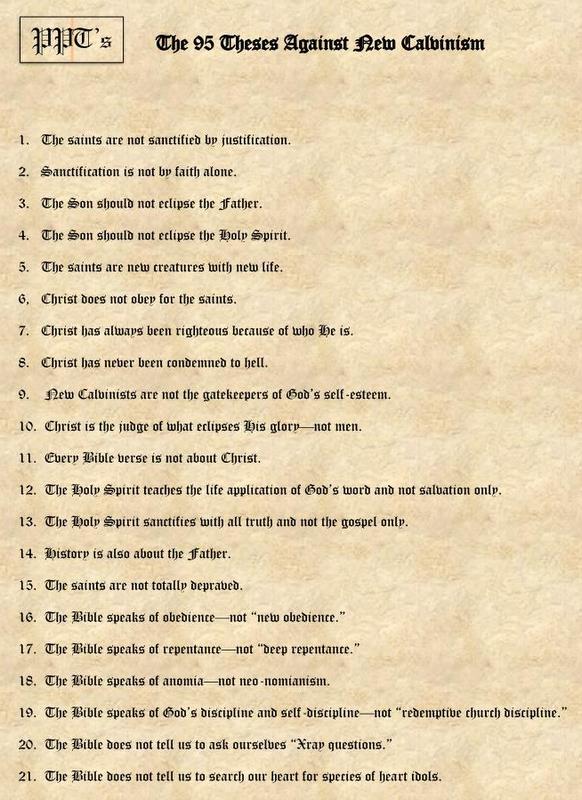
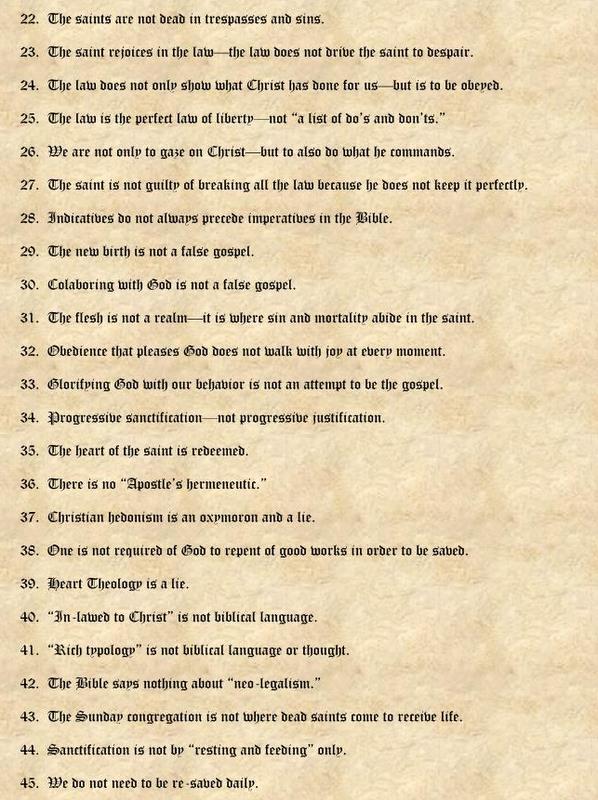
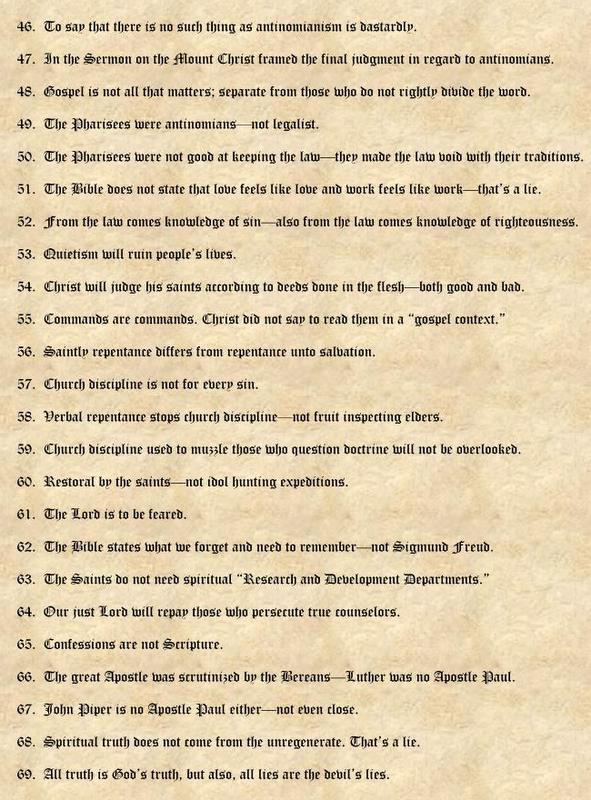
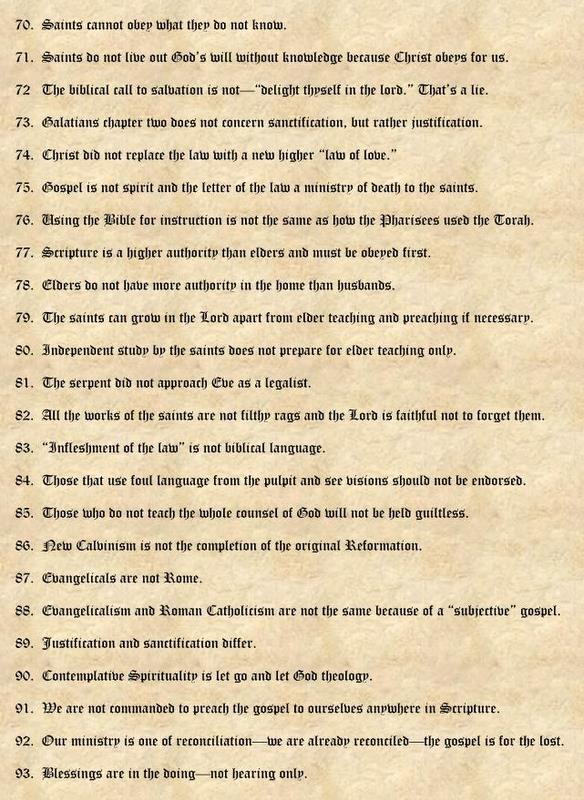
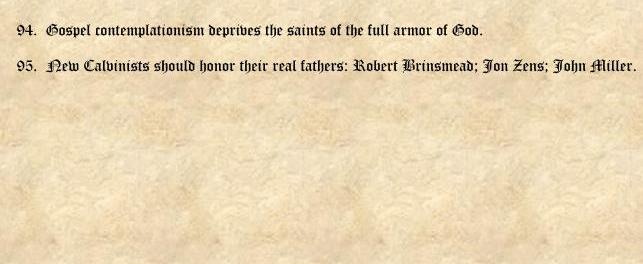
….but tape it, don’t nail it. That way you will only be brought up on church discipline and not also arrested for vandalism. PDF available here: The 95 Theses Against New Calvinism
The Uninformed Reformed
 Most people in our day that call themselves Calvinists or Reformed are really New Calvinists. And most of them are young, uninformed, and misinformed when they are informed by New Calvinists calling themselves Calvinists. John Piper is an example of this. Is he a Calvinist? Hardly.
Furthermore, the word needs to get out that New Calvinism, New Covenant Theology, Gospel Sanctification, and Sonship Theology are the SAME thing and came from the EXACT same source—a Seventh-Day Adventist turned atheist named Robert Brinsmead. No wonder they constantly proclaim, “All truth is God’s truth.” I would also.
Neo-Calvinism is 41 years old, period. And the whole T4G, TGC bunch is the same bunch of antinomians who show-up and harass the church every 50-100 years. It’s the same bunch Ryle had to contend with and Baxter /Rutherford before him. Different doctrine, same goal: anti-law.
I was referred to the same old, worn out song and dance at the Facebook “Reformed Baptist Page,” where a member of the PPT peanut gallery asked a question about the connection between NCT and New Calvinism:
Is New Calvinism and Reformed theology the same Thing? The ones I was talking to think this doctrine is a combination of New Calvinism, Reformed theology and New Covenant theology all in one.
Well, she almost got the question right—NCT and New Calvinism are definitely based on the same doctrine. The uninformed Reformed Page then misinformed “Cindy”:
Hi Cindy,
Typically when folks speak of “New Calvinism” they are referring to the “young, restless and reformed” kind of Calvinism, the hip and cool Calvinists. Though the theology, when it comes to the five points is the same, their philosophy of worship, separation from the world, and other practical issues are not in line with historical Reformed theology and practice. As for New Covenant Theology, as was posted a few days ago is a modern hybrid between classical dispensational theology and biblical covenant theology. I think anyone who holds to New Covenant theology is simply confused, but certainly not heretical.
This is the typical take on NCT; supposedly, a mere attempt to find a middle road between dispensationalism and covenant theology. Not so. Jon Zens worked together with Robert Brinsmead to develop a view of the law that would fit with Brinsmead’s “centrality of the objective gospel.” Cindy then sought the following verdict from this source on Facebook:
Ok, is New Calvinism heretical then? Sorry for asking so many questions, I just want to be informed.
Notice that Cindy is confident that this source on Facebook will “inform” her. Hmmmmm. Makes one wonder how many professing Calvinists have read the Calvin Institutes? Or a Bible for that matter.
Regardless of the fact that many real Calvinists have condemned New Calvinism, the uninformed Reformed Page misinformed Cindy that it is not a heretical movement so now the misinformed Cindy thinks she’s informed. And that’s why she went to that page, because, “I just want to be Reformed informed.” We understand Cindy.
She then asked about Gospel Sanctification and Sonship theology and got the following answer:
The New Calvinists I know are solid on the Gospel Sanctification. Sonship theology seems to be a new name for antinomianism.
This reveals how shallow research is among this bunch. They call Sonship theology antinomianism, but the forefathers of Sonship theology, Tim Keller and David Powlison, are major figures in the New Calvinist movement. The whole “We must preach the gospel to ourselves everyday” was coined by the father of Sonship theology, Dr. John “Jack” Miller, who was Keller and Powlison’s mentor. Powlison based CCEF counseling on Miller’s theology.
I responded by posting a short history of the movement which was answered with the typical response: Nothing can be ascertained because everybody in the movement doesn’t agree on every jot and tittle. And the usual ratcheting back from any information that enables people to connect the dots, followed by personal attacks.
The informed Reformed Page didn’t challenge my post, they pulled it down, I guess because such information isn’t possible because that’s where the Reformed go to get informed. So, if they didn’t know about it, well, it couldn’t be informative. Right?
paul

The New Calvinist Mega-Lie: Obedience and Truth are Separate
 “Therefore, Christians don’t obey for the purpose of maintaining our just standard; it is a finished work by Christ that needs no further maintenance. We obey for other reasons….”
Have you ever noticed? The Scriptures NEVER call “obedience” works salvation. We are never told that people are trying to earn their way into heaven through “obedience.” Obedience, in the Scriptures, is ALWAYS associated with the truthful application of God’s word to our lives in how we think and what we do. It is the truthful application of our role in sanctification which is putting off the old self and putting on the new creature (Ephesians 4:20-24). In the Scriptures, truth is always assumed in obedience.
This is New Calvinism’s greatest deception, the idea that one can sincerely seek to apply God’s word to their lives in a truthful way, and at the same time do so to maintain a just standing before God without realizing they are doing so. This invokes a dependance on them, a don’t try sanctification at home mentality. Though they claim that obedience is motivated by fear within the evangelical community, their sanctification formula propagates an unfounded fear that obedience is nothing more than works salvation, in and of itself. The fact of the matter is that works salvation is always based on falsehood.
Unlike the Bible, New Calvinists don’t associate obedience with truth, a love for the truth, and faith. They separate the two, specifically by separating “law” and “gospel.” Law is obedience, whether practiced in truth or not, and gospel is truth. There are many examples of this, but here is the best one I have seen of late:
This is fundamentally no different than Islam! The Gospel offers us freedom from our sin-stained hearts and our obedience-stained garments and bids us rest in the finished work of Christ which is better than us being better!!!” (Jean F. Larroux, III, Green Grass of Grace Southwood blog).
Notice: obedience is obedience whether it is Christian or Islam. Truth isn’t the issue. But the apostle Paul clearly unites the two:
They have become callous and have given themselves up to sensuality, greedy to practice every kind of impurity. But that is not the way you learned Christ!—assuming that you have heard about him and were taught in him, as the truth is in Jesus, to put off your old self, which belongs to your former manner of life and is corrupt through deceitful desires, and to be renewed in the spirit of your minds, and to put on the new self, created after the likeness of God in true righteousness and holiness (Ephesians 4:19-24).
Obviously, Paul is calling on Christians to learn truth, and put off what we learn to put off, and put on what we learn that is to be put on. The Bible calls this “obedience” when it is done as biblically prescribed. If I tell my son to take the trash out to the curb, but instead he leaves it halfway down the driveway, that’s not obedience. Unless you’re a New Calvinist. With them, truthful obedience is neither here nor there because it is impossible for Christians to accomplish anyway:
The bad news is far worse than making mistakes or failing to live up to the legalistic standards of fundamentalism. It is that the best efforts of the best Christians, on the best days, in the best frame of heart and mind, with the best motives fall short of the true righteousness and holiness that God requires [notice that there is no distinction between this sentence and the one prior (legalistic standards verses true righteousness)]. Our best efforts cannot satisfy God’s justice. Yet the good news is that God has satisfied his own justice and reconciled us to himself through the life, death, and resurrection of his Son. God’s holy law can no longer condemn us because we are in Christ (Michael Horton, Christless Christianity p. 91).
It is also extremely important here to notice the crux of New Calvinist error in this statement; specifically, the supposed need to maintain justification: “….the best motives fall short of the true righteousness and holiness that God requires…. Our best efforts cannot satisfy God’s justice.” But in sanctification, God no longer requires a just standard to maintain salvation, that has already been accomplished as a finished work. God no longer “requires” perfection that maintains our just standing. Therefore, Christians don’t obey for the purpose of maintaining our just standard/standing; it is a finished work by Christ that needs no further maintenance. We obey for other reasons—to glorify God, to experience the reality of our new birth, to show others the abundant life, and to destroy evil works, to name just a few. And also, our God-given love for the truth compels us to apply it to our lives.
Therefore, New Calvinism fuses what shouldn’t be fused and separates what shouldn’t be separated, turning orthodoxy completely upside down. They fuse justification and sanctification, and separate obedience from truth, while fictitiously calling obedience “law” (whether Christian or Islamic), and encapsulating truth in the “gospel” which is supposedly distinct from “law.” But what would we know about the gospel apart from Scripture? Christ said man lives by every word that comes from the mouth of God. Wouldn’t that include the law? Paul told Timothy that we are fully equipped for every good work by ALL Scripture. Wouldn’t that also include the law?
This fusing of what shouldn’t be fused and separating what shouldn’t be separated is the basis of their Gospel Contemplationism. Law (any effort to obey, whether according to the truth or not) is separate from gospel and impossible for us to obey perfectly in order to maintain a salvation that doesn’t need to be maintained to begin with. The formula? Contemplation on the truth that results in a “Christ formation” within totally depraved, dead jars of clay. Doubt that? reread Larroux’s quote; our hearts are sin stained as well as any obedience we may perform.
The truth: we are declared righteous and are righteous, though hindered by the flesh. Though our striving falls short of perfection, we know that can’t affect our righteous standing that has already been declared based on the finished work of Christ. And that cannot be revoked. As we strive, we also long for the day when we can obey our Lord perfectly without hindrance. So like Paul, we cry out, “who will deliver me from this body of death?”
Our striving creates that thirst, experiencing both the blessings of that truth and the failures that prevent the full experience. Peter states clearly that we are to strive for a “rich entry,“ not the beggarly entry that comes from let go and let God theology.
paul
The New Calvinist Takeover of Southwood Presbyterian Church: Part 19; Bachman – Turner Overdrive
Cruising down the highway as a young man, I was feeling pretty good listening to my rock music on the awesome new technology that replaced 8-track tapes, cassettes. One of my preferred bands was Bachman-Turner Overdrive, and one of my favorite songs was “Taking Care Of Business.” Sure, I knew a particular statement in the lyrics made no sense at all; “We love to work at nothing all day,” but I really dug the song man, and at that time of my life, trust me, the tune was way more important than the truth.
Since I have been studying New Calvinism for nearly five years now, that song has constantly been triggered in my mind. As I was perusing Southwood’s blog this morning, stopping to read “Green Grass of Grace,” by Jean (pronounced “ Jon”) F. Larroux (don’t forget: “The Third” hereafter; “JL3”), I observed the opening sentence: “Grace is difficult. It is harder than trying harder.” Then it happened in my head:
“People see you having fun
Just a-lying in the sun
Tell them that you like it this way
It’s the work that we avoid
And we’re all self-employed
We love to work at nothing all day
And we be…
Taking care of business every day
Taking care of business every way
I’ve been taking care of business, it’s all mine
Taking care of business and working overtime.”
In another post, JL3 said, “I’m not arguing for NO EFFORT or WORK I am arguing for GREATER EFFORT and MORE DIFFICULT WORK, the work of humbling ourselves, being broken, repentant, prostrate before God, looking past our ‘symptomatic sins’ to their root causes and being faced with such horror over my depravity that I am left with no other options than Jesus” (not sure, but I think the comment was pulled down).
Tullian Tchividjian, JL3’s obvious mentor stated it this way in “The Tyranny of Accountability Groups”:
The bottom line is this, Christian: because of Christ’s work on your behalf, God does not dwell on your sin the way you do. So relax and rejoice…and you’ll actually start to get better. The irony, of course, is that it’s only when we stop obsessing over our own need to be holy and focus instead on the beauty of Christ’s holiness that we actually become more holy! Not to mention, we start to become a lot easier to live with!
Oh really? I would think that people who focus on Matthew 7:24 with the result of their life being built on a rock would be the ones easier to get along with. And of course, I am constantly told by New Calvinist hacks that for me to say that these kinds of statements insinuate that Jesus obeys for is “reading into their statements.” Whatever. We see four things in Tchividjian’s statement: 1; Christ has done the work of sanctification on our behalf (ie., sanctification’s work was part of the atonement). 2; Doing less results in being “better,” productivity for the sake of the kingdom is conspicuously absent—per the usual. 3; Holiness comes by focusing on Christ’s holiness and not our own, resulting in more holiness. And I am often accused of “reading things into their statements” regarding the “Gospel Contemplationism” charge. Again, whatever. 4; The either/or communication technique, It’s either Christ’s holiness or our holiness, it can’t be both.
JL3 continues:
We are allergic to resting in the finished work of Christ and the hardest ‘trophy’ to lay down is that trophy of obedience I have been working for my whole life. To make the shift from an life driven by fear to a life motivated by love is very, very painful.
Notice that the finished work of Christ pertains to both justification and sanctification. Accuse me of reading into to this if you will, but what else can be surmised? Also, we gain see the either/or hermeneutic: we are either motivated by love or fear, it can’t be something else—it’s either/or. But the contradictions in JL3’s posts are too massive to document; for example, the Scriptures are clear that at times, God does motivate us by fear. Like all New Calvinists, JL3 validates love as something that is always (as stated by, of all people, John MacArthur) “always sweet, never bitter-sweet.” This removes the self-sacrifice aspect of love through obedience. And it brings us back to Bachman-Turner Overdrive theology as well: they only worked hard at what they loved, which was doing nothing.
Most of us have obeyed because of fear of reprisal from God. To know that we are loved apart from our obedience or disobedience is a truth that is elusive. This is why it must be pounded into our souls week after week.
This is a bunch of boloney, and notice JL3’s New Calvinist us against them mentality. “Most” obey from fear? Anybody who does counseling knows that isn’t true—fear of God is never been more lacking in recent church history.
We have purposed to drive deep into those fields ripe with the green grass of the grace of God, not into the rocky crags of fundamentalism, legalism and pietism hoping that some nourishing shoot of grace will emerge every now and again. The sheep cannot be sustained on a sparse diet of occasional grace.
Either/or: it’s either grace, or rocky crags. Nuff said, like all New Calvinists, his whole realm of speech is fraught with deceptive communication techniques.
Everything in Christendom tells them to weave for themselves garments of obedience and performance to wear before the Great White Throne of Judgment as ‘jewels in their crown.’
This hearkens back to JL3’s ancestors of the Australian Forum (the cradle of New Calvinism) who mixed Reformed teachings with SDA investigative judgment theology. Christians fear no future judgment concerning our righteousness—the righteousness of God has already been accredited to our account in full.
This is fundamentally no different than Islam! The Gospel offers us freedom from our sin-stained hearts and our obedience-stained garments and bids us rest in the finished work of Christ which is better than us being better!!!’
So, obedience in Islam is no different than obedience in Christianity? Sure it is. Christian obedience is based on T-R-U-T-H. The fundamental difference between Christianity and all other religions is our God given love for truth (2Thess. 2:10), which translates into applying it to our life. Hence, “If you love me, keep my commandments.” You can’t separate love for the truth from wanting to learn more about it, and then making it part of you. We are promised blessings if we do that (James 1:25).
JL3’s New Calvinistic teachings also has another tone shared by Bachman-Turner theology: the song demeaned people who supposedly wasted their life by doing things they didn’t like to do. New Calvinists often refer to our striving to obey as “rats on a treadmill” etc. Like MacArthur, we are told by JL3 that we should strive for a life that is “sweet, never bittersweet.” The fact is rather this: in pursuing truth, it will often collide with life, and other times it will bring joy. But when the experience is “bittersweet,” that’s not works salvation, it’s called “self-sacrifice.”
The apostle John reminded us that the Lord’s commands are not “burdensome.” We need to be reminded of this, because his commands are truth, and we love the truth. Sometimes the truth is hard, and it calls for us to reject the tune in exchange for the truth. Whatever the tune may be, whether, “resting is better than being better,” or a “love to work at nothing all day.”
paul

 Paul's Passing Thoughts

11 comments