Tragedy At Southeastern? What’s The Big Deal? I Thought We Are All Totally Depraved!
 Stuff like this always causes me to have to stop everything I am doing and post. I didn’t know anything of William Birch or his blog before the breaking story this week that he fell into significant sin and has confessed. Apparently, even though I have never heard of him, he was fairly well known in the blogosphere and was a student at Southeastern Theological Seminary. In fact, the sinful act took place on campus, and we are not talking about getting caught smoking in the boy’s restroom.
Of course, Southeastern is stunned and is busily partaking in damage control. Am I here right now? Southeastern is all but totally in the tank for the doctrine of Gospel Sanctification which is the hallmark of, well, “aggressive Calvinism” or New Calvinism, depending from what perspective you are looking at it. Basically, the doctrine teaches that we are (this includes Christians) totally depraved, really don’t change, and either manifest a sin realm or spirit realm depending on how often we use the Scriptures to contemplate the gospel; ie, Gospel Contemplationism. Supposedly, when we contemplate the works of Christ in the Scriptures, his righteousness is imputed to us in the same way it was when we were saved. In salvation, it is a general imputation; as Christians, specific things are imputed to us in the same way when we see them in the Scriptures. Hence, sanctification is still an imputation of righteousness in the same way justification was.
Therefore, the doctrine denies an orthodox view of the new birth, claims that Christians are totally depraved, and also claims that we do not really change, we only manifest one realm/sphere or the other at any given time. A post that is an example of how they see progressive imputation through use of the Scriptures can be observed here: http://wp.me/pmd7S-1lh . An example of how they view the fact that we do not really change as Christians can be read here: http://goo.gl/T1pMg , but the money quote by New Calvinist Terry Rayburn follows:
There are several problems with that essentially Legalistic view of Sanctification, as reflected in the following observations:
1) Our flesh cannot get better. In Romans 7:18 Paul wrote, “For I know that NOTHING good dwells in me, that is, in my flesh…” Your flesh cannot be improved. Flesh is flesh, and spirit is spirit.
2) Our new nature, on the other hand cannot get better, because it has already been made new and perfect through regeneration. We have been given a “new heart” (new nature, or new spirit), and not a defective one, which would be absurd. This new spirit has been made “one spirit with Him” (1 Corinthians 6:17), such that when we “walk according to the Spirit” (i.e., the Holy Spirit), we also walk according to our own new spirit.
3) Those who deal with Sanctification by zeroing in on so-called “Progressive” Sanctification as the main point of Sanctification, are at best in Kindergarten.
So, Southeastern will come forth in dismay and act completely incredulous that this has happened. Meanwhile, Southeastern’s conference schedule is saturated with propagators of this doctrine, including Tullian Tchividjian. On the one hand, it’s a tragedy. On the other hand, they invite leaders to speak to the students who teach that we are totally depraved and can’t change! Can teaching seminary students such things lead to said behavior? Well, forgive me for thinking so! How ironic that Tchividjian has already spoken there this year, and is scheduled to return in the fall. Consider this commentary on a post he wrote on the total depravity of the saints http://goo.gl/Jiu4I , and the following tweets by Tchividjian:
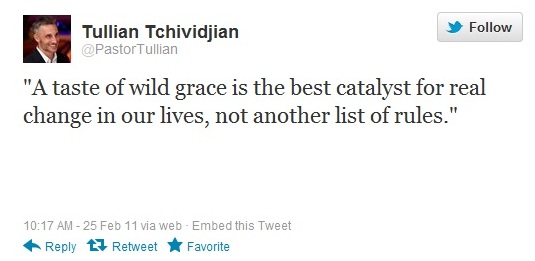
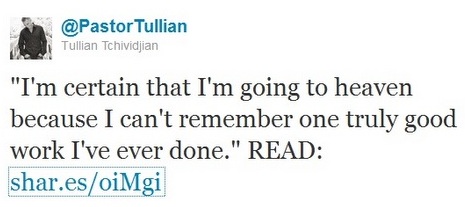
I guess I am the only one scratching my head on all of this, but I also wonder if Southeastern is going to get a “I told you so” from New Calvinist Michael Horton who often warns Christians about trying to “be the gospel” rather than “preaching the gospel.” Like all New Calvinists, Horton teaches that the gospel is “news to be proclaimed” not a list of “do’s and don’ts.” They plainly teach that “law and gospel” are separate. This concept can be found in Horton’s book, “Christless Christianity” on pages 117-119, and also on pages 53-54 of “Family Shepherds” written by Southeastern graduate Voddie Baucham. If the same gospel that saved us also sanctifies us, and the law and gospel are separate; well, you do the math (the law is separated from sanctification). Supposedly, a deeper understanding of the gospel that saved us must always precede obedience which then is a “mere natural flow” without effort because we are really manifesting a spiritual realm that was imputed to us at salvation.
And the present-day New Calvinist movement got this doctrine from Seventh-Day Adventist Robert Brinsmead, who combined Reformed theology with Platonism to come up with the centrality of the objective gospel outside of us. Instead of reality or truth being completely outside of man (Plato), in New Calvinism, the gospel must remain completely outside of us, and nothing of grace may be infused within us. Hence, consider the following quotations by the who’s who of New Calvinism in our day:
When the ground of justification moves from Christ outside of us to the work of Christ inside of us, the gospel (and the human soul) is imperiled. It is an upside down gospel. ~John Piper
Thus, it will inevitably lead not to self-examination that leads us to despair of ourselves and seek Christ alone outside of us, but to a labyrinth of self-absorption. ~ Michael Horton
So what does this objective Gospel look like? Most importantly, it is outside of us.~ Tullian Tchividjian
The blessings of the gospel come to us from outside of us and down to us.~ John Fonville
It robs Christ of His glory by putting the Spirit’s work in the believer above and therefore against what Christ has done for the believer in His doing and dying.~ Geoffrey Paxton (Australian Forum)
But to whom are we introducing people to, Christ or to ourselves? Is the “Good News” no longer Christ’s doing and dying, but our own “Spirit-filled” life?~ Michael Horton
And the new-birth-oriented “Jesus-in-my-heart” gospel of evangelicals has destroyed the Old Testament just as effectively as has nineteenth-century liberalism. (footnoted to Paxton’s article with above quote). ~ Graeme Goldsworthy (Australian Forum)
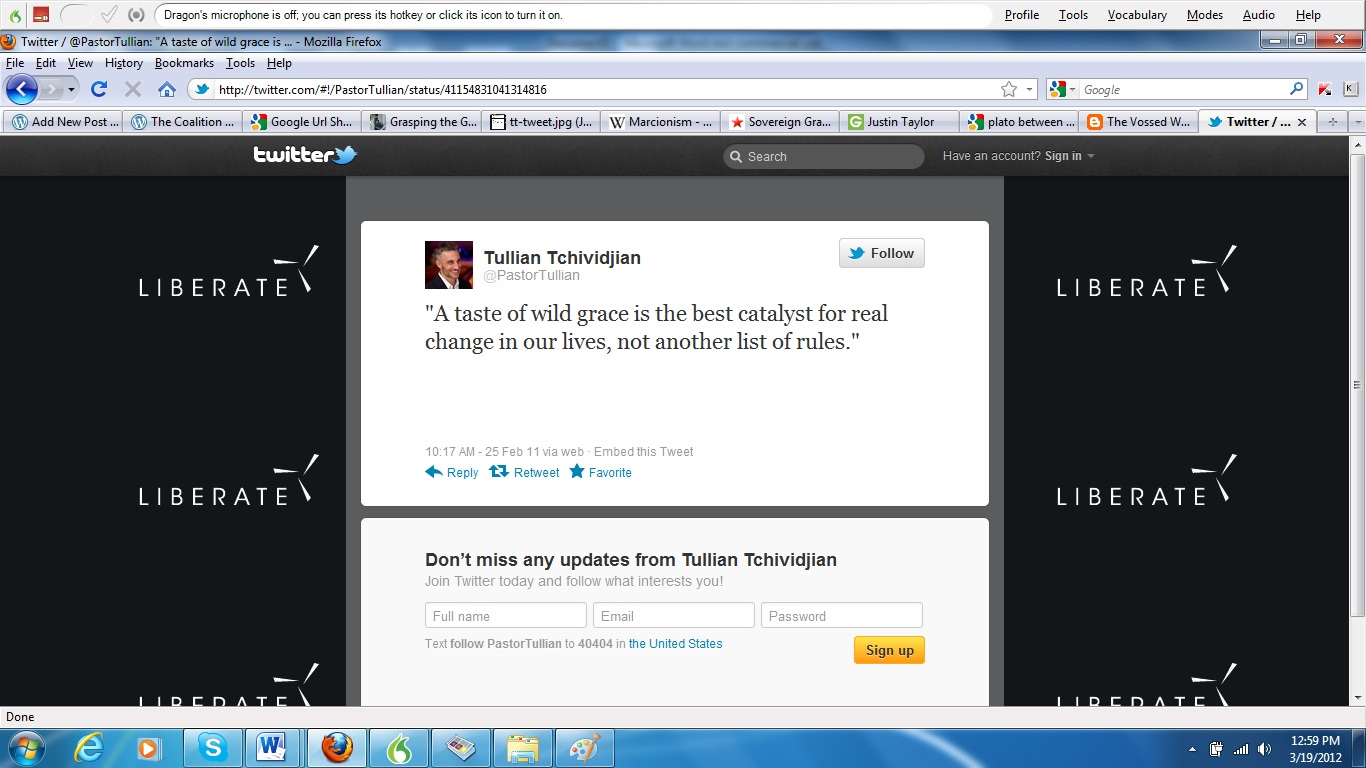
Of course, the only practical application of Platonism is Gnosticism, and incredibly, some of the most popular New Calvinists of our day have Gnostic themes for their ministries as illustrated by the following two screen shots that clearly illustrate Gnostic dualism.


Then if one googles “Plato Two Worlds,” you get:

And the similarities between the New Calvinist concept of separating law and gospel is eerily similar to those of the 2nd century Gnostic heretic Marcion. In regard to the gospel being completely outside of us like knowledge of reality (Plato), many New Calvinists now teach that the gospel cannot be fully known: http://5ptsalt.com/2012/02/23/grasping-the-gospel/
Lastly, I heard on the news that this brother that fell is going to enter counseling at Southeastern! Right, that’s all this brother now needs—to be taught that he is totally depraved, that he can’t change, and that the primary cure for his problem is a deeper understanding of the death, burial, and resurrection. After all, as Southeastern hero Paul David Tripp often states: applying biblical instruction to this problem would not be seeing the problem in its “gospel context,” and instruction also denies Christ’s saving work on the cross by replacing Christ’s personhood with “a cognitive concept applied to a new formula for life.”
The brother has it bad right now. Counseling at Southeastern will finish the job. I am reading a lot on the blogosphere about all the friends this guy has. Ha! We will see.
paul
Why Jay Adams Had to be Neutralized by the New Calvinists
Susan and I had a glorious fellowship with another Christian couple this afternoon. They are in a ministry of significant influence and will be unnamed. At some point, the conversation turned to New Calvinism. As Susan and I sat and listened to the husband’s testimony concerning what he valued in John Piper’s teachings, I was filled with an understanding in regard to why Piper’s teachings are so attractive. I might add that I was very impressed with his calm, articulate answer immediately following my comment that I believe Piper to be one of the premier heretics of our day.
What this brother described was the fact that serious Christians were looking for an alternative to the fallout from the first gospel wave in contemporary Christian History: raise your hand, sign a card, don’t drink, smoke, chew, or hang out with girls that do. Christianity had been reduced to living by a list of do’s and don’ts by people who didn’t have any life to show for it. Fair enough. Guilty as charged.
But the fact of the matter is that Jay Adams did offer a viable alternative. It was based on hearing the word of God and applying it to our lives according to the whole counsel of God’s wisdom and not just, “stop doing that.” I saw firsthand how this “first generation” biblical counseling movement changed lives in radical fashion, including my own. And the movement continues to do so today even though the fact of that matter is covered up by a whole lot of New Calvinist noise.
To me the crux of the matter is in this brother’s testimony. New Calvinists have effectively sold the idea that they are offering the only alternative to easy believeism in our day. That’s only true because they got rid of the other alternative through slander and persecution, and they know it. Jay Adams’ “first generation” biblical counseling was a threat to the emerging New Calvinist tsunami. Why? 1) Because it worked and God used it to change lives. 2) It was/is the antithesis of New Calvinism because the latter fuses justification and sanctification while first generation counseling doesn’t. Furthermore, this is what New Calvinist David Powlison said was the fundamental difference between the two while teaching at John Piper’s church:
This might be quite a controversy, but I think it’s worth putting in. Adams had a tendency to make the cross be for conversion. And the Holy Spirit was for sanctification. And actually even came out and attacked my mentor, Jack Miller, my pastor that I’ve been speaking of through the day, for saying that Christians should preach the gospel to themselves. I think Jay was wrong on that.
If we associate justification with “conversion,” and we do, Powlison’s statement can be reworded as follows for clarification:
Adams had a tendency to make the cross be for justification (justification cannot be separated from conversion). And the Holy Spirit was for sanctification.
Second generation counseling/New Calvinism is sanctification by justification, and that was also propagated by his mentor that he mentions. New Calvinists choose their words carefully. Imagine how far the movement would get if they didn’t replace “justification” with “gospel”:
The same finished work of justification that saved you also sanctifies you. Or, we must preach justification to ourselves every day. Or, sanctification is the finished work of justification in action.
I explained to the brother that the other alternative was relentlessly persecuted, and that’s why it would seem that there is only one alternative. He concurred that he perceives criticism of Adams taking place on a continual basis. Why? Because the truth he teaches is the competition. It’s a threat.
This is an approach that I have never used before: 1) Powlison admits a fundamental difference between first generation and second generation counseling; ie, sanctification by the cross (justification) verses sanctification by the Spirit apart from the finished work of justification. 2) An alternative is confirmed. 3) You only have the New Calvinists’ testimony that they are the only alternative. 4) Why not investigate and find out for yourself?
He agreed, and was sent off with a copy of The Truth About New Calvinism. Please pray for the situation. Christianity doesn’t need a second gospel wave. The first wave devalued sanctification by focusing on justification only; the second devalues it as well by making it the same thing as justification. Both are just as deadly, and when the novelty of New Calvinism wears off, the results will be worse.
paul
Another New Calvinist Lie via Chad Bresson: We Aren’t Postmodern and the Emergent Church is Bad and We are Good
I guess it goes along with being antinomian; New Calvinists constantly lie about many things. In fact, I wonder if they ever tell the truth about anything. New Calvinism dominates the present evangelical landscape because their theological framework invented by a Seventh-Day Adventist (who is now an atheist) is a powerful concept that sells. Robert Brinsmead claimed that he discovered the lost gospel of the Reformation and Reformed folks saw what the supposed finding was doing to the SDA: reforming it. Brinsmead’s Awakening movement via his centrality of the objective gospel (COGOUS) doctrine was turning the SDA upside down. The results were therefore evident, and it had a Reformed label, so the masses have been jumping on the new reformation bandwagon ever since. Many of the elements that make this doctrine attractive to our present culture will be discussed in the second volume of The Truth About New Calvinism.
New Calvinists avoid historical dots that could connect them back to Brinsmead like the Bubonic Plague, and one way of doing that is pretending like you oppose certain dots. Therefore, The dots that they disparage the most are New Covenant Theology (NCT) and the Emergent Church (EU). New Calvinists such as DA Carson stay aloof from NCT, but support it behind the scenes. Brinsmead was a close friend with the father of NCT, Jon Zens, and Brinsmead contributed significantly to the formation of the doctrine. Therefore, pigs will fly before any NCT guys will be invited to one of the big New Calvinist dances, but Carson regularly speaks at NCT conferences.
Likewise, Sonship Theology which was founded on Brinsmead’s COGOUS intermarried with the EC family, so the EC, like Jon Zens, is only one step removed from Brinsmead and his theological think tank that launched present-day New Calvinism: the Australian Form. The Forum may have also influenced the EC which originated in Australia/UK in 1992 and arrived in the US around 1998. Even though New Calvinists such as John Piper associate with EC proponents like Mark Driscoll on a continual basis, and both groups function by the same doctrine (COGOUS, also known as Gospel Sanctification), New Calvinists continually fustigate the EC. The Piper/Driscoll relationship is condoned because Driscoll is supposedly a different kind of Emergent species (http://wp.me/pmd7S-16r).
One New Calvinist “church” that partakes in this deception at every opportunity is Clearcreek Chapel in Springboro, Ohio. A staff elder, Chad Bresson, wrote an article on his blog (a blog dedicated to NCT ) entitled, “The Word of God is an objective, propositional revelation because the resurrection is of such” (Vossed World blog: archives; July 19, 2006). Bresson begins the post with the following:
A supporter of the emergent church posted over at Steve Camp’s blog the following comments:
1. Revelation does not refer to the Bible, it is rather God’s activity in history.
2. Revelation is dynamic and personal, not static propositional.
3. Scripture is a meta-narrative, and by this nature is not a propositional document for us
to pin down all the rules to obey and doctrines to believe.
4. Passages are not always easily discerned for God’s desired message for the Church.
5. Texts may simply indicate direction, not neat and orderly systematic doctrine.
All of these points are either outright false or are only partly true. They represent what is of major concern to many who have observed the development of the emerging church.
These five tenets of EC interpretation, for all practical purposes, are the like hermeneutics of New Calvinism despite Bresson’s disingenuous harpings. Bresson, usually accustomed to linguistic drones of ten-thousand words or more, writes a paragraph or two for each proposition that disputes propositional truth, and I will rebut his deceptive rebuttal of his theological kissing-cousin’s comment. Bresson begins by addressing the first tenet:
God[‘s] activity in history through Christ *resulted in* the Bible. The Bible is God’s *written* revelation to man, and thus the sixty six books of the Bible given to us by the Holy Spirit constitute the plenary (inspired equally in all parts) Word of God (1 Corinthians 2:7-14; 2 Peter 1:20-21). The Word of God is an objective, propositional revelation (1 Thessalonians 2:13; 1 Corinthians 2:13), verbally inspired in every word (2 Timothy 3:16), absolutely inerrant in the original documents, infallible, and God breathed. They are fully self-authenticating, not relying on any external proof for their claims. Since all of Scripture is spoken by God, all of Scripture must be “unlying,” just as God himself is: there can be no untruthfulness in Scripture (2 Sam. 7:28; Titus 1:2; Hebrews 6:18). Because God is the Bible’s author, we are to accept its authority and submit ourselves to it in faith (2 Pet. 1:19,21, 2 Tim. 3:16, 1 John 5:9, 1 Thess. 2:13).
As I will demonstrate, New Calvinists end up in the same place as the EC on this issue. And remember, the staple doctrine of New Calvinism and the EU is one and the same: Gospel Sanctification. This is plainly irrefutable. The EU is most prevalent in American church culture through Acts 29 and World Harvest Missions which were both spawned by the father of Sonship Theology, Dr. John “Jack” Miller. Dr. Miller originally coined the New Calvinist slogans, “We must preach the gospel to ourselves every day,” and its accompaniment, “The same gospel that saves you also sanctifies you.” The former understudies of Dr. Miller and the gatekeepers of Sonship theology after Miller’s passing, David Powlison and Tim Keller, are major figures in the New Calvinist clan.
Regardless of how orthodox Bresson’s opening statement is, his fingers are crossed behind his back with the first ten words: “God[‘s] activity in history through Christ *resulted in* the Bible.” Though the more fringe elements of the EC may think specific revelation can be found outside of the Bible, note that Bresson also states that the Bible is primarily a historical document about Christ. Specifically, a meta-narrative about the gospel, and the gospel only for meditation purposes. All of the rest affirming the accuracy of the Bible is regarding its accuracy for that purpose only. The pastor/teacher of Clearcreek states the following on this point:
May we be transformed by seeing the glory of Christ all through the Bible. The transforming power of beholding Christ emerges from the pages of the whole Bible. We are transformed from glory to glory as we see Him there. Want to grow and change? Want to reflect Christ to others? Gaze on Him in the pages of your Bible (Russ Kennedy: The Fading Glory, 2Corinthians 2:14-3:18).
Furthermore, Bresson posted an excerpt from Robert Brinsmead on his blog to make the point that the Holy Spirit only illumines when the Scriptures are seen through the prism of the gospel and used for that purpose alone (Vossed World blog: archives; July 17, 2008).
Bresson continues to use orthodoxy to deceive:
God’s Word is sufficient for all things pertaining to life and godliness, because Christ, THE WORD, is sufficient (Eph. 1:3, 23; Deut. 8:3/Matthew 4:4/John 6:48-51; John 1:14,16). Because THE WORD is life himself (John 11:25, 14:6; Colossians 1:15-20), The Word is living and active in discerning and judging the actions and thoughts of men (Hebrews 4:12). Christ, as THE WORD, is Wisdom from God (1 Corinthians 1:30), which is *why* the word is sufficient for all of life (Psalm 119:105; Proverbs 2:6, 3:18; Colossians 3:16). Christ’s sufficiency for all of life is best summed up by the covenantal promise/fulfillment: Christ is our God and we are His people (Revelation 21:3,7). As THE WORD, Christ himself is the grace that is sufficient for us (2 Cor. 12:7-10; John 1:14, 16, 17).
After all of the unarguable truth and citation of Scriptures, Bresson once again has his fingers crossed behind his back with the last thirteen words: “As THE WORD, Christ himself is the grace that is sufficient for us.” Hence, Bresson parrots the same EC hermeneutic he claims to be refuting. Note tenet number two: “Revelation is dynamic and personal, not static propositional.” In fact, on the aforementioned post where he cites a long excerpt from a Brinsmead article, Bresson made the following comment:
John 1:1 tells us that Christ incarnated the very Word of God. Thus, the text… the Word… is both witness to and emanates from THE WORD. I should add that John 1:1 is also telling us that Christ *was* the very Word of God from the beginning. So… to draw a distinction between text and Person is a false dichotomy.
Exactly, and the EC crowd agrees, stating that the word is a person and not for the reason of determining propositional truth. I like to state it a different way for clarification; it’s about who Jesus is (or his “personhood”), and not about what He SAYS. Christ warned against such a mentality in Luke 11:26, 27. Clearcreek’s close relationship with Paul David Tripp should also be weighed in this discussion as well. Tripp, who has close ties to Clearcreek and speaks there often, stated the following on page 27 of How people Changed (2006):
Jesus comes to transform our entire being, not just our mind. He comes as a person, not as a cognitive concept that we insert into a new formula for life.
As noted in another post (http://wp.me/pmd7S-hc) here on PPT, Dr. Carol K. Tharp accuses Tripp of having a kinship to the emergent church because of his teachings in Broken Down House:
In these assertions, Tripp reveals his kinship with the emergent church. A belief held in common by emergent church leaders is their “eschatology of hope.” For example, Tony Jones says, “God’s promised future is good, and it awaits us, beckoning us forward … in a tractor beam of redemption and recreation … so we might as well cooperate.” Emergents Stanley Grenz and John R. Franke declare, “As God’s image bearers, we have a divinely given mandate to participate in God’s work of constructing a world in the present that reflects God’s own eschatological will for creation.”‘ Elsewhere, emergent church advocate Doug Pagitt claims, “When we employ creativity to make this world better, we participate with God in the re-creation of the world.”
In regard to tenet number three, Bresson embarks on the following diatribe:
All the words in Scripture are God’s words. To disbelieve or disobey any word of Scripture is to disbelieve or disobey God. The essence of the authority of Scripture is its ability to compel us to believe and to obey it and to make such belief and obedience equivalent to believing and obeying God himself. The word of God contained in the Holy Scriptures is the only rule of knowledge, faith, and obedience, concerning the worship of God, and is the only rule in which is contained the whole duty of man. The Scriptures have plainly recorded whatever is needful for us to know, believe, and practice. God’s word is the only rule of holiness and obedience for all saints, at all times, in all places to be observed (Col. 2:23; Matt 15:6,9; John 5:39, 2 Tim. 3:15,16,17; Isa. 8:20; Gal. 1:8,9; Acts 3:22,23).
In Bresson’s supposed rebuttal, he admits that the Scriptures are a meta-narrative, but argues that the narrative yields objective truth to be obeyed: see above and following:
While the scriptures inherently contain meta-narrative, the various narrative forms, using various Jewish literary genre, are themselves propositional in nature and scope…. And, because there is a common meta-narrative inherent to the whole of scripture (the redemptive story pointing forward to and fulfilled in Christ), it necessarily follows that there is a logical analogy to the whole of scripture which is to be exegeted and preached.
In other words, the concept is objective (the narrative is true and objective), but obviously yields subjective results because one has to interpret every verse of Scripture in a way that shows forth the gospel. But New Calvinists think that this approach is acceptable as long as the point made is a valid gospel outcome. The EC believes that both the narrative and the outcomes are subjective; New Calvinists claim that objective truth is possible while torturing every verse for a gospel outcome, which is highly doubtful. In other words, the results from both camps are the same: subjective.
In addition, the “obedience” Bresson refers to is New Calvinist “new obedience” (Christ obeys for us or obedience is the mere yielding to the evil realm or the gospel realm) which teaches against what Bresson seems to be saying. Where would I even begin to document New Calvinist teachers in regard to their devaluing of obedience as stated by tenet three? “Scripture is a meta-narrative, and by this nature is not a propositional document for us to pin down all the rules to obey and doctrines to believe.” Consider what the New Calvinists themselves write along these same lines:
DA Carson: “In this broken world, it is not easy to promote holiness without succumbing to mere moralism; it is not easy to fight worldliness without giving in to a life that is constrained by mere rules.”
John Piper: “So the key to living the Christian life – the key to bearing fruit for God – the key to a Christ-exalting life of love and sacrifice – is to die to the law and be joined not to a list of rules, but to a Person, to the risen Christ. The pathway to love is the path of a personal, Spirit-dependent, all-satisfying relationship with the risen Christ, not the resolve to keep the commandments.”
Tullian Tchividjian: “A taste of wild grace is the best catalyst for real work in our lives: not guilt, not fear, not another list of rules.”
Lastly, Bresson mentions another New Calvinist substitution for orthodox obedience that I haven’t fully put my mind around—this whole idea of Christians putting ourselves in, or participating in the gospel narrative: “These historical contexts presume an original audience with whom we participate in the same redemptive story.” Again, postmodern emergents (EC) take the same approach with a slightly different application. Note what John MacArthur writes in The Truth War: Quoting Brian McLaren, another proponent of the Emerging Church:
Getting it right’ is beside the point: the point is ‘being and doing good’ as followers of Jesus in our unique time and place, fitting in with the ongoing story of God’s saving love for planet Earth.’ All of that is an exemplary statement of the typical postmodern perspective. But the thing to notice here is that in McLaren’s system, orthodoxy is really all about practice, not about true beliefs (page 36).
So, on the one hand (New Calvinism), we supposedly put ourselves in the gospel narrative in a passive endeavor to manifest a redeemed realm. On the other hand (EU), we put ourselves in the subjective narrative as a form of obedience. What’s the difference? The bottom line: New Calvinists use an objective means of interpretation that leads to subjective, if not mystical results, though they lamely argue that the results are objective because only objective results can come from seeing the gospel in every verse of the Bible. The emergents are at least honest about the means and the results being subjective.
And honesty in and of itself is a good thing; those who follow you at least know what they are following. But the New Calvinist cartel will continue in pretending to be orthodox while confusing the issue by contending against other camps that really believe the same things.
paul


 Paul's Passing Thoughts

17 comments