5 Reasons New Calvinism Will Die
 New Calvinism will die again. For the fifth time in church history. There has been five resurgences and four deaths. That is why the primary agenda of TANC is to educate the church concerning every nuance. Lack of information is what enables this evil beast to come back into the church from time to time. The goal is to educate as many Christians as possible who will hopefully see this coming the next time. The following is an excerpt from the upcoming 2013 TANC Conference. In this first session, the five reasons New Calvinism will die are stated.
Excerpt:
Perpetual Death and Resurgence of the Authentic Reformation Gospel
As we have noted, as the Reformation moved forward in history, many did not realize that it spoke from its own reality. As Christians read their Bibles from the normative reality, the true gist of the Reformation gospel is lost over time. The Reformers were mostly responsible for the printing of English Bibles, but how they wanted the Bible to be read was mostly misunderstood despite their massive commentaries.
The natural tendency is to read literally and take the meaning of verbs, nouns, and prepositions at face value. This will draw one away from the Reformed gospel in general, but will retain the Reformation’s lack of emphasis on aggressive sanctification. Let me give you an example of this. In the book, “How People Change” by New Calvinist Paul David Tripp, he discusses the issue of Christians endeavoring to change their thinking to biblical thinking. This is a pretty passive consideration as far as human activity goes. In fact, changing the way we think is probably the most passive human activity we can think of. Yet, note what Tripp states on page 27 of said book:
….and the Bible does call us to change the way we think about things. But this approach again omits the person and work of Christ as Savior.
~ Paul David Tripp: How People Change Punch Press 2006, p. 27
This statement encapsulates the totality of Reformed metaphysics perfectly. First, we see the clear indication of what we will dissect in my second session; the Reformed gospel of progressive justification. Christians NEED the ongoing work of Christ AS SAVIOR in our lives. To not do Christianity in a certain way OMITS that saving work in sanctification. This statement by Tripp is a damning indictment of Calvinism.
Secondly, we see that although the Bible calls us to change the way we think, to read that in a normative reality is to misinterpret the “true” meaning, and unless those passages are understood via Reformed epistemology, the ongoing salvific work of Christ in our Christian lives will be circumvented. Elsewhere in the same book, Tripp states that biblical commands must be seen in their “Christ-centered gospel context” (Ibid p. 26). Throughout this same book, and like all Calvinists, Tripp speaks of “heart change,” but as we shall see in my second session, this is a term that DOES NOT mean that we change. The title of the book is a Calvinist lie. It is condoned by Gnostic arrogance that doesn’t think the common Christian is “ready” for the hard truth of the authentic Reformed gospel. John Piper made this specific notation in an interview:
I think Rome and Protestantism [the Protestantism that fell away from Reformed metaphysics] are not yet ready. I don’t think the Reformation is over (Online source: http://youtu.be/lQvtAd7WEOY).
The second reason that the authentic Reformed gospel dies a social death from time to time is because it is simply boring. It is driven by a narrow concept; everything is about the gospel. This was the major complaint that Dr. Jay E. Adams received while he was writing Biblical Sonship: An Evaluation of the Sonship Discipleship Course (Timeless Texts 1999). Concerned Christians told Adams that they were hearing the same things from the pulpit every week and the doctrine seemed “vague.” Susan and I have visited churches recently that were very exuberant about New Calvinism a couple of years ago, but follow-up visits reveal a marked decrease in enthusiasm. To be more specific, in protest regarding the possibility that we would ever return to one of the churches, our teenage son remarked, “That place isn’t very interesting.” Susan and I were also overwhelmed with the sense of deadness that was present.
A third reason is the fact that this doctrine does not produce spiritual growth which results in a plethora of negative issues that arise from spiritual immaturity.
A fourth reason is the spiritual tyranny that is ALWAYS part and parcel with this doctrine. Remember, it is basically a spiritual cast system that puts a high premium on control.
A fifth reason is the fact that God’s people eventually figure out that it is a false doctrine.
These are the five reasons why these resurgences die out. The hybrids that emerge are still predicated on weak sanctification which lays the ground work for the next resurgence. The following illustration shows how authentic Calvinism has oscillated between tyranny and weak sanctification throughout church history.

Confused in Denmark: Seeker of Truth Wants Answers to Seven Questions About Salvation
 “I love you, but your thinking is fraught with Reformed morbid introspection that they want to use to control you. Stop reading John Piper.”
Busy and haunted. I received an email from a person in Denmark that is confused about all of the different positions on the gospel floating about today. Our commentary from the first eight chapters of Romans (compiled manuscripts from the Potter’s House) answer the questions in detail. Susan and I have received positive feedback regarding the book. At least one family is using it for their family devotions. So concerning the Denmark person, I offered to send the book and the offer was accepted. That was easy.
And haunting. I once talked to a Christian who was critical of an elder that she sought out for counsel. With an expression on her face somewhere between disgusted and hurt, she stated, “I came to him for help. Do you know what he did? He gave me a book!” Let there be no doubt about it: Christian books have gone way beyond teaching in our day, they are orthodoxy. And by the way, Neo-Calvinism all but completely owns Christian publishing. “Orthodoxy” is a Reformed term. It is the faith repackaged for the unenlightened masses by the preordained Reformed philosopher kings. For the most part, American Sunday Schools teach from Reformed writings and not the Bible. This is a complaint that this ministry hears constantly. These guys have effectively rewritten systematic theology and church history. They have created another standard of Christian reality altogether and speak from that reality as if there is no other reality.
And this is where the confusion comes in. But confusion is good. Confusion is very good. Concern that you are confused is even better. If you are letting other people think for you—you are not confused. Everything makes perfect sense to you even though it is completely illogical. Jesus warned us about letting other people think for us. He referred to it as the blind leading the blind. That rarely turns out well.
So, we may conclude that confused Christians who know they are confused, and are concerned about it, are the top of the crop among Christians in our day. They are the blue chip because they are thinking Christians. We must not merely hand them a book. Besides, others may have the same questions.
1. Who is a true Christian?!
Answer: Those who place all of their hope in God and believe in His way of being reconciled to Him. Remembering that God has promised to reward those who seek Him is also very helpful. Don’t be too concerned with your confusion at this time: He who has promised is faithful. In regard to your residual question, “Should I just then read the Bible and forget about every other theory and just rely on my Bible reading?” The short answer is, ABSOLUTLEY. I am not discarding the need for teachers, but they must bow to the authority of Scripture. The Bible must be your absolute authority for life and godliness.
2. What does a true Christian look like?
Answer: A true Christian doesn’t “look like” anything. That’s the wrong question coming from Reformed metaphysics where verbs are works salvation. The Hebrew writer framed the question this way: what do Christians DO? See Hebrews 11. Aggressive DOING in our Christian life reveals that we really believe that our salvation is a finished work that we cannot contribute to. Fear of doing in our Christian life reveals an attitude that our salvation must be maintained in some way by living a noun life instead of a verb life. Hence, “what does that look like” rather than “how do I do that?” “How do I please God” becomes, “What does that look like” because it really isn’t me doing it. If I am doing it, I am finishing my salvation in some way. Salvation is finished, and it can only be appropriated through faith alone. But the power imputed to us for Christian living must be appropriated through BOTH faith and obedience. In our Christian life, faith and obedience work together and enhance each other (James 2:22). Hence, assurance of salvation grows as our obedience and faith feed each other.
3. Is there such a thing as a wealthy (monetary terms) Christian?
Answer: Yes. Kingdom living is many faceted and full-orbed. God uses a variety of socio-economic types of people in His kingdom.
4. Does being a Christian mean having no money, no career ambitions.
Answer: Only if you are a follower of Martin Luther. We are free from the law and have incredible liberty to pursue the things we enjoy. However, though free from the law’s jurisdiction, we are “enslaved to righteousness.” The balance of liberty and what is pleasing to God is a complex issue, but that is why God gave us a miraculously designed and capable brain. Be patient and wait on the Lord as you prayerfully search the Scriptures for these answers. Even Daniel lived this way. He searched the Scriptures for answers. And many times, the answers we seek will determine the book where we look for the answers (Daniel 9:1,2).
5. How do I please God with my life? For example, how much Bible reading am I supposed to do? Should I wait for the Spirit to lead me? Can I continue reading romance novels or should I stop because Christians say it is wrong, yet I still want to read one?
Answer: No, as Christians, we NEVER wait to do anything that is within our power and abilities to do. To do otherwise is to rob blessings from our Christian life (James 1:25). Granted, we will continually rob ourselves of blessings because we are hindered by our mortality: “The Spirit is willing, but the flesh is weak.” As Christians, we have new desires. But a remnant of the old sinful desires remain. HOWEVER, unlike when we were unsaved, their power to control us is broken because the old us died with Christ. HOWEVER, the old desires wage war against us through feelings, and the argument that we have to obey those desires can be pretty strong. But because of what we know from the Scriptures, those feelings are lying. The strength of the sinful desires’ argument is strengthened through disobedience.
Christians should listen to their conscience. The apostle Paul said to keep a clear conscience before God. However, as our conscience becomes more and more biblically trained, our consciences will give more freedom. Right now, if reading romance novels makes you feel guilty, I would encourage you to stop. Don’t violate your conscience. Don’t allow a desire to lead you into a watered down blessing that you cannot fully enjoy anyway. I know that there is a, well, for lack of a better way of stating it, “need” for Christian romance novels. Some of the content in the novels you are reading could be the issue. Christians are to “dwell” on what is honorable. That doesn’t exclude creative/interesting thoughts provoked by reading.
6. How do I know I am pleasing God from my heart and not as a result of my intellect?
Answer: Learn and do. ALL truthful obedience is from the redeemed heart. Obeying God when we don’t want to or don’t feel like it is the most self-sacrificial. If we have a desire not to obey a clear biblical imperative, it is probably a “desire of the flesh.” Often, when we obey when we don’t want to, we are merely refusing to obey a desire of the flesh. The Bible has much to say about obedience to desires (ROM 6:11,12). ALSO, this is a result of your biblical intellect which is a GOOD THING! I love you, but your thinking is fraught with Reformed morbid introspection that they want to use to control you. Stop reading John Piper.
7. Sanctification, justification, Grace being born again.. right now I am so confused by all of this I am doubting what I believe and whether I am on the right path or am I just lost and not aware.
Answer: I can tell you that you are not lost. Lost people don’t concern themselves with these things. You have great potential to please God because you are a thinker and not a mindless follower of men. A good example of the latter is your everyday Calvinist. There is hope for confused Calvinists. Here is Paul’s justification/sanctification construct in the book of Romans: the lost and saved fall under two categories:
1. Under the law. Definition;
A. Enslaved to sin and the obedience to sinful desires.
B. Provoked to sin by the law.
C. Will be judged by the law.
2. Under Grace. Definition;
A. Released from the law.
B. Enslaved to righteousness.
C. Provoked to please God by the law.
D. Will not be judged by the law.
E. Harassed by sinful desires.
Read Romans carefully line by line. Read it thoughtfully and prayerfully. Take the words at face value. I will mail the book today or tomorrow.
Stay the course. In all, stand immovable in the Lord Jesus Christ our beloved King.
Your brother,
paul
Calvinism’s Denial of Scripture, the New Birth, and the Trinity
 Part and parcel with being a cultist is the ability to communicate your false doctrine in a truthful sounding way. Martin Luther and John Calvin were perhaps the best there has ever been at that.
Volume one of The Truth About New Calvinism sought to primarily do one thing: document the contemporary history of New Calvinism and address some of its doctrinal quirks. New Calvinists claim to have rediscovered the authentic Reformation gospel; I didn’t address that question in volume one because much additional research was required to answer that question. Volume two answers that question, and the answer is “yes.” New Calvinists have the authentic Reformed doctrine down pat, and if not for them, we probably would have never known what the Reformers really believed. I believe John MacArthur has adopted New Calvinism because he was rightfully convinced by John Piper and others that this is what the Reformers believed. In other words, MacArthur’s enamoration with the Reformation motif has led him astray.
What makes Calvinism, the articulation of Lutheranism, so deceptive is the emphasis on two metaphysical realities and the interpretation of all reality through that dualism: our sinfulness and God’s holiness. Much can be written and agreed upon in regard to these two points. So, Sunday after Sunday we hear sermons based on these two biblical concepts only, and probably without much complaint and in many cases much praise.
But this isn’t the full counsel of God, and the overemphasis on these two points and the exclusion of all else eventually leads to the unenviable results. The apostle Paul equated teaching the full of God from house to house night and day with not having the blood of men on his hands.
This brings us to the Emphasis hermeneutic. This is THE Reformation epistemology. This is their key to putting the Bible into use. Luther laid the framework in his Heidelberg Disputation to the Augustine Order and Calvin articulated it in the Institutes of the Christian Religion. In the first sentence of chapter one, Calvin introduces Luther’s dualism, and the rest of the Institutes flow from this concept. All of the Institutes build on the very first sentence that states wisdom is known by knowing us and knowing God more and more. For all practical purposes, the knowledge of good and evil. This is Luther’s Theology of the Cross in his disputation which was written six months after the 95 Theses. The latter was the moral protest; the former is the foundation of Reformation theology. Almost everything that the New Calvinists teach can be found in Luther’s Disputation including John Piper’s Christian Hedonism.
Luther believed that all reality was to be interpreted through the cross story. And by the way, as an aside, this is the first tenet of New Covenant Theology. Luther’s construct was strictly dualist: God’s story, or our story—the cross story or the glory story. A matter of emphasis. Certainly, Luther concurred that many things other than the cross story are TRUE, and to some extent VALUABLE for lesser concerns apart from the Christian faith, but in Luther’s view, any religious matter that distracted from the cross work of Christ diminished God’s glory and in most cases emphasized us instead; i.e., the glory story—our glory, not God’s.
The Emphasis hermeneutic is a Gnostic concept. This shouldn’t surprise us as Augustine’s penchant for Gnosticism is well known and Luther/Calvin were his mentorees. Calvin cites Augustine, on average, every 2.5 pages in the Institutes. Earthly things are a shadow of reality and the “true and the good.” Through education and knowledge one can obtain understanding of the true and the good. In Luther’s construct, Christ was the full representation of the true and the good. Christ is the true and the good; as New Calvinists state it, He is “THE gospel.” The gospel is the true and the good. He is the SUN (Son). The sun/shadows interpretive illustration is key to understanding this Gnostic/Platonist concept.
This interpretive method enables Calvinists to deem many things true, but to the extent that we allow these things to take away from a laser focus on the source of all wisdom and life, THE SUN, sanctification is diminished. Let me repeat that, because it is the crux:
This interpretive method enables Calvinists to deem many things true, but to the extent that we allow these things to take away from a laser focus on the source of all wisdom and life, THE SUN, sanctification is diminished
The diminishing of sanctification: to the extent that we focus on anything else but Christ and the reason for the cross—our wickedness. The focus must be Christ’s crosswork. EVERYTHING points to Christ and interprets Christ. Anything that is true but doesn’t lead to more understanding of Christ casts a SHADOW on reality and wisdom. It is focusing on the shadow caused by whatever is blocking the Sun/Son. Anything that is not seen in a Chrsitocentric reality “ECLIPSES THE SON/SUN.”
Hence, seeing biblical commands in the Scripture as something we should see and do is the what? The glory story. It’s about “what we do, not what Christ has done” a favorite New Calvinist truism. Therefore, biblical imperatives are to be seen in their “gospel context” as a standard that Christ kept for us and imputed to our sanctification. The cross story is then lifted up because it shows Christ’s holiness as set against our inability to uphold the law in sanctification.
To do otherwise is to “eclipse the Son.” Once you know how to look for this, you can see it everywhere in the American church. John MacArthur wrote the Forward to the Rick Holland book, “Uneclipsing the Son” in which this Gnostic paradigm is the very theses. In the Forward, MacArthur states in no uncertain terms that to emphasize “ANYTHING” or “ANYONE” other than Christ is to diminish sanctification. “Pastor” Steve Lawson, in an address at the 2012 Resolved Conference implored young pastors to “come out from the shadows.” Pseudo biblical counselor Michael Emlet framed it as “CrossTalk” in his book that bears that same title. It is a cute play on words that frames any talk other than Christ’s crosswork as crosstalk, a technical communications term that refers to interference from multiple telephone lines transmitting over each other resulting in many jumbled conversations being heard. In this case, shadows and confusion are the same.
Also, another way that this is framed is in regard to our fruits, or good works. By emphasizing anything we do, we are “making a good thing the best thing” or “making the fruit the root.” In other words, to emphasize fruit obscures the root that gives the tree life: Christ. We should focus on Christ only which results in “transformation.” But “transformation” isn’t personal transformation. If we are transformed, that is the what? Right, the glory story. Here, the Calvinistic lingo is very subtle; instead of us changing via the new creaturehood of the new birth, we are transformed “into the image of Christ.” We don’t change, we experience MANIFESTATIONS.
In the recent 2013 Shepherds’ Conference MacArthur used John 3:3 to make a case that our good works are like “the wind blowing.” We feel its effects, we see its effects, but of course, we have no control over the wind. Like Luther, and according to authentic Reformed doctrine, MacArthur believes that these experiences of the wind are rebirths experienced by joy. That’s the Reformed definition of the new birth: a joyful experience of the wind accompanied by joy. This is why MacArthur made the absurd statement in the book “Slave” that obedience is never bittersweet, but always sweet. Right, apparently, Abraham was singing praises while on the way to drive a knife through his son.
This doctrine utterly dismisses any and all work, even by Christ, occurring inside the believer. “Faith” is in us, but according to Reformation doctrine, is not a work. Therefore, anything spoken of as being IN US, is actually, BY FAITH. Which is not a work. FAITH is therefore the conduit that makes ALL works taking place outside of us possible. This is why the doctrine is referred to as “The Centrality of the Objective Gospel Outside of Us.” Anything inside of us is subjective, or shadowy, because it involves the glory story.
Moreover, the work that we see outside of us is also subjective because it deals with wind-like occurrences. And because we are a “reflector” of the image, it will be difficult to know whether the occurrences are through our “own efforts” or the wind. This is why Luther stated in his Disputation that Christians should not be concerned with works or their manifestations. Even when it is the wind and not us, we “see through a glass dimly” and the wind is using a “dull instrument.” New Calvinists call this, “the subjective power of an objective gospel.” We focus on the objective through gospel contemplationism, and leave the manifestations to Christ. This is why John MacArthur has stated that it is his job to explain the biblical text, and then leave the results to the Spirit.
But even in regard to the Holy Spirit and God the Father, they are seen as members of the Trinity that better define Christ. To do otherwise would be to “eclipse the Son.” Remember, MacArthur said, “anything” or “ANYBODY.” It means just that, and is indicative of a large body of Reformed thought.
This undermines and denies the full counsel of God, the new birth, and the Trinity.
paul
NOTES
Forward to Uneclipsing the Son by John MacArthur:
As Christians we have one message to declare: “Jesus Christ, and Him crucified” (1 Corinthians 2:2). “For we do not preach ourselves but Christ Jesus as Lord, and ourselves as your slaves for Jesus’ sake” (2 Corinthians 4:5; cf. 1 Corinthians 2:2; Galatians 6:14).
Rick Holland understands that truth. This book is an insightful, convicting reminder that no one and nothing other than Christ deserves to be the central theme of the tidings we as Christians proclaim—not only to one another and to the world, but also in the private meditations of our own hearts.
Christ is the perfect image of God (Hebrews 1); the theme of Scripture (Luke 24); the author of salvation (Hebrews 12:2); the one proper object of saving faith (Romans 10:9-10); and the goal of our sanctification (Romans 8:2). No wonder Scripture describes the amazing growth-strategy of the early church in these terms: “They ceased not to teach and preach Jesus Christ” (Acts 5:42). That is the only blueprint for church ministry that has any sanction from Scripture.
The pastor who makes anything or anyone other than Christ the focus of his message is actually hindering the sanctification of the flock. Second Corinthians 3:18 describes in simple terms how God conforms us to the image of His Son: “And we all, with unveiled face, beholding the glory of the Lord, are being transformed into the same image from one degree of glory to another” (emphasis added). We don’t “see” Christ literally and physically, of course (1 Peter 1:8). But His glory is on full display in the Word of God, and it is every minister’s duty to make that glory known above all other subjects.
As believers gaze at the glory of their Lord—looking clearly, enduringly, and deeply into the majesty of His person and work—true sanctification takes place as the Holy Spirit takes that believer whose heart is fixed on Christ and elevates him from one level of glory to the next. This is the ever-increasing reality of progressive sanctification; it happens not because believers wish it or want it or work for it in their own energy, but because the glory of Christ captures their hearts and minds. We are transformed by that glory and we begin to reflect it more and more brightly the more clearly we see it. That’s why the true heart and soul of every pastor’s duty is pointing the flock to Christ, the Great Shepherd.
After more than four decades of pastoral ministry, I am still constantly amazed at the power of Christ-centered preaching. It’s the reason I love preaching in the gospels. But I discovered long ago that the glory of Christ dominates Romans, Galatians, Colossians, Hebrews, Revelation—and the rest of Scripture as well. Focusing on that theme has led my own soul and our congregation to a fuller, richer knowledge of Christ—loving Him, worshipping Him, serving Him and yearning for the day when we shall be like Him, having seen Him in His glory (1 John 3:2).
Our prayer is that of Paul: “that I may know Him!” (Philippians 3:10). The apostle knew Him well as Savior and Lord (having been privileged to be the last person ever to see the resurrected Christ face to face, according to 1 Corinthians 15:8)—but never could Paul plumb the rich, sweet depths of the glories of Christ, the inexhaustible, infinite Treasure. Far from allowing Christ to be eclipsed—even partially—by any other object or affection, every believer should pursue with relentless zeal the “full knowledge of the glory of God” provided by a fervent concentration “on the face of Christ” (2 Corinthians 4:6).
The Christian life is Christ—knowing Him in the height and breadth of His revelation, loving Him for the greatness of His grace, obeying Him for the blessing of His promises, worshipping Him for the majesty of His glory, and preaching Him for the honor of His Name: “But grow in the grace and knowledge of our Lord and Savior Jesus Christ. To Him be the glory both now and to the day of eternity. Amen” (2 Peter 3:18).
No greater subject exists than Jesus Christ—no greater gift can be given than uplifting His glory for another soul to see it and be changed by it. This book will be a wonderful help to anyone who senses the need to orient one’s life and message properly with a Christ-centered focus. It is full of fresh, practical, and memorable spiritual insight that will show you how to remove whatever obstacle is blocking your vision of the Son
and allow His light to blind you with joy.
—John MacArthur
Pastor-Teacher, Grace Community Church, Sun Valley, California
April, 2011
John Piper: Don’t Waste Your Life (pp. 58-59).
The sunbeams of blessing in our lives are bright in and of themselves. They also give light to the ground where we walk. But there is a higher purpose for these blessings. God means for us to do more than stand outside them and admire them for what they are. Even more, he means for us to walk into them and see the sun from which they come. If the beams are beautiful, the sun is even more beautiful. God’s aim is not that we merely admire his gifts, but, even more, his glory.
Now the point is that the glory of Christ, manifest especially in his death and resurrection, is the glory above and behind every blessing we enjoy. He purchased everything that is good for us. His glory is where the quest of our affections must end. Everything else is a pointer – a parable of this beauty. When our hearts run back up along the beam of blessing to the source in the blazing glory of the cross, then the worldliness of the blessing is dead, and Christ crucified is everything.
This is no different than the goal of magnifying the glory of God that we saw in Chapter 2. Christ is the glory of God. His blood-soaked cross is the blazing center of that glory. By it he bought for us every blessing – temporal an eternal. And we don’t deserve any. He bought them all. Because of Christ’s cross, the wrath of God is taken away. Because of his cross all guilt is removed, and sins are forgiven, and perfect righteousness is imputed to us, and the love of God is poured out in our hearts by the Spirit, and we are being conformed to the image of Christ.
Therefore every enjoyment in this life and the next that is not idolatry is a tribute to the infinite value of the cross of Christ – the burning center of the glory of God. And thus a cross-centered, cross-exalting, cross-saturated life is a God-glorifying life – the only God-glorifying life. All others are wasted.
Calvinists Pretend That They Think Salvation Changes Us: A Picture Story
 “This is why the present-day Reformed counseling culture led by the likes of David Powlison is the biggest scam ever perpetrated on Christianity.”
John Piper once stated in an interview that Protestants are not ready for the hard truth of the Reformed authentic gospel. And what is that truth? It is the “truth” that salvation doesn’t change us. They say, “We are transformed into Christ’s image, and “We are sanctified” etc., but they believe no such thing and for our sake lie about it because we are not “ready” for the “hard truth.” This is why the present-day Reformed counseling culture led by the likes of David Powlison is the biggest scam ever perpetrated on Christianity. Christians go to counseling because they think we can change with God’s help and for His glory, and the anticipation of happiness. Powlison has built an empire on allowing Christians to believe that initially like we allow our children to believe in Santa Clause. That way, he can draw them in and “help” them with his superior spiritual knowledge.
What is that knowledge? It is the “centrality of the objective gospel outside of us.” John Piper states it plainly: if any work of grace happens in us at all, it makes sanctification the ground of our justification. I document all of this in much detail in chapter four of The Truth About New Calvinism. Below is a picture that illustrates this. It was published by a Reformed think tank that Graeme Goldsworthy was involved in. Like the following pictures, you can click on it for a larger picture:

Let’s look at other Reformed illustrations that show clearly that they deliberately deceive by pretending they believe that Christians change. REMEMBER, these are their illustrations, NOT mine:


In the first chart, we only grow by the same two things that saved us: knowledge of our sin, and knowledge of God’s holiness. This is why we must “preach the gospel to ourselves every day.” But, in this chart, what is growing? Us? No, the cross. We don’t grow, the cross grows. Besides, if we grow, that circumvents the “growth” process right? If we get better, the other half of Reformed epistemology does not keep going down but becomes more level—making the cross smaller. No?
Look at the other chart that is really the same concept turned up instead of sideways. In the heart shape it claims transformation, but again, a second thought tells us that this couldn’t be what they are really thinking. If we get better, it destroys the Reformed metaphysical centrality of the objective gospel outside of us which is predicated on a deeper and deeper knowledge of how evil we are.
Furthermore, a good demonstration of the deliberate deception afoot is Paul David Tripp’s book, “How People Change.” They don’t believe we change, that’s a lie. Calvin’s total depravity also applies to the saints in Reformed theology. I document this in False Reformation. An illustration from Tripp’s book is integrated into the other illustrations by me to demonstrate this:
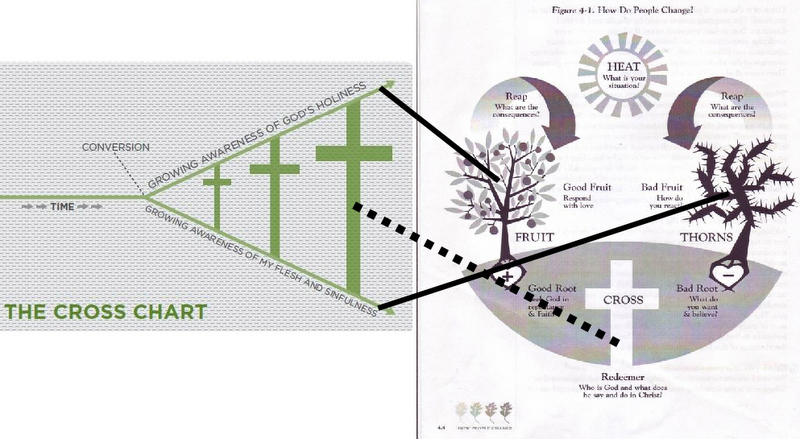
So then, what do these guys really believe about change? Well, it starts with gospel contemplationism which leads to “manifestations” of “the true and the good.” See the man in the first picture? See how he is meditating on all of the stuff outside of him? Through contemplationism, it is kinda like standing in the rain. The world sees the gospel, which in this illustration is the rain as a gospel “manifestation,” and as Christians we experience and feel the rain, but it has nothing to do with us or anything going on inside of us. For all practical purposes (in his general session address at the 2013 Shepherds’ Conference), John MacArthur likened it to a manifestation of the wind. You feel it and see its effects, but it is a force that is completely outside of us. He attributed Nicodemus’ later obedience after conversion to a mere blowing of the wind and not anything that Nicodemus could be credited with. We are talking MANEFESTATIONS here and not anything we do. It is similar to the concept of birthing the spiritual realm into the material realm.
In other words, when it gets right down to it—it’s Eastern mysticism. It began with the ancient paganism that saturated early civilization and morphed into Hinduism. Then Plato integrated the philosophy of Socrates with Hinduism. From there, it became Gnosticism which has all of the caste elements of Hinduism, and not by accident. The Reformed connections to Eastern mysticism are really no big secret and well-known among church historians.
Cults all come from the cradle of society and its spiritual caste. That’s why cults are innumerable and predicated on CONTROL. A characteristic not absent from Calvinism by any stretch of the imagination. The Gnostic Nicolaitans wreaked havoc on the first century church and the word means “conquerors of the lay people.” The name Nicodemus comes from Nicolaitans, so before his conversion, Nicodemus was probably guilty of what MacArthur said he wasn’t guilty of,
being a Calvinist.
paul

 Paul's Passing Thoughts
2 comments