Editing George Carlin for TANC 2014 Conference Promotion
Governments [Churches] don’t want well informed, well educated people capable of critical thinking. That is against their interests. They want obedient workers, people who are smart enough to run the machines and do the paperwork. And just dumb enough to passively accept it.
~ George Carlin
TANC: education on the Reformation myth. Come and learn what you will not learn in churches, seminaries or Bible colleges.
Know Your Cuts of Calvinism
1. Total Depravity: Pertains to the saints also.
2. Justification by Faith Alone: Pertains to sanctification also.
3. Mortification and Vivification: Perpetual death and rebirth for living by faith alone in sanctification to maintain justification. The reliving of our baptism “again and again.”
4. Double Imputation: Christ’s passive obedience to the cross for justification, and His active obedience as a substitution for our obedience in sanctification.
5. Deep Repentance (aka Intelligent Repentance): Seeks the death of mortification in re-experiencing our new birth.
6. New Obedience (aka New Fruit): The experience of Christ’s active obedience in sanctification (vivification).
7. The New Birth: Perpetual mortification and vivification.
8. The Objective Gospel: All reality is interpreted through the redemptive works of Christ.
9. Christ for Us: Christ died for our justification, and lived a perfect life for our sanctification.
10. The Imperative Command is Grounded in the Indicative Event: Biblical commands show forth what Christ has accomplished for us and what we are unable to do in sanctification. Works are experienced only as they flow from the indicative event of the gospel.
11. Neo-Nomianism (New Law, aka New Legalism): The belief that we can please God by obeying the law in sanctification.
12. Progressive Sanctification: The progression of justification to glorification.
13. Progressive Imputation: Whatever is seen in the gospel narrative and meditated upon is imputed to our sanctification, whether mortification or vivification.
14. The Golden Chain of Salvation: See cut 12.
15. Good Repentance: Repenting of good works.
16. In-Lawed in Christ: Christ fulfilled the law perfectly and imputed it to our sanctification.
17. Redemptive Historical Hermeneutics (the Christocentric Hermeneutic, aka the Apostle’s Hermeneutic): The Bible as historical narrative for the sole purpose of showing forth Christ’s redemptive works.
18. Faith: A neutral entity within us with no intrinsic worth that is able to reflect the object of its focus outside of us. The object of focus can be experienced within, but remains outside of us.
19. The Heart: The residence of evil desires and faith. It can be reoriented (the “reorientation of the heart” or “reorientation of desires”) to reflect Christ via mortification and vivification.
20. Flesh: The world realm where evil is manifested and experienced.
21. Spirit: The Spirit realm where the imputed works of Christ are manifested and experienced (not applied through our actions).
22. Christian Hedonism: Seeks to experience the joy of vivification.
23. Obedience of Faith: New Obedience.
24. Christ in Us: “By faith,” and faith only has substance and reality to the degree of the object it is placed in; i.e., Christ outside of us.
25. Vital Union: Makes experiencing the gospel possible. Makes mortification and vivification possible.
26. Eclipsing the Son (aka the Emphasis Hermeneutic): Focusing on anything other than Christ. Anything that is not seen through a Christocentric prism creates shadows that we live in. The obstacles that create the shadows may be truth, but they aren’t the “best truth.” “They may be good things, but not the best thing.”
27. Sabbath Rest: Sanctification. We are to “rest and feed” on Christ for our Christian life. The primary day this is done is Sunday. Through preaching and the sacraments we “kill” (mortification, or the contemplation of our evil and misery) resulting in vivification throughout the rest of the week.
28. The Subjective Power of the Gospel: The manifestation of the gospel that flows from gospel contemplationism. We never know for certain whether it is a result of our efforts or the Spirit’s work (although the Spirit’s work is always experienced by joy); hence, the power of the objective gospel is subjective (Heidelberg Disputation: Thesis 24).
29. Mortal Sin: Good works by the Christian not attended by fear that they may be of one’s own effort (HD 7).
30. Venial Sin: Good works by the Christian attended with fear (HD 7).
31. Power of the Keys (aka Protestant Absolution): Reformed elders have the authority to bind or loose sin on earth (Calvin Institutes 3.4.12).
32. Redemptive Church Discipline: In all cases to convert one to cuts 1-31. This redeems them to the only one, true faith. This can be a long process, and said person is not free to leave a given church until the elders bind or loose.
33. Preach the Gospel to Yourself: See cuts 1-32.
What Christ Would Say About, “Preaching the Gospel to Ourselves”
 The more I learn about Jesus Christ the more I stand in awe of Him. He was/is for the little guy. He wants to be glorified in little people doing great things in His name. Hence, if one pays close attention, he taught His truth in a way that it could be understood by the least gifted. I am not saying that the Word is not deep at times, but I am saying that depth does not stand in the way of the knowledge we need for individual “life and godliness.”
Plato was different. He wasn’t like Jesus. Knowledge was the only way to understanding reality, so vast giftedness in regard to intellect was critical for the wellbeing of society. That gift was only found in a few who should rule the masses for the betterment of “the group” or “the whole.” Knowledge is it.
And that’s the American church. Obviously, in our mindset, a Ph.D. equals intellectual giftedness that must rule over others for the sake of “the group.” We have lots of them telling us that we need to “preach the gospel to ourselves every day.” John Piper and Al Mohler et al continually warn us not to think we can be saved by the gospel and then, “move on to something else.” The brilliant Dr. Horton tells us that we must continually visit the gospel “afresh” in order to live the Christian life. Supposedly, the spiritual peasantry should listen to them because they are the gifted ones appointed by God to, as Al Mohler put it, “save God’s people from ignorance.” Ahmen.
But what did Jesus say thou spiritual ditch digger? Well, He told us a story about a woman He met at a well:
John 4:7 – A woman from Samaria came to draw water. Jesus said to her, “Give me a drink.” 8 (For his disciples had gone away into the city to buy food.) 9 The Samaritan woman said to him, “How is it that you, a Jew, ask for a drink from me, a woman of Samaria?” (For Jews have no dealings with Samaritans.) 10 Jesus answered her, “If you knew the gift of God, and who it is that is saying to you, ‘Give me a drink,’ you would have asked him, and he would have given you living water.” 11 The woman said to him, “Sir, you have nothing to draw water with, and the well is deep. Where do you get that living water? 12 Are you greater than our father Jacob? He gave us the well and drank from it himself, as did his sons and his livestock.” 13 Jesus said to her, “Everyone who drinks of this water will be thirsty again, 14 but whoever drinks of the water that I will give him will never be thirsty again. The water that I will give him will become in him a spring of water welling up to eternal life.” 15 The woman said to him, “Sir, give me this water, so that I will not be thirsty or have to come here to draw water.”
Obviously, Christ was talking about the gospel, salvation, or whatever idiom you want to use. The one drink results in a continuous spring of living water with no need to drink of it again. Then why would we need to continually drink of the gospel “afresh” for our Christian life? Christ is clearly saying that one drink is enough and that particular thirst/need will never reoccur. “But Paul, He wasn’t speaking of the gospel per se.” Then what was He speaking of?
Bottom line: Jesus’ illustration completely refutes the idea that sanctification, or the Christian life, has a realized or unrealized thirst that needs to be satisfied by the gospel. We drink of the gospel once for salvation and have no need to drink again.
paul
Piper’s Tweet: Evangelicals Don’t Understand That He is Talking About Our Children Too
“What’s the attractiveness of this philosophy? Simply, an escape from dealing with real life and responsibility in general.”
There is a lot of discussion among evangelicals (who don’t consider themselves New Calvinists) about John Piper. This is not unusual; we evangelicals love to talk about things we know nothing about. In regard to Piper’s heartless tweet concerning the little children who died in Moore, Oklahoma, evangelicals sit back and ponder why he would attempt to reach out to the lost in this way. What they don’t understand is he’s talking about our children too. All evangelicals can apply the principle of the same tweet to your child dying as a result of you fill in the blank.
Reformed theology is grounded in ancient paganism. It flows from the following basic construct:
1. Metaphysics. The material is evil, only spirit is good.
2. Epistemology. Truth cannot be obtained empirically. It must be obtained through some sort of gateway into the spiritual; usually contemplationism of some sort.
3. Ethics. Determined by the spiritual, and manifested by birthing the spiritual into the material realm.
4. Politics. The enlightened rule over the unenlightened masses on behalf of the spiritual. The masses are in bondage to empirical epistemology.
American evangelicals do not see the line in the sand that should be there. New Calvinism is a return to the same Gnosticism that plagued the first century church and even infiltrated Judaism. It has little patience for those who cling to the material in any way. And that includes children. The ability to dress up Gnosticism in biblical garb and its tsunami-like overtaking of Christianity mirrors what was going on in the first century church to a “T.” In New Calvinism:
1. Metaphysics: The idea that God will renovate heaven and earth with fire and dwell with us eternally in the same basic form that we perceive at this time is an abomination. Hence, Christ will not really dwell on David’s throne literally, Abraham wasn’t really looking for a literal city built by God, etc. It’s all allegory because it’s contradictory to basic Gnostic metaphysics (the idea that God would value a sliver of geography called “Israel” is an absurd notion to the average Gnostic). This is why Christians commonly think the Bride of Christ is the church and that we will dwell in heaven eternally.
2. Epistemology. ALL REALITY is interpreted by contemplating the personhood of Christ. Some call this “gospel contemplationism.” The Bible is a gospel meta-narrative (meta-narrative metaphysics) for contemplation purposes, not grammatical interpretation of reality. This is the basis of the Redemptive Historical hermeneutic.
3. Ethics. Manifested in the “flesh realm” by the imputation of Christ’s perfect life lived on earth, and a natural outflow of gospel contemplationism. New Calvinists call this, “The imperative command is grounded in the indicative event.”
4. Politics. Reformed enlightened elders rule over the unenlightened masses in order to “save them from ignorance” (Al Mohler). Adherence to Reformed elder rule and orthodoxy is one’s best chance to arrive at the final judgment covered by Christ’s obedience. As God’s rulers they also have the authority to declare someone saved or unsaved.
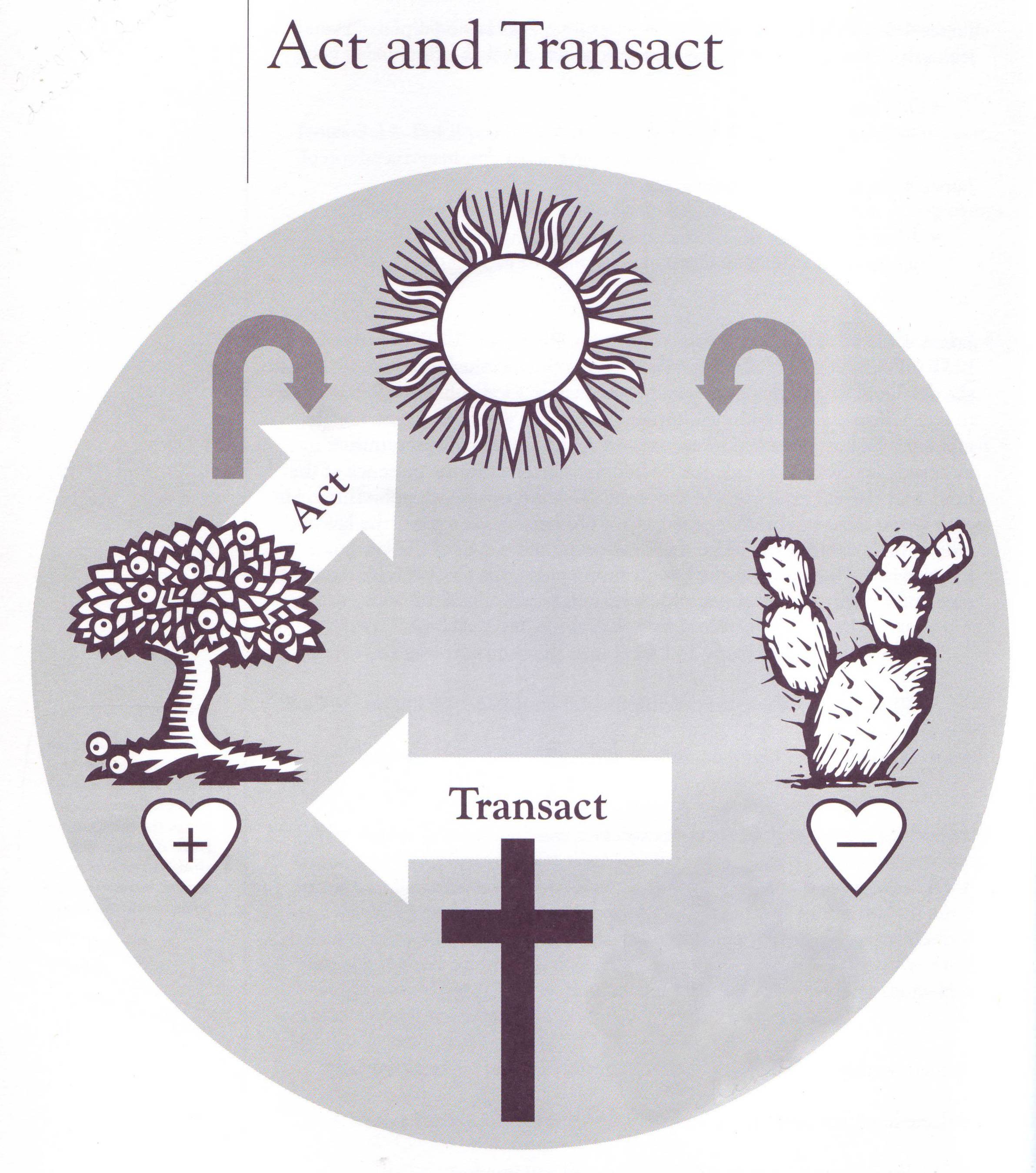
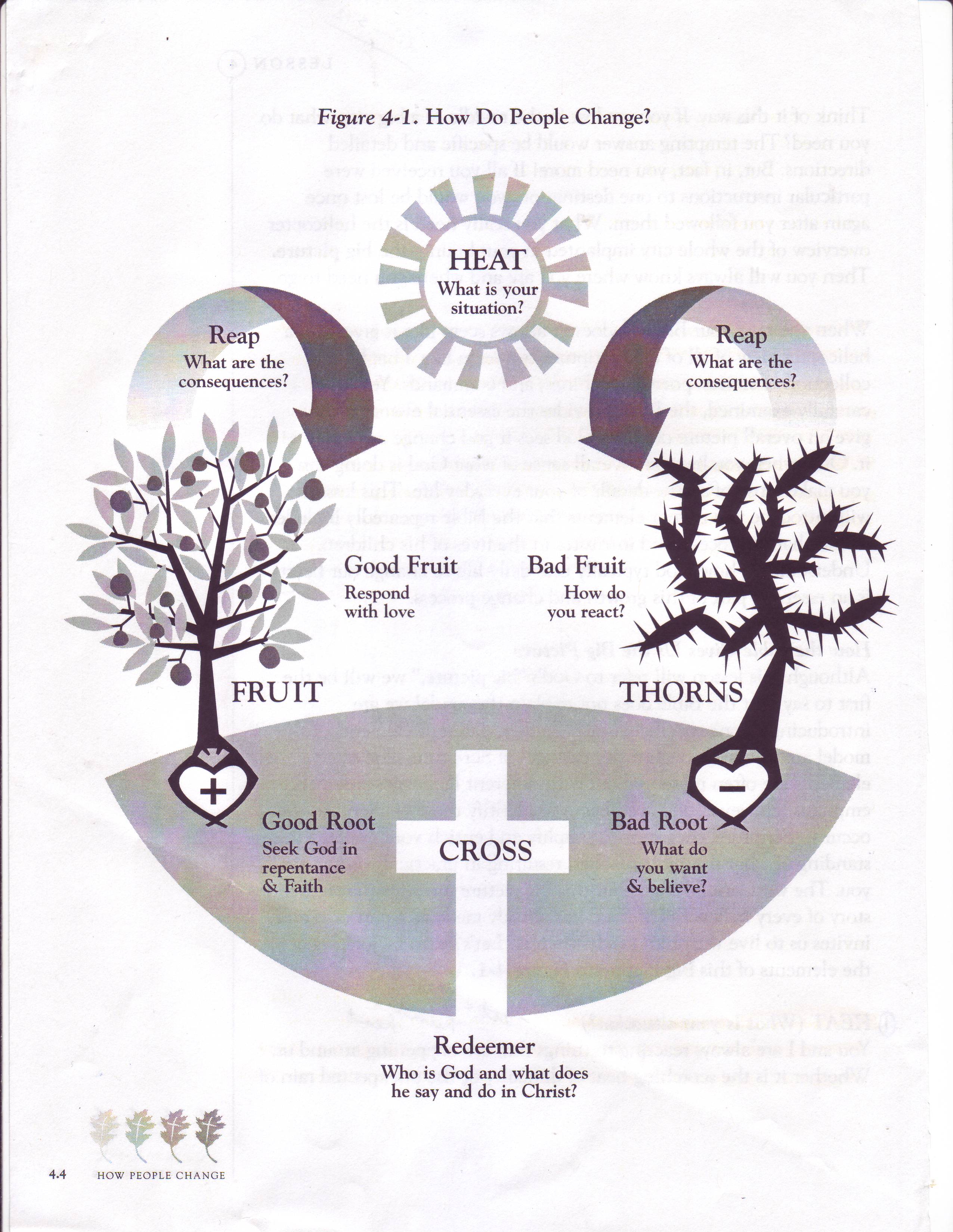
What’s the attractiveness of this philosophy? Simply, an escape from dealing with real life and responsibility in general. Contemplating the gospel and disregarding the material enables us to stand back and observe our lives without emotional attachment. Our only responsibility is to live by faith alone, and by the way, John Piper makes faith absolutely synonymous with joy. This is the premise of his Christian Hedonism philosophy. Therefore, the death of children leads to joy because it shows us the utter worthlessness of this present material world. This is also the thesis of Paul David Tripp’s How People Change: ALL events in life are preordained in order to contribute to gospel contemplationism resulting in spiritual fruit. See the chart below taken from a CCEF workbook based on the same book (click on to enlarge):
And another chart from the actual book:
To Luther, this meant a cycle of deaths and rebirths leading to joy—tragedy enables us to empty ourselves and eradicate connections with the present cares of this material world. Here is how one New Calvinist stated it:
What, then, is the subjective power of this message? Firstly, we find that there is real, objective freedom, the kind that, yes, can be experienced subjectively. We are freed from having to worry about the legitimacy of experiences; our claims of self-improvement are no longer seen as a basis of our witness or faith. In other words, we are freed from ourselves, from the tumultuous ebb and flow of our inner lives and the outward circumstances; anyone in Christ will be saved despite those things. We can observe our own turmoil without identifying with it. We might even find that we have compassion for others who function similarly. These fluctuations, violent as they might be, do not ultimately define us. If anything, they tell us about our need for a savior.
That’s it in a nutshell. And it explains Piper’s heartless tweets down to a gnat’s eyebrow. He has no patience for anyone who entangles themselves in the material world. They are ignorant.
Christians better get a grip on this. This is not mere disagreement on obscure biblical ideas—this is a completely different way of looking at reality that has wreaked havoc on mankind for thousands of years.
paul
SGM’s House of Horrors and the New Calvinist Theocratic Subculture
 The class action law suit brought against SGM has been revised. And with new allegations added, the narrative can now describe SGM as a house of horrors. I will leave the gory details to the Calvinism would be a good thing if not for the Neo-Calvinists crowd and their Reformed versions of the National Enquirer.
In a recent interview, John Piper discussed a few [!] faults that Calvin had; namely, his idea of integrating church and state. Piper then proceeded to propagate the outrageous idea that Reformed Baptists were responsible for reversing that concept. Funny, no matter how many times you read James Madison’s Memorial Remonstrance Against Ecclesiastical Establishments the Reformed Baptists don’t seem to be mentioned. Last year, Piper announced his post-retirement plans to spread “the light” of Calvinism—on location in Geneva as a way of presenting Calvin’s Geneva as a model for the renovation of humanity. If you believe Piper thinks the marriage of Church and state is a bad idea, I have an oceanfront property in Dayton, Ohio I would like to sell you.
CJ Mahaney and company may not think too much of what their pedophile friends have done, but to them, a bigger issue is at hand here: the preservation of their theocratic subculture. Mahaney et al don’t think that they should be subject to civil law. The way they state it: “The church should be free to shepherd their people as they see fit.” And the way they prefer to handle these situations should be evident by now and is directly linked to their Reformed ideology.
I have written on that extensively, and frankly, I am too lazy this morning to rehearse it all. It’s just exhausting: this behavior, though shocking, should not be surprising when their gospel is understood. Calvin and Luther considered the whole concept of Justice to be a joke and part of the “glory story” and not the “cross story.” These are people who function from a total different reality than normative metaphysics. If you believe that you are capable of interpreting your own reality you are living the glory story; if you trust them to interpret your reality for you according to the cross story, you are living in the gospel meta-narrative.
But back to my original point. New Calvinists have simply improvised and built a theocratic subculture. Again, I have written extensively on this and am weary of it. New Calvinist churches are ruled by elder law and have various ways of enforcing that law apart from the state. They would prefer the state, but the likes of James Madison, whom they despise, messed that plan up big-time on this corner of the globe.
Yawn, ugh, let me repeat a few improvisions: in-house security forces; control structure; covenants; church discipline; brainwashing; networking with likeminded government officials willing to operate off the record; etc.
Hence, the New Calvinists see this as an opportunity. If they win this case based on separation of church and state, the implications are staggering. Don’t miss this: that is why the rest of the New Calvinist community is watching this in silent, anxious anticipation. If you think they see this as a bad thing, if you think this puts New Calvinism on the ropes—you are dead wrong—they see this as a grand opportunity to set precedent and further strengthen their theocratic subculture.
paul

 Paul's Passing Thoughts
1 comment