Calvinist Gospel Sexy Time is a Longstanding Reformed Tradition
 “Let me add one to the pile: Francis Chan has noted that Christ was his grandmother’s ‘lover.’ What did he mean by that? Well, he is paid millions to be a communicator—you be the judge. Is he overpaid or did he mean what he said?”
Unrivaled by the Marxist masters of propaganda, the Protestant Reformers of old and new have effectively sold the historic motif that they are the antithesis of mysticism. This is the biggest hoax ever perpetrated on mankind in all of human history. The results speak volumes: the Calvinist camp exemplifies steroidal confusion and weirdness dressed up in scholarly garb. A good example is John MacArthur Jr. who is the personification of religious academia, but in fact is the King of Confusion. Never in the history of the church has confusion been so well-articulated since the other religious John—Calvin.
You can only dignify mystical despotism for so long before remnants of it start showing; it is the proverbial Freudian slip at the formal dinner party. In regard to “intimacy” with God versus the dreaded “O” word (obedience), or the even more dreaded “D” word (duty), it starts with Jesus is my boyfriend music, and progresses to Jesus is my boyfriend theology, and culminates into including children in the wonderful intimacy with the more dignified covering for them. Admittedly, that is a bit snarky, but one wonders since intimacy is in the eye of the beholder. That’s the problem with going to the Bible with a prism, the results are always unpredictable.
It all starts with the idea that man’s fall was a total fall into madness and chaos. In fact, some in the Reformed tradition assert that man was fallen before the fall by virtue of the fact that he was material. Before the fall, man had some integrity, but lost all of it at the fall. That’s why he was fallible in the first place; his fallibility was predetermined for God’s glory. This was John Calvin’s position, also known as supralapsarianism.
In the scheme of determinism, God also predetermines chosen ones to save humanity from chaos and madness. Almost every leader in human history until the American Revolution, whether secular or religious, claimed determinism as the premise of their authority via the Universe, Mother Nature, or God. In Reformed circles, the practical application for that is reality being a narrative written by God. The elect, who get it, see life as a prewritten redemptive-historical meta-narrative (metaphysical narrative) where everything is predetermined for God’s glory including the good, bad, ugly, and mundane. Leaders that rule in God’s stead and save the masses from chaos are predetermined characters in God’s metaphysical narrative. And characters they are.
This is the premise of Pilgrims Progress written by the Puritan John Bunyan. Like the Bible, it is the “story of every believer” and for that matter, every unbeliever as well. Books like How People Change by Calvinist Paul David Tripp supply an interpretive prism for mentally processing life according to God’s gospel meta-narrative. It rivals any mysticism that a shaman from an obscure rain forest could muster up, but again, the traditional Reformed ability to present it as intellectualism is uncanny.
So, if the narrative is all about what God has done in redemption, and not about anything we do, of course, books like The Song of Solomon must be representative of man’s relationship to God. In this narrative of prewritten reality, everything must be vertical; any horizontal consideration is another story, specifically, man’s story. Martin Luther contended that all reality was interpreted through the cross story, and man’s story was darkness and insanity, what he referred to as the glory story. Anything at all to do with man was a contra reality of insanity—only the cross story was real. Luther asserted that only a theologian of the cross story was a true theologian.
Therefore, sex must have a vertical identity. Sex should reveal more about the gospel. Sex CANNOT be separated from the gospel narrative. Sex cannot be separated from its “gospel context.” So, when we have sex with our spouse, it’s not about us, it’s about the gospel. When you have sex with your spouse, or for the YRR crowd, your girlfriend, don’t you dare forget John Piper, John Calvin, or Charles Spurgeon. But fear not for you who are less able to worship, Viagra is sold at a retail outlet near you.
So, when Dort damsel Ann Voskamp wrote of her gospel sexy time with G __ __, was she able to defend herself from the rest of the Reformed, Oh crap! You can’t just come right out and say it plainly like that crowd? Absolutely. Note this post here: http://www.aholyexperience.com/intimacy-with-god/, along with the soft music in the background, where she shows decisively that gospel sexy time is a longstanding Reformed tradition. Let me add one to the pile: Francis Chan has noted that Christ was his grandmother’s “lover.” What did he mean by that? Well, he is paid millions to be a communicator—you be the judge. Is he overpaid or did he mean what he said?
True, at times, the apostle Paul used marriage as an idiom to make a theological point. But this goes far beyond that. This is the idea that sex enhances our actual experiential intimacy with G __ __. Paul used marriage as a metaphor to distinguish the differences between law and gospel. The goal was understanding law and gospel, not a means of experiencing part of our future glorification.
This is a segway into the vital union aspect of the Reformed gospel that keeps us saved by faith alone in our Christian life. The idea of the church being the bride of Christ, oneness with Christ like a married couple become one, and the Reformed doctrine of the vital union are closely related here. We remain one with Christ by faith alone by believing that we can do no work pleasing to God; we are merely playing the part he wrote for us in the gospel narrative. We have all said it: I didn’t do that good thing, it was the Spirit! lest we do a good work and make “the fruits of sanctification the root of justification.”
Hence, all spiritual disciplines merely enhance the gospel experience of grace in our lives resulting in a transformation from “glory to glory” as far as what we experience, see, or perceive, not anything we do. This is an increased experience of the actual full glory that we are to experience at the resurrection and a source of our present assurance. Experiencing more and more of the future full glory is evidence that we are abiding in the vital union. Church fellowship, the Lord’s Table, baptism as the initial experience, trials, John Piper’s exultation style of worship, and yes, sex, all contribute to the experiential future glory found in the gospel narrative. Otherwise known as the “means of grace (salvation).”
Justin Taylor, VP of Editorial at Crossway:
“I think Peter Kreeft is on the right track in his analysis:
For we are designed for something beyond morality, something in which morality will be transformed. Mystical union with God. Sex is a sign and appetizer of that.”
Mysticism is no less mysticism though dignified with credentials.
paul
Notes from aforementioned citation:
The Language and Analogy of Scripture & Historical Protestant Christianity:
John Piper:
“Hosea 2:14-23 is one of the tenderest and most beautiful love songs in the Bible…
In the context of a broken marriage being renewed with the fresh vows of betrothal must not the words, “and you shall know the Lord,” (v. 20) mean, you shall enjoy an intimacy like that of sexual intercourse.
~ John Piper The entire sermon is available here.
Timothy Keller:
“Sex is for fully committed relationships because it is to be a foretaste of the joy that comes from being in complete union with God. The most rapturous love between a man and woman is only a hint of God’s love for us (Rom. 7:1–6; Eph. 5:21–33). …
Positively, we are called to experience the spousal love of Jesus.”
J. Vernon McGee, Thru the Bible Radio:
“When a man and a woman give themselves to each other in an act of marital love, they can know the love of Christ as no one else can know it.”
Jonathan Edwards in the Excellency of Christ:
“So again, we being united to a divine person, as his members –
can have a more intimate union and intercourse with God the Father.”
~ John Calvin:
“The strong affection which a husband ought to cherish towards his wife is exemplified by Christ, and an instance of that unity which belongs to marriage is declared to exist between himself and the Church. This is a remarkable passage on the mysterious intercourse which we have with Christ.”
~John Calvin’s Commentary on Ephesians 5
“…a loving soul wants fresh food every day from the table of Christ.
And you who have once had the kisses of His mouth, though you remember the past kisses with delight, yet want daily fresh tokens of His love.”
–Charles Spurgeon’s sermon on “The Church’s Love To Her Loving Lord

“Consider he makes love to thee. Not one soul that hears me this day but the Lord Jesus is a suitor unto, that now ye would be espoused to him; “He came unto his own, and they received him not.” Whatever the secret purpose of Christ is, I regard not.
In this evangelical dispensation of grace, he makes love to all.…
‘Tis fervent, vehement, earnest love… The Lord longs for this… pleads for this,… mourns when he has not this… Take thy soul to the Bride-chamber, there to be with him forever and ever….” ~ Read the rest of the sermon at Puritan and Reformed Sermons
Peter Leithart, Reformed Pastor: “Sex is allegory… and as allegory it is …theology. For Christians, sexual difference and union is a type of Christ and the church… Only as allegory can the Song play its central role in healing our sexual imaginations.”
A.W. Tozer: The Pursuit of God … to read the entire compelling excerpt, click here …
“We have almost forgotten that God is a Person…
The continuous and unembarrassed interchange of love and thought between God and the soul of the redeemed man is the throbbing heart of New Testament religion.
This intercourse between God and the soul is known to us in conscious personal awareness.
It is personal: that is, it does not come through the body of believers, as such, but is known to the individual…
And to the body through the individuals which compose it. And it is conscious: that is, it does not stay below the threshold of consciousness and work there unknown to the soul (as, for instance, infant baptism is thought by some to do), but comes within the field of awareness where the man can ‘know’ it as he knows any other fact of experience.
From the hymn: The Church is One Foundation
The Church’s one foundation
Is Jesus Christ her Lord,
She is His new creation
By water and the Word.
From heaven He came and sought her
To be His holy bride;
With His own blood He bought her
And for her life He died….
’Mid toil and tribulation,
And tumult of her war,
She waits the consummation
Of peace forevermore;
Till, with the vision glorious,
Her longing eyes are blest,
And the great Church victorious
Shall be the Church at rest.
Yet she on earth hath union
With God the Three in One,
And mystic sweet communion
With those whose rest is won,
With all her sons and daughters
Who, by the Master’s hand
Led through the deathly waters,
Repose in Eden land.
C.H. Spurgeon: Morning and Evening
Song of Solomon 1:2
Let Him kiss me with the kisses of His mouth.
For several days we have been dwelling upon the Saviour’s passion, and for some little time to come we shall linger there…. let us seek the same desires after our Lord as those which glowed in the heart of the elect spouse.
How bold is her love! …
Esther trembled in the presence of Ahasuerus, but the spouse in joyful liberty of perfect love knows no fear. If we have received the same free spirit, we also may ask the like.
By kisses we suppose to be intended those varied manifestations of affection by which the believer is made to enjoy the love of Jesus.
The kiss of reconciliation we enjoyed at our conversion, and it was sweet as honey dropping from the comb.
The kiss of acceptance is still warm on our brow, as we know that He hath accepted our persons and our works through rich grace.
The kiss of daily, present communion, is that which we pant after to be repeated day after day, till it is changed into the kiss of reception, which removes the soul from earth, and the kiss of consummation which fills it with the joy of heaven.
Faith is our walk, but fellowship sensibly felt is our rest.
Faith is the road, but communion with Jesus is the well from which the pilgrim drinks.
O lover of our souls, be not strange to us; let the lips of Thy blessing meet the lips of our asking; let the lips of Thy fulness touch the lips of our need, and straightway the kiss will be effected.
This Evening’s Meditation
C. H. Spurgeon
Art thou, beloved one, with Christ Jesus? Does a vital union knit thee to Him?
… Come, my soul, if thou art indeed His own beloved, thou canst not be far from Him.
If His friends and His neighbours are called together to see His glory, what thinkest thou if thou art married to Him? Shalt thou be distant?
Though it be a day of judgment, yet thou canst not be far from that heart which, having admitted angels into intimacy, has admitted thee into union.
Has He not said to thee, O my soul, “I will betroth thee unto Me in righteousness, and in judgment, and in lovingkindness”?
Have not His own lips said it, “I am married unto thee, and My delight is in thee”? If the angels, who are but friends and neighbours, shall be with Him, it is abundantly certain that His own beloved Hephzibah, in whom is all His delight, shall be near to Him, and sit at His right hand.
Here is a morning star of hope for thee, of such exceeding brilliance, that it may well light up the darkest and most desolate experience.
~ Thomas Watson, Puritan (1620-1686):
There is a closer union in this holy marriage than there can be in any other.
In other marriages, two make one flesh, but Christ and the believer make one spirit: “But he who is joined to the Lord is one spirit with Him.” (I Cor. 6:17).
Now as the soul is more excellent than the body, and admits of far greater joy, so this spiritual union brings in more astonishing delights and ravishments than any other marriage relationship is capable of.
The joy that flows from the mystic union is unspeakable and full of glory (I Peter 1:8).
To read his entire sermon: Mystic Union of Christ and the Saints
“Yet you were naked and bare.
Then I passed by you and saw you, and behold, you were at the time for love;
so I spread My skirt over you and covered your nakedness I also swore to you and entered into a covenant with you so that you became Mine,”
declares the Lord GOD.
Then I bathed you with water, washed off your blood from you and anointed you with oil…
32″You adulteress wife, who takes strangers instead of her husband!“
“God very commonly takes on the character of a husband to us. Indeed, the union by which he binds us to himself when he receives us into the bosom of the church is like sacred wedlock…
“Therefore that joining together of head and members, that indwelling of Christ in our hearts—in short that mystical union—are accorded by us the highest degree of importance.”
John Calvin ~ Institutes of Christian Religion
14″Therefore, behold, I will allure her,
and bring her into the wilderness,
and speak tenderly to her…
16″And in that day, declares the LORD, you will call me ‘My Husband,’ and no longer will you call me ‘My Baal.’…
19And I will betroth you to me forever. I will betroth you to me in righteousness and in justice, in steadfast love and in mercy.
20 I will betroth you to me in faithfulness. And you shall know the LORD.
Edward Fisher in his 1650 book The Marrow of Modern Divinity (Christian Focus, 2009):
––––––––––––––––––
I tell you from Christ,
and under the hand of the Spirit,
that your person is accepted,
your sins are done away,
and you shall be saved;
and if an angel from heaven should tell you otherwise,
let him be accursed.
Therefore, you may (without doubt) conclude
that you are a happy man;
for by means of this your matching with Christ,
you are become one with him,
and one in him,
you ‘dwell in him, and he in you’ (1 John 4:13).
He is ‘your well beloved, and you are his’ (S. of S. 2:16).
So that the marriage union betwixt Christ and you
is more than a bare notion or apprehension of your mind;
for it is a
special,
spiritual, and
real union:
it is an union betwixt the nature of Christ,
God and man,
and you;
it is a knitting and closing,
not only of your apprehension with a Saviour,
but also of your soul with a Saviour.
Whence it must needs follow that you cannot be condemned,
except Christ be condemned with you;
neither can Christ be saved,
except you be saved with him.
And as by means of corporeal marriage all things become common betwixt man and wife;
even so, by means of this spiritual marriage,
all things become common betwixt Christ and you;
for when Christ hath married his spouse unto himself,
he passeth over all his estate unto her;
so that whatsoever Christ is or hath,
you may boldly challenge as your own.
‘He is made unto you, of God,
wisdom,
righteousness,
sanctification,
and redemption’ (1 Cor. 1:30).
And surely,
by virtue of this near union it is,
that as Christ is called ‘the Lord our righteousness’ (Jer. 23:6),
even so is the church called, ‘the Lord our righteousness’ (33:16).
He leans on Christ his beloved and lives by communications of grace from him.
“His life is hid with Christ in God;” and “the life which he now lives in the flesh, he lives by faith on the Son of God.”
This is the vital or real union; the union of affection between Christ and believers. Faith has be some been called the hand or instrument by which believers lay hold on and receive Christ.
But with more propriety may it be called the act of unition itself, or the uniting act, by which Christ and the believer
become one.
~ Jonathan Edwards: The Works of Jonathan Edwards
And would you have him nearer to you than to be in the same nature, united to you by a spiritual union, so close as to be fitly represented by the union of the wife to the husband, of the branch to the vine, of the member to the head; yea, so as to be one spirit?
For so he will be united to you, if you accept of him.
~ Jonathan Edwards: the Excellency of Christ
There he is, for “he feeds among the lilies.” The spouse sees him of whom she speaks; he may be a mere myth to others but he is a substantial, lovable, lovely, and actually beloved person to her.
He stands before her, and she perceives his character so clearly that she has a comparison ready for him, and likens him to a gazelle feeding on the tender grass among the lilies. This is a very delightful state of heart. Some of us know what it is to enjoy it from year to year.
Christ is ours, and we know it. Jesus is present, and by faith we see him.
Our marriage union with husband or wife cannot be more clear, more sure, more matter of fact, than our oneness with Christ and our enjoyment of that oneness.
Joy! joy! joy! He whom we love is ours!
Calvinists Disagree on Calvinist Ghost Sex
 Here we go again. Dignified Protestant mysticism is offended by the fruits of their redemptive interpretation of all reality. You know, the Bible isn’t a book of do’s and don’ts, every verse is about what Jesus did, not anything we do. It is a book that shows us more and more how sinfully depraved we are which results in more and more gratitude for the cross which results in obedience being, as John MacArthur has stated, “never bitter—always sweet.” The mystic exploits of the who’s who of Calvinism is hanging on the Reformed tree in plain view for everyone to see—it’s totally old news.
Yes, on the one hand, the Bible is a gospel meta-narrative, but on the other hand, when a Reformed philosopher king or queen isn’t nuanced enough, all of a sudden, Calvinists start covering up with a grammatical interpretation of Scripture. Hark, all of a sudden the plain sense of Scripture is appealed to in order to reassure the herd that said weirdness isn’t “orthodoxy.” It reminds me of Steve Camp whining and moaning about Jesus is my boyfriend music while holding to the same Reformed gospel that is destined for various and sundry stuff that you couldn’t begin to make up.
The latest How are we going to explain this one? comes in the form of Dort damsel Ann Voskamp claiming that she has sex with G__ __ . Usually I type His name out, but not in that sentence along with that thought—way too creepy.
Here is the problem: the Reformed camp uses the Redemptive Historical or Christocentric method of interpreting the Bible (and all of reality as well, but that is another post). So, in The Song of Solomon, what is written, which is pretty steamy in places, has to necessarily be symbolic of the relationship between Christ and the church. Poke the Reformed wild pig anywhere; this is their take on that book. And that my friend is pretty darn creepy. And of course, this idea runs so deep in the Protestant psyche that even Arminians quickly attest to the “fact” that we are the what?…right, “bride of Christ.”
Such are we: while ratcheting back in horror at Voskamp’s assertion, we speak ourselves of “intimacy with God” etc. Reformed authors who are wildly popular in our day speak of our relationship with God in these intimate terms on a continual basis. One example is the book Crazy Love written by Francis Chan which reeks of Jesus is my boyfriend theology from cover to cover. Chan asserts in the book that our relationship with Christ should feel like our first love of the opposite sex. He states in the book that such exhilaration is proof of a true relationship with Christ. Duty, he says in the book, “feels like work,” but true love “feels like love.” According to the Sola Sisters blog, Voskamp states the following in her wildly popular book, One Thousand Gifts:
I fly to Paris and discover how to make love to God. (One Thousand Gifts, p 201)
I think how lives, whole generations, were laid down to built this edifice, to find a way in. But they thought the steps to God-consummation were but three: purgation, illumination, union. (One Thousand Gifts, p 208)
I remember this feeling. The way my apron billowed in the running, the light, the air. The harvest moon. I remember. The yearning. To merge with Beauty Himself. But here…….Now? Really?…….I am not at all certain that I want consummation…….And who wouldn’t cower at the invitation to communion with limitless Holiness Himself? (One Thousand Gifts, p 211)
I run my hand along the beams over my loft bed, wood hewn by a hand several hundred years ago. I can hear Him. He’s calling for a response; He’s calling for oneness. Communion (One Thousand Gifts, 211)
This invitation to have communion with Love—is this the edge of the mystery Paul speaks of? A man leaves his father and mother and is joined to his wife, and the two are united into one. This is a great mystery, but it is an illustration of the way Christ and the church are one (Ephesians 5:31-32). The two, Christ and the church, becoming one flesh—the mystery of that romance. Breath falling on face, Spirit touching spirit, the long embrace, the entering in and being within—this is what God seeks? With each of us? (One Thousand Gifts, pp 212-213)
If Christians would only abandon Protestant orthodoxy and read the Bible with the mind God gave them. The Bible states plainly that we are the guests of the Bridegroom, we are not the bride. The bride is New Jerusalem that comes down from heaven immediately after the new heavens and new earth.
Look at the unstoppable crazy train that is Protestantism for yourself. Whether it is ghost sex, John Piper’s scream of the damned etc., it is going to continue to get crazier and crazier.
Come out from among them and be separate.
paul

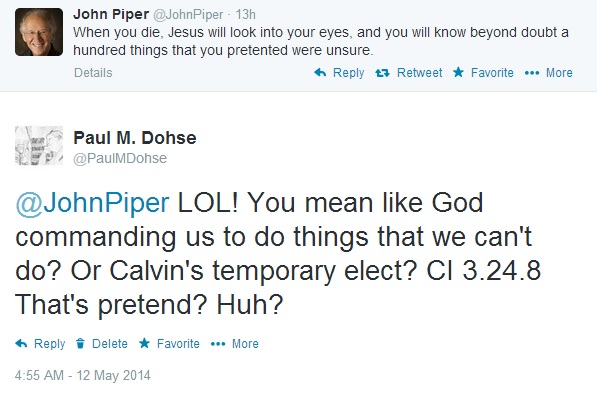
“< Tweet, Tweet

@JohnPiper Doctors who create the disease of confusion will always be needed.
The Confused Gospel: Sinners Saved by Grace Disgraced when they Sin
 I continue to be amazed at how “Christian” leaders with national visibility are disgraced when they get caught with their fingers in the cookie jar. What is amazing about this is for the most part their ministries are predicated on the idea that Christians are just “sinners saved by grace.” This is how it is stated: “I’m just a sinner saved by grace.” That’s in the present tense, and that’s good news because humbleness hath no greater friend than a guy named Zero, as in, Zero Accountability.
Woe is me, “I can do nothing.” Christians shrink back in horror in regard to thinking that they would get credit for doing something good. Tullian Tchividjian once tweeted that he knows he is going to heaven because he couldn’t remember one good work that he had ever done. There is a lot of confusion on this point in regard to the authentic Reformed view of mortal sins versus venial sins. Luther taught that Christ performs all righteous works through us and these works are experienced subjectively. In other words, we really don’t know whether we are doing the work or Christ is doing the work. But, to think that we actually did the work, or were a part of it beyond the mere experience of it, is apart from justification by faith alone and is a mortal sin. But, if we ask forgiveness for doing the good work or “attend the good work with fear” just in case it was actually us doing it, that is only venial sin. Every time you hear Baptists say, It wasn’t me who did it! It was the Holy Spirit! –that’s the Lutheran in them.
This isn’t terribly difficult to understand. If you are standing in the rain, you are experiencing the rain, and anthropomorphically, you have the inner ability to experience the rain. But you can take no credit for the rain; it is being done to you instead of you doing the action to someone else. And just because the experience is in you, does not mean the good work of the rain is in you—you are only experiencing it. The human heart has the ability to experience good works, but not to perform them. The belief that the heart can generate a good work is not of faith and mortal sin. That’s Reformed metaphysics 101.
Take the homeschool icon Doug Phillips for example. It has come out, by his own admission, that he had a long-term inappropriate relationship with a woman that was not biblically sexual [enter pause here for laughter]. In his disgraceful fall, he actually presented himself as a righteous person who slipped up a little bit, but has such high standards that he voluntarily resigned from his immense gravy train to recalibrate his life. After all, everyone knows that a man can have a crush on a female that is just a friend, a “woman” right?
Well, as it turns out, it was the nanny, and a very young nanny, and he denies the nonsexual inappropriate behavior that she is claiming. Apparently, it was less inappropriate than she claims. Phillips denies her allegations, but refuses to specifically cite what the behavior was, that would be gossip [enter another pause here for more laughter]. Apparently, the nanny isn’t up with how this is all going down and is going to get everything on the record in court. And of course, he must be telling the truth because if it was as bad as the evil nanny tells; his wife wouldn’t be supporting him. In fact, in interviews sanctified as ungossip, they claim that God has used the evil nanny to make their marriage better than it has ever been! This is not funny at all; it is a classic example of an elitist throwing away a peasant that he is done using for his own pleasure.
But now my point: Phillips, in his glory days as a Christian icon routinely introduced himself as a “sinner.” Sooooo, what’s the big deal? He is a sinner acting like a sinner, but he can’t keep his job as a sinful leader among sinners? Gee whiz, even the apostle Paul said he was the “Chief of sinners,” and Phillips didn’t even penetrate! So, why can’t he keep his job? Perhaps lack of penetration, the “biblical” definition of sex, disqualified Philips from being a Chief among sinners.
Pardon the sarcasm, but the world is watching this mess play out time and time again while Christians chalk it up to… you got it… “We are all just sinners saved by grace.” “Judge not, lest you be judged.” Newsflash: for the most part, the who’s who of Evangelicals remain silent regarding these scandals other than to say…you got it…”We are all just sinners saved by grace.”
Got church mess? Got church deadness? Got church a mile wide and an inch deep? Go figure, we don’t even know who we are. The Bible never, never, never, never, never, identifies Christians as wicked in the present tense. Usually, Romans 7:24 is cited to make the case that Christians are still “wretched,” but the word actually means to persevere in the midst of affliction. I could point to many other Scriptures that are taken out of context in this way, but the fact is that the Bible refers to Christians as “righteous,” “holy,” “full of goodness,” and “able.”
So, who are we? Don’t you think that it would be a good idea if we knew? Evangelize if you will, but if you don’t know whether we are saints or sinners, good luck with that. But this brings me back to the strange silence of other leaders when one “falls from grace.” That is, other than…well…you know. For the most part, leaders do believe Christians only change positionally and not personally. I have documented the quotations en masse on this blog and will not belabor the point here.
But the fact is, most Christian leaders of our day believe that we should get rid of the whole, “living out our testimony” routine and have said so in no uncertain terms. The likes of Michael Horton have said that living by our testimony is an attempt to “be the gospel rather than preaching the gospel” which supposedly destroys the whole point of the gospel to begin with because, “it’s not our doing—it’s Christ’s doing and dying.” Notice that doing in sanctification is the same thing as doing in justification. James MacDonald stated that he has “resigned from fixing people” because they can’t be fixed. John MacArthur has stated that his ministry no longer requires people to “jump through hoops.” He has also suggested that Christians don’t apply the word of God to their lives; the Holy Spirit does the application for us. He then suggested that Christians therefore often obey unawares. And, we know when the Holy Spirit is obeying for us when the obedience is experienced as “always sweet, never bitter.”
This comes from Luther’s Simul iustus et peccator – “At the same time righteous and a sinner.” Luther believed we are only saints positionally, and are still sinners personally. We don’t change, only our status changes. So, it’s not even like Facebook where a status change means a personal change. This is the reason for the silence. Like John Piper has stated, most Christians are not ready for the real Reformation gospel of Simul iustus et peccator. We are all sinners, and nothing more or less should be expected. Away with all of this “behaviorism” and “moralism” in Christianity; viz, the idea that we do righteousness rather than righteousness being something that is done to us instead of by us.
Who are we? Are we saints or sinners? If my cat, Coaster, had a Facebook page, he could change his status because he just learned how to walk through a cat door. If a door is not shut completely, he can open it with his paw, but it took him awhile to figure out vertical swing versus horizontal swing. It’s the paw for normal doors, but you have to head-butt the cat door. So, is that our message? If we can do more than a cat without Jesus we are going to hell?
When we evangelize, which isn’t often to begin with, do we get a blank stare because the listener hasn’t been sovereignly illuminated, or do they just simply think we are stupid? It would be hard to tell because we don’t even know who we are.
paul

 Paul's Passing Thoughts
5 comments