When Church is Spiritual Gangrene: Sanctification by Justification
 We have recently received our weekly dose of Neo-Calvinist drama. This time, it was Matt Chandler’s turn to give discernment bloggers the gift that just keeps on giving. This recent incident involving Chandler’s Village Church has gone super-viral. Secular news networks are even reporting on the episode resulting in a public outcry.
These incidents are not isolated and will continue to be exposed in both Protestant and Catholic circles because they are the result of a false gospel. As Jesus said, a tree is known by its fruit.
Jordan Root
Apparently, the constant drama taking place in the evangelical church is not nature’s way of telling us something is wrong. However, the most recent drama concerning former missionary Jordan Root supplies a pretty decent insight into the core problem of progressive justification.
Christ’s called out assembly is a body that depends on individual members. The apostle Paul used a body analogy because it is the perfect analogy of Christ’s called out assembly. Strong individual members make a strong body. Consequently, every member’s role must be identified and nourished. To the degree that members (body parts, not the Salvation Club membership) do not function properly, the body is crippled and falls short of fulfilling Christ’s mandate.
Christ is the only head. The common goal is the one mind in Christ. The advent of Christ’s called out assembly was a monumental event. The monumental event was the baptism of the Holy Spirit. The Spirit is a major participant in the plan of salvation. Beware of any doctrine that emphasizes one of the three Trinity persons over the other in the plan of salvation. Salvation is Trinitarian.
 There was a new birth before the death, burial, and resurrection of Christ, but until that time, salvation was atonement by the law. In other words, according to Moses, obedience to the law could bring both life and death, but at that time the law was a covering for sin. All sin was imputed to the law and the law held that sin captive along with the believer. The believer was blessed by obedience to the law, and their sins that were a violation of the law were held in escrow until the coming of Christ. Of course, the terms of this particular escrow is an eradication instead of a payment.
On the other hand, the sins of unbelievers were not imputed to the law, but rather the law condemned them for every offence. In both cases, life and death according to the law was experienced, but with different ENDS. Whether believer or unbeliever, degrees of life and death occurred, but salvation determined a life end while being unsaved determined a death end with degree of violation determining the wages of eternal death.
When it was the Spirit’s time for His major event, He resurrected Christ from the grave and gave gifts to Christ’s assembly while baptizing Jews and Gentiles into one body. Christ died to end the law by paying the penalty for ALL sins imputed to it. With the ending of the law, all sins committed against it were ended as well except for those who were not covered by it. For unbelievers, the law was not ended and therefore they remain condemned by it.
Hence, the law is no longer an atonement for believers, but only serves as a means to love God and others. Before the baptism of the Holy Spirit, it served as atonement and a means of love, now it can only serve as a means of loving God and others. However, for unbelievers in this day, the law has a sort of grace to it; in that sin is still imputed to it. If and when they believe in Christ, every sin they committed against the law (all sin is a violation of the law) is ended with the law and now there is no law that can condemn them in the future. Therefore, the Old Testament atonement is still a “ministry of death” that is “passing away” (From an eschatology point of view, this is why believers were in the abode of the dead until Christ died on the cross. During the three days after His crucifixion, he preached to the “captives” and set others free leading them to heaven in a victory procession).
Nevertheless, through ignorance, the believer can experience as much present death, or even more death than unbelievers who will come to realize a death ending. There is a specific dynamic that figures in. The Bible splits this up into “under law” and “under grace.” Under law is the biblical definition of an unregenerate person and possesses a certain metaphysical dynamic, or state of being. Those under law are free to do good but enslaved to sin. This is primarily because they are under the law’s condemnation or judgement. In conjunction with SIN, the law empowers sin. When the law is ended, sin is stripped of its power because there is no condemnation. Sin finds its power in condemnation.
And death finds its sting in sin. The primary root of all fear is fear of judgment, and mankind, having the “works of the law” written on their hearts and administered by the conscience, knows intuitively that future death means future judgement. But “perfect love casts out fear.” What’s that? That’s “under grace” which is now no longer under the condemnation of the law; the law only serves to inform the believer in regard to loving God and others. There is NOW NO condemnation for those in Christ.
Yet, there is still a death/life dynamic going on that is experienced by the believer and unbeliever alike. The end is different, but not necessarily the life experience. Those under grace are enslaved to righteousness, but unfortunately free to sin. They are enslaved to righteousness because of the baptism of the Spirit. Don’t get too hung-up on the “slave” nomenclature. Under law enslaves the unbeliever to the laws condemnation. That is inescapable. They are crippled and enslaved to constant condemnation and the fear of death. This is where it is vital to realize that the baptism of the Spirit is a literal death of the person who is under law and enslaved to it. They are enslaved to its inevitable endgame of death measured by the degree of life choices regarding law—primarily the law of their conscience, but ultimately the full brunt of God’s specific law of which they are indifferent.
Once a person is saved, they are ”free” from the condemnation of the law also known as the “law of sin and death,” and “free to serve another.”
Romans 7:4 – Likewise, my brothers, you also have died to the law through the body of Christ, so that you may belong to another, to him who has been raised from the dead, in order that we may bear fruit for God. 5 For while we were living in the flesh, our sinful passions, aroused by the law, were at work in our members to bear fruit for death. 6 But now we are released from the law, having died to that which held us captive, so that we serve in the new way of the Spirit and not in the old way of the written code.
Note the slave terminology. Through the death of Christ, he purchased all of mankind by ending the law. His death purchased all people from the Sin slave master. Think about that in regard to those under law. Their freedom has been purchased already. If Christ died to end the law, and He did (Romans 10:4), and all unsaved people are under the law, and they are (Romans 8:2, 6:14), those who believe in Christ are now dead to the law and any possible condemnation in the future.
Christ didn’t die for anyone in particular, He died to end the law that all of mankind is under at one time or another. That necessarily demands a conclusion that Christ died for all people unless some are born into the world who are not under law, and that is obviously not the case.
To believe in Christ is to follow Him in the Spirit’s baptism. It is not merely a mental ascent to the facts of the gospel of first importance, it is a decision to follow Christ in that baptism. You recognize that Christ has purchased you from the Sin master, and know that you will not escape if you reject so great a salvation. The judgement is greater in this era because atonement spoke on earth through Moses and none who rejected it escaped, but now the call comes from heaven.
In Romans 7:4, we see both sides of the Spirit’s baptism:
A. Death;
you also have died to the law through the body of Christ, so that you may belong to another.
B. Resurrection;
But now we are released from the law, having died to that which held us captive, so that we serve in the new way of the Spirit.
This is summarized this way:
Romans 6:3 – Do you not know that all of us who have been baptized into Christ Jesus were baptized into his death? 4 We were buried therefore with him by baptism into death, in order that, just as Christ was raised from the dead by the glory of the Father, we too might walk in newness of life.
5 For if we have been united with him in a death like his, we shall certainly be united with him in a resurrection like his. 6 We know that our old self was crucified with him in order that the body of sin might be brought to nothing, so that we would no longer be enslaved to sin. 7 For one who has died has been set free from sin. 8 Now if we have died with Christ, we believe that we will also live with him. 9 We know that Christ, being raised from the dead, will never die again; death no longer has dominion over him. 10 For the death he died he died to sin, once for all, but the life he lives he lives to God. 11 So you also must consider yourselves dead to sin and alive to God in Christ Jesus.
12 Let not sin therefore reign in your mortal body, to make you obey its passions. 13 Do not present your members to sin as instruments for unrighteousness, but present yourselves to God as those who have been brought from death to life, and your members to God as instruments for righteousness. 14 For sin will have no dominion over you, since you are not under law but under grace.
We are released from the law (death) in order to be freed to “serve” another (resurrection). The guide for that service is the Spirit’s law. That’s a really good thing to call the Bible: the Spirit’s law; He uses it to convict the world of sin and the judgment to come in regard to those under law, and uses it to sanctify those under grace (John 17:17).
This is all by faith because if we do not live by this dynamic, if we do not take it literally, the metaphysical dynamic of life/death starts to bear unfortunate fruit – the death type. We will practice and apply what we believe to be true. How literally we take this dynamic does not modify the natural effect of the dynamic. If a tree really fell in the forest, that really happened whether we believe it or not. And the life/death dynamic happens whether we believe it or not.
Even though the endgame for every believer is life, they can live a life of death through ignorance. Through ignorance, they can actually be enslaved to the sin they were freed from. How does this happen? The Bible is very clear about how this happens.
It begins with ignorance about desire.
Though the old us/we literally died with Christ, and we are no longer under the law and free to serve Christ rather than serving the law of sin overseen by our old master, our mortal bodies that are not yet redeemed still possess the desires of the old man. The “mind” is redeemed, and we therefore share the same desires of the Spirit, but sin can still harass us through sinful desires. It is important to note that “the flesh” is NOT inherently evil, but rather “weak.” “Sins of the flesh” and “desires of the flesh” refer to when the flesh, or our bodies are succumbing to desires that come from sin via our choices regarding obedience. The body can also be used for holy purposes as well as sinful purposes.
At any rate, one who has died with Christ and has been resurrected to new creaturehood with Christ is able to say “no” to desires that come from sin that still resides in our mortal bodies. One reason among others that we are able to say “no” is due to the fact that sin’s power has been stripped away because it can no longer condemn us (1Corinthians 15:56). Our motives in love are by default pure in regard to justification because we are righteous and justified apart from the law. The law cannot condemn us, so the only venture left is to use the law for loving God and others. Any attempt by a believer to earn justification is completely illogical because that would be an attempt to finish an already finished work (Galatians 3:3 | note the YLT version).
Succumbing to sinful desires as a Christian is a matter of family sin, and not sin that relates to justification in any way. So in regard to justification we are blameless via the new birth that ended the law, but we may be chastised by God in regard to not loving our Father and others as we are called to. Note in the Lord’s Prayer that we ask forgiveness from our Father which is an altogether different matter than seeking salvation from sin that condemns us.
The Bible also teaches us that the intensity of sinful desires is increased if we give “provision” to those desires. In other words, by obeying sinful desires, we increase the intensity of sin’s appeal through the passions and emotions. Furthermore, since we become slaves of the master we obey, Christians can become enslaved “once again” to the demands and desires of the old master. Of course, this is due to extreme ignorance. Nevertheless, obeying sinful desires nourishes the desires, intensifies them, and over time a Christians can be habituated in regard to those desires.
This problem finds its roots in religions that promote progressive justification. Because salvation is supposedly a process that begins at point A and progresses to point B (rather than a onetime, and once-for-all-time transformation that guarantees salvation), the “Christian” life, also known as sanctification, is part of the salvation/justification “progression” from point A to point B. Consequently, the very definition of sanctification, ie., knowing how to “control our own bodies” (1Thessalonians 4:3,4) is egregiously circumvented.
And the idea of being sanctified by justification plays well for existing guilt. True believers feel bad that Christ had to die for our sin, and our lack of ability to grasp the full gravity of Christ’s sacrifice feeds that guilt as well. Far removed from the actual historical event, our lack of identification with Christ’s suffering makes us feel unthankful and indifferent. As a result, we are open to ways that enable us to better identify with Christ’s actual suffering as a way to obtain an acceptable appreciation of our salvation. This idea plays to our natural and logical inclinations.
But there are several problems with this approach. First, the Bible doesn’t call us to continually revisit the same gospel that saved us in order to obtain more and more gratitude for our salvation. This can easily become a way of earning our salvation via acceptable gratitude. Secondly, the guy who would be able to plunge the depths of why Christ had to die for him IS dead. Thirdly, the new creature cannot endeavor to better understand the condemnation that Christ died to end precisely because there is no condemnation. The subject is looking for something that cannot exist apart from the law, and therefore, if he/she finds any, it’s a figment of their misguided imagination.
Unless of course, they are deceived and are actually experiencing real condemnation because belief in a progressive justification gospel did not bring about the baptism of the Spirit. Remaining under law, they are finding ample condemnation that is “making the cross bigger and people smaller.”
In most cases, and due to overall ignorance regarding sanctification because all of the traditional rage is to make sanctification part of the justification process, the new Christian is immediately confused that they are experiencing sinful desires. After 2000 years since the advent of the Spirit’s baptism, EVERY new believer should be able to say:
According to the Bible, I just experienced a sinful desire. God has promised me that I am able to say “no” to that desire, and if I disobey that desire, I am sucking the life out of it more and more and learning to hate it more and more. I am a slave to whatever I obey, and sanctification is putting off the old habits of the old person and putting on the new habits of the new creature. Obedience results in habituation to either godliness or ungodliness.
This dynamic is not operative in those under law because they are not born again and are indifferent to God’s word. Psalm 119 is the heart of a born again individual. Those under law may live a moral life that is part and parcel with being created in the image of God, but every violation of the law is a wage for death. Not being subject to certain desires of the baser sort does not exclude them from being under law—they will just suffer a more tolerable end.
There is something VERY important to understand about the desires that come from sin: they are myriad, of various and sundry stripes, and at times horrifying. They can, and do include a desire to murder people, all kinds of covetousness, and a plethora of unnatural sexual desires.
Nothing is sadder than a Christian who experiences a baser type of sinful desire and doesn’t understand what’s going on. Immediately, in most cases, they will doubt that they were really saved. That will lead to fear of condemnation which is not love. Likewise, a person may profess Christ to escape such a desire, and rightfully so, only to find out that the desire is not gone. Not understanding that the desire is stripped of its power, the individual will be thrown into turmoil because the desire still presents itself. At this point, believing that the sinful desire is still a part of their redeemed being, which it is not, is very unhelpful to the cause of godliness to say the least.
How much better is it that a person follows Christ in death and resurrection, but understands that the desire may present itself after salvation? That should be the case. The individual should be prepared to understand the desire and what to do about it. Believing that sin no longer has “dominion” over the saint is part of believing the truth of the new birth and salvation itself. Others who seek Christ will have lesser struggles and different issues that caused them to seek Christ. Some may be moral persons who put many Christians to shame, but want the hope of eternal life. Even though they are upright persons as far as persons go, they are aware that they still fall short of God’s glory. Such persons will have a lesser struggle in sanctification.
But in all cases, various and sundry desires can be reduced to a whisper through depriving the desire of nutrients (provisions), and practicing selfless love. It’s hard to sin while you are loving God and others.
A sanctification dynamic that is not helpful is the idea of a Christian having “two natures.” No, a Christian only has ONE nature, the new one. The two natures construct gives under law and under grace equal billing, and places them in the ring to duke it out. No, Christian living is not a series of battles lost or won between two natures with equal dominion over the believer. Only one nature has dominion, and love is a choice. James explains the dynamic clearly:
James 1:13 – Let no one say when he is tempted, “I am being tempted by God,” for God cannot be tempted with evil, and he himself tempts no one. 14 But each person is tempted when he is lured and enticed by his own desire. 15 Then desire when it has conceived gives birth to sin, and sin when it is fully grown brings forth death.
All sin, even the family sin of saints that does not condemn brings forth some sort of death albeit very subtle in a lot of cases. For the believer, it is the present consequences of sin. ALL sin brings about some sort of death. Again, the death that is often brought about is very subtle. One consequence of sin that is apparent may actually be the culmination of several other sins. A person may look 15 years older than they should, and that can be the result of years of bad thinking, or the culmination of trillions of bad thoughts. This can even be more scientific; researchers have determined, on average, how much each cigarette smoked shortens one’s life. When a person smokes a cigarette, they don’t drop dead on the spot, but the one cigarette has brought forth death. Furthermore, this same analogy can be used to illustrate how obeying the desire to smoke one cigarette leads to being enslaved to the habit of smoking.
Back to Jordan Root
Let’s suppose that as a young man in seminary, Jordan was afflicted with the very unfortunate desire to have sexual relations with children. Horrible. Like most professing Christians in a progressive justification church culture, he would not have had the tools to deal with this affliction. Many in his shoes are afraid to approach individuals privately about the struggle because they are obviously very ashamed and confused that they have this desire. After all, it doesn’t seem to go well with a Christian profession to say the least. Many go to sermon after sermon after sermon in hopes that the issue will be addressed. In the Protestant church—that would be a pipe dream because sanctification is not the focus, returning to the same gospel that saved us in order to keep our justification moving forward is the focus.
That necessarily brings us to the preaching that Root eventually began to sit under: Neo-Calvinism. For Root to make direct efforts to rid himself of the desire through literal biblical instruction would have been “focusing on his own doing instead of what Jesus HAS done.” And you see, the whole problem with desires is that we “desire something more than Jesus.”
This doctrine would have been, and is presently a death sentence for Root. Typical is the creation of such problems by the nonexistent sanctification of Neo-Calvinism followed by their claim to be the cure for what they helped to create.
Gangrene
This is also exactly why the apostle Paul called false doctrine “gangrene” (2Timothy 2:17). My wife Susan contracted gangrene after a motorcycle accident. The doctor discovered it during a routine follow-up examination after the accident. The condition was completely painless and Susan was totally unaware that gangrene was silently and slowly eating away her leg. Fortunately, the condition was discovered before her leg needed to be amputated in order to prevent its spread to the rest of her body resulting in certain death.
There is not a more apt description of sin’s slow death and the false doctrines that promote it.
Progressive justification is driven by a return to the same gospel that saved us because apparently, as Christians, we still need salvation. And if we still need to be saved as Christians, as plainly stated by Dr. John Piper and many others including Matt Chandler, we abide in death still. In fact, the Neo-Calvinist doctrine of mortification and vivification calls for a meditation on our sin while only EXPERINCING resurrection—not walking in it. By a deeper and deeper realization of how sinful we are, we experience the joy of “future glory.” Sin is our function, while resurrection is not our function—only an EXPERIENCE. Even the experience is a progression towards the ultimate experience of “final justification.” Neo-Calvinist Paul Washer stated it this way:
At conversion, a person begins to see God and himself as never before. This greater revelation of God’s holiness and righteousness leads to a greater revelation of self, which, in return, results in a repentance or brokenness over sin. Nevertheless, the believer is not left in despair, for he is also afforded a greater revelation of the grace of God in the face of Christ, which leads to joy unspeakable. This cycle simply repeats itself throughout the Christian life. As the years pass, the Christian sees more of God and more of self, resulting in a greater and deeper brokenness. Yet, all the while, the Christian’s joy grows in equal measure because he is privy to greater and greater revelations of the love, grace, and mercy of God in the person and work of Christ. Not only this, but a greater interchange occurs in that the Christian learns to rest less and less in his own performance and more and more in the perfect work of Christ. Thus, his joy is not only increased, but it also becomes more consistent and stable. He has left off putting confidence in the flesh, which is idolatry, and is resting in the virtue and merits of Christ, which is true Christian piety” (Paul Washer: The Gospel Call and True Conversion; Part 1, Chapter 1, heading – The Essential Characteristics Of Genuine Repentance, subheading – Continuing and Deepening Work of Repentance).
Obviously, in this progressive justification process, “Christians” live for the sole purpose of experiencing joy only through primarily focusing on sin. Note that this joy is accompanied by a progressive “resting.” Clearly, this reduces Christianity to an experience only. Moreover, is this not, for all practical purposes, a rejoicing in evil that the apostle Paul warned about in 1Corintians 13? Is this, in essence, the antithesis of love? I believe it is. Justification is a rest; sanctification is a labor of love more and more as we see the day approaching. If we don’t actually do the work, we are not doing the love.
Progressive justification is a doctrine of death, and there are many Jordan Roots rotting away in the clutches of gangrene. Like Root, they at some point start losing limbs, but return to the source rather than new birth. Their end will be certain death.
paul
The Calvinist Grand Quandary
 Originally published August 28, 2014
“At any rate, the very attempt by Calvinists to evangelize places them in a twofold grand quandary that requires the abandonment of rudimentary logic.” “But in contrast, if God’s choice over our choice is the crux of the gospel, that crux must be explained in order for the presentation itself to be a true gospel.”
At the 2008 T4G conference, John MacArthur Jr. officially came out of the closet as a bonafide New Calvinist. He did this because he was convinced by John Piper and others that New Calvinism is Old Calvinism. MacArthur signed up because it’s true, and he was unwilling to reject Reformation tradition. Apparently, only other-than Anglo Saxon can be deceived en masse.
MacArthur’s keynote address was titled, The Sinner Neither Able Nor Willing: The Doctrine of Absolute Inability. MacArthur was converted from his Lordship Salvation escapades of the late 80’s by the New Calvinist camp. According to a pastor I knew at the time, Michael Horton and others challenged MacArthur to rethink the controversy he had started. The result is MacArthur still affirming Lordship, but as a manifestation rather than actions of new creaturehood. I recently completed a series explaining all of the confused controversy in regard to the Lordship Salvation issue.
At any rate, the very attempt by Calvinists to evangelize places them in a twofold grand quandary that requires the abandonment of rudimentary logic.
I have written before about the Gospel of Sovereignty. Any ability at all on the part of mankind is a slight against God’s sovereignty. This is the hypothesis of MacArthur’s aforementioned messages. Hence, the “good news” is man’s “absolute” inability and God’s sovereignty. MacArthur’s primary text was John 3:1-8…
Now there was a man of the Pharisees named Nicodemus, a ruler of the Jews. 2 This man came to Jesus by night and said to him, “Rabbi, we know that you are a teacher come from God, for no one can do these signs that you do unless God is with him.” 3 Jesus answered him, “Truly, truly, I say to you, unless one is born again he cannot see the kingdom of God.” 4 Nicodemus said to him, “How can a man be born when he is old? Can he enter a second time into his mother’s womb and be born?” 5 Jesus answered, “Truly, truly, I say to you, unless one is born of water and the Spirit, he cannot enter the kingdom of God. 6 That which is born of the flesh is flesh, and that which is born of the Spirit is spirit. 7 Do not marvel that I said to you, ‘You must be born again.’ 8 The wind blows where it wishes, and you hear its sound, but you do not know where it comes from or where it goes. So it is with everyone who is born of the Spirit.
MacArthur stated during his messages that when the gospel is presented we must make it clear that people can only do one thing in response to the gospel: ask for salvation, and then wait to see if the wind blows or not. So, it is not a decision, often maligned in Reformed circles as “decisionism,” or a choice. Either suggests ability on the part of the individual to make a decision for God or to choose God; ability and God’s sovereignty are mutually exclusive. If man can choose, or make a decision, God ceases to be God.
This qualifies a fair challenge to all Calvinists: “Do you make it absolutely clear in your gospel presentation that people have no ability to choose God?” If they do not do this, if this is not qualified, they are presenting a false gospel by their own definition. Why? The truthfulness of their gospel must be verified by the certainty that the individual does not assume they have a choice or can make a decision.
Most Calvinists get around this by replying that people are being called on to believe only, not make a decision or a choice. However, it also stands to reason that belief itself is a choice. When we are presented with a proposition, we DECIDE to believe it or not believe it. In all fairness, according to their own definitions, Calvinists must make this distinction clear in their gospel presentation. Let’s face it; few do if they evangelize at all. In fact, when Calvinists are cornered with this question, they immediately start acting like a toddler who needs to use the bathroom. Basically, they know that the lack of this distinction in their actual gospel presentation is telling. Their presentation is supposedly purified by the absence of information.
On another wise, Calvinists are also admitting that they are asking for a mere mental assent to acknowledging that God saves people. The Bible states that part and parcel with belief is the acceptance that God exists and is a rewarder of those who seek Him. Obviously, among the unbelieving, there are those who reject the existence of God altogether, and those who believe in His existence, but don’t want anything to do with Him. Is the wind only blowing halfway in those cases? Are there three different wind advisories? None, moderate, and gale force? Furthermore, if people have no ability to choose, is a decision to choose Buddha over Allah made for them? The logic seems to be that man can indeed choose, but will only choose other gods unless God intervenes—if they understand that they have no ability to choose.
If we give this whole construct merit to this point, we further find that the definition of faith must be a mere mental accent to the facts of the gospel with an intentional non-response; any response must be from the blowing wind. MacArthur stated in the same message that we know Nicodemus was saved because “the wind blew” referring to his righteous actions.
Hence, if the Calvinist gospel is not false by their own definition, it must be presented as follows:
“God saves people, and you may be one of them and you may not be one of them, but if you are able to choose, God is not sovereign, and you are trusting in your own ability to choose.”
Unwittingly, some Calvinists say it is alright if people initially think they are able to choose, but later understand that it wasn’t their choice. So, it is alright if they initially trust in their decision in order to receive the gift of salvation from God, but later realize this was not the case at all. So at what point were they really saved? And would not sooner be better than later? Why not tell them from the get-go? This implies a cult-like procedure that misrepresents the truth, and then slowly indoctrinates the individual to a just standing. Others suggest that the evangelist should never state that it is their decision, but rather cite Scriptures that imply such—that way, apparently, it is the Holy Spirit lying instead of you. But nevertheless, what the individual believes about choice is uncertain unless clarified.
In the final analysis, everyone but the recipient of the gospel knows they have no real choice, but thinking they have a choice might be necessary to get them into the kingdom. But in contrast, if God’s choice over our choice is the crux of the gospel, that crux must be explained in order for the presentation itself to be a true gospel.
Add to this the definition of “believe” in the Bible. In the Bible, “believe” is never defined as a mere mental assent to the facts of the gospel; it also involves a knowledge of new creaturehood that will radically change one’s life. More than not, it was the “gospel of the kingdom” that was preached by Christ and the apostles. As I explained in the Lordship series, it is impossible for the execution of the commitment to save you because justification and sanctification are completely separate. But clearly, a response to the gospel must include a decision to leave life A for life B. The follow-through doesn’t save you, the decision saves you. Because of the weakness of the flesh, love for God’s ways will vary in application, but you are not only choosing a savior; He is also Lord. It is a choice to leave one master for another. Remember, everyone is under one master or the other. Choosing Christ who purchased you from the Sin master is hardly works salvation through a “commitment” to change. It’s not really a “commitment” but an acknowledgment that the new birth will bring about change in your life and you will be involved in the effort. Again, that’s not what saves you because justification and sanctification are completely separate; one is a finished work and the other is a progression of applied holiness. When you are born again, you are as saved as you will ever be and are infused with the fullness of the Trinity. The concern of anti-lordshippers that “commitment” is works salvation shows their conflation of justification and sanctification which makes them guilty of progressive justification and subsequently the pot calling the kettle black.
Calvinists insist that repentance be left out of the gospel presentation for this reason—it calls on the individual to choose a different way. In the book of Acts, Christianity is referred to as “The Way” in several places. This is more information that must be excluded from the Calvinist gospel in order to make it true by their own definition. Therefore, in order for their gospel to be truthfully presented by their own definition…
“God saves people. If He saved you, you will live differently. The wind will blow, but it’s not your choice, do you believe this? And by the way, don’t change your life to prove to yourself God saved you, that’s fruit stapling. If you believe, that’s great, but now you must wait to see if the wind blows. The Christian life is a Sabbath rest.”
Anything more than this in a Calvinist gospel presentation is a false gospel by their own definition.
And let us not forget, in Calvinist post salvation status, the wind keeps on blowing, or not. It is undeniable that Calvin himself believed in three classes of people: the non-elect, the called, and those who persevere. Said another way: no wind at all, those who are temporarily enlightened (the wind stops), and the ones who get a steady wind to the end.
There is only one way Calvinism can be feasible; logic must be completely divorced from the Bible.
paul
Addendum:
In Hinduism, which is the best example, the spiritual strata is Bhramin, Kshatryia, Vaishya, Sudra, and Untouchables. But listen very careful to what Karma is in Hinduism. THIS IS KEY. I am citing Swami Bhaskarananda: Chapters IX to XI from the book “The Essentials of Hinduism,” Heading; “Predestination”:
Karma is the infant stage of Hinduism where saints believe they are responsible for their own actions, but as growth moves forward, the mature saint…
He becomes convinced that God has been doing everything by using his body, mind, energy and the senses. He feels that he is only an instrument in the hands of God, and whatever God has been doing to him is for his ultimate spiritual good. At this high level of spirituality the doctrine of predestination becomes the only valid doctrine to him. To him the doctrine of karma ceases to be a valid doctrine.
Therefore, these two doctrines, even though apparently contradictory to each other, are valid for people at different stages of spiritual growth.
The Problem with Contemporary Biblical Counseling: Justification “Runs in the Background”
Originally published June 13, 2014
“Jay Adams has often pointed out that people are clueless in regard to the fact that there are about 200 different counseling theories in Psychology. Think about that. When people go to a psychologist for help they are no doubt clueless in regard to the perspective that they will be counseled from. Nevertheless, if biblical counseling is about sanctification, and it is, there are at least as many different theories on how justification ‘runs’ with sanctification.”
The fact that our justification is a finished work is critical to the gospel. If justification is not finished, its proper maintenance by faith alone without works becomes a balancing act between works and faith in sanctification. You have an integration of two things where one calls for faith alone and the other calls for a faith that works.
Therefore, when justification and sanctification are fused together, the Christian life will be marked by confusion, fear, introspection, and a paralyzed, stagnant Christian life. Sound familiar? A radical dichotomy between justification and sanctification frees the believer to aggressively love without fear that anything they do in sanctification will affect their justification. There is no fear in our justified position.
A false gospel cannot help people. All in all, the contemporary biblical counseling movement is saturated with the idea that justification is progressive. Point in case; biblical counseling superstar Lou Priolo believes that justification, “runs in the background.” In a guest post written for Jay Adams’ Institute for Nouthetic Studies, Priolo stated the following:
To my way of thinking, the place of the doctrine of justification in the believer’s life is much like the operating system on a computer. I’m a PC guy. My personal computer operates under a Windows operating system. Windows is always up and running, but most of the time, it runs in the background. I don’t see it. I can go for days without looking at it (although I know it is functioning as long as the other programs are operating properly). Occasionally, I have to go to the control panel to troubleshoot a problem, make some minor adjustments, or defrag my hard drive, but I don’t give it another thought because I have faith that it is doing what it is supposed to do. So it is with my justification. It is always up and running. Though I am not always consciously thinking about it, everything I do flows from it.
If one carefully examines this statement by Priolo, many disturbing anti-gospel ideas could be pointed out, and oddly, Jay Adams himself has written against these very ideas. Particularly, the idea that “everything” we do is powered by, or “flows” from justification. This is no whit different from what Tullian Tchividjian, John Piper, or even Joseph Prince believes.
Justification cannot be both finished and “running.” If justification runs in sanctification, what do we have to do to keep it running properly? That’s a huge problem by virtue of the very question itself. If the race we run as Christians, the one Paul talked about, is powered by justification, and we can be disqualified from that race; well, the ramifications in this issue speak for themselves.
No wonder that confusion, chaos, controversy, and a civil war between “first generation” biblical counseling and “second generation” biblical counseling are the order of the day in those circles.
Jay Adams has often pointed out that people are clueless in regard to the fact that there are about 200 different counseling theories in Psychology. Think about that. When people go to a psychologist for help they are no doubt clueless in regard to the perspective that they will be counseled from. Nevertheless, if biblical counseling is about sanctification, and it is, there are at least as many different theories on how justification “runs” with sanctification.
Who will finally stand up and say, “Enough of this madness!”? Who will finally stand up and say one is finished and one is progressive. Come now, are we saying that one runs in a race that is finished? Indeed, I stood dumbfounded when Voddie Buacham’s answer to that question from me was, “yes.” Is this nonsense the very reason that the world does not take us seriously? We are unable to clarify the gospel we proclaim. Call the world totally depraved if you will, but they are not stupid.
paul
Sigh. Let’s Try This Again: THERE IS NO SUCH THING AS “LEGALISM”
Originally published March 9, 2014
Find the word, “legalism” in the Bible; not there. Find the concept; not there. Why? Because there is no such thing. Wrong application/interpretation of any kind is against the word of God. That’s only called one thing and one thing only: antinomianism. If that is too boring for you, Christ did call it one other thing: the traditions of men. Christ was very concerned with the traditions and teachings of men. Why? Because it produces ideas things like, “legalism.”
Legalism is a concept that supports the idea that Christians can unwittingly obey in a way that “builds fruits back into the instrument of justification” (John Piper). In other words, the idea is based on salvation of the justification sort being progressive instead of a finished work. Hence, how we obey in our Christian life becomes very tricky business. It also posits the following idea: thinking that we can please God through obedience is the root of all evil—it is the very fiber of our vile being to justify ourselves by law-keeping. However, such an attempt is impossible for a real Christian because they know that justification is a finished work that cannot be affected by anything we do.
So, as the theory goes, since it is impossible to obey the law, we look for “loopholes.” If we would just let go and let God, we wouldn’t sin as much because we know we can’t keep the law perfectly anyway. Notice that perfection in law-keeping is still the standard. What does that tell you? Right, the Christian is still, “under law” and that is a huge problem. “Under grace” does not mean that Jesus’ perfect obedience is imputed to us—it means that we now obey the “law of liberty” and are very able to do so. The legalism concept circumvents the law transaction that must be part of a true gospel. The law’s ability to condemn was ended by Christ; we now obey the law from the motive of love.
The Bible does address those under grace who have an unbiblically trained conscience that passes judgment on more mature Christians who have the liberty to partake in certain things. More mature Christians are not to persuade those who are convicted that the issue is sin, nor are they to practice the issue in front of the “weaker brother.” There is no “loophole” issue except in the legalism concept that is the traditions of men and that is what primarily concerned Christ.
No doubt, with the latest scandal concerning Bill Gothard, we must once again suffer a flurry of this nonsense, and worse yet, people are bringing these articles to my attention for the express purpose of annoying me.
I know not if Gothard is a Christian, but the Bible if VERY clear why people fall into this kind of sin; they obey sinful passions. Under law is synonymous with being enslaved to sinful passions, provoked by the law, and ultimately judged by the law, albeit free to do good (Romans 6:20). Under grace is synonymous with being enslaved to righteousness, provoked to do good by the law, and released from the condemnation of the law, albeit free to do evil. No unbeliever sins perfectly, and no believer obeys perfectly. It’s a direction dictated by an exchange of slavery and two different relationships to the law.
Hence, people love to annoy me with the following:
This is surely part of what Paul meant when he said, “The letter (the Law, the old covenant) kills, but the Spirit gives life.” The Law kills because it focuses (or it tends to be applied so as to focus) on external behaviors: how high is high, how good is good, how shiny is shiny.
But the Spirit, which changes us from the inside out, gives life.
No, this is “surely” NOT what Paul was talking about. The law is only death to those born “under the law” who we pray will be transformed and brought under the “law of liberty,” or the “law of the Spirit.” The law is the “law of sin and death” to unbelievers, not believers. The only man born into the world that was not under the curse of the law was Christ because He is able to be judged by it without condemnation. Yet, He bore its curse on the cross so that He could put an end to the law of sin and death for believers. This frees them to zealously pursue the law of liberty in order to please God without fear. Same law; different relationship.
Furthermore, the Spirit does NOT change us from the “inside out.” That’s a bunch of stinking boloney. Christians are called on to change behavior and thinking both. It’s not from the inside out only—IT’S BOTH. Sometimes obedience brings internal blessings (Phil 4:9), and sometimes a change of thinking results in different behavior—it’s both, not either/or.
End rant.
“Grace” is NOT Salvation, and Why Justification is the Antithesis of Sanctification
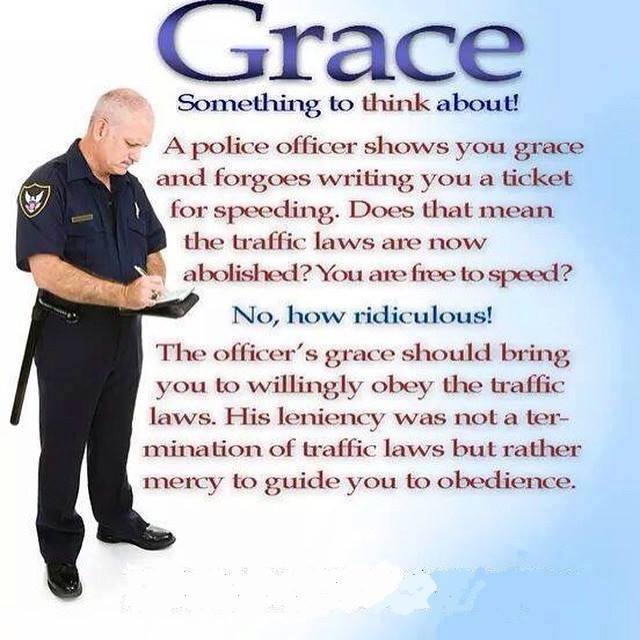 If every verse in the Bible is not about justification, but Protestants believe that, and they do, this will redefine the Bible from cover to cover, and it does. The result is a completely upside down gospel.
For example, the internet placard that inspired this post. How does it define “grace”? Obviously, it defines grace as Christians not getting the punishment they deserve from the “righteous demands of the law.” This “mercy” “guides” you to obedience. But what “obedience”? Well, let me quote the pastor of the person who posted the placard: “You don’t keep the law by keeping the law.”
“You don’t keep the law by keeping the law.” What does that mean in conjunction with “mercy” leading us to this “obedience.” And, do Christians still need “mercy”? According to Protestantism, “yes.” I understand that some Protestants understand this to mean that we are motivated by God’s mercy when we don’t get the punishment that we deserve, but that is a watered down version of the authentic Protestant gospel. And anyway, true Christians no longer need mercy because we are no longer under condemnation; there is “no condemnation” for Christians. But more on the significance of that later.
The crux of the placard and the idea that Christians still need grace is well defined by some comments that were posted in regard to the placard. It starts with the idea that “grace” is synonymous with biblical justification or salvation. And since we still need “mercy” from the law as Christians, we must know how to obtain this mercy leading to keeping the law by not keeping the law. The endeavor is twofold, and exemplified in the following aforementioned comments:
MERCY is when judgement is constrained, and hence is what is being illustrated in this story by the officer letting you off the hook. But GRACE is not that judgement was constrained, but that it was conferred! It’s the picture of the officer, though acknowledging that you were guilty of trespassing the speed limit, determines that he’ll let you go on the premise that he PAID the ticket for you!
And…
What if the police officer decided to jump in the car with you. So every time you drove he’s sitting next to you and just keeps saying don’t worry about speeding I have fulfilled that law. [Viz, I kept the law for you] I’ll whisper to your heart and let you know if you are heading towards the speed limit. I just want to sit and chat with you and get to know you so well that you never ever want to speed again. Because you are forgiven and I love you.
If you think these are armchair theologians, think again. What they are saying is a mirror image of how two heavyweight Protestant theologians stated it in the following video:
What’s the idea here? Since Christians still need mercy from the righteous demands of the law, they must continually receive it by returning to the same gospel that saved them. “Grace” is defined as justification/salvation, so obviously, we must continually return to the same gospel that saved us. To most professing Christians in our day, the idea that Christians still need grace and mercy is a no-brainer and is pontificated with the often-heard, “We must preach the gospel to ourselves every day.”
What is that gospel? It is twofold as exhibited by the two comments. Christ died for our sins which takes care of the penalty of sin (first comment), and then He kept the law perfectly so that His righteousness (perfect obedience) can be imputed to our Christian life. Therefore, as Christians, we continually go back to the salvation well for forgiveness and a righteousness that is not our own. That’s how we keep the law by not keeping the law: Jesus keeps it/kept it for us. The same gospel that saved you also sanctifies you.
Why is this an egregious false gospel? First, we are not under the law for justification. There is no law for Jesus to keep for us. Jesus didn’t come to keep the law for us, He came to end the law… for Justification (Romans 10:4). The fulfilling of the law by Christ does not refer to Him keeping the law perfectly so that His obedience can be imputed to our sanctification.
And “grace” is NOT justification or salvation. “Grace” defines why God saved man; it’s an act of love that expects nothing in return, and of course, we need this same kind of love in our Christian lives, but that doesn’t make our sanctification a progression or specific expression of justification. The love of God is not applied to justification in the exact same way it is applied to our Christian lives (sanctification). Grace, as the reason God justified us (His unmerited love) expects nothing in return because man is utterly unable to justify himself.
However, God also displays His love (“grace” also means “help”) in regard to the purpose for which he saved us: good works…that we actually do in order to please Him. God doesn’t love Himself through us—we are not mere conduits from which God loves Himself; we in fact love God or we do not belong to Him. God’s love towards man in justification has a different application in sanctification. In the former man is completely helpless, in the latter man needs help. Both expressions of love are “grace.”
This is demonstrated by Ephesians 2:8-10…
8 For by grace you have been saved through faith. And this is not your own doing; it is the gift of God, 9 not a result of works, so that no one may boast. 10 For we are his workmanship, created in Christ Jesus for good works, which God prepared beforehand, that we should walk in them.
Grace, or charis, is a Greek word that means “a joyful benevolence.” Actually, the word has a wide variance of applications including, “favor,” “love,” “help,” “dignity,” etc. To define “grace” as synonymous with salvation is inaccurate; grace is the reason God saves, but it is also the reason God does many other things as well. Grace is also the reason that God is our advocate, comforter, co-laborer, and helper in our Christian life. In regard to our Christian life (sanctification), these words are used interchangeably (Heb 13:6, Jn 14:16 Rom 8:26).
Note verse 8: grace is the reason God saved us (John 3:16), but salvation is “the gift.” It is not the result of “works” (v.9), but the result of grace. This is where we have a radical dichotomy between justification (gift) and sanctification (reward). The two are mutually exclusive, and “grace” does not bridge the two. Gift and reward are mutually exclusive. In fact, Hebrews 6:10 says that God would be “unjust” to forget our works in sanctification. Why? Because our works in sanctification is an earned reward that deserves to be recognized. There is no other conclusion that can be drawn from that passage.
The word for “works” in verse 9 is ergon which according to Greek scholar Spiros Zodhiates “stands in direct antithesis” to charis (grace) and the two words are “mutually exclusive” (The Complete Word Study Dictionary, AMG Int. 1992, p.1469). Yet, verse 10 indicates that good “ergon” or works is the purpose of salvation. Salvation is caused by grace, but works is the purpose of salvation. This is why justification and sanctification are mutually exclusive and not bridged by grace. One result of grace is the gift of salvation while the result of the other is reward. Gift and reward cannot be intermingled.
The type and kind of works were predetermined, but we are responsible to “walk” in them with God’s help. In justification, God is a savior; in sanctification, God is a “helper.”
Notice how the professing Christians of our day are obsessed with SIN. Because we are still supposedly under law and need the same “grace” that saved us, our Christianity is obsessed with failure and our dire need for more and more mercy. Life is lived under the cloud of the law, and the focus is how often the holy policemen in the sky does not write a ticket of condemnation.
A pity, because we are not under law and are rather under grace which means we seek to obey God’s law in love. The focus isn’t failure so that we can supposedly glorify God by returning to the foot of the cross, the focus is love which “covers a multitude of sin” (1Pet 4:8). We would sin a lot less if our focus was love, not the expectation of failure under the heavy burden of the law. We are not under the law of sin and death, we are under the law of the Spirit of life (Rom 8:2). We strive to obey that law in love as the primary focus of our life; we dwell on love, not sin.
Moreover, if we glory in more and more mercy that saves us from the law that we are supposedly still under, that will result in a relaxing (lyō) of the law in sanctification that Christ warned us about (Matt 5:19) because after all, we can’t keep it perfectly anyway.
As Christians, our sin is family sin against our Father and can bring chastisement, but it is not sin under the condemnation of the law that requires a return to the same “grace” that saved us. That’s a false gospel. That’s under law, NOT under grace.
So, you do in fact keep the law by keeping the law, because that’s love.
paul

 Paul's Passing Thoughts
leave a comment