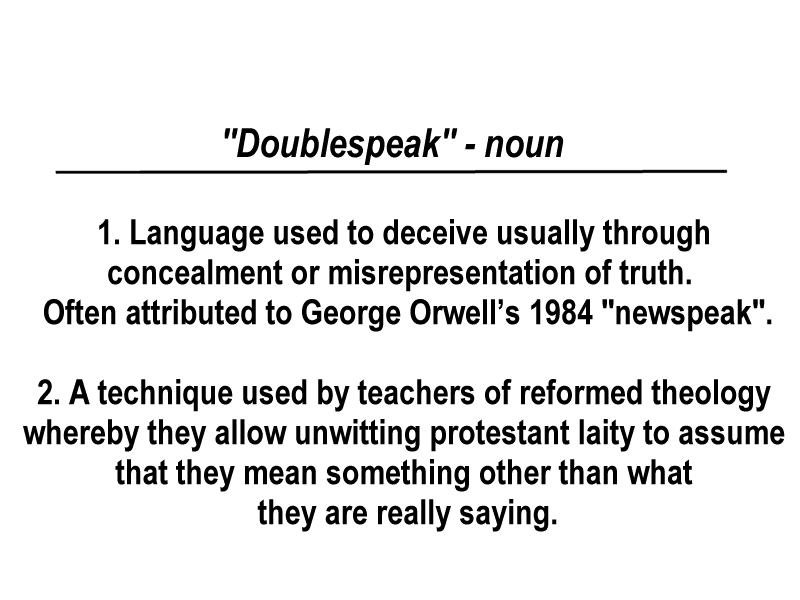
Doublespeak
My contribution to the meme-fest….
The Interpretation of Reality and the Calvinist Swamis

Swami Albert Mohler at 2011 FBC Conference: pastors are “God-appointed agents to save God’s people from ignorance.”
The fact of the matter follows when you boil it down to the least common denominator: the Protestant Reformation was a quarrel about how one should interpret reality. In other words, sola scriptura is pure propaganda. Especially in our present day, preaching for the most part uses Scripture to promote a certain view of reality. The specific studies on this are the historical-redemptive hermeneutic and what is known as Biblical Theology. These terms are egregiously misleading. Instead of the Bible being used to develop a theology with a historical-grammatical view of reality assumed, the Bible is used as a mere tool for aiding one in interpreting reality as a story, or metaphysical narrative written by a god or plethora of gods.
The concept finds its roots in good old fashioned mythology. One should not think of mythology as rank superstition; to the contrary, mythological narratives are stories written by “gifted” spiritual leaders who understand spiritual truth that the populous at large are not able to understand. The gifted leaders package these truths in bedtime stories that the totally depraved masses can understand for purposes of life application. In Protestant context, we know it as orthodoxy and “subordinate truth.” One example would be the Westminster Confession which was penned by the “Westminster Divines.”1 Ponder that one for awhile if you think words mean things.
The foundation and historical progression is not hard to follow.2 It began in the garden when the serpent attempted to present himself as a mediator between people and God. The case presented to Eve follows: there are things about God that you can’t understand, but because I am a superior being, I can guide you in them to make you more like God. At issue from the very beginning was additional mediators between mankind and God. The serpent suggested that the direct relationship between God and mankind was lacking. This is the lie that forms the foundation of all false religions. Instead of mankind at large having initial and ongoing direct access to God at all times, false teachers make the case that they are the gateway to God or some kind of utopia.
Almost immediately after the garden, the religion of spiritual caste was off and running. More than likely, Hinduism was the first formal religion of spiritual hierarchy. True salvation is a body with one head—Christ. Because we are literally born of God into His literal family, we love God and are new creatures who think like Him, and have the same mind of His Son, Christ. Unity comes from having the same mind in Christ, and coming to agreement on such.3 If there is only one mind, and there is disagreement, obviously everybody must agree that someone is right and someone is wrong. However, Scripture instructs us to leave room for the members to be convinced in their own minds and according to the development of a biblical conscience.4 Of course, this would exclude the gospel of first order that cannot be compromised.5
In spiritual caste, an elite class understands reality while the masses are unable. This is usually divided between the material and the invisible as two different realities. Fundamentally, the material is evil and the invisible is good. One may suspect that the incarnation of Christ was a direct pushback to that idea. And of course, if the elite know what’s best for the great unwashed, for the best possible well-being of humanity in general, they must rule over those enslaved to interpreting reality through their five senses. This is where authority comes in; supposedly, for the sake of mankind. So, let’s review the primary tenets of most religions:
- Two realities divided by truth versus illusion.
- Mediators between truth and illusion.
- The mediators should have authority for the sake of humanity.
Usually, the invisible realm is represented by virtue or some sort of deity. Mediators are the elitists in the caste system. They can be visiting deities, or those specially gifted in the material realm. And because they are part of the material realm, they are subject to it, but not to the degree that the ungifted are so…do what they say, not what they do. It’s primarily a gift of perception; because they can see things that the common man cannot see. They create understandable teachings that will best serve man in the material realm.
In most of these caste religions, predeterminism is the centerpiece. This is because in the vast majority of these caste religions, reality is a story orchestrated by the truth realm, or invisible realm. And all stories have an author. If reality is a story, the story must have an author. And if reality has an author, of course everything is predetermined by the author—this is unavoidable. So if redemption is a story as academics of the Reformed tradition constantly state as if in a manner of speaking, of course every detail of reality is predetermined because reality is a story, and all stories have an author. In addition, it may be noted that determinism and fatalism are the historical norm in general, and Protestantism is just another player in the same old song and dance.
The progression of caste started in the garden, found its first formality in Hinduism, was passed on to Plato when he studied in India, became Gnosticism, and later dictated the basic principles of the Protestant Reformation. Augustine’s City of God is a remodeled version of Plato’s Republic and Martin Luther, as well as John Calvin, were rabid followers of Augustine. Luther was a friar in the Augustinian Order, and Calvin quotes Augustine more than 400 times in the Calvin Institutes of the Christian Religion. In some translations of the Institutes, that’s an average of every 2.5 pages.
In the final analysis therefore, the Reformers, especially Martin Luther, made the gospel a metaphysical story that interprets all of reality. When you go to see a movie at your local theater, you are a character in the movie watching a movie. The movie you are in was prewritten by God like all movies are prewritten by an author. Therefore, in some sense, saving faith is seeing yourself in God’s plot which is totally out of your control and would exclude all freewill. If you have any freewill at all, you are trying to write your own reality; you are writing your own story; you are trying to be your own god. In fact, this is the very primary theses of the founding doctrinal statement of the Protestant Reformation: Martin Luther’s Heidelberg Disputation to the Augustinian Order. In that founding document presented to the Order six months after the 95 Theses, Luther presented reality in two parts: the cross story and the story of man. According to Luther a theologian is either a theologian of the cross, or a theologian of glory (the glory of man rather than God).
Presently in the Protestant evangelical church, the idea of Christianity being a story dominates church media. Consider the following citation by the contemporary father of historical-redemptive hermeneutics and Biblical Theology:
If the story is true, Jesus Christ is the interpretative key to every fact in the universe and, of course, the Bible is one such fact. He is thus the hermeneutic principle that applies first to the Bible as the ground for understanding, and also to the whole of reality.6
Similar quotations among evangelicals in our day are myriad. The Bible is merely a prototype of redemptive reality that describes generalities, or prisms of redemptive reality in which we see our own lives. Our own lives are part of the story, and we are to interpret our lives through the redemptive reality described in the Bible. The Bible describes the redemptive reality of the past (other lives as interpretive prisms/examples) and the future (how the story will end), and we are experiencing the present redemptive reality IF we have “entered into the plot”7 or entered the “Divine drama.”8 This is little less than the Hindu Lila.
The basic recurring theme in Hindu mythology is the creation of the world by the self-sacrifice of God—”sacrifice” in the original sense of “making sacred”—whereby God becomes the world which, in the end, becomes again God. This creative activity of the Divine is called lila, the play of God, and the world is seen as the stage of the divine play. Like most of Hindu mythology, the myth of lila has a strong magical flavour. Brahman is the great magician who transforms himself into the world and then performs this feat with his “magic creative power”, which is the original meaning of maya in the Rig Veda. The word maya—one of the most important terms in Indian philosophy—has changed its meaning over the centuries. From the might, or power, of the divine actor and magician, it came to signify the psychological state of anybody under the spell of the magic play. As long as we confuse the myriad forms of the divine lila with reality, without perceiving the unity of Brahman underlying all these forms, we are under the spell of maya. (…) In the Hindu view of nature, then, all forms are relative, fluid and ever-changing maya, conjured up by the great magician of the divine play. The world of maya changes continuously, because the divine lila is a rhythmic, dynamic play. The dynamic force of the play is karma, an important concept of Indian thought. Karma means “action”. It is the active principle of the play, the total universe in action, where everything is dynamically connected with everything else. In the words of the Gita Karma is the force of creation, wherefrom all things have their life.9
And of course, if reality is a story with an author, hard determinism is the order of the day; stories do not write themselves, nor do the characters in the story have freewill to write the story. Consequently, the notion that Calvinists derive their theology from the Bible rather than metaphysics is a misnomer, and in many cases outright deceptive. The Reformed tradition is really the same worn out deterministic mythology that has always dominated world philosophy and wreaked havoc on historical experience from the very beginning. And invariably, converts to Protestantism in the Reformed tradition will mutate from freewill, to soft determinism, and finally hard determinism. Or from “Pelagianism,” to “Semi-Pelagianism,” to “orthodoxy.”
Karma is the infant stage of Hinduism where saints believe they are responsible for their own actions, but as growth moves forward, the mature saint…
“[…] becomes convinced that God has been doing everything by using his body, mind, energy and the senses. He feels that he is only an instrument in the hands of God, and whatever God has been doing to him is for his ultimate spiritual good. At this high level of spirituality the doctrine of predestination becomes the only valid doctrine to him. To him the doctrine of karma ceases to be a valid doctrine.
Therefore, these two doctrines, even though apparently contradictory to each other, are valid for people at different stages of spiritual growth.”10
In regard to practical application, the parallels become even more vivid. The trichotomy of soul and society in Hinduism and Platonism are identical, and the same principles are mirrored in Gnosticism and Calvinism as well. The soul of each person is threefold, and predetermined by God or some other force/deity. In each person, there is the spiritual, intellectual, and instinctive. However, each person will be dominated by one of these characteristics, and society benefits to the degree that each person lives according to the predetermined dominant aspect of their souls. This is the basis for caste systems, and usually coincides with lineage. In other words, you are expected to stay within the social strata determined by birth for the good of society at large. This is jumping ahead a little, but this idea had deep roots in Puritan beliefs who were theological descendants of Calvin. To not remain in the social strata you were born into was thought to be a violation of the 5th commandment according to the Puritans—it was dishonoring your parents.11
The theory also coincides with the two realities of material and invisible, the material being evil and the invisible being truth. The spiritual are the mediators who are able to see beyond the material while the intellectuals are wise enough to know that the mediators should be trusted. They have a special love for the truth, so they love the mediators as well. Those who have souls dominated by instinct are enslaved to the material world and their five senses. To insert another connection somewhat prematurely, the Puritan Jonathan Edwards believed that salvation required a sixth sense in order to see the kingdom of God. In other words, the five senses that evaluate the material world were all but useless for salvation.12 This sixth sense, according to Edwards, is experienced by “delightful conviction” and “inward, sweet delight in God and divine things.” Well known pastor and Puritan wannabe John Piper borrowed these ideas from Edwards to form his Christian Hedonism movement.
In regard to Plato and the aforementioned metaphysical trichotomy, this is the philosopher king, warrior, and producer classes. This coincides with the Hindu Bhramin, Kshatryia/Vaishya, and Sudra/Untouchables. And, John Calvin had his own construct communicated via his election doctrine with more of a Gnostic flavor. Unbeknownst to most people who actually call themselves “Calvinists,” John Calvin propagated three classes of elect: the elect of the elect (those who persevere, the “P” in TULIP), the temporary elect (the called who do not persevere), and the non-elect. This coincides with Gnosticism as follows:
Calvinism derived its 3 classes ultimately from the 3 classes in Valentinian Gnosticism (see Ireneaus’ five books Against Heresies):
1. Pneumatics (spirituals) – The elect of the elect.
2. Psuchics (soulys) – The average elect.
3. Hylics (carnals) – The non-elect.
Meaning, the Hylics have no chance. As for the Psuchics, they are (as you put it) “entered into the race” but not given “the gift of perseverance.” And the Pneumatics, of course, are elect to the uttermost, meaning nothing they do can damn them.
In Gnosticism, this is natural selection, or election by nature according to Clement of Alexandria in Stromata: 2. 3. More specific definitions follow:
In the gnostic view, hylics, also called Somatics (from Gk σώμα (sōma) “body”), were the lowest order of the three types of human. The other two were the psychics and the pneumatics (from Gk πνεύμα (pneuma) “spirit, breath”). So humanity comprised matter-bound beings, matter-dwelling spirits and the matter-free or immaterial, souls.
Somatics were deemed completely bound to matter. Matter, the material world, was seen as “evil” in the gnostic world view. The material world was created by a demiurge, in some instances a blind, mad God, in others an army of rebellious angels as a trap for the spiritual Ennoia. The duty of (spiritual) man was to escape the material world by the aid of the hidden knowledge (gnosis). *
The pneumatics (“spiritual”, from Greek πνεῦμα, “spirit”) were, in Gnosticism, the highest order of humans, the other two orders being psychics and hylics. A pneumatic saw itself as escaping the doom of the material world via the transcendent knowledge of Sophia’s Divine Spark within the soul.†
They conceive, then, of three kinds of men, spiritual, material, and animal . . . The material goes, as a matter of course, into corruption. The animal, if it make choice of the better part, finds repose in the intermediate place; but if the worse, it too shall pass into destruction. But they assert that the spiritual principles which have been sown by Achamoth, being disciplined and nourished here from that time until now in righteous souls (because when given forth by her they were yet but weak), at last attaining to perfection, shall be given as brides to the angels of the Saviour, while their animal souls of necessity rest for ever with the Demiurge in the intermediate place. And again subdividing the animal souls themselves, they say that some are by nature good, and others by nature evil. The good are those who become capable of receiving the [spiritual] seed [and becoming pneumatic]; the evil by nature are those who are never able to receive that seed [and become hylic].—Irenaeus, Adv. Haer. I. 7, 513
Calvin held to these same three types of categories except the determinism is by God rather than nature. For Calvin, it is the non-elect, the elect, and those of the elect that are gifted with perseverance:
In fine, we are sufficiently taught by experience itself, that calling and faith are of little value without perseverance, which, however, is not the gift of all (CI 3.24.6)
The expression of our Savior, “Many are called, but few are chosen,” (Mt. 22:14), is also very improperly interpreted (see Book 3, chap. 2, sec. 11, 12). There will be no ambiguity in it, if we attend to what our former remarks ought to have made clear—viz. that there are two species of calling: for there is an universal call, by which God, through the external preaching of the word, invites all men alike, even those for whom he designs the call to be a savor of death, and the ground of a severer condemnation. Besides this there is a special call which, for the most part, God bestows on believers only, when by the internal illumination of the Spirit he causes the word preached to take deep root in their hearts. Sometimes, however, he communicates it also to those whom he enlightens only for a time, and whom afterwards, in just punishment for their ingratitude, he abandons and smites with greater blindness (CI 3.24.8).14
Calvinism is nothing new; it’s the same worn out ancient mythological song and dance foisted on the Bible. Many preaching in Protestant temples in our day think that it all comes from the Bible because Protestant academics told them such. We call that “orthodoxy.” It is mythology’s noble lie of metaphysical bedtime stories for serfs. Sunday church is hosted by two kinds of pastors: those who think orthodoxy actually came from the Bible and therefore think they are teaching the Bible, and those who know what’s really going on. The former is sad enough, but those who sit under the latter are paying good money to be perceived as useful idiots.
_______________________________________________________________________
1 https://en.wikipedia.org/wiki/Westminster_Assembly
2 Historical progression will be documented in detail: TTANC volume 3
3 Phil 2:2, 2:5-8, 1Cor 1:10, 2:15
4 Romans 14
5 1Cor 15:1-4
6 Graeme Goldsworthy: Gospel-Centered Hermeneutics; p.48
7 Paul David Tripp: How People Change
9 https://en.wikipedia.org/wiki/Lila_(Hinduism) Frijof Capra, The Tao of Physics (1975)
10 Swami Bhaskarananda: Chapters 9-11 The Essentials of Hinduism; Predestination
11 https://paulspassingthoughts.com/2012/10/04/reformed-caste-system-the-puritans-saw-violation-of-caste-as-equal-to-violation-of-the-5th-commandment/
12 https://paulspassingthoughts.com/2015-tanc-conference-on-gospel-discernment-and-spiritual-tyranny/susan-dohse-sessions-1-3-jonathan-edwards-the-man-the-myth-the-message/
13 https://paulspassingthoughts.com/2014/01/30/predestination-and-the-gnostic-connection/
14 https://paulspassingthoughts.com/2014/01/30/predestination-and-the-gnostic-connection/
TANC 2015 – Susan Dohse, Session 3 – Jonathan Edwards: Sinners in the Hands of an Angry God
Jonathan Edward’s famous sermon Sinners in the Hand of an Angry God delivered to a congregation in Enfield, Connecticut on July 8, 1741, is often the only thing written by him some will ever read. American literature courses in high school and college include excerpts, and maybe the entire sermon in literature anthologies. It is usually presented to portray the awfulness of the Puritans and their Calvinistic religion. This was not the only hell fire sermon he delivered, yet, it is the one selected to represent Edwards and the Great Awakening movevent. Contrary to YouTube and others who do dramatic presentations of this sermon, Edwards was not a pulpit pounding, foaming at the mouth, shouting minister. All of his messages were delivered in his low voice, almost monotone, with little emotion.
The old Puritan Way was eroding in New England for political and demographic reasons. They were no longer the majority population and most people living in 1720 who were born in the Congregational churches took it seriously, but did not regard the ministry or church doctrine with the respect their forebearers had felt. Congregationalism wasn’t dead; most Congregationalists were still very concerned with their souls. They just did not respond passionately to traditional Congregationalism anymore. Voila! Enter the First of the Awakenings sometimes referred to as the Small Awakening. The revivals caught on. They addressed the people’s desire to be passionate about religion again. In the absence of a literal wilderness to fight against, New Englanders in the 1730’s and 40’s fought against a spiritual wilderness. Preachers such as Whitfield and Edwards fought against the apathy and religious complacency that had replaced the Puritan religious zeal. Puritan religious zeal was more and more being transferred to politics.
Edwards appreciated the religious revivals because it brought people back to church and got them passionate about religion again. After all, true conversion was connected to the church. Edwards being the theo-philosopher, and amateur psychologist of his time, was given opportunity to study and document the psychological steps involved in religious conversion. Pre-occupied by this documentation, he did not realize that many who came to church in fear of damnation, did not come to believe that they were saved and fell into despair. Some took their own lives, such as Edwards’ uncle, Joseph Hawley, who slit his throat in despair of his soul’s damnation. Is there any question as to why this awakening faded in 1735?
It was sparked back to life in 1740 when the famous English Anglican minister George Whitfield answered Edwards’ request to come preach in Northampton. Whitfield convinced Edwards to preach the full revival. What some do not know is the sermon “Sinners in the Hands of an Angry God” was delivered by Edwards at least four times to four different congregations. He studied the make-up and psychology of each audience, and made changes to the sermon to accommodate each one. The first time he delivered the sermon was in his home church of Northampton and he was able to give the full sermon without interruption. He repeated the sermon at Enfield, but his preaching reduced the audience to wailing, and loud crying, that drowned out the voice of Edwards before he could arrive at his hopeful conclusion.
In the sermon, he crafted his words, illustrations, and metaphors to inspire terror, to lead his listeners systematically and authoritatively to repent and humble themselves before the grace of a loving God in the hope of obtaining salvation. His sermons were never concerned with persuading sinners to come to Christ or accept salvation. For the devout Calvinist only the arbitrary election of God determined who would be saved. (Voices of Democracy (2006)
The puzzles of his sermon:
- He tells people they are in immediate danger of hell, urges them not to continue in their sinful ways, and seek a remedy for their sin. As a Calvinist, he cannot tell them to accept Christ and be saved—he doesn’t believe that. So the remedy is very vague, ie, “Therefore, let every one that is out of Christ, now awake and fly from the wrath to come.”
- The emotional nature of his sermon is a puzzle. Edwards disliked hysterical emotionalism that was often connected to these revivals. Remember the Three Bears principle. He did not approve or encourage his listeners to cry out in church, throw themselves on the floor, or any other dramatic thing. But he could not get the congregation to calm down so that he could finish his message.
- Puritan ministers usually did not deliver hellfire sermons. He usually focused on the process of searching for God’s grace, the technical points of how to read God’s word, and how to live godly lives. They were not focused on hell and damnation because he assumed that most people in the audience did not know their state and so haranguing them about hell would be counter-productive.
- Edwards tells them that very few humans are saved, and even says that most of their friends and loved ones who have died, are undoubtedly in hell. It’s puzzling that he admonishes them to seek the remedy.
- It’s puzzling that being a Calvinist purist he included Arminian ideas: that God can change your heart (the Puritans believed that to be impossible because God never changed his creation); that humans can become good (Puritans thought that impossible); and that God can decide to save someone previously condemned to hell (again, Puritans believed your fate was determined before the world was created). He repeats that there is nothing humans can do to avoid Hell, and then says humans have to do something, ie, “Thus it will be with you that are in an unconverted state, if you continue in it.” Saying if you continue in it clearly implies that you can choose not to continue in your sin, and thus can do something to save yourself.
It makes you wonder if Edwards would be surprised to know that “Sinners in the Hands of an Angry God” would seal his everlasting fame. It was only one of his hellfire revival sermons, and not indicative of the bulk of his work. If he had his druthers, he would likely have chosen his writings on the conversion process, the qualifications one needed for full church membership, even his study of spiders and rainbows to have lived on in popularity instead.
Regardless of this sermon, let’s take a look at the “afterglow” of Jonathan Edwards’ legacy.
Mark Driscoll preaches that God personally hates you and preached a sermon from Mars Hill that drew much comment and complaint. Rick Holland in his book Uneclipsing the Son tells the reader that God is rightfully angry with us and at us, ie, “Our sin draws His wrath like a magnet draws steel.” Jonathan Edwards’ sermon depicts an angry God, as does his treatise The End of the Wicked; and Driscoll, Holland and Piper follow in the bend of their beloved icon.
Example:
John Piper’s version of Sinners in the Hand of an Angry God after the bridge collapse in Minneapolis: “That is God’s message in the collapse of this bridge. That is his most merciful message: there is still time to turn from sin and unbelief and destruction for those of us who live. If we could see the eternal calamity from which he is offering escape we would hear this as the most precious message in the world. The meaning of the collapse of this bridge is that we are sinners and need to repent.”
Those of the Calvinist bent inherited from John Calvin and Jonathan Edwards a picture of God who is constantly angry about something or someone and use portions of Scripture such as Nahum 1 as proof texts: “The Lord is a jealous and avenging God; the Lord takes vengeance and is filled with wrath. The Lord takes vengeance on his foes, and vents his wrath against his enemies.”
We fail to appreciate the difference between an angry God and a God who gets angry. Jonathan Edwards is the poster child for the angry God group, ie, “The God that holds you over the pit of hell, much as one holds a spider or some loathsome insect over the fire, abhors you, and is dreadfully provoked.”
According to a study which analyzed the results of a Gallup survey, belief in an angry God is “significantly associated with an increase in social anxiety, paranoia, obsession, and compulsion.” When you are told repeatedly that you are totally depraved, worthless, and deserve God’s wrath, your mental, emotional, and spiritual health is in peril. Who would want to join in a relationship with someone who is angry with you all the time? Edwards’ God is bound by His anger, and according to the theology of this American icon, has no choice but to be constantly angry at mankind, that’s His fundamental nature.
Consider this: God is not an angry God; God is a God who sometimes gets angry. A God who gets angry when anger is needed, like we see in Isaiah. God is angry at the hypocrisy of his children. He is angry with their evil deeds and ungodly behavior. But in His anger He gives the remedy: “[w]ash and make yourselves clean. Take your evil deeds out of my sight; stop doing wrong. Learn to do right, seek justice, defend the oppressed. Take up the cause of the fatherless, plead the case of the widow.” (Isaiah 1:16-17) Quite a different remedy from the one of Edwards, isn’t it? “Therefore let everyone who is out of Christ fly from the wrath to come. The wrath of God is now undoubtedly hanging over a great number of you.”
Consider this: churches justify the spiritual abuse of their members because they work out of a place of anger, fear, and hate, thinking this is how God wants them to act. This is what ministers have been taught over the years, and this is what they teach to their congregations. So they pour out their wrath from a never dry well because they are embodying in themselves the type of God they believe in—a God who is fundamentally angry, and who has to be constantly angry otherwise He won’t be the omnipotent Being they need him to be, and want to be themselves, powerful and angry. (Zack Hunt)
We need God to get angry. When He sees oppression, injustice, spiritual abuse and tyranny in His house, we need Him to get angry because this is not the way He created us to be. God is not an angry God who wants His people to suffer, God is a God who gets angry when He sees His people suffer.
As believers, we are under the law of love, not under the law of condemnation. Let’s rejoice in that truth, let’s raise our hands and shout Amen to that truth of Scripture, not elevate dead men to hero status. Let’s refuse to make their false doctrines, their misrepresentations of God, and misuse of God’s Word as mission statements and church constitutions.
The insanity must end. We must continue to work to end it. John 17:17 says, “Father, sanctify them through the truth, thy word is truth.”
John Piper Proclaims “Christians” Condemned and in Need of Continued Salvation
 One of the major truths that will be emphasized in the present TANC book project is that the Protestant Reformation was NOT based on the Bible. The Protestant kerfuffle with Rome concerned differences in world philosophy—not theology. Sola scriptura is a blatant falsehood. Martin Luther concocted a contending worldview in opposition to an increased influence of Thomism in the Catholic Church. Luther then dressed up his philosophy in Bible verses. Actually, to be more specific, he dressed up Neo-Platonism in biblical garb. This is hardly some deep, dark secret; a cursory observation of church history reveals this, unless you get your church history from a Protestant seminary.
Since the Protestant Reformation was really based on Plato’s Republic, the necessary theological fit was/is progressive justification for those who are preselected and the last to know if they are really selected or not. They get the news at the final judgment. Until then, EVERYBODY is presently under condemnation and in need of continued justification because we have “present sin.” In order to be perpetually rejustified, we must “preach the gospel to ourselves every day,” obey the pastors, and be a faithful church member.
Due to the fact that sola scriptura is a farce, the present-day expression of authentic Protestantism via New Calvinists routinely contradicts the plain sense of Scripture in insane fashion, and nobody blinks an eye. Moreover, cowardly pastors who know better even as confused Protestants allow the New Calvinists to be named and quoted among their sheep.
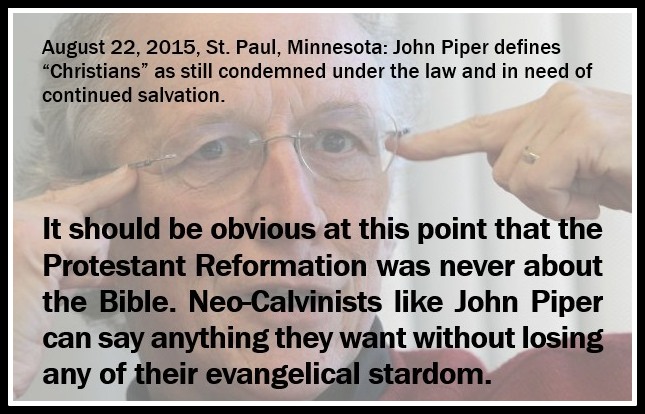
Let’s talk about one example, the one that prompted this post. On August 22, 2015, John Piper prayed at a Christian anti-abortion rally at a Planned Parenthood location in St. Paul, Minnesota. In that prayer, he stated:
And we acknowledge in the face of your holiness and power that we are sinners. Everyone standing here in this gathering is a sinner in desperate need of salvation that you offer in Jesus Christ. We know that our conscience condemns us, and if our own consciences do, how much more your holy law. So we have not lived up even to our own standards, let alone to your standards. And we confess our sins corporately before you as individuals.
In direct conflict to the Bible’s clear definition of a believer, Piper proclaimed everyone at the gathering as condemned under the law; this is the Bible’s succinct definition of a lost person. In addition, Piper clearly proclaimed in the prayer that Christians are still in need of salvation.
How does he get away with this and stand as one of the most beloved evangelicals of our day? Because he supposedly has authority, and we the believers have no real ability to perceive truth. Clearly, if it comes down to what we understand our Bibles to say versus what John Piper says, he will win the day every time.
So then, for all practical purposes, he speaks for God.
paul

 Paul's Passing Thoughts
2 comments