The New Calvinist Anti-Apostle Paul Movement Comes With a T-Shirt
New Calvinist (like Al Mohler, John Piper, Jerry Bridges, John MacArthur, etc.) have a new t-shirt that can be proudly worn to protest what the apostle Paul wrote to the Corinthians:
“So we make it our goal to please him, whether we are at home in the body or away from it” (2Cor. 5:9).
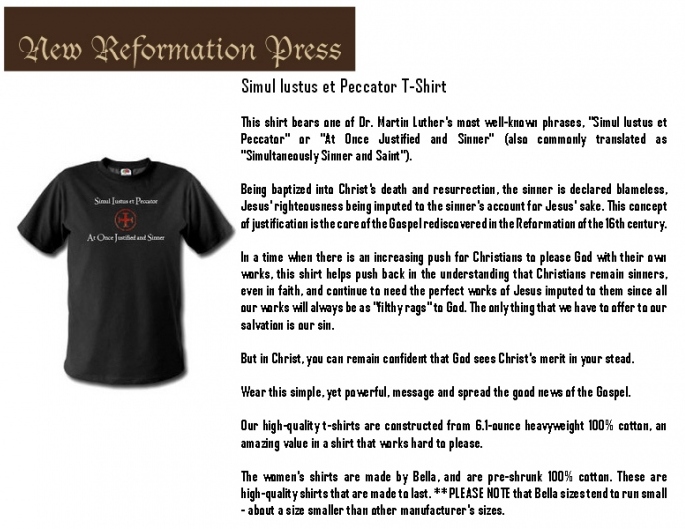
New Calvinist will have no part of that! In Part, the ad reads as follows:
“In a time when there is an increasing push for Christians to please God with their own works, this shirt helps push back in the understanding that Christians remain sinners, even in faith, and continue to need the perfect works of Jesus imputed to them since all our works will always be as ‘filthy rags’ to God. The only thing that we have to offer to our salvation is our sin. But in Christ, you can remain confident that God sees Christ’s merit in your stead.”
Yes, that’s what the apostle Paul said. He said “we” (subjective personal pronoun) make (verb) it (direct object) “our” (possessive pronoun ) “goal” (predicate nominative) to please him (prepositional phrase). Yep, he said it’s our work in sanctification. Of course, any idiot should know that it must be either ALL the Spirit or ALL of us, it can’t be both; and surely, Christ must have misspoke when He called the Holy Spirit our “helper.”
The Sonship / New Calvinist / Gospel Sanctification crowd also apposes Paul’s idea that we don’t “remain sinners”:
“Therefore, if anyone is in Christ, he is a new creation; the old has gone, the new has come!” (2Cor. 5:17).
And then there is Paul’s stupid idea that Christ will judge the works of Christians when they are really all His to begin with, and some of our supposed works will be good works! (the good works Tim Keller says we should repent of):
“For we must all appear before the judgment seat of Christ, that each one may receive what is due him for the things done while in the body, whether good or bad” (2Cor. 5:10).
Here is a jpeg representation of the ad:
Let’s Not Forget That Sonship / Gospel Sanctification / New Calvinism Is Not a Theological Discussion, But a Life Discussion
 I was recently sent a link for an article written for the Reformation 21 blog by William B. Evans. The article was a very apt articulation of Sonship theology in regard to showing its error. In the first paragraph, he cites one of the contemporary fathers of intestinal fortitude, Jason Hood, who has challenged New Calvinism by coining the phrase, “sanctification by justification.” Evans mentioned him in conjunction with Hood challenging Tullian Tchividjian’s assertion that being called an antinomian validates one’s gospel ministry. Welcome to our day. A day in which having a goal of being called an antinomian doesn’t necessarily mean you’re an antinomian. Apparently, when the apostles predicted there would be “many” false teachers in the last days, they never saw New Calvinism coming and the ushering in of “many” Tchividjian like “reformers” instead.
Tchividjian, supposedly an example of one of the worst Sonship offenders, seemed to be the subject of Evans’ post (Again, Evans did a great job of exposing the doctrine’s serious error and the post should be read by all: http://goo.gl/9AgD7 ). After summarizing Hood’s contention, he moved on to the back and forth between Tchividjian and New Calvinist Kevin DeYoung. Apparently, DeYoung thinks the movement may come across as thinking that “effort” is a four-letter word. Actually, “obey” is the word that DeYoung thinks has four letters, and he never mentioned any specific applications for “effort.” Nevertheless, Evans rightly points out that DeYoung presented good arguments for an overly passive approach to sanctification. But in the third and final exchange between the two New Calvinists, and unlike Hood in his follow-up exchanges, DeYoung clearly vacillated and patched things up with Tchividjian.
Which now brings me to my point. Evans cites DeYoung as saying the following: “In this context DeYoung the pastor speaks of those in the church ‘who are confused, wondering why sanctification isn’t automatically flowing from their heartfelt commitment to gospel-drenched justification.’” In other words, DeYoung knows the ramifications, but will not separate himself from the New Calvinist movement. Evans also wrote the following: “In other words, the questions raised in these blog exchanges are important; the contrast in views is rather stark, and the time is ripe for further discussion.” I like his use of the word “stark,” but further “discussion”?
This issue needs way more than discussion! Tchividjian is representative of the New Calvinist perspective, and with it the belief that views similar to the ones Hood espoused are a false gospel, leading to the loss of justification—being interpreted: your not saved. Want proof? Well, Evans mentioned that the issue needs to be further engaged because of the involvement of theological heavy-weights like Michael Horton, so I will quote him to make my point:
“If not only the unregenerate but the regenerate are always dependent at every moment on the free grace of God disclosed in the gospel, then nothing can raise those who are spiritually dead or continually give life to Christ’s flock but the Spirit working through the gospel. When this happens (not just once, but every time we encounter the gospel afresh), the Spirit progressively transforms us into Christ’s image. Start with Christ (that is, the gospel) and you get sanctification in the bargain; begin with Christ and move on to something else, and you lose both” (p. 62 Christless Christianity [emphasis mine]).
This dastardly belief among New Calvinist often leads to marriages in counseling situations being judged as mixed because one spouse will not accept Sonship theology. Do you think the “stark” contrast in these two theologies could cause problems in a marriage? And once in counseling, how much more damage will be done when one spouse is declared an unbeliever? The theology causes marriage problems, then the counseling formed by the theology makes the problem worse! Furthermore, change by putting off unbiblical wisdom and putting on biblical wisdom via obedience will not be the emphasis of this counseling, but rather a “beholding as a way of becoming.” It’s a recipe for disaster! How many spiritually maimed Christians are there who are told that the primary remedy is preaching the gospel to themselves everyday? Discussion? What the….are you kidding me?
Everybody admits this doctrine is causing confusion among Christians—even some New Calvinist themselves. That fact is talked about like it’s just no big deal. Well, tell Christ it’s no big deal, but don’t take me with you—just thinking about it makes me shudder. In addition, bad theology always profoundly effects the lives of Christians. Therefore, theological discussions of this magnitude should always have teeth, and if Tullian Tchividjian, or Michael Horton, or Al Mohler, or John Piper, or Mark Devers, or Tim Keller, or David Powlison, or Jerry Bridges, or DA Carson, or John MacArthur, or anyone else won’t repent, let them be treated like publicans and tax collectors. We are either in the ministry for people or to keep the peace with those obsessed with visions of grandeur. Discussion? Yes. But if necessary, separation also.
paul

2Corinthians 3:18: New Calvinist “Word Pictures,” and Idol Worship
“If MacArthur hasn’t bought into contemplative spirituality, where is the clarification while his verbiage mimics that of antinomians such as John Piper?”
“Please do not bore me with what you think he meant—he’s unclear and that’s on him. Furthermore, a lack of clarity regarding this issue is reckless because of what is widely taught in our day, and coupled with whom and what Phil Johnson endorses.”
New Calvinism (NC) makes much of two primary Scriptures: Galatians 2:20 (the targeted verse for distortion among antinomians throughout the New Testament age) and 2Corinthians 3:18. It reads as follows:
“And we all, who with unveiled faces contemplate the Lord’s glory, are being transformed into his image with ever-increasing glory, which comes from the Lord, who is the Spirit.”
I have chosen the NIV translation because it best fits the NC take on this passage. Supposedly, by contemplating the Lord’s glory in Scripture we are changed (the implication is by contemplation alone) from one degree of glory to the next, or “ever-increasing glory.” The fact that this is the primary message that proponents want parishioners to get can be seen in John Piper’s mantra, “Beholding as a way of becoming.” If there is another way equally as important in the process of change—they don’t talk about it much—if at all. To be certain, conversation about doing (biblical doing) something different as change, which one would assume is change, is avoided like the Bubonic Plague. In his endorsement of Uneclipsing The Son by Rick Holland, Phil Johnson, a close ministry associate of MacArthur, states the following:
“We become like whatever we worship (Psalm 135:15-18). So the key to sanctification and spiritual maturity is a simple principle: As we set our affections on Christ and keep Him at the center of all our thoughts, activities, desires, and ambitions, we are transformed into His likeness (2 Corinthians 3:18).”
Notice that Phil Johnson quotes Psalm 135: 15-18 to make his point:
“The idols of the nations are silver and gold, made by the hands of men. They have mouths, but cannot speak, eyes, but they cannot see; they have ears, but cannot hear, nor is there breath in their mouths. Those who make them will be like them and so will all who trust in them.”
So, in the same way that pagans become like the images they worship, we can supposedly become like Jesus by worshiping “Him,” and keeping “Him” at the center of our lives. But what does that mean? The point of this Psalm is that men trust images that can’t instruct or impart true wisdom (they can’t speak, hear, or see). Therefore, the images represent anything the worshippers want them to represent, and then they become whatever that is. We are not to worship any image in heaven or earth because images can’t impart truth to be obeyed (Exodus 20:4-6), but using Scripture to ascertain the personhood of Christ (ie., the mantra of our day: “Christ is not a quiz—He’s a person”) rather than what He instructs is flirting with making images of Christ that are the result of our own imaginations. Johnson asserts that this nebulous concept is the “key” to spiritual maturity. I strongly disagree. Please do not bore me with what you think he meant—he’s unclear and that’s on him. Furthermore, a lack of clarity regarding this issue is reckless because of what is widely taught in our day, and coupled with whom and what Phil Johnson endorses.
In addition, is this “simple principle” more simple than learning and applying? Johnson’s statement is indicative of the new four-letter word of our age: O-B-E-Y. Note the degree to which the word and the idea is spoken of in the New Testament, and then compare that to what the spiritual rock stars of our time emphasize—hardly anything is more conspicuous.
How subtle this is; in its application to teaching, can be seen in John MacArthur’s recently published, “Slave.” The book is an excellent exposition of the fact that we are slaves to Christ, and the historical documentation/insight is most likely unmatched by anything written in recent history, but the book is all but purely descriptive and not prescriptive for our walk with Christ. In other words, it displays an awesome “picture” of what our slavery to Christ “looks like,” but very little information regarding how that fact can be specifically applied to our lives. This is a marked departure from how MacArthur taught in the past.
It is also a prism that saturates the writings of John Piper as well. His writings are predominantly descriptive and contain little, if any instruction. Piper advocated the idea that the Gospels should be read with the sole intent of looking for “pictures of Jesus” at the 2010 T4G. Funny, Christ’s conclusion to the Sermon on the Mount was: “He who hears these words of mine and puts them into practice is like….” Of course, Paul David Tripp clears up the confusion caused by Jesus’ plain language by clarifying with the term, “word pictures.” Apparently, Jesus doesn’t really want us to study and apply, but rather contemplate what obedience “looks like” so our obedience will “look like” MacArthur’s description in Slave: always without hesitation and full of joy. Like his close friend John Piper, MacArthur now makes these statements without any specific qualification. In Piper’s case, he doesn’t qualify such statements because he believes joy gives obedience its moral value—one can only assume that MacArthur doesn’t qualify such statements for the same reason. Birds of the feather flock together.
Back to 2Corithians 3:18. Asserting that Paul was teaching a contemplation on the glory of Christ only as the paramount way in which we change is an assumption at best. It says both are going on at the same time, but there is no because of or a result of conjunction that also excludes anything else. Besides, this passage is best interpreted by James 1:25 which contains the same types as 2Corinthians 3:18 in context; such as, “liberty” and “mirrors[s]” (see verse 17). We are changed into the likeness of Christ by being “doers” of the word, and not hearers only. Of course, this application is only possible through our vital union with Christ—I think that is Paul’s main point in 2Corinthians, NOT a pie in the sky obedience that flows automatically from contemplative spirituality.
If MacArthur hasn’t bought into contemplative spirituality, where is his clarification while his verbiage mimics that of antinomians such as John Piper? And, the key to spiritual growth is understanding the supposed dynamics of how worshipping an image makes us like that image? Has the key to spiritual growth become worshipping the right “picture”? Again, if biblical instruction and life application (obedience) is equally important, or just as “key” as setting our affections on “Him” and also seeing “pictures” of His “personhood,” it’s conspicuously missing.
But this is for certain: we become what is emphasized, and the emphasis of our day looks more and more like the servant who hid his talents in the ground; because supposedly, we can’t add to the faith Christ has given. Since it apparently doesn’t turn out well for that servant, perhaps we could get some clarification.
paul
John MacArthur: The Evil Empire Only Needs a Little Tweaking
It needs to be stated again, and again: the Emergent Church approaches Scripture the same way that New Calvinism does—as a narrative that devalues propositional truth. One searches the narrative for “pictures of Jesus” for contemplative purposes while the other seeks to emphasize what Jesus has done in the narrative, and endeavors to “enter into the gospel story” by doing what Jesus did. At least the latter has some application to their mysticism as opposed to New Calvinist contemplative spirituality. MacArthur is the pot calling the kettle black.
John MacArthur, apparently equipped with a new motto: “Looking at the face of Jesus one verse at a time,” has some advice for the youth division of the New Calvinist movement (the Young, Restless, Reformed [YRR]). The advice, which is being doled out in a three-part series, is entitled, “Grow up. Settle Down. Keep Reforming.” The whole notion reveals how out-of-touch MacArthur has become—save the fact that the timing of this is good because he knows they have cut ties with him.
First, how can they take such advice when it would mean changing their name? This is a marketing machine, and you don’t mess with name recognition—that’s marketing 101.
Second, “keep reforming”?!! What are they reforming? The movement is wreaking havoc from coast to coast—splitting families, splitting churches, breaking hearts, spreading false doctrine, and leaving the disillusioned strewn across the Christian landscape.
Third, the very coldhearted arrogance of the movement can be seen in what MacArthur states in his article, and in a related article by Tim Challies. MacArthur cites this paragraph in his second article that obviously is fruit from a very bad tree:
Pastors must be innovative, stylish, agents of change. You have got to appeal to young people. They are the only demographic that really matters if the goal is to impact the culture.
And if elderly people in the church prove to be “resisters,” just show them the door. Give them the left foot of fellowship. After all, “There are moments when you’ve got to play hardball.”
But for heaven’s sake don’t dress for hardball. HCo. clothes and hipster hair are essential tools of contextualization. The more casual, the better. Distressed, grunge-patterned T-shirts and ripped jeans are perfect. You would not want anyone to think you take worship as seriously as, say, a wedding or a court appearance. Be cool. Which means (of course) that you mustn’t be perceived as punctilious about matters of doctrine or hermeneutics. But whatever you do, do not fail to pay careful attention to Abercrombie & Fitch.
After some research, I ascertained that this is Mac’s take on an attitude prevalent in the movement—an attitude that he chalks up to the supposed unfortunate influence of the Emergent church movement among the innocent souls of YRR. In his first part, he says this:
“Five years later, the so-called Emergent Church is now in a state of serious disarray and decline. Some have suggested it’s totally dead. Virtually every offshoot of evangelicalism that consciously embraced postmodern values has either fizzled out or openly moved toward liberalism, universalism, and Socinianism. Scores of people who were active in the Emerging movement a decade ago seem to have abandoned Christianity altogether.”
It needs to be stated again, and again: the Emergent Church approaches Scripture the same way that New Calvinism does—as a narrative that devalues propositional truth. One searches the narrative for “pictures of Jesus” for contemplative purposes while the other seeks to emphasize what Jesus has done in the narrative, and endeavors to “enter into the gospel narrative” by doing what Jesus did. At least the latter has some application to their mysticism as opposed to New Calvinist contemplative spirituality. MacArthur is the pot calling the kettle black.
Furthermore, postmodernism isn’t going anywhere, it is being integrated into New Calvinism in the same way that Sonship Theology is. Proof? No problem, just remember what grandma used to say: “Birds of the feather flock together.” Really, I am weary of Mac whining about who the YRR associate with. They associate together for a reason; namely, the antinomian ties that bind.
The arrogance of the movement can be further seen in the Challies post:
“In my travels and in many conversations with people like you [the YRR], I have come to realize that many people discount MacArthur as a man whose time has come and gone. ‘He has finished the New Testament; he fought the theological battles of the 1980’s and 1990’s, but it’s time for him to stop. He doesn’t get it anymore. He’s stuck in the past.’”
Then, Challies, who disagrees with MacArthur, but likes him, and disagrees with the above assessment, but then sort of says that Mac’s criticism of Patrick and Driscoll (who he likes but sometimes disagrees with) confirms what he thinks their kind of wrong about above, and then quickly follows that by mentioning that his mother likes Mac a lot, and….good grief!
If only it were true that MacArthur was “stuck in the past.” Anymore, following him is like being a Cincinnati Bengals fan; you don’t know which team is going to show up—the contemplative spirituality ( Gospel Sanctification /Sonship) Mac, or the expository Mac? If he believes both are applicable, he hasn’t stated that. I suppose that would add a clarity that is out of vogue in our day. In the close to his first part, Mac says the following:
“It is a wonderful thing to come to grips with the doctrines of grace, and it is a liberating realization when we acknowledge the impotence of the human will. But embracing those truths is merely an initial step toward authentic reformation. We still have a lot of reforming to do.”
This statement contradicts the theme / mantra of the movement he has now embraced: “The gospel is not the first step of Christian truth, or the ABC’s, but rather the A-Z….It is not a room in a building, it’s the whole building….it’s a hub that holds together all of the spokes and rim….the same gospel that saves us also sanctifies us….” etc. The first part of the statement is the Sonship Mac: we still have an impotent will and are totally free because now we know we can’t do anything. The second part is the expository Mac: “we” build on the foundation of the first step of understanding. “We,” who have impotent wills, “have a lot of reforming to do.” Say Mac, that wouldn’t be in a list form would it?
Behold our new Mac. Total confusion.
paul

 Paul's Passing Thoughts

4 comments