The False Gospel Duo and a Confused Hypocrite Following
 Missed in the entire fray about New Calvinism is the simple fact that its premise is a false gospel. Clearly, the core of New Calvinism is the Australian Forum’s centrality of the objective gospel outside of us (COGOUS). Not many will fuss over a view that true righteousness comes to us from the outside for justification, but the Forum then extended that same reality to sanctification as well. We are supposedly sanctified by a righteousness that is still completely outside of us and not part of us. Certainly, this should be evident via the constant bellowing by New Calvinists that believers are still totally depraved. Hence, like the Forum, New Calvinists like Michael Horton deny the significance of the new birth.
The fundamental flaw of New Calvinism, like 99% of all false gospels, starts with the idea that justification has to be maintained. In order for us to be proclaimed righteous, we have to actually be perfectly righteous in practical behavior and able to stand righteous before God at any time. But Christians will not stand at a judgment that determines righteousness, for we have already been declared such, and the full righteousness of God has been credited to our account. Sanctification is totally separate from justification and cannot take away from justification or add to it. Romans 8:30 makes this certain.
But the Forum, being primarily grounded in SDA theology, followed the idea that is indicative of all Jesus plus something else doctrines: sanctification is the link between justification and glorification; the two (just. and sanct.) cannot be separated. Starting with that premise, there can only be two outcomes: justification only deals with the past and we have to work our way to heaven via keeping the law (always mixed with traditions or the “commandments of men”) and ritual. Or, the understanding that if that’s the case, Jesus or the Holy Spirit must keep the law for us so perfection can always be offered to God “by faith.” Hence, we are able to stand righteous at the judgment because Christ or the Holy Spirit keeps the law for us. Ie., antinomianism. New Calvinism bought into the latter Forum package hook, line, and sinker.
How this pans out among New Calvinists in “practical application” varies, but a good example is David Powlison’s Dynamics of Biblical Change as articulated by Paul David Tripp in “How People Change”: we are sanctified the same way we are justified; as we partake in “deep repentance by faith” our hearts are emptied of idols that replace Christ and we experience a filling of Christ leading to manifestations of the Holy Spirit. In New Calvinism, sanctification is sort of a purgatory where we work out justification by faith alone. As long as our motive is to be sanctified the way we were justified, by faith alone, we are ok. Like Steve Green’s song, “That’s Where The Joy Comes From,” we are, “empty vessels waiting to be filled.” Like John Piper’s thesis in When I Don’t Desire God, obedience that comes from heaven is validated by joy, and we cannot do anything to obtain joy—it is a gift. We work out our salvation in the weeds and the tares and wait for joy to come (p.43). When we are confronted with a choice to obey and do not possess joy resulting from gospel contemplationism, go ahead and obey, but ask for forgiveness in doing so (ebook, Treating Delight as Duty is Controversial).
Again, according to many New Calvinists, sanctification is a sort of justification purgatory where we work out our salvation through subjective experience while focusing on the works of Christ only, and this is why justification should never be subordinated to sanctification. Yes, the “new birth” is true, but it is not objective like the gospel (justification) and should always be explained in a justification context.
New Calvinism is stayed on the concept that all righteousness remains outside of the believer. This was a Forum distinctive. Therefore, it would stand to reason that repentance on our part would not be included in the gospel message. A call for repentance AND faith insinuates a righteousness within the believer that would see the need for change. Regeneration is not the goal of the New Calvinist gospel—that encourages a focus on self and “navel watching” to the exclusion of recognizing the work of Christ and His glory. Sanctification is different because the goal there is to joyfully endeavor in discovering the depths of our wickedness. As we see and repent, more wickedness is revealed, more Holy Spirit manifestations occur, and the cross is made bigger by seeing more of Christ’s holiness and more of our wickedness. The only difference between a believer and unbeliever is believers see more of who they really are. See chart below published by a New Calvinist organization:

Therefore, two good examples of “the gospel” from two New Calvinists would be John Piper’s gospel “in a sentence” and CJ Mahaney’s gospel in five words. Mahaney often says that the gospel can be summed up in five words: Christ died for our sins. He also states: “Such news is specific: there is a defined ‘thatness’ to the gospel which sets forth the content of both our saving faith and our proclamation. It is objective, and not to be confused with our response.”
And regarding sanctification, Mahaney states:
The Bible tells us that, while there are many different callings and many possible areas of service in the kingdom of God, one transcendent truth should define our lives. One simple truth should motivate our work and affect every part of who we are.
Christ died for our sins.
It’s all about what Christ did, not anything we might do, like repentance as a result of new creaturehood. Likewise, here is what Piper states regarding the gospel:
What’s the gospel? I’ll put it in a sentence. The Gospel is the news that Jesus Christ, the Righteous One, died for our sins and rose again, eternally triumphant over all his enemies, so that there is now no condemnation for those who believe, but only everlasting joy. That’s the gospel.
In the following post http://wp.me/pmd7S-RP , I display four gospel video presentations by Piper in which the new birth and repentance are conspicuously missing. But yet, Piper worshipper John MacArthur continually fustigates others that don’t preach a gospel that includes repentance. The following video is one example:
AND A ONE-SENTENCE GOSPEL, AND A FIVE-WORD GOSPEL IS?
And, once again, like 2005, 2006, 2007, 2008, 2009, 2010, 2011, MacArthur will appear on stage with Mahaney at the 2012 Resolved Conference sponsored by his church, Grace Community. And this after Mahaney was forced to step down from a ministry he founded for serial sheep abuse.

In light of this, I will think of MacArthur in the best possible light: a former stalwart of the faith is now a confused hypocrite. I guess that’s better than saying that he now advocates a false gospel. Even though he does, our former heroes die hard. But because of our love for the truth, die they will as those whom we follow. Even the apostle Paul instructed Christians to follow him “as I follow Christ.” And trust me, MacArthur is no apostle Paul. If Paul were invited to speak at a Resolved Conference, he would shrink back in horror at the rock concert like setting that seems to say that we need more than the excitement of the very words that come forth from God’s own mouth. And the location is also telling: Palm Springs. For sure that would have been Paul’s favorite place for ministry.
paul
Neo-Evangelicalism: A Good Friend of New Calvinism
“In fact, what better example of Neo-evangelicalism is there in our day than the Resolved conferences? MacArthur has appeared on stage with Mahaney at every Resolved Conference since its conception in 2005, and shockingly, even after the recent controversies surrounding Mahaney, will appear with him again in 2012!”
I like to peruse used book stores and look at what was written in earlier years. I bought a book by Charles Woodbridge published in 1969 entitled “The New Evangelicalism.” Funny, I no more than put the book down after finishing it to check my email and saw that I was sent a link to an article written by a friend of Charles Spurgeon, Scottish pastor John Kennedy. An excerpt:
The essay here reprinted appeared in 1874 in the wake of an evangelistic campaign by Dwight L. Moody and Ira D. Sankey, whose 1873 tour wrought a revolution of sentiment in Scotland. Scottish pastors, wishing to think the best, and inattentive to the new trends of thought and practice, were caught up in the swell of excitement. Though Kennedy was temperamentally disinclined to controversy, he was constrained to raise his voice for a full-orbed proclamation of the biblical gospel.
What was the crux of Neo-evangelicalism according to Woodbridge? Separation verses infiltration. Supposedly, more people get saved if they don’t perceive divisions among Christians. Kennedy bemoaned the fact that Scottish pastors embraced Moody revivalism at face value. Supposedly, cooperation furthers the kingdom. Neo-evangelicalism called for a tolerance for anything that called itself “Christian.” The clear biblical mandate for utilizing God’s work in separation was dismissed for “love and unity” and a “humbleness that is teachable.”
The outcry against Neo-evangelicalism was ignored, paving a wide road for destructive doctrines like New Calvinism in our day. Tolerance for blatant error and New Calvinism certainly go hand in hand. Neo-evangelicalism has made stalwarts like John MacArthur little more than hypocrites. Of course, the prime example is the invitation to CJ Mahaney to speak at a Resolved Conference after writing “Charismatic Chaos.” John Piper worshipper Justin Taylor applauded the contradiction. In fact, what better example of Neo-evangelicalism is there in our day than the Resolved conferences? MacArthur has appeared on stage with Mahaney at every Resolved Conference since its conception in 2005, and shockingly, even after the recent controversies surrounding Mahaney, will appear with him again in 2012! What happened to MacArthur’s supposed conviction that elders are to be “beyond reproach”? And I emphasize “supposed” convictions.
Another mantra of our day that finds roots in Neo-evangelicalism is certainly, “All truth is God’s truth.” Supposedly, there is wisdom in turning over every flat rock laying upon the Earth to find some truth God might have hidden underneath. Every book list is a good list, just “eat the chicken and throw out the bones.” “Take off the shelf what is good and leave the rest there.” Of course, books written by Adolf Hitler, who said agreeable things, is conspicuously missing from the list. Presently, that is.
Woodridge aptly points out in the book that separation is the key to protecting the truth and leading violators to repentance (Romans 16:17). This is Christianity 101. Just last night, a pastor shared with me how the separation of an individual from their church membership led to his repentance and the salvation of his live-in girlfriend, with appropriate actions following. Go figure. In another case I recently heard about, an individual who was only shunned by a small segment of his extended Christian family ran into a life shattering circumstance. Guess who he went to for counsel? Right, the small segment. Something made him think they took truth seriously. The counsel resulted in him giving his life to the Lord.
Woodbridge pointed out that it is supposedly unity for the sake of the gospel. Same deal today. New Calvinists believe that all truth is secondary to what they call “the gospel” and not worth fighting over. In MacArthur’s mind, “chaos” in the lives of God’s people is acceptable because that’s a sanctification thing. He is now part of the, “Beholding as a way of becoming” crowd.
paul
Not Knowing Tullian Tchividjian Saved My Life
A reader sent me the latest post by Tullian Tchividjian. Go figure, he wasn’t able to pass on criticizing a concept that involves the possible use of verbs: New Year Resolutions. Susan and I had just finished working on a resolution of our own to begin the new year. We were not excited to partake in the endeavor. We knew it would reveal the necessity to make hard choices together. It was difficult not to focus on that rather than the glory that could be brought to God through the process. Afterward, while somewhat moody about the task, I checked my email, clicked on the link, and read it. So, hide the children.
Tullian Tchividjian is an icon among the Young, Reckless, and Rebellious that are presently tormenting the church. His followers are those who the apostle Paul said would come in the last days with itching ears—wanting to hear that the Christian life is a “mere natural flow.” According to Tchividjian, the acid test for determining if you are preaching the true gospel is to be accused of antinomianism. And while many of this bunch applauded the Queen of Anomia, Elyse Fitzpatrick, for stating that there is no such thing as antinomianism, others like New Calvinist/Super Yuppie Dane Ortlund claim that the apostle Paul was accused of being one; so hence, it is their goal as well. Even more detestable is the way that library theologians like John MacArthur lend credibility to these enemies of righteousness. In his ignorant ramblings about how the Young, Restless, and Reformed need to “grow up and keep reforming,” he is stupidly incredulous that antinomians are acting like antinomians.
And their arrogance is without boundary, having reverence for nothing but their own visions of grandeur. For example: yes, I realize that Dietrich Bonhoeffer had some issues in regard to orthodoxy, but I won’t even go there. Why? Because he left a cushy ministry in the States to take a stand against Nazism in Germany. He observed that like the pastors of this day, they wouldn’t take a stand in Germany, but rather emphasized the positive of what Hitler had to offer. Bonhoeffer was eventually hanged while naked with piano wire. But as ones who talk like those who have taken off their armor before putting it on and standing before the razor thin noose, they constantly rag on him for saying things like, “ One act of obedience is better than one hundred sermons.” Another example that is almost equally disgusting is the book written by the pretentious and puerile Heath Lambert, passing judgment on the likes of Jay Adams. If the book is ever produced in audio, it would be an excellent complement to ventriloquist David Powlison.
And of course, Tchividjian wasted no time speaking for Susan and me regarding our New Year Resolution for the Lord. His message? Like all things that we try to do for the lord, it will fail. And gee whiz, isn’t it great that our acceptance before the Lord doesn’t depend on our performance?
I have some theological news for this vile antinomian and his fiend friend that sent him the quote that he thought was so special. That would be the friend who delights (like all New Calvinists) in bringing elderly saints up on bogus church discipline (I told you to hide the children. I am fed-up with this bunch and the cowards that cover for them). Here is the news flash: Susan and I don’t claim to be the brightest bulbs in the house, but we know at least this much; we cannot do anything to gain favor with God for purposes of justification. That’s impossible because He chose us to be completely justified before the Earth was created. Therefore, He also chose us, and the guaranteed result is glorification at a time of His choosing and good pleasure. Susan and I believe this with all of our hearts and it is the basis of this belief that gives us assurance of our salvation. But unlike these brute beasts, Susan and I have a King that we want to please for many reasons—reasons that He states, not mere men. We long to stand before Him and hear, “Well done, faithful servant.” And guess what? We actually believe He is talking about what we actually do. Excuuuuuse us for taking that literally and not embracing Tchividjian’s Gnostic-like approach to the Scriptures (also known as Redemptive Historical hermeneutics).
But what really torques me off about these men is their HOPELESS message. When I went to a biblical counselor some twenty-four years ago in the midst of a serious trial, I was a New Calvinist before New Calvinism was cool. I read Scripture and prayed for hours “seeking the Lord’s face.” In 1994, MacArthur explained what that means; in essence he said, “We don’t really mean like, you know, looking for a face in the Scriptures like something mystical. We mean like, you know, looking for Jesus in the Scriptures.” Ya, got it, except for the part about what Jesus SAYS, not what he looks like. MacArthur seems to have bought into the New Calvinist hermeneutic that is primarily concerned with who Jesus is as a “person.” It’s almost as if none of them can wait to meet Jesus face to face so they can ask him what His sign is and His favorite color. “Is fish really your favorite food? Or was it because that was the staple food of the day?” Oh to know who Jesus really is! The perfect complement is Francis Chan’s Jesus is my boyfriend theology. Meanwhile, Steve Camp and others have no clue where all of the Jesus is my boyfriend music comes from that they constantly lament. Antinomians acting like antinomians and those seeking to fall in love with Jesus singing Jesus is my boyfriend music, and no one is apparently able to connect the dots. What in the world is going on?
Thank goodness my counselor wasn’t Tchividjian . And thank goodness my counselor had not yet become the president of an evil empire. He told me that I could actually do something about my problem; specifically, what the Lord instructs. “Oh, you mean nothing’s happening because Jesus also wants me to do things? “ Profound.
This ministry is a witness to how New Calvinists counsel: “We are helpless creatures who have this treasure of Jesus in clay vessels. Embrace the pounding of the trial as it breaks apart these vessels of clay and allows the glory of Jesus to shine out!” Meanwhile, New Calvinists play on the results of an existing epidemic of our day: Christians functioning on biblical generalities and trying to do the right thing the wrong way. THAT IS WHY THEIR CHRISTIAN RESOLUTIONS FAIL, not for lack of a Tchividjian false gospel. Thank goodness I didn’t know him. It would have been one New Calvinist leading another into a ditch.
paul
An Allusion to Inclusion and “Spiritual Formation”
“In other words, their definition of the new birth is the living Christ being formed within spiritually dead believers.”
A reader alluded to the ecumenical aspect of New Calvinism based on the core doctrine of Gospel Sanctification, or COG (the centrality of the objective gospel) or COGUS (the centrality of the objective gospel outside of us). If you believe in COG, you’re in the tribe, and anything else, including things like snake handling, are fair game (“secondary issues”):
And I am picking up on something else with these guys after reading over at an SBC Reformed blog and other Reformed blogs: If you are deemed to have correct doctrine concerning this, you can get by with just about anything. It is one reason they totally ignore the antics of Driscoll and Mahaney. See, they have correct doctrine and that is more important than what they do. But one would think that correct doctrine would bring about doing the right things at some point.
Not by them, because they deny the new birth. And they clearly teach that we are still totally depraved. So, what is their version of spiritual growth? They do have one that would ordinary appear orthodox if you start throwing excerpts around. This is the weakest link in the near complete picture we have of the New Calvinist theological system and its life application. It’s called “spiritual formation.” Notice that many elders in Reformed churches are being referred to as “elder over spiritual formation.”
Basically, instead of us growing spiritually as persons (which would be supposedly “infusing grace into us and reversing justification and sanctification” [John Piper et al ]), The works of Christ are “formed within us” as we meditate on the gospel. “We have this treasure in earthen vessels,” right? In other words, their definition of the new birth is the living Christ being formed within spiritually dead believers. This is a constant theme throughout the book “How People Change” written by Powlison Kool-Aid drinkers Paul David Tripp and Timothy Lane.
This is bringing this ministry into a deep study of the postmodern Spiritual Contemplationism movement. There are many ministries out there that have been griping for some time that the likes of Mark Driscoll and Tim Keller are guilty of this. Of course, New Calvinism has enjoyed incremental criticism for years without a vetting of the full picture of who they really are. The second volume of TTANC will complete this part of the puzzle. They believe the new birth is a formation of Christ within spiritually dead believers via Gospel Contemplationism.
Incredibly, John MacArthur Jr. criticized the postmodern view of interpreting Scripture as a meta-narrative in “Truth War” while enthusiastically supporting New Calvinists that hold to that same view. The shameful embracing of New Calvinism by Grace to You ministries will be addressed in volume two as well.
paul
The New Calvinist Takeover of Southwood Presbyterian Church: Part 20; For Southwood’s Door
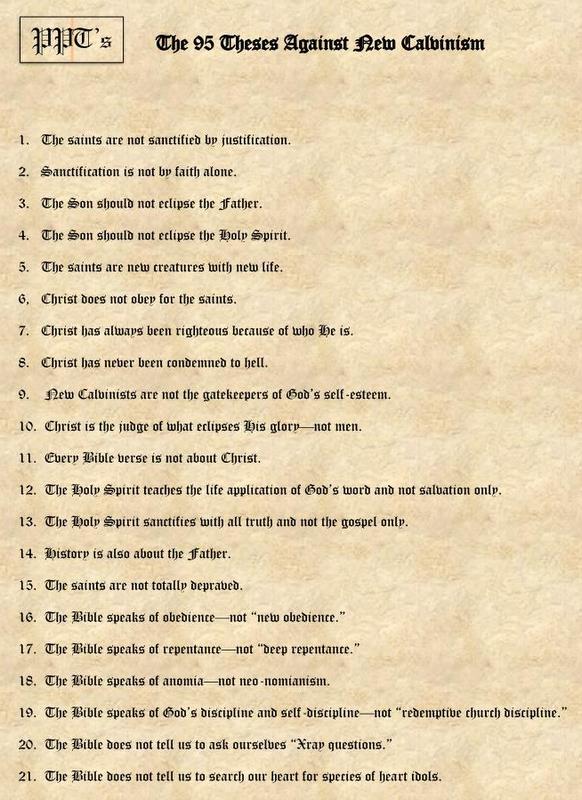
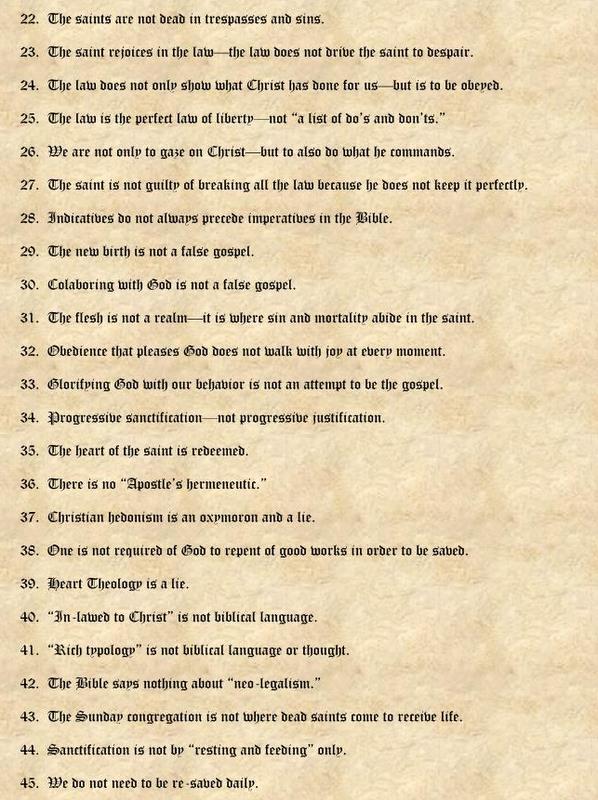
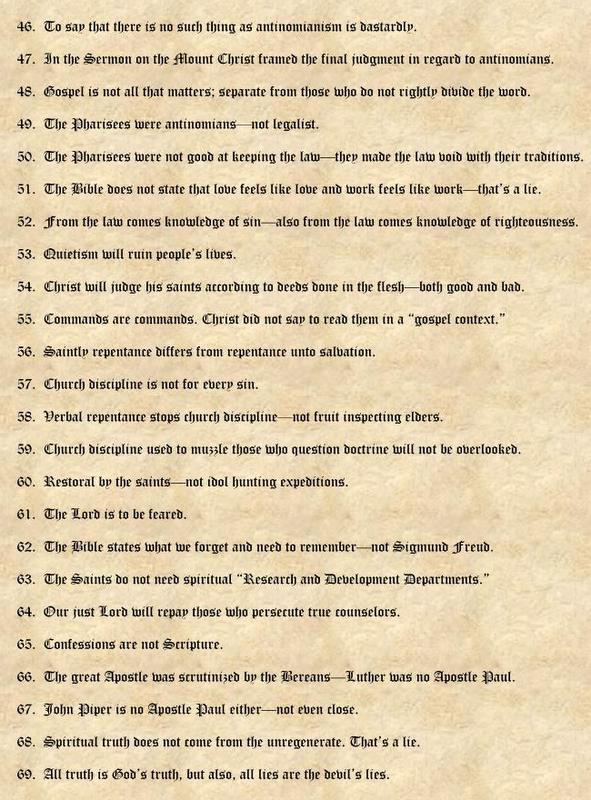
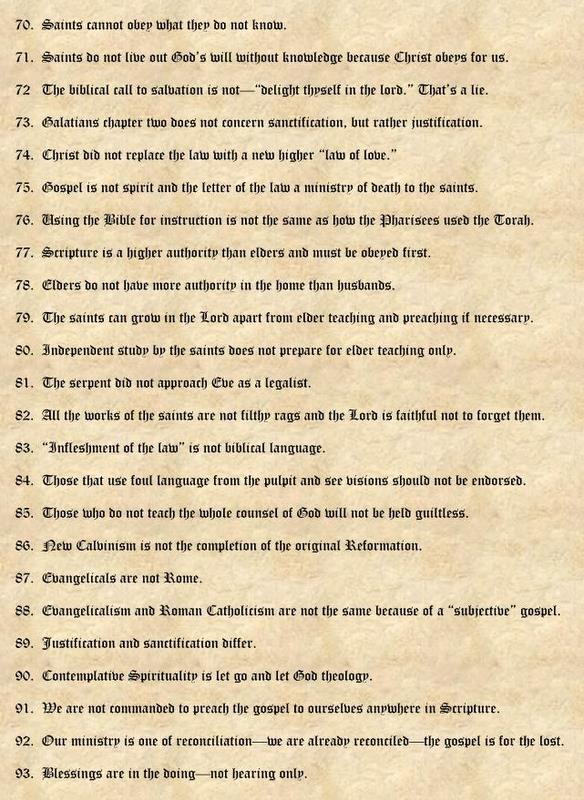
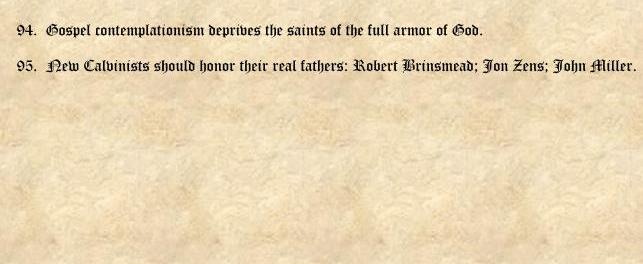
….but tape it, don’t nail it. That way you will only be brought up on church discipline and not also arrested for vandalism. PDF available here: The 95 Theses Against New Calvinism

 Paul's Passing Thoughts
2 comments