MacArthur; 2012 Resolved Conference; Feminism; John Huss; and Mac’s Continued New Calvinesque Demise
 “But again, this is a prime example of how New Calvinists put dead men between us and our Bibles, and then distort history to make their case for progressive justification.”
“What’s good for the goose is good for the gander; if Huss is an authority for promoting Christocentrisity in all reality, then he also ought to be an authority for ordaining women in the church.”
As I learn more and more about the New Calvinist movement, and Reformed history in general, I have to believe that the blogosphere drives New Calvinists blogkers. More on that later. New Calvinism is a return to hardcore Reformed philosophy. In 1970, the real Reformation gospel was rediscovered and systematized by the Australian Forum. The Forum was one of several recovery movements that rediscovered the Reformation gospel since the 17th century. Why does this gospel tend to disappear from time to time? Because it’s not the truth (it’s progressive justification), and it is always accompanied by spiritual tyranny. In fact, the Pilgrims fled to the New World to escape the Augustinian Church of England. You see, among many other issues, the Pilgrims disagreed with it being against the law to not attend C of E “worship” services. However, the Church of England was a little more merciful than New Calvinist Mark Dever—they would merely have the government fine you for not going to church; Mark Dever excommunicated 256 of his church members for nonattendance, an act that launched him into New Calvinist folklore and his present thriving popularity among New Calvinists.
The movement has continued to build on the original foundations of Reformed tradition, even persecuting Old Calvinists that have been sanctified over time by spiritual common sense. New Calvinists continue to promote their neo-reformation by pointing to all things old: creeds; counsels; confessions; catechisms (shorter and longer); and especially dead men of legendary status. Augustine, Calvin, Luther, Owen, Edwards, Spurgeon, etc., and the subject of this year’s 2012 Resolved Conference, John Huss, who will be promoted into New Calvinist iconic canonism by John MacArthur at this year’s Resolved Conference (sponsored by MacArthur’s church). From here, it just gets too rich.
I watched the promotional video clip on Resolved.org ( http://vimeo.com/iamresolved/re12theme ). Four years ago, I would have taken what MacArthur says in the clip at face value because of my former respect/trust for him. But he is a New Calvinist now, and this clip will be used to demonstrate how New Calvinism is making a fool of John MacArthur in the eyes of what used to be a stalwart of the faith. If not for the internet and the blogosphere, God’s people would helpless against the New Calvinist propaganda machine. Back in the day, if you were reading the Calvin Institutes and wanted more information on Augustine because Calvin quotes him in what seems like every other sentence, you were pretty much out of luck. But not in our day. Trust me, Al Gore didn’t invent the internet—God did.
So, since I no longer trust MacArthur, I simply googled “John Huss,” and what Robert Brinsmead said to me the other day in an email immediately came to mind; this is a paraphrase: “I wrote a treatise on Ellen White’s theology that only highlighted the positive points, but that’s what everybody else does with Luther’s writings.” Amen, and this is what the New Calvinists do to build their Reformation motif (at least Brinsmead is honest about it) that drives their propaganda machine; except in this case with Huss, it’s fodder for good humor.
In the clip, MacArthur claims that Huss was burned at the stake for preaching “three things”: every believer is part of the church; the Bible as sole authority; but primarily, Huss’ contention that Christ was the head of his church, and not the pope. Oh really? Of course, the third “thing” is to make the case for New Calvinism’s belief that only Christ is significant in regard to redemptive history. But again, this is a prime example of how New Calvinists put dead men between us and our Bibles, and then distort history to make their case for progressive justification.
Huss was burned at the stake for many other “things” other than the three that MacArthur mentioned in the clip, and one of them is greatly illumined by the lamp of hypocrisy if you consider this year’s Shepherd’s Conference (also sponsored by MacArthur’s church). One of the featured speakers was Voddie Baucham who is a high profile figure in the Patriarchy movement. Baucham was all the rage at the conference which produced endless Twitter posts singing his praises. New Calvinists are also responsible for the Danvers Statement sponsored by The Counsel on Biblical Manhood and Womanhood. MacArthur himself has said: “God cannot be on display in a church where a woman is preaching.” This quote is from his series that contended against speaking in tongues. Oh, did I mention that the “Reformed Charismatic” CJ Mahaney will be featured at the Resolved Conference this year?
This brings us back to all of the much ado about Huss at this year’s Resolved Conference. Other than the “three things” MacArthur mentions, Huss was tricked into attending a counsel at Prague to discuss his many “radical” teachings:
He became a proponent of the ideas of the English reformer and theologian John Wycliffe. Huss like Wycliffe denounced the immorality of clergy, the sale of indulgences, accumulation of wealth by the clergy and the church and saw the Bible as the final authority in ecclesiastical matters. He was a proponent of the laity taking communion in both kinds, that is to say the bread and the wine, at a time when only the clergy received communion in both kinds. He translated the Bible into the language of the people and said “Women were made in the image of God and should fear no man” setting the stage for women to preach at Hussite services and participate in governing councils, not to mention fight beside their men in battle. It was the teaching and writing about his radical ideas that brought the attention of the Pope to Jan Hus [emphasis mine (Online source: http://historyreconsidered.net/The_Hussites.html)%5D.
Oh my. Huss was an advocate of feminism. On the one hand, Huss was executed for the crux of the Reformation (supposedly), but on the other hand, God was not on display in the churches of his followers because women were preaching there. Which is it Mac? I’m sorry, you can’t have it both ways—the blogosphere will not allow it. Let me add some additional references to this point:
Hus was influenced by Wyclif, but he went further than the Englishman ever did. Like Wyclif, much of what Hus wanted was a kind of return to basics: an end to abuses in the clergy, an emphasis on simple Christianity of the sort practiced by the Apostles. He went further in advocating unfettered preaching, and he explicitly refused to recognize a special status for the clergy. He came close to the Donatist heresy in claiming that Christians should listen only to priests who lived virtuous lives. He condemned the upper clergy as corrupt parasites and denied the pope any special powers in the secular world. He acknowledged the apostolic succession, but said only virtuous men were true popes and in any case their authority was strictly spiritual. Like Wyclif, when the Church appeared unwilling to reform itself, Hus argued that it was the duty of the Christian prince to undertake the reform and to use the coercive powers of the state if necessary. The reformed Church should be placed under the dominion of the prince.
Hus advocated both a Czech and a German Bible. He believed the common man could read the word of God without priestly intervention. He published a New Testament and Psalms in 1406 in Czech, followed by a complete Bible in 1413-1414.
It’s interesting to note that in 1412 Hus published a tract entitled “Recognizing the true way to salvation” in which he chose a woman to represent humanity in general. He told women they were made in the image of God and that they should act with dignity and courage and should fear no man. Among the Hussites, women preached and wrote. But after 1421, men again dominated the movement. I do not know the details of why this change occurred [emphasis added (Dr. E.L. Skip Knox, Boise State University; online source: http://europeanhistory.boisestate.edu/latemiddleages/heresy/13.shtml)%5D.
This can also be verified by the fact that Huss was primarily influenced by Wycliffe, and the Lollard Movement spawned by him was populated with women preachers. Why is it ok to prop the Reformers up as authorities by picking and choosing from their teachings only that which helps one’s agenda? Why not leave dead men out of the equation and do what MacArthur used to do: point to the Scriptures as our authority—not dead Reformers. Why can’t the Resolved Conference Have a Scriptural theme instead of a man theme? This is the credibility problem you run into when men are your primary authority. What’s good for the goose is good for the gander; if Huss is an authority for promoting Christocentrisity in all reality, then he also ought to be an authority for ordaining women in the church. But of course, the fruit of such hypocrisy does not fall far from the tree of those he associates with: http://solasisters.blogspot.com/2012/02/john-piper-comments-about-reverend.html .
Something else about this promotional clip makes me wonder. MacArthur presents Huss as a gospel preacher turning the World upside down with the whole the pen is mightier than the sword scenario. I wonder if Mac is going to mention that Huss had a standing military army? Huss set the pace for the following Reformation mentality:
Like Wyclif, when the Church appeared unwilling to reform itself, Hus argued that it was the duty of the Christian prince to undertake the reform and to use the coercive powers of the state if necessary. The reformed Church should be placed under the dominion of the prince (Ibid).
The Hussite army had one of the most feared military leaders in all of human history, Johann Ziska, and he invented one of the most effective military weapons of all time which was named after Huss. A picture of it follows. After Huss was executed, The Hussites kicked some serious Catholic butt and took names.

Say, that picture will look awesome on those high-tech screens at the Resolved Conference, don’t you think? In general, the Reformers followed the philosophy of Plato that government powers are needed to keep the totally depraved (and their uncontrollable instincts) contained. And if you read the email I get, you would know that present-day New Calvinists use everything but a Hussite wagon to keep their totally depraved zombies in line.
MacArthur needs to bail from this movement, ask the church for forgiveness, and salvage what’s left of his legacy. That is, if it’s not already too late. Meanwhile, the more bloggers the better. Let the earth be full of them. Let them be ever fruitful and multiply. Let every word that comes from the mouths of New Calvinists be googled. But, of course, all truth is God’s truth unless it comes from the internet—the other internet—not the Geneva internet.
paul
MacArthur’s Behavior is Now Easy to Understand
Many are totally confused by MacArthur’s recent behavior, especially his association with embattled CJ Mahaney. Once again in 2012, as in every year since 2005, MacArthur will once again stand under the bright lights of the Resolved Rock Concert Conference and lend full Reformation credibility to one of the premier heretics of our day. His scathing assessment of Charismatic theology in Charismatic Chaos notwithstanding (Mahaney is a “Reformed Charismatic”), MacArthur has been recently found comfortable in his hypocrisy; which includes giving John Piper a pass on excluding repentance from his presentation of the gospel while rebuking others for doing the same.
MacArthur has clearly bought into the many problematic teachings of New Calvinism including the backdoor devaluing of the Father and the Holy Spirit in context of “emphasis.” In the forward to Rick Holland’s book, Uneclipsing The Son, MacArthur puts forth the same idea in said book: an equal emphasis on the other members of the Trinity in regard to salvation hinders sanctification. Emphasis is a hermeneutic; unlike horseshoes and hand grenades, there are no points for being close to Christ—He is everything, and “focusing” on anything else is to reject Christ completely and hinder sanctification.
All perplexing, until you realize that this is what Calvin, Luther, and Augustine believed. “Christ alone” in the Five Solas really means, Christ alone. Apparently, in MacArthur’s mind, these three giants of the faith are too big to fail, regardless of what Scripture teaches. Therefore, he has jumped on the New Calvinist bandwagon with both feet because they are a true representation of Reformation theology (at least in regard to Calvin, Luther, and Augustine).
And to me, this clears up everything. However, the Reformers were mere men, and all men look small when their wisdom is compared to “every word that comes from the mouth of God.” Even the apostle Paul constantly pleaded that he would be held to the standard of Scripture. At this year’s Resolved Conference, much will be made of these “great” men and what they said. Conspicuously missing will be the litany of quotations by these men that are an outrageous contradiction to the plain sense of Scripture.
paul
Patriarchy and Shaving Daddy. Really?
Voddie Baucham is presently all the rage at the 2012 Shepherds Conference. Who does the vetting over there? Oh, I forgot, Voddie is a New Calvinist.
Another New Calvinist Lie via Chad Bresson: We Aren’t Postmodern and the Emergent Church is Bad and We are Good
I guess it goes along with being antinomian; New Calvinists constantly lie about many things. In fact, I wonder if they ever tell the truth about anything. New Calvinism dominates the present evangelical landscape because their theological framework invented by a Seventh-Day Adventist (who is now an atheist) is a powerful concept that sells. Robert Brinsmead claimed that he discovered the lost gospel of the Reformation and Reformed folks saw what the supposed finding was doing to the SDA: reforming it. Brinsmead’s Awakening movement via his centrality of the objective gospel (COGOUS) doctrine was turning the SDA upside down. The results were therefore evident, and it had a Reformed label, so the masses have been jumping on the new reformation bandwagon ever since. Many of the elements that make this doctrine attractive to our present culture will be discussed in the second volume of The Truth About New Calvinism.
New Calvinists avoid historical dots that could connect them back to Brinsmead like the Bubonic Plague, and one way of doing that is pretending like you oppose certain dots. Therefore, The dots that they disparage the most are New Covenant Theology (NCT) and the Emergent Church (EU). New Calvinists such as DA Carson stay aloof from NCT, but support it behind the scenes. Brinsmead was a close friend with the father of NCT, Jon Zens, and Brinsmead contributed significantly to the formation of the doctrine. Therefore, pigs will fly before any NCT guys will be invited to one of the big New Calvinist dances, but Carson regularly speaks at NCT conferences.
Likewise, Sonship Theology which was founded on Brinsmead’s COGOUS intermarried with the EC family, so the EC, like Jon Zens, is only one step removed from Brinsmead and his theological think tank that launched present-day New Calvinism: the Australian Form. The Forum may have also influenced the EC which originated in Australia/UK in 1992 and arrived in the US around 1998. Even though New Calvinists such as John Piper associate with EC proponents like Mark Driscoll on a continual basis, and both groups function by the same doctrine (COGOUS, also known as Gospel Sanctification), New Calvinists continually fustigate the EC. The Piper/Driscoll relationship is condoned because Driscoll is supposedly a different kind of Emergent species (http://wp.me/pmd7S-16r).
One New Calvinist “church” that partakes in this deception at every opportunity is Clearcreek Chapel in Springboro, Ohio. A staff elder, Chad Bresson, wrote an article on his blog (a blog dedicated to NCT ) entitled, “The Word of God is an objective, propositional revelation because the resurrection is of such” (Vossed World blog: archives; July 19, 2006). Bresson begins the post with the following:
A supporter of the emergent church posted over at Steve Camp’s blog the following comments:
1. Revelation does not refer to the Bible, it is rather God’s activity in history.
2. Revelation is dynamic and personal, not static propositional.
3. Scripture is a meta-narrative, and by this nature is not a propositional document for us
to pin down all the rules to obey and doctrines to believe.
4. Passages are not always easily discerned for God’s desired message for the Church.
5. Texts may simply indicate direction, not neat and orderly systematic doctrine.
All of these points are either outright false or are only partly true. They represent what is of major concern to many who have observed the development of the emerging church.
These five tenets of EC interpretation, for all practical purposes, are the like hermeneutics of New Calvinism despite Bresson’s disingenuous harpings. Bresson, usually accustomed to linguistic drones of ten-thousand words or more, writes a paragraph or two for each proposition that disputes propositional truth, and I will rebut his deceptive rebuttal of his theological kissing-cousin’s comment. Bresson begins by addressing the first tenet:
God[‘s] activity in history through Christ *resulted in* the Bible. The Bible is God’s *written* revelation to man, and thus the sixty six books of the Bible given to us by the Holy Spirit constitute the plenary (inspired equally in all parts) Word of God (1 Corinthians 2:7-14; 2 Peter 1:20-21). The Word of God is an objective, propositional revelation (1 Thessalonians 2:13; 1 Corinthians 2:13), verbally inspired in every word (2 Timothy 3:16), absolutely inerrant in the original documents, infallible, and God breathed. They are fully self-authenticating, not relying on any external proof for their claims. Since all of Scripture is spoken by God, all of Scripture must be “unlying,” just as God himself is: there can be no untruthfulness in Scripture (2 Sam. 7:28; Titus 1:2; Hebrews 6:18). Because God is the Bible’s author, we are to accept its authority and submit ourselves to it in faith (2 Pet. 1:19,21, 2 Tim. 3:16, 1 John 5:9, 1 Thess. 2:13).
As I will demonstrate, New Calvinists end up in the same place as the EC on this issue. And remember, the staple doctrine of New Calvinism and the EU is one and the same: Gospel Sanctification. This is plainly irrefutable. The EU is most prevalent in American church culture through Acts 29 and World Harvest Missions which were both spawned by the father of Sonship Theology, Dr. John “Jack” Miller. Dr. Miller originally coined the New Calvinist slogans, “We must preach the gospel to ourselves every day,” and its accompaniment, “The same gospel that saves you also sanctifies you.” The former understudies of Dr. Miller and the gatekeepers of Sonship theology after Miller’s passing, David Powlison and Tim Keller, are major figures in the New Calvinist clan.
Regardless of how orthodox Bresson’s opening statement is, his fingers are crossed behind his back with the first ten words: “God[‘s] activity in history through Christ *resulted in* the Bible.” Though the more fringe elements of the EC may think specific revelation can be found outside of the Bible, note that Bresson also states that the Bible is primarily a historical document about Christ. Specifically, a meta-narrative about the gospel, and the gospel only for meditation purposes. All of the rest affirming the accuracy of the Bible is regarding its accuracy for that purpose only. The pastor/teacher of Clearcreek states the following on this point:
May we be transformed by seeing the glory of Christ all through the Bible. The transforming power of beholding Christ emerges from the pages of the whole Bible. We are transformed from glory to glory as we see Him there. Want to grow and change? Want to reflect Christ to others? Gaze on Him in the pages of your Bible (Russ Kennedy: The Fading Glory, 2Corinthians 2:14-3:18).
Furthermore, Bresson posted an excerpt from Robert Brinsmead on his blog to make the point that the Holy Spirit only illumines when the Scriptures are seen through the prism of the gospel and used for that purpose alone (Vossed World blog: archives; July 17, 2008).
Bresson continues to use orthodoxy to deceive:
God’s Word is sufficient for all things pertaining to life and godliness, because Christ, THE WORD, is sufficient (Eph. 1:3, 23; Deut. 8:3/Matthew 4:4/John 6:48-51; John 1:14,16). Because THE WORD is life himself (John 11:25, 14:6; Colossians 1:15-20), The Word is living and active in discerning and judging the actions and thoughts of men (Hebrews 4:12). Christ, as THE WORD, is Wisdom from God (1 Corinthians 1:30), which is *why* the word is sufficient for all of life (Psalm 119:105; Proverbs 2:6, 3:18; Colossians 3:16). Christ’s sufficiency for all of life is best summed up by the covenantal promise/fulfillment: Christ is our God and we are His people (Revelation 21:3,7). As THE WORD, Christ himself is the grace that is sufficient for us (2 Cor. 12:7-10; John 1:14, 16, 17).
After all of the unarguable truth and citation of Scriptures, Bresson once again has his fingers crossed behind his back with the last thirteen words: “As THE WORD, Christ himself is the grace that is sufficient for us.” Hence, Bresson parrots the same EC hermeneutic he claims to be refuting. Note tenet number two: “Revelation is dynamic and personal, not static propositional.” In fact, on the aforementioned post where he cites a long excerpt from a Brinsmead article, Bresson made the following comment:
John 1:1 tells us that Christ incarnated the very Word of God. Thus, the text… the Word… is both witness to and emanates from THE WORD. I should add that John 1:1 is also telling us that Christ *was* the very Word of God from the beginning. So… to draw a distinction between text and Person is a false dichotomy.
Exactly, and the EC crowd agrees, stating that the word is a person and not for the reason of determining propositional truth. I like to state it a different way for clarification; it’s about who Jesus is (or his “personhood”), and not about what He SAYS. Christ warned against such a mentality in Luke 11:26, 27. Clearcreek’s close relationship with Paul David Tripp should also be weighed in this discussion as well. Tripp, who has close ties to Clearcreek and speaks there often, stated the following on page 27 of How people Changed (2006):
Jesus comes to transform our entire being, not just our mind. He comes as a person, not as a cognitive concept that we insert into a new formula for life.
As noted in another post (http://wp.me/pmd7S-hc) here on PPT, Dr. Carol K. Tharp accuses Tripp of having a kinship to the emergent church because of his teachings in Broken Down House:
In these assertions, Tripp reveals his kinship with the emergent church. A belief held in common by emergent church leaders is their “eschatology of hope.” For example, Tony Jones says, “God’s promised future is good, and it awaits us, beckoning us forward … in a tractor beam of redemption and recreation … so we might as well cooperate.” Emergents Stanley Grenz and John R. Franke declare, “As God’s image bearers, we have a divinely given mandate to participate in God’s work of constructing a world in the present that reflects God’s own eschatological will for creation.”‘ Elsewhere, emergent church advocate Doug Pagitt claims, “When we employ creativity to make this world better, we participate with God in the re-creation of the world.”
In regard to tenet number three, Bresson embarks on the following diatribe:
All the words in Scripture are God’s words. To disbelieve or disobey any word of Scripture is to disbelieve or disobey God. The essence of the authority of Scripture is its ability to compel us to believe and to obey it and to make such belief and obedience equivalent to believing and obeying God himself. The word of God contained in the Holy Scriptures is the only rule of knowledge, faith, and obedience, concerning the worship of God, and is the only rule in which is contained the whole duty of man. The Scriptures have plainly recorded whatever is needful for us to know, believe, and practice. God’s word is the only rule of holiness and obedience for all saints, at all times, in all places to be observed (Col. 2:23; Matt 15:6,9; John 5:39, 2 Tim. 3:15,16,17; Isa. 8:20; Gal. 1:8,9; Acts 3:22,23).
In Bresson’s supposed rebuttal, he admits that the Scriptures are a meta-narrative, but argues that the narrative yields objective truth to be obeyed: see above and following:
While the scriptures inherently contain meta-narrative, the various narrative forms, using various Jewish literary genre, are themselves propositional in nature and scope…. And, because there is a common meta-narrative inherent to the whole of scripture (the redemptive story pointing forward to and fulfilled in Christ), it necessarily follows that there is a logical analogy to the whole of scripture which is to be exegeted and preached.
In other words, the concept is objective (the narrative is true and objective), but obviously yields subjective results because one has to interpret every verse of Scripture in a way that shows forth the gospel. But New Calvinists think that this approach is acceptable as long as the point made is a valid gospel outcome. The EC believes that both the narrative and the outcomes are subjective; New Calvinists claim that objective truth is possible while torturing every verse for a gospel outcome, which is highly doubtful. In other words, the results from both camps are the same: subjective.
In addition, the “obedience” Bresson refers to is New Calvinist “new obedience” (Christ obeys for us or obedience is the mere yielding to the evil realm or the gospel realm) which teaches against what Bresson seems to be saying. Where would I even begin to document New Calvinist teachers in regard to their devaluing of obedience as stated by tenet three? “Scripture is a meta-narrative, and by this nature is not a propositional document for us to pin down all the rules to obey and doctrines to believe.” Consider what the New Calvinists themselves write along these same lines:
DA Carson: “In this broken world, it is not easy to promote holiness without succumbing to mere moralism; it is not easy to fight worldliness without giving in to a life that is constrained by mere rules.”
John Piper: “So the key to living the Christian life – the key to bearing fruit for God – the key to a Christ-exalting life of love and sacrifice – is to die to the law and be joined not to a list of rules, but to a Person, to the risen Christ. The pathway to love is the path of a personal, Spirit-dependent, all-satisfying relationship with the risen Christ, not the resolve to keep the commandments.”
Tullian Tchividjian: “A taste of wild grace is the best catalyst for real work in our lives: not guilt, not fear, not another list of rules.”
Lastly, Bresson mentions another New Calvinist substitution for orthodox obedience that I haven’t fully put my mind around—this whole idea of Christians putting ourselves in, or participating in the gospel narrative: “These historical contexts presume an original audience with whom we participate in the same redemptive story.” Again, postmodern emergents (EC) take the same approach with a slightly different application. Note what John MacArthur writes in The Truth War: Quoting Brian McLaren, another proponent of the Emerging Church:
Getting it right’ is beside the point: the point is ‘being and doing good’ as followers of Jesus in our unique time and place, fitting in with the ongoing story of God’s saving love for planet Earth.’ All of that is an exemplary statement of the typical postmodern perspective. But the thing to notice here is that in McLaren’s system, orthodoxy is really all about practice, not about true beliefs (page 36).
So, on the one hand (New Calvinism), we supposedly put ourselves in the gospel narrative in a passive endeavor to manifest a redeemed realm. On the other hand (EU), we put ourselves in the subjective narrative as a form of obedience. What’s the difference? The bottom line: New Calvinists use an objective means of interpretation that leads to subjective, if not mystical results, though they lamely argue that the results are objective because only objective results can come from seeing the gospel in every verse of the Bible. The emergents are at least honest about the means and the results being subjective.
And honesty in and of itself is a good thing; those who follow you at least know what they are following. But the New Calvinist cartel will continue in pretending to be orthodox while confusing the issue by contending against other camps that really believe the same things.
paul
Treats From Today’s New Calvinist Pulpit: Death Never Tasted Better
“And the promised results of the recipe are to die for: it makes the cross bigger.”
Truth is a delightful thing. Jesus said it sets us free, and it is the only thing that truly sanctifies (John 17:17). And when you bait an animal, you use its preferred food. Nothing wrong with the food, the food is good, but in this case the food is being used to bait the animal into an unfortunate demise. For the animal that is. Its death will supply a tasty meal for the hunter or a prized trophy above his mantle to display his hunting savvy.
Eve was a superior being, and the serpent clearly baited her with some truth. It was true; she wasn’t going to die—physically. And it was true; if she ate of the tree, her eyes would be opened, but not for the better. Satan stated specifically that her “eyes” would be opened, and the Holy Spirit used that exact same illustration to describe what happened when Adam and Eve ate the fruit.
The serpent also used some other truth to bait Adam and Eve. He understood the dynamic behind what it would take to bring about the fall. Notice: their eyes were not opened until Adam ate. The serpent didn’t go to Eve first because Adam was created as a smarter being; it’s more likely that Satan didn’t want to exclude Eve from the fall. Apparently, Adam was standing there the whole time observing the conversation, which I find perplexing, but I have to believe that the absence of immediate ill effect on Eve contributed to his decision to eat as well. Hence, another element of truth that the serpent excluded: when Eve’s eyes would be opened. Truth plus error (God’s motives for not wanting them to eat which also had an element of truth), and exclusion of the whole truth resulted in incomprehensible misery and suffering being foisted upon mankind. Satan excluded the whole truth about the results of their eyes being opened, partially misrepresented God’s motives, and excluded mention of when it would happen.
And the kingdom of darkness has not changed their mode of operation. Why in the world would they? The mode of operation that deceived two intellectually superior beings worked wonderfully; why change what works?
In fact, it works so well that in our day we have a hoard of pastors that are the heroes of death. Death has never looked better since Eve gazed upon the fruit hanging from the tree. I would like for you to think with me for a moment. Think about the long list of “premier teachers” of our day, as if they are hanging on trees everywhere. Go into any Christian bookstore of our day and thoughtfully observe. Now read your Bible; something doesn’t add up. The first century church was saturated with false teachers, and then we have the apostle Paul stating that the “latter days” would be “perilous” compared to their day!
That message doesn’t make the cheeseburger easy to swallow—even with a cold beer. It doesn’t make for pleasant conversation when meeting Christian friends at Applebees. Truth is looking and sounding good, coming from the pulpits via well-dressed, hip academics. Some even have sexy European accents. And regarding our pesky consciences tapping us on the shoulder regarding the cult of personality, these stalwarts of the faith assure us that they hate such, while continuing to wear it. They have thus spoken—all is well, move on to the “new Reformation” at hand. But their message is death in the same way that Satan preached to Eve in the garden. This ministry has noticed what seems to be an inordinate number of femitruthers in our day when compared to the men shining the shoes of the who’s who of today’s pulpiteers. I guess you can fool them once, but well, you know the rest.
With the same MO used in the garden, the hordes of New Calvinist pulpiteers in our day deceive the masses on a roadway to death. They use truth, and partial truth, and we now have a Christian subculture living on a steady diet of Esther Price recipes. Like in the garden, death comes by truth left out; death comes by the lack of the whole counsel of God’s word. In essence, let me employ the name of a desert you can get at Applebees: “death by chocolate.” Feed your children nothing but chocolate for a couple of months, and then observe what you have. But in turn, while observing the pitiful sight, ask them if they are happy. Assuredly they will tell you that they are for fear that you will change their diet. Such is the New Calvinist subculture of our day.
And what exactly is that diet? Well, but of course, the name of the diet must sound good. How about, “gospel-driven”? Or, “gospel-centered”? Or better yet, “Christ-centered”? Who would argue with that recipe? Yum, yum. But dare I ask the forbidden question of our day? “What’s in it?” Well, I have been called mentally ill lately by chocolate-fed-children because of my assessment of the recipe, so let me tell you what the New Calvinists themselves say is in the recipe. Fair enough? In fact, I will use the following illustration from a New Calvinist organization:
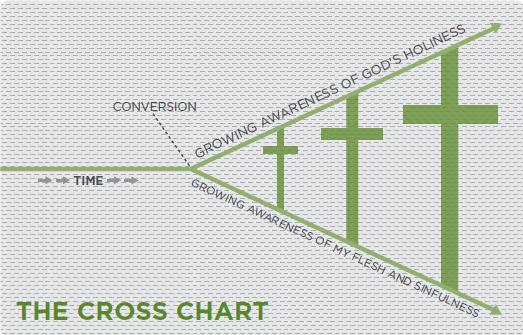
Primarily, the recipe has exposition of how great God is, “Yum, yum!” Hey, as Christians, we could listen to that every day and all day long, right? Secondly, the recipe will involve humbling us by reminding us of how much we fail God and are utterly unable to please Him with our own efforts . “You mean, the pressure is off me?” “No expectations?” Yes, in fact, to have expectations of living by a standard is works salvation, we must “get used to our salvation” by living a “gospel-centered life in the shadow of the cross.” Yum, yum, yum, yum, yum!!!
And the promised results of the recipe are to die for: it makes the cross bigger. Wow! Who would argue with that? Make the cross bigger and us smaller, yum, yum. New Calvinists say that the implications for marriage alone are over the top:
“Hey honey, I have some great news!”
‘What dear?’
“There are no longer any expectations in our marriage! You’re totally depraved, and I’m totally depraved, and change is a pipe dream. There is no longer any need to create tension in our marriage through expectations and efforts to please each other. We have a new goal for our marriage—to make the cross bigger by focusing on how sinful we are and exulting God’s greatness at church.”
‘But what about our testimony?’
“Oh yes dear, that’s very important, but we are called to preach the gospel, not be the gospel.”
‘So, what do we do?’
“Focus on the greatness of God and our own wickedness. That will result in spiritual formation. In other words, it’s not about what we do, but what Jesus has done. We can’t make ourselves better in the flesh, and we can’t make ourselves any better than what Jesus has already imputed to us. So we need to rest and feed on Jesus and let Him make the cross bigger in our lives.”
‘Wow! No wonder those New Calvinist couples always look so happy together on their blogs!’”
Christians should certainly focus on God’s greatness as can be inexhaustibly exegeted from the Scriptures; therefore, there is no lack of material that can be expounded on thereof by the likes of John Piper. Like the preaching of Satan in the garden, New Calvinist preaching has plenty of truth that Christians never get tired of hearing, especially from the lips of interesting characters. But what is missing can kill you, and what is missing is the whole counsel of God. That is why the apostle Paul went from house to house day and night teaching the WHOLE counsel of God—the life of the church depended on it.
And secondly. Like the deadly sermon in the garden, there is partial truth. Yes, Christians still sin, but we are not sinners. The difference between “sin” and “sinners” is very subtle, like the difference between the first death and the second death. Both are death, but the differences in the two are between the temporary and eternal. Satan told Eve she wasn’t going to die, that was the truth, he just didn’t expound on the complete subject.
Thirdly, like the sermon in the garden, a certain result is promised that is the proverbial snapping of the trap. We are led away from the whole counsel of God with the tastier portions including the promise that it will make the cross bigger. This leads to sin, weakness, and a DE-escalation of discernment. And eventually, death. As glorious as the cross is, man does not live by the cross alone, but every word that comes from the mouth of God. People only truly live by the whole counsel of God. To the extent that we live by the whole counsel of God, we are free.
A teacher that I used to deeply respect recently stated that the Christian life is always “sweet, never bittersweet.” You know, like chocolate. But the pure milk that we grow by is the whole counsel of God, the counsel that the apostle Paul expounded on day and night and from house to house. Pure milk is not only void of poison, it is not void of any ingredient that facilitates growth. It is the whole counsel of God, and not death by chocolate.
paul

 Paul's Passing Thoughts
8 comments