Calvinists, Arminians, and Discernment Bloggers: Why they Will Not Accept the Truth About John Calvin
 The Christian community continues to belabor the symptoms resulting from the false gospel of Calvinism. This is a doctrine that is no different from any other works salvation and should be categorized with Adventism, Mormonism, and all of the other isms. Election isn’t the issue; the 5 points are not the issue; at issue is another gospel. A couple of articles written this week are good examples. Dr. Jay Adams wrote a good article about the pervasive lack of practical application in contemporary preaching. But that is a symptom of the problem: Calvin believed that Christian living is the New Testament expression of the Old Testament Sabbath. Hence, to do works in the Christian life is the same as violating the Old Testament Sabbath by working. According to authentic Calvinism, we are saved by faith alone, but since salvation is not a finished work in the believer, we must continue to live by faith alone to keep ourselves saved. Therefore, authentic Calvinism expressed in New Calvinism is a complicated theology that enables us to live the Christian life by faith alone. This is nothing new, James had to refute it and it is why Martin Luther rejected the book of James. That’s why there is no practical application in today’s preaching: it is deemed as works salvation. I have cited John MacArthur in previous articles who has repented of preaching practical application and has stated such plainly. He has stated that we do not apply Scripture to our lives—the Holy Spirit applies it and in most cases we do not even realize that we are obeying. Why? Because it is not us doing the work. He has plainly stated his belief on this. This is the mysticism of realm manifestation that is part and parcel with authentic Calvinism. It enables the living by faith alone in the Christian life by replacing our works with gospel manifestations of good works. In another post this week, Joel Taylor of 5Point Salt suggested that Christians should show New Calvinist Mark Driscoll more mercy because we all “make mistakes.” Mistakes? Driscoll preaches another gospel. The apostle Paul proclaimed a curse on those who preach another gospel. Why is Christianity refusing to deal with this problem? The reasons follow: 1. Calvinists are in-between a rock and a hard place because the resurgence of authentic Calvinism in the form of New Calvinism has brought to light what Calvin really believed. They don’t want to look stupid because they have been calling themselves Calvinists all of these years and didn’t know what he really believed. 2. Arminians are in-between a rock and a hard place because they have been preaching for all of these years that the issue with Calvinism is the election issue. They, too, do not want to look stupid because the real issue all along has been a fundamentally false gospel. 3. Discernment bloggers want to deal with the behavior (the symptoms) and not the gospel because they are Protestants, and by design, they are theologically dumbed down. These are the least guilty of the three. They are attempting to do something about the problem via what they can understand: behavior, but in doing so, they are focusing on symptoms and not the disease. They need to get beyond Hospice care and find the cure. Unfortunately, and perhaps wisely, they treat the New Calvinists as misguided because they don’t have the theological wherewithal to make the case for a false gospel. But again, it is kinda not their fault as they have been deliberately dumbed down by Protestant ecclesia. This has been a Reformed tradition for more than 500 years and is grounded in Augustinian Neo-Platonism. But, looking stupid shouldn’t be the issue; a love for the truth should be the issue; the eternal future of people should be the issue. What a difference it would make if notable Calvinists would admit that they missed it. What a difference it would make if Seminaries would preach the truth about New Calvinism. paul
End Time Prophecy that Doesn’t Match Salvation
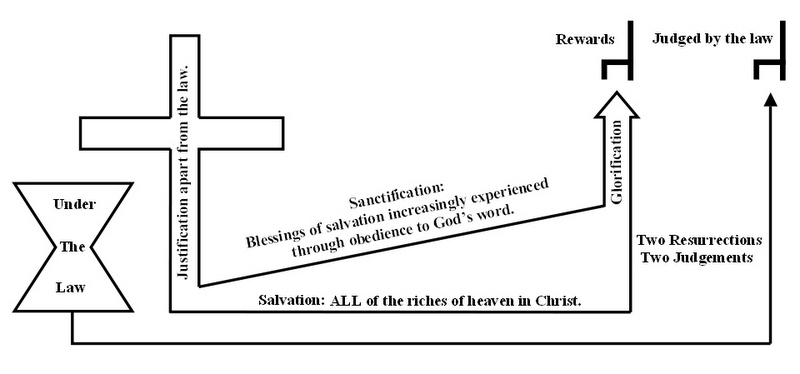
 Popular Sophists of our day like John MacArthur Jr. hold to eschatology (the study of end times) that doesn’t match their soteriology (study of salvation/gospel). Dispensationalists (those who believe God uses different plans in different ages) believe in multiple judgments and resurrections. MacArthur identifies with that camp.
Calvinism fuses salvation (justification) and the Christian life (sanctification) together. Justification is finished for us IF we live our Christian life the same way we were saved (“already, but not yet,” just another Reformed mantra that comforts). So, the goal of the Christian life is to live out sanctification in a justification way (“We must preach the gospel to ourselves every day”). The means of justification are finished, but we must continue to have the perfect righteousness of Christ applied to our Christian life in order to be found righteous at the final judgment. Therefore, Calvin et al believed in one final judgment and one resurrection. That is consistent with their sanctification by faith alone to maintain justification soteriology. Everyone who ever lived shows up at a one final judgment and the sheep are separated from the goats. The sheep are those who successfully lived out their Christian life by faith alone.
This is why most Calvinists are amillennial (no 1000-year reign of Christ on earth from David’s throne in Jerusalem). A millennial construct contradicts one judgment and one resurrection because you have to do something with the mortals who live during that time and the rebellion that occurs at the end.
Multiple judgments and resurrections are consistent with the separation of justification and sanctification including a future for national Israel. The fusion of justification and sanctification is consistent with one judgment and one resurrection.
MacArthur has an eschatology that contradicts his soteriology because he was converted to Calvinism later in his ministry and kept the contradicting eschatology. Many Calvinists that don’t understand Calvin’s soteriology hold to Calvin’s eschatology. They think eschatology is a “secondary issue.”
It is assumed that God’s plan for the end times doesn’t fit with His salvific plan.
There is more than one resurrection because Christians are not under law. They cannot stand in a judgment where law is the measure because it has no jurisdiction over them. Calvin believed the law still has jurisdiction over the Christian and Christ’s perfect obedience has to continually fulfill it through the agency of faith alone. Hence, there is justification, “subjective justification” (sanctification, wink, wink), and “final justification.” This is why Calvinists like MacArthur state that “justification and sanctification are distinct, but never separate.” In other words, a different kind of justification finishes definitive justification.
The other camp says “no.” Justification is completely finished, and sanctification is something entirely different. Therefore, we will not stand at any judgment that has anything at all to do with justification, we will rather stand in a judgment for rewards. Multiple resurrections and judgments facilitate a separation of justification and sanctification as well as a future for national Israel.
Eschatology is NOT a “secondary” issue. It is the gospel.
paul
The Gospel According to Joni Eareckson Tada
Though Joni Eareckson Tada has experienced monumental life setbacks, namely, quadriplegia and breast cancer, she has lived a life of experience and accomplishments that others can only dream of. Also, it cannot be denied that she has propagated a gargantuan mass of good works that has benefited much of the world.
And she is a self-proclaimed Calvinist. THEREFORE, her good works and her life testimony have become an endorsement for Calvinism, because that is what she has proclaimed herself to be. Good works are not a pass for who you are, or how you define yourself, they endorse what you believe. And Tada believes Calvinism. She has even proclaimed that all of her good works, even a smile that she might give someone, flows from her Calvinistic beliefs (Crystal Cathedral: Hour of Power ; May 3rd, 2009).
That’s my point here. Everything Tada is, in turn, sells what she believes—that’s the choice she has made. So, the question/issue becomes the following: is Calvinism true?
The very definition of a Christian is someone who loves the truth (2Thessalonians 2:10). In reality, and regardless of appearances, only truth sanctifies (John 17:17). The greatest errors are closest to the truth, and every landfill full of the dead is located at the end of a road paved with good works.
Tada has stated that shortly after her tragic diving accident that left her paralyzed, she was looking for answers (Scott Larsen: Indelible Ink ; Waterbrook Press 2003, Joni Eareckson Tada, chapter 1):
That was when Joni asked a friend to help her understand God’s sovereignty. Wisely, he gave her meat to chew on~hers was no simple, slightly uncomfortable situation~and started her on Berkhof’s Systematic Theology and John Calvin’s Institutes of the Christian Religion. Still just a few years out of high school, Joni found Calvin too heavy, so her friend replaced it with Loraine Boettner’s The Reformed Doctrine of Predestination.
“Somewhere in its pages I realized I was reading something mansized. Rather, God-sized. Perhaps it expressed the unspoken desire of my soul: to encounter towering biblical doctrine like the Himalayan peaks that rise to the breathtaking height of Mount Everest. To apprehend a God who was much, much bigger than I ever imagined when I was on my feet.”… “I realized that my suffering was the key to unlocking the hieroglyphics of God’s foreordained will. I was about to embark on the adventure of my life.”
Calvinism might have given Tada answers that invigorated her will to live on, but one searches in vain for her concern that Calvin taught a true gospel. And he didn’t. Calvin’s view of God’s sovereignty was the issue, not his gospel. Is there a difference? Obviously there is. Calvin believed that God is completely sovereign, and also believed that we have to ask for forgiveness of daily sins in order to keep ourselves saved:
Secondly, this passage shows that the gratuitous pardon of sins is given us not only once, but that it is a benefit perpetually residing in the Church, and daily offered to the faithful. For the Apostle here addresses the faithful; as doubtless no man has ever been, nor ever will be, who can otherwise please God, since all are guilty before him; for however strong a desire there may be in us of acting rightly, we always go haltingly to God. Yet what is half done obtains no approval with God. In the meantime, by new sins we continually separate ourselves, as far as we can, from the grace of God. Thus it is, that all the saints have need of the daily forgiveness of sins; for this alone keeps us in the family of God (John Calvin: Commentaries on the Catholic Epistles; The Calvin Translation Society 1855. Editor: John Owen, p. 165 ¶4).
Calvinism is no different than any other Christ + something else false gospel. In the case of Calvinism—keeping ourselves saved by perpetual re-repentance for sins in sanctification that remove us from grace:
In the meantime, by new sins we continually separate ourselves, as far as we can, from the grace of God… Thus it is, that all the saints have need of the daily forgiveness of sins; for this alone keeps us in the family of God.
Oh, and by the way, Calvin said such forgiveness can only be found in the institutional church and administered by ordained pastors (CI 4.1.21,22). This Protestant absolution was exemplified by Tada confidant John Macarthur Jr. during the 2013 Shepherds Conference. During a general session, MacArthur shared that a young Aids victim requested that MacArthur seek forgiveness for sins on his behalf. MacArthur agreed to the request accordingly.
During the aforementioned message at Crystal Cathedral’s Hour of Power, Tada stated that God brought said grievous trials into her life so that she would live by the cross daily:
And so God, bless his heart, forces us down the road to Calvary where we are not humanly inclined to go. It’s not our natural inclination to go to the Cross every day. And so God gives us suffering like a sheep dog. It is a sheep dog snapping at your heels, driving you down the road to the Cross where otherwise you might not normally go. You’re driven there by the overwhelming conviction that you just have nowhere else to go. And so God permits the broken heart. He permits the broken home. He permits, he allows, he ordains, he plans even the broken neck until we become broken… Even Jesus himself said blessed are the poor in spirit for theirs is the Kingdom of God. Who are the poor in spirit? Those who come to Jesus every day in empty-handed spiritual poverty, asking him to show them the reason for living that day. Because we’re all richer when we recognize our spiritual poverty.
Come now, are born-again Christians spiritually impoverished? We need to seek God’s purpose for our life daily? Our smiles are not even our own smiles, but we have to get them from God?
“I have no strength for a smile for this woman who’s going to come to the bedroom door in just a moment, and I’ve gotta give her a smile. And Lord, I don’t have a smile… So God, please give me your smile. I have no smile for this woman, but you’ve got a smile. May I please borrow your smile?” And not but a moment goes by and I have a smile. It’s already a miracle. I’ve experienced a miracle before 7:30 a.m. when my girlfriend walks to the door and I can smile, not in spite of my paralysis but because of it. My paralysis has driven me every single morning to the cause of Jesus Christ where I tell him how much desperately I need him. And so that smile is already hard-fought for and hard-won by early morning. That’s the first nugget of wisdom. Begin your day needing Jesus Christ desperately (Ibid).
Is this really the essence of the Christian life? We have to plead and beg God for even a smile? It is, if we also have to go back to the cross daily to beg God for salvific forgiveness. That’s Calvinism; daily resalvation. You have eternal security IF you beg God for smiles every day, and IF you were elected.
You are elected IF you practice a daily application of Christ’s death on the cross. You are elected IF you believe that even the slightest sin in your Christian life separates you from grace.
Tada is sacrificing her stellar life on the altar of Calvinism. Her good works point people to John Calvin who plainly taught a false gospel. What she believes and what she does cannot be separated. There is time to go back to the beginning and once again look for answers.
This time, pick up a Bible, not the Calvin Institutes.
paul
Dear Jane, I Don’t Know About NT Wright, But I do Know Phil Johnson is a Heretic
Paul,
What do you think about this video about NT Wright being called a heretic by Phil Johnson? Phil says Apostle Paul warns in Galatians about the heretic belief that denies imputed righteousness of Christ.
I think Phil is a puffed-up talking head, but curious on your take of this.
Jane.
Jane,
Thanks for this. Phil Johnson is a hardcore proponent of authentic Calvinist (AC) Reformed doctrine. It holds to the double imputation of Christ’s righteousness being imputed to our justification and sanctification. The Bible emphasizes that the righteousness of the Father was imputed to us APART from the law before the foundation of the world. For AC, it is important that it is specifically stated that it is Christ’s righteousness that was imputed to us because He is the only member of the Trinity that would have “kept the law” as a man. And that’s the crux of the heresy, it advocates a righteousness that is NOT APART from the law. It fuses WORKS with grace.
The cute little Calvinist end-around on that is the idea that it is alright that justification is based on perfect works because Jesus keeps the law in our stead. IF we live by the same faith-alone gospel that saved us, the perfect obedience (Christ’s righteousness) of Christ will be perpetually applied to our life and we will be found covered by the righteousness of Christ at the ONE final judgement where the law must be satisfied. The problem here is that a satisfaction of the law is in view, and that is completely antithetical to the point that the apostle Paul strives to make in the Scriptures about grace being apart from the foundation of works. WHO DOES THE WORKS IS NOT THE POINT–WORKS PERIOD IS THE POINT.
But in this false doctrine a practical problem arises. We have to keep our salvation by faith alone so that perfect works will be perpetually applied to our account in sanctification so that we can remain justified. Because of this fusion of justification and sanctification and the fusion of grace and works, our Christian life becomes focused on the ambiguous endeavor of living by faith alone apart from works. The standard for what saved us is now the same standard for our Christian life. “It is [NOT] finished.” If our justification was not finished at the cross, what was Jesus talking about? Plainly, justification is not finished, we have to maintain it by faith alone. This is merely works salvation by proxy; ie., our faith alone in sanctification is a rectifier that imputes works to grace.
Furthermore, it requires a complicated theological system that defines what IS A WORK in sanctification versus what IS NOT a work in sanctification. Critical to the AC construct therefore is the Redemptive Historical hermeneutic that rectifies biblical commands to a faith-alone construct. Simply put, it is a way to only EXPERIENCE obedience rather than to be the actual DOER of the law in sanctification lest it become, “the GROUND of our justification.” Hence, interpreting our Bible grammatically leads to works salvation because it necessarily implies “a leap from the imperative to obedience” rather than the imperative being rectified by the progressive imputation of Christ’s obedience.
It’s backdoor works salvation.
Moreover, it makes sanctification exactly what the Reformers themselves called it: “subjective.” That’s their words exactly, not mine. The power in our sanctification is subjective because we only experience obedience and do not participate in it. We are to meditate on the OBJECTIVE gospel and passively observe the SUBJECTIVE results by faith alone. Hence, “the subjective power of the objective gospel.” John Immel would say that this is all about control; it makes sanctification an ambiguous and fearful endeavor that beckons the saints to depend on God’s annointed to guide them through the tricky and treacherous waters of Christian living by faith alone. Of course, James addressed this very problem in his epistle.
And Immel is absolutely correct about the control issue. That’s why Phil Johnson advocates this doctrine: he is a despicable tyrant filled with lust for the need to control people. Like Calvin, he advocates this false doctrine so as the apostle Paul said, let them both be accursed.
paul

 Paul's Passing Thoughts
8 comments