The Gospel of Sovereignty? Romans Series Interlude: Predestination, a Potter’s House Journey; Part 7

sov·er·eign·ty [sov-rin-tee, suhv-] noun, plural sov·er·eign·ties.
1. the quality or state of being sovereign.
2. the status, dominion, power, or authority of a sovereign; royalty.
3. supreme and independent power or authority in government as possessed or claimed by a state or community.
4. rightful status, independence, or prerogative.
5. a sovereign state, community, or political unit.
“The sovereignty of God” is a phrase that we hear often in Christian circles; in fact, it is a subject that dominates Christian discussion in our day. Moreover, it is an attribute of God that Christians make intrinsic to the gospel itself. In my contention against progressive justification in our day, the argument I hear most is, “You don’t understand the sovereignty of God.”
And no wonder, one of the premier evangelicals of our day, John MacArthur Jr., had this to say in a message titled, “An Explanation of the Sovereign Gospel.”
So we know it has been laid upon us to be faithful in our evangelistic responsibility. At the same time, sometimes we struggle with this reality of divine sovereignty and what it is that we can do when everything is predetermined by God and worked by the Holy Spirit.
Well, the simple answer to the question is God has not only ordained whom He will save, but He has ordained that we in our faithful evangelism would be the means by which He would save His own. To be useful to Him is the purpose in the fulfillment of His sovereign plan, to be an instrument that He can use, to be a vessel unto honor, fit for the Master’s use. To be obedient because that brings, of course, blessing, reward in this life and eternal reward as well (Grace Community Church | Romans 9-11 | September 03, 2011).
Of course, if God has predetermined who will be saved, and uses our evangelism to carry that out, our obedience to evangelism must be preordained as well. As discussed in a previous lesson in this series, this necessarily requires the redefining of the words “obedience” and “reward” as well as many other words and the normative understanding of them. But the main point I want to make here is MacArthur making salvation synonymous with sovereignty which is defined as CONTROL.
Herein is the problem: the word “sovereign” does NOT mean “control,” it means that one has the right to have authority in a given jurisdiction. Even some among the Reformed admit this:
What does it mean to say that God is sovereign? The refrain has become so common, almost clichéd, in Reformed writing and preaching that it sometimes slips away from the reader or listener without lodging meaning in the mind. Worse, we typically hear the phrase to mean something it doesn’t. When Christians affirm that “God is sovereign,” they often mean “God is in control.” Paul Tripp, for example, wrote in his excellent book Lost in the Middle that “God truly is sovereign . . . there is no situation, relationship, or circumstance that is not controlled by our heavenly Father.”
The problem is that the English word sovereignty does not mean control. The U. S. government is sovereign within American territory, but that doesn’t mean the government controls everything within American borders or causes all that happens. If you look up sovereignty in the dictionary you’ll not find control in the definition—nor even as a synonym in a thesaurus.
Sovereignty means “rightful authority.” A dictionary gives “supreme rank” as one definition, and a thesaurus lists jurisdiction and dominion as synonyms. The doctrine of God’s sovereignty tells us God is the rightful ruler of the universe. He has legitimate claim to lordship. His government is just. In fact, justice is defined as his rule. God’s sovereignty doesn’t tell us whether God does in fact rule—just that he ought to, and that we should acknowledge his rule and obey it. (Is “Sovereign” the Best Descriptor for God? Paul D. Miller).
Miller goes on to say…
Once again, it is true God is sovereign. It’s also true he’s in control of everything that happens and he causes all that happens. But that is the doctrine of God’s providence, not his sovereignty.
Does God CAUSE everything to happen? Perhaps, but that’s not what providence means either.
prov·i·dence [prov-i-duhns] noun
1. the foreseeing care and guidance of God or nature over the creatures of the earth.
2. God, especially when conceived as omnisciently directing the universe and the affairs of humankind with wise benevolence.
3. a manifestation of divine care or direction.
4. provident or prudent management of resources; prudence.
5. foresight; provident care.
First, the word “sovereign” appears nowhere in the Bible which should give people pause in regard to the frivolousness of its use in Christian circles. Secondly, it does NOT mean, control, preordination, or predetermination. Certainly, if God wanted to control everything, He could, but does He? Did God know sin was going to come into the world? Yes, so why didn’t he prevent it beforehand? The best answer points to the importance of freewill. God did not cause sin by not preventing it. God tempts no one with sin and is not the creator of evil (James 1:13-18).
When the attributes of God are considered (most theologians name 21 different attributes), absolute deterministic control is not one of them. Even with said attributes, God at times chooses to forfeit the attribute for a period of time. Therefore, if God is predeterminist, He wouldn’t always necessarily choose to predetermine. Some attributes of God are temporarily mutable, and others are NOT ever mutable. An immutable attribute of God is His love towards mankind for all the living. Clearly, an example of an attribute that God has temporarily suspended at times is omniscience:
Genesis 18:20 – Then the Lord said, “Because the outcry against Sodom and Gomorrah is great and their sin is very grave, 21 I will go down to see whether they have done altogether according to the outcry that has come to me. And if not, I will know.”
Mark 13:32 – But concerning that day or that hour, no one knows, not even the angels in heaven, nor the Son, but only the Father.
Also, yes, in regard to some things God is immutable, but in contrast, he can be persuaded by prayer:
Isaiah 38:1 – In those days Hezekiah became sick and was at the point of death. And Isaiah the prophet the son of Amoz came to him, and said to him, “Thus says the Lord: Set your house in order, for you shall die, you shall not recover.” 2 Then Hezekiah turned his face to the wall and prayed to the Lord, 3 and said, “Please, O Lord, remember how I have walked before you in faithfulness and with a whole heart, and have done what is good in your sight.” And Hezekiah wept bitterly.
4 Then the word of the Lord came to Isaiah: 5 “Go and say to Hezekiah, Thus says the Lord, the God of David your father: I have heard your prayer; I have seen your tears. Behold, I will add fifteen years to your life. 6 I will deliver you and this city out of the hand of the king of Assyria, and will defend this city.
2Chronicles 16;12 – In the thirty-ninth year of his reign Asa was afflicted with a disease in his feet. Though his disease was severe, even in his illness he did not seek help from the LORD, but only from the physicians (NIV).
We have established that sovereign would be the wrong word to describe God as causing all that happens, and those things being according to His desired will. It has also been mentioned that the word “sovereign” is not in the Bible. Even if sovereign did mean that all things are predetermined according to God’s pleasure, would it be correct to make that part and parcel with the gospel as most do in our day? Below is yet another version of the infamous Cross Chart that can be applied to this question:
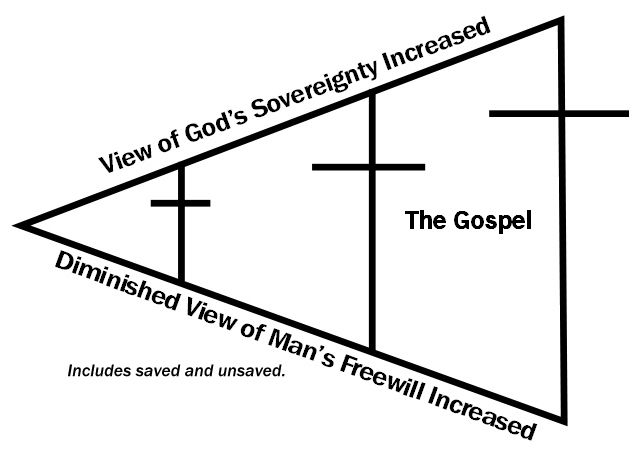
The Problem is defining the gospel according to God’s sovereignty as opposed to God’s love and the good news thereof. Why would the idea that God preordained people to hell be good news? This also speaks to man’s worth. Did Christ die for humanity because it has some kind of worth to God? We can again utilize the cross chart for this question:
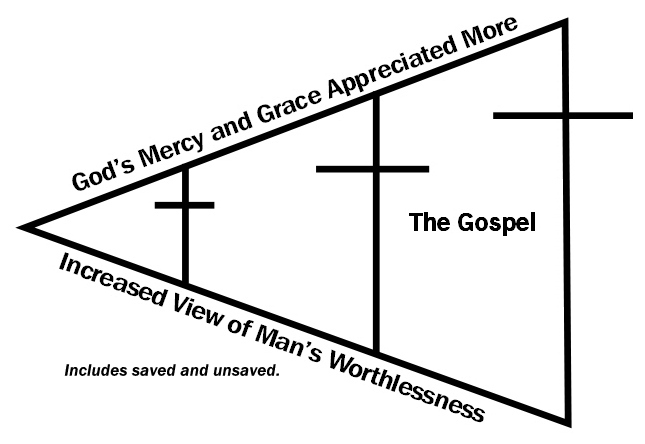
To the extent that man has worth, the gospel gets smaller and God’s grace, and the degree of His sacrifice are diminished. A gospel based on the sovereignty of God must completely eliminate man altogether, and John Immel’s point made in this year’s TANC conference is well taken: it eventually boils down to Man having no right to exist.
All of this greatly hinders the proper answering of questions people have about the Bible. Take note of John Piper’s answer to the question, “Why was it right for God to slaughter women and children in the Old Testament? How can that ever be right?”
It’s right for God to slaughter women and children anytime he pleases. God gives life and he takes life. Everybody who dies, dies because God wills that they die.
God is taking life every day. He will take 50,000 lives today. Life is in God’s hand. God decides when your last heartbeat will be, and whether it ends through cancer or a bullet wound. God governs.
So God is God! He rules and governs everything. And everything he does is just and right and good. God owes us nothing.
If I were to drop dead right now, or a suicide bomber downstairs were to blow this building up and I were blown into smithereens, God would have done me no wrong. He does no wrong to anybody when he takes their life, whether at 2 weeks or at age 92.
God is not beholden to us at all. He doesn’t owe us anything.
Now add to that the fact we’re all sinners and deserve to die and go to hell yesterday, and the reality that we’re even breathing today is sheer common grace from God.
I could make the question harder. As it was stated, it doesn’t feel hard to me, because God was stated as the actor.
My basic answer is that the Old and New Testaments present God as the one who has total rights over my life and over my death.
“The Lord gave, and the Lord has taken away; blessed be the name of the Lord” (Job 1:21). How he takes away is his call. He never wrongs anybody.
~ Ask Pastor John | Desiring God .org | February 27, 2010
In essence, you see the mentality in this answer that man does not have the right to exist, and has no worth. Yet…
Malachi 3:17 – They shall be mine, says the LORD of hosts, in the day when I make up my treasured possession, and I will spare them as a man spares his son who serves him.
John Piper has been called out many times publicly for making these kinds of statements in regard to tragedies, but no one seems to understand the ideology behind such statements. Some also notice tacit acceptance of terrorism as well, and the lack of justice in the institutional church for those who have been abused speaks for itself. If the president of the flagship seminary in service to the largest denomination in the world thinks that “One man’s terrorist is another man’s patriot,” what are we to expect?
When one thinks of life past the fatalistic prism of the “sovereign” gospel that saturates today’s church and reads the Bible in the same thinking way, much better answers evolve. Unfortunately, life teaches us that terrorists cannot be reasoned with. I heard a retired high-ranking military official state this week that the only way to deal with terrorists is to eliminate them. Keep in mind, this is because they do not value mankind or life because of the same presuppositions that we are discussing.
When Israel was getting ready to enter the Promised Land, it could very well be that God knew certain cultures in the area would continually harass Israel and were completely unreasonable while having no regard for life. Israel’s lack of obedience in following God’s command to completely wipe out certain cultures came back to bite them for hundreds of years—even until this very day. These were cultures very much like ISIS, the Islamic State of Iraq and Syria who are presently wreaking havoc in the Middle East and mercilessly slaughtering thousands. These people, unfortunately, cannot be negotiated with.
Lastly, another problem with a gospel that is based on deterministic fatalism follows. There is only one person spoken of less in our day than the Holy Spirit: Satan. The Bible warns us throughout to be aware of the devil’s schemes, and that he “deceives” the world. Why would this be relevant and how do you “deceive” someone who is already preordained for eternal punishment? The Bible continually places blame on Satan for leading people into condemnation.
In the final analysis, a “sovereign” gospel devalues prayer, God’s promises, evangelism, sin, justice, hope, life value, future reward, and the belief that what we do in this life is relevant. I have come to believe that people will perish because we have been neutralized by ignorance:
Ezekiel 3:16 – And at the end of seven days, the word of the Lord came to me: 17 “Son of man, I have made you a watchman for the house of Israel. Whenever you hear a word from my mouth, you shall give them warning from me. 18 If I say to the wicked, ‘You shall surely die,’ and you give him no warning, nor speak to warn the wicked from his wicked way, in order to save his life, that wicked person shall die for his iniquity, but his blood I will require at your hand. 19 But if you warn the wicked, and he does not turn from his wickedness, or from his wicked way, he shall die for his iniquity, but you will have delivered your soul. 20 Again, if a righteous person turns from his righteousness and commits injustice, and I lay a stumbling block before him, he shall die. Because you have not warned him, he shall die for his sin, and his righteous deeds that he has done shall not be remembered, but his blood I will require at your hand. 21 But if you warn the righteous person not to sin, and he does not sin, he shall surely live, because he took warning, and you will have delivered your soul.”
John MacArthur claims that Christians should take part in God’s “sovereign” plan, and therefore find blessings in being obedient to evangelism. I have heard this same take from people who equate freewill with an unsovereign gospel/false gospel. Again, God’s “sovereignty” is the attribute that primary drives the gospel and not love. But the following is irrefutable, such obedience must also be preordained and not really of our own volition. Furthermore, the reward is invalid as well.
I have also come to believe that there are no paradoxes in God’s election. I believe the confusion can be eliminated, and people motivated to labor in God’s ministry field with zeal. But I believe the study will be very hard work.
Nevertheless, let us begin it posthaste.
Why Every Self‐Respecting Premillennialist Isn’t a Calvinist

“One’s eschatology will be consistent with their view of justification—unless you’re John MacArthur.”
At the 2007 Shepherds’ Conference, Pastor John MacArthur gave the opening message titled, “Why Every Self‐Respecting Calvinist Is a Premillennialist.” The message caused a hyper hissy fit among the authentic Geneva style Calvinists that used to associate with MacArthur. Most of the hysterical reviews were whining rants about how the message was an “ambush.” They came to the conference to hear solid fatalistic Reformed doctrine while enjoying sweet fellowship among philosopher kings and instead were personally dressed down at the very beginning of the conference that they attended with hard earned parishioner money. It just ain’t right.
No doubt, the message left amillennialism naked and freezing outside in the cold. Well, sort of, depending on your understanding of Calvin’s election construct. This is why the various responses danced around the real issue and were in bondage to MacArthur’s fundamental misunderstanding about what Calvinism is while calling himself one. Paul warned the Corinthians that elitist academia is not the venue that God works from, and this fiasco is just one good example among many as to why that is so. The Geneva popes could not expose the fact that MacArthur’s fundamental premise is wrong—that would expose what Calvin really believed about election—a truth that the totally depraved artisans can’t handle.
MacArthur said this during the message:
But bottom line here, of all people on the planet to be pre-millennialist it should be Calvinists; those who love sovereign election. Let’s leave amillennialism for the Arminians. It’s perfect! [laughter] It’s ideal. It’s a no-brainer. God elects nobody and preserves nobody. Perfect! Arminians make great amillennialists. It’s consistent. But not for those who live and breathe the rarified air of sovereign electing grace. That makes no sense. We can leave amillennialism to the process theologians . . . The irony is that those who most celebrate the sovereign grace of election regarding the church, and its inviolable place in God’s purpose from predestination to glorification, and those who most aggressively and militantly defend the truth of promise and fulfillment, those who are the advocates of election being divine, unilateral, unconditional, and irrevocable by nature for the church, unashamedly deny the same for elect Israel. That is a strange division.
Ok, so MacArthur highlighted one of the assumed positive notes that can be taken from the idea of Calvin’s election: Once saved always saved. And, absolute assurance of salvation because it is God’s work alone—we can’t mess it up. And, how can you proffer election for the individual and ignore the fact that Israel was elected? This put the Geneva popes in a tough spot because they know that this apparent contradiction fits perfectly with Calvin’s doctrine of election.
Calvin believed in three categories of election: the non-elect, the called elect, and the chosen elect. This necessarily denies assurance because the called elect don’t know for certain whom among them have been chosen. Calvin stated this in no uncertain terms:
Let us, therefore, embrace Christ, who is kindly offered to us, and comes forth to meet us: he will number us among his flock, and keep us within his fold. But anxiety arises as to our future state. For as Paul teaches, that those are called who were previously elected, so our Savior shows that many are called, but few chosen (Mt. 22:14). Nay, even Paul himself dissuades us from security, when he says, “Let him that thinketh he standeth take heed lest he fall,” (1 Cor. 10:12). And again, “Well, because of unbelief they were broken off, and thou standest by faith. Be not high-minded, but fear: for if God spared not the natural branches, take heed lest he also spare not thee,” (Rom. 11:20, 21). In fine, we are sufficiently taught by experience itself, that calling and faith are of little value without perseverance, which, however, is not the gift of all (CI 3.24.6).
You can be called, and you can have faith, but that doesn’t seal the deal, said Calvin:
The expression of our Savior, “Many are called, but few are chosen,” (Mt. 22:14), is also very improperly interpreted (see Book 3, chap. 2, sec. 11, 12). There will be no ambiguity in it, if we attend to what our former remarks ought to have made clear—viz. that there are two species of calling: for there is an universal call, by which God, through the external preaching of the word, invites all men alike, even those for whom he designs the call to be a savor of death, and the ground of a severer condemnation. Besides this there is a special call which, for the most part, God bestows on believers only, when by the internal illumination of the Spirit he causes the word preached to take deep root in their hearts. Sometimes, however, he communicates it also to those whom he enlightens only for a time, and whom afterwards, in just punishment for their ingratitude, he abandons and smites with greater blindness (CI 3.24.8).
So, this fits perfectly with Calvin’s eschatology; Israel was temporarily elected just like many individuals are temporarily elected. The logical conclusion of Calvin is that God’s word did, in fact, fail (Romans 9:6). Moreover, and in direct contradiction to 1John 5:13, authentic Reformed doctrine has always denied assurance. This is reflected in many contemporary authentic Calvinists:
There is danger on the way to salvation in heaven. We need ongoing protection after our conversion. Our security does not mean we are home free. There is a battle to be fought (John Piper: Bethlehem Baptist Church Minneapolis, Minnesota; The Elect Are Kept by the Power of God October 17, 1993).
Words mean things. Piper is clearly saying that our battle in sanctification is a battle for justification. If you really understand the Reformed view of justification, you know the following: the “battle” is against our supposed propensity to gain favor with God through works in sanctification (effot to please/love God changed to; merit for salvation). There is no separation of justification and sanctification so works in sanctification must be sanctified with a faith alone formula. It’s salvation by Christ plus not doing any works in sanctification (Christ + antinomianism to maintain our salvation). We must be sanctified the same way we were justified so that we can properly finish justification. Therefore, Calvin believed that sins committed in the Christian life separate us from grace, and a continual repentance, the same repentance that saved us, is needed to maintain our salvation. Unless we live by faith alone in sanctification, Christ’s blood will not be applied to the new sins we commit. This is the battle Piper is talking about. Said Calvin:
…by new sins we continually separate ourselves, as far as we can, from the grace of God… Thus it is, that all the saints have need of the daily forgiveness of sins; for this alone keeps us in the family of God (John Calvin: Commentaries on the Catholic Epistles; The Calvin Translation Society 1855. Editor: John Owen, p. 165 ¶4).
And, guess what? It just so happens that your local Reformed elder, via the Reformed power of the keys, has the authority to forgive those pesky sins that take away your salvation. Who would have thunk it?
To impart this blessing to us, the keys have been given to the Church (Mt. 16:19; 18:18). For when Christ gave the command to the apostles, and conferred the power of forgiving sins, he not merely intended that they should loose the sins of those who should be converted from impiety to the faith of Christ; but, moreover, that they should perpetually perform this office among believers (The Calvin Institutes: 4.1.22).
Secondly, This benefit is so peculiar to the Church, that we cannot enjoy it unless we continue in the communion of the Church. Thirdly, It is dispensed to us by the ministers and pastors of the Church, either in the preaching of the Gospel or the administration of the Sacraments, and herein is especially manifested the power of the keys, which the Lord has bestowed on the company of the faithful. Accordingly, let each of us consider it to be his duty to seek forgiveness of sins only where the Lord has placed it. Of the public reconciliation which relates to discipline, we shall speak at the proper place (Ibid).
Calvinism is an egregious false gospel being flaunted in broad daylight by academic elitists who are in reality clueless, which brings me to my second point. This is where the vast majority of American Christians are functioning Calvinists…among many other ways while vehemently denying Calvin. Specifically, the whole idea that eschatology is a “secondary issue.” No, no, no, no, no, no, no! Eschatology is gospel; you cannot separate the cross from eschatology. One’s eschatology will be consistent with their view of justification—unless you’re John MacArthur.
The number of resurrections and judgments, and who stands in those judgments, are indicative of a particular view of justification, and election in particular. MacArthur’s dispensationalism coupled with naming the name of Calvinistic soteriology, which really isn’t Calvin’s soteriology, to begin with, is a dumbfounding contraction that leaves one without words to fully explain. Calvin’s eschatology calls for one resurrection and one judgment at the end of time where everyone sweats it out while waiting to find out if they were antinomian enough. Some of the books at the Great White Throne Judgment are the books of the law that will be used by God to judge the works of those standing in that judgment. As one aspect of Christian security, we will not stand in that judgment because we are not under the law. Furthermore, we don’t wait to see if our antinomianism sufficiently utilized the “doing and dying” of Christ to cover our sins—our sins have been completely eradicated.
The number of resurrections and judgments speak to our view of what part of Christ’s works on the cross are finished and not finished, the separation of justification and sanctification, the new birth, election, and future Israel. Eschatology is gospel.
That’s why every self‐respecting premillennialist isn’t a Calvinist, and why MacArthur isn’t a Calvinist, but he thinks he is a Calvinist. As stated by Richard Muller,
There is every likelihood that John MacArthur’s “Calvinism” would probably not be recognized by Calvin himself.
It’s all simply pathetic.
paul

2014 “Shepherds” Conference: Speaker Jerry Wragg Leads Conference in Either Deliberate Deception or Confusion
 Laptops are wonderful. I have been running PPT while doing some major remolding on my mother’s house. I have been watching the comments on a couple of recent posts that have stirred a lot of discussion in regard to law and gospel. If it takes a while for your comment to be moderated, I am probably soldering a water pipe. I have little time right now to jump into the fray, but what a delight to see the laity emboldened to engage this topic. The posts are in relationship to TANC’s latest realization regarding the Reformed view of atonement. I am astounded in regard to the simplicity of the crux: did Christ merely cover our sins, or did He END sin?
Obviously, according to Calvin, Christ died to merely cover sin. We have established firmly that total depravity also pertains to the saints in Reformed thought. Reformed soteriology changes the experience, not the person. This is the official Reformed doctrine of mortification and vivification. Also obvious is the idea that covering goes hand in hand with the idea that Christians are not changed in their personal righteousness. If our sins are ended, a completely different soteriology is demanded. This Sunday, I will be further supplementing our Romans series with another look at atonement, and be sure of this, John 1:29 will be mentioned:
The next day he saw Jesus coming toward him, and said, “Behold, the Lamb of God, who takes away the sin of the world!”
What of this? Did Christ take our sin away, or did He merely cover it? Is our “just standing” merely a realm change with the same relationship to the law, or does salvation change our relationship to the law? I am awaiting a transcript of David Platt’s view of atonement that I will implement in clarifying this position.
This now brings me to the subject at hand. A brother who I have not talked to for some time sent me a tidbit of information about the 2014 “Shepherds” Conference held annually at John MacArthur’s church. Yes, the quotation marks are of the scare variety. Before I get into the tidbit, he reminds me of a longstanding reality in the institutional church. Brothers and sisters who can think for themselves are always going to be deemed a threat in the institutional church. I don’t know of his present church status, but what a joy to see the Home Fellowship movement setting brothers like him free to practice their gifts.
He reminds me very much of Andy Young who is now free to bless people with his gift of teaching, but like Andy, the gift doesn’t match the recognition and opportunity that takes place in the brick and mortar church. Seminaries are where you go to get your Reformed pedigree and certificate that confirms that you will toe the Reformed line. You pay money to get your certificate, then you can get a job as a philosopher king—that’s how the system works. Conferences reinforce the system, and the laity unwittingly pays for it. It is a sanctified caste system like no other.
Now for the tidbit. He informed me that one of the speakers, a Jerry Wragg, delivered a message at the conference entitled, “The New Antinomianism: Evaluating the Implications of Cross-centered Sanctification.” Ok, we understand that there is a bunch of confusion at The Masters’ Seminary, but is this just more confusion, or outright deception? For the most part, Christians intuitively believe that sanctification is synergistic while justification is monergistic. Even if you believe you have a choice, obviously, God alone made a way to be saved. Let me suggest that if our sins are only covered, soteriology becomes very deep and we need the philosopher kings; if our sins are ENDED—not so much.
At any rate, the herd of heretics in these last days are well aware of the intuition, and therefore merely emphasize justification resulting in the out-of-sight-out-of-mind result of “justification by faith alone” which is really sanctification by faith alone as well. James sternly warned the church against this heresy. But every now and then, this herd of supposed stalwarts of the faith that the apostles predicted would be absent in the last days to begin with, sense that the totally depraved zombie sheep are catching on and it is time for a little doublespeak.
I read the title of the message to Susan, and as she looked at me dumbfounded, I asked, “So, do you think this is confusion, or deception?” Her reply: “deception.” Perhaps, but as I have stated before, I believe many of this year’s speakers at TSC 2014 are the premier heretics of our day who are leading untold thousands to hell, in fact, I doubt hell ever looked better while MacArthur is just plain confused. An example is the maintaining of his dispensational eschatology along with his Reformed soteriology. Antinomianism usually walks hand in hand with one judgment and covering, while the former is consistent with multiple judgments for different purposes and the ending of sin resulting in new creaturehood that is personal and not realm related. It is a righteousness that is personal, not merely an imputed experience.
So, will a review of this message, when it is posted, reveal a sound interpretation of sanctification; ie., Mac-like confusion, or has this speaker been called on to calm the herd with Reformed doublespeak?
Let me close with why the title of his message is spot-on. Antinomianism, an actual biblical word as opposed to Phil Johnson’s favorite unbiblical concept of “legalism,” is both good and bad. Anti-law in justification is good while anti-law in sanctification suggests that we are still “under law” and need a continued “covering.” If our sin is still judged by the law, we need perpetual justification. And if we need a perpetual, “covering” by the blood, that obviously suggests a perpetual return to the cross; ie., “cross-centered” sanctification.
Well, humans are created to work and think both. That’s why space aliens have skinny little bodies and big heads; they create reality in a realm by thinking about stuff, you know, like Phil Johnson’s gospel contemplationism. But reality is tricky when you are created to work: how do we work to please God without it going towards our justification? See, that makes things really tricky; that’s why you need them, and that’s why they have conferences…
…if they didn’t continually remind you of that, they would have to get a real job. And besides, you pay for the reminder.
paul

 Paul's Passing Thoughts
1 comment