Mutable Justification: Not Shocking—Just Reformed
 Denver Sound Church is a church of the “Reformed tradition.” I have posted some of their material regarding a rejection of double imputation taught by “some in the Reformed tradition.” They reject the uniquely Reformed idea that Christ lived in perfect obedience to the law as part of the atonement, so that His perfect obedience could be imputed to our sanctification. They rightfully and forcefully make the case that such teachings are “heresy.”
Therefore, you would think that an article published by them propagating a mutable justification would be shocking to me, but not really. The idea that justification has to be maintained by us in sanctification is a Reformed family tradition. Even those who propagate the aforementioned Reformed view of double imputation believe that our justification has to be maintained by faith alone. I know that sounds no-brainer, but there is a big difference between being justified by faith alone and maintaining justification by faith alone. The latter requires faith alone in sanctification, or sanctification by faith alone in order to maintain our justification. The former is free to work in sanctification because justification is finished and immutable. But if justification is mutable as a result of our missteps, we must maintain it the same way we got it—by faith alone. So, we must maintain our justification by faith alone in sanctification. That’s where Reformed double imputation comes into play; we offer the perfect obedience of Christ to the Father in sanctification to maintain our justification.
Denver Sound Church calls that heresy, but agrees that we must maintain justification (obtained by faith alone) via obedience. Here is how they begin the post:
Despite being well-supported in Scripture, the doctrine of the loss of justification is not widely held in the contemporary Evangelical-Reformed community. Instead, most believe and teach that justification is a one-time, legal declaration by God. Contemporary theologians explain that once the decree of “justified” has been declared it cannot be revoked regardless of a person’s future actions.
The idea that justification can be lost is a minority view among Reformed Evangelicals, but that does not necessarily make it wrong. All theologians understand that the majority of Christendom is not always right. In fact, it might be more accurate to say that when it comes to theology, the majority is more often in the wrong. Examples of this from history abound: only eight people made it onto Noah’s ark, the majority of the Old Testament Jews were apostate, Roman Catholics certainly outnumbered Protestants at the beginning of the Reformation, etc.
The point is that every doctrine, even if widely accepted and even doctrines which are at the core of the Reformed faith must be put to biblical test. Our goal throughout this series is to demonstrate that Scripture does not teach justification as a one-time, merely forensic declaration, but that it is a righteous and forgiven state before God which can be lost due to unrepentant sin. Justification is gained by grace through faith alone, but must be maintained through faithfulness. This doctrine is solidly supported through biblical theology and its support from systematic theology is just as sound.
Recently, we published an article highlighting twenty three Scripture passages which teach, imply or warn that a person can lose his justification. That article was followed up with a post about why it is consistent with both Scripture and Calvinistic soteriology to say that one can lose his justification, but that salvation cannot be lost. The doctrine of the loss of justification provides a framework that adds great depth and consistency to the theological unity of Scripture. On the other hand, the more commonly held position that justification is an immutable (unable to be changed) result of a one-time expression of faith causes theological problems throughout the Bible, in fact, the belief in an immutable state of justification undermines many orthodox doctrines. Here are a few:
And the key to the problem here is the words, “orthodox doctrines.” We owe a great debt of gratitude to church historian John Immel for pointing out that “orthodoxy” is a body of interpretation by Reformed “divines” and “doctors” of the Church. We need to be reminded that we have the same illuminating Holy Spirit that they had; or, those “divines” who actually had Him. The Sound Church guys then go on to make their case in the post with nine arguments, some of which are of the Reformed tradition to begin with.
We will address each, but first let me put the argument to bed. I would also like to preface my rebuttal with the following: I believe a careful study of the apostle Paul’s writings indicate that the offer of salvation to all men is a legitimate offer, and Paul believed that his efforts of persuasion made a difference. How do I reconcile that with God’s knowledge of the future and how He makes that a part of His preordained plan? The best I can do is to state that God wants to involve us in the process while preserving all glory unto Himself. How He weaves His sovereignty together with our will is a mystery, and a debate that I do not enter into.
With that said, I believe justification is immutable because of Romans 8:30:
And those whom he predestined he also called, and those whom he called he also justified, and those whom he justified he also glorified.
And when did that happen?
Ephesians 1:4 – even as he chose us in him before the foundation of the world, that we should be holy and blameless before him. In love 5 he predestined us for adoption as sons through Jesus Christ, according to the purpose of his will, 6 to the praise of his glorious grace, with which he has blessed us in the Beloved. 7 In him we have redemption through his blood, the forgiveness of our trespasses, according to the riches of his grace, 8 which he lavished upon us, in all wisdom and insight 9 making known to us the mystery of his will, according to his purpose, which he set forth in Christ 10 as a plan for the fullness of time, to unite all things in him, things in heaven and things on earth.
Are we already glorified? No, but I believe Romans 8:30 states our glorification in the past tense in regard to its certainty which is connected to our justification. Glorification comes part and parcel with our justification.
Christ furthers this point:
John 10: 27 – My sheep hear my voice, and I know them, and they follow me. 28 I give them eternal life, and they will never perish, and no one will snatch them out of my hand. 29 My Father, who has given them to me, is greater than all, and no one is able to snatch them out of the Father’s hand. 30 I and the Father are one.
How peculiar that Calvinism is associated with predestination, yet many of the Reformed tradition believe that we can lose our salvation. Note what Michael Horton writes on page 62 of Christless Christianity:
Where we land on these issues is perhaps the most significant factor in how we approach our own faith and practice and communicate it to the world. If not only the unregenerate but the regenerate are always dependent at every moment on the free grace of God disclosed in the gospel, then nothing can raise those who are spiritually dead or continually give life to Christ’s flock but the Spirit working through the gospel. When this happens (not just once, but every time we encounter the gospel afresh), the Spirit progressively transforms us into Christ’s image. Start with Christ (that is, the gospel) and you get sanctification in the bargain; begin with Christ and move on to something else, and you lose both.
Both what? Answer: justification and sanctification. How peculiar that a doctrine associated with predestination also teaches that we can lose our justification. But they offer assurance that this won’t happen in something that might surprise you, and is offered as one of the nine arguments in said post. Yes, you are predestined for justification, but you can lose it, and the status thereof can change (mutable) under certain conditions. We will get to that, but let me state beforehand that assurance of salvation comes through obedience in sanctification (2Peter 1:5-11 is one of many examples). Our justification cannot change, but assurance of our standing can. Lack of assurance is a time for reevaluation and examination in our Christian lives. And hopefully, we will be associated with those who can help us with the word of God as well.
This brings us to the first argument given:
1. If justification is immutable, then the doctrine of sola fide is destroyed.
So what? Sola fide is one of the five solas of Reformed orthodoxy. It’s NOT Scripture—it’s orthodoxy. And not only that, to many in the Reformed tradition, it isn’t faith alone for justification, but faith alone for sanctification as well. In sanctification, we are called on to mix our faith with works/obedience for the purpose of showing forth our faith—leading to “blessings.” This is what the whole book of James is about. Though Denver Sound Church is not in this camp (sola fide in sanctification), using Reformed orthodoxy as an argument is dead on arrival. And though they offer twenty-three Scriptural arguments in another post, it is obvious from John 10:27, Romans 8:30, and Ephesians 1:4 that those citations cannot be used to make a case for mutable justification. Furthermore, I have reviewed those arguments and do not find them compelling, but you can read them for yourself here; http://www.soundchurch.org/23-bible-passages-which-teach-the-loss-of-something/ . And by the way, let me further my point on Reformed orthodoxy, and the five solas in particular by saying that Solus Christus is blatantly unbiblical. Salvation is not by Christ alone. The Father elected, the Spirit set us apart, and Christ died for our sins. Salvation is Trinitarian; it is not through Christ alone.
2. If justification is immutable, then church discipline is an empty threat with no realistic consequences.
This is the money argument that takes the place of true biblical assurance, and according to church historian John Immel, is the real crux of Reformed orthodoxy. Justification is maintained and assured by submitting to the authority of the Church and being a member in good standing. This is tied to elder rule which supposedly has the authority to declare people unjustified:
An immutable justification means that the removal from the covenant community (the final step of the process of church discipline) has no teeth. In fact, if one who has been excommunicated retains his justification, church discipline might actually seem like a better situation for the person who has been removed from the church. If justification remains intact, life without membership in the covenant community might actually be attractive to some folks. To eventually go to heaven without enjoying potlucks in the basement or having to deal with the interpersonal relationship stresses that come with church participation seems like a pretty good deal!
However, despite what some may say, Scripture makes it clear that there is no justification available to a person who is outside of the local biblical church. Thus, the only conclusion that we can make is that one who is removed from the covenant community has lost his justification. The belief in an immutable justification is logically inconsistent because it creates a class of believers who are on the “outs” with God’s people, but yet somehow still “in” with God. This is biblically impossible. All believers will be in a biblical, visible, local church – the Body of Christ (Acts 2:38-41; 1 Corinthians 10:16-17; Ephesians 1:23). The person who is not in the visible, local church cannot be a believer and is therefore, not reconciled to God – i.e. not justified.
By a local “biblical” church, they mean Reformed. So, regardless of the fact that Reformed orthodoxy is fraught with biblical error (like the Synod of Dort total depravity that is also the total depravity of the saints), and we are only truly sanctified by truth (John 17:17), we hold up our part of the marriage covenant (justification) by submitting to a local church whether they are bearing the truth or not. This in and of itself is another element of a long list of error. Justification is a covenant that God upholds Himself; it is a covenant that God in no wise trusts us to uphold in any way, shape, or form. We have a picture of this in Genesis chapter 15. God put Abraham in a deep sleep and consummated the covenant Himself. When God makes any covenant with mankind, he is the one that guarantees it, and we have no part of that guarantee. We cannot participate in the maintaining of any covenant with God any more than Noah participated in making rainbows.
3. If justification is immutable, then obedience becomes optional.
Obedience is optional, but with consequences following: lack of assurance, discipline, loss of rewards, sin unto death, etc., etc., etc. You can read this post for yourself here: http://www.soundchurch.org/if-justification-is-immutable/ ,but I am not going to address #3 at length.
4. If justification is immutable, then apostasy is a myth.
I believe I stared apostasy in the face shortly before I gave my life over to Christ. God had reach out to me through other people for almost two years. It came to a point where I knew that if I didn’t respond to what God had used other people to do in my life to that point—I never would. What else was God going to do to convince me? I had a very strong sense that it was then, or never. I believe Scripture validates that experience. Again, I have supplied the link to their argument which you can read for yourselves.
5. If justification is immutable, then there is no reason for the Church to exist.
This relates to #2. Basically the same argument.
6. If justification is immutable, then a large number of the parables of Jesus are pointless.
Again, you can read this argument for yourself—I do not find it compelling in light of reconciling Romans 8:30 and the other cited passages.
7. If justification is immutable, then pastors and churches are liars.
See #2.
8. If justification is immutable, then the marriage covenant is irrelevant to salvation.
See #2.
9. If justification is immutable, then the final judgment according to deeds is a kangaroo court.
Again, this argument depends heavily, heavily on Reformed orthodoxy which holds to one resurrection and one judgment. A biblical argument for two resurrections and 2-3 judgments is very strong if the Scriptures are taken literally.
What was the “Reformation”? What did it reform? It Reformed the Catholic Church. But Scripture doesn’t say to reform heresy; it commands us to “come out from among them.” Yet, the father of the Reformation, Saint Augustine, never repented of being a Catholic nor disavowed the Catholic Church. And the Reformed community is looking more like the Catholic Church everyday despite claims to the contrary. We see the same basic philosophy concerning church authority that seeks to control people and tell them how to think. It is the same philosophy that has always led to the same tyranny whether in Rome or Geneva.
And neither have ever repented of it.
paul
Reformed “Total Depravity” and Yin-Yang
 Most Christians are familiar with the Reformed view of total depravity from the T.U.L.I.P acrostic fame. Mankind, being totally depraved, cannot and will not seek God. This is also often prefaced with “also known as Total Inability and Original Sin.” This leads to the logical progression of Unconditional Election, or the “U.” God didn’t choose us because of anything worthy in us. Well, of course not. This leads to Limited Atonement, often prefaced with “also known as Particular Atonement.” This and the “I,” Irresistible Grace, is where most of the arguments come in according to the free will/sovereign grace debate. There is almost no disagreement with the “P,” or Perseverance of the Saints, often prefaced with, “also known as Once Saved Always Saved.” Few argue about that as discussion swirls about regarding “I’m a fill in the blank: 1-5 point Calvinist.”
So goes the arguments around, and round, and round for 500 years now, and with no resolution. Why? Because the arguments are based on a faulty understanding of the doctrine. This is evident from the idea that you can be a partial-point advocate of Calvinism. The points depend on each other. It’s like saying you’re a partial advocate of the equation, 1+1+1+1+1=5. Moreover, once there is an understanding of what makes Calvinism tick, the free will/sovereign grace issue is exposed as just an inferior byproduct of the big picture.
We begin with the dirty little secret concerning the “T.” The total depravity of man (original sin) is also the total depravity of the saints. It has come to the point where neo-Calvinists have had to come clean on this of late. And if you are paying attention, they are constantly saying that we (Christians) are “wicked sinners saved by grace,” “enemies of God,” “no different than unbelievers,” etc, etc, etc. This ministry has a storehouse of data confirming this. Calvin himself stated that Christians are utterly unable please God in any way (Calvin Institutes: Book 3; ch. 14, sections 9-11). The fact that this idea flies in the face of the apostle’s stated goal of pleasing God, whether here or in glory, is irrelevant because of how Calvin approached the Scriptures. Reformed theology is not based on exegesis by any stretch of the imagination.
We remain totally depraved. We remain completely evil. We don’t change. This is foundational to Reformed theology. It also brings us to the next dirty little secret: “P” or, once saved always saved, is not “true” in the way most Christians think it is from a Reformed viewpoint. The perseverance of the saints is really Christ persevering for us. Hence, Christians “manifest” Christ’s perseverance. This is simple math. How can the totally depraved persevere? Once Calvinists have to come clean on the total depravity of the saints, the house of cards will fall. The “P” as worded indicates that the saints have a part in the persevering—this is a deliberate, deceptive lie. Something else is going on. But what?
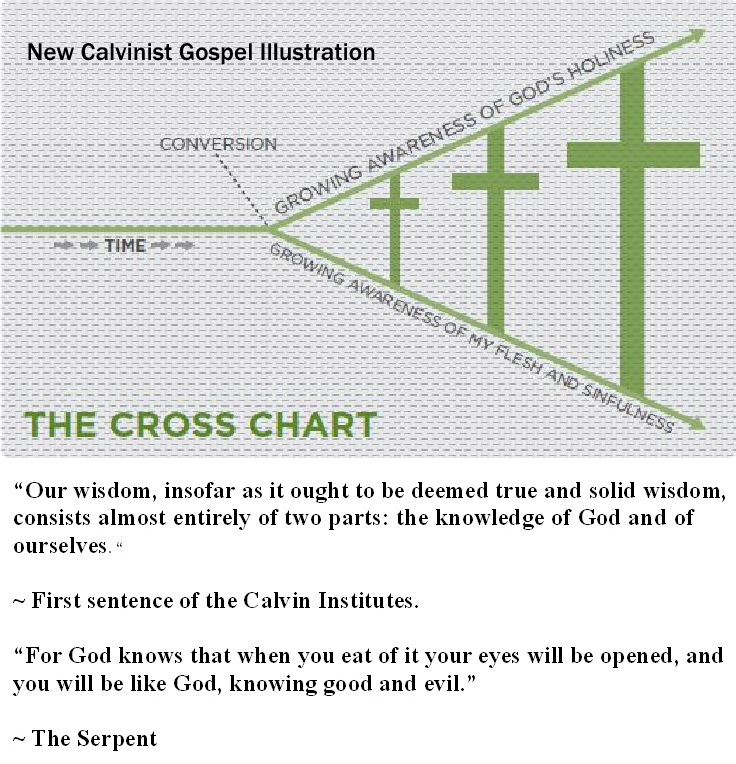
We get a clue from beginnings. Specifically, Genesis and the first sentence of the Calvin Institutes. In the very first sentence of the Calvin Institutes, Calvin states that ALL wisdom comes from a deeper and deeper understanding of God, and ourselves. That’s his metaphysics and epistemology, and is appropriately stated in the very first sentence of his magnum opus. But wait. If we are evil and remain evil, and God is good, is this not the same thing as the “knowledge of good and evil”? Where have we heard that before? This is the knowledge that the Serpent tempted Eve with. He told her God was withholding true wisdom from her which could be found by eating the fruit from the tree of “the knowledge of good and evil.”
Basically, we have Calvin agreeing with Satan in regard to what true knowledge is. But is ALL knowledge ALWAYS the best wisdom? Is all metaphysics good metaphysics? Obviously, sin was a knowledge that Adam and Eve knew nothing about. They had to sin to get the sin knowledge. Let me repeat that in another way because it’s an important element: they had to disobey God to get the knowledge and actually experience it.
The Bible states the details of Satan’s fall and the entering of evil into reality or, what is (metaphysics). The passages are Isaiah 14:12-14 and Ezekiel 28:11-19. At that point, no doubt, evil was born into the knowledge of reality. But was that a good thing? And hold on to this question for now: did God need evil to better define Himself?
Since the garden, men and women have founded many philosophies on the idea of good and evil being the full knowledge of reality. The whole metaphysical story if you will. They often made that knowledge equal with wisdom, and wisdom being good, in and of itself. Added was the idea that good and evilas moral verses immoral is not reality, but was contrived by men because of their misunderstanding of true reality. This is known as Dualism and is the foundation of most false religions of all kinds with thousands of variances. Basically however, it’s the idea that the invisible reality is a higher knowledge than the material, and cannot be obtained through what the five senses can ascertain. The goal (in some cases) is to join the spiritual with the physical by accessing the spiritual (invisible). By gaining a deeper and deeper knowledge of both invisible and material, the invisible can be experienced in the material realm resulting in wellbeing.
We see this concept in the most ancient of civilizations; eg, oriental culture. The goal of the Yin-Yang (literally, “shadow and light”) is to gain understanding of both which leads to an understanding of reality because opposites give definition to each other. Darkness can’t be understood without light etc. Likewise, “the good” or God, can’t be understood without evil. Hence, reality is made up of opposites (male, female, etc), and understanding the opposites and how they define each other is the key (epistemology) to understanding reality. That’s the gest.
And let there be no doubt—this basic idea is the foundation of Reformed theology. Again, the math is simple. If we don’t change—if we remain evil—there is only one place left to go: Mystic Dualism. But how do they make this work? It’s not that difficult, and can be seen throughout Reformed teachings. First, all of the magnificent teachings in Reformed theology are mostly about how great God is. We focus on that (who wouldn’t!), we are mesmerized by that (who wouldn’t be!), and miss what is missing: learn and apply. Learn and apply isn’t the point; more and more knowledge of the good (God) and the evil (us) is supposedly the point. Stopping to apply God things to our life cuts off the God experience achieved through the knowledge of both.
The Reformed camp states it all the time: “Seeing God’s holiness as set against my own sinfulness is the key to transformation.” Al Mohler says it all the time. Elyse Fitzpatrick says it all the time. John Piper says it all the time. CJ Mahaney says it all the time. It’s a first-degree theological felony performed in broad daylight under the cover of how awesome God is—a very powerful cover! It reminds me of my frog-gigging days with my grandfather: the rays from the flashlight paralyze the bullfrog, and then you spear his stupidity.
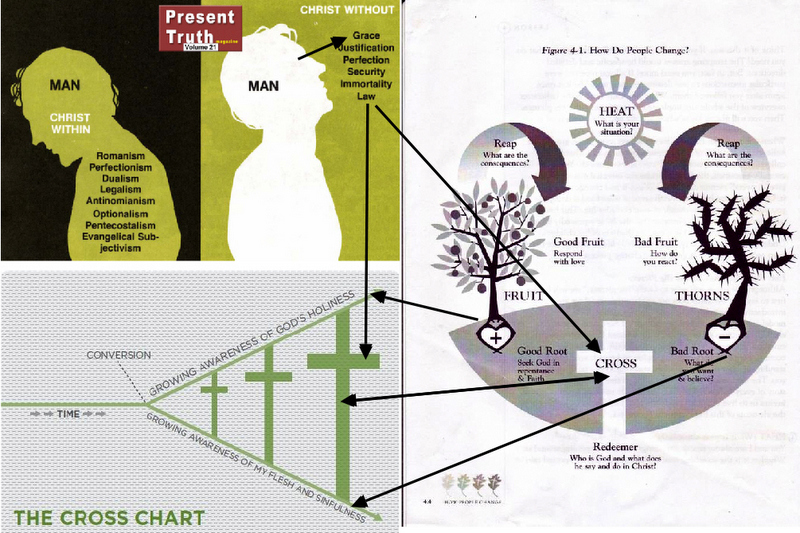
I have often posted the New Calvinist cross chart on this blog, and sigh, I will do it again at the end of this post. This is their chart, not mine, and what is more obvious? We don’t change. By seeing God’s holiness more and more, and our sinfulness more and more, the cross gets bigger. This lends to powerful “rhetorical” questions that argue the case such as, “Do you want to be bigger? Or do you want the cross to be bigger?” “Do you want what you do to be bigger? Or what Christ did on the cross to be bigger?” This is very powerful; primarily, because it was hatched from the minds of demons. But if you stop and think for a while, you might stop and ask: “The cross getting bigger; what does that look like? How is that experienced?”
Good question, and the key is the word EXPERIENCE. What we experience is not necessarily who we are. We can experience the cross getting bigger—that doesn’t necessarily mean we are bigger. We can experience the cross in our lives as we use the Scriptures to see the glory of God and our own sinfulness (Chrsitocentric, or gospel-centered hermeneutics). And, that experience leads to more UNDERSTANDING which leads to more experience, or a “transformation from glory to glory.” But the experience is separate from who we are, more like a manifestation in the realm in which we exist. Therefore, we may experience an obedient act in our lives, but it is not really us obeying, it is the “active obedience” of Christ imputed to us. This is why New Calvinists often say that our obedience, when it is real obedience, isn’t experienced in what feels like “self-effort,” or “obedience in our own effort.” As Francis Chan states:
When we work for Christ out of obligation, it feels like work. But when we truly love Christ, our work is a manifestation [emphasis Added] of that love and it feels like love (Crazy Love: p.110).
That’s because we are experiencing the obedience of Christ imputed to us, and not an obedience that we exercise. Hence, as New Calvinist Chad Bresson often states, it’s a “mere natural flow.” Other Reformed teachers call obedience “kinesthetic” or “experienced, not performed.” It is also interesting what the first tenet of New Covenant Theology states:
New Covenant Theology insists on the priority of Jesus Christ over all things, including history, revelation, and redemption. New Covenant Theology presumes a Christocentricity to the understanding and meaning of all reality.
This simply means that “all reality” is interpreted through the gospel; ie, the aforementioned cross chart. So, gospel contemplationism leads to experiencing “grace,” and that experience leads to an even deeper understanding of grace, leading to more deeper and deeper experiences of grace. Or, “spiritual formation.” Or, “heart transformation.”
What about sin? Well, remember, the cross, or the cross experience, gets bigger as we gain a deeper and deeper knowledge of our own sin as well as God’s holiness. Therefore, our sin serves to give us a deeper understanding of both the Yin and the Yang. In this case, God’s holiness “as set against our sinfulness.” The experience of both, one fruit (Christ’s imputation), and thorns (our sin) contribute to knowledge of the good which leads to deeper experiences of grace. The latter is the theme of Paul David Tripp’s How People Change published by Punch Press in 2006. I included a visual illustration from that book at the end of this post along with the cross chart for your viewing pleasure. Anyone familiar with Gnostic dualism will immediately recognize the cybernetic loop of experience that leads to deeper knowledge through reinforcement, and hence deeper experiences of the spiritual, or the gospel.
There are two fundamental problems with this approach. Serious problems. First, it sees the necessity of understanding evil to better understand God. Evil is factual, but it isn’t God’s truth—He doesn’t need it to define His Holiness. The idea is the epitome of vileness. Secondly, this philosophy encourages an endeavor that Scripture forbids—dwelling on that which is not honorable (Philippians 4:8 among a myriad of other texts). We are to learn what sin is in order to put it off in our lives, not to inflate our supposed identity as among the totally depraved in order to glorify God. This is all a complete distortion of sanctification reality.
In the final equation, total depravity being total inability in both justification and sanctification is the dirty little secret that completely unravels Reformed theology. When we remain unchanged, there is only one formula left: mysticism, and interpreting obedience as something performed by Christ and only experienced by us. In the same way that Adam and Eve could only know evil by experiencing it, we can only know good through experience, but are not able to practice it ourselves. In other words, in the fall, ability to perform and experience our own performance of good was supposedly reversed with evil. Now, we can only perform evil and experience the good imputed to us by Christ’s obedient life as part of the atonement, and added to His, apparently, not all sufficient death. You can add that as a third reason to believe Reformed theology is nothing short of repugnant.
This is elementary. The simple knowledge of what total depravity really means leaves the whole Reformed house in ruins. The only thing that now adds up is the misery, blood, and oceans of foolish ink left in its wake.
paul





13 comments