John Calvin’s False Gospel: How Faith Alone is Made Into a Works Salvation
 The key to being saved by faith alone is once saved always saved. My father in the faith, Pastor Richard Peacock, was most impressed with a rhetorical question that I asked him in one of our conversations when I was a young believer: “If you can lose your salvation, what do you have to do to keep it?” While beaming with approval at what his young mentoree said, he replied, “That is the question isn’t it?” If you have to do something to keep your salvation, that’s works salvation.
John Calvin’s gospel is a works salvation because you have to do something to keep your salvation. You must live by the same faith alone that saved you in your Christian walk (or life; ie., sanctification). You have to do something to maintain your salvation: do not add works to your faith in your Christian walk. Salvation by Christ plus (+) NOT WORKING. This ministry has described in detail how that supposedly works in real life for the Calvinist in False Reformation: Four Tenets of Luther and Calvin’s Egregious False Gospel.
Hence, Calvin and Augustine believed the Sabbath rest was symbolic of the Christian life; working on the Sabbath would result in death. Therefore, to live is to not work. This is evident in the New Calvinist mantra that reflects the authentic Reformed gospel: “We must preach the gospel to ourselves every day.” This isn’t merely stating that the same gospel that saved us also sanctifies us; it is stating that we must do this to maintain our justification in sanctification. Salvation by Christ plus (+) preaching the gospel to ourselves every day. This is the crux of the perseverance of the saints, the “P” in TULIP. The idea is that the essence of our sin is the desire to
Delves into Calvin’s view of Law.
show ourselves righteous by works, so we must persevere against our Pharisaical tendencies that will damn us by constant appeal to the free grace of the cross.
But that’s not all; there is yet another thing that Calvinists must do to keep themselves saved: they must believe that a perfect keeping of the law is the standard for justification and that we are totally depraved. That’s the “T” in TULIP. Because the “believer” remains totally depraved, all of his works are “filthy rags” and will only bring
“condemnation.” But what makes total depravity all-important is the fact that Calvinism makes justification answerable to the law. A perfect keeping of the law must be maintained and imputed to us throughout our Christian life. If we live by faith alone in sanctification, the perfect works of Christ continue to fulfill the law for us. But at any given time that we add works to our faith, that’s not persevering.
I delve into these arguments in-depth in False Reformation and New Calvinism for Dummies which include citations from the Calvin Institutes, Scripture, and Luther’s Heidelberg Disputation. Both books can be found at tancpublishing.com
paul
Calvin: The Essence of God the Father Can Only be Known Through Christ
 When we listen to our friendly neighborhood Calvinist say that God can only be known through Christ, we assume that he means “knowledge” in regard to knowing God in a salvific way. Not so. What is meant is that we can only see any fact or essence of God through a Christocentric prism. In other words, God and the Holy Spirit are shadows of Christ. This goes hand and hand with Luther’s Heidelberg Confession which posits the idea that all realty is interpreted through Christ. This same assertion can be found in Reformed statements such as the first tenet of New Covenant Theology. “All” reality would include God and the Holy Spirit.
Hence, all realty, including the other members of the Trinity, are shadows of Him. In fact, at a funeral just yesterday, I heard a Reformed pastor speak of the Holy Spirit’s work within us as “shadows of Christ.” John MacArthur Jr. stated in the Forward to “Uneclipsing the Son” by Rick Holland that a focus on “anything” or “anyone” other than Christ hinders the sanctification of the flock. Graeme Goldsworthy contributed to an article entitled “The False Gospel of the New Birth” that warns against any emphasis on the Spirits work within us as opposed to the works of Christ. I have also added the following to make the point from the Calvin Institutes. Paragraphs are added.
2.6.4. By familiarising the Jews with these prophecies, God intended to teach them, that in seeking for deliverance, they should turn their eyes directly towards Christ. And though they had sadly degenerated, they never entirely lost the knowledge of this general principle, that God, by the hand of Christ, would be the deliverer of the Church, as he had promised to David; and that in this way only the free covenant by which God had adopted his chosen people would be fulfilled. Hence it was, that on our Saviour’s entry into Jerusalem, shortly before his death, the children shouted, “Hosannah to the son of David,” (Mt. 21:9).
For there seems to have been a hymn known to all, and in general use, in which they sung that the only remaining pledge which they had of the divine mercy was the promised advent of a Redeemer. For this reason, Christ tells his disciples to believe in him, in order that they might have a distinct and complete belief in God, “Ye believe in God, believe also in me,” (John 14:1). For although, properly speaking, faith rises from Christ to the Father, he intimates, that even when it leans on God, it gradually vanishes away, unless he himself interpose to give it solid strength. The majesty of God is too high to be scaled up to by mortals, who creep like worms on the earth.
Therefore, the common saying that God is the object of faith (Lactantius, lib. 4 c. 16), requires to be received with some modification. When Christ is called the image of the invisible God (Col. 1:15), the expression is not used without cause, but is designed to remind us that we can have no knowledge of our salvation, until we behold God in Christ. For although the Jewish scribes had by their false glosses darkened what the Prophets had taught concerning the Redeemer, yet Christ assumed it to be a fact, received, as it were, with public consent, that there was no other remedy in desperate circumstances, no other mode of delivering the Church than the manifestation of the Mediator.
It is true, that the fact adverted to by Paul was not so generally known as it ought to have been—viz. that Christ is the end of the Law (Rom. 10:4), though this is both true, and clearly appears both from the Law and the Prophets. I am not now, however, treating of faith, as we shall elsewhere have a fitter place (Book 3 Chap. 2), but what I wish to impress upon my readers in this way is, that the first step in piety is, to acknowledge that God is a Father, to defend, govern, and cherish us, until he brings us to the eternal inheritance of his kingdom; that hence it is plain, as we lately observed, there is no having knowledge of God without Christ, and that, consequently, from the beginning of the world Christ was held forth to all the elect as the object of their faith and confidence. In this sense, Irenæus says, that the Father, who is boundless in himself, is bounded in the Son, because he has accommodated himself to our capacity, lest our minds should be swallowed up by the immensity of his glory (Irenaeus, lib. 4 cap. 8).
Fanatics, not attending to this, distort a useful sentiment into an impious dream,185 as if Christ had only a share of the Godhead, as a part taken from a whole; whereas the meaning merely is, that God is comprehended in Christ alone. The saying of John was always true, “whosoever denieth the Son, the same has not the Father,” (1 John 2:23). For though in old time there were many who boasted that they worshipped the Supreme Deity, the Maker of heaven and earth, yet as they had no Mediator, it was impossible for them truly to enjoy the mercy of God, so as to feel persuaded that he was their Father. Not holding the head, that is, Christ, their knowledge of God was evanescent; and hence they at length fell away to gross and foul superstitions betraying their ignorance, just as the Turks in the present day, who, though proclaiming, with full throat, that the Creator of heaven and earth is their God, yet by their rejection of Christ, substitute an idol in his place.
Sally Lloyd-Jones: The Wicked Witch of New Calvinism
 “Basically, Jones is actively indoctrinating our children to see reality in a contra-normative construct, and teaching them salvation through perseverance in antinomianism. Christ is clear on this: for those who lead children astray, it would be better for them if they were never born. And that also goes for anyone who propagates her materials.”
It isn’t enough for the New Calvinists to lead adults into hell with a false gospel and let them have the blood of their own children on their hands. No, they have to take their false gospel directly to the children for fear that the parents cannot do the job themselves.
But targeting children with a false gospel is where I draw the line. Now that the New Calvinists have emasculated “Christian” fathers who now stand aside and give these tyrants unfettered access to their families, New Calvinist organizations are cashing in on repackaging the false gospel of progressive justification for children.
A reader sent me a post by Sally Lloyd-Jones in which she endorses her new children’s book that propagates the false gospel of progressive justification via Redemptive Historical hermeneutics; ie., the Bible as gospel metanarrative. Here, “meta” doesn’t mean “grand narrative,” but rather the interpretation of reality through narrative, or story. By seeing our wickedness as set against God’s holiness in the narrative, we experience the works of Christ that He imputed to our sanctification by His perfect fulfillment of the law while on earth. Hence, the Bible is not for instruction or rules. Its purpose is to show the works of Christ that we are unable to perform (though Christ plainly stated that we would do more than He did [JN 14:12]). It’s a formula for living by faith alone in sanctification. This is nothing new, it is primarily what James refuted in his epistle. That’s why Luther rejected the canonicity of said epistle—it contradicts the Reformed gospel that interprets ALL reality through Christocentricity. This also defies the metaphysical reality that all rules are not morally based. “Rules” make living life itself possible in many regards. The rules for baking a cake are morally neutral, but necessary if you want an edible cake.
According to this doctrine, the experience of our obedience, or better said, the experience of “obedient faith,” is subjective because we really don’t know what we are doing in our “own efforts” versus what the Spirit is manifesting in our realm. Anything done in our “own efforts” should be repented of as “self-righteous works.” I have heard elders offer up such prayers for the congregation firsthand. If we actually believe that we can learn God’s will and perform the work ourselves as born again believers, that is “mortal sin” of a false gospel that will condemn us to hell. If all of our good works are attended with fear that they could be perceived as our own works, that’s “venial sin” that doesn’t condemn us and can be forgiven by “repenting of good works” as propagated by the likes of Dr. Tim Keller. In fact, Keller, an in-your-face and in-broad-daylight Christian mystic is Jones’ pastor.
Jones, in the promo post for her children’s book entitled, “Teaching Children the Bible,” begins with this question:
Do you read the Bible like a rulebook? Do you look at the biblical characters as heroes to emulate? Or do you read Scripture as a Story with one great Hero?
This statement is indicative of the Redemptive Historical worldview; there isn’t more than one way to look at the Bible. But most importantly, the Bible is used as a tool for a worldview that is contra-normative to interpreting reality. In this construct, there are only two ways to look at reality: the cross story or the glory story. If it is about us (the glory story), rules and heroes are applicable. But if it’s about the cross story, only Christ and His works are to be seen, “not anything we do.” “It’s not about anything we do, but what Jesus has done.”
So, supposedly, there are two ways to look at reality, and in the correct way, the cross story, realty is only perceived in the difference between the following duality: our sinfulness as set against God’s holiness. Moreover, Jesus as hero is often presented by New Calvinists as Christ saving us from a wrathful God who still holds the law over our heads. That’s why rules are bad: we are still under the jurisdiction of the law and therefore unless we can keep the law perfectly, all bets are off—Jesus to the perpetual rescue. We are still under the law, so if we don’t keep it perfectly, we are guilty of violating all of it. To think we can keep the law in a way that pleases God is a mortal sin because when we break the law at any point, our basis for justification collapses. The basis of justification is a continued maintaining of the law. So obviously, a perpetual maintaining of the law is required to keep us saved; ie., the progressive imputation of Christ’s perfect works to our sanctification which is supposedly the road to “final justification.”
And this is clearly the problem with the Reformed gospel; the law is the standard for our justification and not the death of Christ alone. The one act of obedience is not the ground of our justification, but the perpetual and progressive imputation of Christ’s fulfillment of the law to our life by faith alone without works. This is a gospel that keeps Christians under law and redefines under grace as Christ keeping the law in our stead. But this is still, “under law.” Those under grace are justified “apart from the law.” Therefore, in the same way that we violated the law at every point when we were under it, we fulfill all of it when we love our neighbors because we are under grace and not under law.
The reader who sent me the link protested to a Facebook friend who endorsed the book on her page. Her response was that he was clueless because they were not advocating the unimportance of rules. Exactly, rules are extremely important to them because it is still the basis of our justification. The key is that Jesus keeps the law for us. But of course, this is a metaphysical sleight of hand that comes from Calvin himself and is an under law gospel. Basically, Jones is actively indoctrinating our children to see reality in a contra-normative construct, and teaching them salvation through perseverance in antinomianism. Christ is clear on this: for those who lead children astray, it would be better for them if they were never born. And that also goes for anyone who propagates her materials.
Unbelievably, Jones is given full access to our children by brain-dead shepherds. In the promotion, she brags about how she undermines what the parents in local churches teach their children:
When I go to churches and speak to children, I often start by asking them two questions:
First, How many people here sometimes think you have to be good for God to love you? They tentatively raise their hands. I raise my hand along with them.
And second, how many people here sometimes think that if you aren’t good, God will stop loving you? Almost without fail they raise their hands. These children think they have to keep the rules or God won’t love them. They think if they mess up God will stop loving them.
These children are in Sunday schools. They know all their Bible stories. And they have missed what the Bible is all about.
They are children like I once was.
On display here is the arrogant metaphysical sleight of hand that is indicative of mystic despots that believe they understand the high mysteries of God that the masses are unable to understand. If she is confronted about undermining the parents of the church, she will insist that she was referring to the children only when she said “people” and not the parents of the church. If she is confronted about law and love being mutually exclusive, she will assert that she was only talking about justification. Here we have the diabolical communication of the New Calvinist on full display. Law and love are mutually exclusive in justification, but NOT sanctification. However, that distinction is never made as these wicked false teachers talk about sanctification in a justification way because we are still under the law according to their gospel. They incessantly teach the fusion of justification and sanctification (which equals being yet under law), and only make the distinction when they are called on it. But even then, their “progressive sanctification” is really progressive justification as they play on the assumptions of those being deceived. This is deceptive communication that comes directly from the pit of hell.
Jones continues:
Even though I came to faith as a small child, I somehow grew up thinking the Bible was filled with rules you had to keep (or God wouldn’t love you) and with heroes setting examples you had to follow (or God wouldn’t love you).
I tried to be good. I really did. I was quite good at being good and keeping the rules. But however hard I tried, I couldn’t keep the rules all the time, so I knew God must not be pleased with me.
And as far as being a hero: I certainly couldn’t ever be as brave as Daniel. I remember being tormented by that Sunday school chorus “Dare to Be a Daniel.”
Notice how our love is completely excluded from the metaphysical construct of the argument. That’s because we cannot have any love, that’s the glory story. And if we have love, that enables a dichotomy between justification and sanctification. Hence, justification is the setting of God’s love on us without merit, and our love for God in sanctification is our fatherly love as His children that is not under law but under grace. Like all Calvinists, she makes the two the same. Any ability to love God points directly back to the standard of justification and is not separated from sanctification. And law is not the standard for justification to begin with; it’s the one act of Christ’s obedience to the cross.
In the second paragraph, the idea that perfection is a requirement to MAINTAIN our justification is clearly evident. I was really, really good at keeping the law, but God requires perfection in order to be pleased with us. Therefore, Christ must keep the law for us in sanctification in order to maintain our justification. This is clearly works salvation by persevering in antinomianism. Other Christians can’t inspire us to love God in sanctification by keeping His commands—that’s the glory story.
This doctrine also denies the new birth and the fundamental difference between being under law and under grace. When we are under law, we are enslaved to sin and free to do good (ROM 6:20). That means the overall direction of our life will be law-breaking and then we will be judged by that very law in the end. Under grace is enslavement to righteousness and the freedom to sin (ROM 6:18). In salvation and the new birth, slavery and freedom are switched resulting in an overall direction of life. But our justification will not be judged by our freedom to sin because we are no longer under it. The overall direction of our sanctified life will be righteousness because we are born of God and have His seed within us. Loving God by keeping His commandments is therefore the direction of our life and not the perfection. Per the Reformed false gospel of progressive justification, perfection is still the standard because we are still under law and not born again by the biblical definition:
At the end of the story there were no other teachers around, and I panicked and went into autopilot and heard myself—to my horror—asking, “And so what can we learn from Daniel about how God wants us to live?”
And as I said those words it was as if I had literally laid a huge load on that little girl. Like I broke some spell. She crumpled right in front of me, physically slumping and bowing her head. I will never forget it.
It is a picture of what happens to a child when we turn a story into a moral lesson.
When we drill a Bible story down into a moral lesson, we make it about us. But the Bible isn’t mainly about us, and what we are supposed to be doing—it’s about God, and what he has done.
Children don’t need to be told to try harder, believe more, or do it better. That just leaves them in despair. The moral code always leaves us in despair. We can never live up to it.
I knew it as a child—I could never be good enough or brave enough.
None of that is the point unless we are still under law. The point of sanctification is not moral law, but loving God and glorifying His name and wisdom through obedience. The Reformed gospel denies our ability to please God through obedience (ROM 8:7,8). The crux is perpetual re-salvation by faith alone apart from works in sanctification. Nothing could be clearer. The new birth is redefined by, “mortification and vivification” which is a perpetual reliving of our baptism to maintain our justification. Note Jones’ statement in the same promotion:
We don’t need a moral code. We need a rescuer. And that’s why I wrote The Jesus Storybook Bible and Thoughts to Make Your Heart Sing, So children could know what I didn’t: That the Bible isn’t mainly about me and what I should be doing. It’s about God and what he has done.
That the Bible is most of all a story—the story of how God loves his children and comes to rescue them.
Obviously, in context, one can only conclude logically that this is a perpetual “rescue” and not a onetime event. The New Calvinist Paul David Tripp calls this an “everyday rescue.” In a sermon at Southeastern Theological Seminary (Spring 2007), referring to Romans 7:24, he made it clear that Christians need to be rescued [saved] every day. That’s the crux.
It grieves my heart that these wicked satanic minions are given free access to our children. This is where Christians should be motivated to standup against these false teachers.
If we are not motivated by the eternal wellbeing of our children, we are a disgrace to the cause of Christ.
paul
Evangelizing the Calvinists
Don’t argue with Calvinists–evangelize them! The mission field of those entangled in the false gospel of progressive justification is white unto harvest. Join the cause!

PPT and TANC are developing tracts to be distributed at the Cross Conference in Louisville Kentucky. You can donate to the cause by sending check or money order to TANC PO Box 583 Xenia, OH 45385. TANC is a non-profit LLC. The tracts and information we are developing will be available for input and suggestions in the near future. Your support of our evangelism team is greatly appreciated!
Editing George Carlin for TANC 2014 Conference Promotion
Governments [Churches] don’t want well informed, well educated people capable of critical thinking. That is against their interests. They want obedient workers, people who are smart enough to run the machines and do the paperwork. And just dumb enough to passively accept it.
~ George Carlin
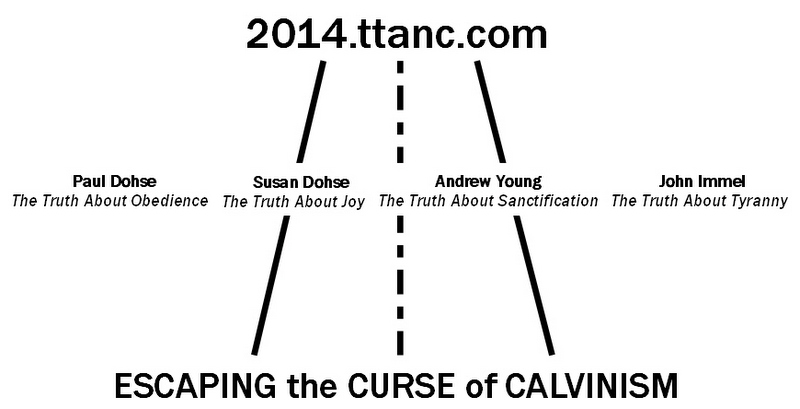
TANC: education on the Reformation myth. Come and learn what you will not learn in churches, seminaries or Bible colleges.

 Paul's Passing Thoughts
8 comments